
Quick Answer
Apply existing CIDE and ISS rules to the actual payment/service before assessing CBS/IBS. CIDE Remessas is 10% on qualifying foreign payments by Brazilian legal entities, with a software exception unless corresponding technology transfer is involved. For CBS/IBS, electronic/remote intermediation plus control of charging, payment, terms or delivery can meet Article 22’s platform test; exclusions, supplier residence and information/invoice conditions determine responsibility. In 2026, CBS 0.9% plus IBS 0.1% remittance is waived on accessory-obligation compliance; the test rates exclude Simples Nacional operations and respect special/reduced regimes, except the specific fuel/biofuel regime. Follow the document-specific official calendar.
What operators need to control in Brazil#
Brazil platform teams need three separate checks: existing CIDE on qualifying payments abroad, municipal ISS on listed services, and the CBS/IBS reform rules for their transaction model. A proposal for a new digital-platform tax does not suspend the rules already enacted.
This article is for compliance, legal, finance, and risk owners at digital platforms and marketplaces. The aim is practical: reduce failures between product design, invoicing, reporting, and remittance evidence.
The constitutional transition begins with a 2026 test, moves to CBS and the federal tax changes in 2027, phases down ICMS and ISS from 2029 through 2032, and extinguishes those two taxes in 2033. Run the relevant old and new controls together according to the transaction date rather than applying one blanket “seven-year overlap” label.
In practical terms, ISS remains part of the current stack as a municipal services tax, while CBS is the new federal VAT and IBS is the new combined state and municipal VAT. The reform direction is destination-based taxation, so where the service is consumed matters more for tax treatment and evidence design.
For 2026, LC 214 Articles 343, 346 and 348 set IBS at 0.1% and CBS at 0.9%—a combined 1% test, not competing rate descriptions. Remittance is waived for taxpayers that comply with the applicable accessory (reporting and document) obligations; PIS/COFINS still apply. The test rates do not apply to Simples Nacional operations, and reduced or special regimes have their own treatment, with the specific fuel and biofuel regime excluded from these test rates. Track document obligations even where remittance is waived.
At the start of rollout, use one simple control check. For each in-scope transaction path, you should be able to show:
- the tax determination source
- the expected electronic invoice output
- the ledger posting reference for later finance reconciliation
Existing CIDE Remessas under Law 10.168/2000 is not merely a platform-tax proposal. Article 2 covers Brazilian legal entities making qualifying technology-related payments to foreign beneficiaries and, since 2002, technical or administrative-assistance services and royalties. Its rate is 10% on qualifying amounts paid, credited, delivered, employed or remitted. Software licensing, commercialization or distribution remuneration is exempt unless it involves the corresponding technology transfer. Classify the contract and payment before deciding exposure; do not apply 10% indiscriminately to all platform revenue.
The controls below connect those legal classifications to invoice outputs, payment events and finance records, with a separate watchlist for genuinely proposed changes.
Start with terms that change decisions#
Use consistent tax terms first, because mixed legacy and reform language can lead to the wrong owner, the wrong invoice flow, and weak control evidence.
- CIDE Remessas: existing federal contribution on qualifying payments to foreign beneficiaries under Law 10.168/2000, with a software exception subject to technology-transfer conditions.
- ISS: municipal tax on services listed in LC 116/2003, including certain digital services and imported services.
- CBS: new federal VAT replacing PIS/COFINS from 2027; it does not simply replace IPI.
- IBS: new state and municipal VAT replacing ICMS and ISS through the transition to 2033.
Keep the taxes distinct in contracts, coding and reporting. Existing CIDE is outside the ICMS/ISS phase-out, and its qualifying foreign-payment analysis cannot be inferred from the CBS/IBS platform classification.
Business-model labels help organize the review, but the statutory test determines platform responsibility:
- Supplier: the party providing the goods or service; identify whether it is resident in Brazil or abroad.
- Platform under Article 22: intermediates remote or electronic transactions and controls at least one essential element: charging, payment, terms and conditions, or delivery.
- Excluded sole activities: Internet access, payment services by institutions authorized by Brazil’s central bank, advertising, or search/comparison without sales-based fees.
- Per-operation check: a platform is not tax-responsible for an operation in which it controls none of those essential elements.
Record the supplier and every applicable responsible party across checkout, invoice output, ledger and registration analysis. Joint liability can involve multiple parties; an internal owner matrix must not erase that distinction.
Use shared sourcing terms the same way across teams:
- Destination principle: tax where goods or services are consumed.
- Origin principle: tax where they originate.
- Place of supply (working usage here): the location your team uses when applying that destination-versus-origin logic.
For a cross-border digital service, record the buyer’s principal domicile and the service category. LC 214 Article 11 supplies location rules and exceptions; the residual rule for an onerous operation generally uses the Brazilian buyer’s principal domicile, or the Brazilian recipient’s if the buyer is abroad. Do not substitute the platform’s office location for that analysis.
What changed in Brazil and what did not#
The transition changes tax systems on different dates. Maintain an effective-date table so a 2026 transaction is not treated as if the 2033 regime already applies.
| Tax or phase | Enacted direction | Operational implication |
|---|---|---|
| PIS/COFINS → CBS | Federal replacement from 2027 | Retain PIS/COFINS controls in 2026 alongside the conditional CBS/IBS test |
| IPI | Rates generally reduced to zero from 2027, except products with incentivized industrialization in the Manaus Free Trade Zone under statutory criteria | Do not describe this as CBS simply replacing IPI |
| ICMS/ISS → IBS | Existing rates fall to 90%, 80%, 70%, 60% in 2029–2032; those taxes end in 2033 | Maintain municipal ISS classification and rates through the applicable phase |
| Selective Tax (IS) | Federal tax on specified goods and services harmful to health or the environment, from 2027 | Check its own scope; it is not a general digital-services tax |
Legal anchors and implementation dates#
Use the current legal text and official implementation calendar for different decisions:
- EC 132/2023 sets the transition architecture; LC 214/2025, as amended supplies the CBS/IBS rules, including the platform test and tax-event timing.
- The official document calendar establishes when each affected electronic document must carry the reform information; a layout publication date is not its obligation date.
As of October 2, 2026, the Receita Federal/CGIBS calendar lists general ISS-service NFS-e obligations from October 1, 2026, and the platform NFS-e and specific ISS subitems 1.03, 1.05, 1.09 and 16.01 from December 1, 2026. Simples Nacional document obligations are listed from January 1, 2027. The July 31 announcement distinguishes the mandatory dates from layout publication milestones. Match your flow to the applicable document, not just the year “2026.”
What does not change during transition#
Under LC 116, ISS applies to listed services, including services originating abroad. For imported services, Article 3(I) places the tax at the buyer or intermediary’s establishment or domicile, and Article 6 §2(I) assigns responsibility to that buyer or intermediary. General municipal rates fall within the statutory 2%–5% framework, subject to exceptions. Identify the listed service and municipality; do not assume the foreign supplier alone handles ISS.
For you as an operator, the recurring risk is over-prioritizing new labels while under-maintaining controls for legacy treatment.
What to prepare now and what to collect actively#
During the pilot or test phase, focus on proving your systems can run new and legacy logic together without breaking traceability. In practice, tax and technology teams will need to adapt systems, workflows, and schemas to the new model.
Use a sample transaction to check how the new document fields coexist with legacy tax fields. Keep the legal rule version and technical layout version separately so a format update does not silently change tax treatment.
Liability mapping by business model#
LC 214 Article 22 provides a current platform test, including platforms abroad: electronic or remote intermediation plus control of at least one of charging, payment, terms and conditions, or delivery. Check its sole-activity exclusions and the per-operation exception where none of those elements is controlled. Then apply the foreign- or domestic-supplier responsibility rule below.
The classification depends on what the platform actually controls. Compare the contract and checkout against fund flows, invoice decisions and delivery/access records; a “listing” label cannot override an intermediary’s payment control.
Working map for common platform models#
These examples illustrate the statutory test; each actual flow still needs supplier-residence, document and information checks. A platform’s own sale must also be assessed in its supplier capacity.
| Business model | Control facts to establish | CBS/IBS treatment to check | Evidence |
|---|---|---|---|
| Listing/advertising only | Advertising alone, or search/comparison without sales-based fees; no essential transaction control | Sole activities listed in Article 22 §2 are excluded; no essential control in the operation also invokes §11 | Fee basis, redirect/checkout design and supplier invoice |
| Payment-facilitating marketplace | Intermediates electronic/remote sale and controls charging or payment | Can meet platform test; sole payment services by a central-bank-authorized institution are separately excluded. Apply supplier-residence and responsibility conditions | Payment initiation, authorization status, settlement and supplier location |
| Full-stack marketplace | Intermediates sale and controls terms, payment or delivery | Can meet platform test; foreign suppliers trigger responsibility jointly with buyer/recipient and in place of supplier; domestic suppliers follow separate information/invoice triggers | Terms, supplier residence, invoice value, information submissions and delivery logs |
One controlled essential element can satisfy that part of the platform definition; three or four are not required. Record the intermediation condition and relevant exclusion as well, rather than treating every payment touchpoint as conclusive.
Supplier-led versus platform-led for non-resident suppliers#
For an Article 22 platform intermediating a foreign supplier’s operation or import, the platform is responsible jointly with the buyer or recipient and in place of the supplier. A foreign supplier operating exclusively through a platform registered in the regular IBS/CBS regime may be exempt from its own registration under Article 22 §3. A foreign supplier’s direct sales require a separate registration analysis under Article 21; the platform exception is not a blanket exemption.
For a domestic supplier, Article 22 establishes joint responsibility if the platform fails to provide the required operation/import information, or if the supplier is a taxpayer—even unregistered—and fails to issue the electronic tax document for the transaction value. Capture supplier tax status and invoice completion, not only a contract promise to collect tax.
The domestic shortfall protection in Article 22 §7 requires both: split payment must be possible and the platform must provide its required split-payment information, and it must provide the operation information under §5. Do not treat payment processing alone as immunity. Platform-initiated payments require information for split payment when available under §6.
Edge cases that change the answer#
Mixed models are where allocation can drift. A platform can look like a listing business on one flow and a merchant-like operator on another, so liability mapping should be transaction-path specific.
Separate a foreign supplier’s direct sale from a sale intermediated by a registered platform. For example, in a hypothetical software marketplace, payment control may bring an intermediated sale within Article 22; that does not settle the Brazilian buyer’s existing CIDE or ISS obligations on an imported service. Record each tax analysis separately.
Contract language also has to match the operating flow. If the contract says supplier-led but checkout, support, and collections function as platform-led, defensibility questions increase before legal analysis is complete.
If X, do Y#
Use these internal checks alongside the statutory classification and evidence pack for each Brazil flow:
- If the flow involves electronic/remote intermediation and at least one essential element is controlled, test Article 22 responsibility and its exclusions.
- If a domestic supplier misses its invoice, or the platform’s required information is missing, assess the specific joint-liability trigger.
- If contracts assign handling to suppliers but platform operations create statutory responsibility, reconcile the documents and controls; a contract cannot remove that responsibility.
- If the model differs by transaction path, split the mapping by path and supplier residence.
Keep an evidence pack for each Brazil flow: checkout view, current terms, supplier residence and tax status, invoice sample, information-submission proof, settlement report, ledger entry and destination fields. For related context, see VAT on Digital Services: A Global Compliance Map for Platform Operators.
Separate existing CIDE obligations from proposed changes#
Do not put all CIDE exposure on a proposal watchlist. First decide whether the existing foreign-payment contribution applies; then track any proposed new measure separately, by instrument and legislative status.
Known vs unknown#
| Topic | Legal position | Action now |
|---|---|---|
| CIDE Remessas | Existing Law 10.168/2000; 10% on qualifying foreign payments by Brazilian legal entities | Classify technology, technical/administrative services and royalties; apply the software exception only without corresponding technology transfer |
| ISS on imported listed services | Existing LC 116; buyer/intermediary responsibility and local taxation rules | Confirm service-list item, municipality, applicable rate and remittance evidence |
| CBS/IBS platform responsibility | Enacted LC 214 Article 22, amended in 2026; defined control and supplier-residence conditions | Map statutory triggers, exclusions, information/invoice duties and conditional domestic shortfall protection |
| Proposed additional digital-platform tax | A draft is not an enacted payment obligation | Keep a separately identified proposal watchlist; do not suspend existing CIDE or CBS/IBS controls |
For a payment described as software licensing, retain the contract and evidence of whether corresponding technology transfer is involved. The CIDE exception turns on that distinction; “digital service” alone is not an exemption category.
Why overbuilding is the wrong move#
Building around a hypothetical new platform tax creates rework, but omitting existing CIDE creates a different failure. Implement confirmed applicable foreign-payment rules and retain the classification decision; reserve proposal scenarios for planning.
For uncertain contract classification or a proposed measure, track the instrument, status, affected entities and flows, potential exposure and review owner. Keep that register separate from the rules already applied to live transactions.
Before you open a build ticket, confirm three points at the document level: the instrument name, whether it is in force, and whether it applies to your sector. If any of those points is missing, keep it on the watchlist.
Escalation trigger that deserves a clock#
Uncertainty still needs an owner and a review cadence. If a proposal or interpretation could change gross-revenue exposure, or widen scope to digital platforms, route it to tax counsel and finance leadership promptly. Apply a simple trigger rule:
- Escalate when a change could affect the tax base, collector identity, or whether platform revenue itself may be taxed.
- Keep status as unclear when support is limited to commentary or narrow sector material and counsel has not confirmed applicability.
Use labels consistently: in force for enacted and applicable rules, proposed for tracked drafts, and unclear where legal status or scope is not supported.
Registration and invoicing controls that prevent rework#
Use this sequence: entity scope, registration readiness, invoice field mapping, then reconciliation. It is a reliable way to avoid rebuilding controls as CBS/IBS moves toward live operation.
Entity and registration decisions determine what your invoice system must support. In 2026, test-rate remittance can be waived on accessory-obligation compliance while document duties remain. Check the official NFS-e/NF-e calendar and layout for the flow before changing invoice rendering.
Sequence work by evidence creation, not document formatting#
| Stage | Decision | Gate before next stage | Evidence to retain |
|---|---|---|---|
| Entity scoping | Which legal entity is seller, facilitator, or invoicing party per transaction path | Approved role mapping by flow | Transaction-path inventory and entity-owner matrix |
| Registration readiness | Whether that entity is ready to issue and report in the relevant path | Readiness tracker with assigned open gaps | Registration log and escalation record |
| Invoice field mapping | How each path maps into an invoice artifact, for example NF-e or NFS-e | Canonical data model and path-level artifact decision | Mapping spec, sample artifacts, version history |
| Reconciliation checkpoints | How tax result, invoice artifact, and reporting chain connect | Posting reference, artifact ID, and reporting extract logic | Reconciliation report and exception queue |
This is an implementation choice, not a claim of one legally prescribed national order. The control objective is practical: registration, invoicing, and timely electronic submissions should align before go-live.
Set a minimum Nota Fiscal data model before format-specific tuning#
Treat NF-e and NFS-e as outputs, not the source of truth. Keep one internal tax record that can generate the right artifact and support downstream electronic filings. Minimum internal fields to carry:
| Field | Detail |
|---|---|
| Transaction identifiers | Transaction path ID and event ID |
| Invoicing party | Invoicing entity |
| Role labels | Supplier, customer, and platform role labels |
| Jurisdiction logic | Jurisdiction or tax-logic driver, including destination logic when used |
| Rule reference | Tax determination source and rule or policy version reference |
| Timing | Supply/completion, installment due date, payment and invoice timestamps, with the applicable tax-event rule |
| Artifact | Selected artifact type, for example NF-e or NFS-e |
| Amounts | Taxable amount and tax amounts for the applied regime |
| Currency | Currency and conversion reference when needed |
| Issued record | Artifact identifier once issued |
| Ledger link | Accounting posting reference |
| Lifecycle | Lifecycle status, such as issued, cancelled, corrected, or reissued |
Article 10 generally places the event at supply—for most services, completion. A payment before supply creates an advance tax calculation on the paid installment, followed by a final calculation at supply. For continuous or installment operations, the event is the earlier of the installment becoming due or payment. Keep these timestamps and rule categories separate; “payment or delivery, whichever first” is not the complete standard.
Require one go-live checkpoint for every transaction path#
Before go-live, every path should answer three questions from one record:
- Tax determination source: what rule and version determined treatment?
- Invoice artifact: what artifact was issued, with what ID and status?
- Posting reference: what ledger reference ties tax and artifact into reporting?
If one of these is missing, the control is incomplete even when the calculation looks correct. Use the actual applicable rate and regime, rather than a forecast combined headline rate, in the transaction record.
Failure mode to monitor#
A common break is evidence integrity rather than arithmetic. Missing or inconsistent invoice fields can sever the link between tax logic, artifact, and posting, forcing manual reconciliation. Watch for these signs:
- The artifact cannot be traced to the rule version used.
- The tax-event trigger and artifact timestamps are inconsistent.
- Corrected or reissued artifacts overwrite links to original postings.
When that happens, fix the canonical record and re-test the full reporting chain, not just the rendered invoice.
For a comparison of seller-data controls in a different regime, see DAC7 for Platform Operators; it does not determine Brazilian tax liability.
Contracts and product settings must reflect statutory responsibility#
If contracts and product behavior assign tax ownership to different parties, treat that as a potential control failure before launch. In this transition period, that operational contradiction can be an immediate risk even when legal interpretation is not fully settled.
ISS remains through 2032 with phased reductions from 2029; IBS replaces it from 2033. Align buyer terms, supplier agreements, checkout, invoices and settlements to the applicable date and regime, and preserve the separate CIDE foreign-payment decision.
Assign operational owners without erasing joint liability#
Assign a clear internal approver per path, while recording all parties that may have statutory responsibility. The operating position should cover:
- who contracts with the buyer
- who controls checkout
- who receives funds first
- who issues or supports the invoice
- who carries the tax burden in settlement
Review whether your pricing and payout logic uses gross or net tax amounts. LC 214 Article 12 excludes IBS/CBS from their own calculation base; the 2026 test and legacy-tax treatment still require separate handling. A consistent tax presentation is necessary for reconciliation and margin analysis.
Compare one live flow across buyer T&Cs, supplier agreement, checkout, invoice decision and payout logic. The records should support the same statutory analysis and internal handling plan, including joint responsibility where it applies.
Red flag for digital platforms#
Use this operational red flag even before counsel provides a final liability view: if contracts place collection responsibility on suppliers, but your platform centralizes checkout, captures payment, and presents customer-facing terms, escalate immediately.
Check the Article 22 intermediation/control test, exclusions and supplier-residence conditions before deciding responsibility. A divergence between contract and production behavior is a reason to revisit that analysis, not a replacement for it.
Test timing using the Article 10 category: supply/completion, advance payment before supply, or continuous/installment due-date versus payment. Contract terms and event logs should support the selected rule and any later adjustment.
Clause topics marketplaces should review now#
These are review topics; do not assume they are statutory clause requirements:
- tax responsibility allocation between supplier and platform by transaction path
- remittance handling, including whether payouts assume tax was withheld, collected, or grossed up
- data sharing needed to support invoicing fields and reporting
- audit and cooperation terms when one party needs records held by the other
Keep a tight evidence pack for each path: signed supplier template version, current platform T&Cs, checkout and confirmation screenshots, settlement logic, and one sample invoice output tied to the same path. When contracts change, version the related product rule and tax policy reference at the same time.
The recurring failure is a disagreement among legal, product and finance about the flow actually being run. Use the statutory responsibility analysis, service location and effective-date table to resolve it before changing wording or payout logic.
What happens if no one registers#
If neither the supplier nor the platform is registered for the relevant Brazil transaction path, treat it as an immediate operational risk, not a contained paperwork issue. Non-compliance is a known penalty-risk topic for foreign businesses, and during the ISS-to-CBS/IBS transition, payment and remittance operations can expose model gaps quickly.
Article 23 requires Article 22 platforms, including those abroad, to register in the regular IBS/CBS regime. Where a foreign supplier or platform is not registered as required, it provides for segregation and collection at reference rates by the institution performing the foreign-exchange remittance, under regulatory criteria, with differences paid by or returned to the buyer/importer. This is a specific foreign-remittance rule, not automatic withholding of every domestic payout.
Use this incident sequence for Brazil transactions:
- Detect early. Reconcile reduced or failed payouts, bank or PSP notices, exception codes, and invoice gaps by specific Brazil path.
- Freeze the risky flow where needed. If the same path keeps producing withholding signals or settlement breaks, pause new volume on that path while ownership and registration assumptions are checked.
- Assess exposure. Map the legal seller, payment recipient, invoice artifact, transaction date, and whether the path sits in ISS legacy logic, CBS/IBS transition logic, or both.
- Document remediation. Preserve bank or PSP notices, affected order lists, contract versions, checkout evidence, settlement records, and the internal decision record of what changed and when.
Trace the registration status and applicable remittance rule through contract, capture, invoice and settlement records. Identify every responsible party, even where one internal team coordinates remediation.
Decision rule: repeated withholding signals can trigger a prompt internal business-model review for non-resident digital suppliers. This is an internal control trigger, not a legal mandate here.
Build an evidence pack your auditor can follow#
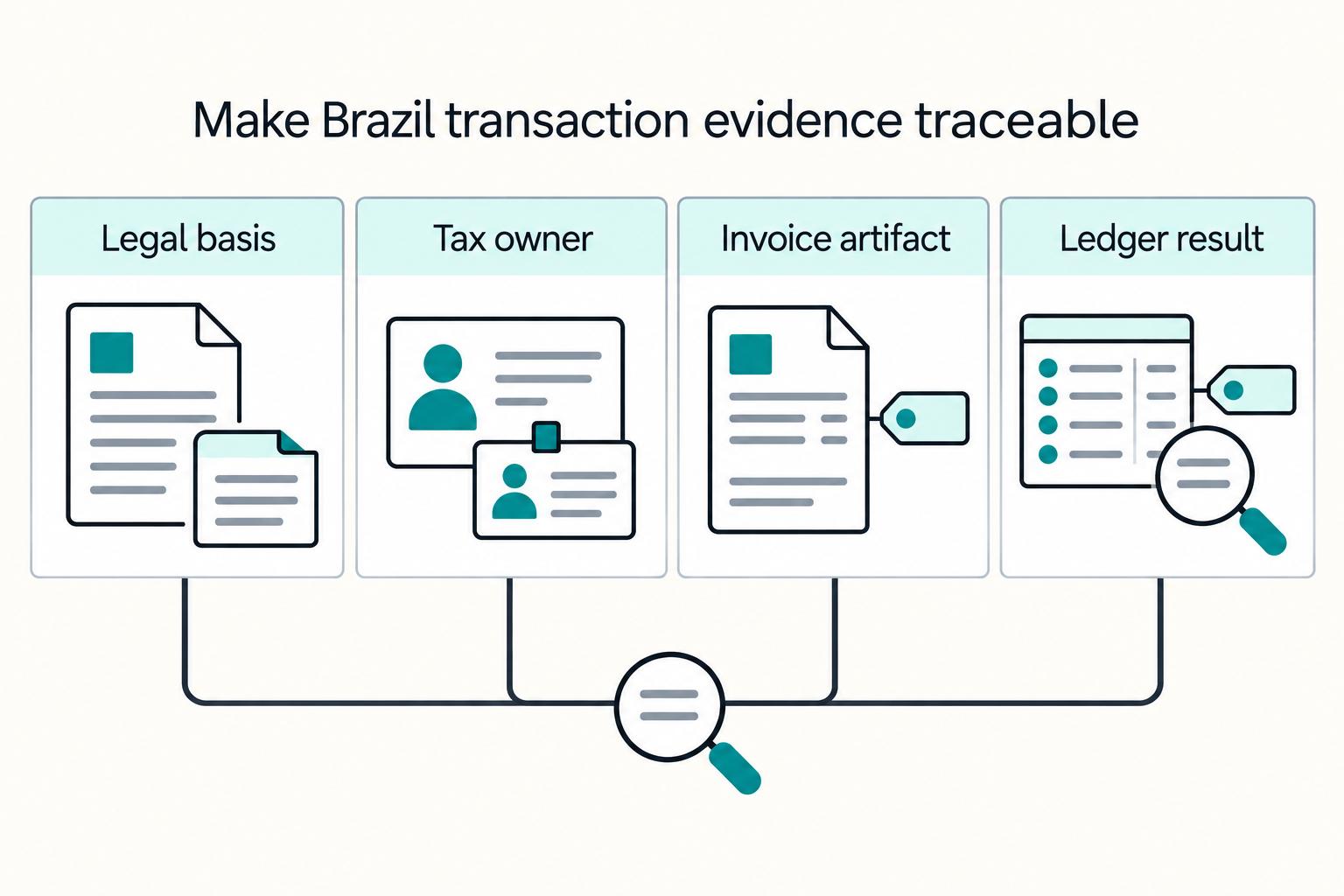
Your evidence pack should let an auditor trace one Brazil transaction on the date it happened: legal basis, applicable responsible parties, invoice artifact and ledger result. Keep the 2026 accessory-obligation compliance evidence alongside the test calculation when remittance is waived.
Start with four anchor artifacts#
Use these as a practical minimum review set, even if they live in different systems:
| Artifact | Content | Trace link |
|---|---|---|
| Legal basis log | Authority or interpretation used for each decision point, including references to Constitutional Amendment 132, plus effective dates and open issues | Decision points |
| Tax owner matrix | Statutory responsible parties and internal operational owner by transaction model, with the conditions supporting each classification | Contracts, checkout, invoicing, and settlement logic |
| Invoice samples | Samples for active paths, including electronic invoice records where relevant | Transaction IDs |
| Reconciliation outputs | Outputs connecting invoice and ledger outcomes | Reporting extracts or draft outputs used for review |
Checkpoint: pick one transaction and confirm the same identifier appears across request, tax decision, invoice record, settlement record, and ledger posting.
Assign owners and sign-off checkpoints#
Named ownership is the control, so keep it simple but explicit. Use a cadence that fits your operating model:
| Function | Primary responsibility | Update cadence | Sign-off checkpoint |
|---|---|---|---|
| Tax | Legal basis log, model classification, tax-logic review | Monthly and on rule change | Before a new model goes live |
| Legal | Contract alignment, interpretation record, open-risk log | On contract change and quarterly review | Before term changes affect checkout or seller role |
| Finance ops | Invoice samples, settlement tie-out, reconciliation outputs | Monthly close and exception review | At close for new Brazil paths |
| Engineering | Request-to-ledger traceability, event retention, and masking controls | Release-based and quarterly control check | Before production releases touching tax or invoicing |
If ownership is shared without a final approver, audit gaps can show up at the handoff points.
Preserve event history, not just final status#
Keep request-to-ledger traceability and idempotent event history so retries and reversals do not overwrite the original decision. Preserve the Article 10 timing category, any advance calculation and the final supply adjustment; an eventual refund should link to that history.
Mask sensitive fields, but keep the join keys needed for audit testing. In practice, retain visible transaction IDs, timestamps, model type, invoice references, and posting references while masking personal or payment data.
Run a quarterly control test#
Each quarter, sample transactions across your main models and timing patterns, including advance payment, standard completion, and an exception path such as a refund or retry. For each sample, verify the tax logic used on that date, the invoice data retained for that path, and audit-trail completeness from source event to ledger.
Where split payment is available and applicable, reconcile the payment instruction, tax segregation, supplier settlement and subsequent differences separately. For Article 22 §7 domestic shortfall protection, also retain both required split-payment information and operation-information evidence; money movement alone does not prove the conditions were met.
Use this section as a control-design checkpoint and map each tax decision to a traceable money flow, ledger event, and export path in Gruv Docs.
A 90-day implementation sequence for platform teams#
Use this 90-day plan as an internal control sequence, not a legal deadline. The goal is documented assumptions, testable records, and clear escalation when uncertainty remains.
| Phase | Primary focus | Grounded tasks |
|---|---|---|
| Days 1 to 30 | Classify live Brazil transaction models and stand up issue tracking | Document who contracts, takes payment, and issues the invoice artifact; test one sample per model across tax decisioning, checkout configuration, invoice flow, and ledger posting; create a CBS/IBS issue log with issue statement, current assumption, owner and escalation path, and evidence or authority link |
| Days 31 to 60 | Invoice and contract readiness | Map current NF-e/NFS-e fields, dependencies and blocking gaps against the applicable official calendar; remediate contract/operating mismatches; validate existing CIDE foreign-payment classification and track proposed measures separately |
| Days 61 to 90 | End-to-end dry runs and governance | Dry-run request to invoice artifact to ledger output across a standard path, a refund, a retry, and a cross-border path; test exception handling where remittance withholding treatment is uncertain; assign closure authority, ownership for invoice-field changes, sign-off for dry-run results, and align evidence retention with Law No 13,709/2018 (LGPD) |
Days 1 to 30#
Start by classifying every live Brazil transaction model you run, including exception paths. If teams cannot name and apply models consistently, tax logic and evidence trails will drift.
For each model, document your current classification and tax-treatment assumption and the operational facts behind it: who contracts, who takes payment, who issues the invoice artifact, and how your current logic treats the transaction. Then test one sample per model to confirm the same classification appears across tax decisioning, checkout configuration, invoice flow, and ledger posting.
Stand up a CBS/IBS issue log immediately. It should carry four required fields:
- issue statement
- current assumption
- owner and escalation path
- evidence or authority link
Use the enacted timing and responsibility rules as the baseline. Log the exact unresolved fact or technical field for counsel or the responsible authority; do not classify all timing and liability rules as unresolved.
Prepare sample records using the applicable Receita Federal/CGIBS document layout. A general international statistical reporting template does not substitute for Brazilian fiscal-document requirements.
Days 31 to 60#
Next, focus on invoice and contract readiness. For NF-e and NFS-e, map what you populate now, what your logic depends on, and which gaps would block a coherent invoice artifact or downstream reconciliation.
Run contract remediation in parallel where legal language and operating reality diverge. If terms assign obligations one way but checkout, settlement, and billing behavior point another way, log and escalate that mismatch instead of treating wording updates as a full fix.
Review existing CIDE payments and the software/technology-transfer condition separately from any new proposal. Keep genuinely uncertain classification points with an owner and deadline, while applying confirmed rules to the live flow.
Days 61 to 90#
Use the final month to dry-run end to end: request to invoice artifact to ledger output across at least a standard path, a refund, a retry, and a cross-border path. Success means the same transaction ID and rationale survive each handoff without reconstruction.
Test exception handling for flows where remittance withholding treatment is uncertain. The control objective is operational: detect, route or pause, preserve evidence, and trigger classification review when needed.
Finalize governance at the same time by assigning closure authority for issue-log items, ownership for invoice-field changes, and sign-off for dry-run results. Keep evidence retention aligned with broader compliance obligations, including Law No 13,709/2018 (LGPD), so you preserve traceability without storing unnecessary personal data.
Optimize for defensibility and traceability, not theoretical perfection. A documented assumption your team can test and explain is safer than a "complete" design built on unresolved inputs.
Frequent errors that create avoidable tax risk#
The most common avoidable risk is mis-prioritization: treating uncertain topics as settled while delaying obligations already tied to CBS/IBS under LC No. 214/2025.
A common error is treating CIDE as wholly speculative. Law 10.168/2000 already governs qualifying foreign payments, while a proposed platform levy requires its own enacted authority. Another is using the original 2025 CBS/IBS summary without checking amendments: LC 227/2026 changed important Article 22 and Article 10 conditions.
Another avoidable miss is dropping ISS-related review too early. You do not need a final position to keep controls active. If a transaction model still relies on legacy assumptions, keep those assumptions visible and test them end to end. A practical control is one sampled transaction per model showing consistent logic across checkout, invoice artifact, and ledger posting.
Risk also rises when contract allocation and production behavior diverge in digital platforms and marketplaces. If terms assign tax handling one way but your product centralizes checkout, payment flow, or invoice generation elsewhere, escalate before release rather than relying on wording updates alone.
The last recurring error is changing electronic invoicing flows without validating downstream consistency in related records. Electronic tax documents are not just customer output, so test the full path from tax determination to invoice artifact to posting reference to reporting extract. Even when tax is calculated correctly, inconsistent document outputs can break reconciliation and weaken defensibility. Related reading: GST Digital Marketplace Platform Comparison for Australia, Canada, and India.
Conclusion#
Run existing CIDE and ISS checks alongside the applicable CBS/IBS transition controls. Keep a proposal watchlist for additional digital-platform measures, without treating existing CIDE Remessas as a draft.
Use the transaction date and document calendar: the conditional 2026 test is followed by the 2027 federal changes, 2029–2032 ICMS/ISS reductions and 2033 replacement. For platform responsibility, use amended Article 22’s intermediation, control, supplier-residence and information/invoice conditions, including its exclusions and conditional domestic shortfall protection.
Execution should center on alignment across transaction reality, contracts, and evidence. For each Brazil transaction model, confirm:
- the contract owner and expected tax responsibility
- who controls checkout or payment
- the issued electronic-invoice artifact
- the ledger or reporting record tied to that tax decision
Maintain timing as a specific rule choice: most services at completion, advances calculated before supply and adjusted at supply, and continuous/installment transactions at the earlier due date or payment. Keep dated legal-basis, responsible-party, invoice and posting records for each choice.
For CIDE, retain the foreign-payment classification and evidence of whether software licensing includes corresponding technology transfer. For proposed changes, use named owners and review dates until enacted scope and effective dates support implementation.
Run a cross-functional review this quarter with tax, legal, finance ops and engineering. Validate responsible-party mapping, invoice readiness, CIDE classification and the timestamps supporting each tax-event category.
If you need to pressure-test your Brazil operating model before go-live, run a scoped control and coverage review with Gruv.
Frequently Asked Questions
Is Brazil's digital services tax regime fully final, or are parts of it still unresolved?
The main rules are enacted: existing CIDE Remessas and ISS, plus LC 214’s CBS/IBS structure as amended in 2026. The transition has distinct milestones—2026 test, 2027 federal changes, 2029–2032 ICMS/ISS reductions and 2033 replacement. Technical rollout and transaction classification can require further decisions, but that does not make all obligations unresolved. Keep proposed additional digital-platform taxes separate from existing CIDE.
When does a platform operator become responsible for collecting CBS or IBS instead of the supplier?
Article 22 covers electronic/remote intermediaries controlling at least one of charging, payment, terms or delivery, subject to sole-activity exclusions and no-control operations. For a foreign supplier, the platform is responsible jointly with the buyer/recipient and in place of the supplier. For a domestic supplier, joint responsibility arises from missing platform operation information, or a taxpayer supplier failing to issue the electronic document for the transaction value. Domestic shortfall protection requires both possible split payment with the required information and the operation-information submission. A contract assigning collection to the supplier does not override these conditions.
How should we treat ISS exposure while CBS and IBS are rolling in?
Keep ISS controls through the transition. LC 116 covers listed services and assigns imported-service responsibility to the buyer/intermediary. Existing ICMS/ISS rates are reduced to 90%, 80%, 70% and 60% in 2029–2032, and those taxes end in 2033. Identify the service-list item, municipality and date; adding CBS/IBS fields does not remove ISS.
What should we do first if neither supplier nor platform is registered and withholding risk appears?
Verify the relevant IBS/CBS tax registrations and the Article 22/23 responsibility conditions, including the registered-platform exception for a foreign supplier operating exclusively through it. Article 23 addresses reference-rate collection on foreign-exchange remittances when the foreign supplier/platform is unregistered as required, under regulatory criteria. Preserve notices, affected orders, supplier residence, invoice outputs, information-submission records and discovery date; route the precise gap to tax and finance for remediation. A commercial-registry check is not the same as IBS/CBS tax registration.
Which invoice and reporting systems need updates first: NF-e, NFS-e, or SPED?
Prioritize the document used by your actual flow and the official mandatory date. As of October 2, 2026, general ISS-service NFS-e duties are listed from October 1; platform NFS-e and specific ISS services from December 1; Simples Nacional documents from January 1, 2027. Layout publication dates are separate milestones. Map each issued artifact into ledger and reporting outputs, including SPED where applicable, rather than assuming one universal system order.
How do we handle CIDE planning when design details are still uncertain?
Implement existing CIDE Remessas where its foreign-payment conditions apply: the rate is 10%, with the statutory software exception unless corresponding technology transfer is involved. Track proposed new platform taxes separately. For the 2026 CBS/IBS test, 0.9% CBS plus 0.1% IBS is the combined 1%; remittance is waived for accessory-obligation compliance, and the test rates exclude Simples Nacional operations and respect special/reduced treatment, except the specific fuel/biofuel regime. Keep the relevant document evidence even where no test remittance is due.
Try a related tool
Researched and edited by the Gruv editorial team. Gruv builds cross-border billing, payouts, and finance-operations software for global businesses.
Sources
Includes 3 external sources outside the trusted-domain allowlist.
Educational content only. Not legal, tax, or financial advice.
Related Posts
Making Tax Digital for Income Tax and UK Platform Operators: Confirmed Rules and Open Scope Questions
For platform operators, the first useful move is to separate confirmed HMRC and GOV.UK statements from scope assumptions. Most public guidance on Making Tax Digital for Income Tax is written for sole traders, landlords, and their agents, not for platform operators as a distinct audience.
Global VAT Compliance Map for Digital Services Platform Operators
For platform operators, VAT on digital services is first a liability and evidence issue, not just a rate issue. If you facilitate cross-border transactions between buyers and sellers, the key question is whether a tax authority may treat your platform as liable for VAT or GST on the transactions it facilitates.

Canadian GST/HST Registration for Digital-Economy Platforms
A platform sells subscriptions to Canadian customers and pays overseas sellers. The Canadian GST/HST decision starts with those supplies and the platform’s legal role. It does not start with whether a payout succeeds or whether the platform has collected a large set of identity documents.