
Quick Answer
Start with ownership and scoping: for eu digital services act for marketplace operators, pause launch until legal issues a written scope memo, then map controls to named owners across legal, compliance, finance, and risk. Build onboarding, listing, and incident records so each case can be reconstructed end to end. Use Regulation (EU) 2022/2065 as the legal anchor, but treat Article 30 and Article 31 requirements as counsel-defined before hardcoding product decisions.
EU Digital Services Act for Marketplace Operators and what this article will help you decide#
If you own compliance, legal, finance, or risk at an online marketplace, the question is not whether EU cross-border compliance matters in the abstract. It is which controls to stand up now, who owns them, and when an issue needs to move from operations to legal review.
This article is for teams handling cross-border contractor, seller, or creator flows, especially where listing, onboarding, payments, and user complaints sit in different parts of the business. That split matters in practice. Compliance wants traceable controls. Legal cares about scope and interpretation. Finance carries the cost of manual checks and payout holds. Risk has to decide what gets escalated fast. If those owners are not named early, the same issue gets debated three times and fixed zero times.
Before you design anything, align on a few plain-English administrative terms that appear in EU VAT materials used throughout this article. One Stop Shop (OSS) is a scheme where a taxable person registers in one EU Member State for VAT declaration and payment on covered EU distance sales and cross-border services. VAT Cross-border Rulings (CBR) are an advance-ruling mechanism for complex cross-border VAT transactions in participating countries where the taxable person is VAT-registered. Union turnover is the annual turnover across the 27 EU Member States used for cross-border SME scheme eligibility, with a EUR 100 000 cap for the current and previous calendar year.
The practical point is simple. You should leave with a view on four things:
- which controls to implement first
- which team owns each control day to day
- what evidence to retain when decisions are challenged
- where frontline teams must stop and escalate
Before you touch product or policy, create a one-page scoping note and have legal, compliance, and finance review it together. Include the service description, target markets, user types, monetization path, and named control owners. Record the source version you relied on. When your team pulls primary materials, prefer official European Union pages on the europa.eu domain so you are not building from stale summaries or vendor glossaries.
The usual failure mode at this stage is not bad intent. It is sloppy internal language. Teams say "we're a marketplace" as if that settles obligations, or they design controls before agreeing which regime and process the flow actually falls under. Another common miss is finance enabling a new seller flow or payout corridor before legal has signed off on scoping assumptions. This guide is meant to help you avoid that sequencing error, but it does not replace legal advice.
If you want a deeper dive, read Online Safety Act UK: What Marketplace and Platform Operators Must Do to Comply.
Where the DSA applies and why non-EU operators still get pulled in#
Use this section as a scoping trigger, not as proof of DSA applicability. If you target or actively serve recipients in the EU single market, treat legal scoping as a launch gate before rollout.
A practical warning comes from EU VAT e-commerce guidance: it explicitly covers "marketplaces/platforms both inside and outside the EU," and the cross-border B2C VAT rules changed from 1 July 2021. The same VAT framework also allows eligible marketplaces/platforms to register in one EU Member State for declaration and payment, including OSS schemes (non-Union, Union, and import). That VAT evidence does not establish DSA scope, but it does show that EU digital obligations can follow the market served, not only where the company is incorporated.
Keep the first decision rule simple: if EU users are in scope for launch, pause and require a written legal scoping memo. Make it dated, and include the service description, user groups, rollout countries, and the legal sources your team relied on.
On the EU legal representative point, confirm with qualified DSA legal counsel when one is required under the DSA. Assign ownership now so the question does not get lost: legal owns the determination and relationship if required, compliance owns evidence retention and contact logs, and finance or procurement owns contract and invoicing controls.
Classify your service correctly before you design controls#
Classify the service before you design controls, because misclassification drives costly rework in either direction. Teams usually lose time by building controls for the wrong layer or by treating potential VLOP/VLOSE exposure too late.
Use the ladder as a legal-classification question, not a tax proxy: intermediary services, platform layer, then potential VLOP/VLOSE status. VAT tools such as OSS, the cross-border SME scheme, and VAT cross-border rulings are useful for VAT operations, but they do not determine DSA service classification.
| Service type | What changes in practice | Evidence to have before control design | Governance and cost signal |
|---|---|---|---|
| Intermediary services | Start with a narrow control scope until classification is confirmed | Dated legal memo, product description, EU user flows, countries served | Keep implementation limited until legal scope is clear |
| Platform layer | Expect a broader control footprint than a narrower intermediary position | Clear map of user-facing marketplace functions and EU recipient context | Cross-functional ownership is usually needed before build starts |
VLOP / VLOSE | Treat as an escalation point that may carry additional obligations | Written legal view on status risk and re-review triggers | Senior oversight and budget planning should happen earlier |
Make this a pre-build gate in your operating model:
- Legal signs off service classification.
- Compliance signs off control scope derived from that classification.
- Finance signs off operating cost before tooling, vendor, or headcount commitments.
Keep the evidence concrete and reviewable: live features, EU user journeys, launch markets, and review date. Re-check classification when product scope or EU reach changes materially.
For a step-by-step walkthrough, see A Business Continuity Plan for Digital Nomads Working Near US National Parks.
Build trader onboarding controls around Article 30 and KYBC#
Build the onboarding system now, but do not treat VAT pages as the legal source for Article 30 or KYBC requirements under Regulation (EU) 2022/2065. Use VAT evidence to design intake discipline, status tracking, and record keeping, then require legal to define the DSA-specific fields and decisions before product lock.
VAT material is useful for process design, not for deciding what is legally sufficient KYBC for marketplace traders. OSS and the cross-border SME scheme support administrative patterns such as controlled registration, explicit processing states, and audit-ready records.
What you can build now without over-claiming#
Use a clear sequence: collect trader data, validate what you can, route mismatches, apply approval or hold logic, then enable permissions like listing or payout. Keep this framed as a control pattern, not as proof of Article 30 requirements.
Set a pre-build legal gate. Before engineering finalizes forms or decision states, legal should issue a dated requirement note covering the live product, trader types in scope, and the version of Regulation (EU) 2022/2065 reviewed.
Use a friction rule for low-confidence cases: restrict activity or pause onboarding until material evidence gaps are resolved. Avoid soft approvals that allow listing or payout while mismatches remain open.
Borrow administrative structure, not legal conclusions#
The VAT sources support these design cues:
- Single controlled intake: the SME cross-border scheme uses one prior notification through the Member State of establishment, which acts as contact point.
- Managed processing states: the SME scheme says registration processing should not exceed 35 working days after prior notification receipt.
- Record-first operations: OSS explicitly covers registration plus record-keeping and audits.
| Design area | What VAT evidence supports | Artifact to keep now | Still requires legal confirmation for DSA |
|---|---|---|---|
| Intake ownership | One controlled submission point and accountable contact point | Dated intake record, submitter identity, country context, versioned form | Exact trader fields under Article 30 |
| Processing status | Managed process with tracked timing | Queue status, case age, reviewer assignment, decision timestamp | Any DSA-specific deadline or hold/release rule |
| Auditability | Records and audits are explicit in OSS | Original submission, validation notes, resubmission history, final decision log | Retention basis tied to Regulation (EU) 2022/2065 |
| Identifier precision | EU schemes use formal identifiers (for example, EX number when granted) | Identifier source, issuance date, verification result, file hash or capture | Which identifiers are mandatory for trader verification |
Common failure modes are operational: overwritten submissions, missing mismatch history, chat-based exceptions outside the system record, and stale files with unclear approval basis.
Build the intake record, status model, and audit trail now. Call it Article 30-compliant only after legal defines the DSA-specific field set, decision logic, and retention requirements.
Design listing and product controls around Article 31 compliance by design#
Design Article 31 controls as explicit product states and owned review decisions, and have legal define the requirements before engineering hardcodes them.
Turn legal interpretation into build requirements#
Use the same operating pattern you used for onboarding controls: one controlled intake, explicit statuses, and records you can retrieve later. For each listing surface, legal should issue a dated requirement note tied to the exact product and the version of Regulation (EU) 2022/2065 reviewed.
Then map that note into product behavior: what the listing form collects, what attestations are required, which checks can hold publication, and which flags must go to manual review. If that legal note is missing, do not let teams backfill with generic moderation habits and call it compliance.
Add friction deliberately where risk is highest#
Faster approvals help growth, but they also move exposure from pre-publication controls into complaint handling and emergency removals. Keep low-risk paths fast, and add visible friction where risk is higher, such as first publication on a new surface, material edits to listing facts, or automated policy mismatches.
Set a minimum path for suspected illegal listings#
A DSA-mandated illegal-goods workflow should be confirmed with qualified legal counsel, so treat this as an operator baseline. At minimum, keep a single detection intake, one owned triage queue, an internal SLA, a temporary restriction state, a final action state, and a logged rationale.
Borrow the administrative discipline, not a legal threshold. In the cross-border SME scheme, registration is expected to complete within 35 working days; that is not a listing SLA, but it is a useful reminder that every case needs an owner, a clock, and a visible status.
Preserve a defensible delisting record#
For each delisting or temporary restriction, preserve the policy basis used, decision actor or team, timestamp, listing snapshot, and user communication record. OSS guidance explicitly covers record keeping and audits, and that is the right evidence standard to apply to your own decision trail.
Related reading: Defend Trade Secrets Act (DTSA) for Freelancers and Consultants.
Set escalation rules for illegal goods and buyer notification obligations#
Set a clear internal default: when illegality looks credible and consumer harm looks plausible, freeze or remove first, then investigate. Treat this as operator policy, not as a claim that this exact sequence is prescribed here.
Anchor that rule to the same legal requirement note used in listing design. If legal has not defined what qualifies as a credible signal for a category, trust and safety should escalate instead of improvising.
Define escalation triggers before the first live incident#
Start with trigger conditions your teams can apply consistently. Escalate when, for example:
| Trigger | Detail |
|---|---|
| Known prohibited-product match | A listing matches a known prohibited-product pattern or a prior enforcement pattern |
| Complaint with specific support | A complaint alleges illegality with specific support, such as order reference, listing snapshot, or product images |
| Material edit to an approved listing | A previously approved listing is edited in a way that changes product identity, safety claims, or intended use |
| Repeat reports | Reports point to the same trader, SKU family, or payment account |
For each escalated case, require one owner, one case clock, and one preserved evidence set. Keep at least the listing snapshot, detection or report signal, decision log, account identifier, and action taken. OSS materials are not DSA illegal-goods rules, but they do support the operating discipline of record keeping and auditability.
Assign drafting, approval, and send responsibility for buyer notices#
The public excerpts do not define a DSA buyer-notification script, channel rule, or fallback process, so set these internally with counsel sign-off. A practical split is: trust and safety drafts the facts, legal approves disputed or high-harm cases, and support or CRM sends through approved channels.
If buyer contact data is missing or stale, log attempted channels, timestamp, send failure, and fallback action. The control objective is a retrievable record of who was contacted, what was communicated, and which orders were in scope.
Coordinate evidence preservation with repeat-sale prevention#
Preserve evidence and prevent re-listing in the same workflow, not in separate tracks. Use one shared case record across trust and safety, compliance, legal, and payments ops so listing actions, communication steps, and account controls stay aligned.
If policy allows payout controls, define when temporary holds are permitted and when legal approval is required. Keep this framed as platform risk control, not as a DSA obligation.
Keep legal uncertainty explicit#
The public excerpts used here do not establish detailed DSA enforcement practice or sanctions outcomes for illegal-goods incidents. Final interpretation of those points should remain counsel-led.
Coordinate DSA with GPSR and DMA so teams do not duplicate controls#
Use one shared control inventory and map it across DSA, GPSR, and DMA internally, instead of running three parallel process tracks. The public materials here do not define the legal boundary lines between those regimes, so final policy text and country-level handling still need specialist review.
| Mechanism | What the article says | Boundary or condition mentioned |
|---|---|---|
| OSS | Registers in one EU Member State for VAT declaration and payment and groups registration, declaration and payment, record keeping and audits, and leaving the scheme into one structure | Covered EU distance sales and cross-border services |
| Cross-border SME scheme | Requires one prior notification in the Member State of establishment | Union turnover ceiling of EUR 100 000 for the current and previous calendar year |
| VAT Cross-border Rulings (CBR) | Advance-ruling mechanism for complex cross-border VAT transactions in participating countries | Taxable person is VAT-registered and national VAT-ruling conditions apply in the relevant EU country |
A practical setup:
- Record each control once.
- Tag it by internal program lane (
DSA,GPSR,DMA), control owner, evidence artifact, and any country exception. - Check that a reviewer can find the policy basis, owner, retained evidence, and exception note from a single record.
- Treat duplicated checks with conflicting retention or approval rules as a control-design failure.
If you want a model for this operating pattern, tax is a useful analogy. OSS groups registration, declaration and payment, record keeping and audits, and leaving the scheme into one structure rather than separate country processes. It also shows where centralization stops: the cross-border SME scheme requires one prior notification in the Member State of establishment and has a Union turnover ceiling of EUR 100 000, while VAT Cross-border Rulings must follow national VAT-ruling conditions in the relevant EU country.
So keep the recommendation operational, not legal: build the strictest evidence pack you already need once, reuse it where it fits, and mark every program or country exception before approval.
Build an evidence pack and reporting cadence that survives regulator scrutiny#
Keep one evidence pack that lets you reconstruct and defend a case end to end without chasing multiple systems. If a regulator or the European Commission asks what happened, who approved it, and what users were told, your answer should come from that single record set.
Keep the evidence pack narrow but complete#
Use a consistent set of records for each case: KYBC files, listing action logs, buyer notification records, incident timelines, and transparency reports where applicable. The standard is simple: a reviewer can open one closed case and follow the full sequence in order, including ownership and sign-off.
The usual failure is fragmented retention across tools with no shared case link. A practical benchmark is the same discipline reflected in OSS materials on "record keeping and audits of traders in the OSS" and rules on records to be kept: each retained item needs a clear owner, stable location, and reliable retrieval path.
| Evidence item | What it should prove | Common gap |
|---|---|---|
| KYBC file | Trader identity, verification result, mismatch resolution | Missing final verifier output or stale documents |
| Listing action log | What changed, who acted, when, and why | No policy basis or timestamp preserved |
| Buyer notification record | What buyers were told, when, and through which channel | Notice sent but not linked to the incident |
| Incident timeline | Sequence from detection to closure | Manual notes with conflicting times |
| Transparency report inputs | Counts and categories feeding public reporting, where applicable | Source data cannot be reproduced later |
Set a cadence you can actually maintain#
Set a reporting rhythm your team can sustain, and treat it as internal governance rather than a fixed legal timetable. Assign clear owners for each layer so operations, risk or compliance, and leadership each review what matches their role.
Then test control quality directly: sample closed cases for completeness, test retrieval speed, and confirm redaction handling in retained records. If complete files are slow to retrieve, the process will not hold up well under scrutiny.
Use an audit checklist, not memory#
For audits or authority questions, keep one live checklist tied to your DSA control set:
- current policy versions and approval dates
- decision logs with rationale and approver
- exceptions register with expiry or review date
- remediation status tracker for open issues
- inquiry log for regulator or European Commission requests and response status
Public EU tax materials also show the value of clear requesting procedures and a single contact point. Apply that same operating discipline here: one inquiry owner, one status view, and no offline side threads that bypass the record.
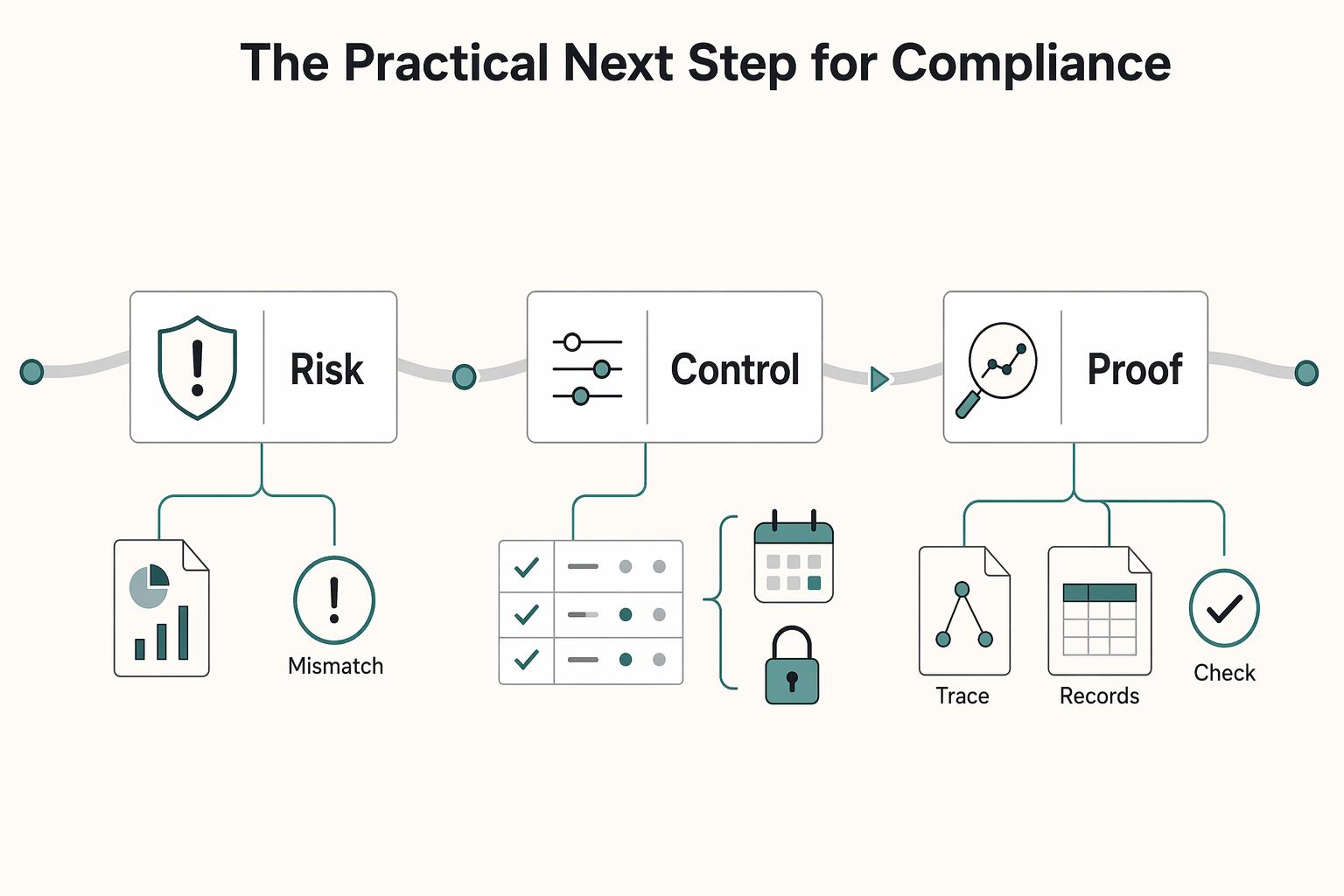
The practical next step for compliance, legal, finance, and risk owners#
If your weak point is proving what happened, use a focused 90-day execution plan with named owners and retrievable records, not a broad policy rewrite. The goal is to reduce surprises with decisions that are traceable, testable, and clearly owned.
| Step | Focus | What to confirm |
|---|---|---|
| 1 | Scope and classification first | Assign one owner to a version-controlled scope memo and make it the single reference across legal, compliance, finance, product, and payments |
| 2 | Tighten onboarding records | Confirm each trader file can be retrieved as one record set: collected data, verification result, mismatch notes, and approval or hold decision |
| 3 | Tighten listing controls | Keep release one narrow: required attestations, a review path for suspicious submissions, and logs for every status-changing action |
| 4 | Define incident escalation | Set who can freeze activity, who preserves evidence, and who approves external communication |
| 5 | Evidence-pack testing | Sample closed cases and verify each one can be reconstructed end to end without chasing multiple teams |
Treat the table above as an operating sequence, not a legal timeline.
Use proven administrative discipline#
Where teams stall, borrow structure from EU processes that are explicit about ownership and records. OSS is built around registration in one single Member State (the Member State of identification) and explicitly covers registration, declaration or payment, record keeping or audits, and leaving the scheme. The operating lesson is practical: one accountable owner, one authoritative record set, one retrieval path.
The same pattern appears elsewhere: in the cross-border SME scheme, the MSEST acts as the contact point with other Member States, and in VAT cross-border rulings involving multiple companies, one company files on behalf of the others. Use that same clarity internally.
Start thin, then deepen where risk repeats#
Start with a minimum viable control set, then add depth where incidents repeat, regulator scrutiny increases, or legal analysis indicates your model may move toward broader obligations (including VLOP/VLOSE analysis). If mismatches repeat, strengthen onboarding review first. If one category drives incidents, add listing friction there first.
The principle stays the same: clear ownership, traceable decisions, and only as much process as your actual marketplace risk profile requires.
Frequently Asked Questions
Does the DSA apply to marketplace operators based outside the European Union?
Official EU VAT e-commerce materials do say marketplaces and platforms both inside and outside the EU can be affected, so non-EU incorporation is not a reliable proxy for being out of scope. Treat non-EU status as a legal-review point, not a comfort point, and confirm DSA scope with qualified legal counsel.
What changed for online marketplaces once the DSA became fully operative?
Do not hardcode a date-by-date DSA obligations list without consulting DSA-primary legal sources. Use DSA-primary legal sources to define the actual change set.
What does Article 30 DSA require in plain language for KYBC?
Use a counsel-reviewed DSA source to define Article 30 KYBC requirements, and make sure your internal records are retrievable and auditable.
What does Article 31 DSA mean for listing design and moderation workflows?
Avoid presenting product assumptions as legal requirements until Article 31 duties are confirmed with DSA-specific legal counsel. Treat any workflow design here as operational practice pending DSA-specific legal confirmation.
When should a marketplace remove a listing immediately versus investigate first?
A DSA legal trigger for immediate removal versus investigation is not established. Define that threshold with legal counsel and document the decision path you apply in practice.
When are buyer notifications required after illegal goods are identified?
Confirm DSA buyer-notification triggers and timing with qualified legal counsel. Record-keeping and audits are important, so if you send notifications, keep complete, auditable case records.
How should operators split controls between Digital Services Act, GPSR, and DMA?
Map controls to each law separately and validate overlap with legal review, as one law's checklist does not necessarily satisfy another.
Try a related tool
Researched and edited by the Gruv editorial team. Gruv builds cross-border billing, payouts, and finance-operations software for global businesses.
Sources
Educational content only. Not legal, tax, or financial advice.
Related Posts

UK Online Safety Act Compliance for Marketplace and Platform Operators
Treat the UK Online Safety Act as operating work now, not a policy debate. The most practical way to reduce uncertainty is to run an auditable implementation plan: make an initial scope call, stand up baseline controls, assign owners, and keep records you can defend if Ofcom asks questions.
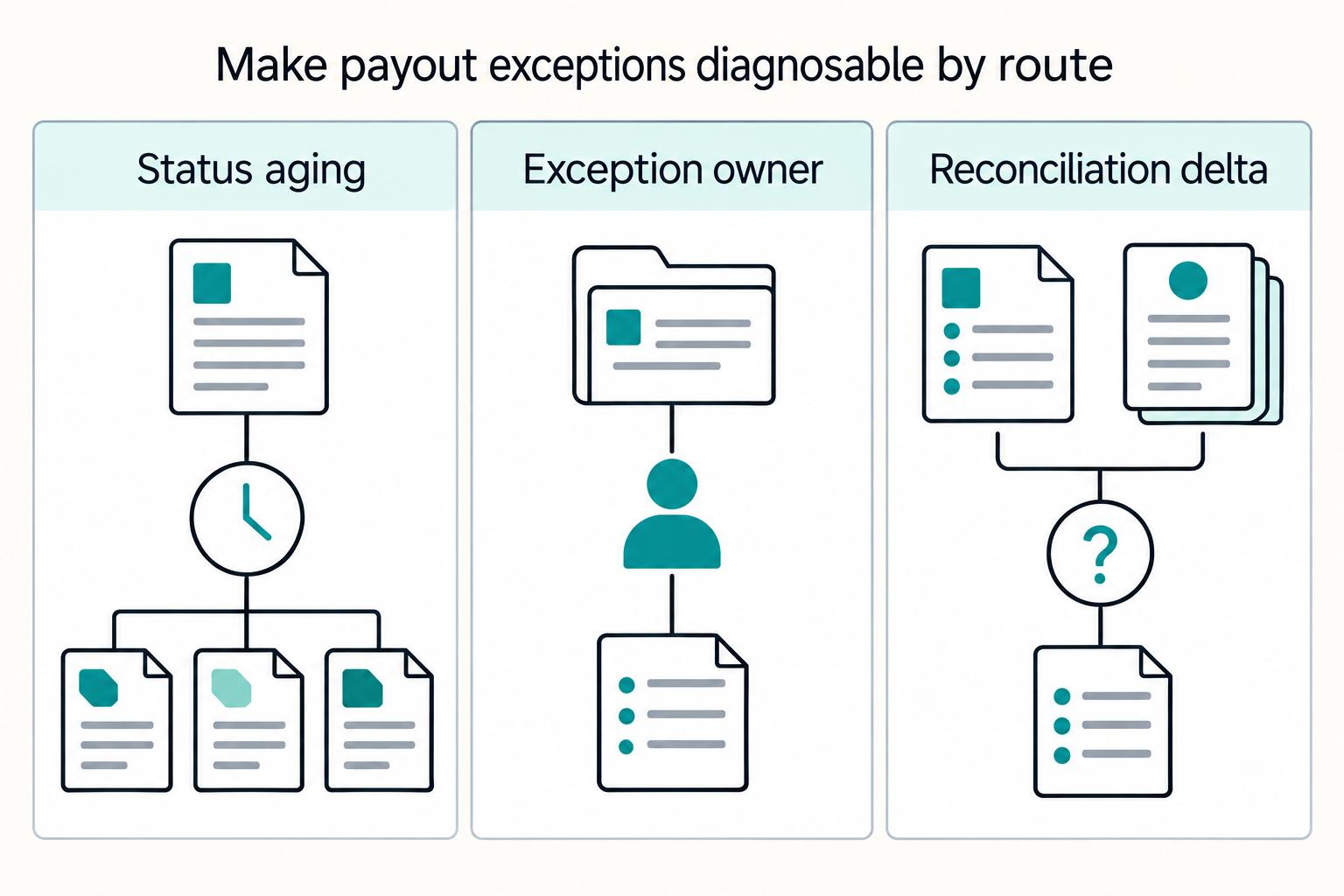
Payment Infrastructure Trends 2026: How Marketplace Operators Should Prioritize Real-Time Rails, Stablecoins, BNPL, and Embedded Checkout
Payments headlines in 2026 are loud, but marketplace roadmap decisions should start with sequence, not trend volume. The useful move is not building a longer list of themes. It is filtering for changes that improve settlement reliability, compliance clarity, or measurable conversion in a specific market. The signals are mixed, which is why headline-led planning can fail:
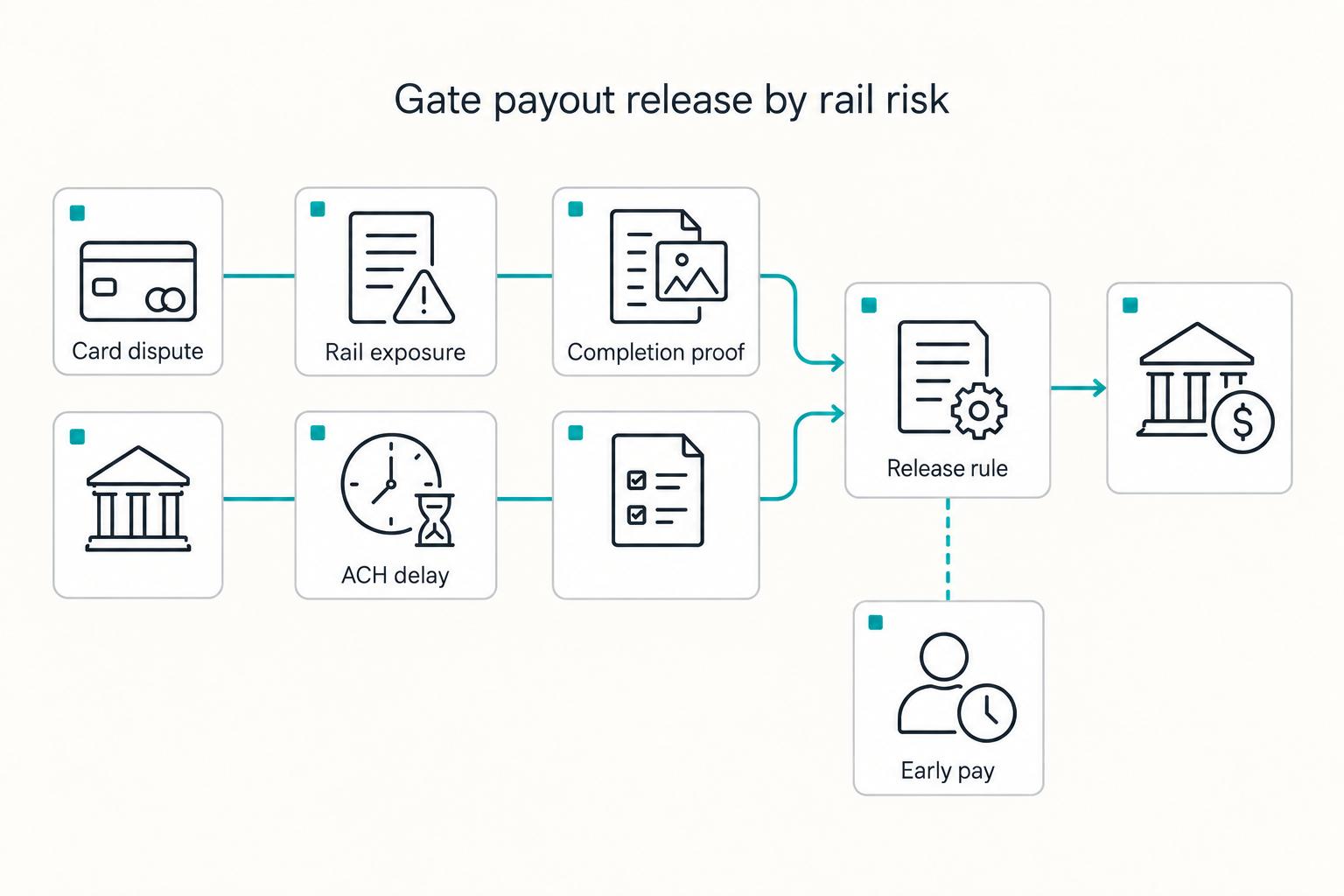
Build a Contractor Payment Flow for Home Services Marketplaces
Build this as an end-to-end settlement system, not a standard checkout flow. If you treat a **contractor payment flow home services marketplace** like card-only commerce, pay-in may look fine while settlement breaks across onboarding, held funds, payout timing, split logic, and disputes.