
Quick Answer
Platforms can add AML rules without slowing payouts by running monitoring inline with payment execution, segmenting risk before tuning rules, and using a clear decision matrix for auto-release, timed hold, or escalation. Build defensible evidence for each decision, keep AML holds separate from document holds, assign named owners, and tune noisy rules with simulation or shadow mode before enforcement.
How to keep transaction monitoring from slowing payouts#
Strong Anti-Money Laundering (AML) controls only help a payout platform when they reduce risk without slowing legitimate payouts. In practice, that means controls need to work during payment execution, support consistent decisions, and leave a clear record of what was released, held, or escalated.
Step 1 Treat payout speed as part of control design#
If your product depends on fast movement of funds, compliance has to operate alongside the payment, not only after settlement. Older compliance models assumed there would be time between payment initiation and final settlement. In real-time environments, that assumption creates friction.
This is already an operating reality in many markets. Real-time domestic payment schemes are active in more than 70 countries, increasing pressure to avoid delays. If a rule only works when you have a long manual review window, treat it as an exception path, not your primary payout path.
Step 2 Anchor the program to defensible regulatory evidence#
For most teams, the real question is not whether you can add more rules. It is whether you can explain and evidence the decisions those rules produce in a way that is defensible under regulatory expectations. A smaller control set with clear ownership is often easier to defend than a large alert stack nobody can fully account for.
Use a simple checkpoint. Pick a recent payout decision and confirm your team can reconstruct the trigger, the action taken, and the supporting evidence without relying on memory, email, or chat. If you cannot do that, your monitoring and case-handling process needs tighter structure and ownership.
Step 3 Decide actions and evidence before tuning rules#
Start with decisioning before detection tuning. Compliance, legal, finance, and risk owners should align first on a response framework for release, temporary hold, and escalation into case management.
That sequence keeps the central tradeoff visible. Broad rules can flood teams with false positives, and alert overload is a real burnout risk for analysts. Overly narrow rules can miss suspicious behavior. Before you tune anything, define the evidence record for each material decision: what triggered review, what happened to the payout, and what supporting context was considered. This matters even more when patterns such as Authorized Push Payment (APP) fraud need closer scrutiny.
Set the outcome and scope before touching rules#
Set the target before you tune alerts. That helps avoid two common failures: weak detection that looks fast, or a heavy rule stack that adds operational friction without improving case quality.
Step 1 Define success in two lanes#
Start with a risk-based approach. FATF frames AML/CFT implementation this way, and the practical discipline is to measure detection quality and residual risk, not just whether rules fire. Write success in two separate lanes:
- Control lane: Are you identifying suspicious activity with enough quality to justify review, hold, or escalation?
- Operations lane: How does monitoring affect review queues, case handling, and payment operations?
Keep the lanes separate. A rule can perform well in detection and still be operationally unacceptable in a fast-moving payment flow.
Step 2 Lock the non-negotiables#
Before you get into behavior rules, document the checks your program treats as required gates.
Make each gate explicit in policy and ownership so it does not become optional when operations pressure rises. A practical evidence pack is one page per gate with three fields: trigger source, decision owner, and proof of completion.
Step 3 Draw hard scope boundaries#
Set scope by market/program and by payment flow. Do not force one rule set across everything. Separate high-volume P2P transfers from other payment contexts where risk signals and operating constraints differ.
High-volume P2P transfers are a known monitoring context, but that does not mean every flow needs the same control intensity. If a corridor or product is new and the evidence is thin, keep it in monitor-first planning until you can justify stricter actions.
For platform-specific fraud detection patterns that protect approval rates, see Transaction Monitoring for Platforms: How to Detect Fraud Without Blocking Legitimate Payments.
Gather prerequisites and evidence before launch#
Before you build or tune rules, finish the evidence pack. If you skip this, you usually get the same launch pattern: noisy alerts, weak auditability, and payout friction that is hard to explain later.
Step 1 Inventory every payout path and entry point#
Start with the actual transaction paths your monitoring will see. Include the funding models, counterparties, rails, and markets tied to each path.
For each path, capture three basics: who initiates it, which event starts monitoring, and which provider or internal service touches it before release. Cross-border programs need this detail early because country-specific compliance and operating rules can increase integration burden, even when flows look commercially similar. Verification point: if operations, compliance, and engineering produce different lists of live payout flows, the inventory is not ready for launch.
Step 2 Assemble the defensibility pack from existing records#
Pull existing records before you add new logic: current alert taxonomy, prior escalation outcomes, and recent monitoring and transaction-history exports.
This is not paperwork for its own sake. Real-time payment compliance depends on monitoring risk, enforcing controls, and producing regulatory evidence without slowing the payment experience. If alerts are inconsistently named, outcomes are fragmented, or transaction history cannot be tied to decision events, you cannot tell whether a new rule improves control quality. You can only see that it added manual work.
Practical check: reconstruct one recent escalated payout end to end. You should be able to match the triggering event, alert, reviewer action, and transaction-state changes from system records alone.
Step 3 Confirm the governing documents and authority chain#
Validate the documents that authorize control actions. Check the current Anti-Money Laundering (AML) policy, applicable regulatory references, and the internal authority map for hold, escalation, and release decisions.
Outdated ownership creates launch risk. Supervisory expectations include real-time reporting, testing, and strong third-party governance, so unclear escalation authority is a control gap, not an administrative issue.
If markets, payout partners, or legal entities changed since the last update, treat that as a red flag and reapprove before go-live.
Step 4 Document integration facts before writing any rule logic#
Document how events behave in production before you write rule logic: how monitoring events are generated, retried, and reconciled across systems.
This keeps compliance decisions tied to stable, replayable events instead of duplicate or partial signals. Poor data quality and siloed records weaken AML effectiveness, and duplicate or fragmented signals can drive inconsistent control actions.
Verification point: replay one provider event and confirm whether monitoring creates duplicate actions or suppresses them. If that behavior is unknown, treat the flow as high risk until engineering and compliance align.
Related: What Is an Audit Trail? How Payment Platforms Build Tamper-Proof Transaction Logs for Compliance.
Segment risk by corridor, user type, and rail#
Do not apply one rule set to all payout traffic. Segment first so you can keep baseline monitoring broad, then increase control intensity only where the evidence supports it and the payout path can tolerate it.
Step 1 Split traffic into defensible cohorts#
Start with three practical cuts:
| Cohort cut | Example split |
|---|---|
| User profile | newer vs more established users (based on your own case history) |
| Corridor risk | standard corridors vs payments involving high-risk jurisdictions |
| Rail | the payout rail used |
Use fields you can consistently recover across systems: transaction amount, timestamp, location, counterparty, and customer profile. Verification point: sample each cohort and confirm those fields are populated and consistent before you write segment-specific hard-hold logic.
Step 2 Keep baseline screening for all, then add risk-tier intensity#
Segmentation should sharpen control intensity, not create blind spots. Every transaction should still run through predefined compliance rules.
Use a baseline for all cohorts, then apply a higher review tier only where documented signals justify it. If you cannot explain why a segment needs stronger treatment, you are probably adding queue volume rather than control quality.
Step 3 Keep control reasons distinct in case records#
When multiple control lanes apply, keep them distinct in your case records instead of collapsing everything into one AML severity label.
If your workflow tracks document-status checks, for example tax forms, tag those checks separately from transaction-monitoring signals so reviewers can see what drove the action. Verification point: review one delayed or blocked payout and confirm document-status checks and monitoring signals appear as distinct tags when both apply.
Step 4 Start weak-signal segments in monitor-only mode#
When a segment has low historical signal quality, start with monitor-only alerts. Promote that segment to hold-capable logic only after alert outcomes show meaningful risk detection and clean case evidence.
Systems can escalate to alerts or automatic blocking actions, so require stronger evidence before you give a new segment authority to interrupt payouts.
For a step-by-step walkthrough, see Event Sourcing for Payment Platforms: How to Build an Immutable Transaction Log.
Build the decision matrix for auto-release, hold, or escalate#
A practical matrix should make one outcome clear from the same evidence every time: release, hold for review, or refuse. Once cohorts are defined, turn them into explicit decision rows with a named owner and required evidence.
Step 1 Start from a typology matrix, then map to actions#
Build decision rows from your risk and coverage assessment, not from out-of-box defaults. A typology matrix gives you a defensible link between identified risk, available data, and the action you will take.
| Trigger class | Typical trigger source | Default action | Constraint to define internally | Audit trail minimum |
|---|---|---|---|---|
| No meaningful concern | Core monitoring and screening checks clear | Auto-release | Standard payout controls | Rule version, segment, screening result, release timestamp |
| Unclear or low-confidence concern | Weak signal or partial match that needs validation | Timed hold | Internal hold window, queue owner, review standard | Trigger details, source, matched fields (if any), hold reason, next owner |
| Material risk requiring judgment | Multiple correlated risk signals or behavior outside expected profile | Manual review | Specialist queue, adjudication standard, escalation path | Linked alerts, customer history, reviewer notes, disposition rationale |
| Policy-defined no-pay outcome | Confirmed match or other policy-defined refusal condition | Reject | Release blocked unless authorized override applies | Evidence packet, decision authority, refusal timestamp, linked case ID |
Set rollout priority based on severity, data availability, and business objectives.
Step 2 Write direct "if X, do Y" rules for screening and monitoring#
Operators need executable branches, not broad labels. Keep separate paths for confirmed outcomes and potential outcomes that need secondary validation.
- If screening returns a policy-defined confirmed match, do not release. Route to refusal or specialist escalation.
- If screening returns a possible or fuzzy match, place a timed hold and require secondary validation before release.
- If monitoring shows a single weak signal in a low-signal segment, keep monitor-only or timed-hold logic unless outcomes justify stronger action.
- If monitoring shows combined value, volume, or velocity signals, promote to manual review.
A time delay can be a valid compensating control, but it needs to be explicitly time-bounded.
Step 3 Add operator constraints and audit evidence#
The matrix is not complete until you define operational limits and ownership.
- Set internal maximum hold windows by payment channel in your policy.
- Set manual-queue SLA targets you can actually meet.
- Assign a specific owner for each decision row.
For the audit trail, capture at least the triggering rule ID and version, segment, list or alert source, timestamps, actor or team, disposition, and reason text. Verification point: sample held cases and confirm a second reviewer can reconstruct the decision without extra context.
Step 4 Add scenario rows and test before production#
Before production, add explicit scenario rows for known risk patterns relevant to your program. Then validate behavior in UAT using scenario matrices, clear adjudication standards, pass or fail criteria, and documentation practices.
A simple reliability check is to give the same scenarios to two reviewers and compare decisions. If they choose different rows, the matrix still needs tightening.
Before finalizing your matrix, map each action to a system status, evidence requirement, and retry rule your ops team can execute consistently.
Implement controls in the right order so payouts do not choke#
The core requirement is clear: compliance should operate alongside payment execution, not after the fact. Keep final release decisions aligned with completed control results to reduce avoidable payout drag.
Step 1 Gate release on prerequisite checks#
Before final release decisions, verify that any prerequisite checks required by your policy are complete. If required inputs are still pending, keep them out of final release decisions until they are complete.
Step 2 Run transaction monitoring inline, not as a batch afterthought#
Apply policy outcomes through transaction monitoring in the live flow, not as an end-of-day batch step. Transaction monitoring is meant to identify and report suspicious activity, and rigid batch-style handling can struggle to keep up.
Keep controls in the live flow so risk checks happen alongside payment execution, not after the payout has effectively moved on.
Step 3 Tie each outcome to clear evidence before final release#
Before final release, make sure each material decision carries enough regulatory evidence to support review.
If upstream control results are still provisional, avoid treating them as final. Final release should follow completed control results.
If instant payouts are part of the program, see How Platforms Can Offer Instant Payouts as a Premium Feature Without Margin Surprises.
Assign case ownership and escalation authority#
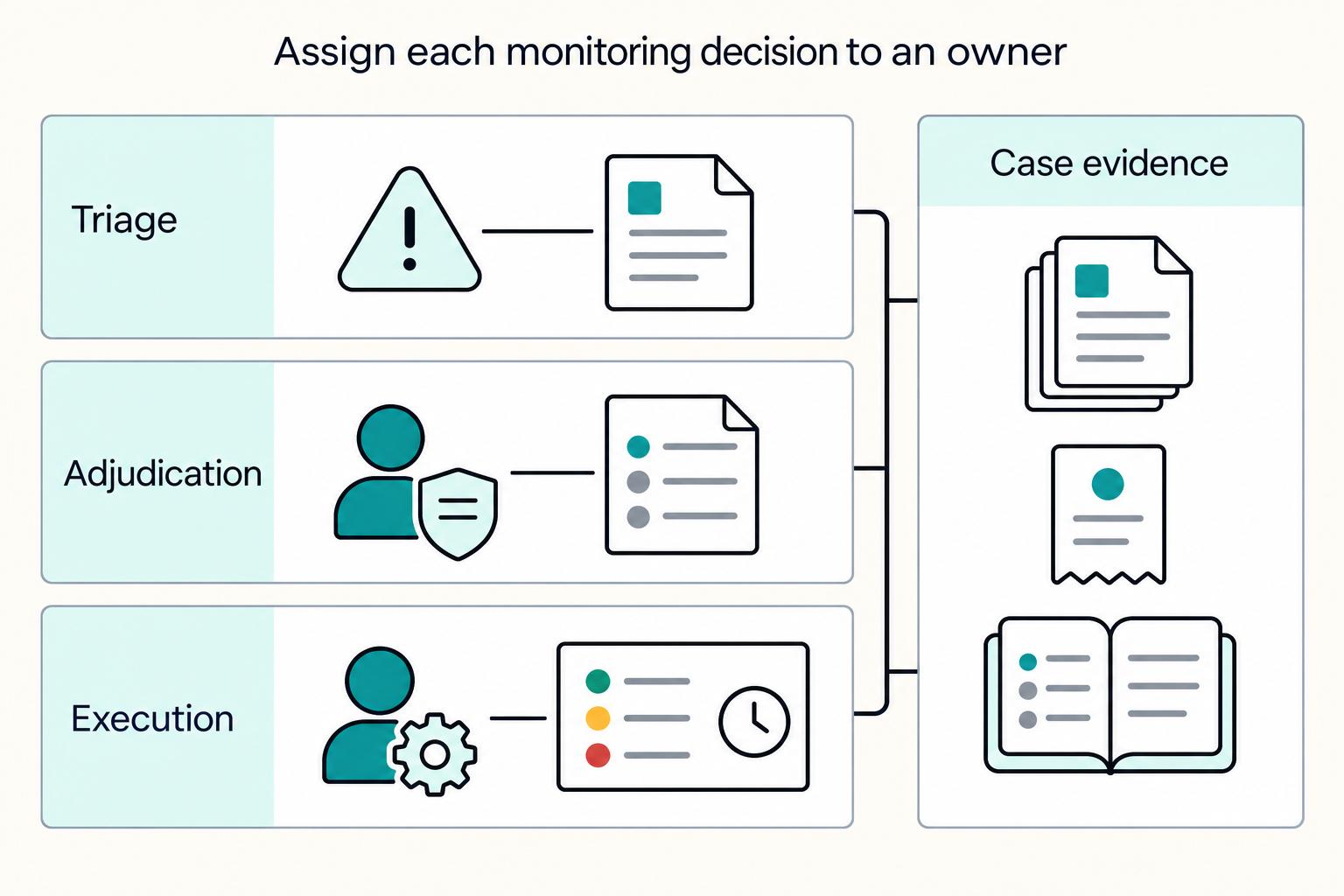
Assign explicit ownership at each decision point. If a case can be held, escalated, or released without a clearly assigned owner, control quality can fall as alert pressure rises.
Transaction monitoring alerts are reviewed by compliance analysts, and some cases may require reporting to a competent Financial Intelligence Unit under local rules. That works best when authority and escalation paths are clear in policy and in case records.
Step 1 Assign one owner to each stage#
Define ownership by stage in written policy. A practical internal split is triage, adjudication, and release execution, with legal input when reporting decisions are unclear.
Keep handoffs simple: complete, escalate, or return for missing evidence. Operations executes authorized outcomes, while suspicious-activity judgments stay with the designated risk/compliance owner. Verification point: sample held payouts and confirm each state change has a named role, timestamp, and decision basis.
Step 2 Require a minimum case packet before adjudication#
Do not let adjudication start without a standard case packet. For consistency, include alert context, relevant user or account history, and supporting audit-trail evidence.
The goal is reproducibility. A second reviewer should be able to reconstruct the decision from the record, not from side conversations or screenshots.
Step 3 Define forced escalation triggers for specialist review#
Do not rely only on reviewer discretion. Define policy triggers that force specialist review when risk indicators are elevated or when a case may require suspicious activity reporting under local rules.
Reserve legal override for true edge cases or reporting uncertainty. Keep the core suspiciousness judgment with risk adjudication. Verification point: each forced escalation should include a reason code and linked evidence.
Step 4 Control the queue when reviewer capacity drops#
When queue load rises and reviewer capacity is constrained, make a deliberate temporary policy adjustment instead of letting unresolved holds accumulate. Use risk-based prioritization so reviewers focus on higher-risk cases first.
This may slow some payouts in the short term, but it is usually more defensible than inconsistent decisions from a growing backlog. Supervisors scrutinize threshold calibration and suspicious activity reporting quality, so controlled, time-boxed queue controls are easier to defend than unmanaged backlog growth.
Track the metrics that prove you protected speed and control quality#
Track speed and control quality together, or you will optimize the wrong thing. If you only watch total alerts, false positives can consume review capacity while real risk slips through.
Step 1 Build one scorecard with paired risk and speed measures#
Use one scorecard for a consistent time window that shows both control pressure and payout impact. At minimum, track alert volume, false-positive trend, review turnaround, hold duration, and payout completion time by payment rail and cohort. Keep rail-level views instead of relying on platform-wide averages.
| Metric | Break out by | Why it matters |
|---|---|---|
| Alert volume | payment rail, cohort, control type | Shows where review load is created |
| False-positive trend | rule family, reviewer outcome | High noise weakens detection quality |
| Review turnaround | team stage, payment rail | Surfaces manual bottlenecks before holds pile up |
| Hold duration | payment rail, reason code | Shows direct payout delay, which can extend to a few days for flagged transactions |
| Payout completion time | payment rail, cohort | Shows whether release speed changed |
Verification point: confirm each metric comes from the same source of truth as case management. Monitoring systems can capture amounts, timestamps, locations, counterparties, and customer profiles, but those fields only help if they map cleanly to payout and case records.
Step 2 Split results by cohort and control type#
Do not tune from blended averages. Break the scorecard out by cohort and control family so changes stay targeted.
Separate rule families instead of treating everything as one bucket. If one rule family generates most alerts with few escalations, that can indicate noise. If one cohort drives most holds on one rail, avoid tightening the whole program when the issue is concentrated.
Step 3 Add a checkpoint after every rule change#
Treat every rule edit as a measured change, not a guess. Record a pre-change baseline, log exactly what changed, measure the post-change delta over a comparable period, and manually review an exception sample.
Sample both released and held payouts. Verify the trigger fired as intended and the final decision aligns with policy. If the metrics look better but the sampled decisions are weak, keep tuning before you adopt the change.
Step 4 Keep oversight reporting short and evidence-backed#
For board or regulator review, keep reporting to four points: what changed, why it changed, what happened to risk exposure, and what happened to payout latency.
Use case management outputs and regulatory reporting artifacts to support the narrative. Include representative case IDs or reason-code examples so the result shows real decision quality, not just cleaner charts.
Tune rules continuously with simulation and shadow mode#
Do not move major AML rule edits straight into enforcement. Use a sequence of simulation, then shadow mode where available, then promotion only when alert quality improves without unacceptable missed-risk drift.
Step 1 Test major edits in simulation before enforcement#
Start with replay across recent, rolling windows instead of a single static backtest. Rule-based AML controls rely on predefined rules and enforcement thresholds, and fixed thresholds can become miscalibrated as transaction conditions change.
Use forward-looking and rolling evaluation as the checkpoint before promotion. Compare the proposed rule or threshold against the current production rule on the same cases, and confirm the test can be tied back to real case outcomes. If the replay cannot be linked to outcomes, treat the result as insufficient evidence for promotion.
Step 2 Prioritize the noisiest rules first#
When false positives are eating review capacity, tune the noisiest rules first. Focus on rule families with high alert volume and repeated dismissals so you reduce operational drag where it is largest.
Keep the tradeoff explicit. False negatives can let illicit activity proceed, while false positives add investigative burden and compliance costs. Do not optimize only for fewer alerts. If counts fall but decision quality does not improve, or sampled outcomes raise new uncertainty, revise and retest.
Step 3 Run shadow mode with explicit promotion criteria#
After simulation, run the revised rule in shadow mode when your environment supports it so you can observe live behavior before changing production enforcement. This matters because strong static classification metrics can overstate real-world AML effectiveness.
Define promotion criteria in advance. Promote only when shadow results show lower false-positive pressure and no unacceptable missed-risk drift in case sampling. If speed improves but risk capture becomes unclear, keep the rule in shadow and revise it.
Step 4 Keep a defensible change log tied to outcomes#
Every material rule change needs a defensible record. At minimum, log the rule or version, old and new thresholds, rationale, simulation and shadow windows, observed alert-volume and false-positive changes, reviewer notes, and the promotion decision.
Tie this record to the audit trail so the decision path is reconstructable. If someone questions the change later, you should be able to show what changed, why it changed, what evidence supported it, and when enforcement behavior changed.
Related reading: Continuous KYC Monitoring for Payment Platforms Beyond One-Time Checks.
Fix the failure modes that repeatedly slow payouts#
Payout friction often traces back to repeat issues in your own data and workflows: overbroad rule scope, duplicate event intake, and mixed AML versus document holds. Fix those first, and validate the results against your own case history.
| Issue | First action | Check |
|---|---|---|
| Overbroad rules | Narrow scope before adjusting thresholds again | Re-test against the same historical cases and tracked scenarios |
| Duplicate event intake | Test idempotent retries and event deduplication before case creation | The same event sent twice should produce one case path, not parallel case work |
| AML and document holds | Keep AML review separate from document-driven holds | Use distinct hold reasons for operators and payees where appropriate |
Step 1 Narrow overbroad rules before tuning thresholds again#
If a rule repeatedly catches routine behavior, narrow scope first before you adjust thresholds again. Re-test the narrowed version against the same historical cases, and include the scenarios your program already tracks. Promote it only if you can still explain how those scenarios surface.
If that traceability is unclear, keep the rule in testing and document the decision in the change log.
Step 2 Stop duplicate events from creating duplicate case work#
If your logs show provider webhook resends or client retries, treat idempotent retries and event deduplication as controls to test before case creation. Validate with replay: the same event sent twice should produce one case path, not parallel case work.
Treat clusters of near-identical cases with the same payout IDs or provider references as intake hygiene issues to fix before you do more rule tuning.
Step 3 Separate AML holds from document holds#
Keep AML review separate from document-driven holds, with distinct hold reasons for operators and payees where appropriate.
According to the FFIEC suspicious activity reporting section, a credible monitoring program has to support investigation and escalation, not just alert generation.
- Regulatory baseline: Use the FFIEC suspicious activity monitoring appendix to test whether a rule belongs in inline monitoring, timed hold, or specialist review.
- Program governance: According to the FFIEC compliance-program section, staffing, independent testing, and case review standards need to move with the rules.
- Technology change control: Use FATF's new-technology guidance when automation changes signal sources, timing, or review expectations.
- Coverage map: Record which market, rail, and user cohort each rule actually touches.
- Release gate: Do not promote a rule until simulation results, reviewer capacity, and escalation ownership are written down.
- Case packet: Keep the trigger, evidence, next owner, and disposition rationale on one record.
In 2025 and 2026, review whether a change that lifts same-day holds from 2% to 6% or treats a 500 USD payout like a 10,000 USD cross-border batch is really improving case quality. If not, you added queue debt, not control quality.
Apply this inside Gruv without overpromising coverage#
Use Gruv as a market- and program-specific control surface, not as a blanket AML claim. If a gate is not enabled and testable on a given path, do not present it as coverage.
Step 1 Apply controls only where the program is enabled#
Start with a market-by-market readiness gate, then publish policy language only for the paths that are live. State KYC or KYB, AML holds, and payout status controls only where enabled, and include VBA or MoR only when those routes are in scope.
A control that works in one country can fail in another. If you are asked for one global statement, use the narrower claim you can defend.
Step 2 Ensure each payout decision can be reconstructed#
For each held or released payout, keep the record traceable from request to provider reference to ledger journals and audit trail. Treat payout batches as higher risk for fragmented records across onboarding, support, and payout systems.
Before rollout, test one real or sample batch item end to end and confirm you can rebuild why it was released, held, or escalated. If the provider reference exists but the journal or audit-trail state is missing, treat the record as incomplete.
Step 3 Confirm ownership on one escalation path before expanding claims#
Before you expand claims, validate one end-to-end escalation path with your banking partner and name the decision owner at each point. If ownership is unclear around exceptions or fund release, responsibility can increase when funds still move after warning signs.
Keep published wording qualified: controls apply where enabled, and coverage varies by market and program. That is safer than implying uniform coverage you cannot reconstruct later.
Conclusion#
Launch or reset the program with this checklist, and resist the urge to add more rules to cover control gaps. Rising alert volumes, stricter regulation, limited investigator capacity, and high false-positive rates can quickly turn monitoring into operational friction.
- Confirm the baseline controls your program treats as non-bypassable, based on market and program requirements.
Define this by market, program, and transaction flow, not as a generic policy line. Test one case and prove which checks ran before decision logic acted.
- Publish the decision matrix for clear, hold, and escalate outcomes, with named owners.
For each trigger, document the action, decision owner, and evidence required to move forward or close the case. If ownership is unclear, alerts stall even when detection is working.
- Standardize investigation workflows before you scale.
Treat this as an operational control. Run repeat-case tests and confirm one outcome, one case state, and one decision path.
- Maintain clear case evidence for every high-risk decision.
You should be able to reconstruct why the alert fired, who reviewed it, what decision was made, and what transaction state changed. If that chain is missing, you are relying on memory instead of records.
- Track speed and risk metrics by segment, then tune thresholds in controlled rollouts.
Track alert volume, false-positive trend, and analyst review time for the affected cohort. Threshold calibration should stay explainable because supervisors are closely reviewing scenario logic, threshold setting, and suspicious activity reporting quality.
- Reconfirm market and program coverage, plus escalation boundaries, before policy expansion.
Recheck this whenever you add a corridor, user type, or flow. Confirm legal, compliance, and operations agree on when a case stays internal, when it moves to specialist review, and what reporting path applies if suspicion is sustained.
This sequence keeps the focus on risk-based prioritization and defensible decisions, not queue growth.
If you want to pressure-test this framework against your actual markets, rails, and escalation ownership model, talk to Gruv to confirm what coverage is supported for your program.
Frequently Asked Questions
How can platforms add AML rules without slowing payouts?
Start with checks that are straightforward to automate, then add behavior rules where your transaction data is reliable. Focus monitoring on attributes such as transaction size, frequency, and counterparties, and route alerts to analysts for judgment calls. Real-time monitoring can reduce manual workload and improve throughput and legitimate approval rates when alert handling is clearly defined.
What minimum controls must exist before we call a monitoring program credible?
A credible baseline includes ongoing transaction monitoring, alert generation, analyst review, and a documented path to report suspicious activity to the competent FIU through SAR or STR processes where local rules require it. As an internal check, you should be able to pull one alert and show why it fired, who reviewed it, and what decision and record followed.
What usually causes payout delays after new AML rules go live?
Common delay drivers include excessive false positives, fragmented customer or transaction data, and outdated systems that increase manual work. Compliance ownership gaps can create the same effect when alerts are generated but review accountability is unclear. If backlog rises right after launch, test for rule noise and data fragmentation first.
When should we auto-release versus hold versus escalate a payout?
Use your own risk framework and local regulatory requirements, and keep the logic explicit. A common pattern is to release when monitoring shows no meaningful concern, hold when an alert needs analyst review or secondary validation, and escalate when suspicious patterns require specialist judgment. The key is documented reasoning at each step, not undocumented judgment.
Which metrics matter most for proving rule changes worked?
Track both control and speed outcomes: alert volume, false-positive trend, manual review workload, throughput, and legitimate approval rates. Compare baseline versus post-change results, then manually review a sample of exceptions to confirm quality. If throughput drops but case quality does not improve, the change is not delivering net value.
How often should we retune rules, and when is shadow mode mandatory?
The article does not support a universal retuning cadence or a universal legal requirement for shadow mode. Retune when operating signals shift, such as rising false positives, backlog growth, or transaction-mix changes. If you run shadow mode, treat it as an internal testing control rather than a legal default.
Researched and edited by the Gruv editorial team. Gruv builds cross-border billing, payouts, and finance-operations software for global businesses.
Sources
Includes 2 external sources outside the trusted-domain allowlist.
Educational content only. Not legal, tax, or financial advice.
Related Posts

The Freelance Payment Penalty: A Modeled Audit of Platform Fees, FX Spreads, and Payout Delays
The money rarely disappears through a single, easy-to-spot fee. The real loss is stacked. A marketplace takes its commission, a processor adds a charge for international cards, a bank or payment company converts the currency at a spread, a platform holds the funds before release, and a wire sheds a little to intermediaries on the way in. Each layer looks defensible on its own, but the worker feels the combined result as a smaller deposit and a later payday.

How to Respond to a Subpoena for Business Records
Move fast, but do not produce records on instinct. If you need to **respond to a subpoena for business records**, your immediate job is to control deadlines, preserve records, and make any later production defensible.

A US Expat's Guide to Investing in UCITS ETFs to Avoid PFIC Issues
The real problem is a two-system conflict. U.S. tax treatment can punish the wrong fund choice, while local product-access constraints can block the funds you want to buy in the first place. For **us expat ucits etfs**, the practical question is not "Which product is best?" It is "What can I access, report, and keep doing every year without guessing?" Use this four-part filter before any trade: