
Quick Answer
A payment stack build vs buy decision should be based on total cost of ownership across the full payment lifecycle, not just tool price or checkout speed. Compare one-time implementation, recurring operating work, opportunity cost of delay, integration burden, compliance operations, and post-launch exception handling. Then validate the model with evidence, downside scenarios, and a time-boxed pilot before choosing Build, Buy, or Hybrid.
How to Compare Build vs Buy for Your Payment Stack#
Use this guide to make a build-vs-buy payment stack decision as an ownership decision, not a tooling debate. The goal is a recommendation that finance, operations, and product can defend with evidence.
The scope here is intentionally end to end, not just checkout. A payment stack is the services, systems, and software used to accept and process payments. In practice, that boundary can include accepting, processing, settling, and reconciling payments across markets and methods. If you scope only the front end, you can undercount both ownership cost and dependency risk.
That boundary matters because the failure modes are operational, not theoretical. Single-acquirer dependency can stop payments during an outage, and scaling teams often need multiple payment service providers across methods or markets. In practice, resilience can require traffic spread across multiple MIDs and acquirers, while finance and ops still need a clean path to reconcile payments.
The model here is total cost of ownership, not a feature checklist. You are comparing implementation effort with ongoing ownership work, including the non-coding responsibilities that show up after launch. Building can reduce some direct costs in some cases, but it does not remove ownership cost. Buying can reduce engineering lift, but it can shift effort into integration work and platform dependence.
Treat the decision as auditable. Score options with weighted criteria such as time-to-value, risk, integration, economics, and lock-in. Then run a time-boxed proof with one real workflow slice, one hard integration, and one measurable outcome before you finalize the call.
By the end, you should have three usable outputs: a defendable recommendation - Build, Buy, or Hybrid - an economics view that includes operational ownership, and a practical implementation sequence. If you are using this as a calculator, aim for a narrower decision with explicit scope, assumptions, and checkpoints, not false certainty.
For a step-by-step walkthrough, see How to Build a RegTech Stack for Payment Platforms: Tools and Vendors by Compliance Function.
At a glance comparison of build vs buy for payment operations#
Estimate delivery time from the scope, available team, required integrations, and provider onboarding. Buying can shorten development, but migration and production approval can still determine the launch date. Compare dated plans for all three options rather than borrowing a generic software timeline.
| Criteria | Build | Buy, using Software as a Service (SaaS) | Hybrid |
|---|---|---|---|
| Cost shape | Often more internal effort upfront | Often lower upfront build effort, with recurring vendor spend | Split cost across internal build and vendor fees |
| Control | Higher internal control | Lower control, bounded by vendor roadmap/config | Control on selected critical components |
| Time-to-market | Estimate from staffed development and approval plan | Estimate from integration, onboarding, and migration plan | Estimate each side and the dependencies between them |
| Integration burden | Internal team owns architecture and ongoing changes | Vendor integration is still required | Shared burden across internal and vendor boundaries |
| Risk ownership | Primarily internal | Shared between internal team and vendor | Shared, with ownership boundaries defined upfront |
Treat payment-specific controls as evaluation tasks for each option. Require a sample journal trace, a duplicate-event test, a reconciliation export, and clear recovery ownership; the labels Build, Buy, and Hybrid do not establish those capabilities.
Scope the calculator before you touch formulas#
Start with scope, not formulas. If you blend lifecycle stages, optional modules, and manual work into one total, the calculator can look precise while still leaving a decision gap. Pair the number with a clear next action, or clearly flag what evidence is still missing.
Map costs to your real operating flow#
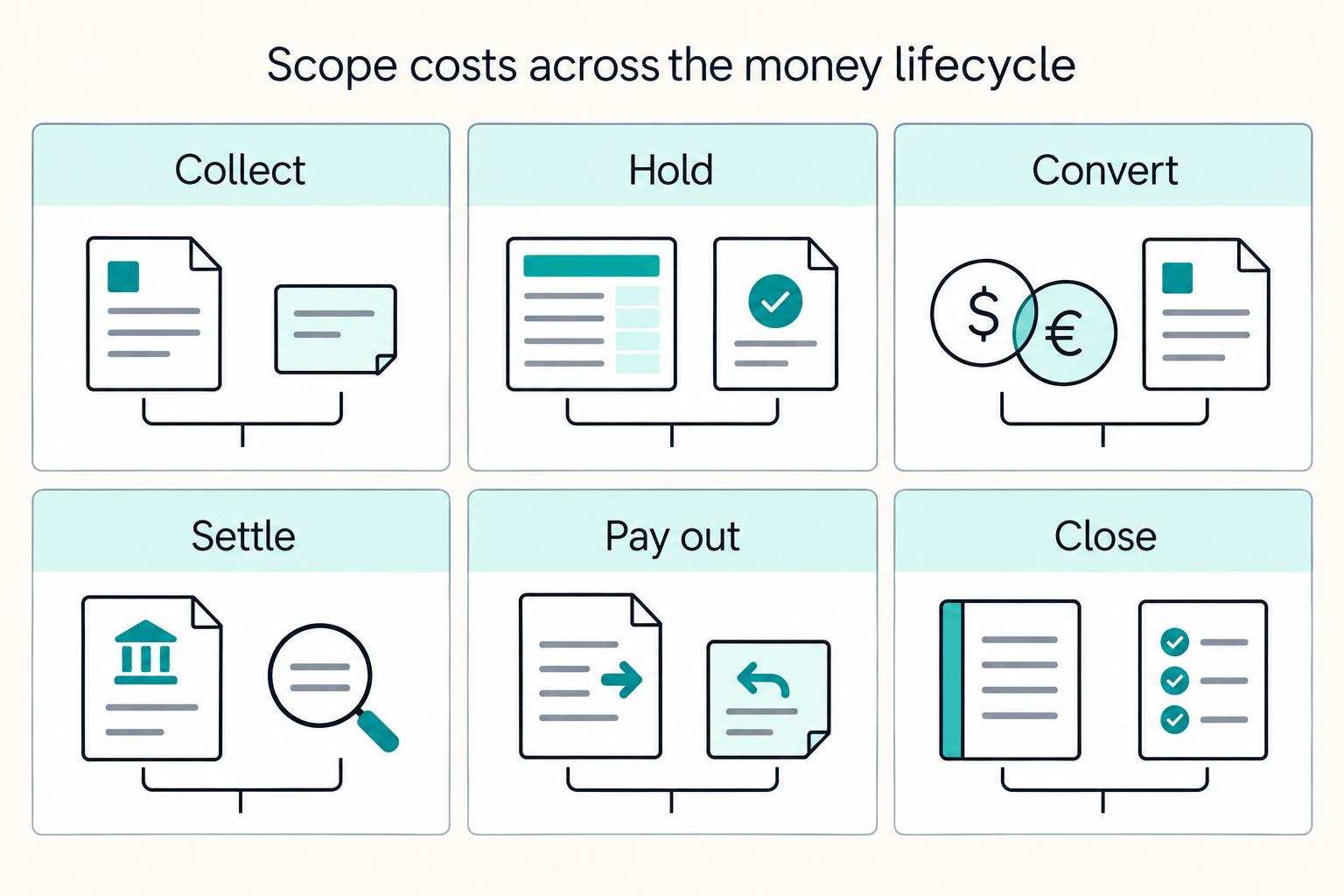
Use lifecycle stages that match how your team actually runs payments. The stages below are a working example, not a universal standard.
| Lifecycle stage | Cost and effort to capture | Verification checkpoint |
|---|---|---|
| Collect | setup work, invoicing/payment-request handling, support touches | current payment methods, manual invoicing steps, DSO direction if collections are in scope |
| Hold | balance monitoring, approval/review steps | where balances are tracked and who intervenes |
| Convert | conversion handling, exception review | how decisions are recorded and checked |
| Settle | settlement matching, reconciliation work, missing-funds cases | reconciliation lag and unmatched items |
| Pay out | payout prep, returns handling, investigation effort | exception and retry patterns, ownership |
| Close books | journal mapping, reconciliation review, close tasks | close checklist, open exceptions, manual mapping steps |
Split one-time build from recurring run cost#
Keep implementation costs separate from ongoing run costs from day one. Then map each line item to an owner team - engineering, finance ops, risk, support. If a line has no owner, it may be missing, duplicated, or too vague to trust.
Require evidence for major assumptions#
Do not treat exception rates, manual touchpoints, onboarding steps, or reconciliation lag as assumption-only inputs. Attach an artifact for each major input, for example a report export, working sheet, ticket sample, or close checklist. Formula-only models often miss operational effort, and manual spreadsheet or invoicing workflows are a common source of errors and slower collections.
If collections are in scope, track DSO direction. You do not need a universal benchmark here. You need a directional signal, because higher DSO is an early warning.
Lock scope before pricing debates#
Set in scope, out of scope, and optional before you compare build and buy scenarios. Model optional modules as separate toggles or separate scenarios, not hidden inside the base case. If a major assumption lacks evidence, use a range instead of a single-point estimate.
You might also find this useful: How to Embed Payments Into Your Gig Platform Without Rebuilding Your Stack.
Build-side TCO model with transparent assumptions#
A build case is not approval-ready until it separates one-time cost, recurring cost, and opportunity cost. Models become unreliable when adoption ramp, ongoing monitoring, and late-found exception work are treated as technical details instead of priced obligations.
Use formulas that finance can audit#
Use explicit formulas, and map every variable to a real payments activity with a named owner. That is what makes the model auditable.
| Metric | Formula |
|---|---|
| One-time implementation cost | internal labor + external implementation help + infrastructure setup + integration work + test and migration work + documentation and training |
| Recurring annual build cost | maintenance engineering + monitoring and alerting + incident response + finance ops exception handling + support load + infrastructure and tooling |
| Break-even analysis | first period when cumulative Build costs, including incremental delay effects, are less than or equal to cumulative Buy costs over the same scope and horizon |
| ROI | (Benefits - Costs) / Costs |
The formulas are the easy part. Variable mapping is what makes the model credible. For payments, include integration and reconciliation design, reporting outputs, finance ops UAT, and first close-cycle support after launch. Recurring cost should also include monitoring, correction work, and support when the operational and accounting views drift.
As a starting point, use 4–8 weeks of baseline data, then include additional periods if seasonality or rare incidents materially affect costs. Keep this as a planning choice rather than a minimum that guarantees representative data.
Add the Time-to-market penalty up front#
Model Time-to-market delay explicitly. Build value typically does not start on day one of development.
Opportunity cost of delay = incremental contribution or process savings forgone during the launch slip. Record interim operating costs in the cost model once; do not count the same manual labor again as both ongoing cost and lost savings.
Keep this directional but explicit. If collections, settlement matching, or payout prep stay manual longer, price the added operator hours and support touchpoints for that window. If a product launch depends on payment capabilities, model deferred revenue contribution as a range, not a single-point claim. Include adoption ramp and ongoing monitoring cost rather than assuming full day-one value.
Back this layer with dated, inspectable artifacts: reconciliation worksheets, exception tickets, close checklists, manual adjustment counts, and timing for current invoicing or collection steps. If an input has no artifact, mark it as weak evidence and model a range.
Price reliability work as first-class scope#
If you do not price reliability work, your build model is underpriced. For payment systems, common reliability scope includes idempotency controls, replay-safe webhooks, retry handling, and correction paths.
Weak monitoring leads to manual reconciliations and late-detected failures, which creates recurring load for engineering and finance ops. Price both build and run effort for:
- duplicate-event protection and replay handling
- webhook retry behavior and dead-letter review
- correction logic, approval steps, and audit trail
- alerting and monitoring for late or missing events
Validate with evidence, not just narrative. Ask for duplicate-event test results, replay logs, retry outcomes, and a sample correction path from source event to corrected journal entry.
Stress test assumption fragility#
Test best, base, and worst assumptions before approval. A build case should hold outside the best narrative.
| Scenario | Launch timing assumption | Adoption and automation capture | Reliability and exception burden | Decision signal |
|---|---|---|---|---|
| Best | build lands on planned date | expected automation benefits show up quickly | low manual review after launch | build may clear break-even if control benefits also matter |
| Base | modest slip from plan | benefits ramp gradually | recurring monitoring and correction work persists | approve only if break-even still holds with evidence-backed inputs |
| Worst | meaningful launch delay | process savings arrive late or partially | high late-found failures and manual reconciliations | do not approve pure build without narrowing scope or shifting to hybrid |
For an illustrative three-year comparison, suppose Build costs $100,000 upfront and $60,000 per year to operate, while Buy costs $20,000 upfront and $100,000 per year including vendor and retained internal work. Build totals $280,000 and Buy $320,000. With simultaneous launch and flat costs, Build recovers its extra $80,000 upfront through $40,000 annual savings after two years. These are hypothetical inputs, not vendor quotes; add differences in processing fees, launch delay, adoption, and exit costs before using the result.
Approve build only when the base case clears break-even, the worst case is operationally survivable, and reliability work has named owners with evidence. If not, move the next model to buy or hybrid based on integration maturity. Related: How to Build a Finance Tech Stack for a Payment Platform.
Buy-side TCO model without vendor blind spots#
A buy-side model is only credible when it prices more than the headline vendor fee. The usual miss is fee mix, payout economics, integration drag, and compliance operations that can remain with your team.
Break out recurring cost by pricing shape#
Do not collapse vendor spend into one processing line. Separate fee shapes because each scales differently and shifts break-even in different ways.
| Pricing shape | What drives spend | Grounded example | What to verify before modeling |
|---|---|---|---|
| Platform or account fee | Number of active accounts or platform-level subscription | U.S. Stripe Connect “You handle pricing”: $2 per monthly active account, checked October 3, 2026 | Confirm what counts as active. For Connect, an account is active in any month when payouts are sent to its bank account or debit card. |
| Transaction fee | Successful payment volume, payment method, and geography | U.S. Stripe standard online domestic cards: 2.9% + 30¢ per successful transaction | Recheck current provider fee schedules during selection; pricing can vary by country and payment method. |
| Payout fee | Number and size of payouts | U.S. Stripe Connect “You handle pricing”: 0.25% + 25¢ per payout sent | Model your real payout cadence, because timing changes unit economics. |
| Add-on or overage fee | Subscriptions, local methods, and advanced features | U.S. Managed Payments: 3.5% per successful transaction in addition to Payments fees | Verify the selected product and quote; add applicable Billing and other product fees separately. |
| Funds routing and platform management | Payout volume under the selected Connect pricing model | U.S. Connect “You handle pricing” also lists 0.25% of payout volume for this category | Check whether this category and other fees apply to your integration; do not assume the payout fee is the full Connect cost. |
For a U.S. pricing example checked on October 3, 2026, Stripe’s standard pricing lists 2.9% + 30¢ for successful domestic online card transactions, with +1.5% for international cards, +0.5% for manually entered cards, and +1% when currency conversion is required. Apply the fees to your actual mix and quote; country, product, and custom-contract pricing can differ.
Add the integration and migration work that "quick start" hides#
Buying can reduce engineering load, but it does not remove integration and migration work. Price migration planning, system mappings, and reconciliation checks that prove mappings are correct.
The recurring risk is integration tax: brittle integrations, reporting mismatches, and manual reconciliation when systems drift. Keep this grounded with concrete artifacts such as a migration plan, field mappings, and a close-cycle tie-out of deposits, fees, payouts, and ledger outputs.
Keep compliance ops in the model even when you buy#
Buying infrastructure does not automatically remove compliance operations. Where those workflows remain with your team, include policy setup, case review time, and escalation handling as recurring operating cost with named owners.
State the tradeoff directly: lower engineering burden can increase vendor dependency and constrain change control. If your operating model changes frequently, include that constraint in buy-side TCO rather than modeling only lighter build effort.
Use real account counts, transaction mix, payout cadence, integration checkpoints, and named compliance ownership before approving the buy case. If those inputs are weak, treat the model as incomplete.
Related reading: How to Build a Payment Health Dashboard for Your Platform.
Hidden costs that usually flip the decision#
The cost that usually changes the decision is post-launch human work: review, rework, monitoring, and evaluation. If your calculator does not price that, your break-even line is probably too optimistic.
The fee model from the previous section needs a second layer. Fees are easier to quote than the operating effort required when exceptions accumulate and teams have to manually verify and correct outcomes.
| Hidden cost area | Build side exposure | Buy side exposure | What to verify before pricing |
|---|---|---|---|
| Adoption ramp | More control, but value can take longer to realize | Faster launch, but adoption still ramps and may not be immediate | Use 4-8 weeks of baseline data and model a realistic ramp |
| Human review and rework | You design and staff escalation and review workflows | Vendor workflows can help, but your team still handles escalations and approvals | Measure error or rework rate, human review rate, and cost per error |
| Ongoing operations after launch | You own recurring usage, monitoring, evaluations, and review operations | Faster implementation does not remove recurring usage, monitoring, evaluations, and review costs | Include post-launch recurring costs in TCO, not just launch costs |
| Strategic risk trade-off | More control can come with delivery risk from long projects | More speed can come with vendor dependency risk | Stress-test both options before committing |
Failure modes are labor costs in disguise#
Treat exceptions and rework as recurring labor, not one-off incidents. A grounded planning pattern is to assume adoption ramps, some work still needs human review, and costs continue after launch. Assign explicit ownership and time for monitoring, triage, and correction in both options.
If your current process already has an exception queue, model a future queue as well. The question is whether it gets smaller and easier to resolve. Use real inputs: error or rework rate and cost per error, for example reprocessing labor, credits, penalties, refunds, or write-offs where relevant.
Measurement drag often appears in cross-team execution#
Build and buy can look similar in a model but diverge in execution once multiple teams share the work. Benefits and costs can be distributed across teams, which makes attribution messy.
You can model this without external benchmarks. Keep checkpoints simple and comparable across options: baseline period, adoption ramp, error or rework rate, human review rate, and cost per error. If attribution is unclear, use conservative assumptions in both models.
Attribution gaps are where ROI models break#
ROI depends on complete inputs, not just headline fees. Before approving either path, require the same minimum input set: baseline, performance, and TCO.
| Evidence item | What to include |
|---|---|
| Baseline snapshot | 4-8 week baseline snapshot |
| Adoption ramp | adoption-ramp assumptions |
| Error and review rates | error/rework and human-review rates |
| Cost per error | cost-per-error assumptions |
| Recurring post-launch costs | usage, monitoring, evaluations, and human-in-the-loop review |
A practical evidence pack can stay lightweight: a 4-8 week baseline snapshot, adoption-ramp assumptions, error/rework and human-review rates, cost-per-error assumptions, and recurring post-launch cost lines (usage, monitoring, evaluations, and human-in-the-loop review). If an option cannot provide this clearly, increase its TCO assumption even when sticker price looks lower.
We covered this in detail in AP Automation ROI Calculator: How to Build the Business Case for Your Finance Team.
Compliance and tax gates that change ROI#
Compliance and tax gates belong in the operating model, not as side notes. If KYC, KYB, or AML reviews slow payout approval, that can show up as lower payout throughput, higher support volume, and more manual follow-up. Projected savings are only credible when the option supports your required markets, entity types, and program setup.
| Gate area | Build side exposure | Buy side exposure | What to verify before sign-off |
|---|---|---|---|
| KYC, KYB, AML reviews | Operational ownership can sit with your team depending on setup | Vendor tooling may reduce engineering lift, but exceptions can still require internal handling | Measure time from profile submission to payout eligibility, plus pass, review, and fail counts |
| Tax-document workflows where enabled | Responsibilities can vary by setup and jurisdiction, including collection and follow-up steps | Vendor tooling can help collect documents, but gaps can still create manual outreach and cleanup | Check document completion and correction rates, and whether exports fit your reporting process |
Before sign-off, require evidence for gate throughput and document handling. Ask for a sample approval log, exception queue aging, and a document evidence pack for enabled tax-document flows. If coverage is unclear, price additional support and manual review into TCO.
Scenario recommendations by operating profile#
Start with the option most likely to survive both upside and downside cases, then prove it with operating evidence. The right choice is the one you can defend when assumptions tighten, not just when the base case looks clean.
| Operating profile | Model first | Why to start there | Verify before approval |
|---|---|---|---|
| Coverage-first profile | Buy first, then Hybrid | Build-vs-buy is a recurring product decision, so start with the option you can pressure-test quickly across best- and worst-case assumptions | Confirm Payout batches, event history, reconciliation outputs, and failure-handling visibility |
| Exception-pressure profile | Hybrid first, then Buy if needed | When scenarios show growing exception handling and reconciliation pressure, test operating resilience before adding custom complexity | Track exception volume, queue aging, retry/replay handling, and mapping into your Ledger journal |
| Control-heavy profile | Hybrid or Build for core controls | If control logic and audit traceability are central to operations, model deeper ownership alongside maintenance overhead | Validate entity-level journal rules, correction paths, approval logs, and maintenance load |
If payout volume is rising while reconciliation headcount is flat, treat that as a trigger to run explicit Buy, Hybrid, and Build downside scenarios rather than assume one model will win. Use this as a scenario-testing order, not an automatic winner.
If your team needs custom control over Ledger journal logic and can absorb longer Time-to-market, include Build in the scenario set instead of treating it as the default answer. Make that call only after modeling downside cases, including ongoing maintenance and event-handling complexity.
A practical Hybrid path can keep core controls in-house while evaluating modules such as Virtual Accounts or Merchant of Record (MoR) only where support is explicitly confirmed for your program. Before approval, define the data boundary, system-of-record events, and the failure boundary. Be explicit about what happens when an external module is late, incomplete, or needs manual correction.
Implementation sequence for a 90 day decision and pilot#
A 90 day decision works best when scope stays narrow, owners are explicit, and decision criteria are set early. Run this as a core decision project on a 30-60-90 cadence, with protected time and a clear end point.
| Phase | Primary goal | Output you should have | Red flag |
|---|---|---|---|
| Day 1-30 | Narrow scope and early tests | One scoped workflow, named owners, and decision criteria for early tests | No protected execution time, so the work drifts into a side project |
| Day 31-60 | Execute one observable pilot | Pilot evidence for one workflow with clear inputs and outputs, plus an integration-risk log | Inputs and outputs are unclear, so impact is hard to observe quickly |
| Day 61-90 | Make and document the decision | Decision memo with a recommended path (Build, Buy, or Hybrid), key assumptions, and a next-step plan | Integration-risk signals are logged but not used in the recommendation |
Lock scope and accountability in days 1-30#
Start narrow and finish this phase with one clear decision boundary. Assign clear ownership for scope and implementation feasibility, and protect execution time so the work does not drift into a side project.
Test one workflow end to end in days 31-60#
Choose one workflow with clear inputs and outputs so impact is observable quickly. Explicitly track integration-risk signals such as point-to-point sprawl and brittle integrations, and use those signals to compare Build, Buy, and Hybrid paths.
Decide on operational evidence in days 61-90#
Close with a memo that makes a recommendation based on pilot evidence. If pilot evidence shows integration maturity is not strong enough to scale, treat that as a decision signal rather than a detail to defer.
This pairs well with our guide on How to Build a Partner API for Your Payment Platform: Enabling Third-Party Integrations.
Decision checklist you can use in a steering meeting#
Leave the steering meeting with one recommendation, not three open options: Build, Buy, or Hybrid, backed by full ownership economics, explicit risk signals, and proof from real operations.
| Checkpoint | Build | Buy | Hybrid | Verify before approval |
|---|---|---|---|---|
| Full lifecycle cost | Undercounted when ownership is treated as development only | Undercounted when the comparison stops at license fees | Undercounted when internal and vendor work overlap | Include implementation, ongoing ownership, support, integration, and compliance-heavy operations |
| Break-even analysis | Not sufficient on its own | Not sufficient on its own | Not sufficient on its own | Review break-even with time-to-value, risk, integration, unit economics, and lock-in |
| Proof artifacts | Show the team can own the hard parts | Show the product handles real edge cases | Show the handoff boundary is clear | Require 1 workflow slice, 1 hard integration, and 1 measurable outcome |
| Final recommendation | Choose when capability is strategic and realistic | Choose when work is mostly context and speed matters | Choose when you must own a narrow control point and orchestrate the rest | Document the triggers that would reopen the decision |
A strong evidence pack should go beyond pricing and architecture slides. Include proof from one real workflow slice, one hard integration, and one measurable outcome, plus clarity on who owns support and compliance-heavy operations. If you cannot show that path, you are still in theory.
Use weighted criteria scoring across Build, Buy, and Hybrid instead of cost alone. Include time-to-value, risk, integration, unit economics, and lock-in together. If an option fails even one diagnostic lens, treat it as unproven until proven otherwise. If your team cannot realistically match the needed capability within two budget cycles, bias toward Buy or Hybrid.
Close with a single line: Build, Buy, or Hybrid, plus the triggers that would change it. That keeps the calculator tied to operating reality instead of spreadsheet optimism.
Before steering sign-off, run your assumptions in the payment fee comparison tool so your model inputs stay explicit.
Conclusion#
The right choice is the one with transparent total cost of ownership, tested assumptions, and explicit risk thresholds, not just the lowest visible price.
Your recommendation should pass two checks at the same time:
- The cost model reflects full lifecycle ownership, not only startup effort or a SaaS line item.
- The operating model still works when payments fail, volume grows, and exception handling increases.
If either side is unclear, the decision is not ready. Publish one clear recommendation, not parallel narratives: Build, Buy, or Hybrid. Tie it to measurable checkpoints: expected TCO, key assumption sensitivities, time-to-market tradeoff, and the risk conditions that trigger a revisit.
Before final sign-off, rerun the checklist against the evidence pack and confirm the model is based on observed work, not optimistic estimates. Startup-cost-only comparisons can mislead, and hidden or rising costs can change the decision over time.
Run one hard risk review. Payment failure can drive involuntary churn, so state the operational fragility you are willing to accept. If build still has unresolved failed-payment recovery risk, shift ownership toward Buy or Hybrid unless there is a clear strategic reason to keep that control in-house. If buy looks cheaper only because transaction fees, add-ons, or scaling limits are missing, do not treat it as cheaper yet.
Practical close-out rules:
- If you cannot explain ongoing operating cost and risk ownership in one paragraph, the model is not approval-ready.
- If break-even moves materially after adding exception and support effort, use the fuller model.
- If Hybrid is still in play, define the boundary clearly: what you own, what you buy, and who signs off.
If scope or market coverage is still uncertain, validate module availability and compliance fit before committing roadmap spend. If your final recommendation depends on market coverage or compliance rollout details, contact Gruv to validate fit before locking roadmap spend.
Frequently Asked Questions
What should a payment stack build vs buy calculator include that generic calculators miss?
Include implementation, ongoing engineering, provider fees, reconciliation, support, compliance operations, incident recovery, and exit costs. Compare the same volume, markets, methods, horizon, and service requirements, with each cost line counted once.
How do I calculate break-even for payment infrastructure without hiding ops costs?
Calculate cumulative costs for each option over the same horizon. Break-even is the first period in which one option’s cumulative cost equals or falls below the other’s, after including upfront and recurring costs and any incremental delay effects. Use the worked example above to check the arithmetic, then test changing volume and launch dates.
Which hidden costs most often make buy cheaper than build?
Maintenance, incident recovery, reconciliation, and support can outweigh a lower headline build cost. Measure retained internal work for Buy too; outsourced processing does not automatically eliminate those tasks.
When does buying still win even if license fees look high?
Buying can still win when speed matters and internal development would take longer while still creating ongoing maintenance work. It can also win when a vendor option covers enough of your required scope with lower internal ownership burden. Do not judge on headline fees alone; compare total operating burden on both sides.
How does time-to-market change total cost of ownership in payments?
A later launch can defer contribution and process savings while interim operations continue. Model the timing difference between options and count each expense or forgone benefit once. Apply an adoption ramp instead of assuming full savings on the first live day.
Should we choose build, buy, or hybrid if we need custom controls and fast launch at the same time?
Hybrid can work when you need custom control in a narrow area but do not need to build everything end to end. Keep ownership boundaries explicit between what you customize and what you buy. Treat hybrid as one viable option, not always the best choice.
Researched and edited by the Gruv editorial team. Gruv builds cross-border billing, payouts, and finance-operations software for global businesses.
Sources
- stripe.com/pricingtrusted
- stripe.com/connect/pricingtrusted
Educational content only. Not legal, tax, or financial advice.
Related Posts

The Freelance Payment Penalty: A Modeled Audit of Platform Fees, FX Spreads, and Payout Delays
The money rarely disappears through a single, easy-to-spot fee. The real loss is stacked. A marketplace takes its commission, a processor adds a charge for international cards, a bank or payment company converts the currency at a spread, a platform holds the funds before release, and a wire sheds a little to intermediaries on the way in. Each layer looks defensible on its own, but the worker feels the combined result as a smaller deposit and a later payday.

How to Respond to a Subpoena for Business Records
Move fast, but do not produce records on instinct. If you need to **respond to a subpoena for business records**, your immediate job is to control deadlines, preserve records, and make any later production defensible.
A US Expat's Guide to Investing in UCITS ETFs to Avoid PFIC Issues
The real problem is a two-system conflict. U.S. tax treatment can punish the wrong fund choice, while local product-access constraints can block the funds you want to buy in the first place. For **us expat ucits etfs**, the practical question is not "Which product is best?" It is "What can I access, report, and keep doing every year without guessing?" Use this four-part filter before any trade: