
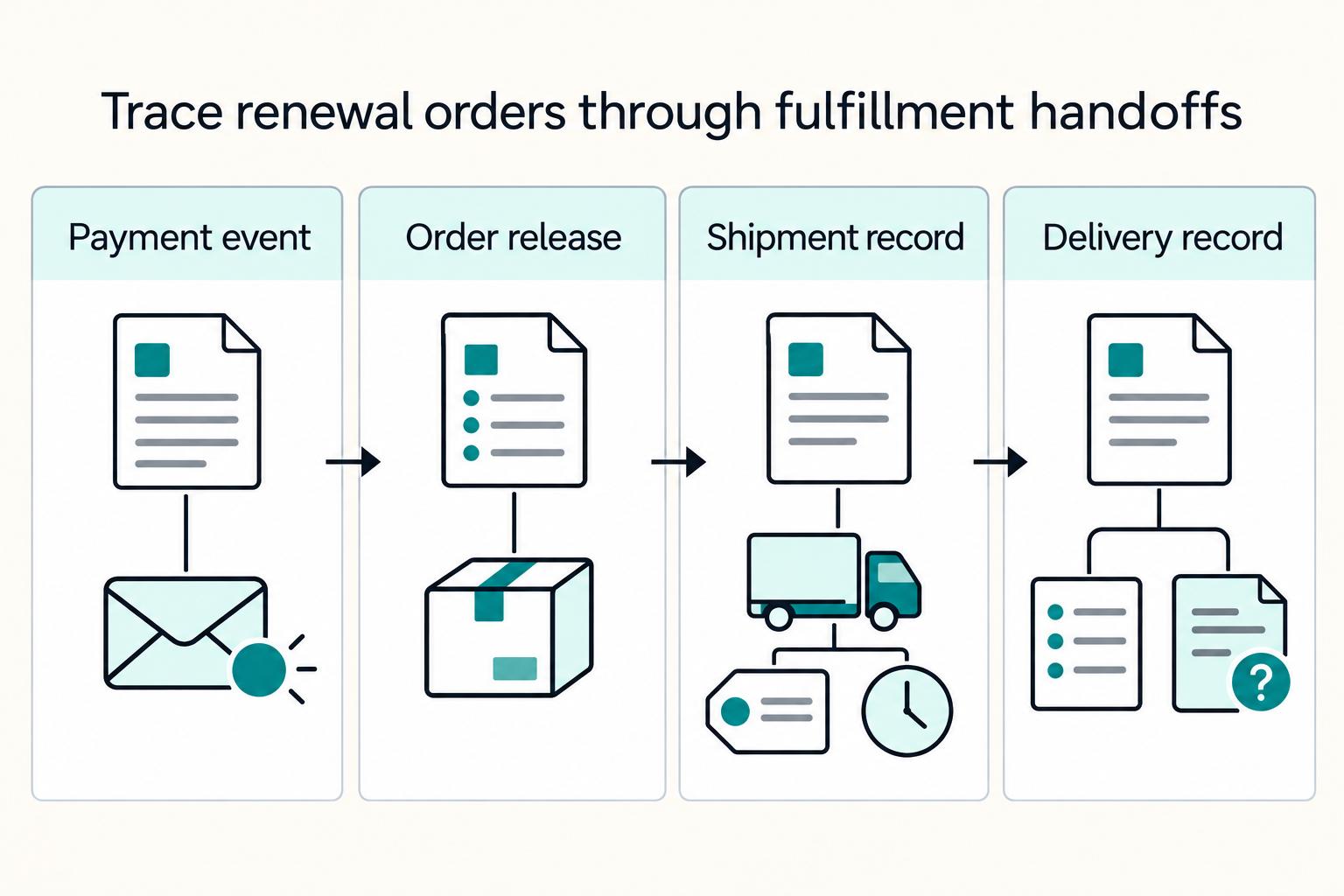
Use a weighted market gate before launch. For each country, score payment acceptance, billing complexity, fulfillment reliability, and churn controllability, then assign confidence from High to Very low based on evidence quality. Require proof that one cycle can be traced from Shopify `SubscriptionBillingAttempt` to Order status and `OrderCancelReason`. If two critical controls are still unproven, run a constrained pilot instead of a full rollout.
Subscription box launch decisions should start with execution risk, not growth headlines. Growth is real, but so is pressure on retention. Stripe reports recurring payment volume is growing 16% faster than one-time payment volume, while 43% of leaders expect churn to rise and 72% are worried about churn hitting the bottom line.
That's the frame for this guide. A DTC subscription box is an operating chain: recurring payment attempts, billing rules, delivery promises, exception handling, and churn controls. When one link breaks, customers feel it through failed renewals and broader service friction.
Billing and delivery are also more tightly coupled than early plans often assume. In Shopify subscription mechanics, a billing cycle is a scheduled interval where a subscription contract attempts to bill for a set of items, and that contract carries a recurring billing and delivery policy. So market entry decisions cannot rest on payment acceptance alone. If you can charge but not ship on promise, or ship but not recover failed renewals, churn and unit economics get distorted early.
This guide is for founders and ops leads deciding where to launch based on what can be operated, not what looks attractive in surface-demand data or vendor feature pages. You will compare markets across four control areas: payment acceptance, billing complexity, fulfillment reliability, and churn controllability. You should leave with three practical outputs:
One early checkpoint matters more than most teams expect: can your team trace one planned billing cycle from charge attempt to shipment handoff to final customer outcome, including cancellation reason? If not, expansion decisions are not sitting on a reliable operational base. Billing systems are often treated as the source of truth for revenue metrics, but in subscription operations they also need to support churn analysis and accountability.
A common failure mode is treating churn as a late-stage retention problem instead of a launch-design input. Recurly defines involuntary churn as customer loss tied to payment or processing issues rather than customer intent. The practical response is to use retry logic and dunning campaigns to recover failed payments. Without those controls, failed payments can cascade across retention and planning.
The sections that follow turn that into a working decision method: set operating scope first, build the evidence pack second, then compare tools, markets, and rollout options.
Related reading: Subscription Revenue Forecasting for Platform Teams Modeling MRR Churn and Expansion.
Define the exact operating unit first, or tool comparisons can hide real risk. Start with one subscription box model in one target market, then test whether billing, payment method coverage, fulfillment promises, and churn measurement work for that unit.
Set a narrow operating unit so constraints are visible instead of averaged away. In practice, this can mean one cadence, one country, one currency path, and one fulfillment promise.
This keeps payment reality in view. Stripe says payment method support varies by country, currency, product, and API options. It also flags country-specific requirements tied to local payment methods or regulation. If a market needs different rails or billing behavior, treat it as a separate operating decision.
Separate acquisition reporting from operating reporting before you start debating churn. GA4 scopes User acquisition to new users and Traffic acquisition to sessions, and Google says those metric values should not be compared directly across reports because the scopes differ.
Use acquisition reports for channel performance, and use churn metrics for subscriber loss over a defined period. If you review early retention, treat GA4's first-42-day return view as context, not as your subscription operating ledger.
Lock one source of truth before you compare Shopify subscription apps or SaaS vendors. Use one harmonized view for billing events, fulfillment status, and cancellation reasons.
In Shopify, SubscriptionBillingAttempt captures billing execution, including payment transactions and billing errors, and a successful attempt creates an Order. The Order object links payment and fulfillment data, and OrderCancelReason provides a cancellation reason field. Validate the chain now: billing attempt, created order, fulfillment status, and cancellation reason if the cycle fails. Also confirm data retention early, since default Order access is limited to the most recent 60 days unless expanded permissions are granted.
This pairs well with our guide on B2B SaaS vs B2C Subscription Billing and Churn Differences That Drive Operations.
Build this pack to prove your operating model works in a real market, not just on vendor pages. Make unknowns explicit before leadership starts treating them as solved.
Your market evidence pack should confirm that you can actually charge in each target jurisdiction from your operating country or region. Stripe makes this gate clear: support starts with your own country or region, and payment-method support varies by country and presentment currency.
| Check | What it means | When to validate |
|---|---|---|
| Payment gateway availability | For your operating entity | For each target market |
| Presentment currency | What the customer is charged in | For each target market |
| Settlement currency | What your destination bank account or debit card accepts | For each target market |
| Connected account eligibility | Separate eligibility rules for connected accounts | If you run a platform or marketplace |
| EU invoicing logic | Article 226 required invoice details for VAT purposes | If the EU is in scope |
For each target market, validate:
If the EU is in scope, include local invoicing logic now. Article 226 of the VAT Directive defines required invoice details for VAT purposes, so mark this as either validated or open.
Your operations evidence pack should treat fulfillment as a reliability system, not a plugin choice. Carrier coverage needs revalidation because service lists can change, including restrictions or discontinuations.
| Claim type | Window |
|---|---|
| U.S. damaged or missing contents | 60 calendar days |
| International damaged or missing contents | 21 calendar days |
| Undelivered or lost shipment | nine months |
Document:
Keep SLA wording precise. USPS service standards describe expected delivery timing, and expected dates are not guaranteed outcomes.
Add claims-process readiness checks. FedEx windows are explicit: 60 calendar days for U.S. damaged or missing contents claims, 21 calendar days for international damaged or missing contents claims, and nine months for undelivered or lost shipment claims.
Build the retention evidence pack before comparing tools. Vendor pages can describe features, but they do not define your policy.
Set dunning rules by decline type, since some failures should not be retried automatically. Stripe explicitly notes no retries when no payment methods are available or when the issuer returns a hard decline code.
Then confirm concrete controls for pause and cancel flows, including operator actions and any subscriber self-service path you plan to offer. Recharge's merchant guidance shows pause, cancel, and delete as distinct actions in the merchant portal, so keep those states distinct in reporting. Also separate involuntary churn from voluntary churn so failed-payment loss is not mixed with customer-choice loss. If useful, see A Guide to Dunning Management for Failed Payments.
Finish with an unknowns register written in plain language. For each market, list the unresolved item, why it matters, what evidence closes it, the owner, and the decision impact if it remains open.
Use a strict confidence rule: if billing eligibility, invoice compliance, or exception recovery still depends on "vendor says it's supported," mark confidence as low. That may not be a no-go, but it is not implementation-ready.
Use a weighted go or no-go matrix so operational blockers are visible early, not averaged away by demand optimism. If a market fails payment coverage or has no credible fulfillment SLA path, treat it as no-go until proven otherwise.
Score four blocks: payment acceptance, billing complexity, fulfillment reliability, and churn controllability. Weight by renewal risk, not feature volume. In most launches, payment acceptance carries the most weight because unsupported gateway or business-category coverage is a launch blocker.
| Block | Suggested weight | What must be true | Typical hard stop |
|---|---|---|---|
| Payment acceptance | 35% | Required payment provider is available for your entity country or region, and target checkout currency is supported | No usable payment gateway coverage for the launch market |
| Billing complexity | 25% | Presentment and payout setup works for your plan and entity, invoice obligations are understood, FX costs are acceptable | You need multi-currency billing behavior that your plan or setup cannot support credibly |
| Fulfillment reliability | 25% | You can name the carrier path and the promised SLA, with an exception path for delays, loss, and returns | No credible fulfillment SLA path you would be willing to promise customers |
| Churn controllability | 15% | Failed-payment recovery, pause and cancel controls, and service-issue handling are defined and testable | You cannot separate payment-failure churn from customer-choice churn, or you have no recovery path |
Use a simple 1-5 score per block, then apply weights. Keep the math simple and put the rigor into the evidence attached to each row.
Set disqualifiers before anyone starts comparing totals. Payment gateway availability is one. Verify it with a date-stamped country-level check because provider listings change.
Apply the same rigor to billing complexity. If your launch depends on multi-currency selling on Shopify, you need Shopify Payments plus international sales setup. If your model depends on Multi-Currency Payouts, plan eligibility is also a gate: Basic, Grow, and Shopify plans are not eligible. That affects conversion-cost exposure when customers pay in a different currency.
Attach three artifacts per market row: current provider-availability proof, your plan tier, and proof of intended presentment and payout behavior. If any item is still "vendor says yes," mark confidence low.
Add a confidence label to every row: High, Moderate, Low, or Very low. Scores show direction, and confidence shows evidence quality.
Use growth narratives as context, not proof. If evidence quality is weak, confidence should stay low even when demand looks strong.
For churn controllability, score operational controls, not just retention messaging. Involuntary churn includes failed payments and service issues, so weak dunning, unclear pause or cancel handling, or weak service recovery should lower the score.
Use one hard rule: if critical controls are unproven, pause the full launch and run a constrained pilot. The pilot should close specific unknowns before broad rollout.
As one DTC founder put it: "As we scaled up, the boxes were expensive in and of themselves. So we had to go looking in China for box printing." Treat that as an execution warning: scaling can stall when operating details are unresolved, even when the strategy looks sound.
Do not mark a market as go when the weighted score is high but confidence is mostly low. That is optimism, not readiness. Before moving from scoring to vendor selection, sanity-check your required payment, ledger, and payout controls against Gruv Docs.
Choose architecture by failure ownership, not demo quality. If you cannot name one accountable owner for failed renewals, delayed shipments, duplicate charges, refund timing mismatches, and cancellations before signing, pause the launch decision.
The go or no-go matrix tells you whether a market is viable. This next choice strongly affects whether that market stays operable once renewals begin.
Start with the customer-visible failures that often create support pressure. These include failed renewal, proration dispute after a plan change, delayed shipment, duplicate charge, canceled subscription that still renews, and refund timing mismatch between billing and fulfillment.
Map each event to the object that controls it. In Shopify terms, the subscription contract is the agreement object between customer and merchant for recurring purchases. In practice, ownership can be split: one system owns the contract, another owns payment retries, and another owns shipment status.
For each event, define the source of truth, human owner, vendor owner, and required evidence pack. For dispute-ready records, include the order timeline, cancellation timestamp, tracking status, and refund timestamp. Shopify chargeback reasons include duplicate, subscription canceled, and product not received, and response windows are usually 7-21 days. Someone must own that clock.
If you need to launch one market quickly and can accept some edge-case limits, Shopify plus Shopify subscription apps can be a fast path.
Shopify requires a subscription app from the Shopify App Store for subscription visibility in admin, and Shopify positions its first-party app as easy to set up from admin. Shopify also separates subscription API domains, such as contracts and payment methods, which helps keep ownership boundaries explicit.
This path can fit when billing logic is mostly consistent across markets and you do not need market-specific gateway routing or invoice logic. It also fits when failed-payment handling can rely on app-level controls, including skip, pause, or cancel after retries fail.
Validate in staging before signing. Confirm contract creation and visibility, failed-renewal end states, and whether support can answer, "I canceled, why was I charged?" from admin data alone.
Use a modular stack when market differences are structural, not cosmetic. If payment method availability, refund handling, or invoicing ownership must vary by country or currency, separate storefront, billing, payments, and fulfillment responsibilities clearly.
Stripe documents that available payment methods depend on currency, country, and integrated Stripe products, and support varies by product and API options. Stripe Connect also explicitly assigns responsibilities for disputes, chargebacks, and refunds. Those constraints make ownership mapping a design requirement, not a cleanup task.
Merchant of Record decisions can also affect architecture. MoR defines the legal entity responsible for payment, tax, and compliance liabilities, and Paddle claims tax registration, charging, and remittance in over 100 jurisdictions. That does not decide your stack by itself for a physical subscription box, but it matters when ownership must vary by market. The tradeoff is integration load. More components can create more handoff risk unless event ownership and state transitions are tightly defined.
Treat Stay AI, Subbly, and ShipBots as components against your failure map, not as strategy substitutes. Stay AI describes specialized platforms by function, Subbly positions recurring billing and failed-payment recovery, and ShipBots highlights fulfillment reliability as churn-relevant.
Ask each vendor four things: which events they own, which states they control, which data they emit, and which evidence they can produce when incidents happen.
| High-risk event | Primary owner to name | Verification before signing | Common miss |
|---|---|---|---|
| Failed renewal | Billing or payment owner | Retry logic, final state, customer comms path | Payment fails but fulfillment still releases inventory |
| Delayed shipment | Fulfillment owner | Carrier-event visibility and escalation trigger | Support sees "paid" but cannot locate shipment |
| Duplicate charge | Billing owner plus dispute owner | Event logs and refund authority | Storefront and billing system both appear to initiate charge |
| Refund timing mismatch | Finance or billing owner with fulfillment input | Refund SLA and shipment cutoff rules | Support promises refund before warehouse action is resolved |
If owner fields are still blank after vendor review, do not launch yet. Keep the market in no-go or pilot status until ownership and evidence paths are explicit.
Need the full breakdown? Read How to Integrate Your Subscription Billing Platform with Your CRM and Support Tools.
Once ownership is clear, lock billing rules before engineering starts. In subscription box operations, vague timing around proration, renewal anchors, retries, and fulfillment release can create avoidable incidents.
Define rules as outcomes, not feature toggles. Start with proration. Mid-cycle changes can produce invoice amounts that look wrong even when they are calculated correctly, so decide in advance whether you prorate, defer to the next cycle, or block changes until the next billing date.
Then lock the renewal clock. The billing cycle anchor controls future billing dates, so document the anchor event, what happens after a skipped cycle, and what happens after reactivation. For failed payments, choose Smart Retries or a custom retry schedule, and set the post-retry end state: pause, skip, or cancel. Do not leave "grace period" to case-by-case judgment.
Keep an evidence pack: billing rule sheet, customer-facing copy, support macros, and sample timelines for signup, failed renewal, skip, and reactivation.
Use one shared cutoff rule for billing and fulfillment. If you bill before a box is releasable, add an explicit handoff gate to reduce the risk that customers are charged for boxes that cannot ship on promise.
Platform behavior should drive this design. In Shopify subscriptions, a successful SubscriptionBillingAttempt creates an Order, so billing success can be the gate before fulfillment release. In Recharge specific charge-day flows, orders made by midnight 00:00 ET (UTC -4) on the charge day do not skip that cycle. That clock needs to be explicit in policy, support notes, and warehouse exception handling.
If finance and operations want different billing timing, resolve that directly by adjusting promise windows or cutoff timing rather than operating with an unresolved mismatch.
Set one policy for presentment, settlement, and FX language before launch. Presentment currency and settlement currency can differ, and FX applies when they differ, so teams need shared wording to avoid conflicting customer explanations.
Your policy should define:
If you use localized pricing, keep support guidance aligned with that policy. Stripe supports local presentment in more than 135 currencies, and FX quote locks can be 5 minute, 1 hour, or 24 hour periods.
Staging sign-off should depend on edge-case behavior, not a clean first renewal. Use explicit pass or fail checks for these cases:
Also validate retry safety. Use idempotency protections so retries, timeouts, or manual resends do not create duplicate operations. If staging logs cannot show one customer action leading to one billing attempt and one order outcome, do not launch.
If you want a deeper dive, read Streaming Media Subscription Billing: How OTT Platforms Handle Billing Trials and Churn.
Define failure recovery before renewals go live, or routine payment issues can spill into churn, support load, and fulfillment issues. Use one simple rule: every failed-payment state needs both a customer communication path and an operational outcome.
Start by defining the trigger and end state, then map messaging and retries. Recurly starts dunning when an automatic invoice fails its initial payment attempt, and Chargebee lets you set subscription status after the final retry, so your policy has to match platform behavior.
Write down these four items in plain language:
Be explicit about the final state. In Recurly, end-of-dunning subscription actions are limited to Expire or Leave active, so teams should not assume a native pause outcome if it is not supported.
Treat soft and hard declines as different paths. Braintree documents soft declines as temporary and retryable, while hard declines are not immediately resolvable.
Use that distinction in your retry logic. Stripe Billing can automatically retry failed subscription and invoice payments, and Stripe does not retry when the issuer returns a hard decline code. In practice, retry temporary failures and move hard declines to a non-retry path with the right customer prompt.
Connect payment state directly to fulfillment release. Unpaid or payment-pending renewals should stay out of normal release flow until payment is confirmed.
| Platform | State | Meaning |
|---|---|---|
| WooCommerce | On hold | Awaiting payment confirmation |
| WooCommerce | Processing | Payment received and awaiting fulfillment |
| Shopify | payment-pending | Inventory can be reserved even though payment is not guaranteed |
Platform order states already support this distinction. In WooCommerce, On hold means awaiting payment confirmation, while Processing indicates payment received and awaiting fulfillment. Shopify also documents payment-pending states where inventory can be reserved even though payment is not guaranteed, so reserved stock should not be treated as settled revenue.
Review recovery outcomes on a recurring cadence so failure handling stays operational, not anecdotal. Stripe recovery analytics provides recovery metrics plus breakdowns for failures, recovery methods, and decline codes.
Track at least these views:
| What to review | Why it matters | What to look for |
|---|---|---|
| Recovery rate | Shows what share of failed subscription payment volume is recovered | Drops after routing or issuer changes |
| Support load | Shows where retry logic is not resolving customer issues | Increases in failed-payment contacts or manual payment update requests |
| Downstream churn impact | Separates payment-failure churn from broader retention movement | Segments where recovery weakens and cancellations rise |
When performance degrades, check decline routing and fulfillment gating first, then adjust messaging.
You might also find this useful: How to Build a Subscription Billing Engine for Your B2B Platform.
A paid renewal should reliably become an on-time, visible delivery, because fulfillment failures can quickly become retention risk. In subscription operations, late or inaccurate execution is repeatedly tied to churn pressure, so treat fulfillment reliability as a core retention control, not a back-office metric.
Shipbots puts the risk plainly: "A missed delivery date? That's not a hiccup; it's a cancellation waiting to happen." Use that as an operating warning: make delays measurable, visible, and recoverable before you scale volume.
Do not manage fulfillment with a single internal "ships on time" label. Break reliability into the actual steps where delays appear, for example kitting complete, carrier handoff, carrier movement, and delivery confirmation.
Use OTIF as the umbrella KPI for on-time, in-full delivery, then track step-level timestamps underneath it. For each step, define the owner, expected window, and what support can see, so teams can separate warehouse delays from carrier delays and respond appropriately.
Visibility is part of retention, not an extra. Shopify describes the order status page as the primary tracking surface, with tracking also visible in shipping emails and the Shop app after tracking is added.
Support should see the same tracking state plus internal exception context. Narvar's Nov 06, 2025 release (3,461 U.S. consumers) reported 74% experienced a late delivery in the past year and 86% encountered at least one delivery issue. Unclear status during delays adds avoidable risk.
When a shipment is late, your team should follow a defined playbook, not improvise. Set escalation rules that connect customer messaging and billing actions by exception type, for example warehouse delay versus carrier delay. Consistency matters more than ad hoc generosity. Clear boundaries can help you recover trust faster while keeping retention decisions predictable.
A paid order should be traceable from payment event to release, shipment, and delivery confirmation. Subscription activity is asynchronous, and Stripe subscription webhooks include payment failures and status changes, so use event-driven handoffs between billing and fulfillment systems.
Keep one connected record from inbound receipt, including ASN details, through final delivery confirmation. Use detailed operational controls as a baseline, then define your own exception-rate and recovery-time thresholds before scaling volume. Related: eLearning Subscription Retention: How EdTech Platforms Reduce Churn with Cohort-Based Billing.
Set one churn method and one reporting cadence, then keep them consistent. A common failure mode is mixing customer churn, revenue churn, subscriber counts, and subscription counts across teams.
Pick one metric scope for leadership reporting and hold it constant by period. You can track churn by customer count or by recurring revenue lost, but trend comparisons stay reliable only when the definition and time window stay the same each cycle, for example month, quarter, or year.
Document the scope in plain language and keep it visible in the report. If you use revenue churn, define exactly what is included. If you use subscriber churn, do not blend it with subscription-level churn in the same view.
Split voluntary churn from involuntary churn before review because they come from different causes and usually need different actions.
Treat cancellations as a retention signal and failed renewals as a payment-recovery signal. Capture enough detail on cancellation reason, failed-payment outcome, and final account state so teams are not solving the wrong problem.
Review churn with cohort, churn-cause, and operating-context signals in the same operating cadence. Cohorts, grouped by first-subscription start interval, show when churn is happening, not just how much.
Compare these three lenses regularly: cohort retention, fulfillment timeliness, and dunning campaign outcomes. Delivery variance is tied to repeat-purchase behavior, and failed-payment recovery has its own performance signals. Looking at these signals together can help you choose the right fix first, whether that is fulfillment execution or dunning management.
For a step-by-step walkthrough, see Partial Payments and Milestone Billing: How to Implement Flexible Invoice Terms on Your Platform.
When launch risk rises, reset the rollout around three controls: platform ownership, billing-to-fulfillment timing, and churn classification.
Choose the platform on failure ownership and proof, not feature-page claims alone. Re-score each option against high-impact events, for example failed renewal, duplicate charge, refund timing mismatch, delayed shipment, and cancellation handling. Require clear answers for who detects the issue, who resolves it, and what record confirms the outcome.
Prioritize evidence you can verify in staging, including sample event logs and the billing-to-fulfillment handoff state. If a capability is only described in marketing copy, treat it as low confidence until it is demonstrated.
Be cautious about scaling signups when billing-cycle timing and cut-off logic are misaligned with fulfillment timing. A subscription billing cycle is the scheduled interval when billing is attempted, and the cut-off window defines how much time sits between charge day and recurring order processing.
Recharge documents that orders after the configured cut-off can skip the next upcoming order date. That cut-off logic helps avoid charging for orders already submitted to fulfillment, and off-cycle processing can happen through dunning or retry flows. If your timing and invoicing logic do not match warehouse handoff behavior, consider pausing signup scaling until that logic is corrected and verified in staging.
Treat churn as separate operating problems, not one KPI. Involuntary churn is when a customer intends to renew but payment fails, which needs a different response than voluntary cancellation.
Track total, voluntary, and involuntary churn separately so the driver is visible, then assign owners by cause. Keep each churn record tied to cause, outcome, and final account state so teams can act on the right fix path.
We covered this in detail in Subscription Billing for eCommerce DTC Brands Adding Recurring Revenue to Physical Products.
Use one hard launch rule: do not open a market until payments, billing, fulfillment, and churn controls are proven together with evidence. Teams can work around product gaps, but not unclear ownership, untested edge cases, or country-level payment and invoicing constraints.
Verify gateway support at the merchant country and business-category level first. If unsupported, use an alternative provider. Then validate payment-method and currency behavior market by market, including presentment currency versus settlement currency. Broad support, for example charging in over 135 currencies, does not remove local payment-method currency limits.
Assign one accountable owner for failed renewals, fulfillment exceptions, refunds, and cancellations, including handoffs across teams or vendors. For subscriptions, this must cover payment failures and subscription status changes, not only successful orders.
Test proration before launch by previewing amounts before mid-cycle changes are applied, then test retries through final account states. If you use Smart Retries, the documented recommended default is 8 tries within 2 weeks, and retries do not run automatically in hard-decline or no-payment-method paths.
EU launches need both EU-wide VAT invoicing rules and member-state-specific checks, so do not assume one invoice setup fits every country. Pair this with fulfillment status visibility, and keep evidence: staging outputs, webhook logs, invoice samples, and order-state transitions.
Keep leadership churn reporting method stable, and separate voluntary from involuntary churn in operations so payment-driven losses stay visible. Review recovery outcomes, fulfillment exceptions, cancellation reasons, and tracking issues in the same operating rhythm.
Launch only markets that pass a formal go or no-go gate with evidence. If a critical control is still unproven, treat that as a pilot-first signal, not a post-launch cleanup item.
If your checklist is complete but ownership risk is still unclear, review your rollout plan with a Gruv specialist via Contact.
These sources do not establish a universal first failure point. Launch risk can rise when renewal outcomes, order creation, and shipment hold-or-release logic are not aligned. Validate that full path in staging before scaling signups.
Evaluate market by market, not from a single global feature list. For Shopify, confirm buyer experience and payment behavior per market, including local payment method availability and whether local-currency processing works with your gateway choice. If checkout falls back to default store currency, treat that as a launch constraint and document it with staging evidence.
These sources do not support a universal winner between all-in-one and modular architecture. Choose based on market requirements: whether you can tune buyer experience by market, support local payment method availability, and handle local-currency behavior with your gateway setup. A modular approach can be lower-friction when adding methods within the same integration family. If ownership for failed renewals and fulfillment exceptions is unclear, adding system boundaries can add risk.
Keep the checklist short and testable: verify market-level payment method and currency behavior, validate billing-cycle and retry logic in staging, and validate how payment states hold or release fulfillment. Include evidence for decline events, order-state transitions, shipment holds, and final account states. If any one of those remains unproven, readiness is incomplete.
Use one consistent board-level formula for customer churn rate and do not change denominator or timing definitions midstream. Then split operations reporting into voluntary and involuntary churn so payment-driven losses are visible. Involuntary churn should be tracked separately because the customer did not intend to cancel.
Do not use a universal percentage threshold from these sources. Call a no-go when critical controls are still unproven, decline analysis mixes retry noise with unique declines, or billing and fulfillment timing is still misaligned. Also classify failures by cause (issuer decline, blocked payment, invalid API call) before making a launch call.
They interact through customer experience: many failed payments are recoverable, but fulfillment behavior during recovery must be explicit. Hard decline codes are not automatically retried, so hold and release rules need to be clear in those cases. Review dunning outcomes and fulfillment exceptions together, and if you want a deeper dunning workflow, read A Guide to Dunning Management for Failed Payments.
Mateo covers the operational side of international growth—payments, tooling, and compliance basics for cross-border commerce.
With a Ph.D. in Economics and over 15 years of experience in cross-border tax advisory, Alistair specializes in demystifying cross-border tax law for independent professionals. He focuses on risk mitigation and long-term financial planning.
Educational content only. Not legal, tax, or financial advice.

If you run recurring invoices, failed payments are not back-office noise. They create cashflow gaps, force extra follow-up work, and increase **Involuntary Churn** when good clients lose access after payment friction.

Start with the monetization model. Choose your monetization path before a product demo starts steering the decision. For a streaming offer, the real question is not which vendor can show subscriptions on a checkout page. It is whether your business is built around recurring access, ad-supported reach, one-off transactions, or a direct-to-consumer mix that may vary by market.

This is not really a pricing-page decision. It is a billing and measurement decision you need to explain, measure, and operate without mixing up product churn, billing churn, and reporting noise. That is the real job behind **elearning subscription retention cohort billing**, especially once finance asks why retention moved and ops has to prove the answer.
