
Quick Answer
Choose one canonical cohort rule first. For elearning subscription retention cohort billing, anchor cohorts to first positive MRR, keep UTC month boundaries, and keep re-subscribers in original cohorts, then test one model at a time across one-time, subscription, hybrid, or trial-led structures. Evaluate outcomes with cohort retention, revenue retention by cohort, ARPU, and churn split by cancellation versus payment failure. If those definitions are not stable across reports and exports, pause rollout.
This is not really a pricing-page decision#
This is not really a pricing-page decision. It is a billing and measurement decision you need to explain, measure, and operate without mixing up product churn, billing churn, and reporting noise. That is the real job behind elearning subscription retention cohort billing, especially once finance asks why retention moved and ops has to prove the answer.
The practical constraint is that your tools may use different defaults. Stripe Billing analytics includes reports like MRR roll-forward, active subscriber roll-forward, trial conversion metrics, and lifetime value metrics. Paddle's ProfitWell Metrics adds dashboards for MRR, churn, customer cohorts, and segment effectiveness, while the MRR Cohorts report tracks customer behavior over time through monthly signup cohorts. Useful, yes. Automatically aligned, no.
So this article stays close to decisions you can actually defend. It focuses on:
- Model choice
You need to know whether a one-time cohort payment, a pure subscription, a hybrid model, or a trial-led offer gives you a retention signal you can trust. The key difference is how cleanly that model maps into subscriber cohorts and MRR over time, not just how well it sells in week one.
- Measurement setup
Before you compare outcomes, lock your cohort definition. Stripe's documented rule is concrete: a cohort is assigned when a subscriber first starts generating positive MRR from an active paying subscription. That detail matters because it gives you a hard checkpoint for validating what your dashboard is actually counting.
- Rollout sequence
Even a sensible model can fail if you launch it before your metrics are stable. The proof is operational: you should be able to show the report names, the cohort assignment rule, and the monthly readout you will use before you expand any experiment.
A common failure mode is definition drift. One teammate reads "signup cohort," another uses "first invoice paid," and a third pulls numbers from a different dashboard without checking how trials or reactivations are treated. If that sounds familiar, do not scale pricing tests yet. First compare a small raw export or subscriber sample against the exact report you plan to use, then write the rule down in plain English.
We will use Stripe Billing, ProfitWell Metrics, Paddle, and Recurly as reference points because they expose the parts operators actually need: cohort views, churn context, MRR behavior, and broader subscription benchmarks. Recurly's industry framing is useful context across 2,200+ global brands and 67M subscribers, but it is not a shortcut to your answer. The goal is narrower and more useful: leave with one model choice, one measurement setup, and one rollout path you can defend across product, finance, and ops.
How to choose the right cohort billing model for your stage#
Choose based on whether you need a trustworthy recurring-retention signal now, or you are still validating demand.
- Use this comparison when recurring behavior drives decisions
This framework is for subscription-based learning programs where Subscriber Cohorts, Cohort Retention, and Subscriber Churn Rate affect roadmap and pricing calls. Stripe defines cohort retention as the share of subscribers in a cohort who have not churned by month end, and churn rate is primarily a recurring-revenue metric.
- Treat it as a weak fit for mostly one-time offers
If you mainly sell one-off courses and do not plan to track Monthly Recurring Revenue (MRR), churn, or re-subscribe behavior, this framework is less useful. One-time payments can improve immediate cash flow, while subscriptions are tied to predictable MRR and higher lifetime value potential.
- Prioritize signal consistency before tool preference
Compare models by how consistently they produce the same retention story month to month, then evaluate implementation in Stripe Billing or ProfitWell Metrics. Stripe assigns a subscription to a cohort when it first becomes active and generates positive MRR. ProfitWell's MRR cohort view groups customers by signup month. Mixing these rules will distort comparisons.
- Pause pricing experiments until one monthly readout is stable
If you cannot maintain a reliable MRR Cohorts Report and a single monthly retention readout, do not scale tests yet. Validate a small raw export against the dashboard, and document re-subscribe handling: in Stripe's cohort method, re-subscribers remain in their original cohort.
Related: The Best Tools for Managing Subscription Billing.
The best cohort billing models for eLearning teams#
Pick the model that gives you the clearest retention signal for your current stage, not just the strongest launch cash result. For most teams, that means one-time for validation, subscription for recurring programs, hybrid for cohort-to-membership transitions, trial-led for acquisition, and regionalized mixes only when local constraints require them.
| Model | Use when | What it supports | Main caution |
|---|---|---|---|
| One-time cohort payment | You are validating whether the cohort offer should exist. | Immediate cash collection while completion behavior and willingness to pay are still uncertain. | You do not get a month-by-month MRR retention read, so treat this as cash validation rather than long-term cohort analysis. |
| Pure subscription access | The curriculum is designed for ongoing use and you need consistent retention instrumentation. | Month-by-month MRR remaining by cohort for pricing and lifecycle decisions. | Separate cancellation behavior from payment-failure behavior before drawing product conclusions. |
| Hybrid cohort plus continuity subscription | You want upfront cohort commitment and ongoing subscription continuity. | A premium one-time cohort fee paired with a lower-tier ongoing subscription. | Define exactly when cohort access ends, when subscription access begins, and how that transition is handled operationally. |
| Trial-led subscription | Reducing initial signup friction is the primary goal. | The subscription transitions automatically to a regular or configured price when the trial ends. | Decide whether your retention read starts at trial creation or paid activation, then keep that rule consistent in cohort reporting. |
| Regionalized billing mix | Cross-border expansion requires market-specific billing choices. | You can vary payment methods by market. | Keep cohort definitions consistent under one reporting rule set or MRR cohort comparisons will drift. |
- One-time cohort payment
Use this when you are validating whether the cohort offer should exist. One-time pricing supports immediate cash collection, which is useful while completion behavior and willingness to pay are still uncertain.
The tradeoff is retention visibility. Without recurring billing events, you do not get a month-by-month MRR retention read, so treat this as cash validation rather than long-term cohort analysis.
- Pure subscription access
Use this when the curriculum is designed for ongoing use and you need consistent retention instrumentation. Stripe's subscription analytics supports month-by-month MRR remaining by cohort, which gives you a clean operating signal for pricing and lifecycle decisions.
The risk is churn interpretation. Churn can include active churn and passive churn, and involuntary churn comes from non-intent payment failures, so separate cancellation behavior from payment-failure behavior before drawing product conclusions.
- Hybrid cohort plus continuity subscription
Use this when you want upfront cohort commitment and ongoing subscription continuity. A hybrid structure can pair a premium one-time cohort fee with a lower-tier ongoing subscription, combining immediate revenue with longer-horizon retention potential.
The hard part is execution clarity. Define exactly when cohort access ends, when subscription access begins, and how that transition is handled operationally so support, billing, and retention reporting stay aligned.
- Trial-led subscription
Use this when reducing initial signup friction is the primary goal. With Stripe trials, the subscription automatically transitions to a regular or configured price when the trial ends.
The caution is reporting discipline. Decide whether your retention read starts at trial creation or paid activation, then keep that rule consistent in your cohort reporting.
- Regionalized billing mix
Use this for cross-border expansion when local market payment preferences require market-specific billing choices. Local payment methods can be important in markets such as South Korea and Nigeria.
The tradeoff is governance overhead. You can vary payment methods by market, but keep cohort definitions consistent under one reporting rule set or your MRR cohort comparisons will drift.
If you want a deeper dive, read Education and eLearning Platform Billing: How to Manage Subscriptions Cohorts and Course Access.
Define cohort retention rules before you trust any dashboard#
Set your cohort rules before you read retention charts, or your trendline will drift with your definitions. Write one canonical version and keep finance, ops, and product on the same rule set.
| Rule | What to do | Why it matters |
|---|---|---|
| Start cohorts at first positive MRR | Use Stripe's cohort assignment rule and do not mix in account creation, trial start, or waitlist dates. | Early cohorts otherwise look larger and weaker than they are. |
| Use UTC month boundaries | Keep UTC consistent across dashboard views and exports. | Month-end churn and retention comparisons do not shift at time-boundary edges. |
| Keep re-subscribers in the original cohort | If a churned subscriber returns, keep them in their original cohort per Stripe's cohort treatment. | Spreadsheet or ad hoc reporting does not silently reassign them and distort continuity. |
| Verify dashboard output against raw exports | Treat the Billing Analytics Dashboard as decision support, then validate it with CSV exports. | When dashboard and export values diverge, investigate definition drift before acting. |
- Start cohorts at first positive MRR
Use Stripe's cohort assignment rule: a subscriber enters a cohort when they first generate positive Monthly Recurring Revenue (MRR). Do not mix in account creation, trial start, or waitlist dates, or early cohorts will look larger and weaker than they are.
- Use UTC month boundaries
Stripe evaluates churn and retention in monthly windows based on Coordinated Universal Time (UTC). Keep UTC consistent across dashboard views and exports so month-end churn and retention comparisons do not shift at time-boundary edges.
- Keep re-subscribers in the original cohort
If a churned subscriber returns, keep them in their original cohort per Stripe's cohort treatment. Document this clearly so spreadsheet or ad hoc reporting does not silently reassign them and distort continuity.
- Verify dashboard output against raw exports
Treat the Billing Analytics Dashboard as decision support, then validate it with CSV exports. Stripe notes data is typically available within one hour, so if dashboard and export values diverge, investigate definition drift before you act.
For a related walkthrough, see Retainer Subscription Billing for Talent Platforms That Protects ARR Margin.
Build a minimum scorecard operators can actually run weekly#
Run a five-metric weekly scorecard with a named owner and a clear trigger for each metric, so movement leads to a decision instead of a debate about tooling.
| Metric | What it tells you | Owner | Trigger |
|---|---|---|---|
| Cohort Retention | Share of subscribers in a cohort who have not churned by month end | RevOps or finance ops | If one cohort month drops while adjacent months look normal, verify cohort assignment and UTC month boundaries before changing pricing or product. |
| Subscriber Churn Rate | Early warning on subscriber loss | Billing ops | Stripe measures this over a 30-day window. If churn rises while retention falls in the same cohort month, split billing failures from true cancellations before changing the offer. |
| Revenue Retention by Cohort | How much cohort MRR remains over later periods, with expansion/reactivation offset by contraction/churn | Finance | If subscriber retention is steady but revenue retention weakens, review downgrades, discounts, and plan mix. |
| ARPU | Average revenue per active customer | Pricing or growth lead | Use MRR ÷ Active Customers = ARPU. If ARPU rises while churn worsens, check whether value improved or lower-priced subscribers were lost. |
| Lifetime Value (LTV) | Expected customer value over the relationship | Finance lead | Use the baseline LTV = ARPU/Churn carefully. If LTV jumps after reporting changes, pause comparisons until churn and active-customer definitions are rechecked. |
Use the MRR Cohorts Report as the weekly anchor, then add a three-line note: what changed, why it likely changed, and what decision follows. Keep the cohort basis explicit every time. ProfitWell for Paddle groups cohorts by signup month, while Stripe Support defines subscriber cohorts from first positive MRR, so those outputs are not directly interchangeable.
Keep an unknowns block on the same page. Public vendor guidance does not provide universal weekly benchmark targets for these metrics, and defaults can differ by tool. Paddle also notes reporting differences between ProfitWell and Paddle, including that trial churn is not included in churn calculations there. If trial handling, reactivation treatment, or active-customer definitions are unclear, record that uncertainty directly.
Need the full breakdown? Read the Fair Credit Billing Act guide to disputing billing errors.
Separate product churn from billing churn before changing pricing#
Do not change pricing until you split intentional cancellations from billing failure, because delinquent or involuntary churn is often a billing-operations issue before it is a product verdict.
- Treat Delinquent Churn as recoverable revenue first
Paddle/ProfitWell define delinquent churn as customers lost because billing failed, and Recurly frames the same pattern as involuntary churn (for example, expired cards, bank changes, or failed attempts). Start with operations: in the affected cohort month, tag each loss as user-canceled, payment-failed-in-dunning, or unknown. If many accounts are still in dunning or just exited it, pricing is usually not the first lever. Paddle/ProfitWell also treat past-due users as active during dunning and recommend a window of at least 15 days, so labeling those users as product churn too early can distort your diagnosis.
- Audit trial-to-paid transitions before calling early churn a product problem
Subscription Trial Periods can change who appears active and when. ProfitWell classifies users on free $0/month plans as trialing, while Stripe lets you choose whether a subscriber is active only after paying the first invoice. That choice can shift how you interpret early churn around trial end. Stripe also groups missed trial conversions with failed payments in revenue recovery, so a weak first month can be a collection or activation-timing issue. Before changing packaging or discounts, compare trial-end cohorts against first-invoice success, failed payments, and missed conversion events.
- If Subscriber Churn Rate rises while engagement holds steady, fix recovery controls before rewriting curriculum
Stable lesson completion or session activity does not prove billing is the only cause, but it is enough for you to prioritize recovery controls first. Stripe positions smart retries as a way to reduce involuntary churn and supports segment-based dunning by billing period, invoice amount, or customer segment. Its automation examples include up to 8 retries within 2 months for annual subscribers, while Paddle Billing retries automatically collected subscriptions up to seven times over a 30-day window before cancellation. Review retry timing, reminder emails, and segment-specific dunning rules before changing price or course structure.
You might also find this useful: A Guide to Dunning Management for Failed Payments.
Account for country and payment constraints before rollout#
Country-level payment support, settlement timing, and tax exposure can change retention outcomes, so verify each market before rollout instead of copying one market's billing model into another. If billing reliability or tax handling is still unclear in a target country, start with a simpler structure and add hybrid logic after country-level Cohort Retention readings are stable.
- Map what each market can actually pay with
Payment method support is country-, currency-, product-, and API-dependent, so acceptance assumptions do not transfer cleanly across markets. Before launch, verify that your target country and currency support the payment methods you plan to offer on the exact product/API path you use. This avoids diagnosing weak retention when the real issue is payment-method fit.
- Treat settlement timing as an operating constraint
Settlement timing varies by country and payment method, so payout expectations are not portable. Check this before committing internal payout cadences or layering complex billing structures that depend on predictable cash timing.
- Check buyer-country tax exposure before localization
Buyer location can trigger VAT or sales-tax obligations in digital sales. Paddle also states it is registered to handle VAT/sales-tax payments for listed regions, which can affect how you assign compliance responsibility in-market. When tax handling is still uncertain, keep the launch model simple enough to interpret cleanly.
- Use a fixed market evidence pack for comparability
Track one evidence pack per market using the same fields each cycle: invoice volume, payment method mix, failure reasons, refund patterns, and cohort movement in ProfitWell Metrics or Paddle reporting. Segment retention by country, but keep MRR Cohorts Report rules fixed across regions so comparisons stay meaningful. Because refunds can change historical chart values, date-stamp exports and log refund events alongside cohort reviews.
This pairs well with our guide on Subscription Billing Platforms for Plans, Add-Ons, Coupons, and Dunning.
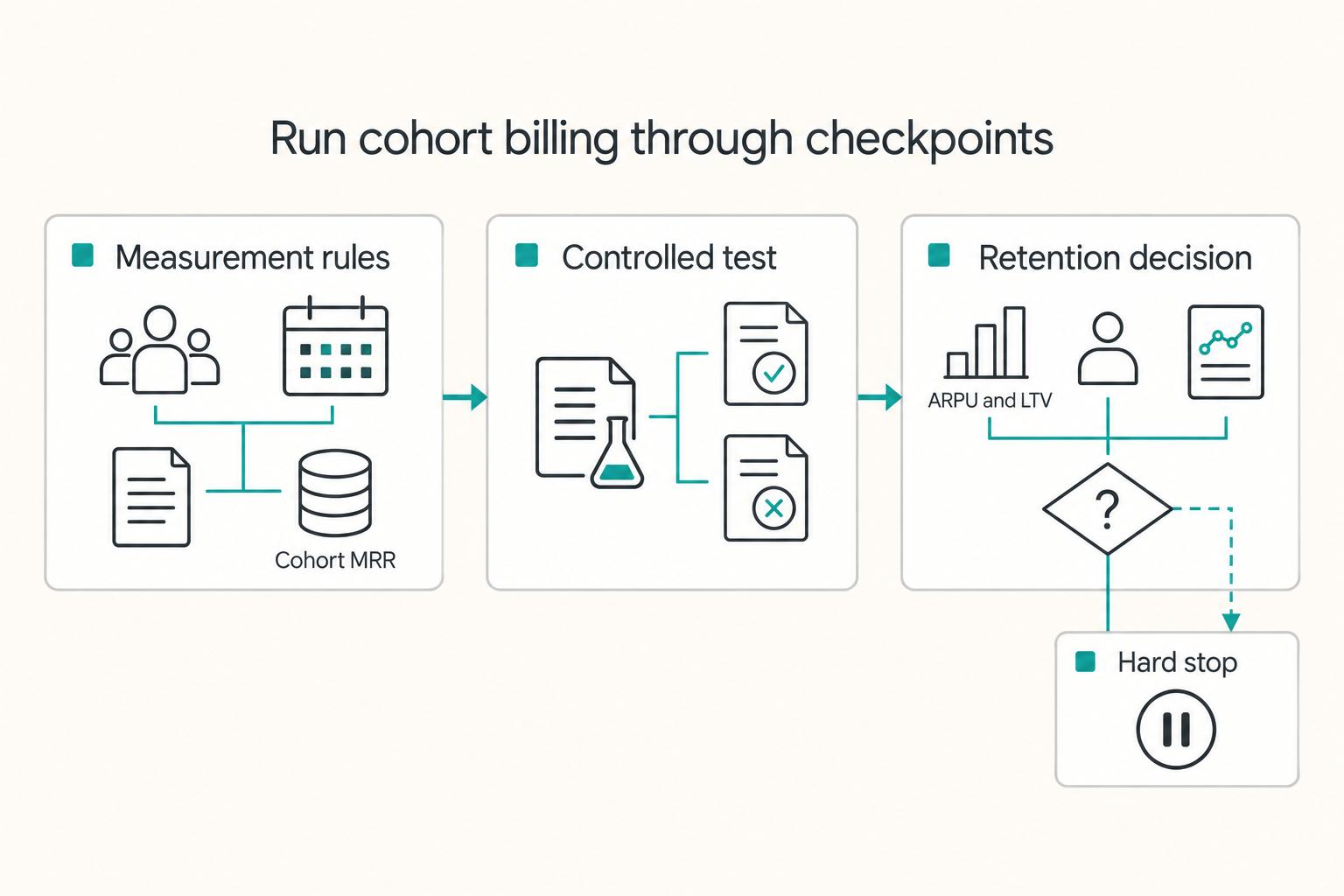
Roll out in 90 days with decision checkpoints#
Use a 90-day rollout only if your reporting is reliable enough to explain retention movement without guesswork.
| Phase | Focus | Key checks |
|---|---|---|
| Days 1 to 30 | Lock measurement rules before launch. | Set cohorts at first positive MRR, use UTC month boundaries, validate Billing Analytics Dashboard mapping, and align on re-subscribers staying in their original cohort. |
| Days 31 to 60 | Run one controlled model test with written decision criteria. | Test one billing shape at a time, tie success and stop criteria to Revenue Retention by Cohort, read the cohort chart in MRR view, and keep offer, payment-term, and entitlement changes stable. |
| Days 61 to 90 | Decide with retention, ARPU, and LTV together. | Review cohort movement with ARPU and LTV, and use dashboard reads after data updates have landed; Stripe notes Billing Analytics is available within one hour in most cases. |
| Hard stop rule | Pause if interpretation depends on unverified assumptions. | Verify first-positive-MRR cohorting, UTC month boundaries, re-subscribe handling, and report mapping before expanding. |
Days 1 to 30: lock measurement rules before launch. Set cohort definitions first, because Stripe assigns cohorts when a subscriber first generates positive MRR. Set month boundaries to Coordinated Universal Time (UTC), since Stripe measures monthly cohort retention on UTC month cutoffs. Validate mapping in the Billing Analytics Dashboard with a downloadable report or drill-down check, and align stakeholders on one rule that often gets missed: re-subscribers stay in their original cohort.
Days 31 to 60: run one controlled model test with written decision criteria. Test one billing shape at a time (for example, pure subscription vs hybrid) and tie success and stop criteria to Revenue Retention by Cohort. In Stripe Billing Analytics, read the cohort chart in Monthly Recurring Revenue (MRR) view when your decision is about revenue retention, not just subscriber counts. Keep offer, payment-term, and entitlement changes stable during the test so the result stays interpretable.
Days 61 to 90: decide with retention, ARPU, and LTV together. Do not treat retention alone as expansion proof. Review cohort movement with ARPU (average income per active user in a defined period) and LTV (customer value across acquisition, retention, and revenue optimization) to see whether gains are durable. Use dashboard reads after data updates have landed; Stripe notes Billing Analytics is available within one hour in most cases.
Hard stop rule: if interpretation depends on unverified assumptions, pause. Treat this as an internal governance checkpoint. If you cannot verify movement from first-positive-MRR cohorting, UTC month boundaries, re-subscribe handling, or report mapping, fix instrumentation before expanding.
For a step-by-step walkthrough, see Building Subscription Revenue on a Marketplace Without Billing Gaps.
Conclusion#
Keep the promise simple: get the definition right, read the signal the same way every time, and only then decide how far to push the pricing model. That is the practical core of elearning subscription retention cohort billing, and it often matters more than adding another plan tier or running another discount test.
- Lock metric definitions first
In Stripe Billing, the detail that matters is that you can explicitly configure how Monthly Recurring Revenue, churn, and active subscribers are calculated. That is useful, but it also creates real risk: if someone changes those settings mid-analysis, the chart can move for configuration reasons instead of customer reasons. What matters is discipline. When you click Configure, treat it like a controlled change, note the date, and remember Stripe says updates can take 24 to 48 hours to appear.
Your checkpoint is not the dashboard alone. Use Stripe's per-customer MRR change log to spot whether a retention shift came from new subscribers, downgrades, reactivations, or churn. If you cannot reconcile the cohort view with that underlying log, pause interpretation before you make a pricing decision.
- Separate involuntary churn from value churn
Recurly defines involuntary churn as loss that happens for reasons beyond customer intent, and Stripe's guidance names payment failures or banking issues as concrete causes. That should change your first reaction. If churn rises but course usage or learner engagement is steady, do not assume the offer is broken. Start with diagnosis order: fix billing recovery first, then revisit product or price if the signal still holds.
That failure mode can be expensive. Teams sometimes rewrite messaging, cut prices, or change access terms when the real issue sits in failed payments or other preventable involuntary churn. Your evidence pack should include failed-payment reasons and reactivation history before anyone approves a pricing pivot.
- Choose the model your operations can actually support
Subscription pricing is, at base, a recurring fee model, and Stripe's own framing is that it supports predictable revenue and longer customer relationships. That does not make it automatically right for every learning business. What matters is fit to operating context, not fashion. If your team can monitor recurring billing cleanly, segment plans well, and review cohort movement consistently, subscription or hybrid models can be worth the extra complexity. If not, simpler billing is usually the safer call until your reporting and recovery work are reliable.
One final rule is worth keeping: each tier should match a real customer segment, not just internal revenue goals. If your segments are fuzzy and your churn labels are unreliable, scaling the model will magnify confusion, not growth.
Done well, this is less about finding a universal winner and more about building a billing setup you can trust under pressure. That is what helps you expand with evidence instead of assumptions.
Related reading: How to Calculate and Manage Churn for a Subscription Business.
Frequently Asked Questions
What is cohort retention in subscription billing?
Cohort retention is the share of subscribers in a defined cohort who have not churned by month end. In Stripe’s wording, it is the percentage of subscribers from that cohort who “haven’t yet churned by the end of the month.” The key difference is that this is a month-end read, not a vague engagement trend.
How is a subscriber cohort defined in billing analytics?
In the Stripe guidance used here, a subscriber joins a cohort when they first generate positive MRR. That definition matters more than most teams expect, because changing it to activation date or first purchase date will change your retention story. If you compare tools, verify whether they cohort by first positive MRR, activation date, or first purchase date before you trust the chart.
How do re-subscribers affect cohort retention?
In Stripe’s model, a subscriber who churns and later comes back stays in their original cohort. That keeps the retention history tied to the first revenue start point instead of treating the return as a brand-new cohort entry. When comparing reports across tools, verify how each one treats re-subscriptions.
What does an MRR cohorts report show?
An MRR cohorts report groups subscriptions or customers by a start period so you can track revenue behavior over time. Chargebee’s definition is explicit: it shows the percentage of Monthly Recurring Revenue retained over time from subscriptions activated during a specified period. The practical checkpoint is simple: confirm whether your report uses activation month, first purchase date, or first positive MRR, because those are not interchangeable.
What is the practical difference between one-time and subscription pricing for cohort courses?
One-time pricing favors immediate cash flow, while subscription pricing supports predictable MRR tracking. That does not mean subscription is always better. A practical difference is that subscription models make churn visible in recurring metrics, while one-time sales do not provide a recurring revenue curve in the same way.
Which metrics should operators track with cohort retention?
At minimum, track MRR, churn, revenue retention by cohort, ARPU, and LTV. Paddle’s ProfitWell Metrics explicitly includes MRR, churn, ARPU, and LTV in its core metric set, and positions customer cohorts as part of the dashboarded view. One useful operator check is timing: ProfitWell Metrics data refreshes every 3 to 6 hours, so do not overread intraday changes as settled retention movement.
What key details are still unknown from current public excerpts?
The public material here does not give universal benchmark ranges for retention, churn, ARPU, or LTV. It also does not provide full vendor setup instructions for tools like Paddle or Recurly, and it does not settle market-by-market payment constraints. If your decision depends on any of those missing pieces, treat them as open questions and gather evidence before expanding pricing changes.
Try a related tool
Researched and edited by the Gruv editorial team. Gruv builds cross-border billing, payouts, and finance-operations software for global businesses.
Sources
Includes 2 external sources outside the trusted-domain allowlist.
- docs.stripe.com/billing/subscriptions/analyticstrusted
- docs.stripe.com/billing/subscriptions/trialstrusted
- stripe.com/resources/more/how-to-calculate-churn-ratestrusted
- stripe.com/resources/more/subscription-pricing-models-a...trusted
- support.stripe.com/questions/subscriber-cohorts-and-cohort-rete...trusted
- support.stripe.com/questions/subscriber-cohorts-and-cohort-rete...trusted
- developer.paddle.com/concepts/profitwell-metricsexternal
- docs.recurly.com/recurly-subscriptions/docs/involuntary-churnexternal
Educational content only. Not legal, tax, or financial advice.
Related Posts
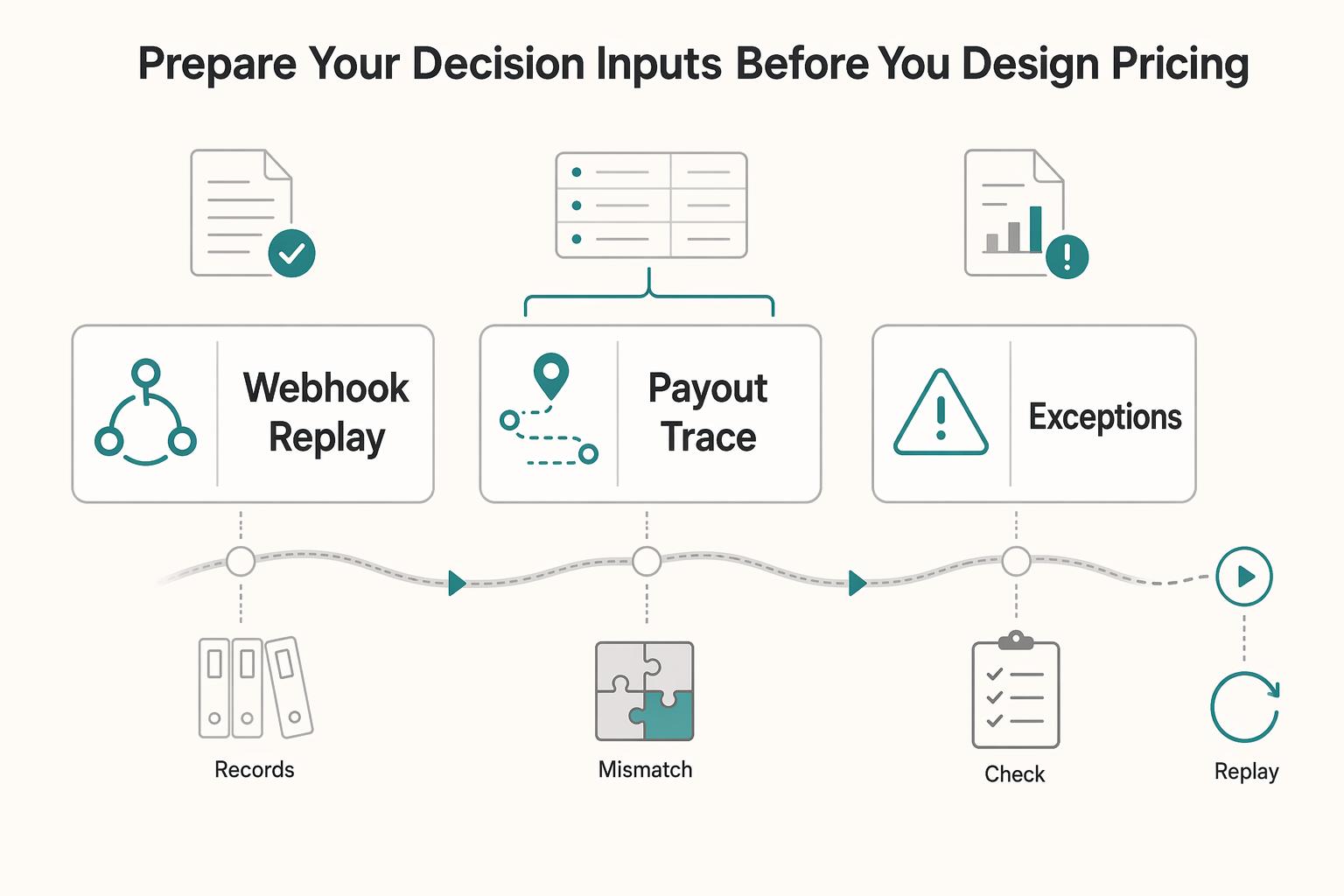
Education and eLearning Platform Billing for Cohorts and Course Access
Start with three linked decisions: what you are selling, how access is granted, and whether your payout setup can support the currencies you plan to offer. Make those calls in the wrong order, and you can end up rebuilding pricing, enrollment logic, and finance operations at the same time.
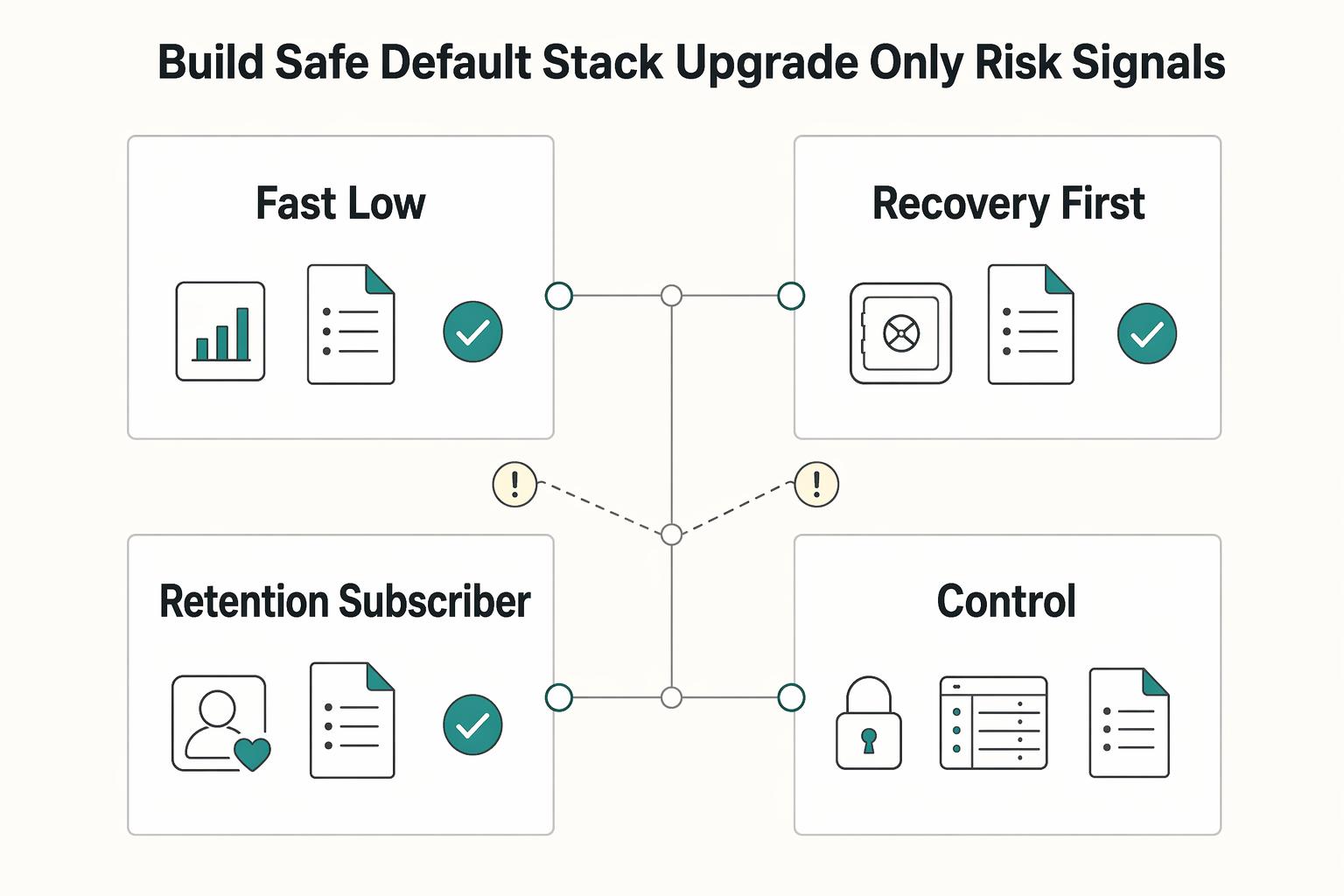
The Best Tools for Managing Subscription Billing
**Protect cashflow by selecting for recovery and control first, then layering convenience features.**
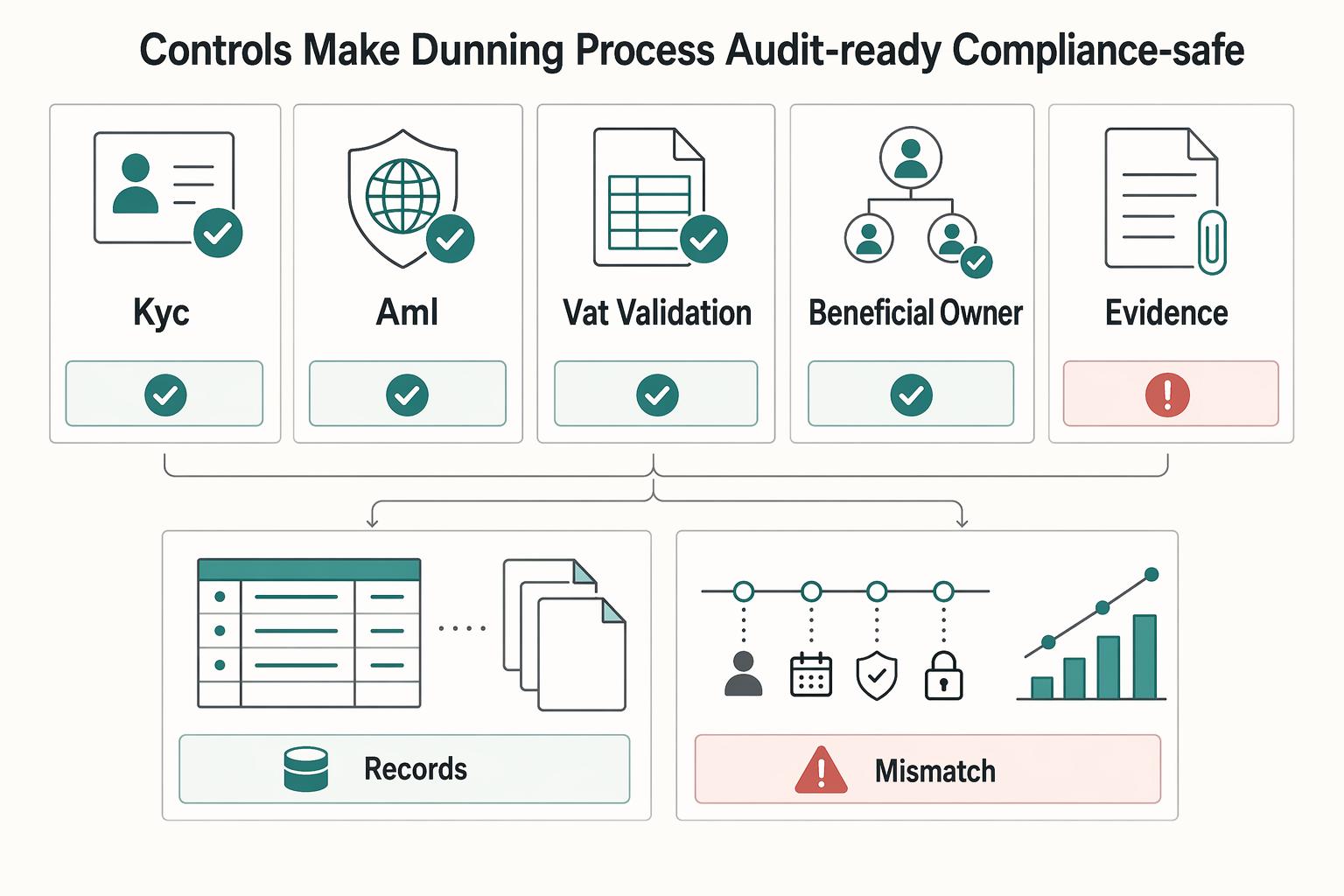
A Guide to Dunning Management for Failed Payments
If you run recurring invoices, failed payments are not back-office noise. They create cashflow gaps, force extra follow-up work, and increase **Involuntary Churn** when good clients lose access after payment friction.