
Quick Answer
For an ordinary full-month 2026 RETA case, the standard combined rates total 31.5% including 0.9% MEI. A minimum base of EUR 653.59 therefore produces about EUR 205.88 before personal adjustments, not a universal EUR 200 fee. Select the base using applicable net returns and use TGSS's actual receipt to confirm the charge.
What the Spanish autónomo quota is#
The autónomo cuota is a Social Security contribution under RETA, not a combined freelancer tax. For an ordinary full-month case, estimate the applicable monthly net returns, identify the contribution-base range, choose a permitted base, and apply the relevant rates. The worker's TGSS record and actual debit determine what is paid; a platform's gross payouts alone do not.
Registration and contribution dates need care. Importass allows up to three timely registrations in a calendar year to take effect on the activity's actual start date; other registrations and late filings can involve full-month rules. Do not tell every new contractor that contributions always begin on the first day of the month, irrespective of the registration circumstances.
Spain's income-based system was introduced through Real Decreto-ley 13/2022. The official RETA simulator uses expected monthly net returns. Estimates and provisional bases can later be regularized against tax-administration data; this is not a fixed annual subscription price.
That gives you two immediate control points. First, verify what you are classifying. Is the issue actually a RETA and Spanish Social Security question, or has your team bundled tax, immigration, and social insurance into one loose "freelancer compliance" label? Second, verify what income input you have. If your records only show gross disbursements, you may not yet have enough to treat a quota estimate as reliable under the income-based contribution approach.
Keep the difference between estimate, selected base, assessed contribution, and paid contribution visible. For a contractor platform, a quota estimate may support a cash forecast; it does not itself authorize deducting the amount from an invoice or withholding a payout.
The rules and primary guidance below were checked on 5 October 2026. The practical sequence is calculation, payment, income updates, and annual reconciliation. Use the legal history to understand the current rule, rather than leaving a resolved legislative sequence as a reason to defer the calculation.
What the autonomo quota covers and where teams scope it wrong#
Treat the autónomo quota as a Social Security control, not a catch-all freelancer tax. RETA is the Spanish Social Security special scheme for self-employed workers, and the quota is the Social Security amount under that regime, calculated from the contribution rate and the base de cotización.
| Regime | What it is | What it does not do |
|---|---|---|
| RETA / autónomo quota | Spanish Social Security special scheme for self-employed workers; the cuota is the Social Security amount under that regime, calculated from the contribution rate and the base de cotización | Not a catch-all freelancer tax |
| Visado de trabajo por cuenta propia | Immigration route for adults planning self-employed work in Spain; the visa request also carries a residence authorization request | Does not determine quota classification by itself |
| Modelo 303 | VAT self-assessment | Does not replace the Social Security quota |
| Modelo 130 | Self-assessment for installment IRPF payments from economic activities | Does not replace the Social Security quota |
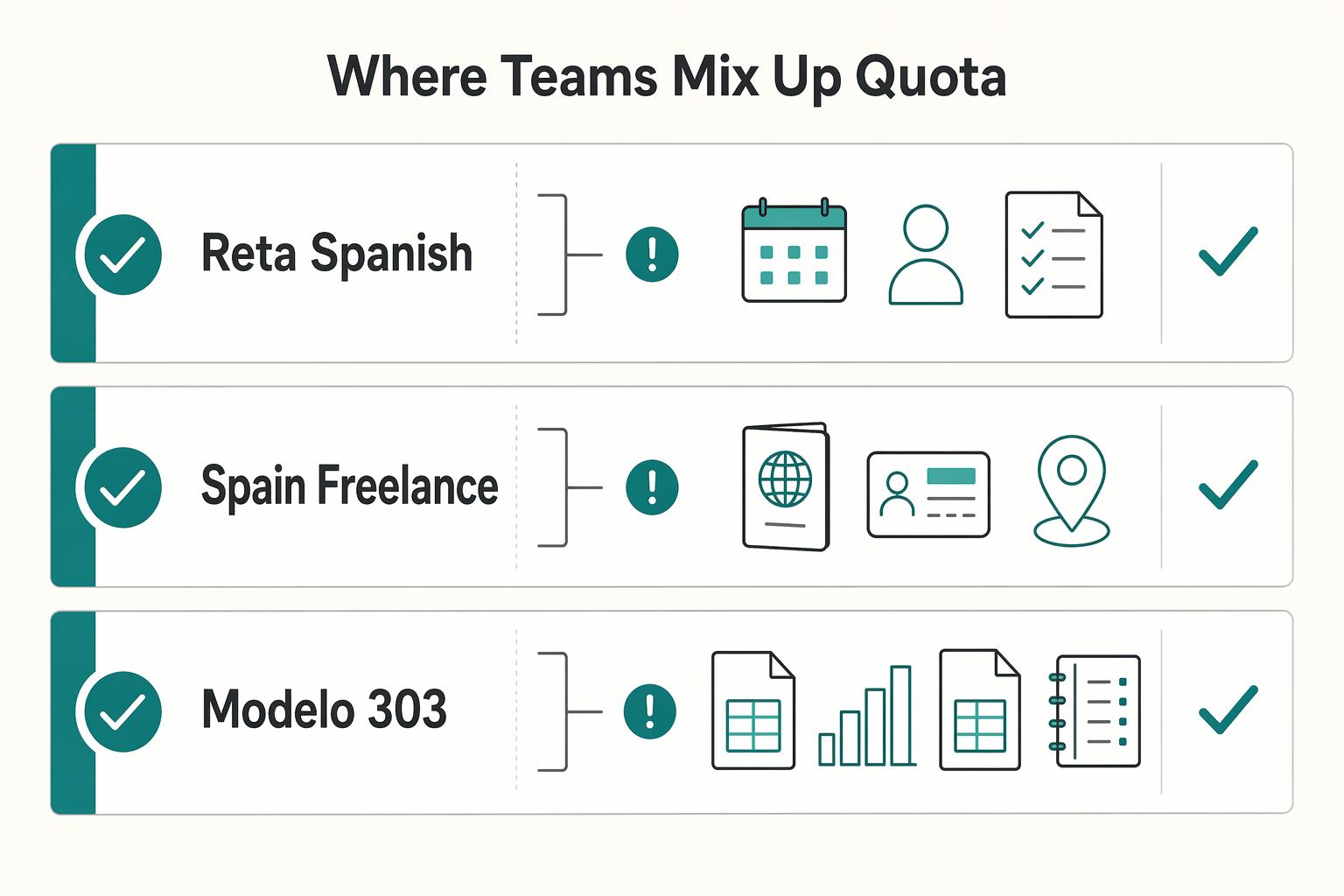
Teams usually scope this wrong by merging three separate regimes into one workflow. The visado de trabajo por cuenta propia (Spain self-employed visa) is an immigration route for adults planning self-employed work in Spain, and the visa request also carries a residence authorization request. Modelo 303 is VAT self-assessment, and Modelo 130 is self-assessment for installment IRPF payments from economic activities. None of those replace the Social Security quota, and visa status data alone should not determine quota classification.
Before automating, split one vague "freelancer tax" control into three named controls:
- Social Security: RETA status, contribution-base logic, and quota handling
- Immigration: visa/residence evidence where relevant to right to work
- Tax filings: Modelo 303 and Modelo 130 ownership, cadence, and evidence
Use one checkpoint in policy review: if a single checklist uses visa documents to validate a RETA amount, your scope is mixed. Keep separate evidence packs for each regime so corrections stay defensible. You might also find this useful: The Best Bank Accounts for Freelancers in Spain.
What changed in 2026 and what did not#
The 2026 contribution order keeps the 2025 income bands and most base limits, while the maximum base reaches EUR 5,101.20 and MEI is 0.9%. Keeping a base unchanged does not necessarily keep the total debit unchanged: MEI is part of the amount due. Apply the current rates rather than recycling a headline quota range.
| 2026 point | Verified position | Operational consequence |
|---|---|---|
| Early proposals | Proposal figures are not the adopted contribution schedule | Use the published 2026 order and current TGSS record |
| RDL 16/2025 | Congress agreed its derogation on 27 January 2026; published 28 January | Do not treat that decree as the current controlling instrument |
| RDL 3/2026 | Dated 3 February, published 4 February; Congress convalidated 26 February, published 28 February | Keep the correct primary links in the legal-basis note |
| Current contribution order | Orden PJC/297/2026,30 March, Article 18 specifies 2026 RETA bases and rates | Use the adopted table, distinguishing base from cuota |
| Same base versus same payment | MEI 0.9% is included in the standard-rate calculation | A carried-forward base does not establish an identical 2025 and 2026 debit |
The primary trail is the derogation resolution, RDL 3/2026, its convalidation, and the 2026 contribution order. Save the provisions relevant to your calculation rather than requiring a new reconstruction of every decree for each monthly payment.
Check the document title as well as its BOE reference. BOE-A-2026-2548 is RDL 3/2026; BOE-A-2026-2024 is the earlier derogation resolution. Confusing the two changes what your source actually supports.
For current onboarding copy, give the adopted rules and a dated calculation. If a later change appears, check its effective date and the affected cases before altering estimates.
A chosen contribution base can affect future benefit calculations as well as the monthly outlay. Do not describe the lowest permitted base as automatically the best choice for every worker.
How the 2026 amount is calculated in practice#
The calculation is: applicable monthly net returns → permitted base range → selected base × applicable contribution rates. MEI is already included when you use a combined rate; do not add it again.
Start with net income, not gross payouts#
Net returns for RETA are not simply the bank deposits received from one platform. For an ordinary direct-estimation sole trader, the statutory calculation starts with relevant tax net income, adds back the worker's Social Security contributions where deducted, and then applies the general-expense deduction. The deduction is normally 7%; specified corporate partners meeting the relevant conditions use 3%. Include all relevant self-employed activities, not only your platform's payments.
Worked income example: assume a full-year ordinary sole trader has EUR 36,000 relevant business revenue and EUR 12,000 deductible costs excluding their own RETA contributions. Before the general deduction, returns are EUR 24,000. Applying 7% gives EUR 22,320, or EUR 1,860 a month for this simplified full-year example. That falls in general-table tramo 5 (>EUR 1,850 to EUR 2,030). Do not subtract RETA twice if your starting tax net income already deducts it; add it back before the general deduction. Part-year and excluded-period calculations need their actual statutory denominator.
From bracket to base to cuota#
Seguridad Social's 2026 table gives permitted bases, not fixed contributions. For an ordinary case with all standard components,28.3% common contingencies +1.3% professional contingencies +0.9% cessation +0.1% training +0.9% MEI totals 31.5%. Exemptions, reductions, partial periods, and special categories can change an individual's result.
| 2026 income band | Permitted monthly base | Illustrative full-month amount at 31.5% of minimum base |
|---|---|---|
| Reduced table tramo 1:≤EUR 670 | EUR 653.59–718.94 | About EUR 205.88 |
| General table tramo 4:>EUR 1,700 and≤EUR 1,850 | EUR 1,143.79–1,850 | About EUR 360.29 |
| General table tramo 5:>EUR 1,850 and≤EUR 2,030 | EUR 1,209.15–2,030 | About EUR 380.88 |
| General table tramo 12:>EUR 6,000 | EUR 1,928.10–5,101.20 | About EUR 607.35 |
These examples multiply the minimum base by 31.5% and round the result to cents. Actual bills may round individual components and apply personal adjustments. For the EUR 1,860 net-return example, choosing EUR 1,209.15 as the provisional base produces about EUR 380.88 a month under the stated standard assumptions; selecting a higher permitted base increases the outlay. The earlier EUR 200–590 range is not a complete 2026 standard-rate calculation.
Revalidate when income moves#
Base-change requests are available up to six times annually, with defined effective dates. For example, a request from 1 September through 31 October takes effect 1 November; a November–December request takes effect 1 January of the next year. Record the request and effective date separately. An improved income estimate does not instantly change a debit already assessed.
Payment responsibility remains with the autónomo. Register the direct-debit account through Importass using a collaborating financial institution; the ordinary monthly charge is on the last working day of the month. Check the assessed amount and keep sufficient available funds. If the debit is returned, inspect the outstanding debt and official payment route rather than assuming an invoice deduction or a later client payment settles it.
Reconcile the TGSS contribution record with the bank debit: period, base, reductions, amount, and successful payment. A forecast supports budgeting; an assessed receipt supports the amount due; a cleared debit or official payment confirmation supports payment.
How to use tarifa plana without building policy on assumptions#
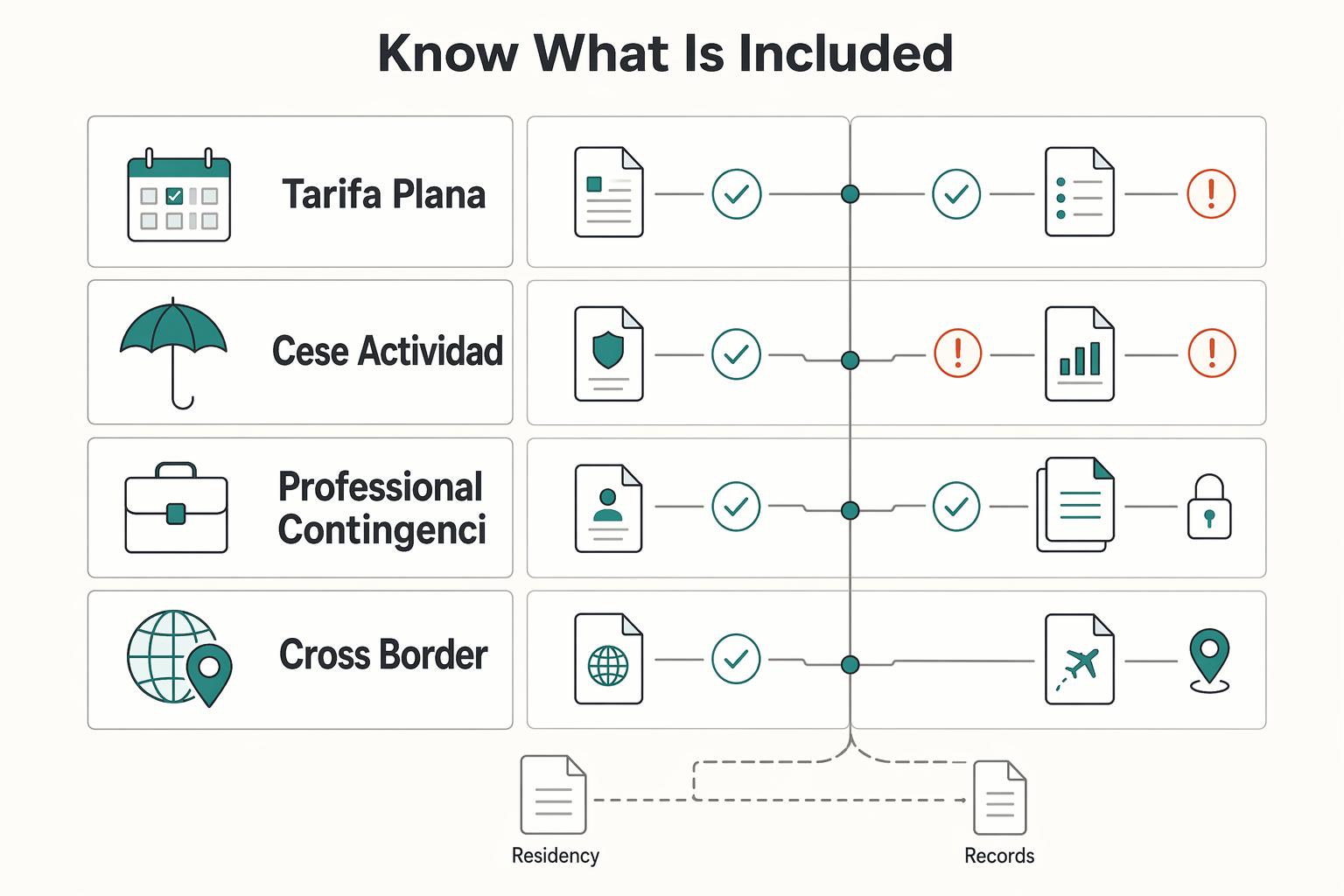
Reduced startup treatment remains a separate case. The Importass practical guide describes EUR 80 a month for the first 12 months, with MEI added, prior-registration conditions, and a possible income-tested extension. Use the recognized benefit, dates, and assessed receipt for the worker. Do not describe EUR 80 as the complete debit or apply it automatically to every new platform account.
| Scenario | Handling | Evidence rule |
|---|---|---|
| Established ordinary registrant | Estimate returns, verify the selected base and actual receipt | No automatic reduced-startup assumption |
| Potential eligible starter | Check first/prior RETA registration and any previous use of the benefit | Apply the benefit only when recognized for the relevant period |
| Recognized reduced period | Record start/end, MEI and the assessed charge | Do not substitute a normal estimate for an actual recognized reduction |
| Eligibility evidence missing | Keep an unresolved estimate separate from actual TGSS assessment | Do not impose a higher contractor deduction or stop earned payouts merely because a forecast is incomplete |
For standard RETA handling, keep your baseline controls: under Real Decreto-ley 13/2022, the regular autónomo quota follows contribution base-and-rate mechanics within the person's monthly net income bracket. Treat reduced startup treatment as a separate case that must be validated.
Separate the two scenarios#
If the person is an established RETA registrant, run standard controls: verify net income estimate, assign bracket, document base assumption, and revalidate when income changes.
The guide describes access for a first registration, or after not being in RETA during the previous two years; that becomes three years after prior use of the benefit. A possible further 12 months requires returns below the applicable SMI and the required request/declaration. Confirm the person's actual recognized period rather than treating a fresh platform signup as a fresh RETA registration.
Store recognition evidence and its end date. If it is missing, mark the forecast's reduced-treatment assumption unconfirmed. That evidence gap does not cancel an existing TGSS benefit.
Use an exception path with an expiry date#
Use an expiry and review trigger for the forecast assumption. At review, check the worker's recognized benefit and actual contribution record. Change the estimate when warranted; do not invent the worker's legal liability or impose an unagreed payout deduction.
Keep the exception path auditable:
- Record the recognized benefit, effective dates, assessed amount, and forecast owner.
- Set a review before the recognized period ends or an extension request is needed.
- If confirmation is unavailable, keep an explicit estimate range and obtain the actual receipt before treating a figure as assessed or paid.
A platform can preserve forecast uncertainty without overcharging the contractor. RETA is normally the worker's contribution obligation; a contractual service fee or lawful agreed collection arrangement must be distinguished from that liability.
The wider autónomo Social Security guide covers the registration and benefit context alongside this calculation and payment process.
Where teams mix up quota, visa, and quarterly tax duties#
Do not let one checklist decide quota, visa, and quarterly tax duties at once. Quota classification is a Social Security decision, not something you can infer from an immigration file or a tax-filing shortcut.
| Control area | Primary owner | What that owner is deciding |
|---|---|---|
| RETA and Spanish Social Security | social security or payroll compliance | whether the person is treated as self-employed and how the quota is handled |
| Spain Freelance/Self-Employed Visa | immigration or mobility | whether the person has the residence and work-authorization path for self-employed activity |
| Modelo 303 and Modelo 130 | tax owner or local tax adviser | whether VAT and IRPF filing duties apply and are being filed |
Keep the tests separate: RETA contributions, residence/work authorization where needed, and applicable VAT or income-tax filings. Timely RETA registration can take effect on the actual start day under the applicable rules; blanket first-of-month advice is unsafe. Visa or tax documents alone do not identify the contribution base.
Add one intake gate: no payout-policy override should fire from visa-status data alone when the open issue is quota classification. If the case is about RETA treatment or contribution outcome, route it to the Social Security owner and require quota evidence.
Red flag: if one checklist asks for self-employed visa papers to validate a quota bracket, your process is combining unrelated regimes. Treat consular age or permit fields as immigration data, not quota-classification evidence.
Related: A Guide to Filing Quarterly Taxes (Modelo 303 and 130) in Spain.
A monthly calculation and payment record#
Build a monthly evidence pack that shows your decision chain end to end: source used, legal basis, income logic, and what will trigger review. Without that chain, later disputes become reconstruction work.
This is an internal control recommendation, not a Spanish statutory template.
| Evidence item | What to capture | Why it matters |
|---|---|---|
| Source snapshot | Dated copy or screenshot of the Spanish Social Security or BOE source used that month | Shows which rule set you relied on at decision time |
| Legal-basis note | Applicable 2026 order and relevant guidance, plus any later effective changes | Anchors the decision to an identified legal basis |
| Bracket logic memo | Net-income assumption, contribution logic applied, and any manual adjustments | Makes the contribution outcome reviewable |
| Exception log | Missing evidence, disputed classification, temporary assumptions, and expiry date | Keeps exceptions visible instead of becoming default policy |
| Approval record | Decision timestamp, approver, affected cohort, and rollback condition | Preserves traceability from policy to operations |
What the legal-basis note needs to say#
Name the actual rule used: Orden PJC/297/2026,Article 18 for 2026 bases and rates, alongside RDL 3/2026 where relevant. Include the person's selected base and any recognized reduction. Avoid labeling a derogation resolution as the replacement decree.
State the RETA classification assumption for the decision you are documenting. Do not rely on old onboarding labels when the same person also has visa, payroll, or tax records in other systems.
Check the moving part, not just the amount#
The control is not just the amount charged; it is whether you are still applying the current income-based contribution logic. Since 1 de enero de 2023, active autónomos can modify contribution base data and communicate or amend net-income data, and base-change requests require declaring expected net monthly returns. Record the income figure used and the date checked.
If you only have payout totals, mark the bracket input as unknown until you have a usable net-income declaration or specialist review. Do not automatically treat gross payouts as a substitute.
Annual regularization compares provisional bases with returns supplied by the tax administrations and produces a formal TGSS result. Monitor Social Security electronic notifications or DEHú. Match an additional payment or refund to the resolution and period; do not silently rewrite the original monthly payment as if it never occurred.
Map policy checks to operating artifacts#
Map each checkpoint to a concrete record. Keep sensitive worker documents accessible only to roles that need them; platform income evidence should not become an indiscriminate request for the worker's entire tax file.
- Dated net-return assumption and selected contribution base for the forecast.
- TGSS assessment or receipt and bank debit/payment confirmation for the period.
- Notification and reconciliation record for annual regularization.
- Exception ticket for missing evidence, with the specific calculation affected rather than a blanket payout hold.
Set retention by the record's actual purpose and applicable obligations. Do not apply a generic four-year tax period to every Social Security, commercial, or dispute record. Keep the source, calculation, assessment, payment, and correction history legible and linked.
If you want a deeper dive, read A Guide to Social Security for 'Autónomos' in Spain.
Escalation triggers when legal or market signals conflict#
Do not let a headline, adviser email, or ministerial announcement change payment logic by itself. If decree status differs across institutions, treat the position as unsettled until your file confirms the BOE publication trail and, where relevant, Congress action.
The key escalation pattern is a mismatch between executive approval and parliamentary outcome. In this 2026 sequence, Congress agreed to derogate Real Decreto-ley 16/2025, with the derogation record published 28 de enero de 2026; the Council of Ministers later approved a new decree-law; and Congress then agreed to convalidate Real Decreto-ley 3/2026, de 3 de febrero, with the convalidation record published 28 de febrero de 2026. The convalidation record also cites article 86.2 of the Constitution, which is a useful legal checkpoint in review.
What should trigger escalation#
Escalate when any of these occurs:
| Trigger | What to verify | Response |
|---|---|---|
| Conflicting rate or base | Effective 2026 order and actual TGSS assessment | Resolve the affected estimate before changing it |
| New reduced-treatment claim | Recognition, start/end dates, and actual receipt | Update the forecast when verified |
| Returned contribution debit | Debt status and payment instructions | The worker or authorized representative resolves official payment |
| Legislative change | Published provision, effective date, and affected cases | Review the affected policy; continue unaffected lawful payments |
Pause only the affected unverified estimate or proposed policy change. Do not stop all contractor payouts merely because an article, headline, or internal forecast conflicts with a contribution amount.
Response windows by risk#
Set timing as an internal control rule, based on impact:
- Payment or returned-debit issue: notify the responsible worker or authorized operator promptly and check the official deadline.
- Policy interpretation: review the affected rule before deployment, with the disputed provision and effective date attached.
Each escalation ticket should include the conflicting source snapshot, the exact decree reference, and the operational assumption at risk, plus whether the issue is derogación or convalidación. This keeps decisions tied to verifiable legal status rather than market noise.
Conclusion#
A usable 2026 quota process distinguishes estimated returns, selected base, assessed contribution, successful payment, and annual regularization. Store each stage so a forecast error can be corrected without pretending a prior payment had a different amount.
For contractor operations, the main error is equating gross payments with RETA net returns and then treating an estimate as a deduction the platform must collect. Keep the worker's own obligation and actual evidence separate from your cash forecasts and contractual payment terms.
You also need to keep three separate tracks visible in your process because they solve different problems:
- RETA / Spanish Social Security decides the contribution logic, including bracket, base, and resulting cuota
- Visado de trabajo por cuenta propia is an immigration route for someone planning self-employed work in Spain. It does not prove a quota bracket
- Modelo 303 and Modelo 130 sit on the tax side and should not be used as substitutes for Social Security classification evidence
If one checklist asks for visa documents to justify a RETA band, or if a tax filing status is being used to infer the contribution base, your controls are crossing regimes that the source material treats separately. That is where audit friction starts, because the evidence pack no longer matches the legal question being answered.
When evidence is incomplete, record the affected assumption and obtain the actual TGSS record. Review a proposed automation change before applying it, but do not turn missing forecast evidence into a blanket payout hold or automatic standard-rate charge for a worker with a recognized reduction.
Before the monthly debit, confirm the worker's contribution record and available funds. Afterward, reconcile payment; later, reconcile the regularization notice. Update income estimates using the permitted effective dates. Those steps make the process usable through changing income instead of leaving it at an unresolved legal-history checklist.
Frequently Asked Questions
Did Spain actually raise the autónomo quota in 2026?
The 2026 income bands and most base limits continue from 2025, but MEI is 0.9% and the maximum base is EUR 5,101.20. An unchanged base does not guarantee an unchanged debit. Use the current 2026 base-and-rate calculation and the worker's actual assessed amount.
What do the 2026 income bands mean for the amount paid?
The table gives permitted contribution bases. For an ordinary full-month case at the standard combined 31.5% rate, the minimum base of EUR 653.59 produces about EUR 205.88, and EUR 1,928.10 produces about EUR 607.35. Personal reductions and other special rules can change the result. Gross payouts are not enough to select the net-return band.
How is the quota linked to contribution base and MEI?
Choose a permitted base in the applicable net-return band and apply the relevant rates. The standard combined 31.5% rate used in this article already includes 0.9% MEI; adding MEI again would double count it. Use separate treatment for recognized reductions and special cases.
Is tarifa plana available for a new autónomo?
Importass describes a reduced EUR 80 monthly contribution for eligible startup cases, with MEI added. First or sufficiently separated prior registration, previous use, recognized dates, and any income-tested extension matter. A new platform account is not proof of eligibility; use the worker's recognized benefit and assessed receipt.
What is the difference between RETA quota obligations and the Spain Freelance/Self-Employed Visa?
RETA is the Social Security regime for self-employed workers, while the Visado de trabajo por cuenta propia is an immigration route for adults intending to carry out self-employed work in Spain. The visa process also includes a residence authorization request, but that does not determine the RETA income bracket. A red flag in your process is any checklist that asks for visa evidence to justify quota banding.
Who should own quota monitoring inside a platform team?
There is no single mandatory internal owner established here, so this is a governance choice. In practice, you want one named operator to maintain the evidence pack, with legal review available when BOE, Congress, and Social Security signals diverge. Split ownership with no final approver is a common failure mode because nobody closes the loop when decree status changes.
What documents should be kept to prove a defensible quota decision?
Keep the dated relevant rule, net-return assumption, selected base, recognized reduction, TGSS receipt, and successful bank debit or official payment confirmation. Link later regularization notices and payments/refunds to their periods. A calculation proves an estimate, not payment.
Try a related tool
Researched and edited by the Gruv editorial team. Gruv builds cross-border billing, payouts, and finance-operations software for global businesses.
Sources
Includes 4 external sources outside the trusted-domain allowlist.
- portal.seg-social.gob.es/wps/portal/importass/importass/Colectivos/Tr...trusted
- portal.seg-social.gob.es/wps/portal/importass/importass/tramites/simu...trusted
- boe.es/buscar/doc.phpexternal
- boe.es/buscar/doc.phpexternal
- seg-social.es/wps/portal/wss/internet/Trabajadores/Cotizac...external
- seg-social.es/wps/portal/wss/internet/Trabajadores/Cotizac...external
Educational content only. Not legal, tax, or financial advice.
Related Posts
A Guide to Social Security for 'Autónomos' in Spain
Treat your autónomo setup as a control point, not background admin. If you get the sequence, contribution choice, and records right, you cut three expensive problems early: lost quota benefits, surprise regularization bills, and weak benefit claims later.
Quarterly Taxes in Spain for Freelancers Using Modelo 303 and 130
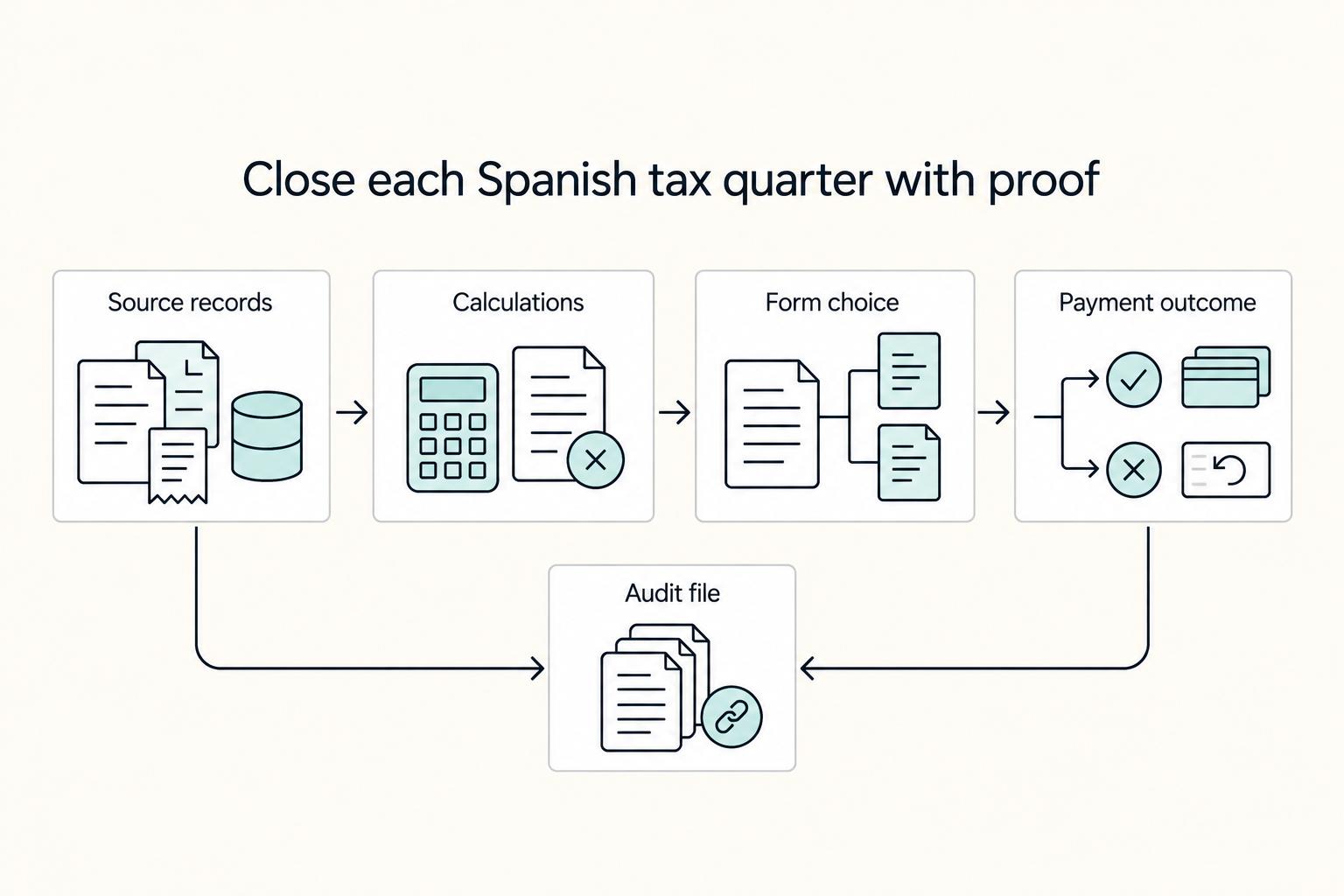
For a freelancer with Spanish IVA and IRPF obligations, quarter close usually involves separate returns. **[Modelo 303](https://sede.agenciatributaria.gob.es/Sede/todas-gestiones/impuestos-tasas/iva/modelo-303-iva-autoliquidacion_/instrucciones-2026/instrucciones-02-12-2t-4t-2026.html)** reports VAT; **Modelo 130** reports income-tax instalments under direct estimation. This guide covers the ordinary quarterly workflow. IVA territory excludes the Canary Islands, Ceuta and Melilla; regional tax administrations and special regimes need their own checks.
Freelancer Bank Accounts in Spain: Choosing a Primary and Backup Setup
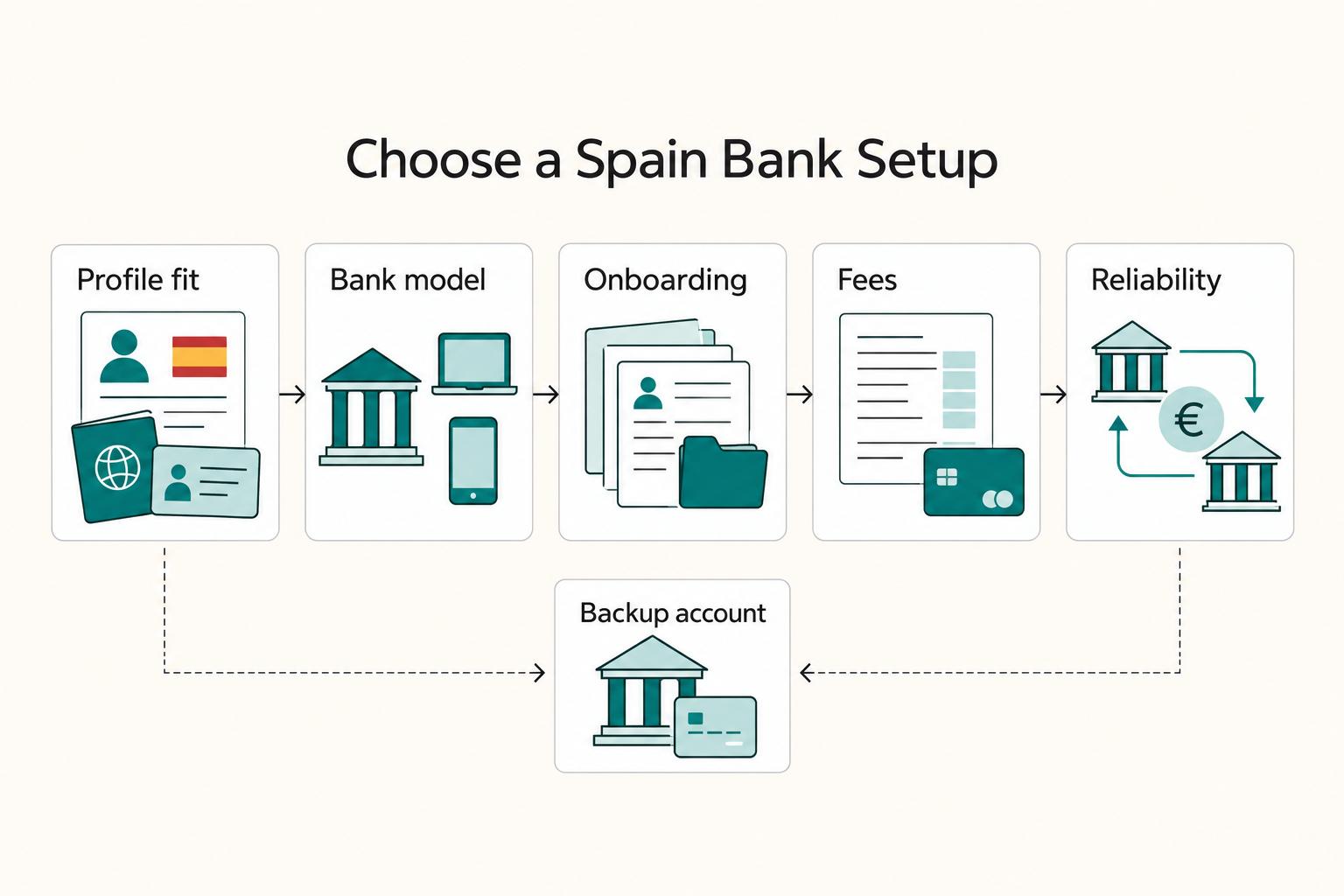
The best freelancer account in Spain depends on who earns the income and how the money will be used. A sole trader paid in euros has different needs from a limited company collecting dollars or a newcomer who has not yet established Spanish residence. Start with those distinctions, then compare the exact products available to you.