
Quick Answer
Keep VAT and income tax separate: Modelo 303 reports IVA, Modelo 130 covers direct-estimation IRPF instalments, and Modelo 131 covers eligible módulos activities. Check the professional 70% withholding exemption and any payer duties for 111/115. Calculate from quarter VAT and year-to-date IRPF records, verify the filing and direct-debit calendar, and save submission and payment proof.
Quarterly taxes in Spain: separate VAT and income tax#
For a freelancer with Spanish IVA and IRPF obligations, quarter close usually involves separate returns. Modelo 303 reports VAT; Modelo 130 reports income-tax instalments under direct estimation. This guide covers the ordinary quarterly workflow. IVA territory excludes the Canary Islands, Ceuta and Melilla; regional tax administrations and special regimes need their own checks.
For ordinary quarterly VAT, calculate accrued output VAT less eligible deductible input VAT, then apply any other adjustments or prior credits. A positive result can mean payment; a negative result usually means a credit to carry forward, with a refund request available under the applicable conditions. It is not a promise of cash back.
This guide is meant to reduce guesswork. You should leave with a practical view of when Modelo 303 matters, how it fits into your broader quarterly process, what to prepare before filing, and when to stop and verify instead of improvising.
Monthly VAT filing applies in cases such as REDEME registration and large-enterprise status. Voluntary SII electronic record reporting does not itself turn a quarterly taxpayer into a monthly filer. Confirm the settlement period in your obligations profile.
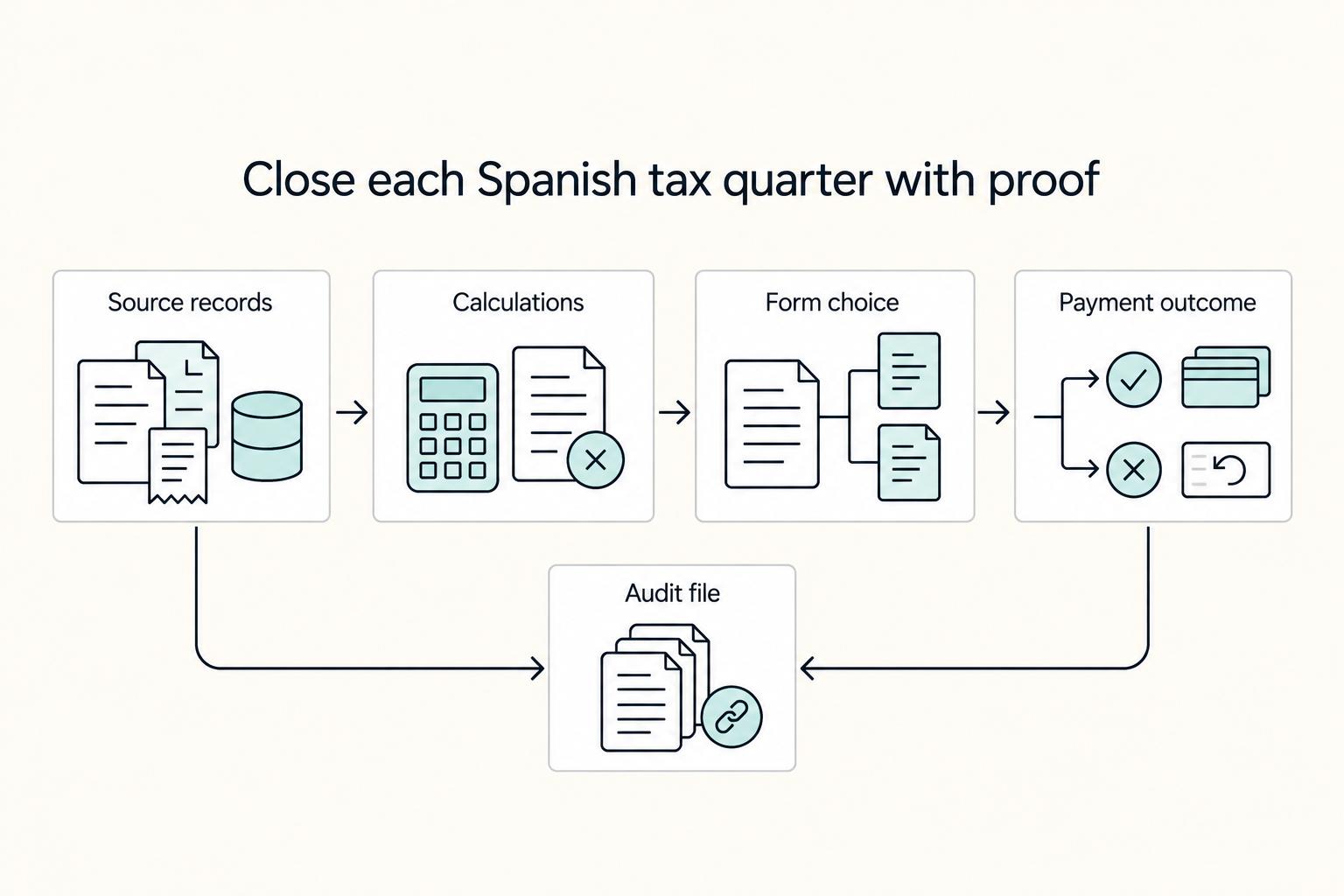
The close needs three answers: which forms apply, how their figures were calculated, and whether submission and payment completed. Keep each answer with the period records so an adviser can review a disputed number without reconstructing your business.
Social-security contributions are a separate obligation: see A Guide to Social Security for 'Autónomos' in Spain. That guide does not replace your IVA or IRPF return.
Start with the filing mental model in Spain#
The safest starting point is to treat the quarterly filing cycle in Spain as a form-selection and verification process, not a single tax event.
Use any model numbers in your own records (for example, Modelo 303, Modelo 130, or Modelo 131) as checkpoints, not assumptions. Keep three things separate in your process: the tax, the filing form, and your regime. Before you submit anything, confirm what applies to your case using your registration documents, prior filings, or adviser notes. Your checkpoint can stay simple:
- review the current official instructions for each model number you think may apply
- confirm the tax year and taxpayer profile those instructions cover
- keep a saved page, PDF, or adviser note that supports your choice
Your registration and current AEAT instructions should agree. If a prior return says 130 but your current regime is módulos, resolve the difference before copying last quarter. A saved registration change and an adviser’s explanation are more useful here than a general economic report.
Check access before deadline week. An expired certificate or missing Cl@ve registration can block submission even when the calculations are ready; confirm the identification methods supported by each return.
This mental model also reduces a common failure mode: reading something broadly true about the quarterly system, then applying it to the wrong model. If you make yourself answer three short questions before every filing cycle - which tax, which form, which regime - you are less likely to submit the wrong return or rely on an outdated note from a different year.
Decide exactly which quarterly forms apply to your case#
Make this a two-track check each quarter: IVA and IRPF. For IVA, the reference return is Modelo 303. For IRPF prepayments, use Modelo 130 or Modelo 131 based on your regime. These forms do different jobs and are not substitutes.
Use a simple yes or no path#
- Do you need to self-assess IVA for the period?
If yes, check Modelo 303.
- For IRPF prepayments, which regime are you registered in?
- Estimación directa, normal or simplified: assess Modelo 130, including any professional-activity withholding exemption.
- Eligible estimación objetiva (módulos) activity: assess Modelo 131. This is not a freely interchangeable form choice.
- Do you have a withholding obligation this quarter?
If yes, check whether Modelo 111 and/or Modelo 115 apply. If not, do not add them by default.
Compare the forms before you file#
| Form | Tax type | Who typically files | Trigger condition | Common "not my case" scenario |
|---|---|---|---|---|
| Modelo 303 | IVA / VAT self-assessment | Taxpayers with IVA self-assessment obligations | You must report IVA for the period | No IVA reporting obligation for that activity or period |
| Modelo 130 | IRPF installment payment | Entrepreneurs and professionals in estimación directa | Direct estimation with an instalment obligation after applicable exceptions | Objective estimation, or qualifying professional income meeting the 70% withholding exemption |
| Modelo 131 | IRPF installment payment | Individuals with eligible economic activities taxed under objective estimation | Your activity is under modules / objective estimation | You are in direct estimation, so 130 applies |
| Modelo 111 | Withholdings and payments on account | Persons or entities obliged to withhold on work income and certain economic-activity payments | You made payments that create a withholding obligation | No such withholding obligation this quarter |
| Modelo 115 | Withholding on urban-property lease income | Persons or entities obliged to withhold on urban-property lease/sublease rents | Your rent setup creates that withholding duty | Your rental setup does not create that withholding obligation |
Use one operating rule here: track first, regime second, withholding triggers third. That gives you a clean form set without guesswork.
Start from the current facts rather than last quarter’s forms. A new office lease, first employee or regime change can alter the filing set. Record the change and its effective date, then check which payment or return it affects.
Build one quarterly deadline calendar you can trust#
Use one quarterly calendar for your internal process, but treat live AEAT deadlines as the final authority before every filing cycle. The stable part is the quarter structure. The variable part is the live filing deadline and submission conditions for each model and case.
For Modelo 130, the return is tied to the calendar year and a period marked as first, second, third, or fourth quarter. Build your tracking around that structure, then verify current-year deadlines on Agencia Tributaria for each form you will actually file.
| Quarter | Ordinary quarterly 303 / 130 / 131 window | 111 / 115 window, when required | Payment check |
|---|---|---|---|
| Q1: January–March | 1–20 April | 1–20 April | Direct debit generally closes 15 April |
| Q2: April–June | 1–20 July | 1–20 July | Direct debit generally closes 15 July |
| Q3: July–September | 1–20 October | 1–20 October | Direct debit generally closes 15 October |
| Q4: October–December | 1–30 January of the following year | 1–20 January of the following year | Direct debit generally closes 25 January for 303/130/131 and 15 January for 111/115 |
These are general windows, subject to non-working-day adjustments and special extensions. The 2026 AEAT payment calendar confirms 15 October 2026 for Q3 direct debit and 20 October 2026 for Q3 filing of these quarterly returns. Verify the relevant calendar year for Q4, which is filed in the following January. Keep a buffer before the direct-debit cutoff.
Before submission each quarter, run two checks:
- Confirm the return's tax year and period match the quarter you are filing.
- Confirm your filing access method is working, for example certificate-based identification or Cl@vePIN for eligible Form 130 filing paths.
For professional activities under direct estimation, the 70% withholding exemption normally uses the previous calendar year’s income. In the first year of the activity, use the income subject to withholding in the quarter concerned. It is not a general exemption for every business with some withheld invoices.
A useful internal habit is to separate your quarter into three moments: record close, draft review, and submission. That way, deadline pressure does not become data pressure. If your records are still moving on the same day you plan to file, errors become much more likely.
Even without changing any legal deadline, that simple sequence makes the process more reliable. Close the books for the quarter, prepare the draft forms from locked records, then verify access and submit.
File Modelo 303 without common VAT errors#
Modelo 303 is a tax calculation, not a bank-receipts calculation. Under the ordinary regime, output VAT follows the applicable accrual rules, so an unpaid invoice can still create VAT due. The special cash-accounting regime has different collection and payment rules; do not apply those merely because a customer paid late.
Start with the sequence that drives the return#
Accrued output IVA − deductible input IVA, adjusted for other applicable items and prior credits = Modelo 303 result
For a simple hypothetical quarter with no special regime, reverse-charge items, adjustments or prior credits: output VAT is €2,100, eligible input VAT is €420, and the result is €1,680 payable. If €500 of the customer VAT remains unpaid but has accrued, it is still included in the €2,100. Set aside cash separately from deciding the tax period.
Before filing, reconcile in this order:
- Reconcile output VAT by tax rate and accrual period, including credit notes and advances where relevant.
- Reconcile purchase VAT to valid invoices and the received-invoice register.
- Apply business-use, deduction-right and any partial-deduction or prorrata restrictions before claiming input VAT.
- Reconcile prior-period VAT credits separately so the same credit is not used twice.
That order matters. If you start from bank activity or broad expense totals instead of invoice support, you can end up with a figure that looks plausible but is harder to defend. Modelo 303 works better when your quarter file lets you move from issued invoices to output VAT, then from supplier invoices to claimed input VAT, then from those totals to the submitted return.
Decide early based on the result#
A positive result requires a payment route or an appropriate debt-handling route. A negative result requires an explicit choice: carry forward the credit (a compensar) or request a refund when allowed. For ordinary quarterly taxpayers, a refund request is available at the final period of the year; earlier-period refund requests require REDEME eligibility.
- Payable: confirm funds and the selected payment method before submission.
- Negative: keep the supporting invoices and record whether the credit was carried forward or an eligible refund requested.
- Zero / no activity: select the appropriate return outcome; the absence of an amount due does not end an existing filing obligation.
Keep a simple quarter file with:
- issued invoices supporting output VAT and its accrual period
- supplier invoices supporting input VAT claimed
- a quarter summary that ties invoice totals to the Form 303 figures
- filing receipt after submission
If you spot a mismatch, stop at the source-document level instead of adjusting the return by feel. Review whether an invoice was placed in the wrong quarter, whether the VAT amount in your ledger matches the invoice itself, and whether a purchase really belongs in the business-claim set. Fixing the record trail first is usually cleaner than trying to force a draft to reconcile.
Keep the monthly exception in the right box#
REDEME is one monthly-filing route, not the only one. Large enterprises and other prescribed cases also have monthly periods. A voluntary SII participant can retain quarterly settlement. Keep electronic record reporting and return frequency as separate fields in your close checklist.
Prevent the easiest VAT error#
A business expense is not automatically deductible input VAT. Check the right to deduct, business use, a compliant supporting invoice and recording in the invoice register; exclusions or prorrata may limit the claim. IRPF expense deductibility is a separate calculation.
A cautious approach here is not overkill. If a purchase cannot be supported cleanly in your quarter pack, that is a signal to verify before filing rather than stretching the claim.
AEAT’s VAT deduction checklist is a better starting point than classifying every bank payment as a deductible purchase.
Choose between Modelo 130 and Modelo 131 correctly#
Choose the IRPF form by your income-determination regime. Modelo 130 instructions cover direct estimation, normal or simplified; Modelo 131 covers eligible activities under objective estimation (módulos). Check eligibility and any exclusion before assuming módulos is available.
| Situation | Review first | Note |
|---|---|---|
| Direct estimation, normal or simplified | Modelo 130 | AEAT confirms Modelo 130 for economic activities under direct estimation |
| Eligible activity under estimación objetiva (módulos) | Modelo 131 | IRPF prepayments use Modelo 131 based on regime |
| Professional activities under direct estimation with at least 70% of prior-year income already subject to withholding or on-account payments | Check whether Modelo 130 filing is required | Previous-year test normally applies; first-year activity uses the quarter concerned |
| Not direct estimation, or regime unclear or changed | Do not assume Modelo 130 is correct | Verify your corresponding obligation before filing |
Modelo 130 sits under Personal Income Tax as a payment-by-instalments self-assessment, so treat it as an IRPF form tied to your income-determination regime.
Calculate Modelo 130 cumulatively#
For ordinary non-agricultural direct-estimation activities, the main calculation runs from 1 January to the end of the quarter, not just the last three months: generally 20% of positive cumulative net income, less the specified prior instalment amounts and cumulative withholding. Apply the remaining form adjustments and reductions where relevant. Special regional rates and other activity categories have different rules.
For professional activities, the 70% rule can remove the instalment obligation for that activity: at least 70% of the previous calendar year’s professional income must have been subject to withholding or payment on account. In the first activity year, test the quarter concerned. Check mixed activities separately; withheld client invoices are not your own Modelo 111 payments.
Worked example: a cumulative Q2 instalment#
Hypothetical non-agricultural direct-estimation case, using the ordinary 20% rate and no additional reductions or other adjustments: January–June taxable income is €30,000 and deductible costs are €10,000. Net income is €20,000, so the main 20% calculation is €4,000. If the applicable prior instalment amount is €1,000 and cumulative withholding is €1,500, the resulting amount is €1,500: €4,000 − €1,000 − €1,500.
The prior-instalment deduction follows the form instructions, not simply the bank payments total: box 05 uses prior positive box 07 amounts less the specified box 16 amounts; box 06 uses cumulative withholding. In this simplified example those deductions are the stated €1,000 and €1,500. Reconcile prior returns before filling the current one.
Handle the Modelo 131 branch safely#
Modelo 131 applies to eligible objective-estimation activities. Check the applicable annual módulos rules and your registered regime; it does not calculate the same actual net-income base as Modelo 130. If you renounced módulos, exceeded an eligibility limit or changed activity, resolve the effective regime before selecting a form.
The common error is choosing by familiarity or copying someone else's process. For IRPF, form choice follows regime first, then exceptions.
Check these points before filing if you are unsure#
- Confirm how your activity is registered with AEAT for income determination, and whether it is under direct estimation.
- For professional activities in direct estimation, check the 70% withholding test using the correct previous-year or first-year quarter basis.
- Before submitting any Modelo 130 draft, confirm identifiers: taxpayer ID, four-figure tax year, and the correct first, second, third or fourth quarter.
- If your regime recently changed, or your status is unclear, pause and verify before filing.
One practical safeguard is to write your regime basis in one line inside the quarter file. It can be as simple as noting that this quarter follows direct estimation and therefore Modelo 130 was reviewed, or that direct estimation did not apply and the alternative IRPF filing branch was verified. That small note helps prevent repeat confusion next quarter and gives you a documented reason for the form you chose.
Know when Modelo 111 and Modelo 115 enter the picture#
Modelo 111 and Modelo 115 are returns for tax you are obliged to withhold as a payer. They do not arise simply because your clients withhold IRPF from payments to you. The latter withholding feeds your own income-tax calculation.
The trigger is withholding, not freelance status#
Both forms start from the same question: are you obliged to withhold and pay those amounts to AEAT for that period?
| Form | Use it when this withholding exists | Do not assume it applies when |
|---|---|---|
| Modelo 111 | As a withholding agent, you paid covered income, such as wages or eligible professional fees; a negative return can apply if covered income was paid but the calculated withholding was zero. | No income subject to withholding was paid in the period; check any corresponding census update rather than inventing a negative return. |
| Modelo 115 | You are required to withhold on income from leasing or subleasing urban real estate. | You have no lease or sublease withholding obligation for the period. |
Check these points before adding either form to quarter close#
Use your own withholding evidence, not a generic checklist:
- paid invoices that include professional withholding, possible Modelo 111 trigger
- lease or rent documentation for urban premises where withholding applies, possible Modelo 115 trigger
- your AEAT obligations profile, especially after setup or rental changes
For ordinary quarterly 111 and 115 obligations, filing is generally 1–20 January, April, July and October; direct debit generally closes on the 15th. Check calendar adjustments and your required monthly or quarterly frequency.
A good discipline here is to review actual payments, not only contracts or expectations. A withholding form belongs in your quarter close because a payment that created a withholding duty happened in that period, not because a similar payment happened in a previous quarter. That distinction helps avoid both over-filing and under-filing.
Handle zero due quarters without creating compliance gaps#
Do not treat a zero-result quarter as an automatic no-action quarter. You cannot safely infer filing obligations from the amount due alone, so a zero-result period should trigger verification, not assumptions.
If you remain obliged to file Modelo 303, a zero or no-activity result still has a return outcome. For Modelo 130, AEAT specifies a negative return when the final result is zero, and for a negative Q4 result; negative Q1–Q3 amounts use the appropriate “a deducir” outcome. A genuine exemption or cessation is a different question from a zero calculation.
Separate the result from the obligation#
Use this order every time: confirm whether the model applies this quarter, then handle the result. A zero calculation by itself does not resolve filing status.
Use this checklist for zero-result quarters#
Keep these filing decisions with the calculation:
- check your active model obligation and the form’s zero, negative or no-activity outcome
- if you filed, keep the submission proof and mark the period complete
- if you did not file, record why and what instruction you relied on
- archive the working papers behind the zero result
If you decide no filing was required, keep enough documentation to explain that quarter later. Keep the draft calculations that led to the zero result, note what model you evaluated, and save the instruction or adviser guidance you relied on.
Watch for this common failure mode#
The failure to avoid is an unexplained blank quarter. Save either the required filing proof or a documented exemption/cessation basis. Do not use “no cash received” as that basis when the return uses accrued VAT or cumulative income.
Run a quarterly close checklist that survives audits#
A quarter is much easier to defend when your file clearly connects calculations, filing steps, records, and any payment or refund outcome. Treat close as a repeatable compliance process, not just a submission task.
Recurring tax compliance is broader than filing alone. It includes reporting, record-keeping, filing workflow, payment or refund handling, and a penalty path if something breaks, so your close process should leave a clear trail across each part.
Use the same order every quarter#
Consistency matters more than complexity. Use one fixed sequence: lock invoices, reconcile totals, validate your tax basis, prepare drafts, submit, then archive proof.
| Step | Action | Note |
|---|---|---|
| Lock invoices | Close quarter VAT records and year-to-date IRPF records | Keep your checks tied to the same locked records before you submit |
| Reconcile totals | Reconcile quarter VAT, cumulative IRPF totals and relevant withholding separately | If they do not line up, resolve the mismatch first and document the exception |
| Validate tax basis | Confirm the tax basis you are filing on | Do not skip this step just because the figures reconcile |
| Prepare drafts | Keep one working draft set | One working draft set is easier to review than scattered exports and renamed files |
| Submit | Submit after the core views agree | Before filing, confirm your core views agree |
| Archive proof | Keep one final filed set | Keep the filing receipt and confirm payment or direct-debit outcome separately |
If you are filing multiple income-tax returns or related reports this period, keep your checks tied to the same locked records before you submit. Before filing, confirm your core views agree: invoice records, ledger totals, and draft figures. If they do not line up, resolve the mismatch first and document the exception.
This is also where naming and version control help more than people expect. One clear quarter folder, one working draft set, and one final filed set is easier to review than scattered exports and renamed files. The goal is simple: someone should be able to open the quarter pack later and understand what was filed, from which records, and whether any exception was left unresolved.
Build the evidence pack before you submit#
Do not leave documentation for later. Build a quarter file during close so another reviewer can follow your logic without having to reconstruct it.
| Keep in the quarter file | Why it helps |
|---|---|
| Issued invoices | Supports reported revenue and related tax treatment |
| Expense invoices | Supports cost treatment where relevant |
| Working calculations/drafts | Shows how records became return figures |
| Filing receipt and payment evidence | Distinguishes accepted submission from a completed payment |
| Exception notes | Explains non-routine decisions while details are fresh |
| Prior 130 returns and year-to-date income / cost / withholding totals | Supports the cumulative instalment calculation without double deduction |
Where possible, make each item traceable to the submitted returns. A quarter summary that shows how invoice totals became return figures saves time later. If an amount was excluded, adjusted, or held back pending verification, note that while the facts are still fresh instead of relying on future reconstruction.
Keep a clean ledger trail if your clients and payment rails are global#
With global clients, reconcile gross invoice value, withheld tax, provider fees and net bank receipts separately. A fee-reduced payout is not automatically the invoice’s taxable amount. Cross-border VAT location and reverse-charge rules need their own review; a foreign customer does not by itself settle every VAT question.
If you use Gruv tooling where enabled, keep the reconciliation exports and audit-ready records used at close with the rest of the quarter file.
Escalate earlier when core inputs changed#
If core tax inputs changed during the quarter, consider a targeted review with a qualified tax advisor before final close.
If nothing material changed, keep the standard checklist. If something did, document the change and confirm your assumptions before you treat the quarter as complete.
Before you submit, standardize your invoice trail so your quarterly evidence pack is easier to reconcile. Use the free invoice generator.
Escalate early when these red flags appear#
Escalate before filing when your model choice, deadline, or withholding scope is unclear. In Spain's self-assessment system, validating first is often safer than correcting later.
Your 130 vs 131 position is unclear#
Escalate immediately if you cannot clearly justify Modelo 130 vs Modelo 131, or that classification changed this quarter. AEAT ties Modelo 130 to direct estimation and Modelo 131 to objective estimation, módulos, so this is a regime decision, not a formatting choice.
If your treatment changed during the quarter, confirm the regime before submission. The quarterly IRPF prepayment still exists, but the required form changes with the regime, and filing the wrong one can create avoidable correction work.
Use a simple test: if you cannot explain in one sentence why this quarter is 130 and not 131, escalate.
Deadline guidance conflicts for your exact model or payment method#
January deadlines differ by form: quarterly 303/130/131 generally close on the 30th, while quarterly 111/115 generally close on the 20th. Holiday adjustments and direct-debit deadlines are separate. If two summaries conflict, compare the model, period, year and payment method.
| Model or context | Window stated | Note |
|---|---|---|
| 303 / 130 / 131, Q4 | Generally 1–30 January | Direct debit generally 1–25 January; verify the calendar for the filing year |
| 111 / 115, Q4 | Generally 1–20 January | Direct debit generally 1–15 January; verify calendar adjustments |
| Q3 2026, these ordinary quarterly forms | File by 20 October 2026 | Direct debit by 15 October 2026 |
Decision rule: if the guidance does not name your exact model and payment method, do not rely on it. Check the Agencia Tributaria taxpayer calendar plus the specific model page for the current year, and keep a screenshot or PDF in your quarter file.
You may have withholding duties you are not reporting#
Escalate if your quarter included payments that may trigger withholding returns outside your usual VAT and IRPF flow.
- possible Modelo 111 exposure from payroll or certain economic-activity payments where you are obliged to withhold
- possible Modelo 115 exposure from urban-property lease or sublease rent arrangements
Neither form is automatic for every freelancer, but both can apply as operations get more complex. Before asking your advisor, prepare a small evidence pack: relevant invoices, payroll records if any, lease or rent documents, and a quarter payment summary. That gives them what they need to confirm whether a withholding obligation existed this quarter.
Conclusion#
The safe default is simple: map your obligations once, then run the same quarter-close process every cycle and verify deadlines on AEAT before you file.
Keep the model map aligned with your active obligations. Direct estimation points to Modelo 130, eligible módulos activity to Modelo 131, and professional withholding exemptions need their own check. Reassess after a regime or operating change rather than copying a software default.
Use the AEAT taxpayer calendar and its direct-debit table together. General quarterly windows:
- 303 / 130 / 131: 1–20 April, July and October; 1–30 January for Q4.
- 111 / 115 when required: 1–20 January, April, July and October.
- Direct debit: generally the 15th in April, July and October; January generally the 25th for 303/130/131 and the 15th for 111/115. Check actual calendar adjustments.
Your quarter-close checklist can stay short:
- Close quarter VAT and year-to-date IRPF records
- Reconcile the figures for Modelo 303, and confirm whether Modelo 130 or Modelo 131 applies for IRPF
- Submit, save the filing confirmation, and archive your working file for that return
Do not treat a zero VAT result as an automatic skip. AEAT indicates the VAT return is still filed even when there are no accrued VAT amounts and no deductions.
If you later find a Modelo 303 error, use the current AEAT correction instructions for that period. The rectifying self-assessment is the general route for periods from September or Q3 2024 onward, subject to exceptions; earlier periods can need a different route. Keep the original submission and the explanation for the correction.
Take unresolved tax-regime, deduction or withholding questions to a qualified Spanish tax adviser before submission. For the operational side, keep invoice exports, ledger calculations and payment evidence together so that review starts from a complete file.
Frequently Asked Questions
What are quarterly taxes in Spain for freelancers?
The main tracks are IVA through Modelo 303 and IRPF instalments through Modelo 130 under direct estimation or Modelo 131 under eligible objective estimation. They are separate returns. Monthly VAT obligations can apply, while voluntary SII reporting does not by itself change quarterly settlement.
What is the difference between Modelo 303 and Modelo 130?
Modelo 303 calculates VAT from accrued output tax, eligible input deductions and applicable adjustments or credits. Modelo 130 is an IRPF instalment calculation; for ordinary non-agricultural direct estimation it uses cumulative income and deductions from 1 January to quarter-end, with prior instalment amounts and withholding accounted for.
How do I know whether to file Modelo 130 or Modelo 131?
Modelo 130 is the direct-estimation route; Modelo 131 is the eligible objective-estimation (módulos) route. Check your registered activity and regime, then the relevant exceptions. For professional activities, the 70% withholding exemption can affect whether Modelo 130 is required.
When are Q1, Q2, Q3, and Q4 quarterly filing windows in Spain?
Ordinary quarterly 303/130/131 windows are 1–20 April, July and October and 1–30 January for Q4. Quarterly 111/115 generally use 1–20 January as well as April, July and October. Direct debit closes earlier. Verify the filing year’s AEAT calendar for holiday adjustments; Q3 2026 filing closes 20 October and direct debit 15 October.
Do I still need to file if I owe zero tax this quarter?
Usually yes if the filing obligation remains active. Modelo 303 has zero and no-activity outcomes, and Modelo 130 instructions specify zero and negative-result filing treatment. Check a genuine exemption or cessation separately; a zero amount does not itself cancel the obligation.
Are Modelo 111 and Modelo 115 required for all freelancers?
No. Modelo 111 concerns covered payments on which you act as a withholding agent, such as wages or certain professional fees. Modelo 115 concerns covered urban-property rents you pay, subject to applicable exceptions. Client withholding from your own invoices is a separate matter.
What should I prepare before submitting quarterly returns to AEAT?
Prepare the correct year and period, quarter VAT records, year-to-date IRPF income and deductible costs, cumulative withholding and prior instalment returns. Confirm filing access, reconcile the draft, then save the filing receipt and payment evidence.
Try a related tool
Researched and edited by the Gruv editorial team. Gruv builds cross-border billing, payouts, and finance-operations software for global businesses.
Sources
Educational content only. Not legal, tax, or financial advice.
Related Posts

Digital Nomad Taxes in 2026 With a Defensible Filing Plan
With digital nomad taxes, the first move is not optimization. It is figuring out where you may be taxable, where filings may be required, and what proof supports that position.

The Freelance Payment Penalty: A Modeled Audit of Platform Fees, FX Spreads, and Payout Delays
The money rarely disappears through a single, easy-to-spot fee. The real loss is stacked. A marketplace takes its commission, a processor adds a charge for international cards, a bank or payment company converts the currency at a spread, a platform holds the funds before release, and a wire sheds a little to intermediaries on the way in. Each layer looks defensible on its own, but the worker feels the combined result as a smaller deposit and a later payday.

How to Respond to a Subpoena for Business Records
Move fast, but do not produce records on instinct. If you need to **respond to a subpoena for business records**, your immediate job is to control deadlines, preserve records, and make any later production defensible.