
Quick Answer
For a Spain-based sole trader paid mostly in euros, compare dedicated autónomo accounts from Santander and BBVA with N26 Business. For international income, compare Revolut Pro or an eligible Business account and Wise Business using your actual currencies. A company needs a company-eligible product: N26 Business and Revolut Pro are designed for individuals, not incorporated companies.
Choose the account holder before the bank#
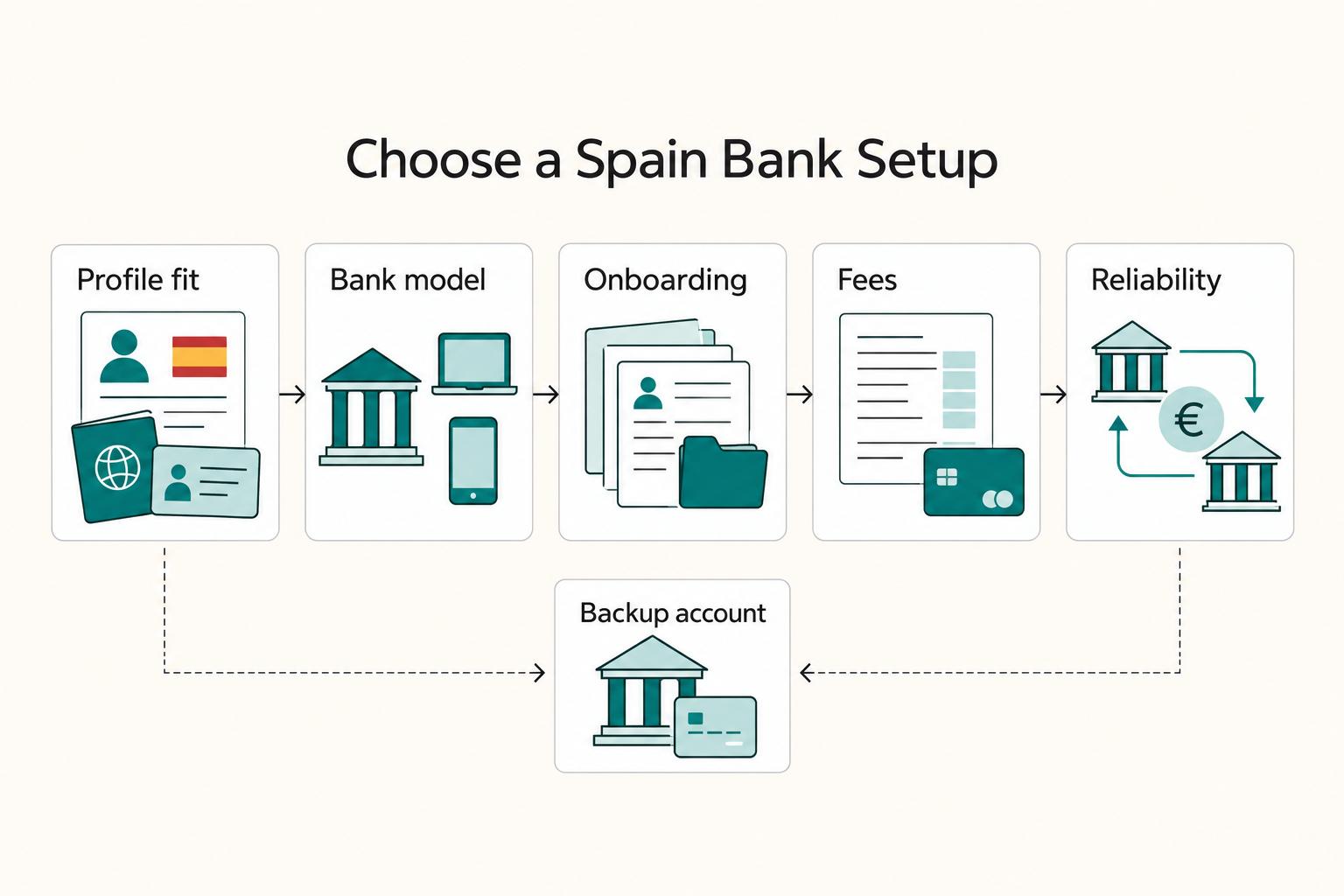
The best freelancer account in Spain depends on who earns the income and how the money will be used. A sole trader paid in euros has different needs from a limited company collecting dollars or a newcomer who has not yet established Spanish residence. Start with those distinctions, then compare the exact products available to you.
Use your own legal name for an individual account. If clients contract with your company, choose a product that accepts that company as the account holder. A provider’s use of “Business” in the product name does not by itself mean it accepts incorporated companies.
Residence and tax residence also matter to onboarding. Prepare identification, address and tax-residence information, and evidence of your activity where requested. A non-resident personal account is not automatically approved for freelance business use. Check that use explicitly before adding its details to an invoice.
A practical Spain shortlist#
The following comparison uses official product descriptions checked on 3 October 2026. It is a shortlist by purpose, rather than a ranking based on hands-on tests. Features and offers can change; use the current account contract and fee document when applying.
| Product | Useful starting point | Important distinction |
|---|---|---|
| Santander Cuenta Negocios | A Spain tax-resident individual seeking an autónomo account | Its published eligibility is for adults who are individuals and tax resident in Spain. |
| BBVA Cuenta Autónomos Bienvenida | A new autónomo customer comparing a Spanish bank account | The product offers online and branch onboarding; transfer inclusions depend on currency, channel and type. |
| N26 Business | A self-employed individual operating under their own legal name | Not an incorporated-company account; existing N26 account status affects the opening route. |
| Revolut Pro | An eligible individual running self-employment or a small business without employees | Not available for legal entities or partnerships. |
| Revolut Business | A company seeking a separate business account and broader business tools | Apply the current company, country and activity eligibility requirements. |
| Wise Business | International client receipts, currency conversion and payments | A European payment account, with safeguarding rather than bank deposit insurance. |
Santander: start with the autónomo product#
Santander’s Cuenta Negocios publishes no maintenance fee or linked-payment conditions, and a debit card without issue or maintenance fees. Its eligibility description is for individuals over 18 who are tax resident in Spain. This makes it a relevant candidate for that profile, rather than a blanket recommendation for every non-resident freelancer.
Read the linked precontractual information and fee document for transfers, currency conversion, cash use and optional services. A zero maintenance fee does not mean every transaction or additional product is free. If you are opening a different Santander account, use that product’s terms instead.
BBVA: compare the included payment channels#
BBVA’s Cuenta Autónomos Bienvenida is offered to new autónomo customers through online and branch onboarding. The page advertises no account administration or maintenance fee and an included debit card without issue or maintenance fees.
Its transfer conditions include specified standard and instant transfers in euros, Swedish kronor and Romanian lei within the EEA through the listed digital channels; some transfer types are excluded. Check the full conditions for your particular route. A client paying dollars or a transfer outside those inclusions needs a separate cost comparison.
If you need cash deposits or help with documents, ask the bank how those tasks work for the exact account. Compare the services you will actually use rather than assume all accounts at a branch bank provide the same service.
N26: an account for a self-employed individual#
N26 Business is designed for self-employed people operating under their own legal name. The company name cannot replace the individual’s name on the account or card. That is the key eligibility distinction for a freelancer who later incorporates.
The Spain comparison page lists Business Standard as free, with a virtual debit card and two free eurozone ATM withdrawals. Paid tiers add different features. Review current charges for a physical card, withdrawals beyond the allowance, and foreign-currency cash use. Do not apply a fee from a German page or an old balance-charge policy to the Spanish account.
N26 states that its deposits are covered by the German deposit guarantee scheme up to €100,000 per depositor and institution. Its Business opening conditions also depend on whether you already have an N26 account, so check the current route before applying.
Revolut: separate Pro from Business#
Revolut Pro’s Spain help page describes a product for freelancers, sole traders and self-employed people or small businesses without employees. It excludes legal entities and partnerships. Applications may require evidence of the business activity.
A Spanish limited company should instead evaluate Revolut Business under the company’s actual eligibility. Pro, personal accounts and Business plans have different terms. Compare the Spain price and allowances for the product you can open, including currency conversion, international transfers and payment-acceptance fees if relevant.
Keep payment acceptance separate from holding an account. A fee for taking a client’s card payment is a different cost from converting the received balance or transferring it to another bank. A plan that suits one task may be expensive for the other.
Wise Business: useful for international income#
Wise Business offers international business payment and receiving features. Check the receiving details and currencies available to your Spain-based business, the current setup charge if applicable, and the quote for the actual payment route. Do not assume every currency has local receiving details or that every type of incoming payment is supported.
Wise Europe explains that it is a payment institution, not a bank. It safeguards customer funds separately from its operating money using cash and low-risk liquid assets. Its payment services are not covered by the Belgian deposit guarantee scheme. This differs from insured bank deposits; investment features have their own terms and protections.
For a freelancer paid in foreign currencies, Wise can be a candidate for the international leg while another eligible account handles euro expenses and administrative payments. That is an operating choice to test, not a requirement to hold both products.
Check Spanish administrative payments without assuming an ES IBAN rule#
Banco de España’s IBAN guidance explains that an eligible euro payment account in another EU country should not be rejected merely because of its IBAN country. A Spanish IBAN is therefore not a universal condition for ordinary SEPA transfers and direct debits.
For tax and social-security payments, confirm the accepted method for the exact procedure, including any participating-entity or account-holder requirements. A bank’s ability to send a SEPA transfer does not prove it supports every administrative payment workflow. Have your gestor check the method and required account details before a deadline.
If an ordinary euro transfer or direct debit is rejected solely because of an EU IBAN, retain the rejection and use the appropriate complaint route. Banco de España’s guidance identifies the responsible authority by the parties involved.
Compare your monthly costs with a worked example#
Make one list of expected receipts, transfers, conversions, card spending and cash withdrawals. Calculate costs using the current Spain contract or route quote. Include fixed plan fees and separate transaction fees, without counting the same conversion cost twice.
For illustration, suppose one option charges €10 monthly plus €8 for your normal international receipt and conversion, while another charges €22 for that same route with no monthly fee. At one such receipt a month, the totals are €18 and €22. At three, they are €34 and €66. These are hypothetical charges, not provider prices; the calculation shows why your payment pattern can change the cheaper choice.
Also compare the amount actually delivered in euros, with the same source amount and quote time. A headline “no transfer fee” can still leave a different result because of the exchange rate, intermediary charges, or the receiving bank’s fee.
Make a backup usable#
A second account helps only if you can access it and it contains enough available funds to cover the expenses you are protecting. Keep authentication and recovery details current, and test a small transfer to the people or businesses you may need to pay. Two accounts at the same institution may share a service interruption.
Keep a near-term expense buffer sized to your actual rent, supplier and other commitments. Pending receipts are not available cash. A backup does not release money held at the primary account and must not be used to evade a legal restriction.
Before replacing the main account, test an incoming client payment, a normal outgoing transfer, statement export, and your relevant administrative payment method. Test cash access only if you need it. Keep the existing account active until the new arrangement works and pending payments or mandates have been accounted for.
If a transfer has an unknown result, trace it with the bank before sending the same payment from the backup. An outage or missing notification is not proof that the first transfer failed. Give clients accurate payment details and a clear date when any change takes effect.
Frequently Asked Questions
Which account is best for a freelancer in Spain?
Start with your account-holder type and payment pattern. A euro-focused autónomo can compare Santander, BBVA and N26 Business; international income may justify comparing Revolut or Wise Business. The best fit is the eligible product that supports the payments you need at a sensible total cost.
Can a Spanish limited company use N26 Business or Revolut Pro?
These products are designed for individuals, not incorporated companies. A company should choose a company-eligible account, including an eligible Revolut Business product or another bank or payment provider’s company account.
Do I always need a Spanish IBAN?
No. An eligible EU euro account should not be rejected solely because its IBAN is from another EU country for ordinary SEPA transfers or direct debits. Verify the separate requirements of the specific tax or social-security payment procedure you use.
Is Wise Business a bank account with deposit insurance?
Wise Europe is a payment institution. Its payment account uses safeguarding and is not covered by the Belgian bank deposit guarantee scheme. Review the protection of the particular product rather than treat safeguarding as deposit insurance.
Can a non-resident open any of these accounts?
Eligibility is product-specific. Santander’s autónomo Cuenta Negocios description requires Spanish tax residence. For another account, confirm residence, accepted documents and permitted business use before applying; a non-resident personal account is not automatically suitable.
Try a related tool
Researched and edited by the Gruv editorial team. Gruv builds cross-border billing, payouts, and finance-operations software for global businesses.
Sources
Includes 6 external sources outside the trusted-domain allowlist.
- wise.com/es/businesstrusted
- wise.com/es/help/articles/50VrYRVwHcsYeKzvWbjf3n/como...trusted
- bancosantander.es/autonomos/cuenta-onlineexternal
- bbva.es/empresas/productos/cuentas/cuenta-autonomos....external
- clientebancario.bde.es/pcb/es/blog/discriminacion-de-iban-que-es-y-...external
- help.revolut.com/es-ES/help/more/revolut-pro/who-can-use-pro-...external
- n26.com/es-es/cuentas-businessexternal
- revolut.com/es-ES/businessexternal
Educational content only. Not legal, tax, or financial advice.
Related Posts

The Freelance Payment Penalty: A Modeled Audit of Platform Fees, FX Spreads, and Payout Delays
The money rarely disappears through a single, easy-to-spot fee. The real loss is stacked. A marketplace takes its commission, a processor adds a charge for international cards, a bank or payment company converts the currency at a spread, a platform holds the funds before release, and a wire sheds a little to intermediaries on the way in. Each layer looks defensible on its own, but the worker feels the combined result as a smaller deposit and a later payday.

How to Respond to a Subpoena for Business Records
Move fast, but do not produce records on instinct. If you need to **respond to a subpoena for business records**, your immediate job is to control deadlines, preserve records, and make any later production defensible.
A US Expat's Guide to Investing in UCITS ETFs to Avoid PFIC Issues
The real problem is a two-system conflict. U.S. tax treatment can punish the wrong fund choice, while local product-access constraints can block the funds you want to buy in the first place. For **us expat ucits etfs**, the practical question is not "Which product is best?" It is "What can I access, report, and keep doing every year without guessing?" Use this four-part filter before any trade: