
Quick Answer
Yes - social security for autonomos in spain is manageable if you run it as an ongoing control routine. Register in the correct order across Hacienda and TGSS/RETA, make a deliberate base choice knowing annual regularization will reconcile estimates with real income, and confirm your protections with your mutua instead of assuming coverage. Keep dated proof for each filing and payment so audits, benefit requests, and pension coordination are easier later.
Get the sequence, contribution choice, and records right#
Treat your autónomo setup as a control point, not background admin. If you get the sequence, contribution choice, and records right, you cut three expensive problems early: lost quota benefits, surprise regularization bills, and weak benefit claims later.
The theme is simple. Do the administrative steps in the right order, make deliberate contribution decisions instead of defaulting into them, and keep a file that proves what you did if TGSS, your mutua, or a future pension review ever asks.
Register cleanly before you optimize anything#
Start with registration hygiene. The sequencing matters: get your NIE and NUSS in place if needed, then align your Hacienda and TGSS/RETA registrations so dates match. If you do not already have a NUSS (Número de la Seguridad Social), request one before your Social Security filing, because it is the identifier TGSS uses for registration and benefits. Use this checklist and keep the receipts:
| Step | What it is | Key note |
|---|---|---|
| NIE | Get your NIE if you do not already have one. | Used for economic and professional ties in Spain. |
| NUSS | Confirm your NUSS or request one if this is your first time in the Spanish Social Security system. | Request it before your Social Security filing if you do not already have one. |
| Hacienda registration | File your tax registration with Hacienda. | The official guide mentions Modelo 036 or 037, but a BOE order published on 9 January 2025 says Modelo 037 was suppressed, so verify the current valid census form before submitting. |
| TGSS/RETA alta | Register your alta as autónomo with TGSS in RETA. | The Social Security alta should coincide with the Hacienda alta and can be communicated on the day you start or up to 60 days before. |
- Get your NIE if you do not already have one. It is the ID number used for economic and professional ties in Spain.
- Confirm your NUSS or request one if this is your first time in the Spanish Social Security system.
- File your tax registration with Hacienda. The official autónomo guide still mentions Modelo 036 or 037, but a BOE order published on 9 January 2025 says Modelo 037 was suppressed, so verify the current valid census form before you submit.
- Register your alta as autónomo with TGSS in RETA. The official guidance says the Social Security alta should coincide with the Hacienda alta, and it can be communicated on the day you start or up to 60 days before.
- Check the current registration window and penalty consequences before you file.
Your first checkpoint is simple: make sure the activity start date matches across Hacienda and TGSS, then save the filing confirmations, PDFs, and any appointment receipts. Do not treat this as a formality. A clean registration file means the same start date, the same identity details, and a complete trail of proof showing when each filing was submitted.
If anything is inconsistent, fix it before you move on to contribution choices or discounts. A common failure mode is filing tax registration, starting to invoice, and delaying the RETA alta. Official guidance warns that late filing can mean losing quota benefits, facing surcharges, and even administrative sanctions.
A quieter but still costly problem is when the dates exist in both systems but do not line up. The mismatch often becomes visible only later, when a benefit request, regularization, or inspection forces someone to compare the records side by side.
So build a basic document pack from day one. Keep the NIE evidence, NUSS confirmation, Hacienda filing proof, TGSS alta proof, and any receipt showing submission time and date. Store the PDFs in one place with filenames you can understand later.
That is not bureaucracy for its own sake. It makes later checks faster when you need to confirm the exact activity start date, prove that a filing was made on time, or show what was on record when a discount or protection period began.
Choose your contribution base on purpose#
Once your alta is clean, the next real decision is your contribution base. TGSS calculates your cuota from the yearly income you estimate, then carries out an automatic regularización anual de cuotas against your actual net returns. If the estimate was off, you will receive a formal resolution with the result. If you owe extra and do not pay on time, the official surcharge cited is 10% or 20%.
The practical point is that your monthly payment is not the final truth. It is a provisional position that gets tested later against what you actually earned. That makes the contribution decision partly a cash-flow call and partly a risk-control call.
If you estimate too high, you may lock yourself into more monthly outflow than your business can comfortably carry. If you estimate too low, you may be setting up a later top-up when the regularization arrives.
What matters most is the 2026 net-return table for your bracket. Officially published examples run from Bracket 1, up to €670, with bases from 653.59 to 718.94, up to Bracket 12, above €6,000, with bases from 1,928.10 to 5,101.20. Within the allowed range for your bracket, a higher base means higher benefits.
| Factor | Minimum base in your 2026 bracket | Higher base in your 2026 bracket |
|---|---|---|
| Cash flow now | Lowest monthly outflow. Useful if your runway is thin or income is volatile. | Higher monthly outflow. Reduces short-term flexibility. |
| Pension impact | Lower future pension accrual because benefit amounts follow the base. | Stronger pension build because TGSS ties benefits to the contribution base. |
| Temporary incapacity | Lower sick leave calculation if you cannot work. | Higher incapacity benefit because the base is higher. |
In practice, if your income swings month to month, choose conservatively and keep a reserve for regularization instead of stretching your base off one strong quarter. That is usually the more controllable move, especially if your business has uneven billing cycles, delayed client payments, or project-based revenue. A single good month does not automatically justify setting your whole year at a level that becomes hard to sustain.
A useful way to approach the choice is this: first estimate what band you can support without stress. Then decide whether moving higher within that permitted range is worth the tradeoff for stronger benefit build.
The wrong way to do it is the reactive version many people drift into. They pick a figure quickly at registration, never revisit it when income changes, and then treat the annual regularization as a surprise instead of the planned end of the process. The rules already tell you that regularization is coming, so use that fact while you still have room to manage the outcome.
Know what is included, what to verify, and what to keep#
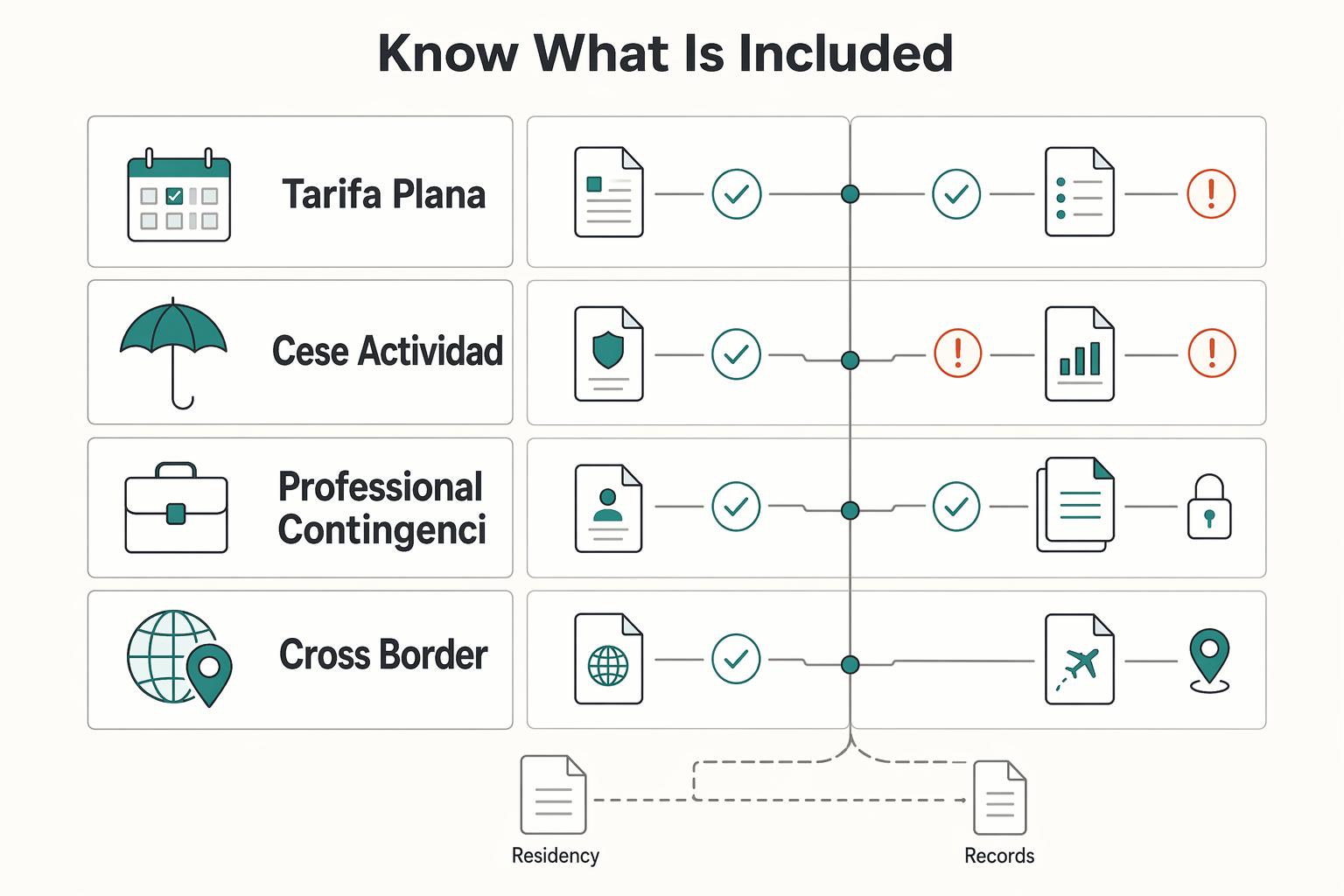
After you choose a base, make sure your protections and paper trail match the risk you are actually carrying. New registrations may qualify for tarifa plana at €80 per month for the first 12 months. Some people can request an extension for 12 more months, and certain protected groups may access 36 more months. Do not rely on that discount until you verify the current eligibility conditions and extension rules.
| Area | Grounded detail | Verify or keep |
|---|---|---|
| Tarifa plana | New registrations may qualify for €80 per month for the first 12 months; some people can request 12 more months, and certain protected groups may access 36 more months. | Verify the current eligibility conditions and extension rules, and keep the confirmation document. |
| Cese de actividad | RETA protection includes involuntary cese de actividad, and the self-employed regime has compulsory protection for cessation of activity. | Verify the current qualifying causes, contribution period, and benefit formula. |
| Professional contingencies | If your work involves travel, shoots, site visits, equipment, or physical risk, confirm how professional contingencies are recorded and covered. | Verify your current mutua and contingency setup. |
| Cross-border coverage | EU coordination or a bilateral agreement may apply; in the EU, you are covered by only one country's legislation at a time, and previous insurance, work, or residence periods can be taken into account when needed. | Keep any Certificate of Coverage that proves exemption from the other country's social taxes. |
That step matters because a discount that exists in principle is not the same as a discount correctly applied to your file. Before you assume your monthly outflow will be reduced, confirm the current requirements, confirm that your registration timing and status fit them, and keep the confirmation document with the rest of your setup records. If the discount affects your budget planning, the proof matters as much as the headline amount.
On coverage, focus on what your file needs to support and what still needs checking. RETA protection includes retirement and protection for involuntary cese de actividad under the applicable rules, and the self-employed regime has compulsory protection for cessation of activity. Do not assume everything will pay automatically.
Verify your current mutua, your contingency setup, and the exact conditions for any claim. If your work involves travel, shoots, site visits, equipment, or physical risk, confirm how professional contingencies are recorded and covered. If you expect to rely on cese de actividad, verify the current qualifying causes, contribution period, and benefit formula before you treat it as a fallback.
The better question is not "am I generally covered?" It is "what would I need to show if I had to claim tomorrow?" That framing changes what you keep.
You want to know which mutua is on record, what contingency setup appears in the file, and whether the paperwork you would need later is already being created now. Claims often become messy not because the event itself is unclear, but because the file was vague, the contingency on record did not match what happened, or the person only started checking conditions after the problem occurred.
If you have prior contributions in another country, first check whether EU coordination or a bilateral agreement applies. In the EU, you are covered by only one country's legislation at a time, and previous insurance, work, or residence periods can be taken into account when needed. Where an agreement applies, a Certificate of Coverage can prove you are exempt from the other country's social taxes.
Keep your NIE and NUSS records, Hacienda filing proof, TGSS alta, monthly cuota debits, annual regularization resolutions, mutua paperwork, and any Certificate of Coverage. Those documents matter in audits and future pension claims.
For cross-border cases especially, assemble the file before anyone asks for it. Years later, the hard part is rarely understanding that a coordination rule exists. The hard part is proving which country covered you at a given moment and producing the documents that support that answer.
Your next move depends on where you are:
- Newly registered: verify the current Hacienda form, line up dates across Hacienda and TGSS, and confirm whether you qualify for tarifa plana before first billing.
- Variable income: use the 2026 bracket table, choose a base you can sustain, and set aside cash for annual regularization.
- Cross-border freelancer: check whether an EU rule or bilateral agreement applies, then build a clean evidence file before you need to prove coverage years later.
If you want a deeper dive, read Japan Digital Nomad Visa 2026: Six-Month Planning Runbook. For a quick next step, try the free invoice generator.
Conclusion: Keep your registration, base, and coverage current#
The useful way to leave this is with a control loop, not a slogan. Your job is to keep three things current: your RETA registration file, your provisional contribution choice, and the protections your file actually gives you when something goes wrong.
| Action | Timing or rule | Record or check |
|---|---|---|
| Alta (RETA registration) | Can be filed up to 60 calendar days before activity starts. | Keep the submission receipt and confirmation PDF. |
| Baja (deregistration) | Follows a 3 calendar day structure. | Keep the submission receipt and confirmation PDF. |
| Data changes | Follow a 3 calendar day structure. | Keep the submission receipt and confirmation PDF. |
| Base changes | TGSS allows base changes up to 6 times per year. | Each request requires expected monthly net returns; store declarations and confirmations. |
| Cese de actividad review | Example rule given: 12 months in the prior 24 months for cese benefit eligibility. | Confirm the coverage scope on record and check access conditions. |
Start with registration hygiene. You are directly responsible for alta, baja, and data-change notices, so keep the submission receipt and confirmation PDF each time, not just a bank debit or a screenshot. Timing matters in the TGSS rules cited here. RETA registration can be filed up to 60 calendar days before activity starts, while deregistration and data changes follow a 3 calendar day structure.
A common failure mode is leaving an address, activity date, or status unchanged and only discovering the mismatch when a regularization or claim arrives. The fix is usually not complicated, but it is always easier when you can see the last confirmed filing and the exact date it was made.
Treat your cuota the same way you treat cash-flow forecasts. Under current rules, your chosen base is provisional and later regularized against your real annual net returns, so delaying reviews can create avoidable catch-up adjustments. TGSS allows base changes up to 6 times per year, and each request requires you to declare expected monthly net returns.
On protection, remember that cese de actividad is compulsory in RETA, but you still need to confirm the coverage scope on record and check access conditions, including minimum contribution-period rules, for example, 12 months in the prior 24 months for cese benefit eligibility. Paying into the system and understanding what your file will support are related, but they are not the same job.
For the next review cycle, keep this short checklist:
- Verify your current contribution setup against the 2026 TGSS table and your expected net returns before each change request.
- Confirm your recorded coverage for health care, temporary incapacity, retirement, and cese de actividad.
- Update data records and store receipts, net-income workings, and base-change declarations and confirmations.
If you also have another-country contribution history, align your Spanish record with that file and keep your Certificate of Coverage or equivalent agreement documents together. That way, if you later need to prove coverage, explain an exemption, or support a pension review, you are working from a prepared file rather than from memory.
That is enough to run this well: verify, adjust, document, repeat. Done on a schedule, it becomes a manageable compliance routine instead of a surprise cost.
Related: Tax Guide for Digital Nomads in Thailand.
Frequently Asked Questions
How much is social security for autonomos in spain each month?
Spain's current autonomo income bands and monthly cuota amounts are subject to change. For budgeting, treat the amount as variable and confirm the current official rules before you rely on a number.
Does your RETA payment cover unemployment, sick leave, and work-related issues?
The exact protections a RETA payment includes can vary by scenario. Check your current coverage and get written confirmation before you rely on unemployment, sick-leave, or work-related protection.
Can you get tarifa plana as a new autónomo?
Possibly, but verify it before you rely on it. The current amount, duration, extension rules, and eligibility criteria can change, so confirm the live rules before you build your budget around a reduced quota.
If you have contributions in another country, can they help with your pension?
Often yes, if coordination rules or a bilateral agreement applies to your case. For the U.S., the Social Security Administration says Totalization agreements have two main purposes: eliminating dual social security taxation on the same earnings and helping fill gaps in benefit protection, and the U.S.-Spain agreement has been in force since April 1, 1988. In agreement-based cases, a certificate of coverage can be required through a country-specific process, so confirm the current procedure for your countries and keep your records together. If you need the mechanics, see What is a 'Certificate of Coverage' for Social Security Totalization Agreements?.
How should you calculate the income figure used for your band?
The exact income-calculation formula used for autonomo contribution bands in Spain can change. Use current official guidance for the figure definition, and keep the working paper you used in your records.
Can you change your contribution base or income estimate during the year?
Whether, when, or how often you can change your contribution base or income estimate during the year in Spain can vary. Confirm the current request windows and effective dates in official guidance before making changes.
Try a related tool
Researched and edited by the Gruv editorial team. Gruv builds cross-border billing, payouts, and finance-operations software for global businesses.
Sources
- employment-social-affairs.ec.europa.eu/policies-and-activities/moving-working-europ...trusted
- employment-social-affairs.ec.europa.eu/policies-and-activities/moving-working-europ...trusted
- ofac.treasury.gov/faqs/all-faqstrusted
- portal.seg-social.gob.es/wps/wcm/connect/importass/importass_contenid...trusted
- portal.seg-social.gob.es/wps/portal/importass/importasstrusted
- sede.policia.gob.es/portalCiudadano/_es/tramites_extranjeria_tra...trusted
- ssa.gov/international/CoC_link.htmltrusted
- ssa.gov/international/Agreement_Pamphlets/documents/...trusted
Educational content only. Not legal, tax, or financial advice.
Related Posts

Japan Digital Nomad Visa 2026: Six-Month Planning Runbook
Treat this as your operating model: identify the right mission first, commit to one route, and keep dated records before you make irreversible plans. That is what keeps the rest of your timeline, paperwork, and decisions coherent.

Thailand Tax for Digital Nomads Without Residency Mistakes
The most expensive mistakes here happen before anyone opens a tax return. People pick a visa, assume the tax answer comes with it, then try to rebuild the year from scraps after the fact. By then, the damage is usually not one dramatic error. It is a pile of small gaps: an unverified day count, a transfer with no clear purpose note, invoices that do not line up cleanly with payments, and assumptions nobody wrote down when the facts were still fresh.
A Guide to Local SEO for Freelancers
Run local SEO for freelancers like an operator: build one defensible local entity across Google Business Profile, your website, and your proof, then tighten it over time instead of spraying tactics. As the CEO of a business-of-one, you are not collecting "marketing tasks." You are building an asset you can maintain and defend. The goal is stable visibility and trust, not constant fiddling.