
Quick Answer
Payment platforms can use future transaction volume in revenue-based financing by treating it as a cash-flow and contract issue, not a simple asset pledge. Repayment is usually a percentage of future revenue, so the key checks are durable revenue quality, downside cash impact, remittance mechanics, repayment caps, and any lien, draw, or default rights that could affect operations.
How Revenue-Based Financing Works for Payment Platforms#
Revenue-based financing (RBF) can fit a payment platform with real revenue that wants growth capital without equity dilution. It only works if the repayment structure matches how cash actually comes in.
RBF ties repayment to revenue instead of fixed installments. You repay as a percentage of monthly earnings until a set cap is reached. In common examples, the revenue share is 5% to 25% of monthly gross revenue, and the total cap is often 1.2x to 1.6x of the funded amount. The appeal is straightforward: repayment flexes with performance instead of staying fixed in slower months.
That flexibility does not remove risk. Revenue-share repayment still pulls cash out of operations, and it can shrink the cash you have available to run the business. RBF can also be faster to secure than a traditional loan because evaluation often centers on revenue flow. That speed can come at a higher cost than conventional debt.
Your first real checkpoint is data readiness. Can your team connect revenue data and monthly earnings, and defend the numbers before terms are discussed? If revenue reporting cannot be reconciled, offer comparison is premature. You also need existing revenue for this model to work at all.
This guide uses a practical decision lens:
- Compare offers on repayment economics, not headline funding alone.
- Review contract behavior if performance drops.
- Stress test repayment through slower and rebound periods.
- Confirm product, finance, and legal teams align before signing.
What future transaction volume collateral really means in RBF#
When an RBF provider talks about future transaction volume as collateral, treat that as a cashflow and contract issue, not a simple asset pledge. The real question is where the provider gets paid, how money moves, and what rights the contract gives them if performance weakens.
Read repayment mechanics before security labels#
Start with the economics that actually move cash. RBF is capital advanced in exchange for a percentage of future gross revenue, so repayment rises or falls with performance instead of following a fixed installment schedule.
Then verify how collection works in practice. Some agreements use periodic direct draws from your business account, and that can affect day-to-day cash management even without a formal dispute. Finance should be able to point to the exact clauses for the revenue share, remittance method, and total repayment cap.
Treat security language as practical control rights#
If the agreement uses security language, do not stop at the label. What matters is the operating control those terms can create alongside the remittance structure, especially in lower-revenue periods when payoff can take longer.
Have legal mark three things in the contract: the repayment or remittance clauses, any direct-debit or account-draw authorization, and what the contract allows after underperformance or breach. "No collateral" in a sales conversation does not help if the contract still gives the provider meaningful control over cash movement.
Keep RBF and MCA analysis separate#
Do not blur RBF and merchant cash advance analysis just because the economics can look similar. MCA is often framed as a daily share of card sales, while RBF is usually framed as a share of future revenue.
If the line between them looks fuzzy, classify the deal by actual remittance mechanics and contract rights, not by marketing language. That is what determines the cash impact if transaction volume softens.
Because repayment is tied to future processing activity, your volume forecast needs to be defensible. See Payment Volume Forecasting for Platforms: How to Predict Cash Flow.
Prerequisites to prepare before requesting any RBF term sheet#
Before you ask for pricing, get your internal file in order. Document your baseline financial condition, focus on repayable cash rather than topline growth alone, and test whether a revenue-share structure still works in weaker periods.
Document baseline financial condition#
Build one baseline financial condition file that finance can send without rebuilding it every time. Some RBF programs explicitly document this baseline and assess whether the business could obtain conventional debt in its current condition.
Keep the file easy to review: clear monthly revenue and cash summaries, plus short notes on material swings. If an outside reviewer cannot trace source reports to one summary, clean it up before outreach.
Separate gross volume from repayable cash#
Do not size a potential advance from gross transaction growth alone. Revenue-linked repayment can tighten quickly if operating cash cannot absorb remittances in softer months.
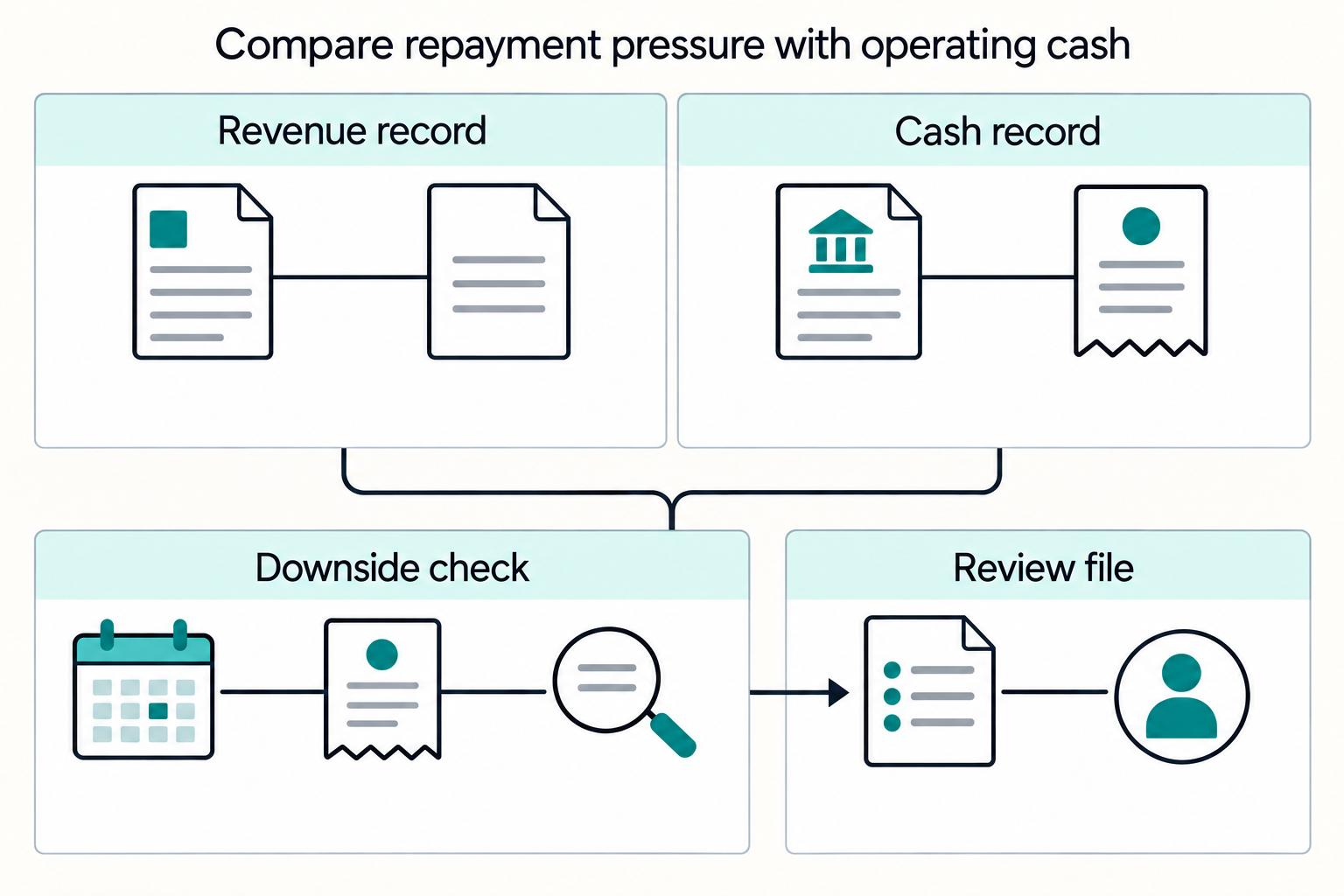
Review sales and operating cash side by side, then run a downside check. If repayment is a fixed share of sales, does cash still clear in a weak month? MCA examples show why this matters. Payments may flex with sales, but short terms (often under 24 months) and high cost can still create pressure.
Align owners before outreach#
Pre-assign ownership so term-sheet discussions stay disciplined. Revenue can own growth assumptions, finance ops can own cashflow and reporting readiness, and legal can own contract-risk review.
| Function | Owns | Pre-call check |
|---|---|---|
| Revenue | Growth assumptions | Forecast assumptions |
| Finance ops | Cashflow and reporting readiness | Remittance cash impact |
| Legal | Contract-risk review | Flag material risk language in draft terms early |
Require written outputs before external calls: forecast assumptions, remittance cash impact, and reporting responsibilities. If legal sees material risk language in draft terms, flag it early.
Pick your provider lane before comparing price#
Choose your initial provider lane before broad outreach so comparisons stay clean. The lane should match how your revenue is generated and how you want underwriting tied to your operating model.
Use the same baseline file and the same weak-month cashflow test in every conversation. That keeps your decision anchored to underwriting reality, not whoever responds first. Related: Usage-Based Pricing for Payment Platforms: Per-Transaction vs. Subscription.
Step 1 map transaction volume quality before you map funding size#
Size from durable cash conversion, not total volume. Some transaction volume can support sales-linked repayment. Some only looks strong because of timing, promotions, or one dominant channel.
That distinction matters because repayment is tied to sales performance. Payments rise in stronger periods and fall when sales weaken, with monthly repayment shares often described around 2% to 3% of gross sales or profits. Flexibility helps, but it does not fix a fragile revenue mix. If your largest segment is also the easiest to lose, size from the durable base, not the headline number.
1. Segment volume by stability tier and channel#
Start by splitting transaction volume into three buckets: recurring, seasonal, and campaign-driven. Then tag each bucket by channel so concentration risk is visible instead of buried in the aggregate.
| Stability tier | What belongs here | What to verify | Why it matters for sizing |
|---|---|---|---|
| Recurring | Repeat buyer cohorts, subscription-like reorder behavior, stable partner demand | Repeat purchase pattern, lower month-to-month volatility, clean payout history | Usually the strongest base for repayment confidence |
| Seasonal | Predictable peaks tied to calendar events or category cycles | Whether peaks repeat and how deep off-season periods get | Can support funding if weak months still clear cash |
| Campaign-driven | Short promotion bursts, paid acquisition pushes, event-driven spikes | Lift duration, refund lag, dispute lag, post-campaign decay | Can inflate current volume but be less reliable over longer repayment paths |
Reconcile segment totals to the same monthly transaction and cash summaries used in your baseline pack. If channel tags double-count orders, or the segment totals do not tie out, pause before you talk about size.
2. Separate high volume but fragile from moderate volume but durable#
The better question is not which segment is growing fastest. It is which segment still converts into retained cash after refunds, disputes, and payout timing are accounted for.
Ask three direct questions:
- Does reported volume convert into retained cash, or do refunds and reversals materially reduce it later?
- Do disputes appear with a lag that could hit after facility sizing?
- Can payout timing slip enough to create cash stress even when sales look healthy?
If a segment repeatedly needs post-period adjustment, treat it as fragile. In sales-linked financing, deterioration in sales quality can stretch repayment and make cash planning harder.
3. Run a one-channel downside for a full cycle#
Before you choose a request size, model a downside case where one meaningful channel underperforms for a full operating cycle. That could be a campaign window, a seasonal period, or your normal repeat interval.
Do not apply only a flat sales haircut. Stress one real channel path, then recalculate net cash after refunds, disputes, and payout delays. That reflects a core RBF tradeoff. The provider is effectively betting on future revenue growth, so you should test what happens if one growth leg misses.
Use this checkpoint: in that downside case, can you still handle remittance without recurring liquidity stress? If repayment only works when promotions bounce back quickly, the target advance is probably too large.
4. Apply the sizing rule before talking price#
Use a conservative sizing rule before you ask anyone for pricing. If more than one critical segment depends on short-lived promotions, reduce the target advance even when aggregate volume looks strong.
That does not automatically kill the deal. It means the dependable borrowing base is smaller than topline suggests. One explainer describes total payback outcomes ranging from about 0.1x to 2.0x of invested capital. When the range is that broad, conservative sizing is usually safer than maximizing nominal offer size up front.
If you need a broader view of platform RBF structures and tradeoffs, see Revenue-Based Financing for Platforms: Alternative to VC and Debt.
Step 2 compare offer mechanics across providers with one scoring table#
Do not compare offers by headline fee alone. Use one shared scorecard, and treat any provider that will not state remittance, default, and control terms in writing as a risk, not a maybe.
For the providers in this section, the current grounding does not support provider-specific claims on remittance basis, repayment caps, minimum payment behavior, default triggers, or legal-control terms. Missing contract detail is not neutral. It is unpriced operating risk.
Build one table and treat unknowns as risk#
Mark those fields as unknown until you have written terms.
| Provider | Remittance basis | Repayment cap structure | Minimum payment behavior | Default triggers | Legal-control fields | Special modeling note |
|---|---|---|---|---|---|---|
| Shopify Capital | Unknown (require written term sheet) | Unknown (require written payoff logic) | Unknown (require written floor/catch-up terms) | Unknown (require written default language) | Unknown (require explicit lien scope, sweep/draw rights, cure periods, amendment flexibility) | No presumed advantage without documentation |
| Stripe Capital | Unknown (require written term sheet) | Unknown (require written payoff logic) | Unknown (require written floor/catch-up terms) | Unknown (require written default language) | Unknown (require explicit lien scope, sweep/draw rights, cure periods, amendment flexibility) | If Stripe is your payment stack, model payment fees separately |
| Clearco | Unknown (require written term sheet) | Unknown (require written payoff logic) | Unknown (require written floor/catch-up terms) | Unknown (require written default language) | Unknown (require explicit lien scope, sweep/draw rights, cure periods, amendment flexibility) | No presumed advantage without documentation |
| Wayflyer | Unknown (require written term sheet) | Unknown (require written payoff logic) | Unknown (require written floor/catch-up terms) | Unknown (require written default language) | Unknown (require explicit lien scope, sweep/draw rights, cure periods, amendment flexibility) | No presumed advantage without documentation |
| Uncapped | Unknown (require written term sheet) | Unknown (require written payoff logic) | Unknown (require written floor/catch-up terms) | Unknown (require written default language) | Unknown (require explicit lien scope, sweep/draw rights, cure periods, amendment flexibility) | No presumed advantage without documentation |
| Storfund | Unknown (require written term sheet) | Unknown (require written payoff logic) | Unknown (require written floor/catch-up terms) | Unknown (require written default language) | Unknown (require explicit lien scope, sweep/draw rights, cure periods, amendment flexibility) | No presumed advantage without documentation |
| Capital by Walmart | Unknown (require written term sheet) | Unknown (require written payoff logic) | Unknown (require written floor/catch-up terms) | Unknown (require written default language) | Unknown (require explicit lien scope, sweep/draw rights, cure periods, amendment flexibility) | Any native-channel data advantage is unverified until written terms are provided |
| Amazon Lending | Unknown (require written term sheet) | Unknown (require written payoff logic) | Unknown (require written floor/catch-up terms) | Unknown (require written default language) | Unknown (require explicit lien scope, sweep/draw rights, cure periods, amendment flexibility) | Any native-channel data advantage is unverified until written terms are provided |
Convert every offer into one monthly cash-impact view#
Once you have the table, convert each offer into the same month-by-month cash model using your Step 1 base, downside, and rebound cases. Compare operating cash burden, not just quoted pricing.
If Stripe is part of the setup, include the fee layers that can move monthly cash:
| Fee item | Amount | When it applies |
|---|---|---|
| Successful domestic card transaction | 2.9% + 30¢ | Per successful domestic card transaction |
| International card add-on | 1.5% | Add-on for international cards |
| Currency conversion add-on | 1% | If currency conversion is required |
| Connect monthly active account | $2 | In Connect "you handle pricing" mode, per monthly active account |
| Connect payout sent | 0.25% + 25¢ | In Connect "you handle pricing" mode, per payout sent |
| Instant Payouts | 1% of payout volume | For Instant Payouts |
| Managed Payments | 3.5% per successful transaction | In addition to standard processing fees |
Stripe also notes that fees can change. Country-level pricing can supersede listed examples, so verify current fee schedules before final scoring.
Apply the hard filter#
Use a hard filter before you spend more time negotiating:
- Request the written term sheet, agreement draft, fee schedule, and the clauses defining remittance, default, amendment, and control rights.
- Mark any missing field as unknown, not favorable.
- Compare all providers in one monthly cash-impact model.
- Remove any provider that will not make default and control terms explicit in writing.
Related reading: Net Payment Terms for Platforms: How to Offer Net 30 60 90 and When to Use Each.
Step 3 stress-test repayment timing under base, downside, and rebound cases#
After offers are on the table, repayment timing matters more than headline price. If the downside case creates recurring liquidity stress, you may need a smaller advance or a different structure.
Step 3.1 Build three revenue paths from the signed payment formula#
Model repayment timing from the signed terms that actually control cash movement: the revenue definition, remittance rate, and repayment cap. In RBF, repayments are a fixed share of future revenue, so payoff speed rises and falls with sales volume.
Build three monthly paths for each shortlisted offer:
- Base case: expected volume path.
- Downside case: trough period with weaker volume.
- Rebound case: recovery path and faster paydown.
For each month, calculate remittance from the contract formula and track cumulative payments to the cap. If the agreement uses gross sales, net sales after returns, subscription revenue, or another base, use that exact base with the stated rate. Do not swap in market averages.
Published examples vary, including caps around 1.5 to 3 times funded amount and revenue-share examples of 2% to 10% of monthly revenue in one source and 5% to 15% in another. If you are comparing a different financing structure, run the same three paths and map payment timing directly from that agreement.
Step 3.2 Shift channel mix and measure timing sensitivity#
Do not stress only topline volume. Changes in the revenue mix used by the contract can also affect payoff timing, even when total sales stay flat.
Re-run base, downside, and rebound cases with different mix assumptions using your own data. A useful check is to hold total monthly sales constant, shift the revenue mix that feeds the contract formula, and compare months to payoff. If timing changes materially from mix shifts alone, treat that as a cash-timing risk and size to the weaker path, not the optimistic blend.
Step 3.3 Run a monthly liquidity checkpoint before approving the offer#
Before you approve any offer, run a month-by-month survivability check after each modeled remittance. Confirm you can still cover:
- payout obligations under your internal policies
- reserve targets
- core operating spend
Also review downside control terms carefully. Blanket UCC liens, weekly minimums, and discretionary defaults can turn a slower-pay scenario into immediate liquidity pressure even when headline pricing looks acceptable.
A practical red flag is repeated months that force emergency cuts, delayed payouts, or reserve drawdown to stay current. If that appears in the downside case, reduce size, renegotiate structure, or walk away.
For a step-by-step walkthrough, see Event Sourcing for Payment Platforms: How to Build an Immutable Transaction Log.
Step 4 review lien, control, and default terms before legal approval#
If the downside case still works, the next decision is contract-control risk. Before signing, have counsel mark what this specific agreement says about filings, account control, and default-related actions. Do not assume these terms are standardized across RBF agreements.
Step 4.1 Redline control terms, not just economics#
Do not stop at the economics. If present in the contract, redline clauses that can change how the business operates: UCC filing language, blanket-lien wording, account access or control provisions, and default language with broad discretion.
If a clause could affect cash access or operating freedom, require it to be marked directly in redline. Verbal explanations are not enough if they do not appear in the signed text.
Step 4.2 Map post-breach operations from the actual contract#
Ask one plain-language question: what happens operationally after a covenant breach under this exact agreement? Do not assume standard timelines or remedies.
Have legal extract what the contract says about:
- notification timing
- cure windows
- account or draw rights
- suspension, termination, or continuation paths
If any of these are missing, inconsistent, or buried, mark them as unresolved.
Step 4.3 Review jurisdiction-specific paper instead of assuming consistency#
If this deal may be signed in multiple states (for example, Virginia, New York, Utah, or California), ask counsel to compare the exact agreement and disclosures for each state. Use that comparison to identify whether wording differs, whether addenda apply, and whether notice requirements are explicitly stated. If jurisdiction-specific variation exists and the operational impact is still unclear, pause approval.
Step 4.4 Require a one-page legal-risk summary before sign-off#
Before final acceptance, ask legal for a one-page summary with three buckets:
- Clear in contract: rights and obligations stated in the signed text
- Limited or conflicting: terms that may conflict with law, disclosures, or other contract language
- Unclear: terms dependent on ambiguity, missing definitions, or jurisdiction questions
Use that page as the sign-off gate. If too much remains in Unclear, the deal is not ready.
Step 5 implement repayment operations in your money movement stack#
Once you sign, repayment has to run as an operating process, not just a finance assumption. In RBF, repayment is a percentage of revenue, so the amount moves with sales.
Step 5.1 Define your repayment basis clearly#
Start by locking one clear repayment basis: which revenue data you use, which period it covers, and which percentage applies. One documented implementation pattern is to connect revenue data first, then run automatic repayment from that agreed basis.
Keep the rule explicit so finance and ops can explain each remittance cycle without reinterpreting inputs. Consistency matters more than complexity here.
Step 5.2 Align repayment timing to revenue cycles#
Match your remittance rhythm to your actual revenue cycle so cash flow stays manageable. This matters with variable repayment because the payment amount changes with sales performance.
Use the contract math as your control check every cycle. The same percentage can produce very different payment amounts as revenue moves.
Step 5.3 Monitor cash impact as an operating signal#
Revenue-share repayment reduces available cash, so track that impact continuously, not just at month end. Compare expected versus actual remittance each cycle so mismatches are identified early.
When cash timing drifts from plan, treat it as an operating issue and fix it early. Waiting turns normal variability into avoidable pressure.
Step 5.4 Keep platform controls explicit before scale#
If you use Gruv modules, confirm what is enabled for your program and document how repayment operations map to your team's close process. Specific remittance-control mechanics can vary by provider and contract, so keep ownership and review steps explicit as volume grows.
Failed transactions can shrink the volume base lenders underwrite. See Revenue Leakage from Payment Failures: How Much Are Failed Transactions Really Costing Your Platform?.
Step 6 decide when RBF is the right tool and when it is not#
RBF is generally a better fit when you already have revenue, a consistent sales history, and enough room in cash flow for variable repayment. It is a weaker fit when those basics are missing, because revenue-share payments still reduce available cash.
Step 6.1 Verify that your revenue base is stable enough#
Start with the readiness check that matters most: do you meet the revenue thresholds, and is your sales history consistent? If not, pause before signing.
Then model repayment in plain numbers. At a 5% revenue share, payment changes with revenue: $1,000 on $20,000 monthly revenue versus $3,750 on $75,000. That flexibility only helps if both scenarios still work inside your operating budget.
Step 6.2 Choose RBF for non-dilutive speed only when the tradeoff is worth it#
RBF is often positioned as non-dilutive, and some providers market funding in as little as 24 hours. That can be useful when speed and ownership matter and your revenue can support repayment.
Keep the tradeoff explicit: revenue share reduces available cash, and RBF can cost more than traditional debt. Compare funding amount, fees, and repayment terms across options, not just against equity.
Step 6.3 Stop if key stakeholders cannot explain the deal the same way#
A deal is not ready if stakeholders cannot explain it in the same terms. Before signing, make sure the funding amount, fees, revenue-share percentage, repayment basis, and cash impact in slower periods are modeled and understood the same way. If those points are not clear, do not sign yet.
If your go or no-go hinges on whether repayment operations stay controllable in downside months, review how Gruv Payouts can support policy-gated execution and status visibility.
Common mistakes that create hidden balance-sheet surprises#
Once RBF looks viable, surprises can still come from contract controls and operating gaps, not just the headline fee. A deal can look flexible in the model and still become much harsher when sales slow or operations slip.
Step 1 Re-rank offers by contract control, not fee alone#
A cheaper-looking offer can still be riskier if it includes a Blanket UCC lien, weekly minimums, or discretionary default language. Downside risk is shaped by what the provider can do when performance slips, not just by the repayment cap.
Use one shortlist view that includes the total payback cap, remittance rate, any minimum-payment behavior, default triggers, and control terms. Before sign-off, legal and finance should be able to point to the exact clause for each item. If a provider will not make those controls explicit in writing, move it down the list.
Step 2 Recut sizing on conservative volume paths#
Optimistic forecasting can understate risk. Because repayment is tied to revenue, slower sales can stretch repayment even when the total obligation remains a multiple of the amount funded, and some structures may not have a set end date.
Rerun terms on a downside case, not just a base case. Check the 180-day cash position and effective APR under weaker volume, then ask whether the business still clears payroll, refunds, and core spend. If the model only works under strong performance, the advance is too large.
Step 3 Assign one owner for pre-signing checks before launch#
Do not split accountability for pre-signing checks and assume gaps will self-correct. Assign one finance ops owner to track remittance assumptions, exceptions, and contract red flags through approval.
Use a practical check: each required item should map to a clear contract clause and the downside-case model before execution.
Step 4 Write down legal and contract assumptions before board approval#
Do not assume every term is clear from headline economics alone. Ask counsel for a short memo that states working assumptions, key caveats, and any clauses that remain unclear.
The memo does not need to resolve every edge case. It does need to give the board a clear record of what is known, what comes directly from the contract language, and what remains uncertain.
Make the decision with a copy-paste checklist#
Do not make the call on headline fee alone. Make the go or no-go decision only after this checklist clears evidence quality, repayment survival, legal control terms, and launch ownership.
| Step | Focus | Decision check |
|---|---|---|
| 1 | One evidence file for revenue and cash-flow assumptions | Finance, growth, and legal agree on durable versus promotional revenue |
| 2 | One sheet across economics, control rights, and repayment mechanics | Remove any provider that will not define minimum-payment behavior and setoff rights clearly |
| 3 | Base, downside, and rebound modeling | Survive the downside without recurring cash stress or relying on an immediate rebound |
| 4 | Legal redline of payment-control terms | Keep the legal output explicit: enforceable, not enforceable, or unclear |
| 5 | Named owners, monitoring, and an exception process | Team can trace remittances and close support without ad hoc workarounds |
1. Confirm your transaction evidence is decision-grade#
Before comparing any RBF offer, align on one evidence file that documents the revenue and cash-flow assumptions you are using. Decision test: finance, growth, and legal all agree on what revenue is durable versus promotional, instead of sizing from gross volume alone.
2. Compare offers in one table across economics, control rights, and repayment mechanics#
Put every shortlisted offer into one sheet and force written clarity on minimum-payment behavior and setoff rights. If a provider will not define those terms clearly, remove it from the shortlist.
Use contract structure, not sales summaries, for verification. As a practical redline pattern, check the payment section, any minimum-amount language, and any setoff or payment-sharing language, then verify the exact clauses in your own draft.
3. Run base, downside, and rebound scenarios and check liquidity survival#
Model all three cases before approval. MCA-style structures can remit as a percentage of daily card sales, so payments can move with sales volume. Some revenue-based products work this way, while others can impose fixed installments.
Decision test: you can survive the downside without recurring cash stress or relying on an immediate rebound. Confirm whether the contract includes fixed scheduled payments or an absolute repayment obligation.
4. Complete legal redline before executive sign-off#
Review payment-control terms together and keep the legal output explicit: enforceable, not enforceable, or unclear. If lien or cure/default terms are material to your decision, confirm the exact wording in your own draft before sign-off.
Jurisdiction and contract terms matter because legal treatment is not uniform, and commercial-financing disclosure rules can vary by jurisdiction.
5. Launch only with named owners, monitoring, and an exception process#
Assign clear ownership for reconciliation and provider communications, and document exception handling before go-live.
Decision test: your team can trace remittances and close support without ad hoc workarounds. If that traceability is missing, the deal is not operationally launch-ready.
When your team is ready to validate fit across controls, reconciliation, and rollout constraints, contact Gruv for a practical architecture review.
Frequently Asked Questions
How does repayment change when transaction volume falls?
Repayment usually falls with revenue because RBF is typically a defined share of sales rather than a fixed installment. When volume drops, remittance amounts can drop too, but payoff can take longer because the cap still has to be reached. Check whether the clause is based on gross revenue and how often remittance is collected.
Is future transaction volume actually collateral?
This guide does not support a single, universal collateral treatment for future transaction volume. It frames the issue as cash flow and contract rights. Focus on the exact remittance, lien, draw, and remedy terms in the agreement rather than the label.
Which contract terms matter most before signing?
Prioritize repayment cap logic, remittance rate, minimum-payment behavior, default triggers, and any lien or security clauses. Hidden control terms can change downside risk, including blanket UCC language, weekly minimums, or discretionary defaults. Legal and finance should be able to point to the exact clause for each one before approval.
How is RBF different from fixed-payment debt?
Traditional debt usually uses fixed scheduled installments. RBF repayment commonly rises and falls with revenue performance instead. That flexibility can help in slower periods, but it can also extend payoff duration.
Which platforms most often show integrated access points today?
This guide does not support a definitive current platform list. Treat any list as time-sensitive and verify directly in current provider product documentation and contract terms. The practical test is whether the provider can reliably access the revenue data your business actually runs on.
What is still unknown even after a strong term sheet review?
A strong term sheet can clarify economics and key controls, but it does not remove all uncertainty. Enforcement behavior, underwriting assumptions, and downside outcomes remain agreement-specific. Keep those residual risks explicit before final sign-off.
How should you sense-check the repayment math before saying yes?
Run a simple base case, then a downside case using the actual contract formula. The guide gives an example where a €50,000 advance with an 8% fee implies a €54,000 cap, and a 10% remittance rate may look manageable in base conditions but stretch if revenue drops. The real test is whether slower repayment still fits alongside core cash obligations.
Researched and edited by the Gruv editorial team. Gruv builds cross-border billing, payouts, and finance-operations software for global businesses.
Sources
- cftc.gov/sites/default/files/idc/groups/public/@swaps...trusted
- community.lawschool.cornell.edu/wp-content/uploads/2020/12/Avraham-Sebok-fin...trusted
- fdic.gov/bank-financial-reports/051-glossary-december...trusted
- fdic.gov/resources/supervision-and-examinations/exami...trusted
- federalregister.gov/documents/2026/03/27/2026-05959/regulatory-c...trusted
- federalreserve.gov/publications/fr-y-14-qas/fr-y-14-qas-fr-y-14...trusted
- federalreserve.gov/publications/2021-april-dodd-frank-act-super...trusted
- occ.gov/news-issuances/bulletins/2025/bulletin-2025-...trusted
Educational content only. Not legal, tax, or financial advice.
Related Posts

The Freelance Payment Penalty: A Modeled Audit of Platform Fees, FX Spreads, and Payout Delays
The money rarely disappears through a single, easy-to-spot fee. The real loss is stacked. A marketplace takes its commission, a processor adds a charge for international cards, a bank or payment company converts the currency at a spread, a platform holds the funds before release, and a wire sheds a little to intermediaries on the way in. Each layer looks defensible on its own, but the worker feels the combined result as a smaller deposit and a later payday.

How to Respond to a Subpoena for Business Records
Move fast, but do not produce records on instinct. If you need to **respond to a subpoena for business records**, your immediate job is to control deadlines, preserve records, and make any later production defensible.

A US Expat's Guide to Investing in UCITS ETFs to Avoid PFIC Issues
The real problem is a two-system conflict. U.S. tax treatment can punish the wrong fund choice, while local product-access constraints can block the funds you want to buy in the first place. For **us expat ucits etfs**, the practical question is not "Which product is best?" It is "What can I access, report, and keep doing every year without guessing?" Use this four-part filter before any trade: