
Quick Answer
Reconcile each platform refund from original payment through verified execution, actual fees, seller recovery where applicable, and posted accounting. Keep recognition dates distinct from later payout and bank settlement. Choose ledger-first, ERP-first or a reviewed spreadsheet bridge based on the controls and evidence your team can maintain.
Connect refund status to one ledger truth#
If you treat commerce orders, payment activity, settlement data, and bank deposits as separate truths, your refund accounting can drift even when each source looks internally consistent. Refund reconciliation is more reliable when you model those records as one connected chain from customer event to payout impact to General Ledger (GL) entry.
At a basic level, reconciliation means matching transaction records. For platform operators, the problem is that a single refund rarely lives in one place. It can start in a commerce or product surface, move through a gateway, get netted inside a payout, and land in the bank as part of a smaller aggregate deposit. The difference between a usable approach and a prettier report is whether you can verify one refund across all of those states without letting any one feed behave like its own ledger.
Reconcile the actual fees and balance transactions, not a percentage calculated from the refund amount. For example, Stripe’s U.S. standard card price is 2.9% plus USD0.30, but its standard refund terms retain the original processing, Connect and currency-conversion fees. A retained fee can be correct rather than a missing reversal. Bank-transfer refunds or custom contracts can have different charges; use the effective account contract and transaction evidence.
This article is for teams already feeling the pressure between finance accuracy and operational speed. That pressure often shows up in payout netting, processor-fee handling, dispute-adjacent exceptions, and clean ERP posting. It walks through operating models with explicit tradeoffs instead of demo language.
Separate the customer refund, recovery from a seller or connected account, application-fee refund, retained processor fees and payout movement. They are related financial events with distinct references and outcomes, not one automatic reversal.
Selection criteria that separate usable systems from vendor demos#
Use this checklist only if you are reconciling refunds across payment systems, ERP posting, and bank payouts under real close pressure; otherwise, manual workflows may still be enough at low volume.
| Criterion | Require | Grounded detail |
|---|---|---|
| GL traceability | Trace payment, refund, balance entry and posted journal | Use a controller-approved double-entry example for the actual account model |
| Auto-match quality | Test a mixed cohort | Include partial, pending, failed and duplicate refunds |
| Exception handling | Name owners for execution, fees and recovery | Distinguish correctly retained fees from missing expected adjustments |
| ERP compatibility | Verify actual posting coverage | Keep recognition, clearing and bank settlement separate |
| Audit quality | Retain effective contract and original records | Preserve links without rewriting historical evidence |
Require a trace from the original payment to each refund, its processor balance transaction, applicable recovery or fee adjustment, and posted journal. Define the refund schedule as your internal evidence index, not a product feature promised by every vendor.
Validate matching on a cohort with partial refunds, retained fees, approved fee refunds, failed or pending refunds, disputes and cross-period settlement. Require the exact fields and status evidence behind each match.
Require queues for unexplained fee variance, unknown or failed refunds, payout timing differences and missing expected recovery. Preserve original evidence instead of editing totals to force a match.
Ask for approved journal samples and a documented account map. Test gross customer refunds, retained costs, seller liabilities, processor clearing and tax adjustments separately. The platform’s principal or agent model affects which accounts and amounts it recognizes.
Assume pricing inputs can change over time and may vary by country page. Your evidence pack should retain refund ID, processor reference, payout ID, journal ID, and the pricing basis used at the time. If that chain is not available on demand, close review risk is high.
This pairs well with our guide on Invoice Settlement for Platforms That Match Payouts and Close Disputes.
Core architecture choices and tradeoffs before you pick tools#
Pick the status owner first, then pick tools. If refunds are asynchronous and high-volume, ledger-first is usually the safer control pattern; if accounting policy is rigid and ERP posting control is non-negotiable, ERP-first is usually the better fit.
Three patterns that show up in real teams#
| Pattern | Brief description | Where payout netting is resolved | Where retained fees and fee adjustments are reconciled | Failure mode to test early | Key differentiator |
|---|---|---|---|---|---|
| Ledger-first orchestration | An internal ledger or refund schedule owns operational case transitions, with provider and bank evidence linked to GL posting. | In the ledger against balance transactions, payout context and bank evidence as available | Separate actual retained fees, approved fee refunds and recovery entries using effective contract terms | Duplicate webhook events can duplicate state changes without idempotent ingestion; partial refunds can be overstated if only order totals are stored; late bank payout adjustments should remain open timing exceptions until bank evidence arrives. | Strongest when sequencing is complex and you need one control point to absorb asynchronous updates before the GL. |
| ERP-first orchestration | The ERP owns refund status and approval logic, while gateway and operational systems feed posting queues and references. | Inside ERP posting logic or reconciliation queues after source normalization. | Near journal creation, where finance can enforce policy before posting. | In Stripe-to-ERP pipelines, including Stripe-to-NetSuite setups, test duplicate webhook events before import, partial refunds at line level, and late payout adjustments as timing exceptions instead of edits to posted totals. | Strongest when controller signoff and close discipline are the primary constraint. |
| Spreadsheet-bridge orchestration | Finance runs a manual bridge outside core systems, then posts reviewed totals into accounting software. | In analyst-maintained schedules that tie processor activity to bank payouts. | Manually from processor reports and pricing references. | Duplicate imports can hide double counts, partial refunds are often collapsed, and late payout adjustments are easy to patch without preserving evidence. | Fast to launch, but control quality depends on the operator and does not scale cleanly. |
Ledger-first typically handles timing noise better. ERP-first typically gives tighter posting control. Spreadsheet bridges are usually transitional once payout timing and fee structure complexity increase.
Make one book authoritative for status#
One internal system should own the case workflow, while the provider remains authoritative for its execution outcome and the GL for its posted accounting records. Distinguish requested, pending, succeeded, failed and canceled refunds, plus accounting recognition and cash reconciliation. A case marked approved internally is not proof of external completion.
Store actual gross, fee, net, currency, balance-transaction identifiers and the fee terms effective for the original transaction. Do not infer that a refunded customer amount reverses the original processor fees. Keep financial recognition and later bank settlement as separate milestones.
Before committing, test one refund cohort and verify traceability across refund ID, processor reference, payout ID, and journal ID without manual total edits. If that fails for duplicate events, partial refunds, or late payout adjustments, the architecture is not production-ready yet.
You might also find this useful: Improving Credit Card Reconciliation for Platforms: How to Auto-Match Card Charges to Invoices.
Option one using a ledger-first stack#
Pick this option when refund timing and state changes are harder than ERP approval routing. It works best if your team can own idempotent retries, replay logic, and clear refund-state ownership before GL export.
Where this option fits#
Use this model when refunds start in product and then spread across the processor, connected accounts, bank payouts, and ERP posting. The internal ledger owns case state and links the evidence. The processor remains authoritative for execution outcomes, and the accounting system owns posted journals; internal case status does not replace either record.
In Stripe destination charges or separate charges and transfers, the platform balance is debited for refunds; direct-charge refund handling differs. Recovering funds from a connected account uses a distinct transfer reversal where supported. A separate-transfer reversal requires sufficient destination balance, so seller recovery can fail or remain unresolved even when the customer refund succeeds.
Use the payout reconciliation report for automatic payouts, including manual platform payouts when connected accounts use automatic payouts. Other manual-payout flows use balance reporting. Instant payouts require your own transaction-history reconciliation because Stripe cannot identify their included transactions. Preserve a refund’s balance-transaction reference even before a later payout reference exists.
Why operators like it#
A ledger-first design can give finance a consistent evidence chain, but replay safety must be implemented and verified. Persist a durable refund operation ID before submission; reuse the provider-supported idempotency key with the original payload and retain your own history beyond provider key retention. Resolve an unknown external outcome before submitting a replacement refund.
A practical sequence is:
- Persist the approved refund operation and remaining refundable amount before external submission.
- Send the refund once with provider-supported replay controls; an unknown outcome goes to status lookup, not a replacement operation.
- Record provider outcome and its balance transaction; track seller transfer reversal and application-fee refund separately where applicable.
- Post recognition and financial entries at the dates required by the approved accounting policy, preserving pending settlement or recovery.
- Reconcile subsequent payout and bank evidence without duplicating the original journal.
Illustrative posting: if a USD100 customer refund liability has already been recognized and the provider debits USD100 from a positive processor balance, debit refund liability USD100 and credit processor clearing USD100. This clears that recognized obligation rather than recording a second sale reversal. Any retained processing fee and seller-recovery entry remain separate. The controller must approve the earlier recognition entry and account mapping for the actual principal or agent model.
If posting to NetSuite, verify the selected connector and account mapping with actual journal examples. Keep operational execution evidence and GL posting references linked; an integration logo does not establish refund coverage.
What can go wrong#
The tradeoff is implementation discipline. Event-sourced patterns improve auditability, but they add real complexity in replay, ownership boundaries, and exception handling across product, finance, and ops.
Verify signed webhook deliveries, deduplicate event IDs and business effects, and make posting concurrency-safe. Stripe retries live failed deliveries for up to three days, with different sandbox behavior; its event recovery API covers the last 30 days. Test repeated and out-of-order events, partial refunds and refund-versus-dispute races against original refund IDs and remaining refundable amount.
Option two using ERP-first suites for accounting control#
Choose ERP-first when finance needs refund decisions and evidence controlled near journal posting in NetSuite. It fits teams that prioritize close discipline and policy enforcement over faster operational iteration when exceptions appear.
Where this option fits#
ERP-first centralizes accounting rules, journal approvals and reconciliation. Apply the approved recognition policy at the required accounting date, recording pending clearing or recovery where appropriate. Later matching of gateway and bank records confirms settlement and identifies differences; it must not postpone required recognition.
NetSuite Account Reconciliation supports reconciliation compliance, transaction matching, preparer/reviewer workflows and signoff evidence. Its Oracle EPM integration is distinct from assuming every NetSuite ERP account includes that module. Verify licensing, connector coverage, data mappings and the controls enabled in your tenant.
Why finance teams choose it#
The benefit is controlled posting with a clear review trail. Route refund records through the required accounting approvals without waiting solely for a later bank movement. Post policy-required recognition using available evidence and documented pending balances, then match gateway and bank records and review any adjustments separately.
This approach also improves auditability near the journal. Detailed audit trails make period-timing and approval decisions easier to defend during close and review cycles. If your team already runs governance-heavy finance operations, this control posture usually aligns well.
The tradeoff to test early#
The tradeoff is coordination between product, operations and accounting owners. Give review queues deadlines that meet the required recognition dates. Unresolved settlement or recovery remains visible after recognition, with later reconciliation and adjustments approved under the accounting policy.
Before committing, run one traceability test end to end: source refund ID, gateway reference, bank or payout statement line, and final NetSuite journal reference. Then test a failure path like a partial refund or late bank adjustment. If finance can reconcile the posted journal but cannot clearly connect the original refund event to settlement evidence, add stronger upstream normalization before expanding ERP posting rules.
Option three using a QuickBooks and spreadsheet bridge for growing teams#
Use this as a bridge when you have outgrown fully manual QuickBooks work but are not ready for an ERP-first setup. It fits best when finance owns a Unified Refund Schedule outside core systems, reviews it on a fixed cadence, and posts approved entries into QuickBooks with clear cutoffs.
Where it fits#
The main benefit is lower change friction: keep QuickBooks as the GL, standardize refund logic in a spreadsheet, and connect supporting systems where possible. This can improve day-to-day visibility for teams that still need a practical transition model.
Spreadsheet Sync is available for QuickBooks Online Advanced or Intuit Accountant Suite, subject to the selected plan and region. There is no verified universal 500-order cutoff. Evaluate volume, reviewer capacity, data quality and exception aging with your own cohort.
What breaks first#
The first thing to break is detail. A simple bank feed may only show lump-sum payouts, which can hide individual sales, refunds, and processing fees, so reconciliation can look clean while key components are missing.
Intuit now offers Stripe Connector by QuickBooks, importing sales, refunds, payouts, adjustments and other transactions into QuickBooks Online. Verify availability and selected workflow coverage. Review app transactions first and match the bank feed to them so the same payout is not booked again as new revenue.
The operator check#
Before scaling this model, trace one refund through four points: source refund ID, spreadsheet row in the Unified Refund Schedule, processor export or payout detail, and final QuickBooks journal entry. If any step depends only on lump-sum bank-feed data, keep this as a temporary bridge and tighten controls before expanding volume.
Decision checkpoints for auto-match, manual review, and escalation#
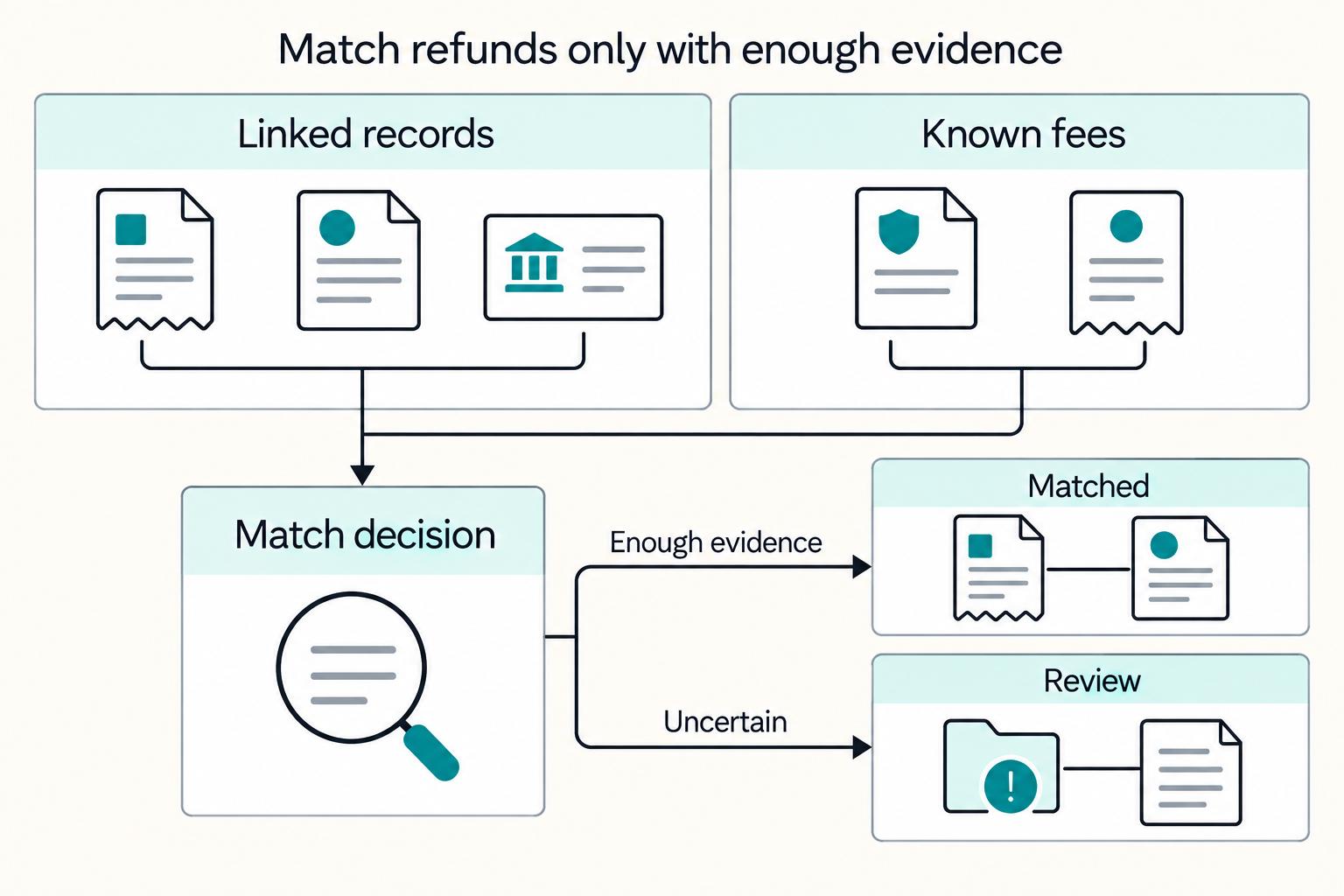
Overconfident matching is the usual failure point, so auto-match only when linkage, payout context, and fee logic are all clear enough to defend.
| Decision point | Trigger | Required evidence |
|---|---|---|
| Auto-match | Verified provider outcome, amount and currency match the original transaction; settlement context and effective fee basis are known | Keep the refund ID, original charge or order reference, payout or settlement reference, and the fee basis in the Unified Refund Schedule |
| Manual review | Source data is incomplete, payout timing is out of sequence, or the fee outcome is ambiguous | Do not force an auto-match when a variance cannot be clearly attributed |
| Escalation | The case falls into duplicates, missing reversals, partial refunds, or fee mismatch | Assign a named owner for each category across finance, ops, engineering, and processor-facing teams |
| Pre-close check | Recognized and unsettled items have documented treatment | Trace accounting dates, actual fee terms, journal and open settlement or recovery items |
Auto-match only when original payment and refund identities, verified outcome, amounts, currency and expected financial treatment agree. Compare actual fee and balance entries to the effective contract. A retained fee is not an exception if retention is correct; an expected but absent fee refund or seller recovery remains an open variance.
Send cases to manual review when source data is incomplete, payout timing is out of sequence, or the fee outcome is ambiguous. A net payout can look directionally right while still masking a fee mismatch or missing reversal. If your team cannot clearly attribute a variance, do not force an auto-match.
Use a short taxonomy for duplicates, missing reversals, partial refunds, and fee mismatch, and assign a named owner for each category. The goal is root-cause ownership across finance, ops, engineering, and processor-facing teams, not a single finance queue. You do not need one escalation path for every case, but every case type needs a documented handoff.
Before close, verify the posted accounting and documented period treatment against the refund schedule and provider evidence. Use the fee contract effective for the original transaction, not only today’s public price. Keep outstanding cash or recovery items visible without postponing a required liability or other recognition solely because the bank movement occurs later.
Execution checklist for the first sixty days#
Once your match rules are set, use the first sixty days to prove fee economics and evidence quality, not just event flow. The fastest way to create month-end pain is automating before you can explain which pricing model, payout rule, and GL outcome each refund should follow.
- Weeks 1 to 2, define the canonical refund object
Start by locking one refund record format and explicit fee-ownership rules across your source systems. At minimum, tie each refund to the original transaction or order reference, the refund reference, the payout or settlement reference when available, and the accounting result your ERP expects.
Confirm the chosen Connect charge model, pricing program, funding account, seller recovery rights and fee ownership. Those determine whose balance is debited and whether a separate transfer or application-fee refund is required. Reconcile actual entries to the contract rather than stacking unrelated pricing programs.
- Weeks 3 to 4, break the logic on purpose before trusting it
Validate payout netting against bank payouts and ERP postings, and test idempotency and replay behavior before you trust automation. Do not validate only on gross refund amounts; validate the fee layer and posting layer together.
Test the actual contractual treatment of retained processing fees, approved fee refunds and seller recovery separately. An expected reversal that fails is different from a fee correctly retained under the contract. Preserve original fee evidence and do not recalculate historical postings using a new public price.
- Weeks 5 to 6, launch exception queues and period cutoff tests
Stand up queues for duplicates, missing reversals, partial refunds, and fee mismatch, then assign dispute operations ownership by exception type. Finance should not become the default owner for every break.
What matters most here is cutoff behavior under real close pressure. Test timing edges where refunds and settlements cross period boundaries, then verify who approves holds, adjustments, or releases. Every exception needs a named owner, a review path, and a visible posted outcome.
- Weeks 7 to 8, publish the audit pack before broad rollout
Create an audit pack with original payment and each refund ID, approved amount and currency, execution status, balance transaction, retained or refunded fees, seller recovery where relevant, accounting date, posted journal and later payout or bank evidence.
The pack should explain the account model, status at the cutoff, actual fee treatment, remaining customer or seller obligation, and outstanding settlement evidence. A price-program label alone does not establish the accounting outcome.
| Workstream | Owner | Dependency | Failure mode | Verification artifact | Rollback trigger |
|---|---|---|---|---|---|
| Canonical refund object | Engineering + finance | Source event access from payment and order systems | Same refund represented differently across systems | Approved field map tied to GL outcomes | Missing link to original transaction or posted entry |
| Fee and payout validation | Finance ops | Effective account contract, processor balance transactions and bank evidence | Customer refund matches but expected fee or seller-recovery entry differs | Payout to bank to ERP tie-out | Unexplained variance after replay testing |
| Exception queues | Ops + dispute operations | Taxonomy and owner matrix | Items age in a generic finance inbox | Queue report with assigned owners | No owner for duplicates, partials, or fee mismatch |
| Audit pack | Controller or finance lead | Final export format from ERP | Signoff depends on bank totals alone | Completed pack from a real refund cohort | Missing approval trail or GL export evidence |
For a step-by-step walkthrough, see Six Marketplace Payment Setups for Two-Sided Platforms: Checkout, Payout Control, and Reconciliation.
Frequently Asked Questions
How do platforms reconcile refunds when payouts are netted?
Match the refund to the original transaction and its own balance entry, then to any payout or bank movement when available. Netted payouts can include sales, refunds and fees. Reconcile expected retained fees as retained costs; only an expected but missing fee refund or recovery creates that particular variance. Preserve unsettled items without treating gross equality as full reconciliation.
Should the source of truth be processor reports or the internal ledger?
Use one owner for internal case transitions, verified provider records for execution outcomes, and the GL for posted accounting. Reconcile those records; an internally closed case cannot override a pending or failed external refund.
What are the most common refund reconciliation breaks in Stripe and Amazon flows?
Test duplicate imports, partial refunds, retained versus refundable fees, seller recovery, unknown outcomes and settlement across accounting periods. For Amazon or another marketplace, use that account’s itemized settlement reports and contract rather than assuming Stripe’s fields or fee treatment apply.
When should a refund be auto-reconciled versus manually reviewed?
Auto-reconcile when the verified provider outcome, amount and currency match the original transaction and the settlement and effective fee context are clear. Incomplete data, unclear accounting or fee treatment, and unexpected settlement timing need review. Keep pending items visible without delaying recognition required by the approved accounting policy.
How do refunds and reversals affect month-end close timing?
Recognition and bank settlement can fall in different periods. Apply the controller-approved accounting policy to the platform’s principal or agent role, refund obligation, seller liability, taxes and retained fees. Do not defer required recognition solely until payout matching completes. Keep subsequent cash reconciliation and any recovery receivable or liability separately visible.
What evidence should finance keep for audit-ready refund reconciliation?
Keep original payment and each refund ID, approved amount and currency, actual execution status, balance and fee entries, approval evidence, accounting date and posted journal. Include payout or bank evidence when available and an owner for outstanding settlement or seller recovery. A reviewer should distinguish recognized obligations from completed external cash movement.
Try a related tool
Researched and edited by the Gruv editorial team. Gruv builds cross-border billing, payouts, and finance-operations software for global businesses.
Sources
Includes 4 external sources outside the trusted-domain allowlist.
- docs.stripe.com/refundstrusted
- docs.stripe.com/api/transfer_reversalstrusted
- stripe.com/pricingtrusted
- docs.oracle.com/en/cloud/saas/netsuite-account-reconciliationexternal
- netsuite.com/portal/assets/pdf/ds-netsuite-account-reconc...external
- quickbooks.intuit.com/learn-support/en-us/help-article/manage-inte...external
- quickbooks.intuit.com/learn-support/en-us/help-article/accounting-...external
Educational content only. Not legal, tax, or financial advice.
Related Posts
Airline Delay Compensation Payments for Customer Experience and Control
If you are evaluating an `airline compensation payments customer experience delays platform`, split the work into three lanes first: legally owed refunds, discretionary compensation, and outsourced claims recovery. Vendor pages often blur these together, but they lead to different policy choices, ledger treatment, and customer outcomes.

Account Reconciliation for Payment Platforms: How to Automate the Match Between Payouts and GL Entries
A processor paying collected sales into your bank is an incoming settlement. Your company paying a contractor is an outgoing disbursement. They can share identifiers and reconciliation tools, but they do not share the same accounting chain. Define the entity, funds owner, provider account and financial effect first; then match the relevant source populations to bank movements and GL entries.
Improving Credit Card Reconciliation for Platforms with Auto-Match Invoice Controls
Auto-match works at scale only when you treat it as a control layer across invoices, the general ledger, approvals, and payout decisions, not as a convenience feature. At its core, credit card reconciliation is still a financial-control task. You are comparing card activity to internal accounting records to confirm transactions are accurate, authorized, and posted correctly.