
Quick Answer
Route each PO match exception to the owner who can correct its source: receiving for receipt evidence, procurement for commercial terms and AP for invoice validation. Check unbilled receipt quantities and prior invoices before releasing partial amounts. Revalidate after correction or an authorized override; match resolution, accounting and bank settlement remain separate checkpoints.
Why Partial Receipts and Variances Create PO Matching Exceptions#
Many PO matching exceptions are less a knowledge problem than an ownership problem. Teams usually know what a Purchase Order and an invoice are. What breaks under volume is who acts when matching finds a mismatch, what evidence clears it, and when that exception is allowed to move toward payment.
The purpose of matching is straightforward: compare payables documents against purchasing and receiving records so you pay only for goods and services that were ordered and received. When those details do not agree, you have a match exception. Left unresolved, that exception can block payment to the supplier. That is why vague handoffs between Accounts Payable, Procurement, and receiving teams create avoidable delays.
Keep three starting assumptions in view:
- Ownership first
A mismatch is easier to manage when one team owns first response and one team owns final approval. Oracle's payables guidance supports routing match exceptions to specified users, and that matters because resolution often requires cooperation across two, three, or four teams. If nobody owns first touch, exceptions can sit unresolved for reasons that have nothing to do with matching logic.
- Decision rules beat tribal knowledge
You need a clear rule for what happens when PO, billing, and receipt records disagree. In some flows that means 3-way matching, where vouchers, purchase orders, and receipts are compared. In others, teams may use a different matching setup with a documented escalation path. The point is not stricter control for its own sake. It is whether your rule tells AP when to hold, reroute, or request more evidence.
- Closure needs evidence, not a status change
An exception is not closed because someone clicked approve. You should be able to verify the closure package against the source documents: the PO, the bill, any receipt or service confirmation, and the approval record that explains why the mismatch was accepted or corrected. If you want cleaner reconciliation later, require that evidence before the item is treated as payment ready.
Before you choose a model, run one practical test. Pull a sample of recent exceptions. Ask three questions for each one: who owned it first, what document actually resolved it, and could another team reconstruct that decision a week later? If the answer breaks down on any of those, your main problem is not matching design yet. It is routing, accountability, and proof.
That is the lens for the rest of this guide. You are not picking an abstract control pattern. You are choosing the operating model your teams can route, verify, and close consistently.
How to choose the right exception model for your platform#
Choose your exception model based on risk and operating capacity, then make sure each exception type routes to a clear owner. If your matching process depends on multiple systems, include integration needs and exception volume in the decision so routing stays predictable.
| Criterion | What to assess | Decision cue |
|---|---|---|
| Exception volume | Volume and pattern of mismatches; repeating exception types | Separate cohorts and route them with explicit ownership and SLA expectations |
| Manual Review Queue capacity | Whether reviewers had the needed document on first touch | Staff the required controls and improve evidence capture; queue pressure alone is not a reason to remove receipt checks. |
| Settlement pressure | Payment timing as the main risk | Prioritize due invoices while preserving the documented validation and override policy. |
| General Ledger close sensitivity | Overpayment and close accuracy as the bigger risk | Use stricter verification for higher-risk cohorts and require complete closure evidence before marking items payment-ready |
Use these four criteria:
- Exception volume
Start with the volume and pattern of mismatches, not just eventual clearance. Repeating exception types are a signal to separate cohorts and route them with explicit ownership and SLA expectations.
- Manual Review Queue capacity
Review queue capacity by missing evidence and owner response time. One-to-one document mapping describes cardinality, not whether a match is two-way or three-way. Improve receipt capture and routing before weakening required controls merely to clear a backlog.
- Settlement pressure
Prioritize invoices approaching their contractual due dates and identify the exact blocking condition. A faster payment target does not itself authorize bypassing receipt checks. Use an approved exception process when evidence supports release, retaining the remaining discrepancy and decision record.
- General Ledger close sensitivity
If overpayment and close accuracy are the bigger risk, use stricter verification for higher-risk cohorts and require complete closure evidence before marking items payment-ready.
For a deeper dive, read Invoice Matching Explained: How Platforms Automate 2-Way and 3-Way Matching to Prevent Overpayment.
Best for high-volume goods spend with receiving controls#
If you have high-volume goods flows with reliable receipt data, default to 3-Way Matching and tier the Manual Review Queue. That keeps quantity checks tied to what was actually received while routing incomplete lines to review.
- Best fit: reliable receiving signals at the PO line level. Compare the current bill with the unbilled receipt quantity after earlier invoices, returns and corrections; total received quantity alone is insufficient.
- Why it works: It improves control of Quantity Variance by checking PO, receipt, and invoice together. In a 100 ordered, 80 received, 100 invoiced case, the unmatched portion is visible instead of passing on PO alignment alone.
- Where teams get burned: Queue pressure rises when receipt events lag or receipt detail is weak. Inconsistent PO Format Standardization across categories or supplier tiers can also create avoidable exceptions.
- How to run it: Tier review lanes by what is missing. Keep receipt-backed variances in a lighter lane, and route unresolved Partial Receipt lines to a higher-touch lane. Where supported, set match behavior by supplier cohort, supplier site, or PO shipment level.
- Decision rule at cut-off: where the agreement and ERP permit partial payment, release only the supported amount and keep the remainder explicitly held. Verify that an invoice-level hold does not block the supposedly payable schedule.
Hypothetical partial-receipt case: 100 units ordered at $10, 80 received and 100 invoiced creates an initial $1,000 invoice with $800 receipt support and $200 unsupported. If 50 of the 80 received units were already billed, only 30 remain available to match this new invoice. Do not reuse those 50 units as evidence for another payment. Ask the supplier to correct duplicate or excess billing, record any receipt correction, and revalidate the invoice.
Best for service-heavy spend where receipts are weak#
When receipt records are missing or vague for service work, use 2-Way Matching as the base and make service attestation the control point in your Approval Workflow. Match the Purchase Order and invoice within configured tolerances, then require accepted-work evidence before release.
- Best fit
Check your ERP’s actual matching definitions. Legacy Oracle Payables documentation describes two-way matching against both ordered quantity and price, while Dynamics 365 describes its two-way policy as price matching. Neither product definition makes service acceptance automatic; retain the evidence required by your service agreement.
- Why it works
This model works when responsibility is explicit: procurement owns PO terms, and the budget or service owner confirms accepted work. It also avoids forcing warehouse-style receipt logic onto milestone, timesheet, or service-period approvals.
- Where teams get burned
Control is weaker than 3-Way Matching because receipt-versus-invoice quantity checks are not part of the base path. If attestation is vague or treated as a rubber stamp, mismatches can pass even when PO and invoice totals appear aligned.
- How to run it without losing control
Make attestation testable at first touch. The reviewer should be able to tie each billed line to accepted work, such as a milestone, service period, or named approver.
- Use rule groups to apply different logic by supplier or spend type, for example 2-Way Matching for low-risk services and stricter checks for higher-risk categories.
- Treat tolerance discrepancies as true exceptions and resolve matching holds before payment.
- Decision rule for missing evidence
If service acceptance is required, keep missing attestation in exception review even when totals align. An amount-based service receipt or an acceptance workflow can provide the missing control. Oracle’s four-way matching adds accepted-quantity inspection to its three-way checks; it is not simply any generic extra approval document.
For service exceptions, record the milestone or service period, acceptance owner, claimed amount and disputed portion so the approver can decide without reconstructing the entire project.
Best for frequent pricing and logistics deltas#
Use this pattern when pricing and freight deltas are common: auto-clear only isolated, documented variances, and route stacked or unclear exceptions to manual review.
Oracle invoice tolerances determine which quantity, price or amount differences create matching holds. A percentage tolerance of zero permits no variance; an active tolerance left without a value permits unlimited variance in that documentation. Confirm the field, active state, currency and scope instead of assuming blank means strict.
Variance routing table#
Start with a conservative routing table so each cleared delta still leaves a clean Reconciliation trail.
| Variance type | Auto-clear eligibility | Required evidence | Approver role | Reconciliation impact |
|---|---|---|---|---|
| Price Variance | Auto-clear only when it is the only mismatch and remains within your configured Price Percentage tolerance | PO line, bill line, and approved pricing support (revised quote or PO change reference) | AP can release within policy; Procurement handles out-of-policy exceptions | Usually clean if the reason code is captured on the matched PO line |
| Freight Charge | Keep auto-clear narrow; use it only when freight is expected and the charge is isolated and documented | Carrier or supplier freight document, shipping terms, and bill reference | Procurement or logistics owner approves, not AP alone | Creates tie-out noise if support is missing or outside expected terms |
| Price Adjustment | Auto-clear only when the adjustment is documented and fits amount-based tolerance policy | Credit memo, debit memo, amended terms, or approved change record | Procurement approves commercial change; AP confirms document match | Needs a clear audit trail so the adjusted amount is explainable at close |
Where to draw the line#
Recommended routing policy: isolated, documented variances within the configured tolerance can proceed through the required approval path. Combined quantity and price discrepancies go to a named reviewer. This is an operating policy to configure, not a universal ERP rule, and an in-tolerance result does not approve a commercial change by itself.
Oracle’s Total Amount tolerance can combine Conversion Rate Amount and Schedule Amount variances. Keep entered-currency commercial changes distinct from ledger-currency conversion effects. A favorable exchange-rate movement should not conceal an unauthorized unit-price increase.
Keep the checkpoint simple: one primary reason code, one supporting document, and one accountable owner. If any of those are missing, send it to the Manual Review Queue.
Tolerance width is the tradeoff: looser settings reduce holds but increase drift risk; tighter settings protect spend but can age the queue if approvals lag. If you are uncertain, start tighter on unit price and more flexible on documented foreign-currency effects, then review hold patterns before widening.
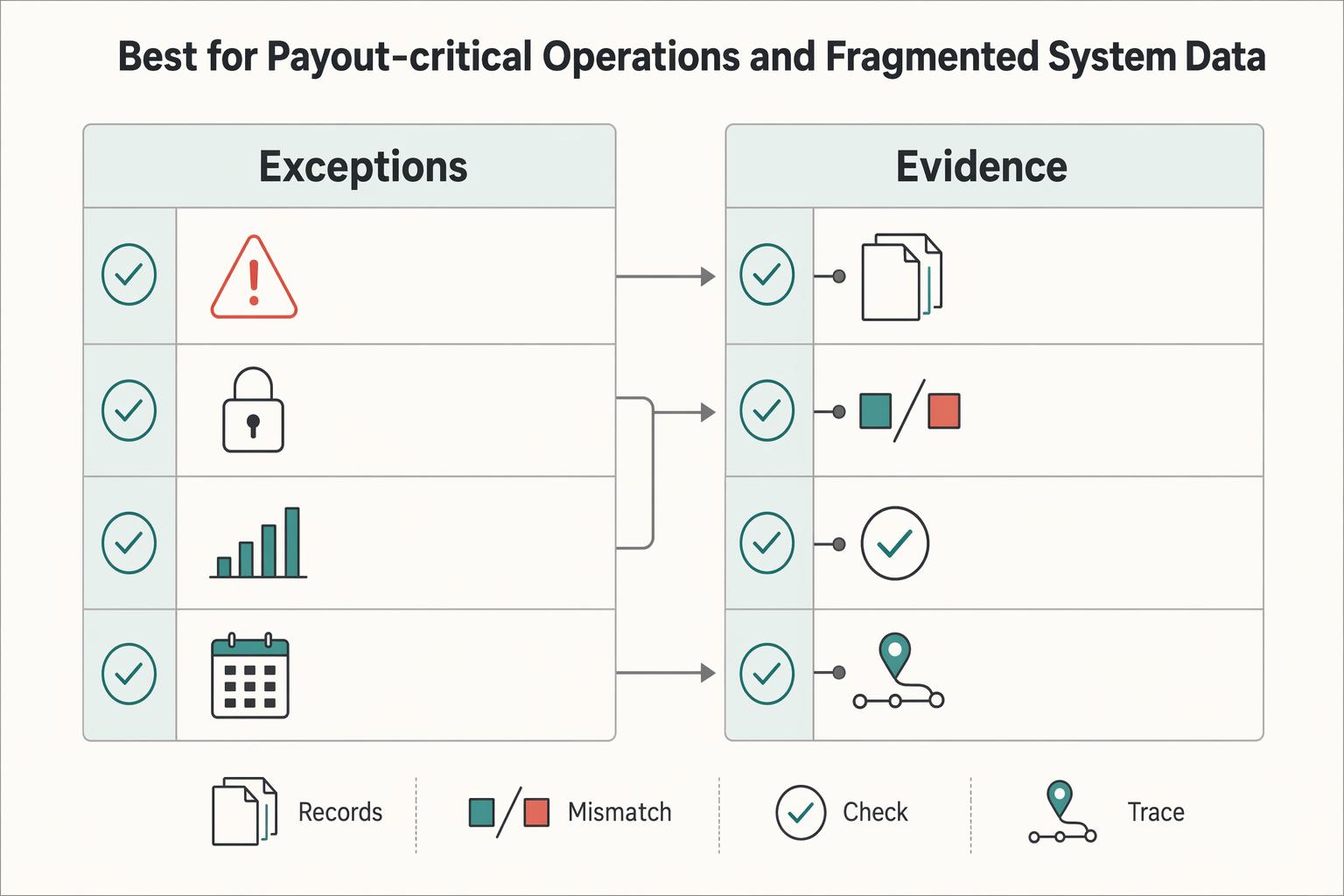
Best for payout-critical operations and fragmented system data#
When payout timing is at risk, triage exceptions by payment impact first, then handle cleanup work.
- Prioritize exceptions that block payment.
Prioritize exceptions that actually block payment and keep non-blocking cleanup separately visible. Confirm your own matching schedule and re-run behavior: New York’s published SFS process runs hourly during business hours plus a nightly batch, rather than a universal twice-daily schedule. After correction, verify the rematch result before releasing payment.
- Control supplier-record drift at the source.
Check supplier identity and PO-line mapping across the intake system and ERP, especially after master-data changes. Validate the supplier and invoice reference before payment release, with duplicate-invoice checks as a separate control. Correct a bad mapping at its source instead of overriding each affected invoice.
- Treat exception resolution as a cross-team workflow, not just a system rule.
UVA’s published Workday guide lists percentage and dollar variance reason codes, including at least 10% and at least $100. Its companion policy describes 10% or $100, whichever is lower. Those are institution-specific settings, not a default for every platform. Assign receiving, procurement, AP or integration support according to the actual reason and verify the corrected result.
Resolve the source discrepancy or record an authorized override with its reason and approver, then revalidate. An override can release a justified exception without rewriting a correct original document; it must not hide an unresolved quantity or duplicated receipt.
Comparison table and go-live decision checkpoints#
Before go-live, define this per supplier cohort: which matching model you use, which artifacts make an invoice payable, and who owns escalation when documents conflict. If those three points are not explicit, the rollout is not operationally ready.
| Model | Best-for profile | Control strength | Operating cost | Failure mode | Required artifacts |
|---|---|---|---|---|---|
| 3-way matching with tiered manual review | High-volume goods spend with dependable receipt capture | High, because invoice, PO, and receipt quantity are compared at line level | Medium to high when receipt timing lags operations | Receipt is late, partial, or mapped to the wrong line, so payment stays blocked | PO, invoice, receipt, approval record for any manual release |
| 2-way matching plus service attestation | Service-heavy spend where receipt data is weak or artificial | Medium, because control depends on PO-to-invoice match plus service-acceptance evidence | Medium, with effort shifting to approver discipline | Totals align, but no valid attestation exists | PO, invoice, attestation, approval record |
| Variance-managed matching with manual approval for combined deltas | Categories with recurring price, freight, or post-issue adjustments | Medium to high when low-risk deltas are separated from combined exceptions | High, because tolerance tuning and edge-case review are ongoing | Tolerances are too wide and leakage passes, or too tight and queue aging rises | PO, invoice, receipt or attestation (as applicable), approval record for variance approval |
This table anchors go-live because invoice matching depends on a clear evidence chain: invoice, PO, and product receipt, with line-level matching configured as 2-way or 3-way. Choose the model based on which artifact is reliable for that cohort.
Set a go-live gate with three owned controls in place. Vendor Master Data should have named ownership and a working duplicate/drift check. PO Format Standardization should be documented so line entry follows supplier quote structure. Escalation should route through a defined Service Center (or equivalent collaboration point) so AP and non-AP teams can resolve exceptions with segregation of duties.
Four checkpoints that determine go-live fitness#
| Checkpoint | What to verify | Article detail |
|---|---|---|
| Queue aging | Aging by model, not only as one blended backlog | Use a formal exception report where available, for example APX1090, or an equivalent report |
| Closure quality | PO, invoice, receipt or attestation, and approval record support the resolution | Treat closure as evidence completion, not status movement |
| Reconciliation completion | Cleared exceptions no longer appear on open exception reporting and can be traced through reconciliation | A shrinking queue alone is not success |
| Downstream Settlement impact | Payment impact as the pass/fail checkpoint | Unresolved match exceptions can stop payment processing |
- Queue aging
Track aging by model, not only as one blended backlog. Use a formal exception report where available (for example, APX1090) or an equivalent report.
- Closure quality
Treat closure as evidence completion, not status movement. Spot-check that PO, invoice, receipt or attestation, and approval record support the resolution.
Reconciliationcompletion
Confirm cleared exceptions no longer appear on open exception reporting and can be traced through reconciliation without unresolved mismatches. A shrinking queue alone is not success.
- Downstream
Settlementimpact
Use payment impact as the pass/fail checkpoint, since unresolved match exceptions can stop payment processing.
- Goods cohort: primary three-way; if evidence is missing, retain receipt-based review and hold rather than silently downgrading to two-way. Receiving owns receipt corrections; AP owns payability triage and procurement owns commercial changes.
- Services cohort: primary
2-way+ attestation; fallback manual exception review; escalation owner:Procurementfor missing acceptance, AP for payability decision. - Variance-prone cohort: primary variance-managed model; fallback
3-waywhere receipt data is dependable; escalation owner: AP for intake/routing,Procurementfor commercial-change approvals.
Before a cohort goes live, identify its payable artifact chain, blocking-status report and escalation owner. Include a case with prior billing against a partial receipt, so the pilot demonstrates that one receipt cannot support duplicate payments.
30-day implementation checklist with ownership and evidence pack#
Use the first 30 days to lock down ownership and traceability before you tune throughput. If you cannot show who resolves each Match Exception and what evidence closes it, faster queue movement will not reliably improve payability or ledger quality.
| Phase | Primary action | Checkpoint or required evidence |
|---|---|---|
| Week 1 | Classify live exception patterns and assign owners | Separate at least Partial Receipt, Quantity Variance, and Price Variance; each exception tied to one owner and one escalation destination |
| Week 2 | Codify decision rules and map them to approvals | Document handling rules for each exception type and connect each rule to an Approval Workflow |
| Week 3 | Enforce a closure evidence pack on every resolved item | Require reason code, action taken, approver, and accounting reference when available |
| Week 4 | Pilot one cohort, then verify downstream outcomes | Pass condition: resolved items do not reopen as discrepancies, and payment proceeds where evidence supports payability |
| Exit criterion | No closure without end-to-end traceability | PO, bill, receipt or attestation, approval decision, reason code, and accounting reference when available should align for independent review |
- Week 1: classify live exception patterns and assign owners.
Start with your current queue and separate at least Partial Receipt, Quantity Variance, and Price Variance. Assign one primary resolver per type across Accounts Payable (AP), Procurement, and system admin, then publish one escalation route through your Service Center. Checkpoint: each exception can be tied to one owner and one escalation destination.
- Week 2: codify decision rules and map them to approvals.
Document handling rules for each exception type and connect each rule to an Approval Workflow. Matching rules define how the system responds to variance, and resolution steps differ by exception type, so avoid a single generic queue path. If you run mixed cohorts, keep that explicit: you can combine 2-way and 3-way matching, but each route still needs clear manual-review gates where required.
- Week 3: enforce a closure evidence pack on every resolved item.
Require reason code, action, approver and revalidation result for each resolved exception. An exception may close before the invoice is accounted or paid; link the later subledger and General Ledger references when available. Match closure is not proof of posting or bank settlement.
- Week 4: pilot one cohort, then verify downstream outcomes.
Run one supplier cohort with the new rules and hold expansion until Reconciliation and Settlement checks pass. Time review to your operating cadence so you can observe a full cycle from exception creation through resolution and posting. Pass condition: resolved items do not reopen as discrepancies, and payment proceeds where evidence supports payability.
- Exit criterion: no closure without end-to-end traceability.
At match closure, preserve the PO, invoice, receipt or attestation, decision and revalidation result. Track later accounting and payment completion separately, including the subledger or General Ledger reference when posted. At close, unresolved payment holds do not by themselves establish that no liability or accrual exists.
Keep exception-resolution, accounting and payment statuses in the same report so finance can see a resolved match that still awaits posting or settlement.
Conclusion#
Pick one model and make it the default. Teams that handle exceptions cleanly tend to keep matching rules consistent across suppliers, approvers, and queue pressure.
- Choose one primary matching model
Start with the real control point: Accounts payable invoice matching means matching the vendor bill, Purchase Order (PO), and, where relevant, receipt information. If your receiving data is dependable, 3-Way Matching can stay primary because it adds quantity validation against product receipts. If you are service-heavy and receipt evidence is weak, 2-Way Matching can be the better operating choice because it compares bill price to PO price. The right model is the one your teams can execute consistently, not the one that looks strongest on paper.
- Treat matching as validation before approval, with one owner per exception type
Use the sequencing required by your ERP and approval policy. Matching, commercial approval, accounting and payment release can be distinct stages; New York’s published workflow also distinguishes online and bulkload agencies. Confirm that the specific required hold is released after correction or authorized override, rather than treating a generic approved flag as payability.
- Keep tolerances, closure evidence, and ledger traceability practical
Write the tolerance basis, boundary, currency and cumulative rule. Hypothetically, a $10 unit price with a 5% upward tolerance accepts $10.50 but rejects $11, subject to the configured policy. Independently validate quantity, charges and prior billing. At match closure retain the reason, approval and successful revalidation; link accounting entries when posted and reconcile payment when executed.
That is the real end state for PO matching exceptions on platforms: one explicit model, one decision path, and auditable closure from PO and bill intake through approval, Reconciliation, and final Settlement. If a control cannot be verified at the line level, it is probably not protecting your ledger as well as you think.
Frequently Asked Questions
What are po matching exceptions for platforms?
PO match exceptions are discrepancies between an invoice and its order, receipt or acceptance records. Depending on ERP configuration they can create warnings, posting restrictions or payment holds. Resolve the specific discrepancy or obtain an authorized override and successful revalidation; a status label alone does not establish payment completion.
What causes PO matching exceptions most often in `ERP` and `Vendor Portal` flows?
The most common causes supported here are missing receipts, mismatched quantities, mismatched prices, duplicate invoices, and tax variances. In cross-system flows, these often show up when the Purchase Order (PO), bill, and receipt are not carrying the same values or status at the same time. A useful first check is to compare one failed line across the systems involved before you change any rule.
When should a `Match Exception` be routed to a `Manual Review Queue`?
Route it to manual review when a tolerance breach puts the item on hold, when receipt evidence is missing, or when the exception requires an explicit hold release before payment. If quantity and price are both mismatched on the same line, treat it as a strong manual-review case. The failure mode is letting a blocked document look operationally complete while payment is still impossible because correction or override never happened.
Who should own exception resolution across AP, `Procurement`, and product teams?
Not AP alone. Exception handling should be owned across Accounts Payable, Procurement, and adjacent operational teams. If you want one practical rule, assign one named resolver plus one escalation path per exception type.
How should teams decide between `2-Way Matching` and `3-Way Matching` for partial receipts?
Use 3-Way Matching when partial-receipt risk matters, because receipt-to-bill validation is part of the control. Use 2-Way Matching when you are matching only PO and invoice data within configured tolerances. If partial receipts are common, 3-Way Matching is generally the stronger control.
How do exception queues affect `Settlement`, cash timing, and month-end close?
A payment hold can delay the scheduled cash movement until corrected or appropriately released. Revalidation cadence is system-specific: New York’s SFS example runs hourly during business hours and again overnight. At month-end, assess the actual goods or services received and accounting requirements separately from whether the invoice can be paid.
Try a related tool
Researched and edited by the Gruv editorial team. Gruv builds cross-border billing, payouts, and finance-operations software for global businesses.
Sources
Includes 3 external sources outside the trusted-domain allowlist.
- finance.princeton.edu/buying-paying/work-suppliers-and-payees/proc...trusted
- osc.ny.gov/state-agencies/gfo/chapter-xii/xii8b-matchingtrusted
- uvafinance.virginia.edu/quick-reference-guide/match-exception-invest...trusted
- docs.oracle.com/en/cloud/saas/financials/26c/fappp/invoice-t...external
- docs.oracle.com/cd/A60725_05/html/comnls/us/ap/point04.htmexternal
- learn.microsoft.com/en-us/dynamics365/finance/accounts-payable/a...external
Educational content only. Not legal, tax, or financial advice.
Related Posts
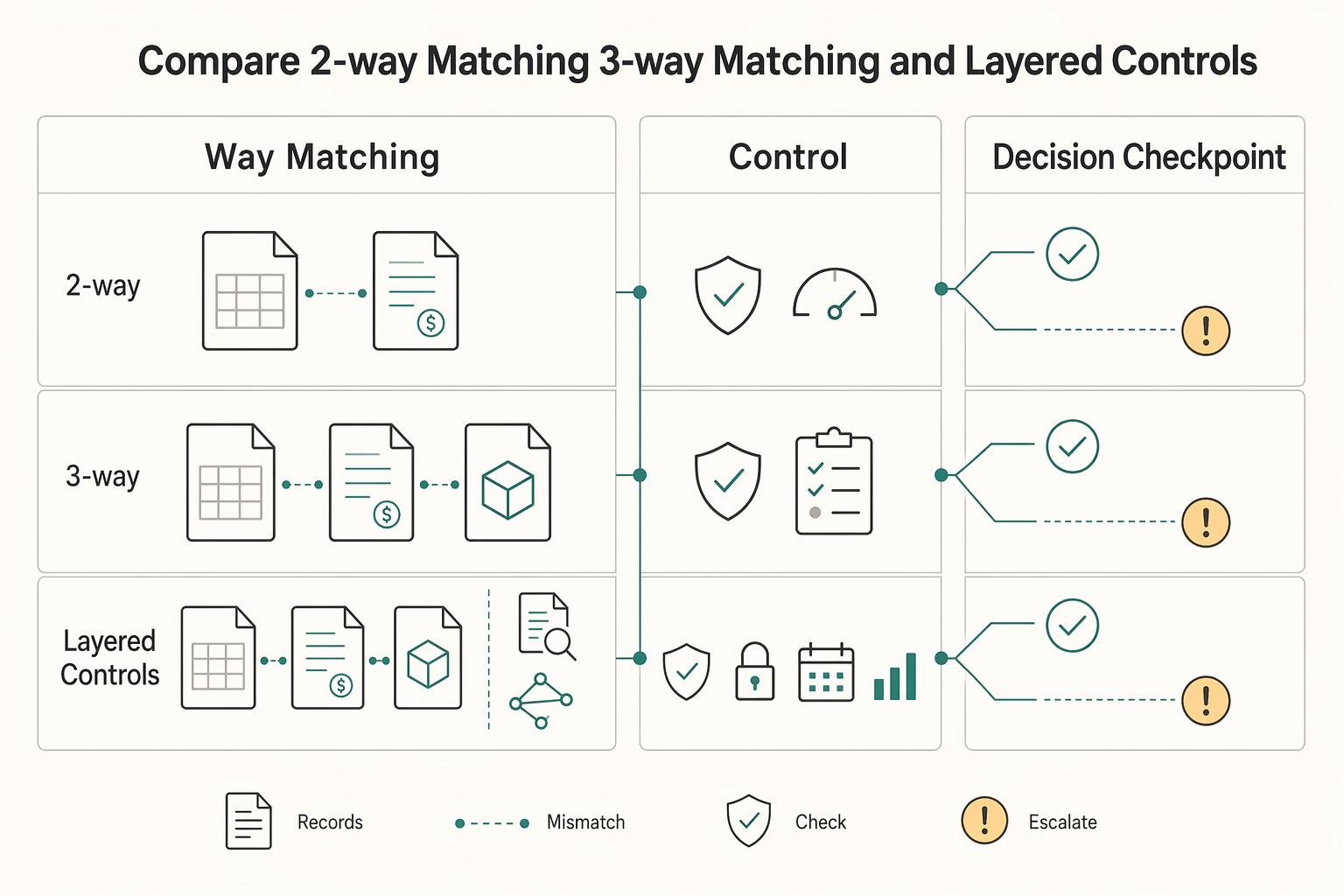
How Platform Teams Use 2-Way and 3-Way Invoice Matching to Stop Overpayment
Platform teams do not need another glossary entry on invoice matching. They need controls that stop real overpayment paths before money goes out the door. At its core, invoice matching compares an invoice with supporting records before payment. The practical question is what you add when a clean match still does not mean the invoice should be paid as submitted.
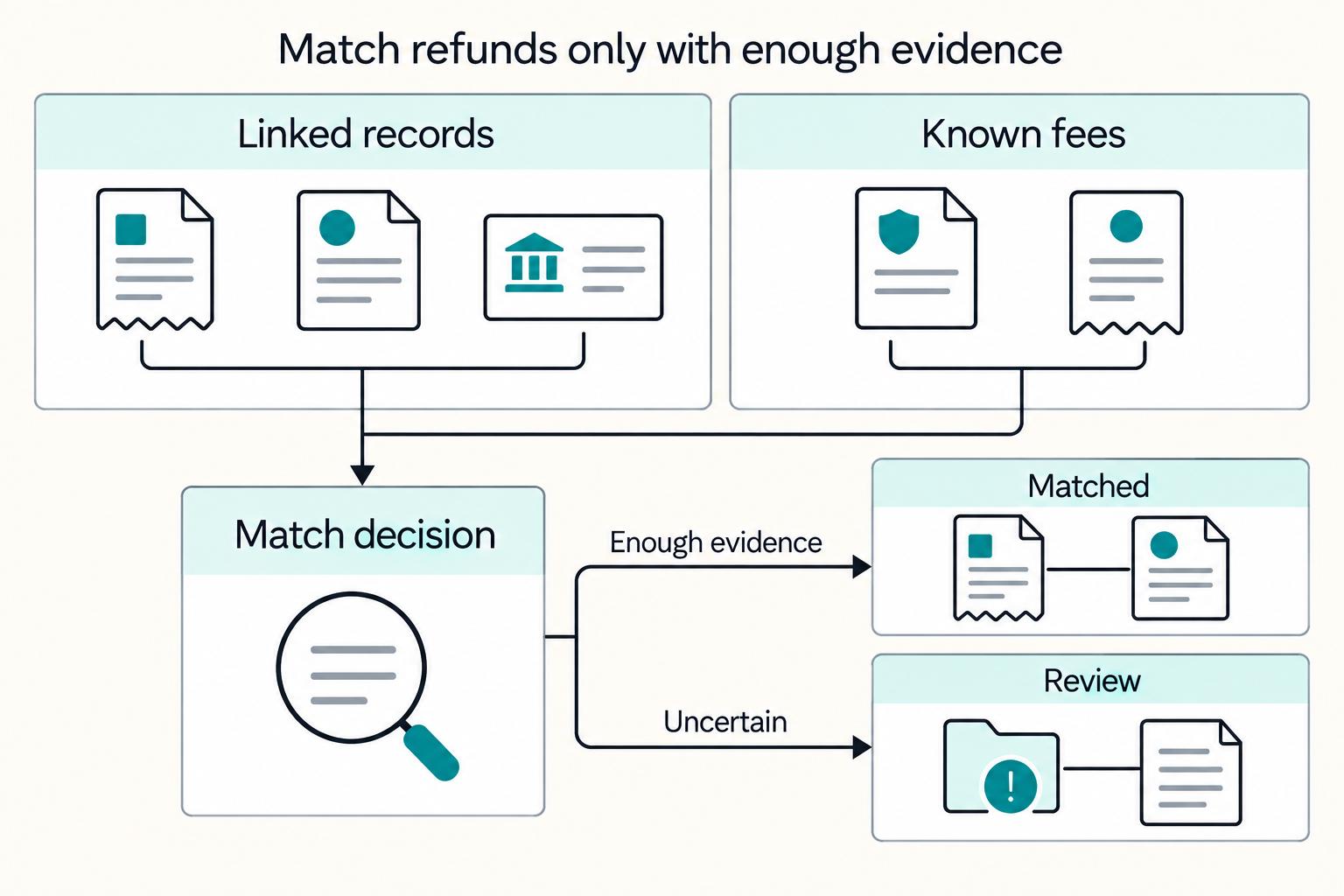
Refund Reconciliation for Platforms and Clean Ledger Entries
If you treat commerce orders, payment activity, settlement data, and bank deposits as separate truths, your refund accounting can drift even when each source looks internally consistent. Refund reconciliation is more reliable when you model those records as one connected chain from customer event to payout impact to General Ledger (GL) entry.

The Freelance Payment Penalty: A Modeled Audit of Platform Fees, FX Spreads, and Payout Delays
The money rarely disappears through a single, easy-to-spot fee. The real loss is stacked. A marketplace takes its commission, a processor adds a charge for international cards, a bank or payment company converts the currency at a spread, a platform holds the funds before release, and a wire sheds a little to intermediaries on the way in. Each layer looks defensible on its own, but the worker feels the combined result as a smaller deposit and a later payday.