
Quick Answer
Normalize provider activity, payout references and bank receipts into one ledger, preserving currencies and source identities. Match at the correct grain: transaction, batch or bank movement. Keep unexplained differences in owned queues, and block affected releases when funding or eligibility cannot be established under the approved policy.
Multi-PSP, Multi-Currency Reconciliation Means One Ledger and a Clean Exception Process#
Multi-PSP, multi-currency reconciliation means turning several provider payout views into one ledger and a clean exception process. The goal sounds straightforward but is difficult in practice: bring multi-currency payouts from several PSP accounts into one ledger, then route every mismatch into a clear exception path instead of a spreadsheet note. Done well, your ledger becomes the place you trust for cash reporting, while Stripe, Adyen, and PayPal stay what they should be: source evidence, not competing versions of the truth.
Each provider exposes different evidence. Stripe’s payout reconciliation report groups activity into automatic payouts; manual and instant payouts require different reconciliation handling. Adyen’s Settlement details report contains settled transaction and cost records within merchant-account batches. PayPal recipient payout items and merchant settlement reports describe distinct flows. Preserve that distinction before combining them in one ledger.
In eligible Stripe setups, same-currency settlement can avoid a conversion, but non-primary settlement-currency fees may still apply. Store the actual fee schedule and distinguish balance availability, payout submission, estimated arrival and bank posting. A schedule change does not accelerate pending funds.
This guide stays practical. You should be able to see your daily cash position across providers, explain what is still in flight, and prove how each payout landed in the ledger.
A real audit trail is not a vague claim of traceability. It means you can take a ledger line back to a provider artifact such as a payout ID, batch number, date, or other unique identifier, then forward again to the bank movement or open exception. That is the verification point that matters most early on.
The success test is concrete. By the end of this process, you should be in a better position to reduce unresolved breaks at close because timing issues, FX differences, fee lines, and provider adjustments are separated instead of blended together. If a payout cannot be tied to the right provider identifiers or reporting window, do not force a match just to move the numbers. Hold it as an exception and attach the evidence. That discipline is what helps keep one ledger reliable even when settlement reports arrive on different timelines and in different formats.
Related: What Is Payment Orchestration? How Platforms Route Transactions Across Multiple PSPs.
What to prepare before you start#
Set your evidence and decision rules before matching anything. If you skip prep, normal timing gaps and provider-specific events will look like breaks later.
| Prep item | What to collect or define | Control note |
|---|---|---|
| Collect source artifacts per PSP | payout reports; balance/activity exports; fee detail; raw webhooks event history | For each payout period, confirm both a settlement-facing report and the underlying event stream |
| Define one-ledger object types before import | transaction; fee; FX conversion; payout; return; adjustment | Validate currency fields against ISO 4217 formats |
| Confirm governance before exceptions appear | payout gating rules for KYC, KYB, and AML; approvers for write-offs or manual reclasses | Keep ownership clear so exception queues do not stall payouts |
| Lock reconciliation scope by corridor and rail | corridors and rails such as SEPA, iDEAL, or card rails across North America, Europe, and LATAM | Do not start by mixing all rails into one rule set |
Map the money path before matching anything#
Map the money path before matching. Missing source rows, report scope, timing and provider state can all explain a break; investigate them separately.
Document the event order for each rail#
Write the sequence rail by rail: authorization or collection, capture, any currency conversion, PSP settlement, bank arrival, and ledger posting. Do not assume one universal sequence across PSPs or payment methods.
Keep authorization separate from capture. For Stripe, consult the payment method’s capture deadline and the PaymentIntent state rather than treating an authorization as settled funds. Uncaptured funds are not automatically part of the expected payout.
Verification checkpoint: sample five real transactions per rail and confirm you can trace each stage end to end.
Separate provider state from ledger truth#
Keep provider state as evidence, and keep one ledger as the reporting decision point. Provider balances can remain pending until settlement, and changing payout schedule does not make pending funds available faster.
Use this distinction to classify temporary differences correctly instead of treating every status mismatch as a break.
Keep a stable key chain across systems#
Persist the provider account, economic object, delivered event and accounting-effect identities. Link these to the internal payment and relevant payout or batch. A request idempotency key prevents certain API retries; it does not by itself deduplicate delivered events or ledger postings.
Adyen supports request idempotency keys of up to 64 characters; Stripe has its own key contract and expiry. Preserve each key with the operation it protects. When an outcome is unknown, look up the original request or provider object before creating a fresh key. Posting deduplication needs a durable effect identity beyond either provider’s retry window.
Standardize PSP and currency data into one schema#
Build one canonical schema before matching, or your reconciliation logic will spend its time translating PSP field differences instead of finding real breaks.
Build a normalization table first#
Create a normalization table that preserves provider-specific meaning but lands core fields in fixed columns. Do not assume Stripe, Adyen, PayPal, and Shopify Payments use identical fee or reversal semantics; keep raw source fields for audit and map only what you can explain.
| PSP | Mandatory key to normalize | Timing detail to keep | Currency or batch constraint to store | Platform note |
|---|---|---|---|---|
| Stripe | Balance-transaction ID for activity; payout ID for payout movement | expected bank arrival date from the payout object | payout currency is a three-letter ISO code in lowercase and must be a supported currency | keep raw fee/reversal source fields separate from normalized flags |
| Adyen | report row key plus merchant account and batch | source timestamps from the Settlement details report | Settlement details report is for transaction-level settlement reconciliation; default generation is per merchant account, per batch | do not merge batches across merchant accounts before import |
| PayPal | Provider batch and payout-item IDs, linked to sender_batch_id | source batch and item event times from the payout export or API response | separate API call may be needed for each currency type | The sender batch key protects creation within the documented 30-day window; each recipient outcome needs item-level evidence |
| Shopify Payments | provider payout identifier from the payout export | source payout date and related timestamps | multi-currency payouts are plan- and location-constrained | keep eligibility and bank-account constraints as explicit columns |
For fees and reversals, use two layers: raw provider fields as received, then normalized columns (for example fee_amount, fee_currency, reversal_flag) only where mapping is defensible.
Put currency on every normalized row#
Include currency dimensions on every normalized row: transaction_currency, settlement_currency, ledger_base_currency, and fx_source.
This is what lets you separate PSP conversion, internal base-currency translation, and bank-side effects when payout currency differs from charge currency. Keep row grain strict: one row should represent one economic meaning, not a mix of transaction amount, payout total, and FX adjustment.
Make platform constraints explicit and reject bad imports early#
Put platform constraints directly in the schema and enforce them at import time.
For Shopify Payments, store eligibility for Multi-Currency Payouts and bank-account constraints as explicit fields, because eligibility is plan/location constrained and supported account types are constrained. If your process assumes multi-currency EMI routing, keep that as an internal routing-assumption field unless your provider setup explicitly documents it.
Require the keys appropriate to each source’s row grain. Preserve Adyen merchant-account and batch context. For PayPal Payouts, link the sender batch reference to the provider batch and individual payout-item IDs. For Stripe activity rows, keep the balance-transaction identity; add a payout reference when one exists, rather than rejecting legitimate unallocated activity.
Verification checkpoint: reject imports missing mandatory provider identifiers, containing unknown currency codes in your schema, or failing date-window controls for that source.
Keep an evidence pack per import: raw file/API extract reference, provider or merchant account, extract window, and import job ID.
If you want a deeper dive, read Xero Multi-Currency for Payment Platforms: How to Reconcile Foreign Currency Payouts.
Set deterministic matching and exception rules#
Make matching strict before it gets clever: require hard-field agreement first, then route everything else into explicit exception paths.
Start with strict auto-match rules#
Match at the grain of the evidence. Compare a bank deposit with its payout total in the same currency, and reconcile that total to signed constituent transactions, fees and adjustments. Do not compare every gross transaction directly with a net payout.
| Auto-match check | Requirement | Rule note |
|---|---|---|
| Identifier | Require hard-field agreement on identifier | Anchor each provider to its native reconciliation artifact |
| Amount | Compare like-for-like amounts, or reconcile constituent signed rows to the payout total | Gross, net and bank-received amounts have distinct meanings |
| Currency | Require hard-field agreement on currency | If it fails, do not force a match |
| Settlement window | Match only inside the intended reporting period and timezone | Keep the window source-aware and explicit |
For Stripe automatic payouts, use its payout reconciliation report; for manual balance movement, use balance reporting, and reconcile instant payouts against transaction history. For Adyen, retain the merchant-account batch and the settlement report’s row-level references. For PayPal, distinguish merchant account balance reporting from recipient payout-item outcomes.
Keep the settlement window source-aware and explicit. Compare rows only inside the intended reporting period and timezone, especially for Adyen fee work where period and timezone alignment are called out checks.
Verification point: sample auto-matches daily and confirm each one against the native artifact, provider account/merchant account, import window, and payout/batch reference.
Add bounded fallback logic only for known edge cases#
Fallback logic should be bounded: relax one dimension at a time while keeping the others fixed. For example, allow timing-lag review when identifier, amount, and currency still match, but settlement timing is just outside window.
Treat queue routing as internal policy, not provider truth. If a mismatch includes currency or fee variance, route it to FX/fee review first. If identifiers are missing or malformed, route it to data-quality first.
For duplicate-event risk, keep request/event references and idempotency key where available. Stripe documents idempotency for safe retries, allows keys up to 255 characters, and notes keys can be pruned after at least 24 hours, so key reuse after that horizon cannot be your only duplicate check.
Define exception classes with owners and SLAs#
Define internal exception classes with an owner and SLA field, and require every unmatched row to land in one class.
| Exception class | Use when | Recommended owner | SLA field to set |
|---|---|---|---|
| Timing lag | IDs, amount, and currency align, but settlement timing does not | Payments Ops | review-by timestamp |
| Split payout | one expected amount appears across multiple payout lines or batches | Finance Ops | disposition due date |
| Withheld reserve | funds appear held back rather than missing | Finance Ops | next provider check date |
| Conversion drift | transaction, settlement, or base-currency math disagrees | Finance Ops | FX review due date |
| Duplicate webhook | repeated event created a false candidate match | Engineering or Payments Ops | fix-by timestamp |
| Manual provider adjustment | provider posts a correction outside normal transaction flow | Payments Ops | evidence completion due date |
Keep manual overrides auditable. For every forced match, store actor, reason code, evidence link, and audit-trail record. Reason codes should explain why the entry was created, and the evidence pack should include the exact report extract, provider account, report window, and the strict rule that failed.
Execute a daily reconciliation cycle with measurable checkpoints#
Run one fixed daily sequence and make the payout-release decision explicit at the end of triage. Once strict matching and exception classes are in place, the control is cadence: ingest, normalize, match, triage, post, then publish metrics before close.
Prove source completeness before matching#
Start with completeness, not matching. Pull expected webhooks, API extracts, SFTP drops, and batch files for each PSP, then normalize to your canonical schema before matching. Keep ingestion and normalization as separate steps so missing-source issues do not get misclassified as reconciliation breaks.
Use the same sequence every day:
- Ingest webhooks and provider files
- Validate expected source arrivals and reporting windows
- Normalize to your ledger schema
- Run deterministic auto-match
- Route mismatches to the exception queue while matched items post
- Triage exceptions and complete approved adjustments
- Publish control metrics and archive the day's evidence
Verification point: for each PSP, confirm expected sources landed and the loaded window matches the intended day. Late inputs should be handled as source-timing issues, not hidden inside matching noise.
Apply the payout gate after triage#
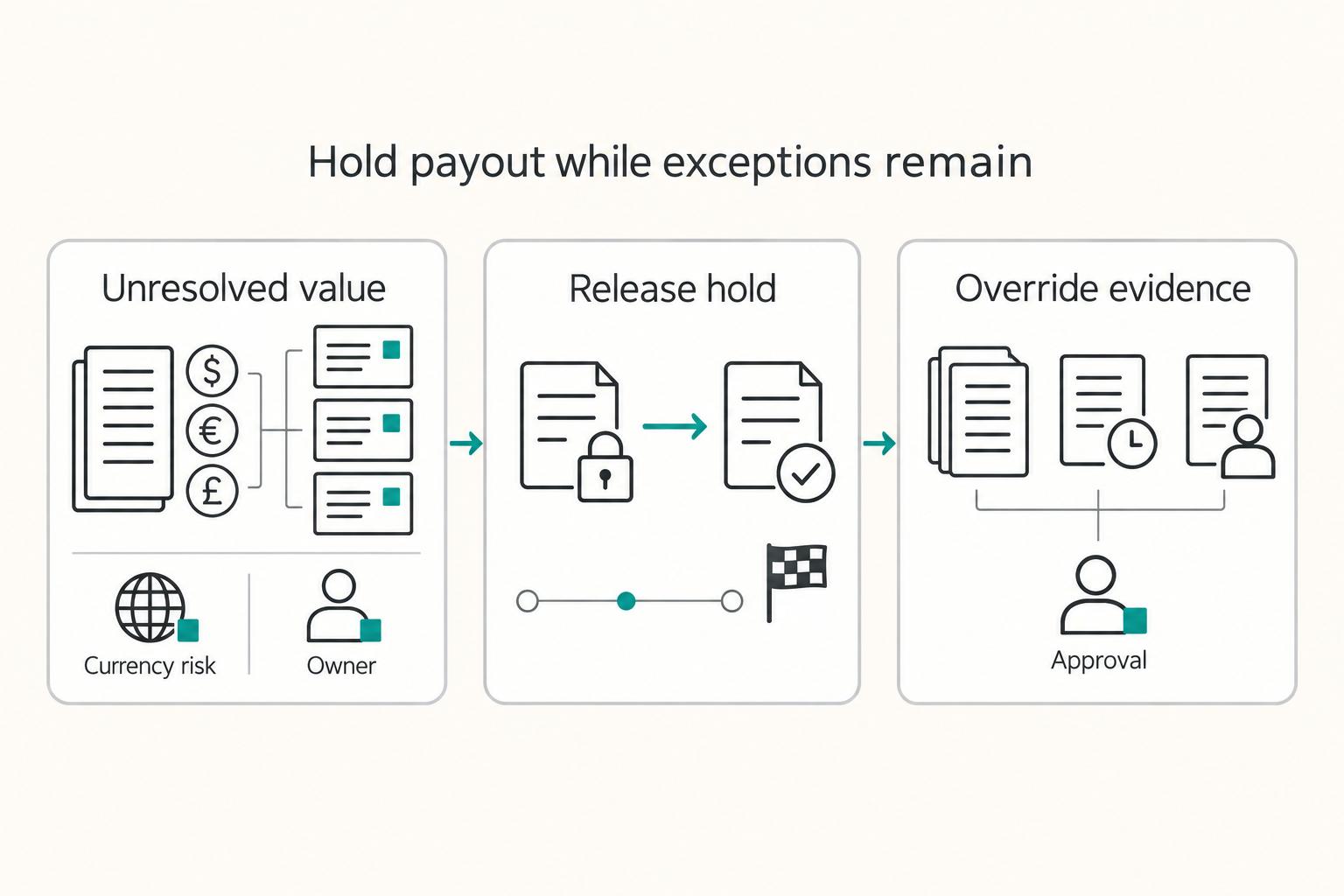
After triage, apply the approved release policy to the affected account, currency and funds. Unknown funding or ownership can require a hold; an explained timing difference need not stop unrelated eligible payouts. Mandatory legal or provider restrictions apply regardless of internal materiality. Require authorized evidence for any permitted policy exception.
The diagram illustrates an internal hold-and-approval workflow. An override requires authority, evidence, affected value by currency and a resolution owner; it cannot override a mandatory compliance or provider restriction. Finance can report an explained in-flight amount separately from bank cash.
Publish a short daily control pack#
Publish a short daily control pack by PSP so you can see whether operations are actually getting cleaner.
| KPI | What to measure | Why it matters |
|---|---|---|
| Auto-match rate | Matched items as a share of total eligible items | Tests whether rules and normalization hold at volume |
| Aging exceptions | Open items by age bucket and value | Surfaces close risk before it accumulates |
| Reopened items | Exceptions resolved earlier but opened again | Signals weak triage, late sources, or unstable mappings |
| Time-to-resolution | Median or percentile resolution time by PSP | Shows where operational effort is concentrated |
Set matching targets from your own source completeness and exception mix. Track aged value and repeat failures alongside the auto-match percentage, so a high match rate cannot hide unresolved material breaks.
Resolve timing, FX, duplicate and compliance breaks#
Your daily cycle is only credible if you classify hard cases correctly. Keep timing, FX, duplicate, and compliance issues in separate queues, and only finalize states in one ledger when provider evidence supports them.
| Breakpoint | Primary handling | Evidence to keep |
|---|---|---|
| Delayed or partial settlement | Keep provider settlement and transfer-in-transit separate; bank receipt requires bank evidence | Provider reference, currency and amount plus matched bank entry or open investigation |
| FX variance | Keep it separate from fee variance | Keep transaction currency, settlement currency, base currency, and applied rate source |
| Retry or duplicate event risk | Separate request, delivered-event and economic-effect deduplication | Keep request/event references and idempotency key where available |
| Compliance holds or returns | Route it to a dedicated queue instead of generic reconciliation exceptions | Keep provider status, affected amount and currency, owner, and next review date |
Hold delayed or partial settlement in a provisional state first#
Record provider settlement and transfer-in-transit separately from bank cash. A provider report can establish its balance movement without proving the receiving bank posted the deposit. Reclassify to bank cash using bank evidence and the accounting policy; explain partial or delayed receipts as open items.
Confirm provider account, payout or batch reference, currency and amount, then match the recipient-bank entry. Preserve estimated arrival and actual posting dates as different fields. If receipt is missing, retain the transfer-in-transit position and investigation evidence rather than marking it received from provider success alone.
Separate FX variance from fee variance every time#
Separate FX variance from fee variance on every multi-currency payout review. Do not net them together to shrink the exception list, because cause and ownership are often different.
Adyen reports fee components with each event, while exchange differences are treated as a separate accounting concept under IAS 21. In your exception record, keep transaction currency, settlement currency, base currency, applied rate source, and fee line reference. If gross is right in settlement currency but net is off, check fee mapping first. If converted gross is wrong, route it to FX review.
Make retries replay-safe before posting#
Deduplicate ledger postings by provider account, object and economic effect. A capture, refund and reversal need distinct effect identities even when they share one payment ID. API request idempotency and webhook-event deduplication protect different stages; keep all three linked.
Stripe's idempotency guidance is explicit: retries should not perform the same update twice, and keys can be pruned once they are at least 24 hours old. So do not assume a PSP will retain every retry forever. A common break is duplicate webhooks or API retries being treated as new cash activity.
Route compliance holds and returns to their own queue#
Route compliance holds and returns to a dedicated queue. KYC checks can gate payment processing and payouts, and holds or reserves can exist for claims, chargebacks, and returns, so these should not be buried in generic reconciliation exceptions.
Use operator labels that match decisions: verification pending, reserve hold, failed, returned, or canceled. For each item, keep provider status, affected amount and currency, owner, and next review date. That keeps restrictions visible to Finance Ops and avoids false "missing payout" investigations when the real issue is a verification gate or returned payout.
Pick cadence, ownership, and escalation that fit your volume#
Set your reconciliation cadence, queue ownership, and escalation path based on exception risk and close-readiness, not payout schedule alone. Payout schedules can be daily, weekly, monthly, or manual, but your control rhythm should still support clear positions and reporting decisions.
Set cadence from close requirements backward#
Start with what you need to support at close, then set review frequency. A weekly cycle may be workable for low-volume, low-complexity corridors, but only if you can still explain positions as of the previous business day when required. As breaks spread across multiple PSPs, a tighter cycle is usually more reliable.
For each cycle, confirm you received the expected provider files or exports for the previous business day before reviewing exceptions. A common failure mode is matching cadence to a quiet payout schedule and then finding unresolved items stacked across days at close.
Assign one primary owner per queue#
Give each queue one primary owner and a clear handoff rule. A practical model is Finance Ops for variance disposition, Payments Ops for provider-side defects, and Engineering for mapping or parser failures. That specific split is a choice, but explicit ownership is the control requirement.
Go beyond team labels: document the named owner, backup, and decision authority for each queue. Without a decision owner, items can bounce between PSP support, reconciliation, and engineering without an accountable close date.
Escalate cross-PSP, high-value items quickly#
Use a defined escalation trigger for unresolved, high-value breaks that span PSPs, and tie reporting sign-off to evidence quality. Many teams use a cross-functional review within one business day as an internal rule for those cases.
Treat a queue as close-ready only when support is traceable and decision-grade: provider reference, affected amount and currency, source report/export name, owner decision, and posting impact. That keeps records usable as an audit trail and supports reasonable reporting conclusions.
Keep the close evidence usable#
For each close period, retain the source-completeness check, matching results and open-item decisions. Finance should be able to explain both the provider position and bank cash without recreating the import.
- Confirm source counts, account scope and reporting windows before matching.
- Reconcile activity, payout batches and bank entries at their respective grain.
- Give every unresolved difference an owner, evidence and next decision date.
- Archive approved adjustments and metrics, including aged and reopened exceptions.
Frequently Asked Questions
What is multi-PSP, multi-currency reconciliation in one sentence?
It is the process of matching what each PSP says happened in each currency to what your ledger records, then isolating timing, fee, FX, and data-quality breaks so you end up with one defensible cash position rather than separate versions of the truth from Stripe, Adyen, and PayPal.
What are the five most common breakpoints when reconciling Stripe, Adyen, and PayPal payouts?
A practical set of common breakpoints is timing differences between transaction activity and payout arrival, currency mismatches between transaction and settlement, fee-detail gaps or misreads, duplicate event posting, and report-scope differences. Stripe explicitly supports collecting, accruing, and paying out in currencies beyond a country default, so transaction currency and payout currency can diverge if you do not store both. Adyen's Settlement details report is transaction level and includes fee breakdowns, which makes it a strong control point to verify settled amount versus fee composition. PayPal's Transaction Detail Report shows payout transactions affecting the PayPal balance, but declined payments do not appear, and Stripe also documents that webhook endpoints might receive the same event more than once.
How often should teams reconcile multi-currency payouts across several PSPs?
There is no universal cadence in the referenced guidance. A practical default is daily once you have more than one PSP, more than one settlement currency, or more than one region in scope. Less frequent cycles can work for simpler, lower-volume flows only if you can still explain prior business day positions without month-end backfilling.
What is the minimum checklist for reconciling into one ledger without spreadsheet sprawl?
Capture provider account, native row identity, internal transaction reference where available, amount, currency and source window. Preserve transaction, settlement and functional currencies where relevant. Require payout or batch IDs only for rows that belong to those objects; retain valid unallocated activity separately. Give each exception an owner, evidence and posting impact.
How should we classify FX differences versus fee differences in exception queues?
Separate a provider conversion or rate mismatch from an accounting exchange difference on a foreign-currency monetary item. Keep the applied and expected rate sources, currency amounts and valuation date. Trace fee differences to fee records rather than netting them into FX.
How should we document provider-specific settlement sequences?
Record each provider product’s object identities, status meanings, timestamp fields and report scope. Verify those mappings against a sample of actual events, reports and bank entries. Merchant settlement, recipient payout and cash receipt are different stages and can require different evidence.
Try a related tool
Where Gruv fits
See reconciliation and mismatch review
Compare ledger entries, provider payment records, and statement rows to see what matches and what finance needs to review.
See how FX quotes work
Request a quote, check the rate and expiry, and keep the quote details with the payment record for finance.
Researched and edited by the Gruv editorial team. Gruv builds cross-border billing, payouts, and finance-operations software for global businesses.
Sources
- developer.paypal.com/docs/api/payments.payouts-batch/v1trusted
- developer.paypal.com/api/payments.payouts-batch/v1/definitions/pa...trusted
- doa.virginia.gov/reference/CAPP/CAPP_Topics_Cardinal/20905.pdftrusted
- docs.stripe.com/payouts/multicurrency-settlementtrusted
- docs.stripe.com/webhookstrusted
- ecb.europa.eu/paym/retail/sepa/html/index.en.htmltrusted
- fdic.gov/sites/default/files/2024-03/fil16035.pdftrusted
- sao.wa.gov/sites/default/files/2023-05/Best-Practices-f...trusted
Educational content only. Not legal, tax, or financial advice.
Related Posts
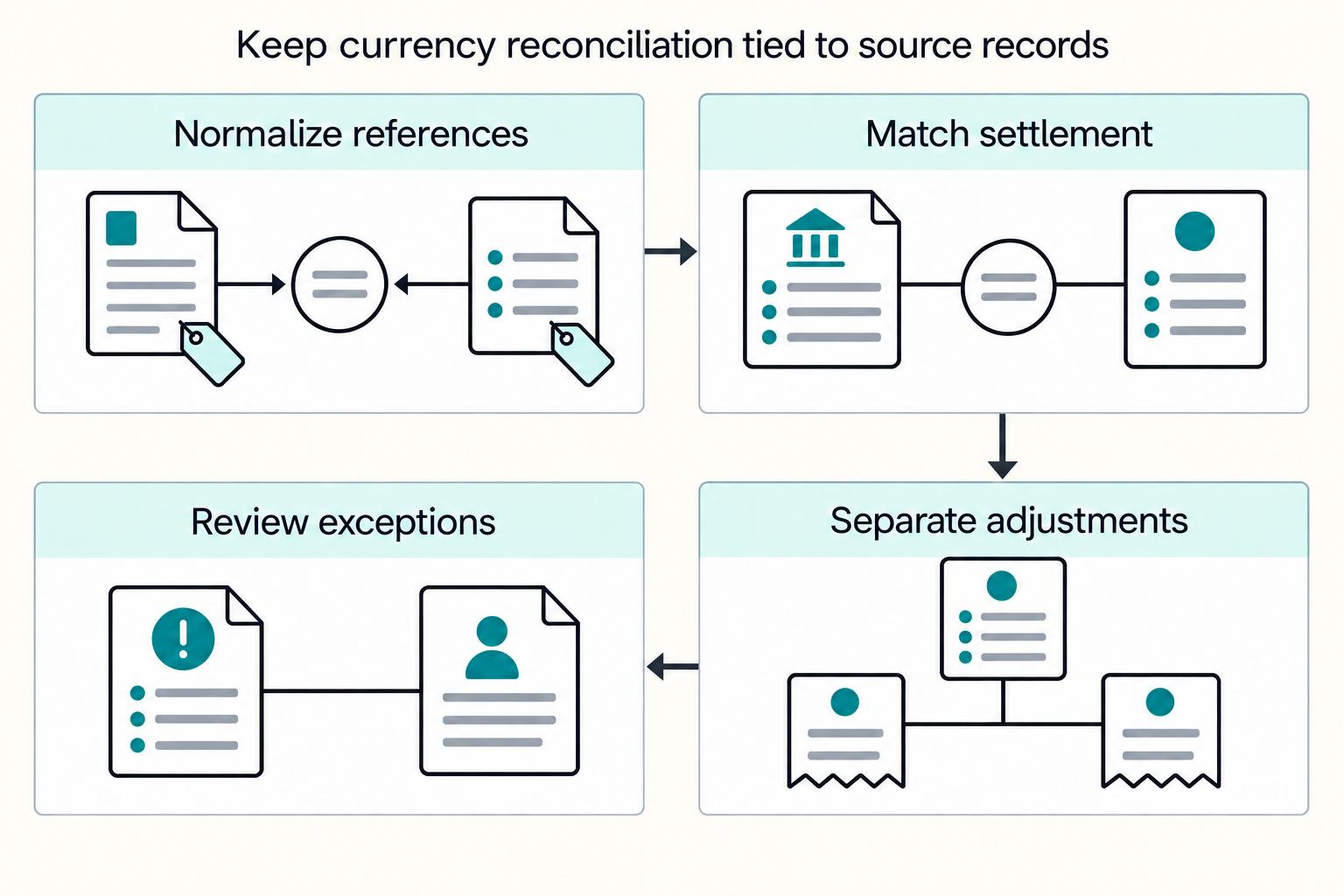
Xero Multi-Currency for Payment Platforms: How to Reconcile Foreign Currency Payouts
If you operate a platform, the goal is not just to post foreign-currency activity in Xero. The goal is a close that reconciles foreign-currency payouts the same way every time, with evidence finance, ops, and engineering can all trust.
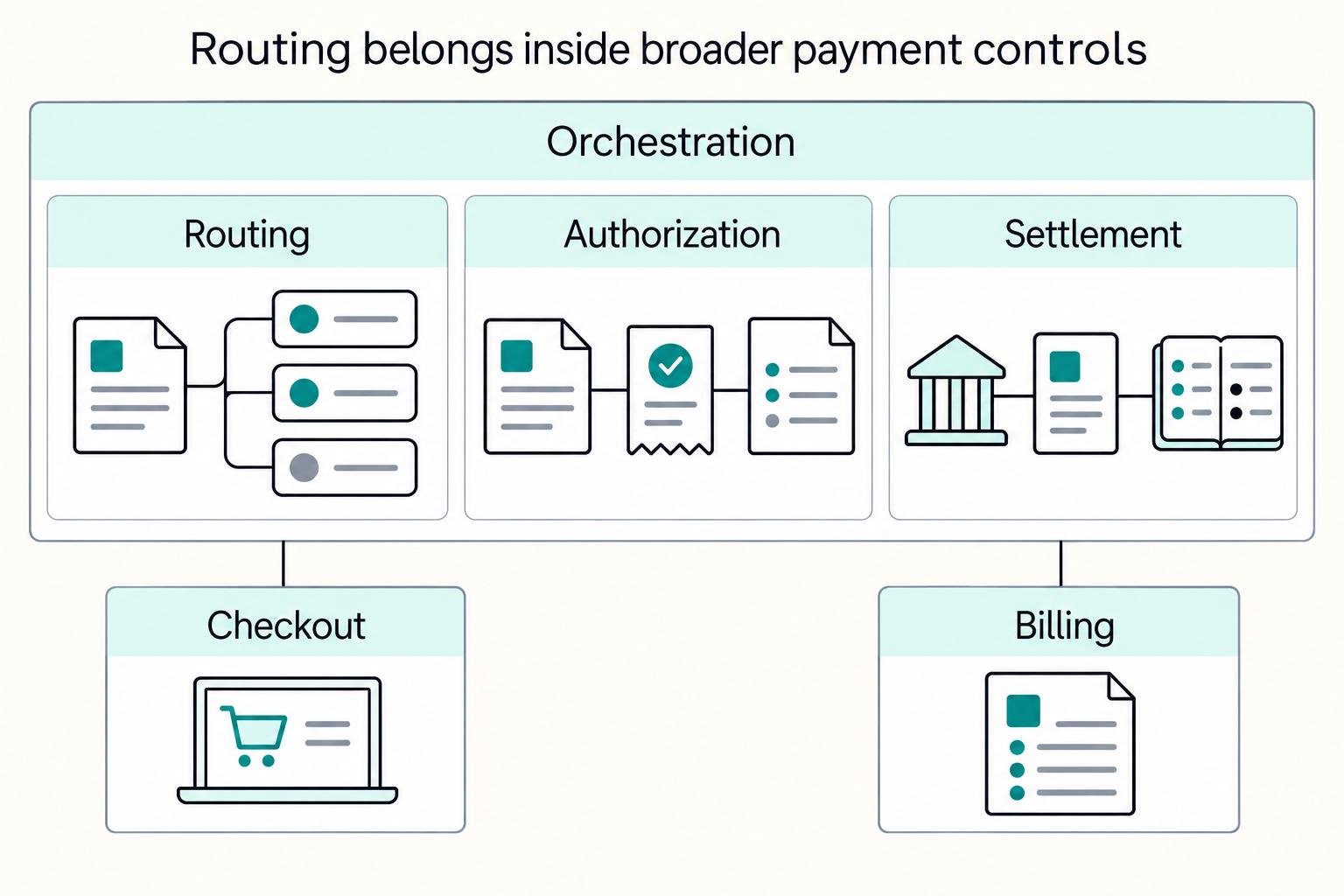
What Is Payment Orchestration? How Platforms Route Transactions Across Multiple PSPs
Payment orchestration coordinates payment providers, routing decisions, attempt history and operational reporting through a shared control layer. It becomes useful when checkout traffic needs more than one PSP and separate integrations make outcomes harder to explain. One integration can simplify access; it does not automatically settle funds or reconcile every connector.

The Freelance Payment Penalty: A Modeled Audit of Platform Fees, FX Spreads, and Payout Delays
The money rarely disappears through a single, easy-to-spot fee. The real loss is stacked. A marketplace takes its commission, a processor adds a charge for international cards, a bank or payment company converts the currency at a spread, a platform holds the funds before release, and a wire sheds a little to intermediaries on the way in. Each layer looks defensible on its own, but the worker feels the combined result as a smaller deposit and a later payday.