
Quick Answer
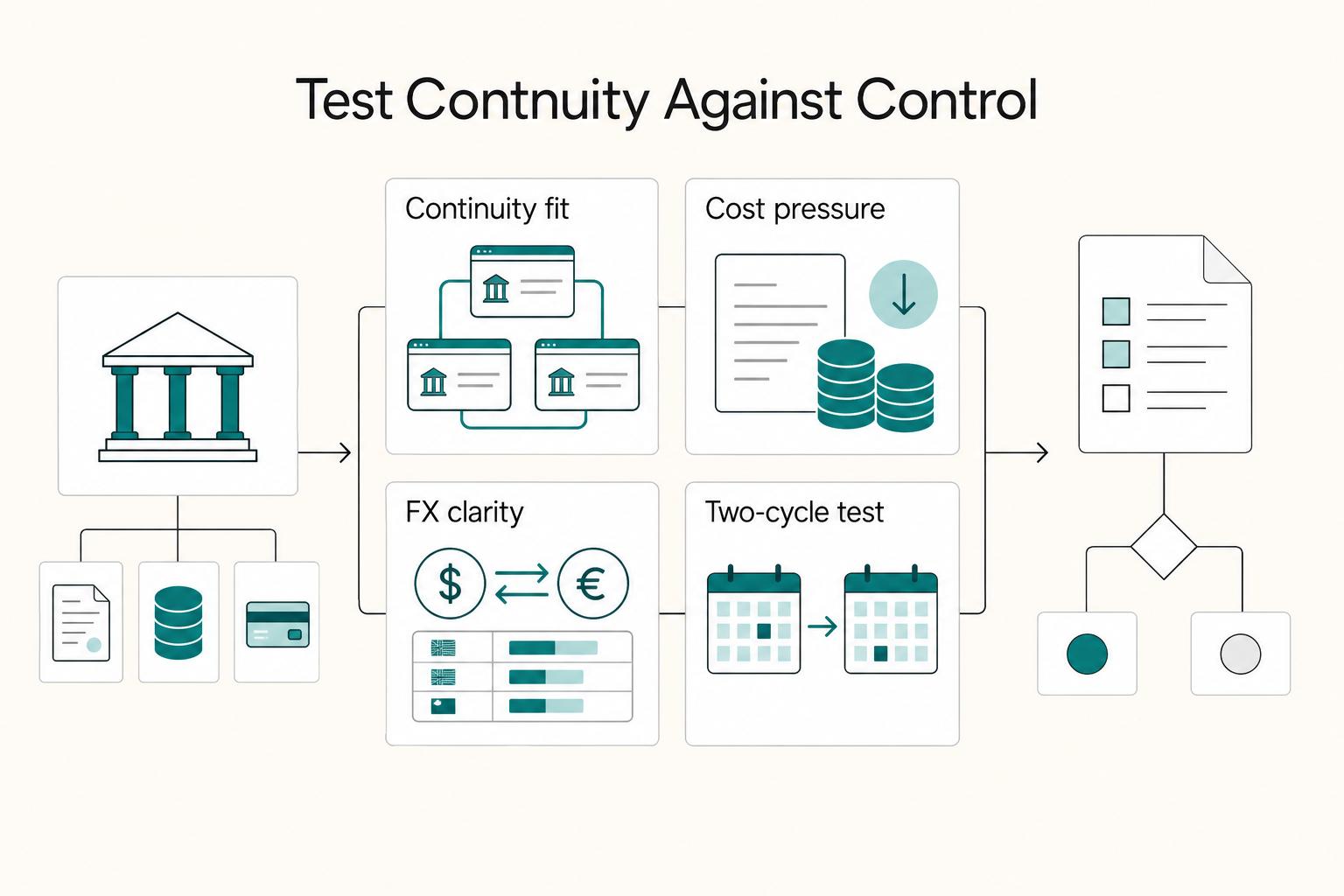
Compare UK business products in the same market: Wise Business for quoted usage, Revolut Business for plan allowances, Airwallex for its wallet and business-payment workflow, and HSBC Global Wallet alongside eligible HSBC business banking. Price receiving, conversion and payouts together.
Choose the business account for your registration country#
A multicurrency account can let a freelance business receive foreign client payments, keep the original currency and convert only the portion needed for local bills. The important choice is the exact product and market. A personal travel account, a UK business account and a US business edition can share a brand while having different eligibility, fees and protections.
This comparison uses UK business offerings checked on 3 October 2026, with a worked example for an eligible UK limited company. Wise Business, Revolut Business, Airwallex and HSBC Global Wallet are four useful paths to compare. It does not rank personal travel accounts or claim a universal winner for digital nomads. If you are a sole trader or operate elsewhere, confirm the applicable product and ownership rules before using any of these prices.
A practical UK business shortlist#
| UK product | Baseline pricing | Useful fit | Boundary to keep visible |
|---|---|---|---|
| Wise Business | £50 one-time setup; transaction fees vary | Receive and retain supported currencies with quoted conversion fees | Safeguarded e-money, not ordinary FSCS-covered deposits |
| Revolut Business Basic / Grow | Basic £10 monthly; Grow £35 monthly or £360 annually | Plan allowances for exchange and transfers | Personal Standard terms do not apply; additional fees and eligibility remain |
| Airwallex Explore | £19 monthly, waived under defined £10,000 activity or balance conditions | Global Accounts, currency wallet and business payments | FX pricing and payment charges remain even if subscription is waived |
| HSBC Global Wallet | £5 receive/pay-like-a-local; £17 Pay SWIFT in standard tariff | Add currencies to an eligible HSBC business-banking relationship | Distinct from personal HSBC Global Money; underlying account and FX costs matter |
Wise Business: pay for the route you use#
Wise’s UK business pricing lists a £50 setup fee for receiving details and free supported domestic non-wire/non-Swift receipts. Conversion and sending fees depend on currency and method. Incoming USD wire/Swift, GBP Swift and EUR Swift each have separate receive-fee lines; “free receiving” does not cover every route. Obtain the quote for the actual amount and funding method.
Shortlist it for a business that wants to hold invoice currency and inspect conversion costs before exchanging. Keep the customer’s gross payment, receiving deduction, conversion and eventual bank deposit visible. A fee starting from a low percentage is not a quote for your currency pair. Avoid applying a US setup price or personal ATM allowance to the UK business account. Holding money and investing through a separately offered Assets feature also have different terms.
Revolut Business: cost depends on the plan and timing#
Basic’s UK fee schedule lists £10 monthly, £1,000 monthly exchange allowance, 0.6% on excess exchange and an additional 1% outside FX market hours. Grow’s schedule lists £35 monthly or £360 annually, with £15,000 exchange allowance. Its annual price averages £30 monthly but requires the annual commitment; “from £30” is not the month-to-month charge.
A larger allowance can justify the subscription when conversion recurs. Check remaining allowance and the quoted fees at the time of each exchange, as well as separate receiving and transfer charges. Allowances reset on the subscription billing cycle, not necessarily the calendar month. The legal-entity help page lists UK limited companies as supported and freelancers/sole traders as unsupported. Do not assume a personal or Pro product has Business features or pricing; the applicable onboarding offer controls eligibility.
Airwallex Explore: separate subscription waiver from FX costs#
Airwallex’s UK pricing lists Explore at £19 monthly, waived if the defined monthly deposits reach £10,000 or the wallet balance is at least £10,000 at the subscription-period end. The page describes major-currency conversion at 0.5% above interbank rates and 1% for other currencies. Global Accounts and the multicurrency wallet are part of the business offering.
The waiver can help a business already meeting those conditions; retaining extra idle cash solely to avoid £19 deserves a separate cash decision. Confirm the exact currency pair and quote, and price collection or payout methods independently. UK onboarding documentation describes entity and owner verification. A document checklist is not guaranteed acceptance, and an available account does not establish eligibility for every payment method.
HSBC Global Wallet: use the business product and detailed tariff#
HSBC Global Wallet adds multicurrency holding and payments to business banking through Business Internet Banking. It is a different product from the personal HSBC Global Money Account. For an existing eligible HSBC business customer, keeping currency activity in the same banking relationship may reduce additional account administration.
Use HSBC’s Business Price List, not the headline £5 alone. Its Global Wallet rows list £5 each for Receive like a local and Pay like a local, and £17 for Pay SWIFT. Add applicable account charges, the actual conversion quote and other-bank charges where relevant. A bank relationship can be convenient without being the cheapest conversion path.
Work through one monthly conversion scenario#
Suppose an eligible UK company converts foreign funds worth £6,000 before conversion costs. It exchanges during FX market hours, starts with unused allowances, makes no chargeable transfer in this calculation, and compares the recurring monthly plans. This isolates subscription and conversion pricing; receiving, payout, card and intermediary fees still belong in a full account comparison.
Revolut Basic charges £10 plus 0.6% on £5,000 above its £1,000 allowance: £10 + £30 = £40. Grow’s £15,000 allowance covers this conversion, so the monthly-plan cost is £35. On these assumptions Grow saves £5 for the month. If its annual commitment is appropriate, the £360 annual fee averages £30 monthly; compare that separately from the cancellable monthly choice.
For Airwallex Explore, use a simplified cost estimate of 0.5% × £6,000 = £30 for a qualifying major-currency pair. Assume deposits and ending balance do not qualify for the subscription waiver: add £19 for £49. If the waiver applies, this estimate is £30. The actual quoted rate and calculation method determine proceeds; this markup estimate is not an executable exchange quote.
Wise requires the exact conversion quote, so do not insert its advertised minimum as an equivalent rate. If a hypothetical quote for this transaction were £34, that would be £34 recurring conversion cost, plus its £50 one-time setup in the opening period. HSBC similarly needs its actual FX quote; a £5 transfer fee alone cannot be compared with a subscription-plus-conversion total.
| £6,000 conversion under stated assumptions | Illustrative subscription + conversion cost |
|---|---|
| Revolut Basic monthly | £40 |
| Revolut Grow monthly | £35 |
| Airwallex Explore, waiver not met | About £49 |
| Airwallex Explore, waiver met | About £30 |
| Wise Business | Exact quote needed; hypothetical £34 is not current pricing |
| HSBC Global Wallet | Exact FX quote plus applicable account/payment charges needed |
For Basic versus monthly Grow, the simplified break-even within Grow’s allowance is £10 + 0.006 × (C − £1,000) = £35, or C ≈ £5,166.67 converted per billing cycle. Below that, Basic costs less on these inputs; above it, Grow can cost less until its own allowance and other charges matter. Already-used allowances, outside-hours exchange, transfer activity and annual commitments change the answer. Do not apply this threshold as a universal plan recommendation.
Then add the receiving and payment legs#
Suppose the business uses HSBC Global Wallet for four Receive-like-a-local payments and three Pay-like-a-local payments. The tariff contribution is 7 × £5 = £35 before FX and underlying account costs. If the three outgoing payments instead use Pay SWIFT, those three contribute 3 × £17 = £51; together with the four local receipts, the payment-fee contribution is £71. The receiving rail is part of the cost model, not an interchangeable label.
Compare the full path for your actual invoices: receipt, retained balance, conversion, transfer and any card spending. Use quotes captured at similar times with the same currencies and intended recipient amount. Record whether fees reduce the deposit, are charged separately or sit inside the conversion rate. Count an embedded spread once. A cheap conversion quote can still lose on numerous fixed receiving or payout charges.
Match currency holdings to known expenses#
Imagine the business receives $4,000 and has a documented $1,200 supplier obligation in dollars. Keeping $1,200 for that bill leaves $2,800 to convert for sterling costs, avoiding an unnecessary dollar-to-pound-to-dollar round trip on the committed portion. This is an operating match, not a guarantee of profit from exchange-rate movements. Confirm the supplier deadline and transfer costs before treating the held balance as sufficient.
Uncommitted foreign balances still expose the business to currency movement relative to its accounting and spending currency. Holding money until a rate improves is speculative and may conflict with product terms; it can also leave sterling bills underfunded. Keep a dated cash forecast in each material currency and maintain the accounting rate and settlement evidence for each transaction. The account balance and the profit report answer different questions.
Check protection and access for the exact provider entity#
Wise Payments Ltd’s UK guidance describes safeguarding, with its e-money and payment services outside FSCS protection. Airwallex UK’s guidance likewise distinguishes safeguarding from a bank-deposit guarantee. A return of safeguarded funds after insolvency can involve administration and deductions; safeguarding does not promise instant access.
For eligible UK bank deposits, the FSCS deposit limit is £120,000 per eligible person, per authorised firm, from 1 December 2025. Revolut Bank UK’s Business Terms describe this cover for eligible deposits under that bank agreement. Check your own contracting entity and account documents; do not infer bank protection for another entity or investment product from the brand name. Currency sub-accounts do not each create a new limit.
Move invoices only after the receiving path works#
Confirm the business holder name, required account details, accepted currency and local or SWIFT route with the provider. A digital nomad’s personal residence and a company’s registration country are separate eligibility inputs. Notify the provider when relevant address or business circumstances change. Travelling does not automatically transfer your account into another country’s pricing or protection scheme.
Run a small authorized receipt and an intended onward transfer, then reconcile the statement entries and fees. Keep the prior account available while outstanding payments, refunds and direct debits are resolved. If a transfer is pending or unknown, recover the original outcome before sending a replacement through a backup. A second provider helps only if its approved route and accessible balance can meet the obligation.
Choose Wise for an eligible business that values quoted usage costs; compare Revolut’s plans when allowance use is predictable; evaluate Airwallex when its wallet and business-payment workflow fit; and consider Global Wallet for an eligible HSBC relationship. Let actual quoted proceeds, recurring work and protection requirements decide the shortlist, rather than a score built from unrelated personal-account fees.
Frequently Asked Questions
Does this comparison apply to personal travel accounts?
No. It compares UK business offerings and uses an eligible UK limited company for the worked example. Personal account, Pro, US and other-country terms can differ; confirm the appropriate product before using the prices.
What is the Revolut Grow monthly price in the comparison?
The UK Grow fee schedule lists £35 monthly or £360 annually. The annual commitment averages £30 per month and is distinct from paying month to month.
Is HSBC Global Money the business product discussed here?
No. HSBC Global Wallet is the business multicurrency product. Its standard tariff distinguishes £5 Receive/Pay-like-a-local payments from £17 Pay SWIFT, before applicable other charges and FX.
Does a waived Airwallex subscription mean free currency conversion?
No. Explore’s waiver applies to the subscription under specified activity or balance conditions. Published FX pricing and any payment or collection charges still apply.
Are Wise and Airwallex UK balances ordinary FSCS-covered deposits?
Their UK guidance describes safeguarded customer funds rather than ordinary FSCS-covered bank deposits. Check the exact provider entity and product; separate investment and bank products have their own terms.
Why keep a foreign-currency balance instead of converting everything?
A known expense in the same currency may be funded directly, avoiding a conversion round trip. Unmatched balances retain FX exposure, so align amounts and dates with actual obligations rather than expecting a favorable future rate.
Researched and edited by the Gruv editorial team. Gruv builds cross-border billing, payouts, and finance-operations software for global businesses.
Sources
Includes 6 external sources outside the trusted-domain allowlist.
- wise.com/gb/pricing/businesstrusted
- wise.com/help/articles/4IusAofIppsIGPcs7sEIXI/how-our...trusted
- airwallex.com/en-uk/pricingexternal
- business.hsbc.uk/en-gb/products/hsbc-global-walletexternal
- business.hsbc.uk/-/media/media/uk/pdfs/regulations/business-p...external
- help.airwallex.com/hc/en-gb/articles/900001755746-Documents-req...external
- help.airwallex.com/hc/en-gb/articles/4404265644185-How-does-Air...external
- help.revolut.com/business/help/setting-up-an-account/is-my-bu...external
Educational content only. Not legal, tax, or financial advice.
Related Posts

The Freelance Payment Penalty: A Modeled Audit of Platform Fees, FX Spreads, and Payout Delays
The money rarely disappears through a single, easy-to-spot fee. The real loss is stacked. A marketplace takes its commission, a processor adds a charge for international cards, a bank or payment company converts the currency at a spread, a platform holds the funds before release, and a wire sheds a little to intermediaries on the way in. Each layer looks defensible on its own, but the worker feels the combined result as a smaller deposit and a later payday.

How to Respond to a Subpoena for Business Records
Move fast, but do not produce records on instinct. If you need to **respond to a subpoena for business records**, your immediate job is to control deadlines, preserve records, and make any later production defensible.
A US Expat's Guide to Investing in UCITS ETFs to Avoid PFIC Issues
The real problem is a two-system conflict. U.S. tax treatment can punish the wrong fund choice, while local product-access constraints can block the funds you want to buy in the first place. For **us expat ucits etfs**, the practical question is not "Which product is best?" It is "What can I access, report, and keep doing every year without guessing?" Use this four-part filter before any trade: