
Quick Answer
Implement programmable payments by defining the condition, trigger, and execution point first, then separating decision logic from settlement. Start with one narrow payout flow, document the trigger evidence and blocker states, choose the off-chain, on-chain, or hybrid model that fits the failure path, and require idempotent state changes plus traceable accounting before launch.
How Programmable Payments Work#
According to Chainlink's overview of programmable payments, the model works when money moves only after predefined conditions are satisfied. For a platform team, that means you should define the condition, the trigger, and where execution happens before you automate anything.
Define the condition, trigger, and execution point#
Reduce each payment flow to three testable parts before you build or automate anything:
- Condition: the rule to satisfy, such as release on delivery, expire in 30 days, or spend only with approved vendors.
- Trigger: the event that tells the system to evaluate the rule.
- Execution point: where that decision logic runs, such as a smart contract or a bank-side programmable environment.
Treat vocabulary as part of the design. "Programmable" can mean smart contract execution or client logic deployed as programmable instructions in a bank environment, so align on that meaning before you build.
Start from known failure modes#
A common goal is to reduce manual handling in conditional flows, but start from the baseline problem, not the promise. Traditional conditional transactions often rely on manual intervention, multiple intermediaries, and slow reconciliation. That pattern is associated with delays, higher costs, and increased counterparty risk.
Before you choose any technology, pressure-test one real payment path. Ask what event proves the condition, who owns that event, and what record you will rely on if the outcome is challenged. If those answers are fuzzy, the design is not ready.
Use this guide to sequence decisions#
Sequence matters more than tooling. This guide is for CTOs, engineering leads, and solution architects who need to move quickly without creating payment operations that are hard to unwind later.
Start with the narrowest conditional payout you can explain end to end. Then choose the execution model and implement around those boundaries with clear tradeoff handling. Programmability can help, but only if each decision stays auditable and operable.
What programmable payments actually mean in platform architecture#
Payment programmability becomes usable when business rules, events and execution boundaries are defined in plain operational terms. Get product, engineering and finance to use the same words before encoding a payout rule.
Define the payment primitives in plain language#
Get product, engineering, and finance to use the same words for the same thing. For implementation, a condition can be the business rule, such as release after approval or expire in 30 days. A trigger can be the event that causes that rule to be evaluated. Execution is where that logic runs, whether in your API services, smart contracts, or both.
A good checkpoint is to write one payout as a single if-then statement. Then name the exact event and evidence source that proves it. If no clear owner can vouch for that event, the trigger is not ready for automation, especially when off-chain inputs are involved.
Separate decision logic from settlement logic#
A related operating pattern appears in Partial Payments and Milestone Billing: How to Implement Flexible Invoice Terms on Your Platform, where release conditions also need to be explicit before funds move.
In practice, programmable payments can be modeled as two layers: a decision layer for when funds should move, and a settlement layer for how funds move. Keeping those layers separate makes payout behavior easier to operate, explain, and change.
Keep each decision explainable in financial operations#
For a concrete trigger-based payout example, see Airline Delay Compensation Payments: How Aviation Platforms Disburse Refunds at Scale.
Keep each payout decision explainable to finance and operations in plain language: what condition was checked, what evidence was used, and why funds moved or stayed constrained.
What to prepare before implementation starts#
Before implementation starts, lock one narrow release rule that everyone involved describes the same way. Starting from one payout with explicit pass and fail states keeps the automation target clear.
| Preparation area | What to define | Release implication |
|---|---|---|
| Payout use case and release test | One payout scenario in plain if-then form, including what must be true and what happens when conditions are still unmet | If the same rule is described differently, the use case is too loose for automation |
| Trigger evidence pack | Condition inputs for each trigger and how they will be evaluated in code | If inputs are unclear, do not let that trigger release funds automatically |
| Policy blockers | Dependencies that can block release, placed explicitly in the decision path | Vague blockers lead to manual side decisions that drift away from the code |
| Traceability with finance | The minimum record needed to trace each automated release from condition check to fund movement | If that path is not clear in staging, implementation started too early |
Lock one payout use case and define the release test#
Start with one payout scenario and write the release logic in plain if-then form. Make it clear what must be true and what happens when conditions are still unmet.
This is the core checkpoint for coded conditions: agree on the condition first, then encode it. If the same rule is described differently, the use case is still too loose for automation.
Create a trigger evidence pack before anyone writes handlers#
Do not let implementation outrun condition design. For each trigger, define the condition inputs up front and document how they will be evaluated in code.
If those inputs are unclear, do not let that trigger release funds automatically. Keep funds constrained until the conditions can be evaluated consistently.
Define policy blockers before funds can be released#
Blocked states should be designed, not discovered late. List the dependencies that can block release, and place them explicitly in the decision path.
Funds can be issued or locked with rules attached, and they remain constrained until conditions are met. If blockers stay vague, teams end up making manual side decisions that drift away from the code.
Decide traceability with finance before launch dates are set#
Agree up front on how each automated release will be traced from condition check to fund movement. Define the minimum record needed so teams can verify why funds moved or stayed locked.
A practical launch gate is this: each release should show which coded condition was evaluated and whether it passed before funds moved. If that path is not clear in staging, implementation started too early.
Choose your execution model before writing trigger logic#
Choose the execution model before you code triggers. Keep policy logic off-chain when it changes often, and use on-chain execution where shared state or composability are central to the product.
Compare the three models by failure handling, not just features#
Use a simple first cut: off-chain rules with API and webhooks, on-chain smart contracts on public smart contract platforms, or a hybrid control plane.
| Model | Best fit | What you gain | What gets harder | Operator checkpoint |
|---|---|---|---|---|
| Off-chain rules engine | Policy changes frequently or needs frequent exceptions | Policy iteration and tight integration with internal systems | Event drift, retries, and manual side decisions can create inconsistent outcomes | Reconstruct each release from event payload, policy result, and ledger record |
| On-chain smart contracts | Settlement finality, shared execution, or composability on blockchain is required | Verifiable state transitions on a shared programmable substrate | Contract changes, governance, and contract-security failure modes | Prove the condition is fully machine-testable before encoding it |
| Hybrid control plane | You need policy flexibility plus selected on-chain settlement or proof steps | A clear split between policy decisioning and execution target | Drift between off-chain decisions and on-chain execution if controls are weak | Carry one decision ID across the policy record and transaction outcome |
Public blockchains are a programmable substrate for value transfer, access control, and verifiable state transitions. Use that property when it is a product requirement, not just because automation is available.
Apply one decision rule to each condition#
Analysis by Harvard's smart-contract overview is a useful boundary: self-executing code is powerful when the condition is fully machine-testable, but it is not automatically the right home for every payout rule. If release still depends on human interpretation, keep the deciding logic off-chain.
Define a portable condition package before implementation so later model changes do not distort the rule:
- Transaction Intent Schema for unambiguous intent
- Policy Decision Record for auditable policy enforcement across execution environments
That can make later model changes safer because finance and ops can verify that a moved rule did not silently change meaning.
Screen compliance and rail constraints early#
Before you lock the model, run a compliance-fit check against your program constraints. Include applicable compliance, rail, and program eligibility checks in design review, and keep business eligibility separate from rail selection.
That separation can reduce architectural lock-in. "Payout approved" and "payout on this rail" should be distinct decisions. If rail eligibility changes, you can switch the execution target without rewriting the core condition.
Choose the model you can operate during incidents#
Do not choose on feature breadth alone. Include rollback path, incident containment, and cross-team coordination in the decision.
Smart contract vulnerabilities can cause substantial financial loss, and safe, reliable smart contract development remains challenging in practice. If you move conditions on-chain, require an evidence pack for change control, pause or containment, and security review.
One practical rollout path is phased adoption: stabilize controls first, then move specific high-value conditions on-chain when the condition is stable and fully auditable end to end. As a working bar, you should be able to replay any disputed decision from intent, inputs, policy result, and payment action.
Related reading: Gaming Platform Payments for Market Entry and Developer Payouts.
Define a trigger catalog with ownership and dispute paths#
Define the trigger catalog before you get lost in implementation details. For each payment type, make it clear what fires, what is trusted, who executes, and who handles exceptions. If exception ownership is unclear, route that trigger through manual review until ownership is assigned.
Catalog each trigger as a payment-decision input#
Build the catalog by payment type, not as one generic registry. A contractor payout, a marketplace refund, and a treasury movement can share infrastructure, but they still need different trigger definitions.
For each trigger, record the source event, validator, execution target, and fallback owner. Mark the execution target at design time, whether an API service or smart contracts. In practice, trigger tooling bridges conventional systems and DLT systems rather than assuming one fully replaces the other.
Classify trust before autonomy#
Classify trust before you design automation.
| Trigger class | Typical source | Validation focus | Default exception owner |
|---|---|---|---|
| Internal system event | Product or ledger-adjacent service | Internal controls and data quality checks | Engineering and payments ops |
| Partner-provided signal | PSP, bank, or partner platform | Counterparty trust assumptions and integration consistency | Partner ops or payments ops |
| External network/provider signal | Blockchain data or provider feed | Provenance and governance assumptions | Treasury, risk, or designated owner |
Platform model matters here. Permissioned environments emphasize controlled collaboration, while public networks emphasize transparency and tokenization. That trust and governance posture changes what you can verify directly versus what you must accept from counterparties.
Define dispute paths before release paths#
Dispute handling should sit next to trigger design, not behind it. Write dispute handling into the catalog beside each trigger so incidents are operational instead of improvised. Cover late or contradictory signals, and potential revocations, with explicit routing and decision ownership.
For smart contracts, include an explainability check as part of readiness: can teams explain why execution happened, not just that it happened? Keep the explanation purpose explicit across justification, clarification, compliance, and consent, because missing context increases surprise risk.
Make decisions reconstructable#
A trigger catalog is only useful if someone outside the implementation team can follow it. Make each trigger decision reconstructable from records, so another team can trace the path from event to decision to payment impact. If that reconstruction is not possible, the catalog is not complete.
Use more detail where payment value or dispute risk is highest. Richer explanation and audit detail, especially around on-chain execution, can raise deployment and execution cost.
Build an idempotent payment state machine that finance can audit#
Treat this as an auditability problem first. Every payment transition should be explainable as a decision, a state change, and an expected accounting effect.
Define explicit states and deterministic transition rules#
For an illustrative payout, use requested, held, approved, submitted, outcome_unknown, settled, failed and returned states, adapting them to your provider. Approval authorizes submission; it does not prove settlement. Give the instruction a durable identity with its amount, currency, beneficiary and approved policy version. Keep provider retries tied to that instruction even after provider idempotency keys expire; reconcile an unknown outcome before another attempt or rail switch.
For each transition, persist two artifacts with the payment record so finance and ops can verify what happened:
- Transaction Intent Schema for the unambiguous transaction goal
- Policy Decision Record for why the transition was allowed
Model async outcomes as first-class state#
Do not hide late or conflicting outcomes in flags. Represent relevant async outcomes as explicit states or substates so operator handling and accounting expectations stay aligned when signals arrive late or in conflict.
If you include on-chain execution, define the boundary between external execution progress and internal completion for your books. Public blockchains are described as a programmable substrate for value transfer, access control, and verifiable state transitions, but your internal accounting state still needs a clear mapping rule.
A transaction hash identifies a transaction; it does not prove network acceptance, successful transfer or finality. Verify the execution receipt, the intended asset transfer and the network’s finality criterion before treating an on-chain payout as settled. Ethereum’s transaction documentation distinguishes broadcast, inclusion and finalization; other networks require their own policy.
Add verification checkpoints at every transition#
Define the accounting effect for each transition. Some transitions change only operational status and require no journal; financial effects need balanced entries and a mapping to the general ledger. The verification record should cover:
- journal entries where the transition has a financial effect, or an explicit no-posting reason
- mapping of financial entries to the general ledger
- expected operator-visible status
Also retain reconstruction evidence for each move: event reference, normalized event ID, policy result, related journal IDs, provider or chain reference when present, and transition reason. Preserve enough evidence to verify transition integrity later. Where on-chain execution is involved, the network transaction record and a readable execution trace, as described in ethereum.org's smart-contract documentation, can serve as an additional checkpoint.
Guard against stale inputs before release#
Time-sensitive inputs need a freshness gate before release. If the decision context is expired, fail closed to review or re-evaluation, and show that reason in operator status. Set timeout and expiration windows explicitly in your own policy; no universal thresholds are defined here.
Test replay and adversarial failure modes before launch#
Before launch, test failure handling against payment-specific edge cases: duplicate callbacks, stale approvals, conflicting triggers, partial execution, key misuse, and delayed settlement updates. For replay and duplicate-delivery behavior, define and validate your own guarantees explicitly rather than assuming a default model.
Enforce one rule here: state advances only when the decision record, accounting expectation, and operator status agree.
For a step-by-step walkthrough, see AgriTech Platform Payments: How to Pay Farmers and Agricultural Workers in Emerging Markets.
Embed compliance and tax gates into payment release decisions#
Put the compliance and tax checks required by your program on the payment release boundary. Retain current applicable decisions and document checks that do not apply, so the engine follows the actual policy rather than a universal document list.
| Gate | What to record or model | Release rule |
|---|---|---|
| Compliance outcome | Applicable KYC, AML and KYB decisions as allow, hold or block, with policy version, timestamp, source and subject ID | Hold when a required check lacks a current decision for the same payment or beneficiary |
| Tax-document state | Required tax-document status, or documented inapplicability, with a remediation owner | Hold where required reporting or withholding treatment is unresolved |
| Jurisdiction caveats | Market and program caveats stored in the release logic notes with an effective date and policy owner | Avoid global assumptions that are not tied to a specific jurisdiction or program context |
| Policy drift control | Dated policy versions, version ownership, and review cadence, with compliance or legal review before deployment | Release only after applicable requirements pass; retain the policy basis for inapplicable checks |
Codify compliance outcomes as release decisions#
Model applicable KYC, AML and KYB decisions as allow, hold or block outcomes consumed by the payout engine. Record the policy version, timestamp, source and subject ID. Required checks must be current for the payment or beneficiary; inapplicable checks need a documented policy basis.
If a required release check cannot be tied to a current decision for the same payment or beneficiary, route it to review. An onboarding approval should not silently authorize later payouts after the relevant risk posture or program requirements change.
Make tax document state and reporting ownership explicit#
Tax-document state needs to be operational, not implied. Model required tax documentation as structured eligibility fields such as present, missing, expired, or under review, with a clear remediation owner. Add explicit ownership for reporting and withholding where those flows apply, so release is blocked when that responsibility is unclear.
That gate matters whenever payout release depends on tax documents, corridor rules, or program-specific eligibility. Keep those fields operational and visible to the release engine so finance and ops can see why a payout is blocked or allowed. Programmable Payments by Kinexys Digital Payments is a useful reminder that programmability still needs explicit controls around who can act and when.
Keep jurisdiction caveats versioned and visible#
For multi-rail or tokenized-money programs, store market and program caveats directly in the release logic notes with an effective date and policy owner. Avoid global assumptions that are not tied to a specific corridor, beneficiary type, or program context.
If you use smart contracts, keep legal and policy interpretation references outside immutable execution paths. Smart contracts can execute automatically on predefined triggers, so the policy context still needs a human-readable, versioned record.
Monitor policy drift with authoritative-review controls#
Track version ownership and review cadence for the policy domains you monitor. Use dated policy versions in release decisions so you can prove which rule set was applied.
Do not treat vendor release notes, chain announcements, or design memos as authoritative policy by themselves. Use a dated review checklist, tie the approved rule version to the control, and require legal or compliance signoff before a release gate changes.
Before release, record the current decisions required by your program. Mark genuinely inapplicable document or jurisdiction checks as such, with the policy basis, rather than inventing a universal tax-document gate.
Related: Non-Resident Withholding on Contractor Payments.
Implement ingestion, observability, and reconciliation from day one#
Make trigger handling deterministic before you launch. Treat payout-triggering events as message-based external inputs, and make each event traceable to a verification decision, an execution result, and immutable audit records. Your team should also be able to reproduce outcomes in staging.
Harden intake for retries, delays, and out-of-order delivery#
Verify event authenticity and durably accept the payload before acknowledging receipt. Keep provider/account/event identity and intake metadata. Commit the processed-event marker with the local state change and any required downstream work, then dispatch after commit, so a crash does not lose work or repeat a journal.
Design handling so uncertain, delayed, duplicated, or conflicting deliveries do not create new side effects. If event identity or integrity cannot be confirmed, pause payout-state changes and require review.
If you need a baseline for these controls, the Gruv docs are a practical reference for webhook retries, payout states, and reconciliation workflows.
Persist full lineage for every payout decision#
Keep a single evidence chain for each payout: inbound event, policy result, execution result, and linked ledger records. If an operator intervenes, record who acted, why, and when in the same chain.
That gives you enough context to explain later why a payout was released, held, or blocked. That is the point of pre-settlement verification, risk controls, and audit-trail discipline.
Route broken cases into explicit exception queues#
Do not leave critical failures buried in retries. Route unresolved or contradictory outcomes into an explicit review path with a named owner.
For contradictory terminal-state updates, stop automatic processing and require review. If a correction changes paid status or posted journal outcomes, use dual-control approval and preserve the original audit trail.
Reconcile operations and accounting as a standing control#
Use dual logging as a standing control so operational status and accounting records can be checked independently. An ops match with an accounting mismatch is still an incident.
Set one launch gate: your team can replay a failed payout end to end in staging, reproduce the same policy result, and avoid duplicate journal postings.
Select rails and settlement options by use case not hype#
Choose the rail that creates the fewest operational surprises for the payout type. If two rails can deliver funds, prefer the one your team can explain, reconcile cleanly, and support during exceptions without improvising.
Define settlement shape before comparing rails#
Start with the transfer pattern, not the rail label: atomic settlement, netted settlement, or both. A dual-mode settlement layer, atomic plus netted, can be a more important design choice than whether the endpoint uses bank rails, bank-issued tokens, or stablecoins.
For marketplace or contractor payouts, document three checks early: what can block release, what can reverse or return after initiation, and what status evidence the provider exposes at each state. If provider statuses and references do not map cleanly to your internal payout states, the rail is likely not production-ready for your operating model.
Treat newer rails as conditional options#
Use stablecoins only where your corridor, compliance posture, and provider support are confirmed, not assumed. Treat central bank digital currencies (CBDCs) and programmable fiat as design considerations unless live coverage exists for your corridor and operating model.
Keep legal boundaries explicit: smart contract execution should implement agreed legal terms, not replace them. If release logic uses on-chain triggers, disputes, returns, and eligibility may still need an off-chain source of truth.
Prefer fewer cross-mode failure paths#
Favor the rail with fewer mode transitions. Transfers that span on-chain, off-chain, cross-chain, and hybrid paths require more careful implementation and can add exception-handling and reconciliation complexity.
In staging, compare each rail’s terminal and non-terminal statuses with your accounting treatment. Include failed execution, returns and an unknown outcome. Start with the option that requires fewer status translations and manual exception branches for the actual corridor.
For teams evaluating contractor or cross-border use cases, Non-Resident Withholding on Contractor Payments is a useful companion when rail choice intersects with tax handling.
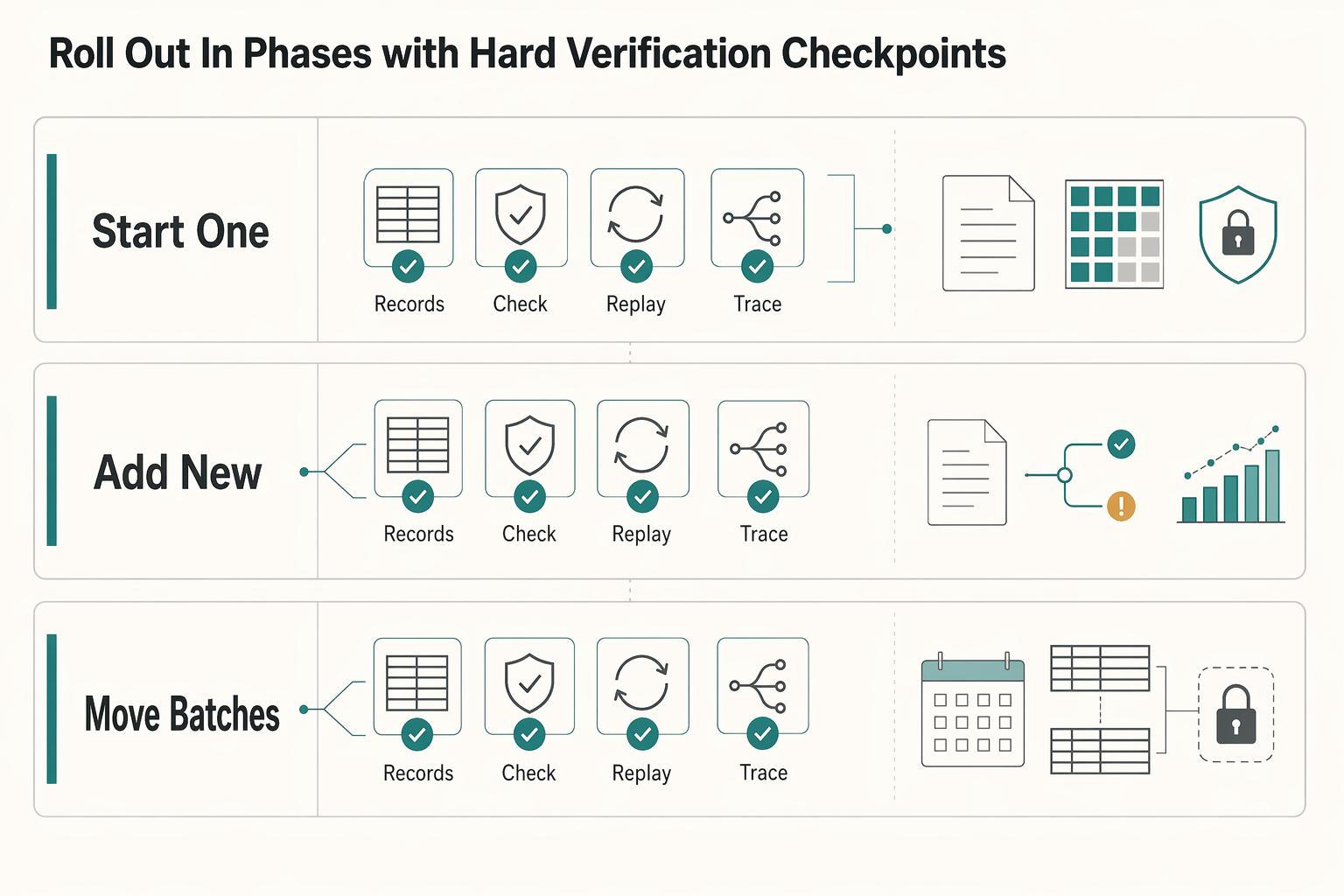
Roll out in phases with hard verification checkpoints#
Roll out in phases because safe, reliable smart contract development is still hard, and failures can emerge in edge paths as scope grows. Treat each phase as a hard gate. Prove the system is explainable under retries, overrides, and exceptions before you increase scope.
| Phase | Scope | Checkpoint |
|---|---|---|
| Start with one corridor and one trigger family | Keep the slice small enough that the team can trace every payout decision, including non-release outcomes | Keep a complete trail from input event to policy result to execution result and resulting records |
| Add new condition types or rails | Expand one dimension at a time only after behavior is consistently understood | Verify ordering assumptions, duplicate handling, stale-event rejection, and mapping from provider outcomes to internal payout states |
| Move to batches and higher volume | Scale volume only when replay and exception handling are routine operational work | Review behavior under retries and partial failures, and confirm reconciliation remains clear across success and exception states |
For each phase, test the release condition, duplicate handling, incident containment and reconciliation before expanding scope.
Use the sequence below as an operational pattern, not a universally validated order.
Start with one corridor and one trigger family#
Start narrow: one corridor and one trigger family. Keep the slice small enough that your team can trace every payout decision, including non-release outcomes.
Require strict observability before moving on. For each decision, keep a complete trail from input event to policy result to execution result and resulting records. If any on-chain logic is involved, record the on-chain transaction reference with the related off-chain decision record rather than relying on blockchain history alone.
Add new condition types or rails only after behavior is consistent#
Expand one dimension at a time. Add a new condition type or a new rail only after behavior is consistently understood. The checkpoint is deterministic behavior, not just higher throughput.
Verify event handling end to end: ordering assumptions, duplicate handling, stale-event rejection, and clear mapping from provider outcomes to internal payout states. If adding a rail forces rule rewrites or breaks reconciliation clarity, separate rule evaluation from money movement before expanding again.
Move to batches and higher volume only when exception handling is routine#
Scale volume last. Move to batches and higher volume only when replay and exception handling have become routine operational work.
Use a final gate with explicit approval criteria. Review behavior under retries and partial failures, and confirm reconciliation remains clear across success and exception states. This ordering matters because programmable automation can reduce manual intervention, but tradeoffs in throughput, privacy, and key management, plus known smart contract risks, still require tight controls before batch scale.
Need a concrete baseline for webhook retries, payout states, and reconciliation controls? Review the Gruv docs.
Common mistakes that create platform debt and how to recover#
If phase-gate reviews keep surfacing exceptions your team cannot explain, the debt is often architectural. In programmable flows, especially those that use smart contracts, immutable transactions and composable, transparent execution can amplify small design mistakes into bigger operating problems.
- Treating automation as a substitute for oversight.
A common mistake is assuming disintermediation removes the need for intermediary-style controls. Recovery is to embed compliance safeguards by design and add governance and technology controls that replicate core compliance and risk-management functions.
- Fixing only code-layer risk.
Teams often focus on technical bugs and underweight protocol-economic risk, infrastructure risk, or cross-chain risk. Recovery is to design controls across all three layers: technical and code, economic and protocol, and infrastructure and cross-chain.
- Shipping without lifecycle defenses.
Another debt pattern is treating launch as the main control point and leaving mitigation and recovery vague. Recovery is to make all three phases explicit: pre-deployment prevention, runtime mitigation, and post-incident response and recovery.
- Assuming transparency means explainability.
Transparent execution does not automatically make failures easy to diagnose. Recovery is to pair transparency with explicit runtime mitigation and post-incident response paths so incidents can be explained and resolved without ad hoc decision-making.
- Underestimating governance and cross-border exposure.
Vulnerabilities tied to governance and cross-border anonymity can be material in programmable systems. Recovery is to account for those risks in your control model before you expand scope or volume.
The recovery pattern is consistent: establish controls in design, enforce them during runtime, and prove recovery readiness before scaling.
If your payment rules depend on milestones or partial release conditions, see Partial Payments and Milestone Billing: How to Implement Flexible Invoice Terms on Your Platform.
Conclusion#
The fastest path to a defensible launch is to make payment conditions explicit, choose execution per condition, and make accounting outcomes easy to verify. Keep smart contracts targeted, and use blockchain execution only where on-chain guarantees materially improve outcomes enough to justify tradeoffs in throughput, privacy, and key management.
- Finalize trigger ownership before release automation.
Define each payout condition up front, including who owns exceptions, what fallback applies, and how disputes are handled. In a condition-based model, funds should not move until the defined condition is satisfied.
- Choose execution per condition, not by default.
Use API-driven logic where policy changes are frequent. Use smart contracts where blockchain-resident code is necessary for the agreement, and make the architecture choice explicit based on benefits and trade-offs.
- Tie trigger execution to accounting state.
Check that submitted, settled, failed and returned outcomes remain distinct in operational and accounting records. Mark an item paid only at the settlement point your program defines, with the provider evidence and any resulting journal linked to the decision.
- Keep release gates explicit.
If your program uses compliance or document-based eligibility checks, encode them directly in the release path so operators are not relying on informal process.
- Treat auditability as launch-critical.
You should be able to trace one payout from trigger input to execution result to ledger impact without guesswork. This matters even more for on-chain logic, where known smart contract risks include issues such as reentrancy and oracle exploits.
Copy and paste this checklist into your launch doc before rollout:
- Trigger catalog finalized with owners, trust level, fallback, and dispute rule
- Execution model chosen for each condition, whether API, smart contracts, or hybrid, with rationale
- Trigger initiation and parameter checks are defined and validated
- Program-specific compliance and eligibility gates where enabled are wired to payout release
- Payment-trigger events and general ledger status stay consistent in staging before production rollout
For a first release, the goal is not maximum automation. The goal is payment execution you can explain and reconcile. If you want to pressure-test this rollout plan against your corridor and compliance constraints, talk with Gruv.
Frequently Asked Questions
What is a programmable payment trigger in a platform architecture?
A programmable payment trigger is the event or data input that causes coded payment conditions to be evaluated. In the model here, you define the condition in software, tie it to a specific evidence source, and evaluate it when the trigger arrives. Until the condition passes, funds stay constrained by those rules.
When should we use smart contracts instead of API-based rule execution?
Use smart contracts when blockchain finality or composability materially changes the product outcome. Keep the main logic in API-based rule execution when policy changes often, when you need frequent exceptions, or when release still depends on human interpretation. A good check is whether the condition is fully machine-testable before you encode it.
How do we prevent duplicate payouts when webhooks are retried or delayed?
Keep one durable instruction identity across provider retries and key expiry. Commit processed-event identity with the local state change and required journal or downstream work. If submission has an unknown outcome, reconcile it before making a new attempt or switching rails; a fresh transport key must not become a fresh business payment.
Which compliance checks should block payout release by default?
Consume the checks required by your program as explicit allow, hold or block decisions. Tie them to the correct payment or beneficiary and current policy version. Apply tax-document, reporting and withholding gates where those duties exist, and document genuinely inapplicable checks instead of treating them as universal requirements.
What should happen when trigger data is late, wrong, or disputed?
Fail closed. If the decision context is stale, send the payout to review or re-evaluation rather than releasing funds on expired inputs. For contradictory or disputed signals, stop automatic processing, preserve the evidence chain, and route the case through the dispute path defined for that trigger.
How do we choose between stablecoins, bank-issued tokens, and traditional rails for a first launch?
Start with settlement shape and failure handling, not the rail label. Document what can block release, what can reverse or return after initiation, and what status evidence you receive at each state. Use stablecoins only where the corridor, compliance posture, and provider support are confirmed, and prefer the option with fewer cross-mode failure paths and cleaner reconciliation.
Researched and edited by the Gruv editorial team. Gruv builds cross-border billing, payouts, and finance-operations software for global businesses.
Sources
Includes 6 external sources outside the trusted-domain allowlist.
- corpgov.law.harvard.edu/2018/05/26/an-introduction-to-smart-contract...trusted
- stripe.com/resources/more/programmable-money-explainedtrusted
- chain.link/article/programmable-paymentsexternal
- docs.sui.io/paper/sui.pdfexternal
- ethereum.org/en/smart-contractsexternal
- ethereum.org/en/developers/docs/smart-contractsexternal
- jpmorgan.com/kinexys/digital-payments/programmable-paymentsexternal
- jpmorgan.com/kinexys/documents/Application-of-Programmabi...external
Educational content only. Not legal, tax, or financial advice.
Related Posts

The Freelance Payment Penalty: A Modeled Audit of Platform Fees, FX Spreads, and Payout Delays
The money rarely disappears through a single, easy-to-spot fee. The real loss is stacked. A marketplace takes its commission, a processor adds a charge for international cards, a bank or payment company converts the currency at a spread, a platform holds the funds before release, and a wire sheds a little to intermediaries on the way in. Each layer looks defensible on its own, but the worker feels the combined result as a smaller deposit and a later payday.

How to Respond to a Subpoena for Business Records
Move fast, but do not produce records on instinct. If you need to **respond to a subpoena for business records**, your immediate job is to control deadlines, preserve records, and make any later production defensible.

A US Expat's Guide to Investing in UCITS ETFs to Avoid PFIC Issues
The real problem is a two-system conflict. U.S. tax treatment can punish the wrong fund choice, while local product-access constraints can block the funds you want to buy in the first place. For **us expat ucits etfs**, the practical question is not "Which product is best?" It is "What can I access, report, and keep doing every year without guessing?" Use this four-part filter before any trade: