
Quick Answer
To launch agritech payouts well, pick the first country on payment feasibility, separate farmer settlement from worker pay, and validate real cash-out paths before scale. Use market-specific verification gates, keep assisted fallback where connectivity or support needs are high, and expand only after pilot evidence shows reliable completion, reconciliation, and inclusion for smallholders and women.
Key payout challenges for agri platforms in emerging markets#
If you are choosing where to launch an agritech payout product first, start with payment feasibility, not market narrative. Use this guide to pick an initial country, decide how to pay both smallholder farmers and agricultural workers, and avoid the constraints that only become visible once funds actually have to move.
Start with an execution lens#
Use this as an execution guide, not a market-opportunity tour. The focus is market entry decisions, payout operations, and rollout sequencing in emerging markets, not agronomy tools or broad digitization claims. That discipline matters. Agriculture accounts for more than 25 percent of GDP in developing countries, and 65 percent of poor working adults depend on it for livelihoods.
Set the decision boundary early#
Set the decision boundary early: payout readiness is part of launch readiness. In agriculture, disbursements sit inside a wider chain of buyers, workers, intermediaries, and rural access constraints, so payments are not a standalone product feature. They are part of how the market works.
Many smallholders still face limited market access and dependence on intermediaries. If your first launch country requires multiple handoffs before a farmer or worker can receive and use funds, payout design is already a go-to-market decision. Before you commit product or sales effort, you should be able to name:
- the beneficiary type
- the likely collection and payout path
- the fallback path when direct digital access fails
Keep the scope tighter than most agritech coverage#
Keep the scope tighter than most public agritech coverage. Discussions that reference companies such as FBN or DeHaat can help explain category momentum, but they rarely answer the operating questions that decide whether a launch works. Be careful about leaning on growth stories when you still have unanswered questions about country choice or payout architecture.
A common failure mode is picking a market because the story sounds strong, then finding out too late that access, affordability, or channel support is weak for the users who matter most.
Define success as concrete outputs#
Define success as concrete outputs, not general optimism. By the end of this guide, you should have:
- a country shortlist you can defend on operational grounds
- a payout design choice that separates farmer settlement from worker wage needs
- a pilot plan with explicit go or no-go checks
A phased posture is usually stronger than an all-at-once rollout. "Think Big, Act Fast, Start Small" fits this context, especially because agriculture value chains are sensitive to labor and logistics disruptions.
Include an inclusion test in your success criteria. Transformation should align with inclusivity, affordability, accessibility, and collaboration, including support for digital and phygital channels, a design stance echoed in the World Economic Forum's 2024 agritech framing. If onboarding or payout paths assume digital-only access, you risk excluding smallholders and women who contribute significantly to food production. That is not just a social concern. It is an operating risk that can weaken adoption and distort pilot outcomes.
For a step-by-step walkthrough, see Gaming Platform Payments: How to Pay Game Developers Studios and Tournament Players at Scale.
Pick your first market with a payment feasibility screen#
Once you know who your intended users are and what the fallback path is, run each target country through an implementation feasibility screen before you rank the market story. The question is simple: can you onboard the intended users and support adoption in ways people can actually use?
Build a comparison sheet before debating market size#
Start with India and one ASEAN candidate. Require evidence for each score, and use red, amber, and green only with evidence notes. A green without proof is still unresolved.
| Screen item | India | ASEAN candidate | Evidence to collect |
|---|---|---|---|
| Infrastructure readiness | R / A / G + note | R / A / G + note | Pilot-area connectivity and physical infrastructure constraints |
| Digital literacy and language fit | R / A / G + note | R / A / G + note | Onboarding steps, language needs, and skilling support required |
| Inclusion readiness | R / A / G + note | R / A / G + note | Mobile-penetration and gender-dynamics risks that affect adoption |
| Stakeholder alignment and trust | R / A / G + note | R / A / G + note | Local partner ownership, trust-building plans, and rollout responsibilities |
| Network footprint | R / A / G + note | R / A / G + note | Geographic map of agritech network actors and market-facing FPOs, or equivalent local organizing bodies |
| Implementation readiness | R / A / G + note | R / A / G + note | Concrete implementation artifacts, owners, and open risks |
Before you treat a market as launch-ready, map where agritech network actors and market-facing FPOs, or equivalent local organizing bodies, are actually present. If your pilot corridor sits outside that footprint, your implementation plan may already be out of sync.
Add implementation fit early, not after vendor selection#
Add implementation-fit columns at shortlist stage so you do not discover blockers after product scoping. Track three questions per country:
- where infrastructure constraints are most likely to limit adoption
- which user groups face the highest digital-literacy or language barriers
- which local stakeholders own trust-building and adoption support
Ask partners to put ownership mapping in writing. If ownership, delivery steps, or risk-mitigation responsibilities are unclear, treat the item as open and score it that way.
Score inclusion readiness as an operating factor#
Inclusion readiness should stand on its own, not get buried as a UX footnote. Adoption can be constrained by infrastructure gaps, digital literacy, language barriers, and digital-divide factors such as mobile penetration and gender dynamics.
Use a practical test: can women farmers and low-connectivity users complete onboarding and use the core service in the real pilot environment? If not, treat the item as unresolved.
Apply a hard defer rule when implementation readiness is weak#
Set this rule before debates start: if infrastructure readiness and inclusion readiness are both weak, defer launch. Do not override that rule with market-size narratives.
Keep the stay-on-shortlist evidence pack small but concrete. Include a completed screen, written implementation notes, a pilot-area network map, and field observations from onboarding and early-use tests for the intended user groups. If that pack is incomplete, the market is not launch-ready.
Split payout design for farmers vs agricultural workers#
Split the design by actor, but keep the evidence limits visible. This pack gives stronger adoption evidence for farmers than for worker-payment specifics, so your rollout should reflect that.
Separate the payment job before you pick channels#
Treat farmer settlement and worker pay as separate operating tracks. Evidence from a survey of 1000 farmers across ten Canadian provinces shows that comfort with sharing data varies by data type, granularity, actor, and sharing scenario. Data and data users are not homogeneous. Build onboarding, consent language, and support flows to match that segmentation instead of forcing one combined experience.
Use evidence strength to sequence rollout#
Sequence the rollout around the flow that is easiest for users to understand and for you to trace. For farmers, the adoption risk is clearer in the evidence. A study on 126 Indian farmers reports skepticism toward platforms and warns that top-down design can lead to poor configuration and limited utility. Keep farmer payout communication concrete and tied to the underlying trade event.
For worker payments, identity and attendance-proof standards, KYC thresholds, and labor-payment rules are not yet validated. Treat those items as open and verify them before broad rollout.
Map who pays whom in plain language#
Before you finalize flow design, document the payer relationship in plain language. One cited paper supports a direct farmer-buyer shape, noting that e-commerce platforms can create direct links between farmers and buyers. If you also plan worker payouts or platform-mediated disbursement, record those relationships separately and flag unresolved legal or compliance ownership rather than assuming one model fits all actors.
Define "on-time" per actor and keep unresolved items visible#
A validated SLA definition of "on-time" for farmer settlements versus worker wages is not established. If you set internal "on-time" targets, define them per actor so status, support, and escalation are not blended into one generic clock. Keep this practical: map each delayed payout to an actor-specific trigger, expected release point, and owner. Where worker-payment timing rules are not yet evidenced in your market, mark them as unresolved and validate them before scale.
Related: Crowdsourcing Platform Payments: How to Pay Micro-Task Workers Globally at Scale.
Choose payout rails and cash-out paths that match field reality#
Pick a primary digital rail, but do not force a digital-only model until pilot evidence shows people can reliably receive and cash out in real field conditions. The real decision is not which rail looks best on paper. It is which path still completes when connectivity is unstable and support has to happen close to the user.
Compare rails by completion risk, not feature lists#
Treat the payout and assisted cash-out options available in your target market as candidate paths to test, not assumptions to hardcode. Availability, limits, and pricing are market-specific and should be validated in pilot. Infrastructure readiness and network reliability are core enablers, and connectivity instability can show up as user-visible failures such as stale views and late notifications. A payout is not operationally successful if your system marks it complete but the beneficiary cannot confirm or use it.
| Check | Question |
|---|---|
| Beneficiary understanding | Can the beneficiary understand what happened and what to do next without live support? |
| Completion when connectivity drops | Can the payout still complete when connectivity quality drops? |
| Trace from initiation to confirmation | Can operations trace the payment from initiation to beneficiary confirmation? |
| Fallback path proof | Can you prove which fallback path was used when the primary path did not complete? |
Keep a field-level completion log, not only provider status, so you can separate rail failure from onboarding or support failure.
Choose the phygital option deliberately#
Use digital-first only where your pilot shows reliable end-to-end completion. Keep an assisted path live where completion drops under unstable connectivity or support-heavy conditions, even if your long-term direction is more digital.
Make that tradeoff explicit in rollout criteria. Connectivity issues that look like minor UX defects in product flows can quickly become "money did not arrive" incidents in payout operations. Removing assisted support early because provider success codes look healthy can erode trust.
Set a deterministic fallback rule before launch#
Set fallback logic before go-live: try the primary rail, retry with idempotent controls, then route to one approved fallback path. Do not rely on manual ad hoc transfers as the default response to failed or delayed payouts. Minimum controls should include:
- one internal transaction ID per payout instruction
- idempotent retries so timeouts do not create duplicate payments
- a fixed, pre-approved fallback order
- a hold state for cases that cannot be confidently reconciled
Validate this in the pilot by reviewing timeouts, late callbacks, and stale statuses. If your ops team cannot prove why a retry happened, which path completed, and what the beneficiary experienced, the routing design is not ready.
Set compliance gates before onboarding starts#
Before onboarding begins, define verification gates and payout states so money does not move on incomplete records. If it is unclear who pays, who receives, and how unresolved cases are handled, treat launch readiness as market- and program-specific rather than automatic.
| Step | Focus | Grounded detail |
|---|---|---|
| Step 1 | Minimum gates by actor type | Set separate requirements for payer, farmer, worker, and aggregator partner instead of one generic flow, and document which verification checks your program uses in each market before they can initiate or receive payouts. |
| Step 2 | Verification evidence | Tie each actor record to supporting evidence in one system; a documented program used automated checks against system and customer data plus sales and installation records, with dashboards for real-time status tracking. |
| Step 3 | Check order | Define and enforce one internal check order ahead of payout operations, including identity verification, payout eligibility, and clear hold/release workflows. |
| Step 4 | Exception handling | Document dispositions for failed, partial, and stale verification cases before go-live so operations can route issues consistently. |
| Step 5 | Market-specific language | Use precise wording such as "coverage varies by market/program" and "when enabled." |
Step 1. Define minimum gates by actor type. Set separate requirements for payer, farmer, worker, and aggregator partner instead of one generic flow. For each actor, document which verification checks your program uses in each market before they can initiate or receive payouts.
Step 2. Make verification evidence operational, not ad hoc. Tie each actor record to supporting evidence in one system. A documented program used automated checks against system and customer data plus sales and installation records, with dashboards for real-time status tracking. Use that pattern to confirm eligibility and monitor status around disbursement events.
Step 3. Sequence checks before money moves. Define and enforce one internal check order ahead of payout operations, including identity verification, payout eligibility, and clear hold/release workflows. When verification or eligibility is unresolved, keep payouts in a visible hold state until the case is resolved.
Step 4. Document exception handling before production. Document dispositions for failed, partial, and stale verification cases before go-live so operations can route issues consistently. This matters in last-mile contexts where programs are often transitioning from paper-based to digital processes.
Step 5. Use market-specific language. Policy environments vary substantially across countries and programs, so avoid universal claims. Use precise wording such as "coverage varies by market/program" and "when enabled."
For a fuller compliance workflow, read How to Launch a Legal Compliance Platform for Freelancers and Handle Their Payments.
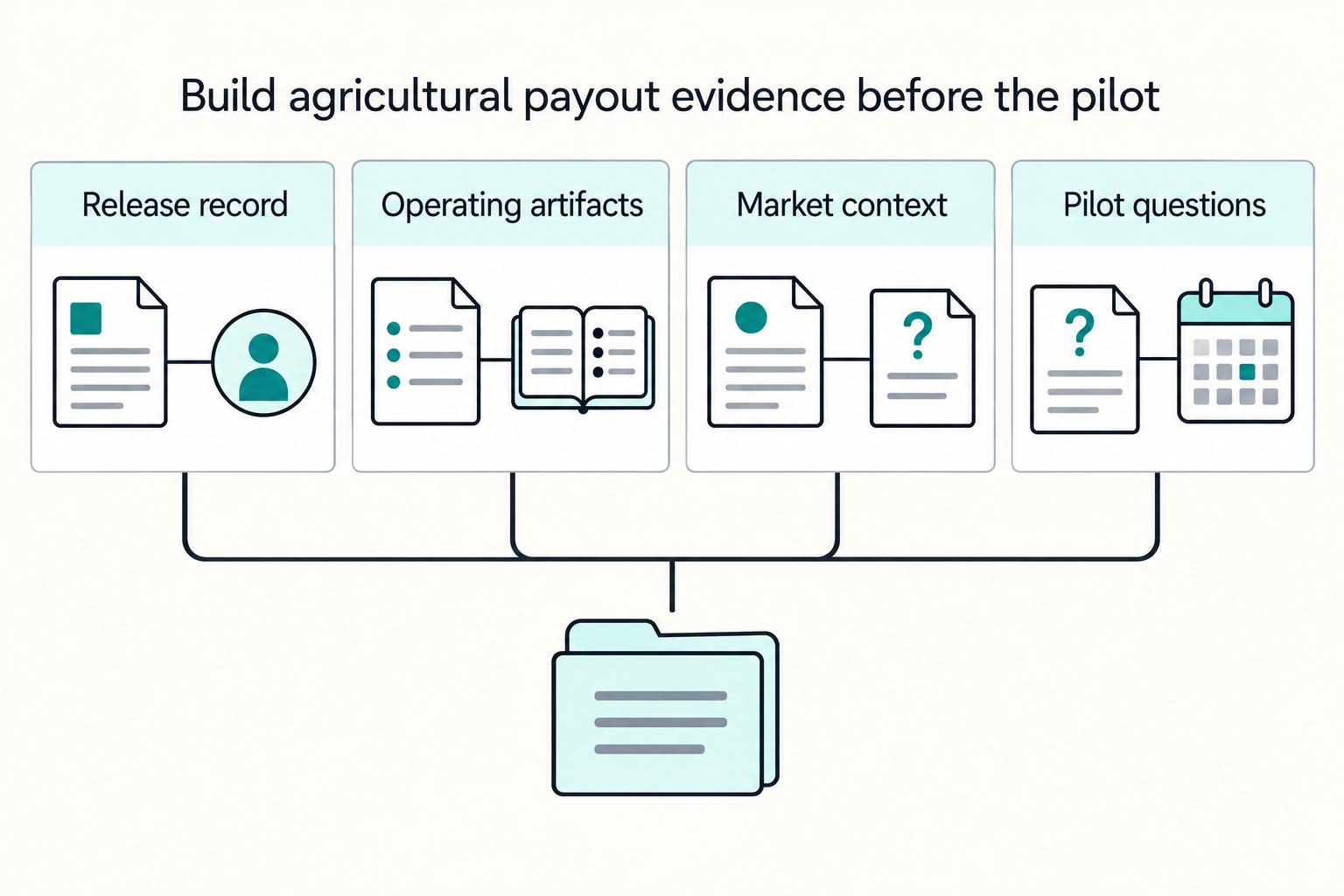
Prepare the evidence pack before the first live payout#
Build the evidence pack before launch so release decisions are made from complete records, not first-day exceptions. Keep payout and compliance specifics explicitly marked as unvalidated until market checks confirm them.
Step 1. Build the launch packet around release decisions. Anchor the packet to what allows, blocks, or conditions release decisions. Record payout and compliance requirements as market-specific hypotheses until validated, and assign an owner, storage location, and review date for each required record.
Step 2. Prepare day-one operability artifacts. Include internal operating artifacts, for example beneficiary schema, status taxonomy, reconciliation export format, and incident ownership map, and label them as internal controls rather than market-mandated standards. Teams should share the same definitions and be able to trace one beneficiary from onboarding to payout status to reconciliation without manual reinterpretation.
Step 3. Add market notes that separate context from proof. Document inclusion and access assumptions using external context from the World Economic Forum and Brookings. Use WEF's 2024 framing to justify digital plus phygital outreach and a systems perspective across interrelated value-chain actors. Use Brookings context to reflect who must be included, including ASEAN smallholder-heavy employment patterns and constraints that can affect women smallholder farmers. Keep these notes as design context, not proof that your model already works.
Step 4. Define unknowns as pilot questions. List unresolved items explicitly, including worker payout benchmarks, failure-rate baselines, and whether inclusion design works for women farmers or low-connectivity users. Assign each unknown an owner, expected evidence, and pilot checkpoint, and follow a "Think Big, Act Fast, Start Small" rollout posture so expansion depends on validated outcomes, not assumptions.
Related reading: IRS Form 1042-S for Platform Operators: How to Report and Withhold on Foreign Contractor Payments.
Build the payment flow in the right order#
Build payouts as staged controls, not as a single send-money action. WEF's systems perspective is useful here: when multiple actors and channels are involved, clear stage boundaries make failures easier to detect, explain, and fix.
Separate funding from release#
Treat money-in and money-out as different stages, then release only after funds are confirmed as usable. The exact account structure and release mechanics vary by market and provider.
The Brookings chapter notes the operational scale at stake in ASEAN: agriculture is about 35 percent of employment, and 60 percent of that is smallholder farmers. In that setting, an unclear funding state can become a trust problem, not just an accounting cleanup.
Freeze the payout input, then run checks#
Before disbursement, use a stable release input so checks apply to a consistent beneficiary set. Keep funding confirmation, release eligibility, and exception handling as explicit checkpoints rather than blending them into one step.
The exact legal and compliance gates are market- and provider-specific. Follow sequencing discipline, but do not assume it satisfies country-specific AML, KYC, or KYB thresholds or a universal control checklist.
Execute with batch discipline and reconcile exceptions#
If you use payout batches, treat each batch as the control unit for release and post-release tracking. Keep outcomes separated, for example paid, failed, and held, so retries and investigations stay traceable.
Design exception handling for real access conditions, not ideal ones. The WEF report emphasizes that effective agritech reach often requires both digital and phygital channels. It also points to inclusivity, affordability, accessibility, and collaboration. Some payout issues will require assisted follow-up through human channels.
If you need one operating rule, use this: keep controls explicit at each handoff, and treat exact payout sequencing as implementation-specific.
For a separate architecture pattern, review Virtual Accounts.
Pilot with explicit go and no-go checkpoints#
Run a narrow pilot, then scale only if checkpoint evidence shows operations are getting more reliable and support friction is coming down. The pilot should function as a checkpoint system, with clear cohort scope, explicit monitoring artifacts, and predefined pause conditions.
Limit the pilot to one operational slice#
Start with one contained cohort, such as a single crop cycle or one buyer corridor, rather than mixing crops, geographies, and worker types.
Use explicit selection criteria for that cohort and partner set. The CASA material points to Value Chain Selection Criteria and Setting the Criteria for Partner Selection. Apply that discipline by documenting what the pilot includes, what it excludes, and why. Before first release, confirm that each beneficiary maps to one owned path for onboarding, payout support, and reconciliation.
Track the outcomes that prove operability#
Track outcomes that show whether payouts worked in practice and whether recovery is functioning, and keep the evidence in a structured record for each cycle:
- payout outcomes and exception patterns
- failure handling and recovery actions
- reconciliation artifacts that tie provider outcomes, internal payout states, and beneficiary confirmation
Do not treat provider-side success alone as operational proof. CASA's Engaging SMEs in Monitoring, Evaluation and Learning supports keeping this as a structured pilot record.
Apply an explicit go/no-go rule each cycle#
Use a written go/no-go rule each cycle and apply it consistently. If unresolved delivery issues persist, hold scope and fix root causes before scaling. Criteria-driven checkpoints and adaptive management support this approach, but do not assume numeric go/no-go thresholds are prescribed.
CASA's guidance on managing common delivery challenges and shock-responsive partnerships supports this approach: pilots should surface stress and drive adjustments, not just confirm the original plan.
After each cycle, produce a written checkpoint memo covering what changed, what failed, what was resolved, what remains open, and whether the next cycle proceeds, proceeds with limits, or pauses.
Define rollback and delay communications in advance#
Write rollback triggers and delay communications before incidents happen. CASA explicitly states that the paper does not purport to give legal advice, so treat legal obligations as jurisdiction-specific and obtain local legal guidance separately.
At minimum, document:
- events that trigger pause or rollback
- decision owner for pause or rollback approval
- communication owners for buyers, field teams, farmers, and workers
- message templates for delayed, held, or reissued payouts
Scale only when checkpoint evidence, incident handling, and communications show the pilot can run without recurring unresolved issues.
For another example of running cross-border payouts for a distributed workforce, see Translation and Localization Platform Payments: How to Pay Freelance Linguists in 100+ Countries.
Plan for failures before they happen#
Failure handling belongs in launch design, not in a later ops patch. If recovery is improvised, operational risk rises and outcomes become less consistent.
| Control | What to set | Expected outcome |
|---|---|---|
| Failure classes | Set incident categories before your first scaled payout cycle so support and finance are not inventing labels mid-incident. | Every failed case is assigned to one primary class and one owner within a defined internal SLA. |
| Default recovery path | Each failure class should have one default next action, with clear handoffs and stop conditions. | Incident handling is consistent across teams, shifts, and payout cycles. |
| Reconciliation evidence | Set a minimum evidence standard for every incident and use a fixed checklist before it is marked resolved or reissued. | Resolution quality is verifiable and audit-ready. |
| Escalation clocks | Set escalation timing based on beneficiary impact and document decision ownership up front. | Queue priority reflects real risk and beneficiary impact, not ticket arrival order. |
Define failure classes before launch#
Set incident categories before your first scaled payout cycle so support and finance are not inventing labels mid-incident. Keep the categories simple enough for fast triage and clear ownership.
This matters most in environments where connectivity is inconsistent, tools may depend on outside maintenance, and physical constraints still shape digital operations. Not every incident starts in product code, so your taxonomy also needs to work when the trigger is operational rather than technical. Expected outcome: every failed case is assigned to one primary class and one owner within a defined internal SLA.
Assign one default recovery path per class#
Each failure class should have one default next action, with clear handoffs and stop conditions. The goal is a predictable next step. Your team should be able to answer "what happens next?" without ad hoc escalation.
A single payout-control path, for example retry versus manual handling, is not established, so document your internal default for unclear-status cases and require status verification before reissue. Expected outcome: incident handling is consistent across teams, shifts, and payout cycles.
Require reconciliation evidence before resolve or reissue#
Set a minimum evidence standard for every incident before it is marked resolved or reissued. Use a fixed checklist and make it a hard gate, not a preference.
Required reconciliation fields are not established, so define the fields and trace steps your team will treat as mandatory, then apply them consistently using system records rather than chat history or memory. Expected outcome: resolution quality is verifiable and audit-ready.
Set escalation clocks by beneficiary risk#
Set escalation timing based on beneficiary impact rather than treating all delays the same. Define faster escalation paths for higher-impact cases and document decision ownership up front.
Jurisdiction-specific payout timelines are not established, so confirm legal obligations with local counsel before relying on internal targets. Expected outcome: queue priority reflects real risk and beneficiary impact, not ticket arrival order.
Avoid common launch mistakes and recover fast#
When something breaks, recovery often starts upstream. Tighten scope, controls, and market readiness before the next payout cycle instead of relying only on more retries.
Split handling paths when payout risk is not the same#
Do not force all beneficiary payouts through one internal path if risk, evidence, or escalation needs differ. Define separate internal approval and exception paths where those differences are material, and document what counts as late or blocked for each path. Treat this as an operating control decision, then align the legal interpretation as it is finalized.
Re-rank markets by readiness, not narrative#
Market narrative is not enough for launch sequencing. Re-rank countries using practical readiness checks such as a network maturity assessment and a direct review of the enabling regulatory environment before you commit to rollout.
Referenced datasets can be scoped and non-exhaustive. For example, IFC's cited mapping covers seven African markets and is not guaranteed complete, accurate, or current. Your go or no-go decision should rest on current operational evidence.
Use controlled fallback paths where digital-only flow stalls#
Digital-first can work, but avoid assuming one path fits every context. If your own operating data shows repeated stalls in a digital-only corridor or onboarding path, test one controlled assisted fallback and measure outcomes before broad rollout. Track results by location, onboarding mode, and confirmed cash-out status so any change is tied to evidence rather than assumption.
Tighten onboarding gates before the next payout cycle#
Weak onboarding controls are a launch defect, not just a support issue. Set hard onboarding exception handling with named approvers and a minimum evidence pack for each beneficiary or partner before the next run. This matters even more when operations depend on outdated IT software or face denial-of-service and malware risks, because breaches can lead to data loss and reduced efficiency in digitized systems.
If you want a deeper dive, read Global Payouts and Emerging Markets: 5 Regions Every Platform Should Prioritize.
Measure what proves expansion is working#
Do not fund the next country on growth narrative alone. Expand only when your current-market data shows stable payout execution and a complete audit trail at batch level.
Build one operator scorecard at batch level#
Use one scorecard for every payout batch, and keep it operational: payout success rate, resolution time, exception rate by cause, and reconciliation completion. If those signals are split across tools and cannot be tied back to a single batch record, you do not yet have a reliable expansion signal. Set targets from your own batch history rather than external payout KPI benchmarks.
Segment where risk and access are different#
Cut the same metrics by farmers versus workers, first-time versus repeat beneficiaries, and India versus ASEAN cohorts. Aggregate results can hide failure pockets, especially in ASEAN where agriculture represents about 35 percent of employment and 60 percent of that is smallholder farmers. For India-versus-ASEAN decisions, rely on your own batch history rather than external payout benchmarks.
Measure trust and inclusion, not only throughput#
Do not stop at throughput. Include access signals for women farmers, repeat completion patterns, and support burden by payout rail in your internal tracking. Brookings notes that women are nearly half of the world's smallholder farmers, and WEF warns that excluding smallholders and women harms production outcomes. Treat assisted completion across digital and phygital channels as a product signal, not a side metric.
Gate expansion funding on stability and complete artifacts#
Set a hard rule: no new market until current-market metrics are stable over your defined review window and audit artifacts are complete. The record should let you trace reconciliation, exceptions, internal transaction IDs, and final dispositions for each batch. If that evidence is incomplete, you cannot show that operating fixes are holding under live conditions.
Conclusion and copy-paste launch checklist#
Given the evidence gaps, treat agritech payouts as a market-by-market operating decision, not a generic feature rollout. If your team cannot explain how money is released, held, retried, reconciled, and evidenced in one specific country, treat that market as not ready to scale.
Turn this into a short internal rulebook that defines legal, business, and technical rules, plus fair, transparent access and usage policies for who can view, approve, hold, and change payout data.
Use this copy-paste launch checklist#
- Confirm market feasibility first. Validate what is known versus unknown for local requirements, rail availability, and real beneficiary access to funds. Make untested assumptions explicit launch blockers.
- Separate payout cohorts where requirements differ. Keep distinct policy surfaces, exception handling, and review paths so each cohort is operationally and auditably clear.
- Lock compliance gates before production. For KYC/KYB/AML controls where applicable, document who can be paid, what triggers a hold, who can approve exceptions, and what evidence is retained.
- Launch with controlled payout batches. Use safe retries and reconciliation checkpoints so each exception can be traced to a recorded decision and final disposition.
- Expand only after stable, repeatable evidence. Set written internal thresholds for stability and exceptions, and require the same audit standard across consecutive cycles.
Grow only when controls, evidence quality, and exception handling stay reliable under pressure. After validating your checklist against local policy constraints, talk with Gruv to confirm market coverage and compliance gating for your launch plan.
Frequently Asked Questions
How do agritech platforms usually pay farmers in emerging markets?
In rural India, UPI and QR payments are used for seeds, fertilizers, and labour payments. Do not assume the same pattern applies across ASEAN or other emerging markets without local validation.
What is operationally different about paying agricultural workers instead of farmers?
Farmer settlement and worker pay should be treated as separate operating tracks. For workers, items such as identity, attendance-proof standards, KYC thresholds, and labor-payment rules should be treated as open until validated in your market.
What must be validated before launching payouts in a new country?
Do not assume there is a country-by-country pre-launch checklist or mandatory verification sequence. Validate infrastructure and inclusion readiness, real onboarding and early-use conditions, network footprint, and whether channels are affordable and accessible through digital and phygital delivery. Check that smallholders and women are not excluded before launch.
When should a platform use digital-only channels versus phygital channels?
Use digital-only only where pilot evidence shows reliable end-to-end completion in real field conditions. The evidence supports digital and phygital channels to improve access and outreach. If connectivity is unstable or support needs are high, keep an assisted path live.
Which compliance checks are non-negotiable before first disbursement?
This guide does not define one country-agnostic checklist or legal threshold set. Set minimum gates by actor type in each market, including identity verification, payout eligibility, and clear hold and release workflows. Get local legal and compliance input before first disbursement.
What should teams do when payouts fail at scale during harvest or payroll windows?
The article does not provide one universal failure procedure, so define and test your own by market and channel. Set incident categories, one default recovery path per class, reconciliation evidence requirements, and escalation timing based on beneficiary impact before scaled payout cycles. Use controlled fallback and clear ownership instead of ad hoc handling.
Which metrics best indicate a market is ready for expansion?
This guide does not establish a universal benchmark. Use your own batch history, including payout success rate, resolution time, exception rate by cause, reconciliation completion, and whether access is working for smallholders and women. Expand only when metrics are stable and audit artifacts are complete.
Researched and edited by the Gruv editorial team. Gruv builds cross-border billing, payouts, and finance-operations software for global businesses.
Sources
- brookings.edu/wp-content/uploads/2021/12/Chapter-Seven_Bre...trusted
- documents1.worldbank.org/curated/en/099053025063021993/pdf/P508004-f9...trusted
- documents1.worldbank.org/curated/en/099110225213042661/pdf/P179477-44...trusted
- live.worldbank.org/en/event/2025/annual-meetings-agriconnect-fa...trusted
- oecd.org/en/publications/agricultural-policy-monitori...trusted
- oecd.org/content/dam/oecd/en/publications/reports/202...trusted
- pmc.ncbi.nlm.nih.gov/articles/PMC10163574trusted
- pmc.ncbi.nlm.nih.gov/articles/PMC9340744trusted
Educational content only. Not legal, tax, or financial advice.
Related Posts

The Freelance Payment Penalty: A Modeled Audit of Platform Fees, FX Spreads, and Payout Delays
The money rarely disappears through a single, easy-to-spot fee. The real loss is stacked. A marketplace takes its commission, a processor adds a charge for international cards, a bank or payment company converts the currency at a spread, a platform holds the funds before release, and a wire sheds a little to intermediaries on the way in. Each layer looks defensible on its own, but the worker feels the combined result as a smaller deposit and a later payday.

How to Respond to a Subpoena for Business Records
Move fast, but do not produce records on instinct. If you need to **respond to a subpoena for business records**, your immediate job is to control deadlines, preserve records, and make any later production defensible.
A US Expat's Guide to Investing in UCITS ETFs to Avoid PFIC Issues
The real problem is a two-system conflict. U.S. tax treatment can punish the wrong fund choice, while local product-access constraints can block the funds you want to buy in the first place. For **us expat ucits etfs**, the practical question is not "Which product is best?" It is "What can I access, report, and keep doing every year without guessing?" Use this four-part filter before any trade: