
Quick Answer
Use a clear reward and release promise, compare countries with labelled unknowns, and resolve material live-payout requirements before enabling a lane. Pilot the actual product with funded, authorized instructions, reliable reconciliation, and failure ownership. Test cadence locally; a task-specific reward experiment does not predict global payout outcomes.
Why Crowdsourcing Platform Payments Get Complex at Scale#
Demand for microtasks is only one part of an expansion decision. The real question is whether your payout design and operating reliability will hold as you scale.
In piecework crowdsourcing, each accepted task has a stated reward. The payment design also needs rules for approval, release, small balances, and failed transfers. Those rules can affect worker trust and participation, so test them alongside the task itself.
A CHI 2016 field experiment illustrates why local testing matters. It followed 300 Japanese mobile-phone subscribers for twenty days on phone quality-of-service surveys. Rewards for sets of ten tasks raised response odds by 1.4x versus per-task rewards; the reported completion-rate gain was eight percentage points, or 16% relative. The coupon condition’s small negative effect was not statistically significant. This is a task- and cohort-specific result, not a forecast for global bank-transfer cadence.
Plan for uneven participation and exceptions. Compare repeat participation, accepted-task completion, batch timeliness, and payout outcomes by cohort. Signups or task views alone do not show whether workers can complete the work and receive the promised reward.
This guide is for that decision point. It gives you a structured path to evaluate payout design and operating risk before you commit rollout resources.
By the end, you will have practical working artifacts for planning and testing:
- a market scoring table for pre-launch comparison
- payout model decision rules for per-task vs batched release
- a controls checklist for operational gates before funds move
- a launch-readiness checklist for pilot vs backlog decisions
Test assumptions early and keep uncertainty visible. A country score can help prioritize research with incomplete data; a live payout needs the actual provider, eligibility, funding, and release controls to work.
You might also find this useful: How to Scale a Gig Platform From 100 to 10000 Contractors: The Payments Infrastructure Checklist.
What to prepare before you compare countries#
Start country comparison with a proposed payout unit, available country information, labelled gaps, and a pilot plan. You can compare candidates while evidence is incomplete. Distinguish piecework microtasks from other crowdsourcing models so the scores answer a consistent question.
Step 1 Define the worker cohort and payout unit#
Define what earns a reward: an accepted task, an approved batch, or a timed service. Separately define when earned balances are released. Price per task where that fits the work; evaluate more complex crowd projects separately rather than assuming the same reward and payout rules apply.
For each cohort, document:
- task type
- expected task value
- expected repeat frequency
- what a good payout experience looks like for that group
Different cohorts can face different time, income, device, and withdrawal constraints. Collect those differences in interviews and pilot observations rather than assuming the same cadence will work for everyone.
Step 2 Gather available country information and label gaps#
Use a lean evidence pack, but make it strong enough to surface risk early. For each country, record:
| Evidence item | What to record | Note |
|---|---|---|
| Workforce characteristics | For your target cohort | Mark as unknown if it is not known |
| Importance of microtask income | For that cohort | Mark as unknown if it is not known |
| Sample stability | Whether samples look stable across collection windows | Do not fill gaps with assumptions |
| Data limits and unknowns | Known data limits and unknowns | Keep a limits log |
Mark an item unknown when you lack support. Record where your sample came from, collection date, cohort size, and likely selection limits. Repeat the same observations over time to see whether the worker mix changes; do not treat a convenience sample as an official country-wide labor statistic.
Step 3 Assign owners and define the first validation test#
Assign a provisional owner to each workstream and open question. Then choose a first test tied to your workload: for notification-driven tasks, response-to-notification rate may fit; for an open task queue, acceptance and completion rates may be more useful.
Use the Japan mobile-survey experiment as a signal to test a milestone design, not a guarantee. Its bulk condition also risked leaving incomplete sets unrewarded. Preserve workers’ earned entitlements under the applicable agreement, law, and platform rules; test release timing or additional milestone rewards without casually withholding earned task pay.
Step 1 set your payout unit economics and service promise#
Before launch, turn your country evidence pack into two concrete outputs: a worker-facing payout promise and explicit cost guardrails. For microtasks, clarity matters more than fee optimization at the start. Make unknowns explicit up front, especially exact payout release timing, minimum payout thresholds, and returned-transfer handling.
1 Lock the worker promise#
Write the promise in worker language, not internal finance language. Microtasks are small, similar, straightforward tasks, including work like content labeling, data clustering, and file editing, so many small earnings events can quickly turn into payout confusion if the rules are unclear.
| Promise element | What to define |
|---|---|
| Payout release expectation | State the release expectation, or clearly say timing is still being tested |
| Minimum payout behavior | Clarify whether small balances roll forward or require action |
| Returned or held transfer path | Define the failure path, status visibility, and support access |
Use one version of this promise across product copy, help center content, support macros, and ops notes.
2 Choose the default cadence#
Pick a simple default rule, then test from there. Do not assume an optimal payout cadence or its retention impact is already established, so treat cadence as an explicit experiment.
If tasks are very low value and high frequency, payout batches can be a starting hypothesis. If trust is weak or early complaints are high, more frequent release windows can be a test variant.
Keep work-type boundaries clear as you do this. Microtasks and more complex crowdsourcing modes are not interchangeable, and bundling them together creates fuzzy workforce assumptions.
3 Set margin guardrails before country pricing#
Assume payout operations may compress margin unless you have evidence they will not. Set guardrails on the full payout path, not just on task-rate assumptions.
Include:
- task payout cost
- conversion exposure between collection and payout
- failed payout handling
- manual review time
- payout-related support load
Track assumptions by country as known, test, or unknown. If a cost driver is still unknown, do not price as if it is already solved.
4 Scope MoR and Virtual Accounts before launch#
If Merchant of Record (MoR) and Virtual Accounts are in scope, treat them as launch-scope decisions, not cleanup items. Their legal/compliance definitions, operational role, and constraints require early alignment with your legal and payments teams, so keep those assumptions explicit.
Set ownership boundaries across collection, conversion, and payout. If MoR or Virtual Accounts are unresolved, label alternative margin scenarios and the open questions. Confirm the chosen product, responsibilities, and costs before relying on them in a live launch promise.
Step 2 score countries before committing product or GTM#
Use available data and labelled gaps to compare countries and plan product or GTM research. Prioritize the open questions and assign owners. Before enabling the affected live funds flow or making a firm payout promise, resolve material provider, legal, funding, and operational blockers.
Worker participation findings do not establish country-level payout-rail coverage, tax obligations, or provider eligibility. Verify those for the actual product, worker cohort, and funds flow you propose.
1 Build a weighted country table before launch planning#
Use the same rubric for every country so demand does not override operability. The weights below are an illustrative planning choice; adjust them to your funds flow and keep incomplete scores provisional.
| Factor | Suggested weight | What you are scoring | Evidence or open question to record |
|---|---|---|---|
| Payout rail availability | 35% | Ability to deliver the worker payout promise in that market (unknown until verified) | Named payout path, owner, documented test or provider confirmation |
| KYC / KYB / AML burden | 25% | Identity and screening effort, plus exception workload before release (unknown until verified) | Written gates, review owner, escalation path |
| Tax form complexity | 20% | Applicable worker tax-document intake and separate platform information-reporting duties | Payee-status routing, reporting responsibility, storage owner, and unresolved scope questions |
| Expected support load | 20% | Volume and complexity of payout-related worker contacts (unknown until verified) | Draft help copy, macros, language coverage plan |
Use explicit scoring rules. Every score needs an evidence note, an owner, and a last-checked date.
2 Add operator constraints as explicit gating rows#
Do not bury operational risk in notes. Track these as named rows and keep each one unknown until country-specific evidence exists:
- local withdrawal friction
- return or rejection risk
- investigation turnaround
- VAT handling where it affects fees or invoicing
Separate comparison factors from launch blockers. Support-cost uncertainty can remain a pilot hypothesis; a missing required authorization or unsupported payout destination blocks that funds flow. Map what workers see, what action is required, where failures happen, and how support responds.
3 Apply a hard rollout rule#
Launch the scoped funds flow only after its required eligibility and release controls are satisfied. Where those material requirements remain unresolved, continue research or a simulation instead of offering live payouts.
An unknown launch-critical permission, funding requirement, or provider limitation blocks the affected live commitment. A labelled estimate about demand or support volume can still support comparison and a controlled test.
4 Capture unknowns directly#
Keep open questions in a separate section instead of mixing them into scored cells. Prioritize unknowns in two areas:
- worker take-home outcomes across the full payout path
- platform quality-pay tradeoffs you have not measured yet
Worker availability or personal constraints may explain a participation change without establishing a payout failure. Track both types of evidence and test the suspected cause in the actual cohort.
Final state each country as one of: launch candidate, research in progress, or demand-only backlog.
If your country scorecard flags payout reliability as the go/no-go constraint, review Payouts to pressure-test batch controls, status visibility, and exception handling before rollout.
Step 3 choose per-task or batched payouts with explicit decision rules#
Treat payout timing as a lever you test, not a belief you defend. Start with a clear default, then change timing only to test a specific bottleneck hypothesis, such as low acceptance, trust concerns, or payout-ops pressure.
Step 1 set a clear default, then document why you would batch#
Set one worker-facing payout promise first, then list the exact condition that would justify batching. If trust appears to be the issue, clarify payout uncertainty in your policy and onboarding copy before assuming cadence is the main cause.
The Japan mobile-survey study found a bulk-reward advantage in its setting, but it did not identify one optimal global payout cadence. Distinguish the reward milestone from the timing of a bank withdrawal and test the mechanism you actually intend to change.
- A reward milestone may affect effort differently from delaying withdrawal of an already-earned balance.
- An incomplete-batch rule needs explicit earned-pay treatment, worker communication, and review against applicable requirements.
Step 2 apply the decision rule before changing rates#
Before you raise base pay, separate the problem you are actually trying to fix.
Use this rule:
- If your main issue is low task acceptance, test timing changes and pay changes separately instead of assuming one is the driver.
- If your main issue is worker trust, reduce payout uncertainty first and treat cadence effects as unproven.
Track three events separately: task accepted, task completed, payout released. That separation helps you see whether changes align with acceptance, effort, or only release visibility.
Step 3 Keep study findings separate from your pilot assumptions#
Record the study’s task, population, reward method, outcome, and limits beside the hypothesis it suggests. For your pilot, record the exact variant and success measure before changing it. A participation result is not proof of payout-rail reliability or a reason to change already-earned compensation.
| Evidence item | Supported claim | Not supported |
|---|---|---|
| Japan mobile-survey reward experiment | Sets-of-ten rewards improved completion in this cohort; incomplete sets created fairness concerns. | Universal global bank-transfer cadence or permission to withhold earned task pay. |
| Prolific payment model | Fixed study rewards are assessed against its hourly-equivalent minimum; actual underpayment needs adjustment. | A universal legal wage floor or automatically variable per-participant hourly pay. |
| Your controlled pilot | Observed acceptance, completion, release, support, and repeat-participation outcomes. | Causal claims without a comparable test or reliable records. |
Step 4 run one clean test and log unknowns#
Run one clean test at a time. Keep base task price and eligibility fixed, and change only release timing or bonus timing. Then evaluate acceptance rate, completion rate, payout-timing support contacts, and repeat participation.
If you batch releases, specify the trigger, maximum expected wait, any review hold, and release owner. Explain what happens to a small remaining balance when a worker stops. Measure your chosen cadence and support outcomes locally instead of extrapolating a reward experiment to every country.
Step 4 design compliance and tax gates before launch#
Define applicable compliance and tax gates before the affected payout. Manual controls can support a bounded pilot when documented, tested, staffed, and reviewable; cap volume to that capacity. A missing required gate or owner blocks its affected release.
Step 1 sequence the gates in the order money gets blocked#
Use one internal sequence: account creation, eligibility review, payout release, then exception escalation. This is an operating rule for consistency, not a claim about legal mandate in every jurisdiction.
Collect only the data needed for the actual account and review path. For example, Stripe Connect API onboarding requirements vary with the connected account’s country, service agreement, requested capabilities, business type, and structure. Responsible platforms must monitor changing requirements and account status. Map applicable platform legal duties separately, and record the review status, outstanding requirements, and payout block in one place.
Run eligibility review before payout release. Do not let payout release become the first review step, or you will create avoidable cases where work is completed but payout is held.
Step 2 standardize tax-document routing with audit visibility#
Route tax documents by payee status and the actual requester’s obligations. A U.S. person generally supplies Form W-9; a foreign payee may need the applicable W-8 form when properly requested, rather than W-9 merely because they have a U.S. tax number. Forms in the 1099 series are information-reporting outputs where required, not a universal worker intake form. Record the relevant form, version, collection date, review owner, and any applicable reporting duty.
| Gate | What you verify | Evidence to retain | Common failure |
|---|---|---|---|
| Account creation | Worker type, relevant country, and fields required for the selected product | Timestamp, submitted fields, consent record | Collecting data you do not use |
| Eligibility review | Applicable provider eligibility and identity requirements; relevant tax-document status | Review result, reviewer or vendor, block reason | User can work but is not pay-ready |
| Payout release | Required verification/capability status, funding, release approval, and applicable holds | Status at release, approved instruction, and payout hold history | Last-minute hold with no worker-facing reason |
| Exception escalation | Complex cross-border or document mismatch cases | Ticket link, escalation owner, resolution note | Case stalls with no clear owner |
If exception handling is undocumented or inconsistent across operators, your controls are not reliable yet.
Step 3 Keep tax support tied to platform records#
Give workers access to the transaction facts your platform holds: gross rewards, deductions, payment dates, currency, and relevant reporting documents. Explain which field or document your own intake flow needs and why.
For a name, country, or tax-status mismatch, request the specific correction through the approved channel and record the outcome. Do not infer a worker’s personal tax residency or filing eligibility from payout destination alone.
Escalate personal tax questions to a qualified adviser. Platform support should explain its records and applicable withholding or reporting process, while limiting access to sensitive documents to the people who need them.
Step 4 block expansion until controls are repeatable#
Before expanding, have another operator follow the documented process for a valid account, a missing required document, and a payout failure. Manual review can remain if its decisions are consistent and capacity is adequate. Fix material release-control gaps before increasing the affected volume.
Step 5 map money movement and ledger truth#
Make the money path traceable. Define the record created at each step so finance can connect earned worker balances, approvals, transfers, fees, returns, and the remaining liability.
Step 1 document your end-to-end money path#
Write down the path your platform intends to use and the source record at each stage: earned task reward, worker liability, funding, payout instruction, provider response, and settlement or return. Match those stages to the actual provider integration.
For each stage, ask which record proves it happened and which identifier links it to the worker obligation. Assign an owner to gaps before relying on the stage for release or reconciliation.
Step 2 define inbound references and exception handling#
Use consistent internal references so events can be matched without guesswork. Document inbound rails and return-handling procedures as implementation choices and confirm them separately with your payments provider.
Document one investigation path for exceptions, and require a recorded decision before any manual credit or adjustment.
Step 3 make retries replay-safe#
If your flow includes retries, document how repeated instructions are recognized and handled. Treat idempotency and webhook patterns as control objectives to confirm against your stack's capabilities.
Keep a change history instead of overwriting states so repeated processing can be reviewed.
Step 4 reconcile against ledger entries, not UI balances#
Run reconciliation from underlying event records, then compare derived balances to that baseline. Avoid asserting fixed checkpoint standards; set a cadence your team can evidence and audit.
If a break cannot be explained from records alone, pause further scale-up in that lane until the trace is complete.
Step 6 build payout operations for failures before they happen#
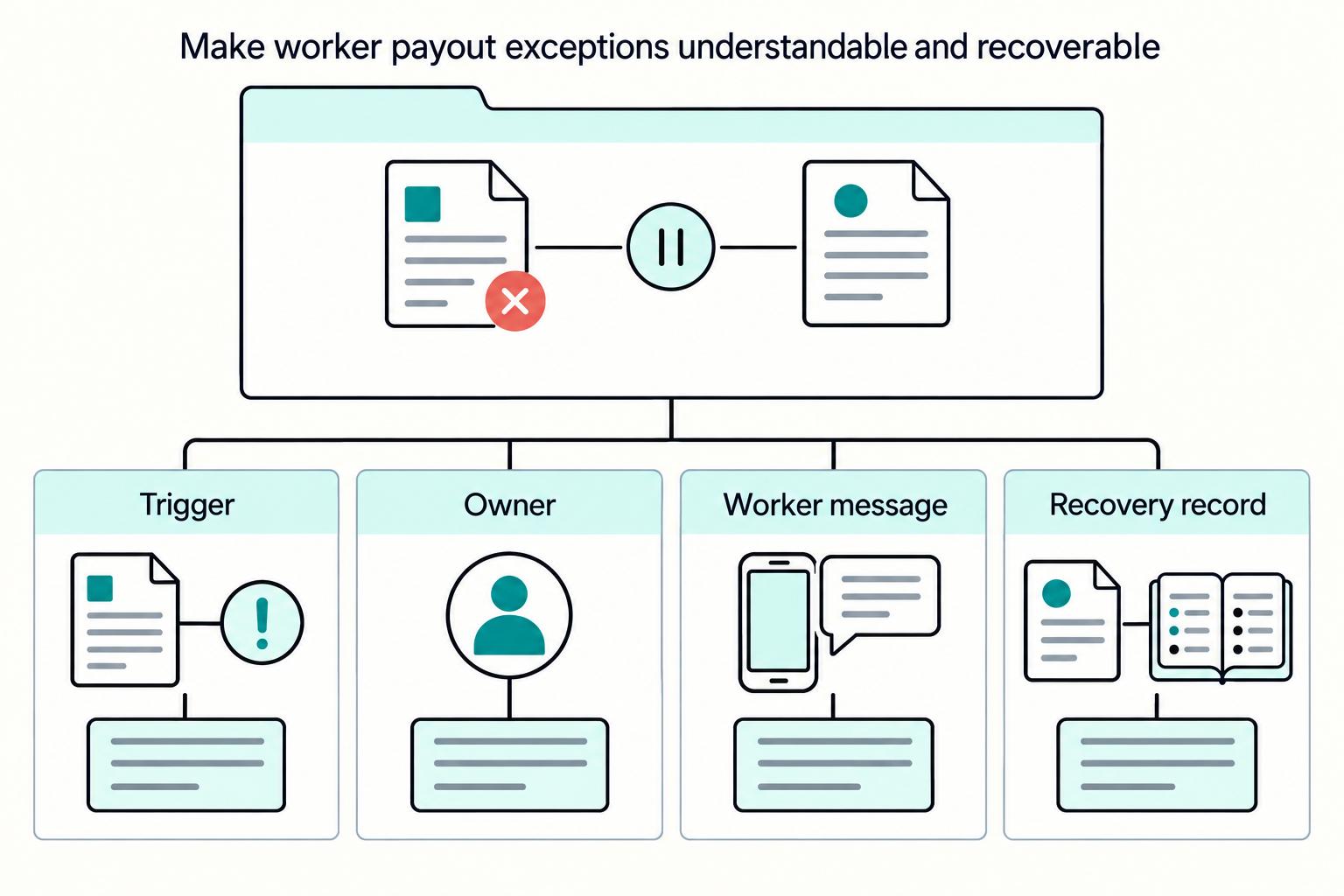
Design for failures: make each exception classifiable, owned, and recoverable, with clear worker communication and retained internal records. A useful failure process tells the worker what happened and helps the operator decide whether to correct, retry, cancel, or escalate.
Step 1 standardize failure handling in one table#
Use one shared failure-mode table so support, payments ops, compliance, and finance work from the same definitions. Include examples from actual provider responses as your pilot develops.
Include trigger, owner, severity class, worker message, and recovery action. The table below is an illustrative internal policy template; set timing targets from your provider and staffed support capacity.
| Failure mode (example) | Trigger | Owner | Severity class | Worker message | Recovery action |
|---|---|---|---|---|---|
| Execution reject or return | Provider or internal system reports a reject/return after release attempt | Payments ops | High (policy-defined) | Confirm payout did not complete, state whether worker action is needed, and explain next step | Pause retries, verify ledger state and return details, correct data if needed, then reissue with linked instructions |
| Compliance review hold | Screening, manual review, or provider hold blocks release or settlement | Compliance | High (policy-defined) | State that payout is under review and request only required documents if needed | Pause release, gather required evidence, record decision, then release, cancel, or escalate per policy |
| Expired quote context | Quote is no longer valid under internal policy before release or approval | Treasury or payments ops | Medium (policy-defined) | Explain the delay for quote refresh and amount confirmation when applicable | Refresh quote, reprice lane or batch, and reapprove if totals changed |
| Invalid beneficiary data | Required fields are missing or malformed in preflight or reject response | Support with payments ops | High (policy-defined) | Identify the field that must be corrected without exposing sensitive data | Lock payout, request correction, revalidate, then resubmit only after checks pass |
For worker-facing updates, prioritize clarity over false precision: what happened, whether the worker needs to act, and what happens next. If timing is uncertain, say that plainly.
Before any ledger adjustment, define a minimum evidence pack for each case. A common baseline is payout instruction ID, batch ID (if used), provider reject/response artifact, worker data snapshot used at release, ledger event references, and communication log.
Step 2 control Payout Batches with explicit gates#
Use the following internal checklist for each Payout Batch, adapted to your product and funds flow. Verify the controls in a simulation and bounded pilot before relying on them at scale.
| Control step | Checks included |
|---|---|
| Preflight validation | Required beneficiary fields, duplicate instruction IDs, lane eligibility, compliance status, available balance, and quote validity under policy |
| Dry-run summary | Worker count, total amount, lane or country mix, blocked records, and overlap with unreconciled instructions |
| Approval gate | At least one approver beyond the preparer; review totals, exceptions, lane coverage, and any overrides |
| Release window | Release only when responsible teams are staffed for monitoring and response |
| Post-batch reconciliation | Trace batch file, accepts and rejects, status updates, and posted ledger outcomes |
If traceability breaks, pause further release until controls are restored.
Step 3 define pause rules before an incident forces them#
Document severity levels and decision owners in advance. Scope a pause to the affected lane or control where possible, and broaden it when the same failure threatens other releases.
A pause can be lane-scoped or broader, depending on where control integrity is uncertain. Define upfront what evidence is required to escalate, pause, and resume so incident decisions are not made from incomplete context.
Before resume, require a documented root cause, a control-level fix, and a verified rerun or test showing the failure no longer reproduces.
Step 7 run a controlled pilot and verify with hard checkpoints#
Run a narrow pilot to confirm that your candidate lanes are operable under live conditions, then expand only when results are repeatable across operations, compliance, and finance.
Step 1 Start with countries whose required payout controls have cleared#
Start with a small set of countries whose material live-payout requirements have cleared, and keep scope tight enough to inspect exceptions. Noncritical unknowns can remain explicit pilot hypotheses; unresolved required permissions, provider support, funding, or release controls block the affected lane.
If your workload includes data enrichment work, watch participation and payout clarity closely because throughput is labor-dependent.
Step 2 review the same pilot checkpoints on a fixed cadence#
Use one fixed review cadence, for example weekly, so issues show up early and stay comparable over time. At minimum, review:
- first-pass payout success
- manual review rate
- reconciliation breaks
- support ticket root causes
Bring the same evidence packet each cycle: released and held payout counts, return or reject artifacts, batch IDs when applicable, ledger event references, unresolved reconciliation items, and a coded support summary. If finance cannot trace released instructions to ledger outcomes in a lane, treat that lane as a stop signal.
Validate any provider or automated rules used for release and holds during the pilot. Retain understandable reasons for decisions and a review path when a worker disputes an outcome.
Step 3 compare worker outcomes by cohort, not as one average#
Do not rely on one blended metric. Compare outcomes by payout model and worker cohort, because worker motivation, tools, and constraints vary and pooled averages can hide lane-level problems.
Treat payout speed, payout predictability, and incentive structure as hypotheses to test in your own context. Use a structured worker check-in format so responses stay comparable across cycles.
When signals point to worker-side barriers, do not assume the payout mechanism is the only cause.
Step 4 set an internal expansion gate and test repeatability#
If you use two consecutive clean cycles as an expansion gate, treat it as an internal policy choice rather than an evidence-backed threshold. Define "clean" in advance across compliance handling, payout execution reliability, and finance reconciliation.
If any one area fails, pause expansion, document root cause, rerun the corrected lane, and decide from verified outcomes.
Common mistakes that derail global micro-task payouts#
Some failures start before the first transfer. Teams treat crowd access as launch readiness and then find the operating model does not hold under real conditions.
Mistake 1 confuse marketplace visibility with payout readiness#
Visible worker activity tells you demand may exist. It does not prove your operating lane is stable. Crowdsourcing markets are shaped by human factors, so visible activity is a weak proxy for stable speed and quality.
Before you launch a lane, verify your own end-to-end operating path, not just marketplace presence.
Mistake 2 launch before your control sequence is defined#
If critical controls are still being designed under live traffic, holds and support friction are likely. Define the order of checks, required evidence, and escalation ownership before release so operations are auditable from day one.
This risk is practical, not theoretical: execution gaps can surface under load.
Mistake 3 overgeneralize from one payout or incentive lever#
Do not assume one lever explains outcomes across markets or cohorts. In microtask systems, reward, task type, competition, and requester reputation interact in ways that are not fully predictable.
Test extra milestone rewards or optional gamified features without assuming they will improve either completion or quality. Preserve promised base compensation, and measure the chosen outcome alongside worker complaints and dropout.
Mistake 4 treat workforce reach as proof of operating coverage#
"Global workforce access" is a sourcing signal, not proof that a lane is ready to onboard, pay, and support workers cleanly. Keep market access and operating readiness as separate go or no-go checks.
If you use HIT-style batches, track two concrete signals: tasks left in the batch and batch recency. They help you distinguish execution bottlenecks from task-market fit problems.
Related: How to Scale Global Payout Infrastructure: Lessons from Growing 100 to 10000 Payments Per Month.
Metrics that decide whether to scale or pause#
Use one shared scorecard to judge whether the pilot supports expansion. Investigate changes in worker or cost metrics, and pause the affected flow when a defined material release or reconciliation red line is breached.
Step 1 Build one executive scorecard#
Use a shared scorecard for worker participation and payment operations: accepted and completed tasks, repeat participation, withdrawals after task start, release timeliness, first-pass payout success, material reconciliation breaks, and support causes. Compare like cohorts and keep the source and denominator for each metric.
Investigate falling repeat participation or rising dropout even when throughput increases. Those signals can reflect task fit, pricing, worker availability, or payout friction. Use the evidence to decide whether to adjust a test; do not automatically stop all lanes because one retention average moved.
Step 2 Set pause triggers as hard events#
Set specific red lines for unauthorized release, duplicate payout risk, unavailable funding, or material unexplained ledger differences. Participation or batch-delay thresholds can trigger investigation or pause a particular experiment. Name the decision owner and the scope of each response.
When a shift appears, check the changes that preceded it. Compare payout status, task routing, approval rules, reward variants, and worker feedback. Isolate a suspected change where practical; preserve the actual release and reconciliation controls while testing it.
Step 3 Measure contribution after variable operating costs#
Calculate contribution from the full operating path. For a hypothetical cohort earning the platform $1,000 of task fees, $700 of worker rewards, $30 of payment and FX costs, $80 of variable review/support, and $20 of platform-borne losses leave $170 of contribution before fixed overhead. Keep worker take-home deductions separate from costs borne by the platform and avoid counting either fee twice.
Keep the calculation beside cohort participation, completion, payout-success, and support trends. Include the promised treatment of incomplete work and any required partial compensation; improve that policy without disguising who earned a reward or shifting costs invisibly to workers.
Conclusion and launch checklist#
Expand in controlled waves after the payout controls work and the worker promise is sustainable. Review participation and completion alongside execution, reconciliation, and support outcomes; no single throughput or retention metric proves readiness.
Copy and use this launch checklist#
1. Define your reward promise and unit economics by worker segment. Set a clear worker-facing promise for base rewards and any bonus milestones. Keep that promise narrow enough to sustain under load, because changing reward levels over time can affect how many tasks workers complete in a batch.
2. Set explicit go or no-go checkpoints at the batch level. Use launch criteria tied to observed batch performance, not assumptions alone. Track tasks remaining and batch recency as early stall signals and predictors of completion timing.
3. Lock your incentive and monitoring plan before scale. Document how reward, task type, market competition, and requester reputation are expected to interact, and treat those assumptions as uncertain until your own data confirms them. If decisions are still ad hoc or person-dependent, pause expansion until ownership and checkpoints are clear.
4. Ship failure handling before scale traffic. Prepare for incomplete work, payout holds, rejects, and returns. Make worker communication, correction, retry, and escalation responsibilities clear, with enough capacity for the scoped volume.
5. Pilot narrowly, verify at fixed checkpoints, then expand in controlled waves. Use a small, operationally supported cohort and compare payout execution, reconciliation, unit economics, and worker outcomes. Test reward or cadence variants locally; keep promised base compensation and applicable provider rules intact.
Before expanding beyond your pilot, use Docs to align engineering and ops on batch checkpoints, retention signals, and escalation paths.
Frequently Asked Questions
Which payout model should a microtask platform start with first?
Start with the simplest model you can run and explain reliably. Piecework can price an accepted task separately from the balance-release schedule. For a product-specific example, Prolific sets a £6/$8 minimum hourly-equivalent rate and recommends £9/$12: its base study reward is fixed using estimated completion time, rather than changing automatically for every participant’s time. Those are Prolific’s rules, not a universal minimum for all microtask platforms.
Does payout frequency actually change completion rates?
It can affect behavior, but distinguish reward structure from withdrawal timing. The Japan mobile-survey experiment found better completion with sets-of-ten rewards in that setting; it does not establish a universal payout frequency for global platforms. Test your actual release change against comparable worker cohorts while preserving earned-pay rules.
What should founders compare before entering a new country?
Compare provider-supported destinations and account eligibility, the full worker payout path, applicable identity and tax duties, take-home fees, and support capacity. Use available data with labelled gaps for comparison; resolve material requirements before enabling the live funds flow. The suggested weights in this article are a planning example, not a country-ranking benchmark.
What risk should be prioritized first at scale?
Prioritize lawful, funded, authorized releases and traceable worker obligations. Keep the worker promise clear and exceptions owned. Manual controls can support a bounded rollout when tested and staffed; missing required gates or unreliable reconciliation block the affected release.
What is still unknown from public evidence on microtask payments?
A task-specific reward experiment does not establish global country rankings, universal retention effects, or payment-rail reliability. Verify current provider eligibility and costs for your funds flow, and collect comparable local pilot data before generalizing the participation results.
What is the minimum checklist before moving from pilot to multi-country rollout?
Use a documented internal checklist: provider and legal eligibility for the scoped flow, required account and tax-document status, funding, approved reward and release rules, duplicate-prevention controls, material reconciliation, and failure ownership. Test those controls at a volume your team can support. Noncritical demand or support estimates can remain labelled hypotheses during the pilot.
Researched and edited by the Gruv editorial team. Gruv builds cross-border billing, payouts, and finance-operations software for global businesses.
Sources
Includes 1 external source outside the trusted-domain allowlist.
Educational content only. Not legal, tax, or financial advice.
Related Posts

The Freelance Payment Penalty: A Modeled Audit of Platform Fees, FX Spreads, and Payout Delays
The money rarely disappears through a single, easy-to-spot fee. The real loss is stacked. A marketplace takes its commission, a processor adds a charge for international cards, a bank or payment company converts the currency at a spread, a platform holds the funds before release, and a wire sheds a little to intermediaries on the way in. Each layer looks defensible on its own, but the worker feels the combined result as a smaller deposit and a later payday.

How to Respond to a Subpoena for Business Records
Move fast, but do not produce records on instinct. If you need to **respond to a subpoena for business records**, your immediate job is to control deadlines, preserve records, and make any later production defensible.
A US Expat's Guide to Investing in UCITS ETFs to Avoid PFIC Issues
The real problem is a two-system conflict. U.S. tax treatment can punish the wrong fund choice, while local product-access constraints can block the funds you want to buy in the first place. For **us expat ucits etfs**, the practical question is not "Which product is best?" It is "What can I access, report, and keep doing every year without guessing?" Use this four-part filter before any trade: