
Quick Answer
Classify the case, assign an owner immediately and collect the evidence needed for investigation and safe action. Track the applicable rail, consumer-rights or sanctions deadline separately from internal SLAs. Confirm external payment outcomes before correcting the ledger or retrying money movement, and retain independent approvals and reconciliation evidence for manual actions.
Why Payment Exceptions Need a Clear Routing Path#
Handling payment exceptions at volume takes more than a policy statement. You need clear routing, correction controls, and Manual Overrides guardrails so one failed payment does not turn into ledger drift, broken reconciliation, delayed settlements, or an unnecessary customer escalation. If you run payment ops, you need a routing rule your overnight team can follow without rebuilding the case.
For platform finance, payments ops and product owners, the daily decisions are practical: who investigates first, what evidence permits a money-state change, which deadline applies and who can approve a manual action.
Before you start#
Use this guide if your team already handles exceptions across one or more payment rails and needs cleaner decisions under pressure. It assumes you already have payment requests, provider references, internal ledger entries, and event history, but your handoffs or escalation paths still create delay. If your handoffs still depend on chat context, you should fix that before you widen automation.
Public guidance from the Office of the Comptroller of the Currency and the Federal Reserve matters, but it serves a different purpose. The OCC Comptroller's Handbook is written for examiner supervision work. The OCC Payment Systems booklet is framed as an overview of payment types, risks, and risk management practices for OCC supervision of national banks and federal savings associations. That is useful control context, but it is not a queue ownership guide for platform teams.
The same limitation applies on the Federal Reserve side. Federal Reserve Financial Services are governed by twelve Operating Circulars, and Operating Circular 5 sets general terms across services. Effective January 5, 2026, Operating Circular 5 was retitled from Electronic Access to General Financial Service Provisions. That tells you where legal and service terms sit, not what your finance ops lead should do when provider status, ledger state, and payout timing conflict in real time.
Classify the exception, assign its owner and deadline, assemble the evidence, then determine whether investigation, an external action or an internal journal correction is needed. Record any manual approval and reconcile before closure.
Missing evidence limits the actions you can safely take; it must not prevent intake or investigation. Route incomplete cases to an owner who can recover the facts, preserve received notices and deadlines, and block unsupported money-state changes.
Define what counts as a payment exception and who owns it#
Set your exception taxonomy and ownership map before you set SLAs. If one case can land in two queues, you can get reopen loops, duplicate outreach, and ledger fixes that lag behind customer messaging.
Define the exception classes#
Define exception classes by the operational question, not by who is complaining. You can use labels like data mismatch, settlement variance, provider failure, compliance hold, and customer dispute. This is an internal operating model, not a federally mandated taxonomy.
Use a single intake checkpoint: can a second reviewer tell from the first case note whether the issue is bad data, missing money, rail behavior, a policy gate, or alleged customer harm? If not, the class is too vague.
Split classes by rail and timing risk#
Handling paths change by rail, so split each class by rail and timing risk.
| Rail | What matters for triage |
|---|---|
| Automated Clearing House (ACH) | ACH is a batch network, and Federal Reserve exception guidance uses defined case types with reporting time frames, required fields, and supporting documentation. |
| Fedwire Funds Service | Fedwire is generally used for large-value, time-critical payments, with payment finality once credits post to Federal Reserve master accounts. |
| Instant-payment networks | Identify the actual network and its finality, status and return-request rules. FedNow and The Clearing House RTP are distinct services. |
| Consumer open-end credit billing errors | Where Regulation Z applies, a qualifying written notice generally arrives within 60 days after the creditor sends the first statement reflecting the error; track acknowledgement and resolution separately from card-network dispute rules. |
Assign default and after-hours owners#
Assign a default owner and an after-hours backup where needed. Route applicable identity, AML and sanctions questions to the responsible compliance function. US CDD obligations depend on the covered institution and current requirements, including FinCEN’s 2026 relief from repeated beneficial-owner identification at every additional account opening.
Publish the first-triage rule#
Publish one first-triage rule where your queues are actually managed, and label it as an internal operating rule rather than a federal standard.
Assign an owner promptly and check the provider reference against the latest ledger journal during investigation. Missing evidence must not delay urgent escalation or a valid consumer error notice.
Collect the evidence needed for the next action#
Capture the notice and route the case immediately, then fill missing identifiers and records through investigation. Do not wait for a perfect packet before recognizing a consumer-rights clock or escalating a time-critical issue. Require sufficient evidence before a correction or release is authorized.
Start with identifiers#
Build the packet around identifiers first, not screenshots or chat excerpts. Depending on your systems, the packet may include payment request ID, provider reference, internal ledger journal IDs, a timestamped event timeline, and current status.
For ACH, this discipline is explicit. Exception handling ties submission to supporting documentation, and intake uses structured fields such as Settlement Date, Processing Date, Trace Number, and Amount. Missing required fields delay resolution, so it is worth applying the same intake-completeness standard across rails. A practical packet can include:
- payment request ID and account or customer identifier
- provider reference or trace number
- internal ledger journal IDs tied to the payment lifecycle (if used)
- timestamped event timeline, including request, provider events, retries, and holds (if available)
- current state across provider and internal records
Add compliance artifacts only when they matter#
Attach compliance artifacts only when compliance is the reason the case is blocked. Include the specific failed check and result, not just a label like "AML" or "KYC."
Attach relevant identity or business-verification results with access limited to the reviewers who need them. Keep restricted compliance material in its authorized review system; a general payment ticket should contain the permitted operational status and handoff, rather than unrestricted copies of sensitive investigations.
Add tax or account documents only when they change the outcome#
Add payment-model tax documentation only when it affects the action: for example, a current payee form or a reporting/withholding exception. Personal FEIE or FBAR records are not general payment-release evidence.
| Record | When useful |
|---|---|
| W-9 or applicable W-8 documentation | A payee documentation or withholding decision affects the case |
| Information-return record | A reportable payment or correction must reconcile with filing records |
| Tax exception decision | The responsible owner needs to document the action and deadline |
Keep the requested document tied to the specific payment decision. Missing or incorrect tax data may require withholding or a reporting correction; it does not establish a blanket right to omit the payment or hold every payout indefinitely.
Make investigation and action decisions reproducible#
A second reviewer should be able to understand the routing decision, the missing facts and the next authorized action. Separate evidence needed to start investigating from evidence needed to release or correct funds.
The fast check is simple: what payment is this, what external transaction does it map to, what happened in time order, and what condition still blocks closure? That matters most when case types come with defined field requirements, reporting time frames, and response checkpoints.
You might also find this useful: Gateway Routing for Platforms: How to Use Multiple Payment Gateways to Maximize Approval Rates.
Map rail-specific failure modes before they become disputes#
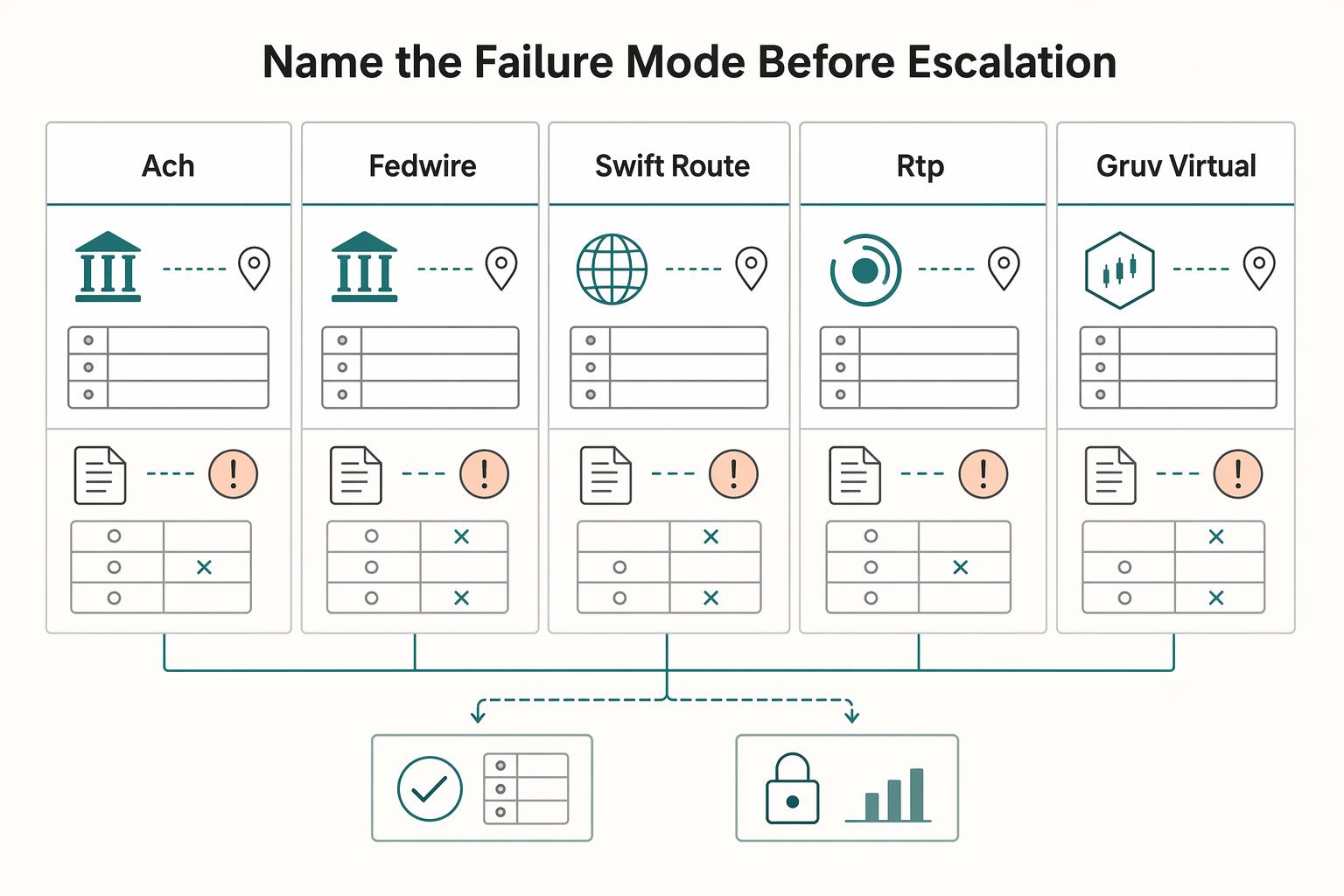
Route by rail and timing boundary as soon as the case is received, while completing the evidence packet in parallel. A single "payment missing" report can point to very different failure paths across ACH, Fedwire, SWIFT-route payments, RTP, Gruv Virtual Accounts, and Merchant of Record settlement flows.
Name the failure mode before escalation#
Escalate urgent cases promptly and refine the failure classification as evidence arrives. If the break is machine-detectable and repeatable, flag it for possible automation after policy and risk review.
| Rail or model | Common breakpoint | First recovery action | Escalate to third party when |
|---|---|---|---|
| ACH | Standard return vs disputed return confusion, or improper reversal on a non-consumer account | Confirm the return reason, account type and governing window. For an improper reversal to a non-consumer account, Nacha permits R17 return availability to the ODFI by opening of business on the second banking day after the reversal’s settlement date. | Return reason is still unclear, required fields are missing, or the R17 window is at risk without ODFI or processor action. |
| Fedwire | Ledger timing mismatch against wire confirmation | Check whether events are inside the same Fedwire business day (9:00 p.m. ET to 7:00 p.m. ET). If needed, use nonvalue operational messages such as return or report requests. | Order is accepted but internal state is still mismatched, or cutoff risk requires bank or provider action before close. |
| SWIFT-route payments | Aging cross-border item on a variable route | Reconstruct instruction and status by route or corridor, not as one generic international queue. | The item exceeds the agreed route/method arrival estimate and the provider cannot explain its current status. |
| RTP | Status divergence between ledger state and network response | Use the RTP Message Status Report (pacs.002) and reject reason codes to classify before any manual balance action. | pacs.002 status or reject output conflicts with your posted state and provider confirmation is required for final disposition. |
| Virtual Accounts (where supported by the selected program) | Unmatched deposit | Open an unmatched-deposit investigation and confirm provider credit or return status before final posting. | Provider details are incomplete or the deposit cannot be matched to an internal payment after investigation. |
| Merchant of Record | Settlement timing difference vs expected availability | Confirm which entity is the MoR, because the MoR carries legal transaction responsibility, including disputes and refunds. Then check whether payout delay is calculated in business days or calendar days for that country or configuration. | Your ledger assumes one settlement calendar while provider logic applies another, or liability is assigned to the wrong entity. |
Two operator checks help reduce avoidable disputes:
- Verify the external transaction identifier before treating the issue as a provider failure.
- Log the exact timing boundary that controls recovery options, such as Fedwire close or ACH return windows.
Escalate through third-party risk controls#
Use the provider escalation path agreed for the relationship, with a named internal owner and next update. The 2023 US interagency third-party guidance describes a lifecycle for banking organizations; it is control context rather than a universal queue rule for platforms.
Capture, at minimum:
- third party, service role, and relationship criticality
- timestamp of first contact and next committed update
- escalation path used and the exact unresolved dependency
For urgent escalation, send the known identifiers, deadline and missing facts immediately. Complete the reproducible case record as evidence arrives rather than allowing an incomplete packet to miss a cutoff.
For a step-by-step walkthrough, see How to Handle Payment Disputes as a Platform Operator.
Build a routing matrix your team can execute under pressure#
After you identify the rail failure, the next decision should be close to automatic. Your matrix should let any responder quickly decide whether a case is a dispute, a correction, or an investigation, who owns it now, and what approvals are required before funds move. We recommend making the owner and next action obvious enough that your responder can act without guessing. We also recommend tagging the required approval before funds move.
Build the matrix around decisions#
Build the matrix around decisions, not queue names. Include exception class, financial exposure band, compliance risk, owner, SLA, and escalation path. Use exposure bands tied to your internal Risk Assessment, not assumed universal dollar cutoffs. The point is consistent internal rules for when tighter controls apply and when scheduled review is acceptable.
| Exception class | Exposure band | Compliance risk | Owner | SLA | Escalation path |
|---|---|---|---|---|---|
| Correction | High | Medium to high if release or reversal is pending | Senior finance ops | Immediate triage, especially near cutoff risk | Finance lead, then bank or processor if external confirmation is required |
| Dispute | Any | Timing-sensitive when consumer-rights clocks apply | Dispute ops with compliance input as needed | Route by the applicable notice and resolution clock | Compliance review, then provider follow-up if needed |
| Investigation | Low to medium | Low unless flagged by internal risk signals | Payments ops or reconciliation | Short internal triage, then reclassify to dispute or correction | Provider or internal product or engineering owner if facts are incomplete |
That first branch matters because it reduces queue bouncing. ACH exception handling has historically relied on bilateral, time-consuming communication, so clear first-pass ownership matters even more as volume grows.
Tie each row to money-movement controls#
Tie each row to internal controls before it can trigger money movement. Ownership alone is not enough. The row should also say whether the owner can execute or only recommend for approval.
For higher-risk wire actions, separate initiator and approver roles. When full segregation is hard, use dual approval as a compensating control for high-exposure cases.
Fedwire carries time-critical, final transfers. Its current schedule lists 6:45 p.m. ET for core customer transfers and related listed messages, with other message-specific cutoffs. Use the bank or provider’s earlier customer deadline where applicable, and check any service extension before relying on the schedule.
Define each branch in plain language#
Define each branch in plain language so cases do not ping-pong between teams.
A dispute is a formal exception lane, not just "customer unhappy." In the ACH context, exceptions include disputes, notifications, questions, and requests for additional information. For payment cards, a written billing error notice should route to a billing-error lane that tracks its own clocks.
A correction means the internal state is known to be wrong and the next step is record correction or a release or return decision. An investigation is a temporary holding lane for missing facts, followed by reclassification.
If a case changes owner twice without changing class, add a branch rule. That is a sign the matrix is missing a decision point.
Set SLAs to the governing clock#
Identify the covered product and responsible entity before applying a legal clock. For consumer EFT errors under Regulation E, qualifying oral or written notice generally arrives within 60 days of the first statement reflecting the error. Investigation normally completes within 10 business days; longer periods require the conditions in §1005.11, including applicable provisional credit. For covered open-end credit billing errors under Regulation Z, timely written notice generally has a 60-day window, acknowledgement normally within 30 days, and resolution within two complete billing cycles and no later than 90 days. These are different procedures from internal corrections or card-network chargebacks.
| Covered procedure | Clock to record | Handling cue |
|---|---|---|
| Regulation E consumer EFT error | Notice receipt, statement date, applicable investigation/provisional-credit and result/correction deadlines | Do not defer investigation for internal packet completion; apply the rule’s extensions and conditions where relevant |
| Regulation Z open-end credit billing error | Timely written notice, acknowledgement and resolution deadlines | Keep creditor duties separate from merchant/network dispute procedures |
| High-exposure wire discrepancies | Immediate | Route immediately rather than batching |
| Lower-risk mismatches | Scheduled triage when no statutory clock is at risk | Batch only where risk permits |
Operationally, that means you route time-critical, high-exposure wire discrepancies immediately. Lower-risk mismatches may follow scheduled triage under your policy when no statutory clock is at risk.
Provider escalation does not transfer accountability. Keep an internal owner on the row and log the next committed update time until final resolution.
Process corrections in ledger-first order so rework stays low#
Once the facts support a correction, freeze conflicting case actions, confirm provider outcomes and source ledger entries, approve the adjustment, then reconcile downstream balances and statuses. An accounting correction and an external refund, return or reversal are distinct actions; document and coordinate each one required.
Freeze the case state#
Freeze the case state before broad status updates. Pause ad hoc retries, lock the active case state, and keep one evidence set attached to the case: request ID, provider reference, ledger journal IDs, and event timeline. This helps prevent conflicting fixes and preserves a clean pre-correction snapshot for review.
Confirm source ledger entries#
Confirm the provider or bank outcome and the source ledger entries before a balance adjustment. The ledger is the internal accounting record, but a wrong or missing ledger state does not make an external payment unknown, reversed or safe to resend.
Start from the original journal entries, not wallet projections or UI labels. If you cannot trace the source entry and the supporting external event cleanly, keep the case in investigation.
As a practical check, compare issued and cleared records, including amount, date, and any variance, and keep the case open until unexplained variance is resolved.
Post correction journals without rewriting history#
Post correction journals, but do not rewrite history. Use auditable reversing or offsetting entries so balances stay mathematically consistent and the correction trail remains reviewable.
Make internal journal actions safe to repeat using a durable correction-action identifier and consistent ledger writes. External retries must follow the selected provider’s idempotency contract, including its scope, parameter checks and retention limits.
Stripe, for example, can prune keys after at least 24 hours. Keep durable internal instruction and provider-attempt records; opening a new case or using a new key does not make an uncertain first payment safe to execute again. Resolve its outcome or retain an investigation hold before another money movement.
Reconcile balances and statuses after the journal posts#
Reconcile derived balances and statuses against the posted correction journal and verified external outcome. Wallet views, settlement dashboards, and user-facing states must distinguish internal accounting corrections from completed external funds movement.
Treat closure as a control check. Before closing, confirm provider status, internal ledger status, and user-facing status are consistent. For reconciled bank items, also confirm cleared and corrected issued records align and any variance is documented. Before you close, we recommend checking whether you could defend the record to audit without adding new context.
Sample corrected cases on a recurring cadence#
Run sample audits of corrected cases as an operational checkpoint, not a universal legal requirement. Sample across rails and exposure levels, then trace each case end to end: original request, provider reference, event and log history, source ledger entry, correction journal, reconciliation result, and final decision.
Retain records long enough to support later investigation and operational review. If a reviewer cannot reproduce why a correction was made, your case documentation is not strong enough.
Set strict rules for when Manual Overrides are allowed#
Manual Overrides should be rare, explicit, and reviewable. If people can bypass routing or release logic too easily, exception volume and repeat risk can climb back up.
Define the override gate#
Allow only the operational actions authorized by your policy and the governing legal/program rules. Manual approval may resolve a documented automation exception; it cannot remove a sanctions prohibition or other legal restriction.
Define the case packet before approval: request ID, provider reference, ledger journal IDs, event timeline, current status, and the exact action requested. If a responder cannot explain why automation was bypassed, keep the case in investigation.
Use a reproducibility check here too. A second reviewer should be able to read the case and reach the same decision without missing context.
Separate initiation from approval#
For high-risk actions, use dual control with segregation of duties: one person initiates, a different person approves, and both use separate credentials.
Do not treat informal acknowledgments as approval, and do not allow shared logins. If one person prepares, changes, and releases the same override, the control has failed.
Apply maker-checker discipline to actions like releasing funds, reopening settled cases, changing destination accounts, or force-closing exceptions. More approval layers can be configured in some systems, but two distinct people remain the baseline control pattern.
Protect the audit record#
Keep tamper-resistant audit records that can survive review. Capture who initiated, who approved, what event occurred, when and where it happened, the source event, and the outcome.
Log a reason code for why the override exists so decisions stay searchable at scale. At minimum, store event details, both user identities, timestamps, and the reason code. Protect logs from unauthorized modification or deletion.
Retire repeated overrides#
Manual overrides should stay exceptional, not become normal operations. Review override reasons regularly, and when the same reason keeps recurring, consider moving it into product logic, routing rules, or intake validation.
If a repeated reason code is treated as business as usual, you are preserving a design gap instead of fixing it. Define which actions qualify for bypass and the approval standard for each one so the override path stays controlled.
Handle compliance holds without stalling legitimate payouts#
Compliance holds should be narrow. If you treat operational failures as compliance issues, legitimate payouts can get stuck in the wrong queue and your real compliance work gets harder to see.
Classify holds by cause, not inconvenience#
Split holds into two paths at intake: compliance and operational. Use the compliance path for KYC, KYB, AML, sanctions, and CDD triggers, where CDD means ongoing monitoring for suspicious activity and keeping customer information current, including beneficial-owner information for legal-entity customers.
If the issue is missing payout data, a provider rejection, or a technical or business rail message error, keep it in the operational path unless a compliance trigger is actually present.
Require a named trigger source, or record the unresolved trigger as a compliance investigation. A missing label does not prove that a compliance concern is cleared. Distinguish legally blocked property from rejected payments and ordinary operational holds.
Define release conditions in plain language#
For each compliance hold type, define three things clearly: what clears the hold, who can approve under your internal policy, and what evidence must be retained.
| Hold type | Release condition | Evidence to retain |
|---|---|---|
| KYC or CDD refresh | Required customer information is updated and review is completed | Submitted records, review result, timestamp, case notes |
| Legal-entity verification | The applicable identification/verification gap is resolved under the program’s current requirements and any valid relief | Beneficial-owner data source, reviewer identity, decision time |
| OFAC blocked property | A valid legal basis permits unblocking or transfer, and the responsible compliance owner confirms the applicable authorization and reports | Block record, release decision, OFAC report when applicable |
For OFAC blocked property, release requires the applicable legal authority, such as a valid license or termination of the relevant prohibition; internal approval alone is insufficient. Under 31 CFR 501.603, an unblocking/transfer report generally is due within 10 business days, subject to its stated exceptions. Section 501.601 requires blocked-property records throughout the block and at least 10 years after unblocking.
Keep tax exceptions tied to the required decision#
If tax documentation affects withholding or reporting, route that decision to the responsible owner with a deadline. A documentation gap should not silently become a universal payment hold.
Separate transaction tax questions from payment eligibility. Record the specific requirement, affected transaction and resulting action rather than treating a VAT registration check as permission to release or block every payout.
An incorrect or missing TIN can require applicable backup-withholding procedures. A failed voluntary pre-filing match is not itself an IRS B notice. Track withholding, documentation and reporting decisions separately from operational payout status.
Verify release integrity before the payout leaves hold#
Before a held payout is released, require one complete audit trail: original trigger, clearing document or check, reviewer identity, timestamps, and release action in one record.
Where card data appears, restrict access and mask PAN display according to the applicable PCI DSS requirement. PCI SSC identifies the BIN and last four digits as the normal display limit, with documented business justification needed for more; a BIN can have eight digits. Showing only the last four may meet the support task without exposing the BIN.
As an internal control, consider failing release when masked sensitive fields appear manually rewritten in the case record. Route those cases to investigation and correct data at the authoritative source before release.
Related: How to Scale Global Payout Infrastructure: Lessons from Growing 100 to 10000 Payments Per Month.
Track the few metrics that actually prove improvement#
If you only measure speed, you can make the queue look better while controls get worse. Measure speed and quality together, and split both by exception class and rail so rework does not disappear inside averages.
Measure the core five by exception class#
Track queue aging, first-touch time, time-to-resolution, reopen rate, and correction accuracy by class, such as data mismatch, settlement variance, provider failure, compliance hold, and dispute. Treat these as internal operating metrics, and keep classes separate so faster handling is less likely to mask early closure.
For customer-facing cases, pair response time with an accuracy check. A prompt answer that misstates payment status or closes an unresolved balance problem is not a successful resolution.
Use a simple verification loop: sample recently closed cases weekly and confirm ledger state, provider state, and user-facing status still match.
Segment by rail before reading trends#
Segment by rail before you read performance trends, because ACH, wires, and cards behave differently.
| Rail | Metric detail worth tracking | Why it matters |
|---|---|---|
| Automated Clearing House | Return rates by subtype, especially unauthorized, administrative, and overall debit returns | Apply Nacha’s applicable return-code categories, measurement windows and thresholds; unauthorized, administrative and overall debit-return measures are different |
| Fedwire | First-touch and resolution time for high-value, time-critical cases | Finality and message-specific cutoffs require timely escalation; the bank may set an earlier customer deadline |
| Payment Cards | Monthly dispute and fraud counts or ratios | Use the current applicable Visa program definitions, scope and exclusions rather than treating every dispute count as the same metric |
Keep additional rails separate as well, even when thresholds are internal, so correspondent-banking issues do not get buried inside ACH or card volume.
Read exposure and override signals together#
If you track value at risk in the active queue and the share of cases requiring Manual Overrides, treat both as internal control metrics with internal definitions. They are not regulatory benchmarks, but they can highlight where unresolved work still creates financial or operational exposure.
If reopen rate rises while time-to-resolution falls, treat that pattern as a warning signal to investigate, not proof by itself that quality is worsening. One possible failure mode is closing on a status update before reconciliation proof is complete, so tighten closure checks in the classes and rails where the pattern appears.
Use a phased rollout with explicit checkpoints#
The following four-week sequence is an example plan. Advance when owners, routing and approval controls are demonstrated, and adjust the schedule to your existing workflows and deployment constraints.
| Week | Focus | Grounded actions |
|---|---|---|
| Week 1 | Taxonomy, ownership, evidence packet | Lock the minimum exception taxonomy, name the accountable owner for each class, and use one shared evidence packet template |
| Week 2 | Routing and SLA rules for ACH and wire transfer | Publish rail-specific routing and SLA rules, with ACH timing windows and same-day wire escalation tied to Fedwire operating timing |
| Week 3 | Manual Overrides and closure training | Enforce dual control for high-risk actions, audit logging, and train responders on override justification and mandatory closure evidence |
| Week 4 | Baseline KPIs and choose fixes | Split baseline results by ACH and Fedwire, then prioritize one automation fix and one control fix |
Finalize taxonomy, ownership, and the evidence packet#
In week 1, lock the minimum exception taxonomy, the accountable owner for each class, and one shared evidence packet template across finance ops, payments ops, and compliance. Keep ownership explicit for cases that touch money-movement state versus ledger state.
Treat this as an internal-control design step, not an analyst-only exercise. The OCC framework places responsibility for effective controls with leadership, so ownership and decision authority should be named and clear.
Keep the evidence packet lightweight but reproducible for independent review. Include the core identifiers and timeline details needed to reconstruct the case, plus any compliance gate result that affected release.
Ship routing and SLA rules for ACH and wires#
In week 2, publish rail-specific routing and SLA rules for top exception classes, starting with ACH and wire transfer. ACH and wire need different handling because timing constraints differ, and Fedwire settlement is immediate, final, and irrevocable once processed.
Set ACH rules using the applicable reason code, account type, settlement date, triggering event, and deadline calculation. Record those facts rather than applying a general two-day or sixty-day shortcut. Set wire escalation around the applicable message cutoff and earlier bank or provider cutoff; the Fedwire business-day opening and closing times do not replace those limits. If Reserve Bank electronic access is in scope, align procedures and evidence handling to Operating Circular No. 5 controls.
Enforce Manual Overrides and train to closure standards#
In week 3, enforce manual overrides with dual control for high-risk actions and audit logging. Capture who initiated, who approved, what changed, why automation was bypassed, and what follow-up check is required.
Train responders on two decisions: when an override is justified and what closure evidence is mandatory. Keep second review independent so the person making the change is not the person validating completion.
Baseline KPIs and pick one automation fix and one control fix#
In week 4, baseline core exception metrics and split results by ACH and Fedwire before making changes. Use the baseline to identify top reopen causes, then prioritize one automation fix and one control fix.
Keep scope tight: fix one repeat issue that is automation-ready and one control weakness driving avoidable reopen loops. If resolution time improves while reopen rate rises, treat that as a control-quality warning and adjust closure standards before scaling further.
Conclusion#
Fewer reopens usually come from tighter controls, not more triage. A clearly documented workflow, explicit routing ownership, and tightly governed exception handling can reduce both risk and rework.
That is also the practical through-line in the control expectations behind this work: documented requests, clear accountability, dual control, segregation of duties, independent review, and prompt reconciliation. You do not need a heavy model. You need a small set of rules that gets enforced every time. If you want a copy-and-paste starting point, use this checklist:
- Define your exception taxonomy and assign a clear owner for each path.
- Capture sufficient case evidence for investigation and authorized action; preserve valid notices and urgent deadlines even when information is incomplete.
- Keep dispute and correction routing separate, including ACH error-on-authorized-payment cases (R11) versus no-authorization claims.
- For policy-defined high-risk Manual Override paths, require initiator and independent approver controls with auditable reason tracking.
- Close cases only after reconciliation evidence and documented internal review are complete.
- Track a small, consistent KPI set and review repeat reopen causes regularly to drive root-cause fixes.
Frequently Asked Questions
What is a payment exception at scale?
A payment exception is any case that still needs action, not just a failed payment. In the Federal Reserve Exception Resolution Service, exceptions include disputes, notifications, questions, and requests for additional information. At scale, a practical operating goal is consistent classification and routing so the same issue does not get handled differently across multiple queues.
How should payment disputes be routed differently from correction requests?
Route formal disputes or covered consumer error notices to the appropriate procedure, and route internal record corrections to the team authorized to make them. A consumer’s computational or bookkeeping error claim can still fall under Regulation E; calling it a correction does not remove the rights clock. Track the applicable product, responsible entity and notice, investigation and reporting deadlines.
When is a manual override acceptable, and who must approve it?
Use an authorized manual action when automation cannot resolve the case safely and the retained evidence supports independent review. Require an initiator and independent approver for the high-risk actions defined in your policy. Approval cannot override a legal block; document the permitted action and its reconciliation check.
Which metrics best show whether exception handling is improving?
Public guidance does not prescribe a universal KPI set for exception handling. Teams often track both speed and control quality, such as first-touch time, time to resolution, queue aging, reopen rate, correction accuracy, value at risk in queue, and override rate. Segment results by payment channel so comparisons stay operationally meaningful, and treat faster closure with rising reopen rates as a control-quality warning.
How do we apply high-level guidance from the OCC Comptroller's Handbook to daily operations?
Apply the OCC Handbook as a control framework, not a queue playbook. The Handbook states institutions differ, and it keeps accountability for effective internal control with the board and senior management. In daily operations, that translates into explicit ownership, approval authority, evidence requirements, and review checks.
What details are still unclear in public guidance like Federal Reserve Banks Operating Circular No. 5?
Operating Circular No. 5 contains general terms for Federal Reserve Financial Services. Use the applicable service-specific circular, current exception guide and bank/provider procedure for case fields, deadlines and action permissions. General access terms alone do not define a platform exception workflow.
Researched and edited by the Gruv editorial team. Gruv builds cross-border billing, payouts, and finance-operations software for global businesses.
Sources
- consumerfinance.gov/rules-policy/regulations/1005/11trusted
- consumerfinance.gov/rules-policy/regulations/1026/13trusted
- docs.stripe.com/api/idempotent_requeststrusted
- docs.stripe.com/error-low-leveltrusted
- ecfr.gov/current/title-31/subtitle-B/chapter-V/part-5...trusted
- ecfr.gov/current/title-31/subtitle-B/chapter-V/part-5...trusted
- fincen.gov/news/news-releases/fincen-issues-exceptive-r...trusted
- irs.gov/businesses/small-businesses-self-employed/ba...trusted
Educational content only. Not legal, tax, or financial advice.
Related Posts

The Freelance Payment Penalty: A Modeled Audit of Platform Fees, FX Spreads, and Payout Delays
The money rarely disappears through a single, easy-to-spot fee. The real loss is stacked. A marketplace takes its commission, a processor adds a charge for international cards, a bank or payment company converts the currency at a spread, a platform holds the funds before release, and a wire sheds a little to intermediaries on the way in. Each layer looks defensible on its own, but the worker feels the combined result as a smaller deposit and a later payday.

How to Respond to a Subpoena for Business Records
Move fast, but do not produce records on instinct. If you need to **respond to a subpoena for business records**, your immediate job is to control deadlines, preserve records, and make any later production defensible.

A US Expat's Guide to Investing in UCITS ETFs to Avoid PFIC Issues
The real problem is a two-system conflict. U.S. tax treatment can punish the wrong fund choice, while local product-access constraints can block the funds you want to buy in the first place. For **us expat ucits etfs**, the practical question is not "Which product is best?" It is "What can I access, report, and keep doing every year without guessing?" Use this four-part filter before any trade: