
Quick Answer
Run an NGN-first pilot and expand only after proof by payout lane. For this keyword, the practical path is to verify bank-account routing first, confirm required KYC fields before disbursement, and treat mobile money as unverified until your provider confirms eligibility and failure handling for your recipient profile. Document payout currency behavior in writing, then test real outcomes against provider references and internal ledger records. If non-NGN delivery is still uncertain, keep scope narrow and block unsupported routes.
What Platforms Need to Handle in Nigeria#
You can launch Nigeria successfully, but not on vague payout assumptions. Treat payout currency behavior and rail coverage as core product constraints from day one, not cleanup work for Ops after go-live.
The upside is real. Nigeria is widely viewed as a deep talent market with scale, including a population of over 200 million residents. That makes the market worth serious attention. It does not make the payout path simple, and regulatory navigation is often described as complex.
What changes the launch decision is the operational surface area around Nigerian Naira (NGN), KYC, and local banking realities. The basic context is straightforward: NGN is the local currency, the Central Bank of Nigeria is the relevant central bank context, and provider materials for Nigeria explicitly call out KYC and banking-related checks. Teams can underestimate how quickly a promising country turns into a support problem when payout setup, due diligence, or recipient verification is weaker than the sales case.
Before you start#
Use this guide as a decision filter before you commit product, treasury, and go-to-market resources. Your first job is not to build every edge case. It is to answer three questions with evidence:
- Can your provider reliably support the payout route you need in Nigeria, especially for NGN disbursement?
- Can your onboarding flow collect and clear the KYC data your contractor population will actually submit?
- Do you know which assumptions are confirmed versus still unverified, especially around payout currency behavior and mobile money coverage?
Ask for proof, not general capability language. You want confirmation of supported payout rails, the recipient information required before first disbursement, and any account setup or due diligence steps that could slow launch. That last point is easy to miss. Provider guidance notes that opening and managing corporate bank accounts can be complex and time-consuming, with extensive checks and due diligence.
A common early failure is designing a universal payout experience before you have validated country-specific constraints. That can show up as rework in KYC, tax intake, treasury handling, or support scripts when real recipients do not match the model you assumed. If non-NGN predictability is central to your product, validate that first. If it is not yet clear, a narrower NGN-first scope is often the more honest starting point.
The rest of this guide is meant to get you to a launch decision, not give you a generic market summary. By the end, you should know whether Nigeria is a now market for your team, what to validate before first payout, and where avoidable operational debt can start. Related reading: How Platform Teams Pay Brazil Contractors with Pix.
Decide if Nigeria is worth launching now#
Launch now only if your team can prove the payout path, onboarding/compliance path, and operating model together; if any one is still assumed, stay in research mode.
Set a hard go/no-go screen#
Treat Nigeria as a go only when you have written confirmation of:
| Check | Written confirmation | Status |
|---|---|---|
| Payout path | Reliable NGN payout support for your use case | confirmed / unknown / blocked |
| Recipient requirements | The recipient data and checks required before first payout | confirmed / unknown / blocked |
| Banking or due diligence | Any banking or due-diligence steps that sit outside your current flow | confirmed / unknown / blocked |
- Reliable NGN payout support for your use case
- The recipient data and checks required before first payout
- Any banking or due-diligence steps that sit outside your current flow
In your market brief, label each item as confirmed, unknown, or blocked, with an owner and next action.
Choose your currency lane early#
If your model depends on predictable non-NGN disbursements, validate that first with your provider. If that proof is missing, scope an NGN-first pilot rather than a broad multi-currency launch.
Separate confirmed facts from open questions#
Keep mobile money assumptions explicit: document what is confirmed versus what is still unverified for your contractor segment, routing path, and payout-currency behavior. Until verified, mobile money is not a fallback you should promise.
Also treat regulation as a moving constraint. The Central Bank of Nigeria has issued agent-banking rules that, from April 2026, require PoS agents to operate with a single super-agent, bank, or mobile money operator, with a stated focus on tighter regulation, fraud reduction, and payment traceability. This is not direct proof of contractor payout API rules, but it is a clear signal to re-validate payment-channel assumptions before launch.
Recommendation: launch only if Finance and Ops accept higher operational overhead than in single-rail markets. For deeper implementation detail, see How to Pay Contractors in Nigeria Using Local Rails for Compliance-Safe Operations.
Gather prerequisites before first payout#
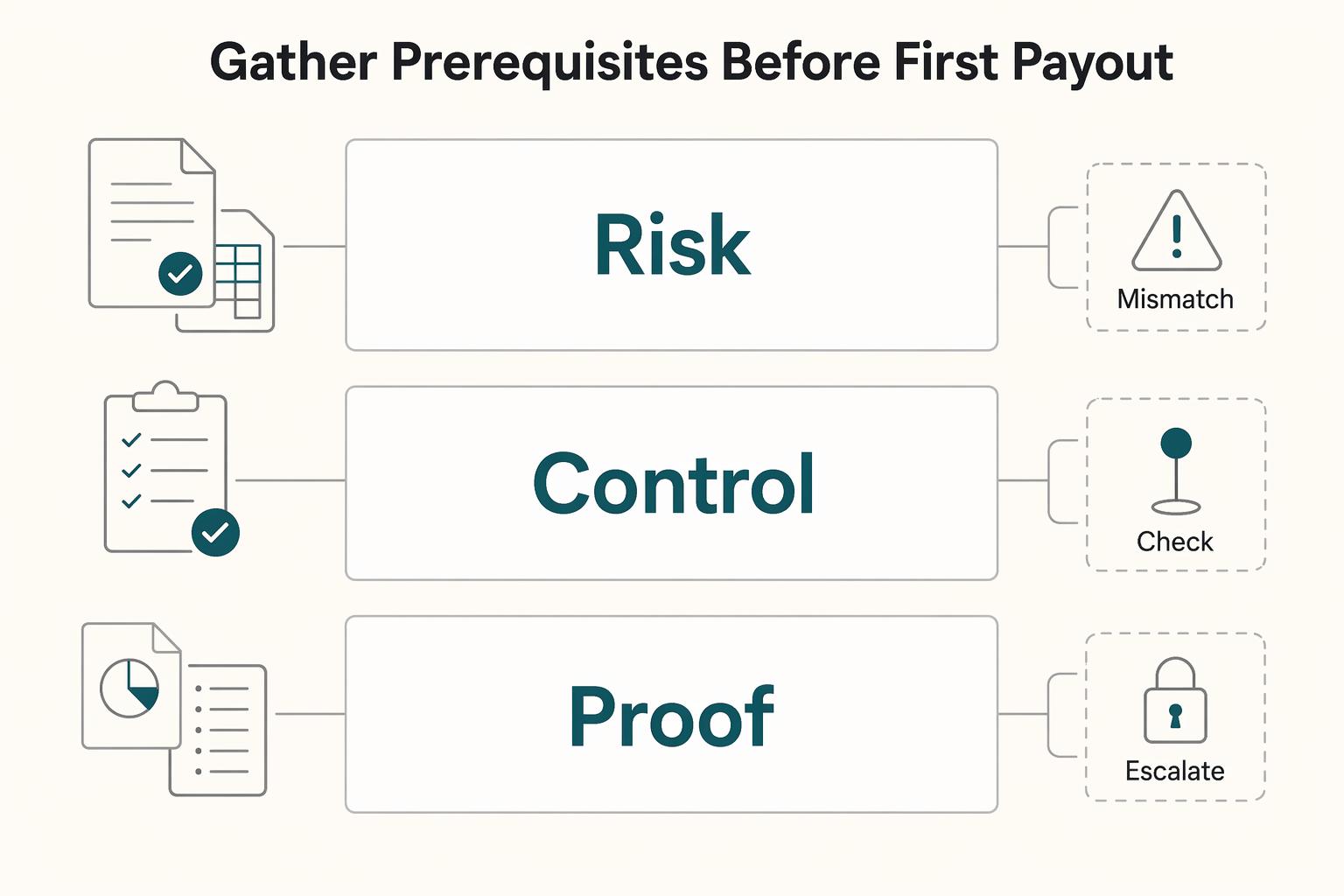
Your model is not launch-ready until worker classification, KYC evidence, tax ownership, and exception handling each have a named owner.
Step 1. Define your worker model and escalation path. Decide what your platform treats as an independent contractor engagement, who approves edge cases, and when Legal reviews possible employee-misclassification risk. Use working-practice signals in your policy, not just template labels. For example, control over how, where, and when work is done is one indicator often used in status assessments, but do not treat that point alone as a Nigerian legal test.
Step 2. Build a minimum evidence pack before onboarding opens. Document the KYC fields you require, the tax data you collect, the payout-destination data required for your disbursement flow, and the exception paths you allow under applicable banking rules. Then run one dry-run onboarding record from start to payout-ready status to confirm every required field is collected in product, not only in policy docs.
Step 3. Set the tax handling boundary in writing. State what your flow does with VAT signals and where WHT or PAYE responsibility sits across platform, client, contractor, or external advisor review. If ownership is still unclear, block automated tax messaging instead of implying treatment you have not validated.
Step 4. Publish one launch artifact your team can approve. Use a one-page owner matrix across Product, Ops, Compliance, and Finance, with each prerequisite marked confirmed, unknown, or blocked. If no one owns a field, rule, or exception, it is not launch-ready.
For cases where contractors cannot receive bank payouts reliably, see Paying the Unbanked: How Platforms Reach Contractors Without Bank Accounts in Developing Markets.
Design payout route and currency path#
Make the payout route and currency path explicit before launch. For a first Nigeria rollout, default to verified bank-account payouts in NGN, and only add other routes when your provider confirms support for the exact recipient profile.
Step 1. Choose the rail you can verify in operations, not the one that looks broad in sales material. The grounded options here are bank transfers, NIBSS instant rails, and wallet-based disbursement patterns. Bank-account flows are often simpler to run first because eligibility is concrete: collect destination data in the correct 10-digit NUBAN format and verify account details. That discipline matters in a fragmented network where settlement behavior can vary by institution.
| Settlement path | Best fit | Verification checkpoint | Main tradeoff |
|---|---|---|---|
| Bank transfers | Standard payouts to verified bank accounts | Correct 10-digit NUBAN format and verified destination details | Institution-level variation can increase support load |
| NIBSS instant rails | Local NGN payouts where provider connectivity is confirmed | Confirm routing setup, destination validation, and coverage with your provider | Do not assume uniform performance across institutions |
| Wallet / Virtual IBAN pattern | Holding segregated funds before processing payouts | Reconcile inbound funds to a specific payout batch or beneficiary set | Adds another balance state to reconcile |
Treat mobile money as a separate lane unless you have stronger proof for your cohort. Nationwide eligibility, standard coverage, or common reversal behavior are not established, so avoid presenting it as a universal Nigeria route. Before enabling it, get written confirmation on who qualifies, what validation is performed, and how failed or misdirected payouts are handled.
Step 2. Define the conversion point in writing. Document your collection currency, conversion timing, and final payout currency so treasury exposure is not hidden between approval and disbursement. If conversion timing is vague, variance will surface in reconciliation and support.
Step 3. Route by recipient profile, not one universal payout rule. If a recipient passes bank-destination checks, use your supported bank or NIBSS path. If a recipient only qualifies for another supported destination type, route through a separate rule set with its own validation and support flow. If profile data is incomplete, hold the payout instead of guessing.
The architecture choice follows that routing. Direct initiation from your treasury flow is usually simpler when funding is stable and volumes are manageable. Virtual IBAN accounts (wallets) are useful when you need funds segregated and safeguarded until payouts are ready to process. The tradeoff is reconciliation overhead, so use a strict checkpoint: every inbound funding event should map cleanly to downstream payouts.
For another West Africa mobile money example, see How to Pay Contractors in Senegal: Wave Mobile Money and BCEAO Rules for Platforms.
Build compliance and tax controls before go-live#
Once the route is set, treat controls as the hard stop: a contractor is not payable until required identity, screening, tax, and payout checks are complete or explicitly held by policy.
Separate KYC, screening, and payout eligibility#
Run KYC, sanction/AML screening, and payout eligibility as separate gates, in that order. KYC confirms who the person or entity is. Screening confirms whether you can transact. Payout eligibility confirms whether the recipient can receive the payout path you configured with your provider.
| Gate | Confirms | Required tracking |
|---|---|---|
| KYC | who the person or entity is | distinct result, owner, timestamp, and hold reason |
| Sanction/AML screening | whether you can transact | distinct result, owner, timestamp, and hold reason |
| Payout eligibility | whether the recipient can receive the payout path you configured with your provider | distinct result, owner, timestamp, and hold reason |
Do not collapse those into one status. Your checkpoint should show a distinct result, owner, timestamp, and hold reason for each gate so Ops can resolve issues without guesswork.
Define tax checkpoints as required records#
Define tax checkpoints as required records, not last-minute judgment calls. Before first disbursement, document which contractor fields are mandatory, who provides them, and which cases require Finance or legal review before payout.
Keep tax-relevant inputs structured (not free text) and tie them to clear ownership. Where your process depends on filing or registration accounts, include an active-status check so stale account states do not create avoidable delays. Recordkeeping is part of the control: keep the records needed to support accurate treatment, including items like bank statements or receipts where relevant.
Make every payout reconstructable#
Make every payout reconstructable without detective work. Each disbursement should trace one chain: payout request, approval, provider reference, ledger posting, and an exportable evidence pack for internal review.
Test this before go-live with a sample payout reconstructed by someone outside the build team. If they cannot trace it quickly, the control design is not ready. Block payouts when required fields are missing; temporary bypass logic usually becomes long-term operational debt.
Execute the pilot in five steps with verification at each step#
Run a controlled five-step pilot and treat each step as a launch gate, not a checklist item. Keep the first Nigeria cohort small enough for manual review, because broad payment-system references do not define your provider behavior for your contractor mix or exception patterns.
| Step | Focus | Verification |
|---|---|---|
| 1 | Onboard a small cohort and confirm payable readiness before live payouts | Validate independent contractor classification under your policy and confirm KYC completion outcomes (start, complete, stall, fail) with clear hold reasons |
| 2 | Run low-volume disbursements in Nigerian Naira (NGN) and verify outcome by destination type | Compare intended payout currency versus delivered payout currency, and confirm records across provider status, internal ledger entry, and recipient-side outcome where available |
| 3 | Test both happy-path and broken-path events for each payout lane | For bank account payouts and mobile money (if enabled), test success, rejects, timeouts, and retries; verify duplicate protection so one payout intent ends in one final payable outcome |
| 4 | Reconcile each batch end to end with tax/compliance records | Trace payout request, approval, provider reference, ledger posting, and compliance artifacts in one chain; tie tax checkpoints to your documented policy, including any FIRS-relevant record expectations your team has defined |
| 5 | Hold a cross-functional launch gate before scaling | Finance, Ops, and Compliance should review the same scorecard and scale only when failure handling, reconciliation, and exception management meet pre-agreed targets |
SIIPS 2025 includes Nigeria in its data-contributor set, and the World Bank Fast Payment Systems report explains why faster rails change operations. Use that as context, not as a substitute for operator-level testing in your own flow.
-
Onboard a small cohort and confirm payable readiness before live payouts. Validate independent contractor classification under your policy and confirm KYC completion outcomes (start, complete, stall, fail) with clear hold reasons.
-
Run low-volume disbursements in Nigerian Naira (NGN) and verify outcome by destination type. Compare intended payout currency versus delivered payout currency, and confirm records across provider status, internal ledger entry, and recipient-side outcome where available.
-
Test both happy-path and broken-path events for each payout lane. For bank account payouts and mobile money (if enabled), test success, rejects, timeouts, and retries; verify duplicate protection so one payout intent ends in one final payable outcome.
-
Reconcile each batch end to end with tax/compliance records. Trace payout request, approval, provider reference, ledger posting, and compliance artifacts in one chain; tie tax checkpoints to your documented policy, including any FIRS-relevant record expectations your team has defined.
-
Hold a cross-functional launch gate before scaling. Finance, Ops, and Compliance should review the same scorecard and scale only when failure handling, reconciliation, and exception management meet pre-agreed targets.
For a step-by-step walkthrough, see How Platform Operators Pay Creators Globally Across YouTube, Twitch, and Substack.
Set failure handling and reconciliation controls#
Set explicit failure classes, owners, and a fixed recovery sequence so each payout intent ends in one clear ledger outcome. Cross-border payouts are complex, and manual handling adds compliance risk, cost unpredictability, and operational bottlenecks, so treat bank account payouts and mobile money as separate exception lanes.
Define failure classes and assign owners#
Define failure classes once, and assign one owner to each class. Standard classification is the control: it keeps failures from turning into ad hoc support work.
| Failure class | Typical trigger | Primary owner | Verification checkpoint |
|---|---|---|---|
| KYC rejection | identity check not passed or incomplete | Compliance or onboarding ops | KYC status and contractor record match; payout remains blocked |
| Account mismatch | legal name, account identifier, or destination type mismatch | Payout ops | destination data matches approved contractor profile |
| Rail unavailability | provider cannot complete via selected rail | Payments ops | provider status captured by rail: bank account vs mobile money |
| Stale conversion quote | quote expired before execution | Treasury or payments ops | quote timestamp and booked payout currency are logged |
| Provider timeout | no final response within your review window | Payments ops or engineering | payout intent linked to one retry key and one final outcome |
A useful checkpoint is simple: one case view should show KYC result, destination type, provider reference, intended payout currency, and current ledger state.
Set the recovery order#
Use one recovery order and keep it fixed: detect failure, classify reason, decide retry vs reroute, notify the contractor, then post corrected ledger state. When teams improvise this order, duplicate support work and unclear status follow.
Retry when the payout intent is still valid and the failure is operational (for example, a timeout). Reroute when the destination or rail is the issue. If the cause is KYC, keep the payout blocked until the contractor file is corrected.
Require idempotent retry keys#
Require idempotent retry keys for every payout API call. This prevents one payout intent from becoming duplicate disbursements when responses are delayed or jobs are replayed.
Your verification test is direct: the same retry key must resolve to one final payable outcome, even if submitted more than once. Store the retry key, request payload, provider reference, and final status together so reconciliation can confirm what happened.
Publish a weekly control report#
Publish a weekly control report and review it with Ops, Finance, and Compliance. Keep it decision-ready: exception volume by rail, unresolved-item aging, and reconciliation breaks by payout currency and recipient type.
For this flow, split results at minimum between bank account payouts and mobile money, and flag cases with no owner, no failure class, or no next action. Those are early signs that "processing" is hiding unresolved control debt.
Avoid common rollout mistakes and recover fast#
The fastest recoveries come from tightening ownership and checks before you add volume. If Nigeria starts behaving differently from your default markets, pause scaling and re-check KYC, banking-regulation assumptions, recipient rail setup, and tax-role ownership on the same records.
Re-test country assumptions before adding volume#
Do a record-level assumption check before you scale. Treat Nigeria as its own operating lane, not a copy-paste of another contractor market. Pull a small sample of payout-ready records and confirm that KYC status, approved destination type, intended payout currency, and selected rail all match in each case.
If those fields do not align, scale will turn small mismatches into recurring exceptions. The recovery is straightforward: fix the rule mapping first, then resume volume.
Override generic global payroll defaults#
Generic global payroll defaults are usually too broad for rollout control. Make your NGN handling explicit, separate recipient account types, and route exceptions by rail instead of one shared queue. If one failed payout cannot be traced to a clear country rule and routing decision, your defaults are still doing too much.
Recover by replacing opaque "country = rule" behavior with visible rule paths your ops team can validate quickly.
Publish a tax responsibility map#
Tax-role ambiguity is a rollout risk, so publish ownership before exceptions pile up. Define who owns FIRS-facing interpretation, who reviews VAT signals, and who decides whether WHT or PAYE questions block payout, escalate, or sit outside scope. Then enforce those decisions with policy gates in product so support and payout ops are not deciding case by case.
Process discipline matters: registrations, deadlines, and filings fail when ownership is vague. Apply that ownership model locally, without importing UK-specific HMRC rules or timelines into Nigeria.
Conclusion#
The launch decision comes down to one test: can your team pay contractors in Nigeria repeatedly, explain the result, and reconcile the exceptions without improvising? Nigeria is a sensible expansion only when your pilot proves three things under real conditions. The payout route works reliably, the compliance gates hold when records are incomplete, and reconciliation still makes sense when exceptions show up. If any of those are still assumptions, keep the launch narrow and delay broad GTM spend.
For most teams, the right next move is not a bigger rollout. It is a scoped pilot with explicit rules for payout currency, KYC, and rail fallback across bank accounts and any enabled mobile money path. That matters even more in a market shaped by the vagaries of Central Bank of Nigeria foreign exchange policies, where unmanaged FX risk can add cost, delay settlement, and make reconciliation harder.
- Confirm go or no-go criteria and write down unknowns.
Decide whether your baseline offer is local-currency-first and whether any non-local-currency assumption is still unverified. Your checkpoint is a short decision note that separates confirmed facts from open questions on payout currency, recipient type, and rail coverage. If Finance is still guessing about FX behavior, you are not ready to scale.
- Finalize contractor classification and escalation ownership.
In the grounded guidance, an independent contractor in Nigeria is a person or business providing services under a Contract for Service, and misclassification is a real legal risk. Your evidence pack should include contract type, review owner, and a documented escalation path for employment-like cases. A common failure mode is building payout logic first and asking classification questions after money starts moving.
- Lock the payout route matrix before onboarding volume.
Treat bank payouts and mobile money, defined here as an e-wallet service, as separate destinations with separate eligibility checks. Your checkpoint is one approved matrix showing which recipient profile can use which rail, what fallback is allowed, and who approves a reroute. Do not let Ops improvise a rail switch during exceptions without that rule written down.
- Validate compliance and tax data gates up front.
Make sure required KYC fields, payout eligibility checks, and tax data expectations are complete before first disbursement. Nigeria hiring and pay operations can require attention to Labour Act and FIRS obligations, so name the policy owner before launch. If missing records can be bypassed manually, assume that bypass will become permanent.
- Run a small pilot batch and reconcile it end to end.
Match each payout request to the provider reference, internal ledger entry, and exception outcome. Review both success cases and broken cases, especially account mismatch, timeout, or reroute events. If you cannot explain one failed payout cleanly, your controls are not ready for more volume.
- Scale only after controls pass, not after the first success.
A single clean batch proves very little. What matters is whether your team can repeat the result, handle exceptions consistently, and keep audit evidence intact when the easy path breaks. That is the real decision point for a platform evaluating Nigeria.
For a country-specific bank-transfer payout setup, see Pay Contractors in Mexico With SPEI for Platform Operators.
Frequently Asked Questions
Can platforms pay contractors in Nigeria in currencies other than Nigerian Naira (NGN)?
NGN is the confirmed country currency in the source material, so that should be your baseline assumption. If your model depends on non-NGN payouts, do not promise it from a generic country setting. Verify it with your provider by recipient type and rail first, then test one real payout before you roll it out.
What changes operationally between bank account payouts and mobile money disbursements?
From the source guidance, the safe point is high-level multi-rail support: providers may support rails such as mobile wallets and bank accounts. It does not confirm detailed Nigeria-specific operational differences between those destinations. Treat them as separate payout configurations and confirm provider requirements by rail before launch.
Which compliance checks are non-negotiable before the first contractor payout in Nigeria?
The non-negotiable starting point is process discipline: classify the worker first, then confirm your provider's requirements for the selected recipient type and rail before the first live payout. Keep clear ownership for compliance and tax interpretation before money moves. Also plan for complexity in cross-border emerging-market flows, rather than relying on ad hoc manual exceptions.
How should teams handle independent contractor classification risk and avoid employee misclassification?
Start where the Nigeria contractor guidance starts: classify the worker before you build payout logic around them. That means you should keep a documented contractor policy, an escalation owner for edge cases, and a block or review step when facts look employment-like. If your Ops team is guessing case by case, you do not have a classification process yet.
What is the minimum viable pilot setup for Nigeria payouts for a platform operator?
Keep it narrow: a small contractor cohort, NGN-first payouts, one approved destination type, and full reconciliation from payout request to provider reference to ledger entry. You also want an exceptions log that captures why a payout failed and whether it was retried, rerouted, or blocked. If you cannot trace one failed payout end to end, do not add volume.
When does Virtual IBAN setup help, and when is it unnecessary complexity?
Virtual IBAN accounts, described by Papaya as segregated wallets that hold funds until payments are ready to be processed, can help when Finance wants cleaner prefunding segregation or clearer custody before release. They are useful when treasury timing, reconciliation separation, or client-fund segregation is a real operational issue. They are unnecessary complexity if your Nigeria launch is a low-volume pilot and your direct payout flow already gives you clean funding control and auditability.
Try a related tool
Where Gruv fits
Researched and edited by the Gruv editorial team. Gruv builds cross-border billing, payouts, and finance-operations software for global businesses.
Sources
Includes 2 external sources outside the trusted-domain allowlist.
- business.gov.uk/support/business-structures-governance-and-e...trusted
- elibrary.imf.org/view/journals/001/2025/211/article-A001-en.xmltrusted
- elibrary.imf.org/view/journals/087/2025/004/article-A001-en.xmltrusted
- fastpayments.worldbank.org/sites/default/files/2021-11/Fast%20Payment%2...trusted
- scholarworks.waldenu.edu/cgi/viewcontent.cgitrusted
- sec.gov/Archives/edgar/data/1782170/0001782170230000...trusted
- africanenda.org/uploads/files/siips2025/SIIPS2025-mainreport...external
- globalli.io/resources/blogs/pay-contractors-nigeriaexternal
Educational content only. Not legal, tax, or financial advice.
Related Posts
Paying Contractors in Senegal Under BCEAO Rules With Wave in Scope
Senegal is attractive for contractor payouts, but the first useful question is not whether you can connect to Wave. It is whether your planned role fits an operating model you can defend under applicable BCEAO and local payment rules.
Internal Controls for AP Platforms to Prevent Fraudulent Disbursements
Start here: your AP control design should reduce fraudulent disbursements and payment errors without turning every payout into a bureaucratic exercise. In practice, that means clear escalation points at the moments where money can move incorrectly, not extra approvals added just to look controlled.

Paying Unbanked Contractors in Developing Markets: Best Payout Routes for Platforms
If your team needs to send money to contractors, creators, freelancers, marketplace sellers, or other non-payroll recipients across borders, the payout decision can look deceptively simple at first. On paper, you are choosing a payment rail. In practice, you are choosing an operating model that affects onboarding, compliance, support load, engineering effort, treasury visibility, failure recovery, and the degree of legal risk your company is willing to carry.