
Quick Answer
Map one real transaction first: collection currency, hold currency, conversion moment, and payout currency. Then classify each corridor as hold, convert on receipt, or hybrid based on cash-flow predictability. Enforce quote expiry, stale-quote rejection, and approval ownership before release. Add hedging only after execution is stable, because many losses come from delayed approvals, failed conversions, and exception handling rather than pure rate moves.
Set Up a Multi-Wallet Strategy That Reduces FX Losses#
Short answer: minimize FX losses by mapping where currencies change, holding funds where same-currency inflows and outflows naturally match, converting earlier when they do not, and adding quote, approval, and ledger controls before you add hedging.
Treat FX as a product and operations decision, not only a treasury one. As you add multiple wallet balances, you also change payment flows, payout routing, and approval paths. Those issues show up when money sits in one currency and leaves in another.
- Start by framing the problem around flows, not rates.
FX risk is not only about whether a currency moves up or down. It also shows up when exchange-rate moves increase costs, reduce the value of sales, or disrupt cash flow. In practice, your first question is not "what rate can we get?" It is "where do currencies change across collections, holds, conversions, and payouts?" If you are designing a cross-border product, you need to understand those flows, especially the cross-border ones, before you set any conversion rule. Verification point: for one real transaction, you should be able to name the collection currency, the wallet hold currency, the conversion moment, and the payout currency without asking three different teams.
- Design for operational reality, because ad hoc payments create hidden loss.
Automated multi-currency liquidity tooling can reduce currency exposure and volatility risk, but only if the operating model stays visible and controlled. When payments and collections are ad hoc, visibility drops and the control burden rises. That is where teams confuse market FX risk with operational leakage from manual timing, delayed approvals, routing choices, or settlement issues. In stressed conditions, disruption in payment and settlement infrastructure can make FX transactions more expensive. A practical red flag: if your ops team cannot quickly explain why a payout was delayed, whether a conversion already happened, and which balance was used, you are carrying more risk than your treasury policy suggests.
- Set decision checkpoints before you add complexity like holding or hedging.
This guide will help you decide where FX loss actually occurs, when to convert, when to hold, and when hedging belongs. The main rule is simple: do not add wallets, conversion timing rules, or hedge instruments until you can prove who owns each decision and what evidence is retained. Your minimum evidence pack should trace the money from payment initiation to payout, including conversion records, approval trail, and ledger impact. By the end, you should be able to choose a policy by corridor and cash-flow predictability, not by instinct. If inflows and outflows are predictable, holding may make sense. If they are not, earlier conversion and tighter controls usually matter more than sophisticated tooling.
Map where FX losses actually occur in your flow#
FX loss usually comes from identifiable handoff points in your flow, not one dramatic rate move. Map one real transaction from collection to payout, then separate market exposure (rate movement during a timing gap) from operational leakage (process or execution failures).
| Flow step | What to check | Risk noted |
|---|---|---|
| Collection to hold | Whether you collected in one currency and held in another before payout needs were clear | Avoidable conversion risk |
| Hold to conversion | Whether funds sat while approvals, quote refresh, or batch prep ran | Long waits increase exposure windows |
| Conversion execution controls | Whether the conversion was tied to a valid quote window and executed on time | Stale-pricing risk |
| Exception and reject handling | Whether the reject reason and next action could be identified quickly | Fix traceability and procedural controls before changing wallet policy |
Start by naming four fields for that transaction: collection currency, wallet hold currency, conversion moment, and payout currency. Then trace where time lag appears between contracted amount and settlement. That window is where transaction exposure builds.
- Collection to hold.
Did you collect in one currency and hold in another before payout needs were clear? That creates avoidable conversion risk.
- Hold to conversion.
Did funds sit while approvals, quote refresh, or batch prep ran? Long waits increase exposure windows.
- Conversion execution controls.
Was the conversion tied to a valid quote window and executed on time? Time-bounded quote controls, for example 5 minute, 1 hour, or 24 hour windows, help limit stale-pricing risk, but only if your process enforces them.
- Exception and reject handling.
When execution failed, could your team quickly identify the reject reason and the next action? If not, fix traceability and procedural controls before changing wallet policy.
Use one failed or low-margin payout as a test case and reconstruct the full path from records. If you cannot clearly attribute the loss to market movement versus execution leakage, your first priority is a better currency map and cleaner operational controls. Related: A Guide to Tax-Loss Harvesting.
Gather prerequisites before you design rules#
Before you set wallet rules, make four inputs explicit: baseline data, decision rights, quote-validity behavior, and compliance gates. If any of these are vague, later FX decisions will be noisy or delayed.
| Prerequisite | What to capture or test | Why it matters |
|---|---|---|
| 90-day baseline by corridor | Conversion timestamp, payout release timestamp, realized spread, failed conversion count, and payout delays that affected profit margins | Shows whether erosion came from market movement, delayed approval, failed conversion, or payouts held too long |
| Decision rights | Who owns policy changes, who approves exceptions, and who can authorize larger conversions | Governance lets financial decisions be delegated in a controlled way |
| Quote-validity behavior | What quote type is available, how long validity lasts, and what happens at expiry | Quotes are time-bounded and stale-quote rejection should be tested in the product |
| Policy and compliance gates | AML/KYC holds, manual review states, release conditions, who can clear them, and what evidence is retained for financial reporting | These controls can change execution order |
Step 1. Build a practical 90-day baseline by corridor. Use 90 days as an operating sample, not a regulatory requirement. For each corridor, capture conversion timestamp, payout release timestamp, realized spread, failed conversion count, and payout delays that affected profit margins. For any corridor, you should be able to show whether erosion came from market movement, delayed approval, failed conversion, or payouts held too long.
Do not blend all currencies into one average. Keep this tied to real corridors and payout flows so operational delay is not misread as FX risk.
Step 2. Codify who can decide what in treasury workflows. Large conversions should have named approval authority before volume scales. Product, finance, and ops may all influence execution, but governance is what lets financial decisions be delegated in a controlled way. Document who owns policy changes, who approves exceptions, and who can authorize larger conversions when timing is critical.
Use one stress test: if a high-value conversion is needed now, can an operator state who approves it, where approval happens, and who is the fallback?
Step 3. Verify quote behavior in the product, not in assumptions. Quote-validity mechanics should be explicit because quotes are time-bounded. Confirm what quote type is available, how long validity lasts, for example lock_duration, and what happens at expiry. Extended quote windows can be 1 hour or 24 hours, which directly affects when pricing, approval, and execution can happen.
Do not assume stale-quote rejection is enforced. Test it by attempting execution after the documented validity window and confirming actual system behavior.
Step 4. Map policy and compliance gates that can reorder execution. AML/CFT controls can change execution order, so map them before rule design. In practice, flows may include AML/KYC holds, manual review states, or release conditions between quote creation and payout. Document those states, who can clear them, and what evidence is retained for financial reporting.
If a hold appears after quote creation, define the action path in advance: re-quote, cancel, or route to review.
Choose wallet and conversion policy by cash-flow predictability#
Choose the policy that reduces risk first: hold when same-currency inflows and outflows reliably match, and convert earlier when they do not. Use predictability, not rate guessing, as the decision driver.
When should you hold in the same currency?#
Hold in the same currency when payouts are reliably funded by same-currency inflows inside your payout cycle. That is a natural hedge, and it can reduce unnecessary conversions.
If EUR inflows this week usually fund next week's EUR payouts, holding EUR in multi-currency wallets can be cleaner than converting out and back in. But do not treat natural hedging as enough on its own for every corridor. Where flows are large and active, multi-currency liquidity structures can also reduce repeated physical transfers or conversions.
| Operating mode | Best fit | Operational load | Expected earnings volatility | Delay blast radius |
|---|---|---|---|---|
| Convert on receipt | Inflow and payout currencies do not reliably match | Medium | Low | Medium |
| Hold and convert later | Strong same-currency matching inside the payout cycle | Medium to high | Higher if matching breaks | High |
| Hybrid by corridor | Mix of predictable and less predictable corridors | High | Low to medium | Low to medium |
Use this as relative guidance, not a standard taxonomy. As unmatched balances grow, delays in approvals or payouts can extend FX exposure across larger amounts.
Why should you run the policy corridor by corridor?#
Set policy corridor by corridor, not from blended averages. Predictability can differ materially across currency pairs and payout flows.
A marketplace with shifting contractor currency demand may see matching change cycle to cycle. An enterprise payroll-style flow may have steadier schedules and currency mix. Neither pattern guarantees one policy, so verify what actually happened in recent cycles before classifying a corridor as hold, convert-on-receipt, or hybrid.
What should the written corridor policy include?#
Write each corridor policy so operators can execute it without interpretation. Document hold currency, payout currency, conversion timing rules, exception approvers, and what to do when payout timing slips.
For hybrid models, list which corridors qualify for holding and the evidence used. Keep decisions tied to risk reduction and earnings-volatility control, not expectations about where rates will move. Maintain a corridor evidence pack with the baseline summary, approval owner, quote behavior notes, and classification rationale, and reclassify quickly when real matching breaks.
Set rebalancing triggers and quote handling logic#
Once corridor policy is set, remove day-to-day FX discretion from execution. Use trigger-based rebalancing, convert only on valid quotes, and block payout release when quote validity, retry safety, or ledger evidence is missing.
What triggers should each corridor use?#
Use explicit triggers per corridor instead of "rebalance when balances look off." Define rules for balance floor or ceiling, forecast delta, payout batch size, and time-to-payout based on your own flow predictability baseline.
A practical starting point is target-balance logic: when a wallet drops below a trigger, top it up to a target; when it exceeds range, sweep or convert. Run checks both on schedule and on balance-changing events, since a single payment can quickly change exposure.
| Trigger | What it answers | Typical action | Preserve in records |
|---|---|---|---|
| Balance floor/ceiling | Is the wallet outside its operating band? | Top up, sweep, or convert | Pre/post balance, corridor owner |
| Forecast delta | Has expected same-currency use changed? | Shift to earlier conversion or reduce held balance | Forecast version, variance note, approval |
| Payout batch size | Is the next batch large enough to act now? | Convert for that batch | Batch/payment ID, payout currency, quote ID |
| Time-to-payout | Is there too little time left to carry FX risk? | Convert now and lock execution path | Scheduled release time, quote expiry, release timestamp |
How should quote-first execution work?#
Set one fixed sequence: request quote, validate quote expiry, execute conversion, post ledger journals, then release payout. If the provider returns an explicit validity timestamp, for example expiry_time, treat it as a hard gate.
Link the quote ID to the payment or payout batch so execution uses the approved quote terms. Quote validity can be short in practice, for example Wise notes transfer creation within 30 minutes for the cited endpoint, so reject stale quotes before conversion rather than cleaning up later.
Use idempotency keys on every retry path for conversion and payout calls. If retries exceed your internal policy, route to manual review with the full evidence pack attached: quote ID, expiry, request timestamp, idempotency key, batch/payment ID, and approver details when required.
How should exception paths work?#
Define exception handling up front so teams do not improvise during volatility. For unmatched deposits, held funds, and partial fills, route through explicit checks before release or additional conversion.
For partial fills, journal the executed portion immediately and re-quote the remainder before further execution. For held funds, pause release and reassess timing because the original exposure window has changed.
Run a weekly operational checkpoint for triggered events: what fired, what action ran, realized FX impact, and whether the audit trail is complete. Complete means you can show who changed what and when, with timestamps, transaction records, and any approval notes.
Decide where hedging belongs and where it does not#
Use hedging as a selective layer on top of wallet controls, not as a default replacement. It belongs where exposure is forecastable, linked to committed payouts, and worth the added operational work because the goal is risk reduction, not market speculation.
Which exposures are actually hedgeable?#
Start with corridors that already run on stable trigger and quote controls. If expected outflows are reliable, hedging can help reduce earnings volatility and protect future cash-flow value.
Use a simple rule: if forecast confidence is low and payout windows are short, fix wallet timing first. When payout mix keeps moving or release is still vulnerable to holds and exceptions, adding derivatives usually increases complexity before the exposure window is stable.
Validate each hedge with evidence, not intuition: payout forecast, corridor link, expected payout dates, notional amount, and approver. If you plan for hedge-accounting treatment, IFRS 9 requires the forecast transaction to be highly probable; if you cannot support that, do not assume hedge accounting in policy design.
A common failure mode is hedging a forecast that later shrinks, shifts, or does not happen. At that point, you are managing hedge risk instead of reducing payout exposure.
How do you match the instrument to the exposure?#
| Instrument | What it does | Practical fit | Operational burden |
|---|---|---|---|
| Forward contract | Obliges exchange at a pre-agreed future date and price | Fits when amount and timing are known well enough | Moderate: notional and maturity must match real payouts |
| Option contract | Gives a right, not an obligation, to transact | Fits when protection is needed but forecast may move | Higher: more decision points during execution |
| Futures contract | Standardized forward traded on an exchange | Better for standardized exposure than custom payout timing | Higher fit risk for irregular platform payout calendars |
| Currency swap | Exchanges principal and coupons across currencies over longer tenors | More relevant for longer-term funding or balance-sheet exposure | Typically heavier than payout-level hedging |
Which tools do not solve payout execution risk?#
Do not treat currency-hedged ETFs as a default tool for routine payout operations. They may be relevant in a separate balance-sheet context, but they do not solve quote expiry, payout timing, held funds, or corridor mismatch. In a multi-wallet strategy, execution controls still drive most of the operational outcome.
Need the full breakdown? Read How to Reconcile Multi-Currency Payouts Across Multiple PSPs in One Ledger.
Implement ledger, payout, and reporting controls before scaling#
Scale should not hide control gaps. Before you expand wallet usage or add hedging, make the ledger authoritative, make payout flow traceable end to end, and make exception reporting routine.
Why should the ledger be the source of truth?#
Use ledger journals as the source of truth for conversions and payouts, and treat wallet balances as an operational view that must reconcile back. For foreign-currency transactions, initial recognition uses the spot rate on the transaction date, so each conversion record should preserve transaction-date rate evidence, not only period-end remeasurement outputs.
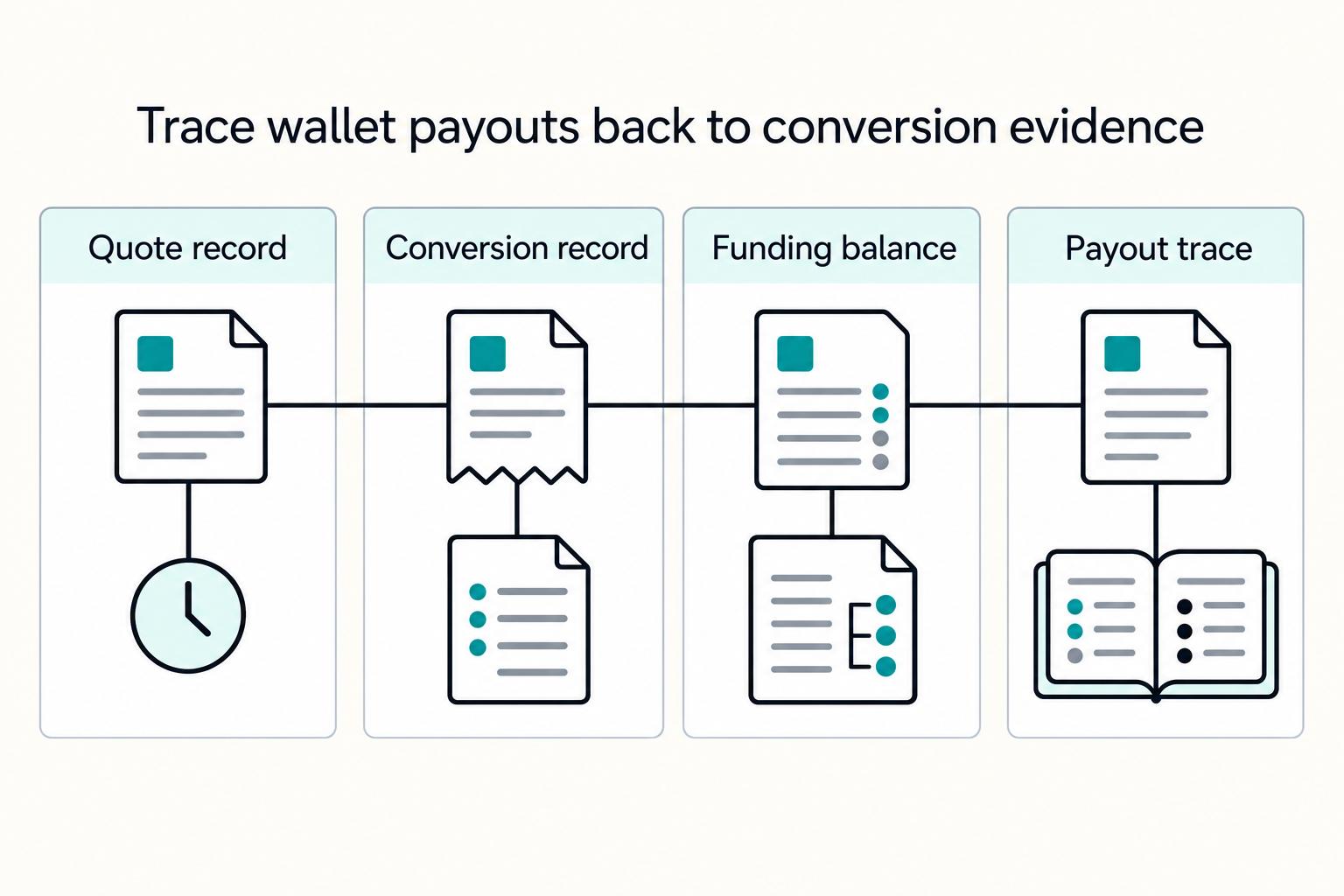
Your practical test is simple: can you trace a disbursement back to the conversion and funding balance that supported it? If not, the operating model is not yet reliable. Set a clear reconciliation cadence, including reconciliation by end of day for credited payments.
What traceability should exist before payout release?#
Do not scale until quote request, conversion, and disbursement are linked in one traceable chain with audit-trail artifacts ready for financial reporting. Keep core event data consistent across handoffs, and assign a clear accountable owner for payment-message integrity at each step in the routing flow.
Payout release should be policy-driven, not improvised. Require approval status, compliance status, and routing validity checks before release, and keep an explicit hold path for investigation or other special compliance action.
What should the monthly operator pack show?#
Your monthly pack should make control risk visible to ops, product, and finance. Include:
- conversion exceptions and unresolved reconciliation breaks
- quote rejections or expirations
- corridor variance between expected and realized conversion outcomes
- margin impact by product line
- end-to-end payment status, including items on hold
Use this pack to support management assessment of internal control effectiveness over financial reporting, not just daily operations. When one corridor repeatedly misses reconciliation or routing checks, fix traceability and control flow before adding more volume.
Related reading: How to Structure an LLC Operating Agreement for a Multi-Member Partnership.
Avoid common implementation mistakes and recover fast#
Most multi-wallet failures are recoverable when you treat them as control problems first: policy fit, payout timing, and documented exceptions.
| Mistake | Recovery | Details noted |
|---|---|---|
| One global conversion policy for every corridor | Segment first, then tune execution | Use corridor predictability and customer-facing delivery expectations; split highly predictable intercompany flows from customer payout flows |
| Optimizing spread while payout timing slips | Protect on-time credit first, then optimize rate timing | Cross-border targets include a one-hour benchmark for wholesale flows by end-2027, and missing the disclosed availability date is an error event in remittance contexts |
| No clear owner for failed conversions | Set explicit ownership with escalation timing, retry rules, and handoffs | This matters most when compliance reviews or FX settlement risk can delay one leg and stall payout availability |
| Weak evidence capture during execution and exceptions | Require consistent audit-trail fields for every conversion and exception decision | Keep quote ID, timestamps, currency pair, funding wallet, disclosed availability date, reason code, action taken, and case owner; record written findings and the communication outcome for necessary investigations or other special actions |
- Mistake: one global conversion policy for every corridor.
Recovery: segment first, then tune execution. The cross-border target model is already segmented, with 11 targets across wholesale, retail, and remittances, so use corridor predictability and customer-facing delivery expectations to decide policy before changing conversion timing. Split highly predictable intercompany flows from customer payout flows as an operating choice, not a one-rule default.
- Mistake: optimizing spread while payout timing slips.
Recovery: protect on-time credit first, then optimize rate timing where risk stays controlled. Cross-border targets include a one-hour benchmark for wholesale flows by end-2027, and in remittance contexts, missing the disclosed availability date is itself an error event.
- Mistake: no clear owner for failed conversions.
Recovery: set explicit ownership with escalation timing, retry rules, and handoffs across product, ops, and treasury. This matters most when compliance reviews or FX settlement risk can delay one leg and stall payout availability.
- Mistake: weak evidence capture during execution and exceptions.
Recovery: require consistent audit-trail fields for every conversion and exception decision, including quote ID, timestamps, currency pair, funding wallet, disclosed availability date, reason code, action taken, and case owner. If delays come from necessary investigations or other special actions, record written findings and the communication outcome instead of resolving them informally.
Conclusion#
The strongest version of a multi-wallet strategy is usually operational before it is financial. Start by reducing avoidable conversions and timing errors, then use hedging only for exposure you can forecast and defend.
- Map exposure before you optimize rates.
Trace where currency changes happen across collection, wallet hold, conversion, and payout release. That helps separate true FX risk from avoidable execution leakage. If a corridor has matched inflows and outflows inside the normal payout cycle, consider holding in that currency first. If payout currency is known and timing is firm, consider converting earlier to limit the exposure window.
- Set wallet policy by corridor, not globally.
One rule for every market usually creates the wrong tradeoff somewhere. A practical checkpoint is simple: for each corridor, confirm the funding currency, expected payout currency, time to payout, and whether operational constraints can interrupt release. If those facts are stable, you can justify a hold-and-convert-later rule. If they are noisy, simplify the policy and accept somewhat more conversion frequency in exchange for fewer payout misses.
- Add controls only when they reduce measurable FX risk without breaking execution.
Operational multi-currency liquidity management is a core control layer in volatile markets because it helps preserve funding access and cost discipline. But every added control has a cost. If a new approval hop, rebalance trigger, or quote check reduces variance on paper while increasing payout delay or exception handling, it may not be helping enough. For higher-risk or higher-volume flows, strengthen settlement handling with mechanisms such as netting or payment versus payment instead of stacking more manual review on top.
- Use hedging selectively and document the decision.
Hedging is useful when it protects committed cash flows and reduces earnings volatility, not when it is covering weak execution discipline. If forecast confidence is high and payouts are committed, treasury can consider hedging instruments as a second layer. If forecast confidence is low and payout windows are short, fix wallet timing and quote handling first. Either way, keep governance explicit: clear approver ownership, active senior oversight for material risk, and documentation that ties key FX decisions to execution outcomes.
A good closing checklist is not universal, but it is repeatable: map exposure points, define policy by corridor, set quote and rebalance rules, assign approval owners, and make reporting audit-ready. Then review outcomes on a regular operating cadence. The pack should at least show conversion exceptions, corridor variance, and whether the audit trail is complete with key details such as timestamps, currency pair, funding wallet, payout amount, approver, and exception reason. That is how you keep complexity earned rather than assumed.
For a step-by-step walkthrough, see How to Build a Global Accounts Payable Strategy for a Multi-Country Platform.
Frequently Asked Questions
What is a multi-wallet strategy for minimizing FX losses in a platform context?
It means holding and moving funds in more than one currency wallet so you do not force every inflow through an immediate conversion. In practice, you match funding currency, hold currency, and payout currency where possible instead of running cross-border flows from one base-currency account, which can increase FX leakage and payment costs. The value is operational as much as financial: fewer unnecessary conversions and clearer exposure tracking.
When should we hold funds in source currency versus converting immediately?
There is no universal threshold, but a practical approach is to hold when inflows and outflows are likely to match within your payout cycle and convert earlier when payout currency and timing are firm. A useful checkpoint is simple: for each corridor, verify expected payout timing, currency match, and whether compliance holds could delay release.
How do forward contracts, options contracts, and currency swaps fit with wallet-based execution?
They can be used as selective hedging tools, not as a substitute for wallet policy or quote controls. The exact mix depends on your exposure profile and treasury framework, so keep core execution discipline first: approvals, quote-validity checks, and payout-release controls.
What minimum controls are required for safe conversion operations?
You need explicit governance, named approval authority, and traceability from quote request to conversion to payout release. In practice, teams often keep records such as quote ID, timestamps, currency pair, funding wallet, payout amount, approver or case owner, and exception reason where relevant. This matters because FX settlement risk is real: one side of a currency trade can fail to deliver the owed currency, so senior accountability should be explicit.
Which triggers should govern wallet rebalancing in volatile markets?
Use triggers your team can monitor consistently, and define them in policy with clear review and escalation paths. Exact trigger design varies by business model, but governance should specify what is monitored, who approves non-routine rebalances, and how actions are logged.
How do quote expiry and stale-quote rejection affect realized FX outcomes?
They matter because provider quotes are time-bounded, and a quoted rate may not still be executable when you finally release the payout. Some providers support defined validity windows such as 5 minutes, 1 hour, or 24 hours through extended quotes, but that still requires your logic to validate the quote at execution time. Common failure mode: treasury prices the conversion, ops delays release, and the payout tries to use an expired or withdrawn quote.
Who should own policy decisions across product, treasury, and payments ops?
There is no single mandatory model, but there should be clear senior accountability to resolve tradeoffs between margin, payout speed, and risk. Many teams split responsibilities across product, treasury, and payments ops, with one policy owner empowered to make final decisions and approve exceptions. If exceptions cannot be approved promptly under defined authority, ownership is still unresolved.
Try a related tool
Researched and edited by the Gruv editorial team. Gruv builds cross-border billing, payouts, and finance-operations software for global businesses.
Sources
- bis.org/publ/qtrpdf/r_qt2212i.htmtrusted
- bis.org/cpmi/pietf/fx_risk_mitigation.pdftrusted
- consumerfinance.gov/rules-policy/regulations/1005/33trusted
- ecfr.gov/current/title-12/chapter-X/part-1005/subpart...trusted
- federalreserve.gov/supervisionreg/srletters/sr1324.htmtrusted
- federalreserve.gov/econres/notes/payment-stablecoins-and-cross-...trusted
- hbs.edu/ris/Publication%20Files/21-096_3317d99c-a5fb...trusted
- imf.org/-/media/files/publications/gfsr/2025/october...trusted
Educational content only. Not legal, tax, or financial advice.
Related Posts
When Platforms Should Move to Payment Orchestration and Multi-Gateway Routing
Payment orchestration can become a practical priority when payment performance and finance operations start limiting growth, not just checkout delivery. A single PSP can be the right setup for a long time. But once approval paths, provider constraints, or reconciliation workload start affecting outcomes, you need a clearer strategy than adding providers ad hoc.
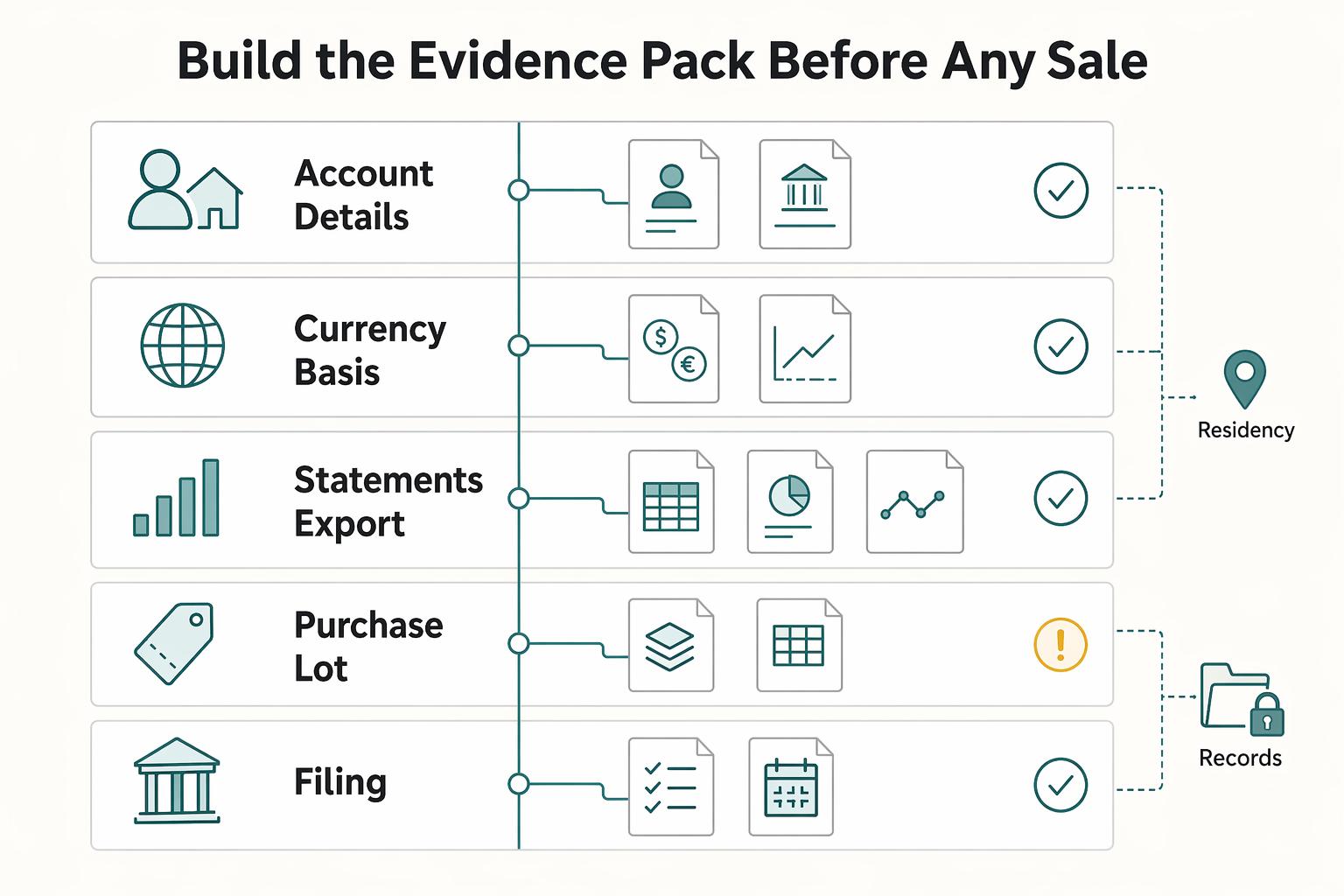
Tax-Loss Harvesting for U.S. Expats Living Abroad
Before you sell anything, settle one question: which country may tax the sale, and which records will support the filing. If residency is clear, move on. If you see dual-residency signals or treaty uncertainty, stop and sort that out before you trade.

Payout Retry Strategy for Failed Disbursements Across Multiple Rails
This guide is about handling failed payment attempts with clearer retry decisions. A declined payment is not a single problem type, and treating every failure the same creates avoidable risk.