
Quick Answer
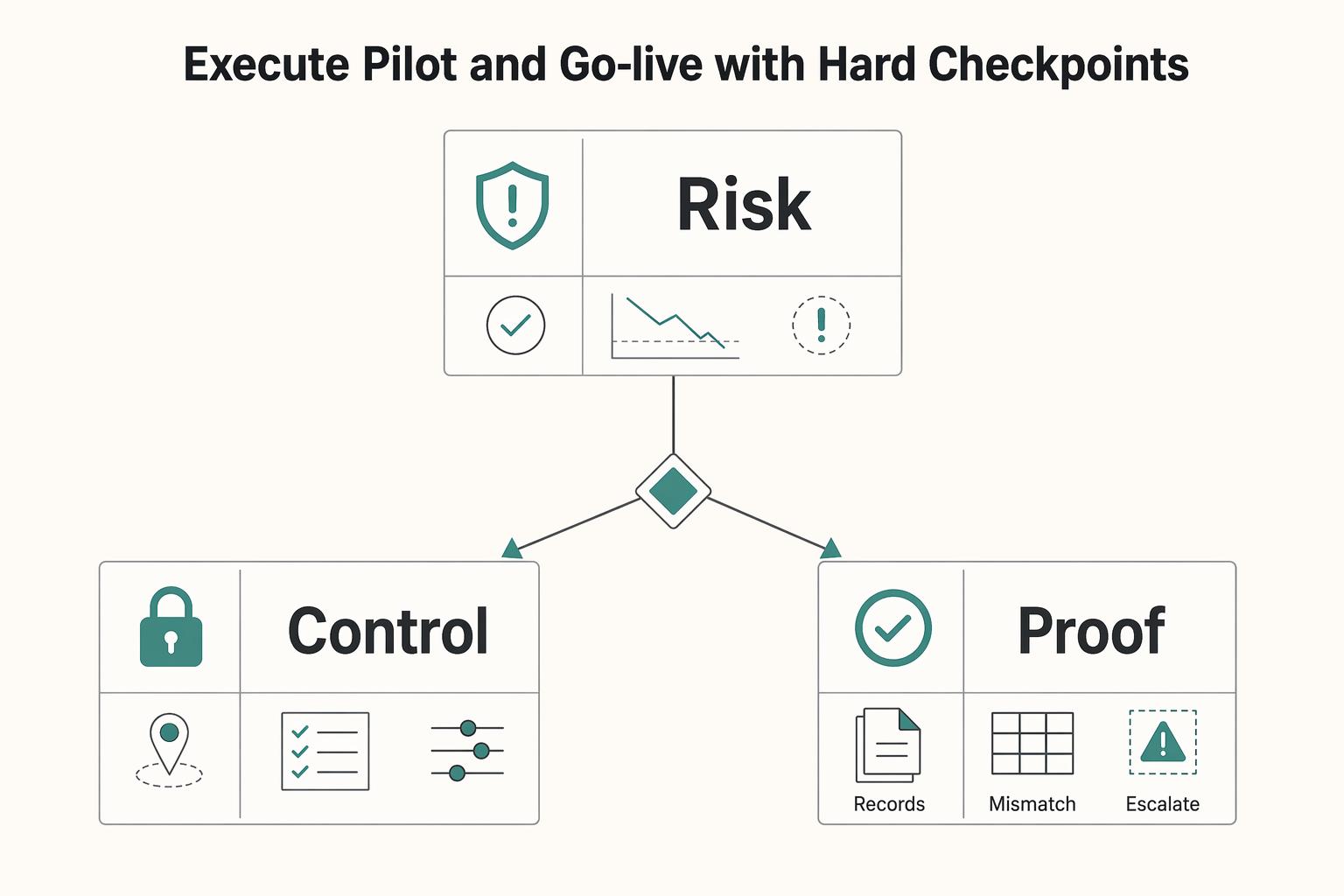
Start with a cohort-based pilot, not a full cutover, and require written go/no-go gates before each expansion step. Lock scope, assign accountable owners, and complete an evidence pack covering identity status, payout eligibility, policy-gate visibility, and reconciliation mapping before build. For each pilot payout, verify traceability from internal payout ID and ledger reference to provider reference and final status history. Expand only when adoption, exception handling, and time-to-reconciliation stay stable.
What to Confirm Before Moving Contractors Off Checks#
Moving from contractor checks to digital payouts is not just a payment rail swap. It is a staged change effort, and teams that treat it like a feature launch can lose control in three familiar places: compliance readiness, reconciliation, and contractor trust.
This guide gives you a practical path to move in stages, with named owners, explicit go or no-go decisions, and outcomes you can verify before you expand. The upside of digital payouts is real: better user experience, better operating efficiency, and less paper-related cost. But those gains do not show up just because a payout method exists. They show up when the operating model around it is ready.
Before you start#
Use this guide if you work in finance, ops, product, or engineering and need to ship under real constraints, not in theory. You may be dealing with spreadsheet-heavy contractor records, uneven verification states, or pressure to replace checks quickly. In that situation, the right first move is not tool configuration. It is agreeing on scope, stage exits, and who owns each decision when the data or controls are not clean enough to proceed.
Start with one simple checkpoint: can you name one accountable owner for each of these four areas, without debate?
- contractor data quality
- compliance and policy signoff
- payout operations and exception handling
- reconciliation and audit evidence
If that answer is fuzzy, pause there. Teams often think they are aligned because everyone supports the migration in principle. The real failure mode shows up later, when the first payout fails, a verification state is incomplete, or finance cannot trace a transaction back to the source ledger.
How this guide approaches rollout#
Treat this more like a modernization playbook than a one-time migration plan. In practice, that means building governance into delivery instead of bolting it on after launch, and tracking adoption progress and barriers openly instead of discovering them later in support queues. Each later section turns that into operator detail: what to define before build starts, what evidence to collect, how to choose a rollout model, and what must be true before you widen exposure.
The guide also assumes a bias toward measurable results over vague readiness language. Stage advancement should be tied to outcomes you can inspect: adoption by cohort, payout success, exception volume, and time to reconciliation. If those measures are off, the answer is not "launch anyway and stabilize later." It is to hold the line, fix the blocker, and protect the next cohort from the same problem.
Read the rest as an operator's guide for controlled adoption. The goal is not only to replace checks. It is to do it in a way your finance team can reconcile, your ops team can support, and your contractors will trust after the first real payout.
If you want a deeper dive, read How to Pitch Instant Payouts to Gig Contractors: Messaging and Adoption Strategies.
Set migration scope and success rules before you touch tooling#
Before vendor demos or configuration, freeze scope and success rules, because execution quality drives outcomes more than tooling choice. Across 51 enterprise cases over 5 months, Stanford's conclusion was direct: results came from organizational readiness and execution, not model choice. In payout migrations, vague scope later gets misread as a product problem.
| Stage | Exit condition |
|---|---|
| Stage 0 | Scope approved and owners named |
| Stage 1 | Pilot-ready evidence complete |
| Stage 2 | Pilot outcomes proven |
| Stage 3 | Broader go-live approved |
- Define the exact replacement boundary first.
Document which contractor checks move first and what stays on checks for now. Name in-scope contractor cohorts, payout geographies, and payment timing commitments, plus explicit exclusions. If your scope reads like "all contractors everywhere," narrow it.
Use a scope register that finance, ops, product, and engineering interpret the same way. Include cohort, geography, payout cadence, current check path, planned digital path, owner, and exclusions. Capture off-cycle payments, manual corrections, and cross-border edge cases early so they do not reappear as avoidable exceptions after go-live.
- Turn scope into staged exits with evidence.
Replace "are we ready?" debates with named stage exits and evidence requirements. TechFAR, aligned with the Digital Services Playbook, supports incremental, iterative releases because they improve manageability, lower project-failure risk, and shorten time to value.
A practical model:
- Stage 0: scope approved and owners named
- Stage 1: pilot-ready evidence complete
- Stage 2: pilot outcomes proven
- Stage 3: broader go-live approved
If teams define a stage differently, the stage is not usable yet.
- Lock outcome metrics before build starts.
Set the measures now and define calculation, source of truth, and owner for each one: adoption rate by cohort, payout success rate, exception volume, and time-to-reconciliation. This prevents launch-week arguments about whose numbers are correct.
Define audit-trail requirements up front. For each payout, make sure you can trace contractor identifier, payout identifier, status history, provider reference, ledger reference, exception code, and approval record. A simple test: can someone outside the build team trace one pilot payout end to end without manual screenshots?
- Set hard go/no-go criteria tied to controls.
Feature completion alone is not a launch gate. Tie go/no-go to KYC completion for the in-scope cohort, AML review states resolved per internal policy, and reconciliation completion with a clean audit trail. If any control is incomplete, hold the cohort even if the payout flow appears to work.
Do not relax these controls for schedule pressure. Expanding with uneven compliance states or weak ledger traceability is how trust breaks.
Prepare the prerequisite evidence pack and data cleanup backlog#
Do the data cleanup and evidence-pack work before configuration starts. If source integrity is unclear, rollout risk rises fast and support load follows.
Step 1: Stabilize the legacy record inventory first#
Start with a single inventory of every system feeding contractor payout records, then mark one source of truth and one accountable owner for each core field used in the first in-scope cohorts. The goal is not a perfect master record on day one. The goal is to remove ambiguity about which record is current and usable for launch decisions.
Use one readiness check before calling data "pilot-ready": sample records from each in-scope cohort and trace them back to origin without manual interpretation. If teams land on different versions of the same contractor record, pause and fix source integrity before rollout.
Step 2: Build a sign-off evidence pack finance and ops can use quickly#
Create one practical pack so finance and ops can confirm, in one place, what they need to approve pilot movement:
- identity status visibility for the in-scope cohort
- payout-method eligibility visibility for those records
- policy-gate visibility for hold/release decisions
- reconciliation mapping visibility to internal records
If policy gates depend on U.S. federal rules, anchor references in the Code of Federal Regulations text, which is the official codification of federal regulations and whose contents are judicially noticed. Avoid relying on paraphrases in tickets or chat.
If your team uses external framework guidance, keep it explicit: the DOL update notes it provides additional information and technical assistance, and that workforce stakeholders may adopt and promote the framework.
Step 3: Require artifact completeness before build, then pause hard on dirty inputs#
Before engineering builds around the new payout path, require a complete operating artifact set:
- approval matrix
- exception taxonomy
- audit-trail requirements
- rollback triggers
Treat missing artifacts as a launch blocker, not pilot "cleanup later." If inputs are still dirty after first-pass cleanup, hold rollout and fix data quality first.
We covered this in detail in Timesheet Management for Contractors to Track and Submit Hours.
Pick the rollout model with explicit tradeoffs#
Choose the rollout model only after you document your own tradeoffs; the current evidence does not establish that big-bang, cohort-based, or dual-run is inherently better.
Compare the three options side by side in one decision record:
| Rollout model | Define before launch | Go/no-go evidence to require |
|---|---|---|
| Big-bang replacement | Single cutover scope, rollback owner, rollback trigger | Signed scope, approval, and rollback conditions |
| Cohort-based migration | Cohort boundaries, expansion rules, pause rules | Per-cohort decision log and approval trail |
| Dual-run (checks + digital) | Routing rules between payout paths, ownership, reconciliation process | Clear routing decisions and period-close review record |
If compliance and payout-readiness states are uneven, keep dual-run active until your internal readiness criteria are met and documented. Do not leave those criteria implied.
Set stage gates per cohort and tie each gate to explicit go/no-go criteria: data readiness, policy pass state, payout outcomes, and support load. Record owner, evidence, and pause trigger for each gate before expansion.
Use Modern Change Management language if it helps governance, but keep execution payout-specific. A label is not a control: for example, ServiceNow lists a release-notes entry named "Change Management for Field Service release notes," but your control still has to be the payout decision record for this rollout.
Design contractor adoption motions that reduce friction#
Do not rely on one broad migration email. Use segmented onboarding, staged communication, and written support rules so the move to digital payouts stays operationally clear for contractors and internal teams.
Step 1: Segment by readiness and handling path. Set explicit segments such as high-volume pros, occasional earners, and first-time recipients, then assign each one a distinct timing, instruction set, and escalation path. Before you draft messages, define business objectives and performance targets for each segment so owners and expected actions are clear.
Step 2: Sequence communication by adoption stage. Use a short sequence that matches the contractor journey:
- Announce the change and why it is happening.
- Request required payout details.
- Confirm verification status or what is still missing.
- Confirm the first successful payout and where status is visible.
Step 3: Give support clear decision rules for edge cases. Document rules for failed verification, bank-detail mismatch, and unclaimed payout notifications before the first cohort moves. Run user acceptance testing and performance validation on support scripts, status labels, and handoffs using realistic scenarios.
Step 4: Use one concrete trust proof point. Avoid broad promises. If your flow supports it, state that digital payouts provide faster status visibility and a clearer audit trail than checks, and show contractors exactly where to find that status.
Implement the payout stack in Gruv with controls turned on#
Do not launch digital payouts until five controls are live and visible: retry safety, compliance gating, reconciliation traceability, batch/status monitoring, and PII access limits. If those controls are missing, check-era friction does not disappear; it shows up later as payout-day incidents.
| Control | Enable | Check |
|---|---|---|
| Retry safety | Use one stable payout instruction identifier for every retry, timeout, and handoff of the same payout request | Force a timeout in test, replay the same request, and confirm one logical payout record, one contractor-facing status trail, and one downstream amount to reconcile |
| Compliance gating | Enforce KYC-before-release and AML policy holds as explicit payout states visible to finance and ops | For any hold, answer what blocked it, who owns resolution, and whether contractor action is required |
| Reconciliation traceability | Keep traceability from ledger entry to payout instruction to provider reference to final status update | Finance can export and reconcile without manual matching |
| Batch/status monitoring | Use payout batches and operational status surfaces so finance can monitor throughput, pending/failed items, and retry recoveries in one place | Finance can answer what was submitted today, what is held, what failed, what succeeded after retry, and what still needs intervention without engineering log pulls |
| PII access limits | Keep masked views in ops workflows and limit full sensitive fields to users who truly need them | Support can confirm status, explain next action, and route exceptions without broad PII access |
Step 1: Make retries deterministic before first live payout. Use one stable payout instruction identifier for every retry, timeout, and handoff of the same payout request. In Gruv, this is how retries behave like safe replays instead of duplicate sends. Checkpoint: force a timeout in test, replay the same request, and confirm you still get one logical payout record, one contractor-facing status trail, and one downstream amount to reconcile. Failure mode: generating a new identifier on retry or queue redelivery, which creates duplicate-looking records and unclear money movement.
Step 2: Put compliance gates in the payout path. Where supported, enforce KYC-before-release and AML policy holds as explicit payout states visible to finance and ops. A payout should not move from ready to sent when the contractor is incomplete, under review, or policy-blocked. Checkpoint: for any hold, your team can quickly answer what blocked it, who owns resolution, and whether contractor action is required. Failure mode: manual release that bypasses holds without an audit note.
Step 3: Treat reconciliation as an engineering requirement. Do not stop at provider accepted. Keep traceability from ledger entry to payout instruction to provider reference to final status update so finance can export and reconcile without manual matching. Minimum artifact set per payout: internal payout ID, contractor ID, amount, currency, created timestamp, provider reference, status history, and any hold or exception reason. Failure mode: orphaned status events or missing provider references on the original record.
Step 4: Centralize operational monitoring for finance. Where supported, use payout batches and operational status surfaces so finance can monitor throughput, pending/failed items, and retry recoveries in one place. Checkpoint: finance can answer what was submitted today, what is held, what failed, what succeeded after retry, and what still needs intervention without engineering log pulls.
Step 5: Restrict sensitive data by role and screen context. Keep masked views in ops workflows and limit full sensitive fields to users who truly need them. Support should be able to confirm status, explain next action, and route exceptions without broad PII access. Failure mode: teams needing unrestricted identity or bank data for routine support work.
Related: How Home Services Platforms Pay Contractors: Insurance Verification Background Checks and Payouts.
Execute pilot and go-live with hard checkpoints#
Treat pilot and go-live as evidence-based stage exits, not calendar milestones.
Step 1: Define a pilot that is controlled but meaningful. Choose a cohort that can reveal real failure modes while keeping risk contained. Before day one, document who is in scope, who is out of scope, and who can pause expansion if issues rise. If the pilot is too narrow or overly hand-held, it will not give you reliable signal for broader rollout.
Step 2: Run one daily checkpoint using shared evidence. Have product, engineering, and finance review the same operational facts each day, including control-state outcomes, exceptions, reconciliation behavior, and support pressure. Keep the review focused on repeat issues, ownership, and next actions, not status theater. If teams still need ad hoc log translation to explain a held or failed payout, stay in pilot.
Step 3: Promote only when exit criteria are met. Set clear goals, objectives, and performance measures for the stage exit, then enforce them. If control gaps remain, do not expand because the launch date arrived. Outcome evidence should override delivery-calendar pressure.
Step 4: Record the go/no-go decision formally. Capture the criteria reviewed, results, known exceptions, approvers, and follow-up owners in a durable decision record. Keep links to the exact artifacts used for the decision so finance, ops, and engineering are aligned on one evidence trail.
Need the full breakdown? Read Contractor Spend Management: Total Cost and Payout Controls.
Handle common failure modes and recover without rollback panic#
When issues show up after go-live, do not roll everything back by default. Pause expansion, isolate what failed, and fix the operating gap before you add another cohort.
| Failure area | Recovery move | Resume condition |
|---|---|---|
| Failures spike | Freeze new cohorts first and keep the current cohort contained; route every exception through one shared taxonomy | Each failed or held payout has one reason, one owner, and one next action before expansion resumes |
| Surprise compliance blocks | Move KYC and AML checks earlier in onboarding and show incomplete states before contractors expect funds | Identity state, policy state, and payout eligibility are visible together so active does not get confused with ready to pay |
| Reconciliation breaks | Start with ledger source-of-truth artifacts and provider references, then repair downstream reporting views | Finance can trace a payout from ledger entry to provider reference to batch output without guesswork |
| Confusing status language | Replace vague updates with submitted, under review, approved, paid, or action required, and pair each error state with one clear next step | Tighten status wording before assuming the payout rail is the core problem |
Step 1 Freeze expansion and classify failures before changing settings#
If failures spike, freeze new cohorts first and keep the current cohort contained. Route every exception through one shared taxonomy so teams can consistently separate provider rejects, contractor-data issues, compliance holds, and internal handling errors. Use a simple operating check: each failed or held payout should have one reason, one owner, and one next action before expansion resumes.
Step 2 Pull KYC and AML checks earlier#
Surprise compliance blocks usually mean KYC or AML prerequisites stayed implicit until payout day. Move those checks earlier in onboarding and show incomplete states before contractors expect funds. Keep identity state, policy state, and payout eligibility visible together so "active" does not get confused with "ready to pay."
Step 3 Reconcile from source-of-truth records first#
When reconciliation breaks, start with ledger source-of-truth artifacts and provider references, then repair downstream reporting views. Do not treat dashboard cleanup as recovery if underlying mappings are still wrong. Recovery is real when finance can trace a payout from ledger entry to provider reference to batch output without guesswork.
Step 4 Simplify contractor status messaging and next actions#
Confusing status language slows adoption. Replace vague updates with milestone confirmations like submitted, under review, approved, paid, or action required, and pair each error state with one clear next step. If "where is my money?" tickets stay high, tighten status wording before assuming the payout rail is the core problem.
For a step-by-step walkthrough, see How Intermediary and Correspondent Banks Change Payout Outcomes.
Final launch checklist you can copy#
Use this checklist to expand only when your written plan removes ambiguity and keeps the contractor experience consistent across cohorts.
- Lock the decision record.
Keep one current document as the source of truth for scope, current stage, go/no-go criteria, open risks, and owners. A reviewer should be able to read it and understand what is launching, what is blocked, and who decides next steps.
- Standardize the evidence pack by cohort.
Define the required artifacts for each cohort and apply the same standard every time. If one cohort is well documented and another still depends on ad hoc notes, pause and normalize before expanding.
- Verify the operating flow against your implementation plan.
Confirm teams can follow the documented path for normal processing, retries, and exceptions without improvising. If ownership or handoffs are unclear, fix that before broader go-live.
- Prove pilot exit before broader rollout.
Expand only when pilot outcomes meet the exit criteria you set in advance. Also confirm recovery steps are documented and rehearsed so known failure paths are not handled for the first time in production.
- Stage contractor communication and support handling.
Prepare cohort-specific messages and support scripts before launch so guidance stays consistent. If support cannot clearly answer "what happens next?" for common edge cases, adoption risk is still high.
One final rule: tool docs and release notes are not a launch checklist. Your checklist should reflect your scope, your controls, and your evidence.
Related reading: How Positive Pay Controls Check Fraud in Digital Payment Platforms.
Want a quick next step? Try the free invoice generator.
Frequently Asked Questions
What is the fastest low-risk way to move from contractor checks to digital payouts?
Start with one cohort-based pilot, not a full cutover, and keep checks available temporarily if contractor compliance states are uneven. Your verification point is simple: for the pilot cohort, finance should be able to trace a payout from ledger entry to provider reference to final contractor status without manual guesswork. The red flag is a calendar-driven launch that expands scope before those traces hold up.
What should we complete before go-live if our contractor data is spread across Excel and multiple systems?
Finish the legacy data migration step before launch: Inventory, Cleanse, and Map Legacy Data. In practice, that means one normalized record per contractor, required payout fields filled, and an evidence pack that shows identity status, payout eligibility, policy gates, and reconciliation mappings together. If the same contractor has conflicting bank, tax, or status data across Excel and internal tools, pause and fix source integrity first.
Which team should own each part of the migration between product, finance/ops, and engineering?
Use a clear ownership model, but avoid assuming one fixed split fits every organization. Define accountable owners and approvers for the critical artifacts: migration scope, policy signoff, exception handling, reconciliation acceptance, data mapping, status events, retry behavior, and audit-trail outputs. The important control is not the org chart but explicit artifact ownership, or issues will bounce between teams after go-live.
How do we structure a maturity model that is strict enough for control but practical for rollout speed?
Use stage exits based on evidence, not feature completion. A workable maturity model is pilot-ready, go-live-ready, and scale-ready, with each stage requiring visible compliance state, clean exception handling, and reconciliation proof appropriate to that stage. That discipline matters because implementation results usually track to organizational readiness and execution more than tool choice, which matches the broader lesson highlighted in a Stanford review of 51 enterprise cases over 5 months.
Which post-launch outcome metrics prove real migration success rather than a superficial launch?
Track adoption by cohort, payout success, exception volume by reason, and time to reconciliation with a clean audit trail. Also watch support demand tied to payout visibility, especially repeated “where is my money?” tickets, because that often signals unclear status design rather than payment rail failure. The Sirion migration guidance uses the idea of Measuring Success: Progress Signals After Go-Live, and that is the right posture here: look for operating proof, not a launch announcement.
When should we pause rollout and fix issues before adding more contractor cohorts?
Pause when failures cannot be sorted into one reason, one owner, and one next action; when compliance holds are still surprising people on payout day; or when finance cannot reconcile a payout cleanly. You should also stop expansion if support volume is rising faster than learning, because new cohorts will only add noise. Fix the operating gap first, then resume rollout with the same stage-exit checks.
Try a related tool
Researched and edited by the Gruv editorial team. Gruv builds cross-border billing, payouts, and finance-operations software for global businesses.
Sources
- cio.gov/assets/resources/Cloud%20Operations%20Best%2...trusted
- congress.gov/bill/115th-congress/house-bill/2810/text/enrtrusted
- das.nebraska.gov/materiel/purchasing/122777%20O5/NE%20Interac...trusted
- dhs.wisconsin.gov/medicaid/bc-waiver-cms-demo-review-2025.pdftrusted
- digitaleconomy.stanford.edu/app/uploads/2026/03/EnterpriseAIPlaybook_Per...trusted
- dol.gov/node/182965trusted
- ebudget.ca.gov/2026-27/pdf/BudgetSummary/FullBudgetSummary.pdftrusted
- forms.augustaga.gov/WebLink/DocView.aspxtrusted
Educational content only. Not legal, tax, or financial advice.
Related Posts
How to Pitch Instant Payouts to Gig Contractors Without Overpromising
Instant payouts are not a headline feature first. They are a promise about what your payout operation can actually deliver, explain, and recover when something goes wrong. If that promise is vague, any growth upside can be short-lived, and cleanup can land in support, finance, and contractor trust.
How Home Services Platforms Verify, Dispatch, and Pay Contractors
We recommend treating contractor onboarding, dispatch gating, and payout release as one operating chain. In home services, the sequence is simple: verify the contractor, control who can be assigned work, then release payout when the verified file says the contractor is clear.
A Deep Dive into Argentina's 'Blue Dollar' for Digital Nomads
If you earn in USD, or another hard currency, and spend in Argentina, the real decision is not just where to get the best rate. It is how to balance exchange value, cashflow control, documentation quality, and payment reliability. This is an operational risk problem, not a tourist tip.