
Quick Answer
Choose the smallest Positive Pay model that still covers your real payment rails and oversight needs. Begin with issued-check matching and disciplined exception decisions, then add ACH controls when ACH volume is meaningful. Set explicit ownership for cutoff actions, keep approver-attributed records, and pilot before scaling. If your team cannot export issued-file history, decision timestamps, and final exception outcomes on demand, the control is not ready to expand.
How Positive Pay Helps Control Check Fraud#
This list is for compliance, legal, finance, and risk owners who need to use Positive Pay without turning it into a bigger build than the risk justifies. The goal is practical: reduce check and electronic transaction fraud while keeping decisions and approvals auditable across products and bank relationships.
The risk is current, not theoretical. Federal Reserve Financial Services highlighted that 63% of respondents experienced attempted or actual check fraud in 2024. An FBI alert dated January 27, 2025 says check-fraud-related suspicious activity reports nearly doubled from 2021 to 2023. If checks still appear anywhere in your payout flow, control design matters.
Start with scope. Some providers use Check Positive Pay narrowly to mean matching presented checks to an issuance file, such as check number and amount. Others use Positive Pay more broadly across checks, ACH debits, and approved wire drawdowns. Confirm that scope first, then map owners, exception handling, and reporting around it.
For platforms, the control only works if decision records are actually usable. Exception items must be reviewed and approved or rejected before processing, and those actions should be retained for oversight. Positive Pay can support a clean audit trail when issuance-file history and exception decisions are preserved with clear approver records.
Keep the boundary clear. Positive Pay is one treasury control. It can help detect unauthorized checks and, in some programs, support ACH review, but it is not a complete fraud stack on its own. Bank materials also document separate ACH controls, including ACH Positive Pay reporting and ACH blocks/filters.
Governance is part of the design, not a later add-on. Nacha guidance says ACH planning may need legal, compliance, fraud, cybersecurity, and other stakeholders, and requires risk-based processes and procedures for organizations sending ACH payments. The implementation dates are March 20, 2026 for corporate end users sending 6 million or more ACH transactions annually and June 20, 2026 for all corporate end users sending ACH transactions.
By the end of this list, you should be ready to lock three rollout decisions. If those three are settled, you avoid a common failure mode: overbuilding the feature while underbuilding the control.
- Choose an operating model: bank portal only, mixed-rail controls, or a more integrated setup based on your check and ACH exposure.
- Assign named owners: clear accountability across finance, compliance, legal, fraud, and operations.
- Define the evidence pack: issuance-file history, exception decisions, approver records, and related review outcomes needed for oversight.
Who this list is for and how to choose quickly#
This list fits teams managing mixed-rail payments where check and ACH controls need to coexist. It is not a glossary. It assumes you need decision rules, an exception queue, named approvers, and records you can review later.
1. Best fit for mixed-rail payout teams#
Use this list when one team is making fraud decisions across both rails under deadline pressure. Check-focused Positive Pay matches presented checks to issued-check data, and some bank programs also apply Positive Pay controls to ACH. In ACH Positive Pay workflows, exception review is typically a daily task.
2. Not for definition-only research#
If your question is still "what is Positive Pay," start with a primer. This section is for teams choosing operating controls, not learning terms.
A quick checkpoint helps here. Can you show where exceptions are reviewed, who can approve them, and which report preserves that action? Some implementations include audit-trail reporting, but confirm exportability before you depend on it for oversight.
3. Choose with three fast filters#
Use three filters to narrow the right setup quickly. Start with rail mix, then architecture, then governance burden by market or program.
| Filter | Article detail | Example or note |
|---|---|---|
| Rail mix (check vs ACH) | If ACH is material, check-only coverage may be incomplete. | Nacha deadlines are March 20, 2026 (6 million+ ACH payments annually) and June 20, 2026 (all corporate end users sending ACH payments annually). |
| System architecture (portal vs API) | Some banks support API and webhook exception flows. | Portal-led setups usually rely on explicit user-role administration. |
| Compliance burden by market/program | ACH fraud-rule planning is cross-functional. | It can require legal, compliance, fraud, cybersecurity, finance, and accounting input. |
Use those filters in that order: rail mix, architecture, then governance burden.
4. Pilot only if governance is still fuzzy#
If you cannot document approvers, cutoff ownership, and return decisions, keep the initial scope to a narrow pilot. The reason is simple: cutoff behavior is not universal. Examples include a 4 p.m. local account-time check decision cutoff, a 12 noon CST cutoff in another program, and ACH exceptions that may require decisions by 10 p.m. CT on the next business day for same-day effective items.
You need records that show who owned each deadline and what pay/return default applied. Related: Velocity Checking for Fraud Prevention: How to Detect Suspicious Payment Patterns.
Compare the main Positive Pay setups for digital platforms#
The right setup depends on where decisions happen, how quickly exceptions reach an approver before cutoff, and whether you can export defensible evidence later. If exception volume is high and approvals span multiple entities, integrated orchestration may be more workable than relying only on portal queues. If one treasury bank relationship is central, bank-native Positive Pay is often the practical start.
| Setup type | Best for | Key pros | Key cons | Required systems | Evidence produced |
|---|---|---|---|---|---|
| Bank-native Positive Pay | Check-heavy teams with one primary treasury bank and modest entity complexity | Bank-channel screening and control, direct pay/return decisions | Portal work can stay manual, cutoff ownership is critical | Bank treasury portal, issued-check file feed or reverse-positive-pay workflow, named user roles | Issued-file history, exception decisions, pay/return timestamps, bank activity reports |
| Positive Pay + ACH controls | Mixed-rail programs where ACH is material | Adds rule-based ACH control alongside check controls, more consistent policy coverage | More tuning and daily review, broader rules can create noisy queues | Check controls plus ACH rule configuration and exception-review access | ACH exception reports, rule-hit logs, decision history, return outcomes |
| Platform-integrated orchestration | High exception volume, strict multi-entity governance, teams needing one operating queue | API/webhook visibility, clearer ownership, easier reconciliation, better multi-entity scaling | Higher build effort, dependency on status mapping/retry logic, bank cutoffs still apply | Payout or digital-banking integration, API/webhook ingestion, ledger and case mapping | Status histories, webhook logs, approver actions, entity-level audit trail, consolidated exports |
| Legacy check-printing stack controls | Teams still printing checks locally or running accounting-led issuance | Practical bridge, stronger print/stock controls, Positive Pay file conversion to bank formats | Evidence is fragmented across tools, check-centric model, harder central oversight | Check-printing software, accounting package, secure stock/MICR supplies, file-conversion tooling | Print logs, transmission records, stock-control records, bank acceptance confirmations |
1. Bank-native Positive Pay#
Choose this when your immediate problem is presented-item control and your treasury bank already anchors operations. Independent Bank is a concrete example and explicitly offers both ACH Positive Pay and Check Positive Pay in one bank channel.
The tradeoff is governance depth across entities. Reverse Positive Pay can be simpler and lower cost, as Bottomline positions it, but it still depends on return requests submitted before bank cutoff windows.
2. Positive Pay + ACH controls#
If ACH is meaningful, check-only coverage leaves a gap. Advanced Fraud Solutions is a concrete example for rule-based ACH controls and exception analytics, including trend views by type, decision, dollar value, or SEC code.
This setup often surfaces staffing pressure first. Keep it only if you can export, on demand, the triggered rule, reviewer, timestamp, and final outcome for sampled exceptions.
3. Platform-integrated orchestration#
Choose this when the real problem is cross-entity decision traceability, not just check matching. Tipalti is a positioning example for API and webhook orchestration and detailed payment-status visibility, not a bank-native check presentment-matching provider. Its stated December 22, 2025 Hub visibility milestone for new detailed statuses is relevant here.
Lumin Digital plus AFS, announced April 9, 2025, is another concrete signal that Positive Pay delivery is moving into integration layers beyond portal-only operations. Do not treat this setup as complete until one export can tie exception states, approver actions, and outcomes to payment and entity identifiers.
An older treasury quote still makes the operating point on speed. In 2007 lockbox coverage, Nationwide assistant treasurer Tim Dwyer said web exception tooling had "dramatically cut the amount of time and effort we spend handling exceptions." The item is older, externally provided content on Finextra, and not Positive Pay-specific, but it still points in the right direction for exception-queue operations.
4. Legacy check-printing stack controls#
This is the bridge option for teams still running local check-print workflows. AP Technology is a concrete example. SecurePay Advantage states it converts and transmits Positive Pay files to bank requirements and cites typical install time under 15 minutes. TruPrint stock cites 15+ built-in security features.
The main risk is fragmented evidence across accounting, print, stock, and bank systems. If you stay on this model, assign one evidence owner and test whether that person can assemble a full exception sample without cross-team chasing.
If you want a deeper dive, read What Is Positive Pay? How Platforms Protect Against Check Fraud and Unauthorized ACH Debits.
Bank native Positive Pay from your treasury bank#
If one treasury bank already anchors your operations and your immediate risk is check fraud, this is a practical first control to deploy. You send issued-check data to the bank, the bank matches presented checks, for example serial number and amount, and your reviewers make pay/return decisions on exceptions in the bank channel.
1. Why this is a strong starting point#
This is a strong starting point because the operating model is direct: submit issued-check details, then review non-matches as exception items. The first phase stays focused on presented-item control without forcing immediate integration changes across multiple systems.
For lower-complexity teams, that narrower scope is often the advantage. You stabilize one high-risk rail inside a treasury workflow your staff already knows.
2. What you operate each day#
Each day, you work in the treasury portal: review exceptions and submit pay/return decisions. Two controls matter most early: file integrity and clear ownership of cutoff-time decisions.
Confirm the issued-check file includes the fields the bank matches, especially check serial number and amount. Cutoff timing is operationally critical. Example windows differ by bank, including 4 p.m. local account time (Chase) and 2:00 PM CT on the business day after presentment (Regions).
3. Tradeoff to manage early#
The benefit is focused control over check presentment decisions. The tradeoff is that you still need defensible records for who reviewed each exception and whether it was paid or returned. Treat evidence assembly as part of daily operations, not as an audit-only task.
For sampled exceptions, be ready to produce:
- issued-check file history
- exception decision record
- reviewer identity
- decision timestamp
4. Expansion path after check control is stable#
Once check control is stable, a common next step is adding ACH controls. Banks position these as companion controls, including ACH exception review and status tracking, with their own decision windows, for example First Merchants: Monday through Friday, 8:00 AM to 3:00 PM ET.
Before go-live, document the default behavior for undecided items. Defaults vary by product design. One reverse Positive Pay example states undecided items are paid when the decision period ends, and some banks let you set automatic pay or return defaults.
Positive Pay plus ACH controls for mixed rail risk#
If your platform handles both checks and ACH, check-only Positive Pay is incomplete. Use check controls for issued-item matching, then add ACH-specific monitoring and exception decisioning so unauthorized ACH activity is covered too.
1. Why this is the right next step#
This closes a rail gap; it is not about adding features for optics. Mixed-rail operations are still common: Federal Reserve Financial Services reported 63% of respondents experienced attempted or actual check fraud in 2024, while 91% still used checks and more than 75% had no immediate plans to stop.
ICBA guidance also frames Positive Pay as a control that can help prevent check or ACH fraud, and highlights added ACH control as especially important for unauthorized ACH debits. If funds can leave by check and ACH, your control design should cover both.
2. What changes when ACH is added#
Adding ACH usually means managing a second exception stream. Check workflows stay tied to issued-check matching, while ACH adds its own monitoring rules and pay/return exception decisions.
| Operational point | Article detail | Example or note |
|---|---|---|
| Decision window | Adding ACH typically means managing a second exception stream. | First Merchants is cited with Monday through Friday, 8:00 AM to 3:00 PM ET, and items not acted on are processed by your default, pay or return. |
| Rail coverage | Some providers position Positive Pay across checks, ACH, and wires. | Others are check-first in practice. |
| Exception ownership | Define who reviews ACH exceptions and who makes pay/return decisions. | Also define who covers absences. |
| Default behavior | Document what happens to unworked ACH items. | Also document who approved that default. |
The operational shift is deadline management. In one bank example, First Merchants, ACH Positive Pay decisions run Monday through Friday, 8:00 AM to 3:00 PM ET, and items not acted on are processed by your default, pay or return. Do not assume that window is universal, but do assume time-boxed decisions and default outcomes.
Before rollout, confirm three points in writing:
- Rail coverage: some providers position Positive Pay across checks, ACH, and wires, while others are check-first in practice.
- Exception ownership: define who reviews ACH exceptions, who makes pay/return decisions, and who covers absences.
- Default behavior: document what happens to unworked ACH items and who approved that default.
3. Tradeoff to plan for#
The upside is more consistent control across rails. The cost is more operational load in exception handling and cutoff tracking. Avoid split ownership where check exceptions and ACH exceptions sit in different systems without clear accountability. That setup can increase the risk of missed deadlines and default-driven outcomes.
Expand your records at the same time. Keep check-side issued-item history, and add ACH exception records, reviewer identity, decision timestamps, default-decision settings, and final outcomes. With Nacha fraud-monitoring amendments effective in March 2026 and June 2026, tightening this operational evidence now is practical, even though this setup alone is not a full compliance program.
If ACH is a meaningful rail in your operation, Positive Pay-only coverage is incomplete. Add ACH controls before exception volume puts more pressure on your decision process.
For a step-by-step walkthrough, see Device Fingerprinting Fraud Detection Platforms for Payment Risk Teams.
Platform integrated controls with API and webhook tracking#
For multi-market platforms, an API- and webhook-integrated model can work well because it can keep one trace from request to provider state to ledger posting to reconciliation output.
Best for: platforms that need shared, defensible answers across compliance, finance, and ops. Pros: can provide clearer ownership, stronger audit evidence, and cleaner reconciliation. Cons: more implementation work, especially around idempotent retries, cutoff handling, and exception routing.
Why this setup earns its keep#
This setup earns its keep when portal-first handling stops being enough. A portal can work at lower volume with one treasury team. Integration matters when multiple teams need the same answer to three questions: what happened, what was decided, and where it posted.
That matters most when check controls, ACH exceptions, and payout accounting have to be handled together. Positive Pay requires explicit pay/return decisions, and some reporting surfaces provide up-to-date exception tracking with audit-trail support. Pulling those states into your own queue can reduce mismatches between provider portals and your ledger.
What must be wired correctly#
You need the core records to line up from start to finish so reviewers can reconstruct the item without portal hopping:
- original request record with a stable internal identifier
- provider response (accepted, rejected, pending)
- webhook-driven lifecycle updates
- ledger posting record
- final exception or return outcome
A single webhook endpoint can handle multiple event types, but routing has to keep event type and required action obvious. Otherwise, ACH returns, check exceptions, and payout events collapse into one noisy inbox.
Idempotency also matters. Repeated keys should return the same result so retries do not duplicate operations. Watch the timing tradeoff closely. If keys are pruned after 24 hours but webhook redelivery can continue for up to 25 retries over 3 days on non-2xx responses, your duplicate-protection window may be shorter than your event-retry window.
Where teams get tripped up#
A common problem is that some Positive Pay implementations do not clearly separate check and ACH decisioning when both are enabled. If that is true in your provider setup, your internal queue has to add that classification layer.
| Timing item | Timing or state | Article detail |
|---|---|---|
| Idempotency key pruning | 24 hours | Repeated keys should return the same result so retries do not duplicate operations. |
| Webhook redelivery | Up to 25 retries over 3 days on non-2xx responses | Your duplicate-protection window may be shorter than your event-retry window. |
| Published cutoff example | 12 noon CST Monday-Friday | Published examples vary by bank. |
| Published cutoff example | 11:00 am CT | Published examples vary by bank. |
| Post-cutoff state | Read-only after cutoff | If your queue still shows a practical choice after cutoff, reviewers are looking at a false option. |
Cutoffs must also be explicit in both code and ownership. Published examples vary, for example 12 noon CST Monday-Friday at one bank and 11:00 am CT at another, and items may become read-only after cutoff. If your queue still shows a practical choice after cutoff, reviewers are looking at a false option.
Audit evidence is another regular gap. Even when provider reports can be exported as PDF, Excel, or CSV, you still need platform-level exportability of linked records. That includes the issued-check reference where relevant, exception state history, reviewer identity if captured, timestamps, pay/return decision, and final outcome.
The use case that justifies the effort#
The effort is justified when you need one operations queue that combines Positive Pay exception items and ACH exception states, tied to payout and ledger events. Checks still rely on issued-item matching. ACH still follows ACH-specific return and exception logic. Reviewers can handle both in one operational view.
That also supports unauthorized ACH monitoring. Nacha sets the unauthorized ACH debit return-rate threshold at 0.5%, so return outcomes and reason patterns should be visible next to payment and reconciliation records, not isolated in portal exports.
Go-live checkpoint#
Do not move to production until exception states, approver actions, and return outcomes are exportable for audit review. This is an operational control gate, not a legal mandate.
Before launch, test end to end:
- a clean item that posts normally
- an exception item decisioned before cutoff
- a late or failed webhook path with retries
If you cannot export evidence for all three without manual reconstruction, the integration is not ready.
Check printing stack controls for legacy check flows#
If you still depend on printed checks, use the check-printing stack as a controlled bridge while you mature a centralized Positive Pay process. It is practical for legacy operations, but by itself it may not provide full treasury visibility.
Positive Pay can coexist with legacy technology, so a transitional model can still be defensible. In that model, issued-check data is sent for bank matching, exceptions are reviewed as pay or return decisions, and print-layer controls support issuance control. Keep the scope clear: Positive Pay matches check details, such as check number and amount and, in some offerings, payee name, but it does not verify account balances.
What belongs in the bridge#
A workable bridge usually includes separate tools for issuance, signature handling, and physical stock control:
- SecureCheck: fits teams that need check-issuance software with integrated Positive Pay and approval workflow support, and compatibility with existing accounting systems.
- ezSigner Direct: fits teams where signature handling is still tied to print operations, since it applies authorized signatures, logos, and graphics during printing in one pass.
- TruPrint Check Stock and TruPrint MICR Toner: physical-control components rather than decisioning tools. TruPrint check stock is marketed with 15+ built-in security features and paired MICR toner.
Where evidence can break#
Evidence can fragment across systems in mixed setups, even when each tool works as designed. In mixed setups, for example bank portal + print tooling + Checkrun + QuickBooks Online, define record ownership up front: which system is authoritative for issued-check creation, approval, pay/return decision, and final accounting trace.
Before scaling, test one item end to end and confirm you can produce issued-check data, print authorization, Positive Pay exception outcome, and accounting trace without manual reconstruction. QuickBooks Online audit logs can support this review because they track broad activity and keep events for 2 years. But with 150 records shown at a time, ad hoc screen review alone can be limited as an audit method. If ownership is still unclear, stabilize the legacy flow first, then migrate decisioning and evidence capture into one centralized process.
Related reading: How Platforms Detect Free-Trial Abuse and Card Testing in Subscription Fraud.
Exception queue rules your team can enforce every day#
Treat the exception queue as a daily decision process, not a passive inbox. Lock the sequence, assign decision ownership, and track drift so pay/return outcomes stay consistent and auditable.
- Set intake order before case review
Start with source-data integrity, then move to decisioning: confirm issued-check file intake, classify the mismatch, route by risk tier, then submit pay/return. Positive Pay matching depends on issued-check data, and matching may use serial number, amount, and, if enabled, payee name. If intake is late, incomplete, or conflicted, downstream decisions become less reliable.
- Route by risk and timing, not analyst availability
Separate routine mismatches from higher-risk exceptions first, then prioritize by decision window. Positive Pay workflows support explicit exception decisions and can expose both prior-day and same-day exception feeds, so timing can be managed deliberately. Where supported, use dual control for higher-risk items. Some setups keep actions in Entered status until final approval.
- Define ownership by decision type
Use a clear operating split for the queue, for example: one owner confirms transaction intent, one owner reviews policy concerns, and one owner handles escalations. Treat this as an operating model, not a universal legal requirement. Document escalation procedures, reviewer identity, facts considered, dual-control use, if any, and final pay/return action so exception history is defensible.
- Escalate repeated exceptions and monitor drift daily
When the same counterparty repeatedly triggers exceptions, move from routine handling to enhanced review. Track queue aging, decision turnaround, repeat return reasons, and unresolved investigations. For ACH, monitor R return reason codes and return-rate trends over the preceding 60 days or two calendar months, including the 0.5% unauthorized threshold and the 3.0% administrative and 15.0% overall return-rate levels used for inquiry/evaluation.
Audit evidence and reporting checklist for compliance reviews#
A practical audit-readiness standard is being able to produce complete evidence for a sampled period without rebuilding history by hand. If you cannot, treat it as a control gap and fix the evidence path before you scale.
For Positive Pay and ACH reviews, keep one evidence register with artifact, owner, source system, retention location, and review cadence set by your program. Control quality depends on reliable reporting and compliance outcomes, not just on whether an exception was cleared.
| Artifact | Owner | Source system | Retention location | Review cadence |
|---|---|---|---|---|
| Issued check file history (manual entries and file uploads) | Treasury or finance operations | Bank portal upload history and Issued Check File Processing Log | Controlled evidence archive | Per policy; include periodic sampling |
| Exception decisions (pay/return and return reason) | Treasury operations | Positive Pay exception queue and exception audit trail report | Case archive with exports | Per policy; include timely exception review |
Approver logs and dual-approval status changes (for example, Pending Approval) | Treasury manager or delegated approver | Issued Check File Processing Log and approval history | Approval evidence folder | Per approval workflow and control sampling |
| ACH exception outcomes and decisioning user | Payments operations | ACH exception report with paid/returned outcomes and decisioning user(s) | ACH evidence archive | Per policy; include periodic sampling |
| Decision timestamps and cutoff evidence | Treasury operations | Portal decision export, case timestamps, alert history (if used) | Period evidence pack | By cutoff window for deadline-sensitive items |
| Return outcomes and follow-up status, including Request for Return tracking where relevant | Payments operations | ACH returns reporting and bank correspondence logs | Returns archive | Ongoing until closed |
| Reconciliation outputs tying bank outcomes to ledger or cash posting | Accounting | Reconciliation tool, ledger exports, close workpapers | Finance close folder | Per close cycle |
| Current Positive Pay and ACH rule versions, plus change approvals and sign-offs for your chosen governance model | Compliance, with finance/legal as designated | Policy repository, ticketing records, e-sign records | Governance repository | At each change; periodic validation |
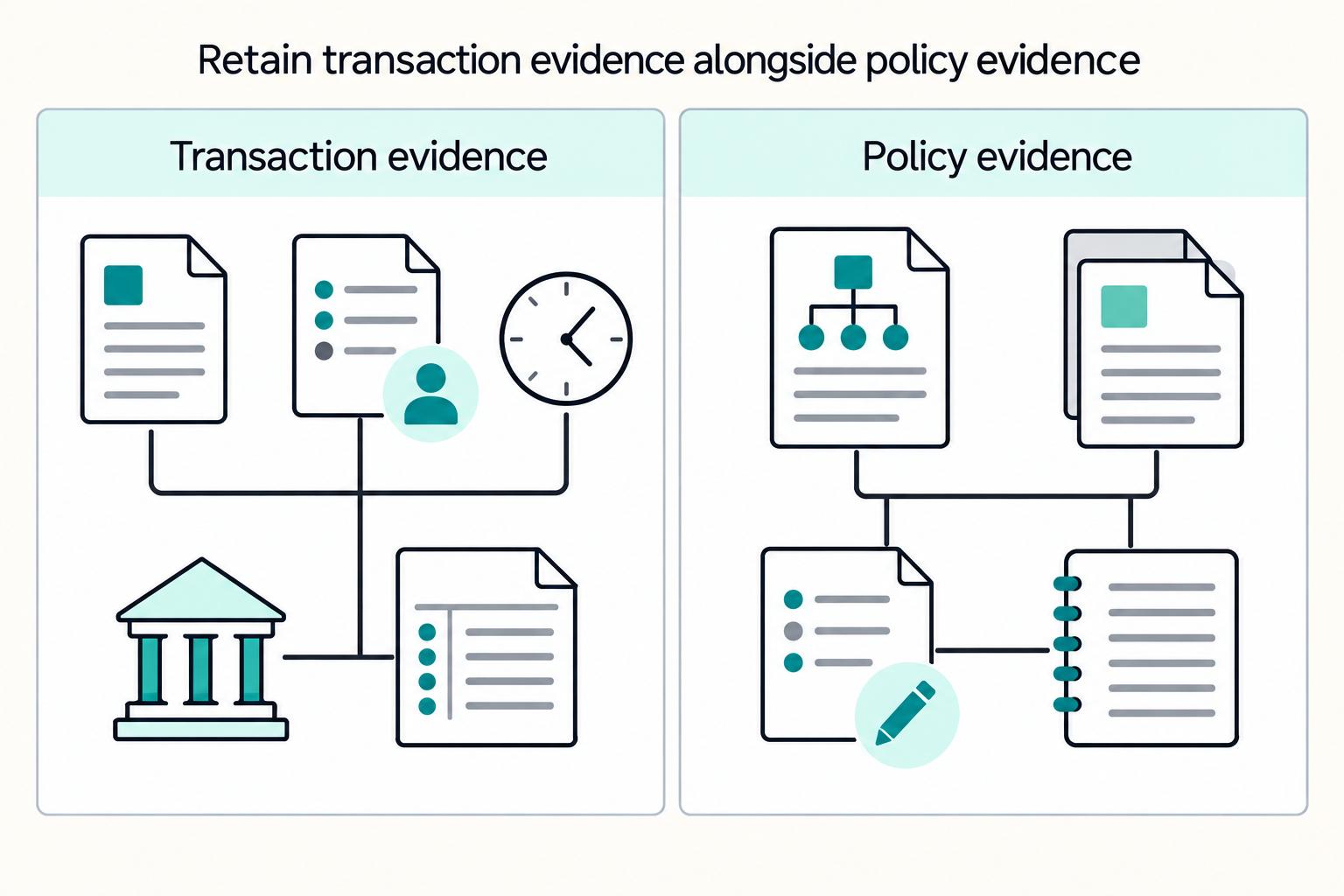
Keep two evidence groups complete:
- Transaction evidence: issued-check history, exception decisions, approver actions, timestamps, return outcomes, and reconciliation outputs.
- Policy evidence: current Check Positive Pay matching setup, ACH authorization rule criteria, version history, and change approvals/sign-offs in your operating model.
Use system reports instead of after-the-fact screenshots whenever possible. The Issued Check File Processing Log can show submission and approval status, exception audit trail reporting can show decisions over time, and ACH exception reports can show both outcome and decisioning user.
Preserve timestamp evidence carefully. One institution example requires Positive Pay exception decisions by 3:00 p.m. EST (2:00 p.m. CST), and some programs apply a pre-set default if no decision is submitted by cutoff. For ACH return handling, Nacha's Request for Return status requirement became effective April 1, 2025 and requires status advice within ten (10) banking days. For ACH authorization records, keep the two years retention expectation from termination or revocation of authorization.
We covered this in detail in How to Build a Deterministic Ledger for a Payment Platform.
If your team needs one place to run payout decisions with clear status tracking and audit-ready records, review Gruv Payouts.
Common failure modes that create regulatory surprises#
Regulatory surprises usually come from weak control boundaries and inconsistent operating discipline, not from the Positive Pay match itself. If your program stops at check comparison, runs across split tools with no clear evidence owner, or lets exception backlogs outrun review capacity, gaps tend to show up in audit or incident review.
Treating Positive Pay as the whole fraud program#
This is the first mistake to avoid. Positive Pay is one control layer, not a complete fraud strategy. It compares presented items to issued-item data and helps detect check fraud, but fraud risk also spans ACH, wire, and instant payments.
If ACH volume is material, check controls alone are not enough. OCC guidance states that failing to implement appropriate ACH controls is unsafe and unsound. Your documented procedures should clearly define who can initiate, approve, and execute ACH payments, and your records should support that decision trail on demand.
Running disconnected tools with no single evidence owner#
Disconnected tools are manageable when one owner is accountable for the full audit trail. Without that ownership, decisions, postings, and approvals fragment across systems, and it becomes difficult to reconstruct who decided what, when, or from which record.
A practical warning sign is manual evidence assembly during review. If teams must rebuild history manually instead of relying on retained system records, exception decisions, and user activity, the control is fragile. Assign one evidence owner and require one retained record set that ties intent, decision, timestamp, and reconciliation outcome.
Letting the exception queue outrun operating capacity#
Exception backlog is a control risk, not just an operations issue. As queues age, pay/return decisions can become less consistent, cutoff risk can increase, and escalations can stall.
This is especially sensitive for ACH exceptions, where some return windows can be less than two banking days. Track queue aging daily and intervene early by narrowing scope, adding reviewers, or tightening routing so decisions remain timely, user-attributed, and audit-traceable.
Conclusion#
Choose the smallest Positive Pay setup that still covers your real rail mix and audit-trail obligations. Check matching still matters, but it is not enough once ACH becomes a meaningful part of your flow.
- Right-size controls to the rails you actually use. Positive Pay is strongest when it matches presented checks to your issued-check file and requires pay-or-return decisions on exceptions. That still matters in practice: a 2025 survey reported that 63% of respondents experienced attempted or actual check fraud in 2024. If ACH is material, add ACH-specific fraud controls instead of expecting check controls to do both jobs.
For ACH, focus on documented, risk-based fraud-detection procedures for that path. Nacha's requirement is principles-based, so implementation can vary, but it still requires defined processes. For in-scope corporate end users, cited dates are March 20, 2026 (6M+ ACH annually) and June 20, 2026 (any ACH volume). Verify your role and applicability rather than assuming those dates apply the same way to every platform.
- Treat execution quality as the real control test. Strong programs depend on clear ownership, disciplined exception handling, and segregation of duties where feasible, not feature count. Teams should be able to make authorized pay-or-return decisions before the bank cutoff and leave a clear, chronological record.
A cited example cutoff is 3:30 pm ET, but cutoff times are institution-specific. The key point is operational discipline: decisions, approvers, and escalation paths should be reliable under normal conditions, not improvised when pressure rises.
- Scale only after the evidence trail works from start to finish. Run a scoped pilot first, then test retrieval as if an auditor asked for a sample immediately. You should be able to produce issued-item history, exception decisions, approver logs, timestamps, outcomes, and records in a chronological sequence that reconstructs events.
If you cannot consistently retrieve exception states, user actions, and outcomes from your systems, the control is not ready to expand. Grow by market or program only after those controls stay dependable.
Before expanding beyond a pilot, map your control flow against Gruv Docs.
Frequently Asked Questions
What is Positive Pay in a digital payment platform context?
Positive Pay is a bank fraud-detection service that compares presented transactions against issued files or configured criteria. For checks, it typically matches fields like check number, dollar amount, and account number against your issued-check file. In practice, confirm that your setup can produce exception records and user decision logs you can retain.
Does Positive Pay protect only checks, or can it cover ACH and other electronic transactions?
It depends on the provider configuration. Some banks position Positive Pay mainly as check verification with daily exceptions, while others describe it as usable for both check and ACH transactions. Confirm your bank documentation to see whether ACH is included in Positive Pay or handled through a separate control such as ACH Filter and Block.
Is Positive Pay alone enough to prevent payment fraud?
No. Positive Pay is one control layer, not a complete fraud program by itself. If your risk exposure includes ACH or other payment workflows beyond check presentment, you need controls for those paths as well.
What should compliance teams monitor daily in an exception queue?
Focus on pending exceptions that require pay/return decisions before your bank’s cutoff. Make sure decisions are made by authorized users and captured clearly in the record. Some institutions use specific deadlines, including a cited example of 4 p.m. local account time, but cutoff times are not universal.
What documents should be included in an audit evidence package?
There is no single universal checklist in the cited sources, so align evidence to the controls you actually operate. In practice, keep records that support issued-item comparison, exception handling, and decisioning activity. For suspicious-activity handling, retain supporting documentation tied to the case.
When should an exception move from operations handling to legal or compliance escalation?
Escalate when an item indicates suspicious activity or otherwise requires immediate attention under your internal policy. Escalation should follow risk-based internal procedures and controls, not ad hoc judgment. For banks, suspicious-activity handling may involve SAR timelines, but non-bank platforms should not assume identical filing obligations automatically apply.
Try a related tool
Researched and edited by the Gruv editorial team. Gruv builds cross-border billing, payouts, and finance-operations software for global businesses.
Sources
- bsaaml.ffiec.gov/manual/OfficeOfForeignAssetsControl/01_eptrusted
- bsaaml.ffiec.gov/manual/AssessingTheBSAAMLComplianceProgram/02trusted
- consumerfinance.gov/rules-policy/regulations/1005/6trusted
- csrc.nist.gov/glossary/term/audit_trailtrusted
- csrc.nist.gov/CSRC/media/Projects/risk-management/document...trusted
- ecfr.gov/current/title-31/subtitle-B/chapter-X/part-1...trusted
- fbi.gov/investigate/cyber/alerts/2025/mail-theft-rel...trusted
- federalreserve.gov/apps/proposals/FR-2025-0036-01/detailstrusted
Educational content only. Not legal, tax, or financial advice.
Related Posts
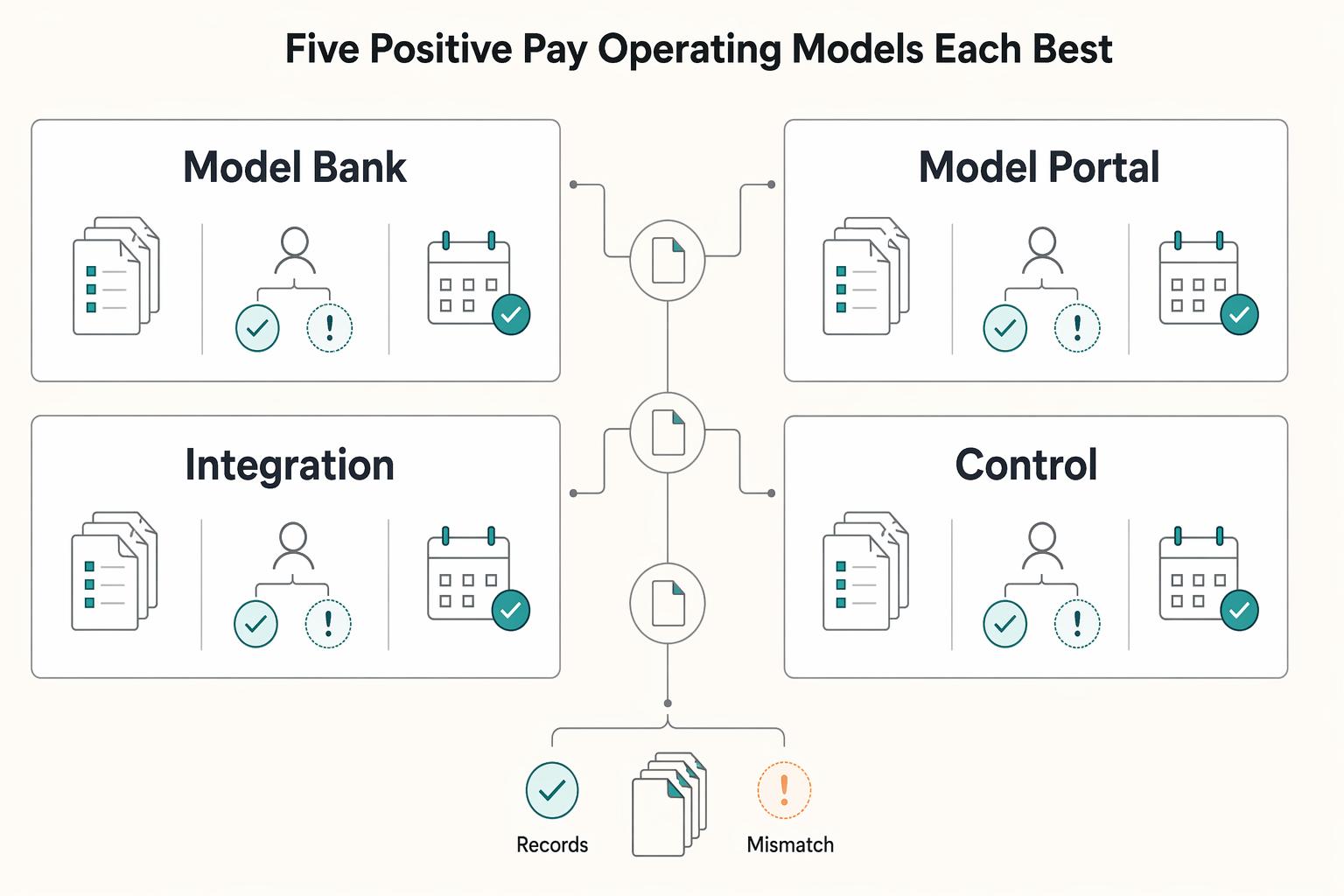
What Is Positive Pay? How Platforms Protect Against Check Fraud and Unauthorized ACH Debits
Positive Pay works best when you treat it as a control process, not a feature you turn on in a bank portal. For platform teams, the real question is not "do we have it?" It is "can we show who reviewed each exception, who approved or rejected it, and whether that happened before cutoff?"
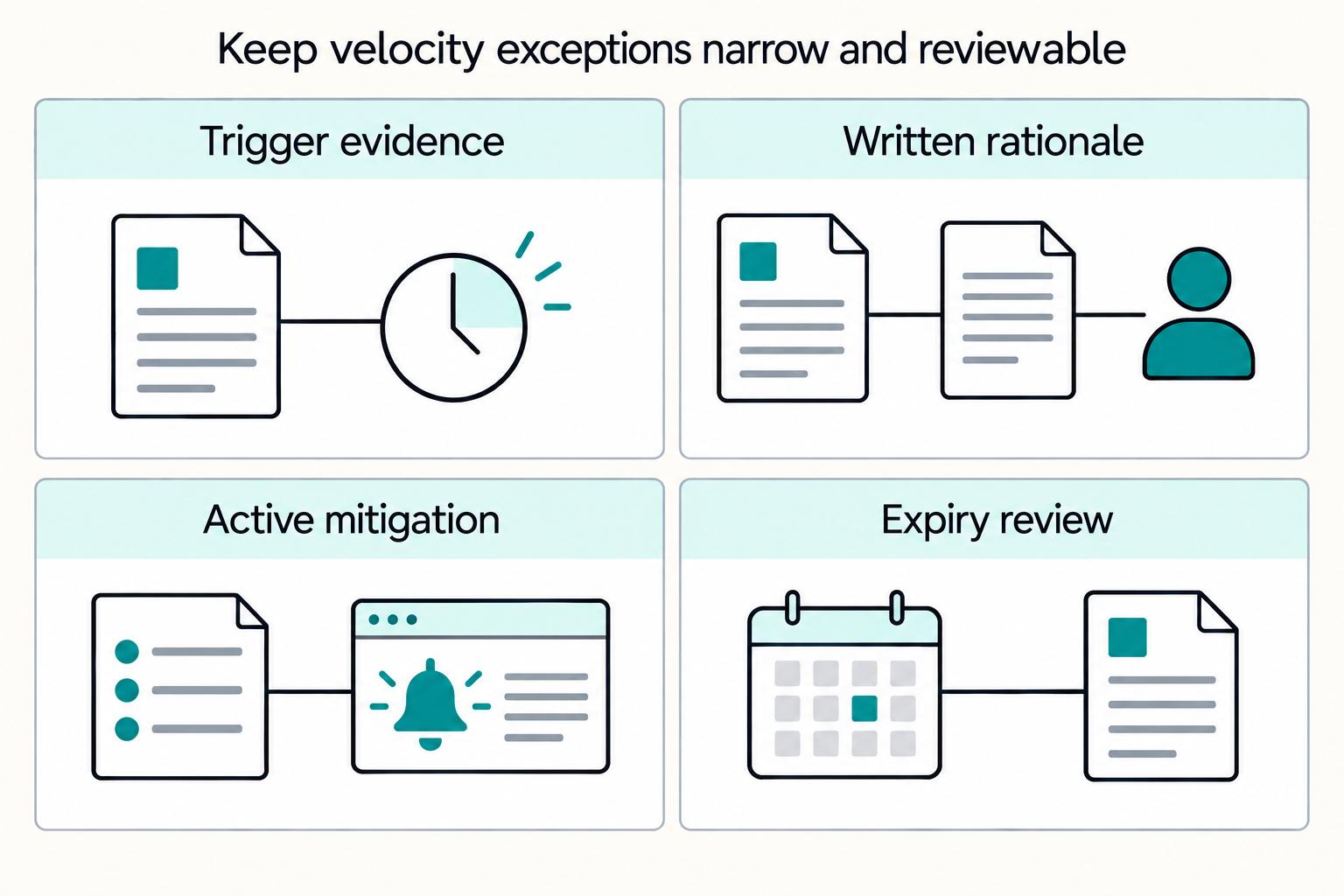
Detect Suspicious Payment Patterns With Velocity Checks
A velocity check is a fraud control that monitors transaction frequency and patterns over a defined timeframe so you can catch suspicious concentration early. In practice, it asks whether too many payment attempts are tied to the same account, IP address, or payment instrument in too little time.
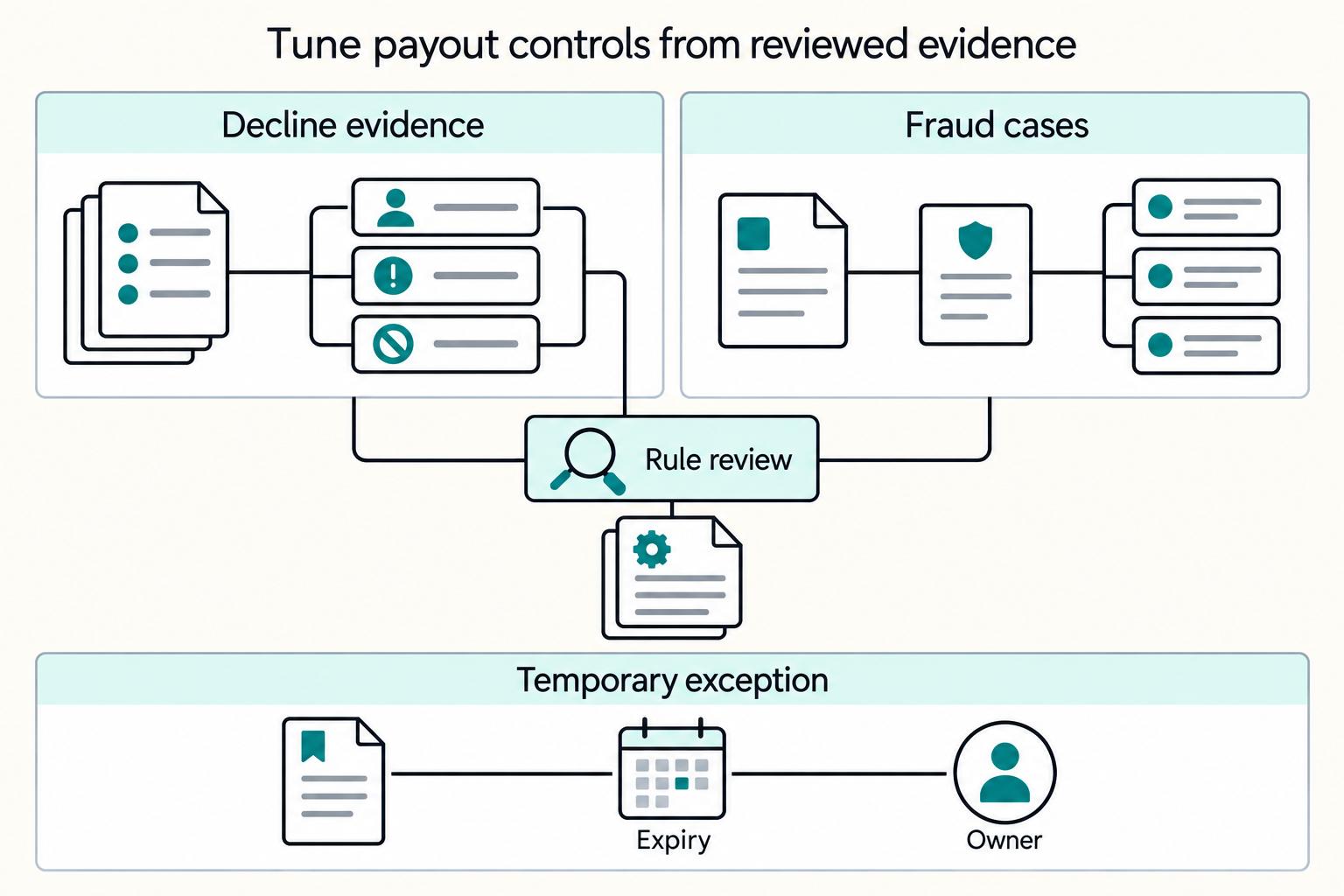
Velocity Checks for Payment Platforms: How to Cap Payout Frequency and Amount to Prevent Fraud
**Payout velocity controls are not just fraud settings. They are policy decisions you will need to explain and reconstruct later.** If you cannot show why a payout was allowed, held, escalated, or declined, the rule is not ready for production.