
Quick Answer
Choose recurring fees where users receive value between transactions. Define the payer, tier benefits, renewal and cancellation rules, then verify server-side billing and entitlement states. Keep fund availability and seller payout eligibility separate from paid access. Pilot one cohort and compare retention, contribution, and exception rates before expanding.
Why Add Subscription Revenue to a Marketplace#
Treat a Subscription Revenue Model as an operating decision first and a pricing decision second. Recurring fees can turn uneven sales into steadier monthly revenue, but in a cross-border marketplace they also expose entitlement logic, country-specific payout constraints, and tax responsibility gaps quickly.
Before you start#
Step 1. Define the decision you are actually making. This guide helps you answer three questions before you add recurring fees: should subscriptions exist at all, which side should pay, and where can you launch them without hurting liquidity or compliance. Recurring billing can smooth revenue that would otherwise swing with transaction volume. The tradeoff is operational. Unclear tiers or weak access control can create adoption and support friction that undercuts monetization.
Step 2. Bound the problem to cross-border operations. The hard part is rarely the price itself. It is the market-by-market plumbing behind the price. Cross-border payouts are not universally available on a self-serve basis across all countries and regions, so you should assume country and program gating from day one. A real launch decision usually starts with a simple matrix: target country, collection method, payout eligibility, tax owner, support owner, and what happens if a renewal succeeds but the account cannot be paid out.
Separate the tax treatment of the subscription fee from that of goods or services sold through the marketplace. For EU consumer electronic services, the EUR 10,000 cross-border threshold is conditional and is not a global VAT exemption; the supplier must meet the single-Member-State establishment and other applicable conditions. Identify the legal supplier, customer type and location, and service classification before choosing a tax setup.
Step 3. Set the bar for a real go or no-go decision. By the end of this article, you should have three outputs you can act on: a yes or no on adding subscriptions, a rollout sequence by cohort or country, and a short list of operating checkpoints to verify before launch. The minimum standard is practical, not theoretical. Confirm that a successful charge triggers the correct entitlement. Confirm that the target market and program support your planned payout flow. Confirm that finance can reconcile billed amounts against what was earned and what is still blocked.
A paid plan needs a working entitlement path. If the plan promises a payout-related benefit, disclose and check its eligibility before charging for that benefit. Ordinary reporting or workflow access can remain available while a separate payout prerequisite is unresolved; do not turn every payout hold into loss of all paid access.
This pairs well with our guide on Subscription Billing Platforms for Plans, Add-Ons, Coupons, and Dunning.
Decide if subscriptions fit your marketplace economics#
Start with where users get value. Keep the Commission Revenue Model primary when value is mostly realized at transaction close. Move subscriptions higher in the mix when users get ongoing utility between transactions.
Step 1. Score each model on the four criteria that drive outcomes#
Recurring billing can make revenue easier to forecast when retention and ongoing utility are stable. Fixed fees also raise the cost of participation before a seller earns anything. Compare that friction against the value of features used between transactions rather than assuming subscriptions always improve predictability.
A Commission Revenue Model is usually strongest on supplier-side onboarding friction because users pay after value is realized. That supports supply growth while you are still building listings, seller activation, or order frequency.
A hybrid model combines a recurring plan with transaction-linked fees. Amazon’s U.S. selling plans illustrate the distinction: Individual charges $0.99 per item sold and Professional charges $39.99 per month, with additional selling fees. Those are provider-specific fees, not a recommended price for your marketplace.
Implementation effort is the main tradeoff. Hybrid expands operational scope because you must run recurring billing and transaction fees together, then reconcile both reliably.
Step 2. Match model choice to marketplace shape#
Use this as a starting bias, not a universal rule.
| Marketplace shape | Suggested starting model | Why it tends to fit | Main risk to watch |
|---|---|---|---|
| High-frequency transactions, fragmented sellers, cross-border payouts | Commission primary | Lower entry friction helps grow supply; fees track realized value | Monthly seller fees can reduce participation before sellers trust the platform |
| High-frequency transactions, concentrated sellers, domestic payouts | Hybrid | Larger sellers may absorb plan fees when plans unlock meaningful capabilities | Overbuilding packaging before proving paid capabilities matter |
| Low-frequency transactions, strong recurring utility between sales, concentrated participants | Subscription or hybrid | Users may pay for ongoing access even when transactions are intermittent | If recurring utility is weak, churn and support load increase |
| Cross-border first, mixed seller quality, payout eligibility varies by country | Commission primary, narrow hybrid later | Keeps monetization tied to completed value while country gating stabilizes | Recurring charges can outpace operational readiness and create disputes |
Practical rule: if your unit economics still depend on transaction-volume growth, keep commissions primary and layer subscriptions onto premium capabilities. If retention and recurring utility are already strong, prioritize subscriptions earlier.
Compare contribution before adding a plan#
For a hypothetical cohort, a seller processes $2,000 of monthly orders. A 10% commission yields $200 before costs; a hybrid $40 plan plus 8% commission also yields $200 at that volume. At $500 of orders, the same hybrid costs $80 versus $50 under commission alone. At $5,000, it costs $440 versus $500. These are illustrative prices, not recommendations. Test whether low-volume sellers receive enough ongoing value to justify the fixed fee, and subtract collection, support, refunds, and benefit-delivery costs to compare contribution rather than gross receipts.
Write a renewal example too: a plan paid through October 31 remains usable until the agreed end date if canceled. A November renewal failure follows the disclosed grace and recovery policy; updating a card does not create a new subscription or retroactively erase the failed invoice. Reconcile the current billing state before restoring access. Trials and free plans need their own access rules.
Step 3. Check launch disqualifiers before committing#
Delay launch if you cannot reliably enforce Access Control. Paid plans require deterministic entitlement changes across signup, renewal, downgrade, cancellation, and failed renewal.
Delay launch if subscription events do not reconcile into Ledger Journals. Your finance team must be able to trace what was billed, earned, reversed, and still blocked without gaps between billing, entitlement, and accounting records.
Decision summary: choose commission first when growth depends on low seller friction; choose subscriptions earlier when recurring utility is already proven; choose hybrid when you need both, but only after Access Control and Ledger Journals are reliable end to end.
Define what subscribers actually get and who pays#
Define paid rights before price. Subscription tiers work when each tier maps to clear entitlements that show up in product behavior, not just in billing labels.
Step 1. Turn each tier into enforceable entitlements#
Build tiers around what Access Control can grant or deny. Keep boundaries concrete: access rights, workflow limits, reporting depth, payout handling priority, and service levels.
Package outcomes, not vague labels. "Premium" is a label; a higher workflow limit or exportable reporting is an entitlement users can see and support can verify. If a benefit cannot be tied to a rule or visible state, do not charge for it yet.
Use a simple check per tier: what can this user do now that they could not do before? Confirm that answer appears in product state.
Step 2. Choose the payer side on purpose#
In a two-sided marketplace, who pays is a strategic decision, not just a price-level choice. Decide explicitly whether the seller pays, the buyer pays, or both sides pay.
Then document the tradeoff: who pays, what that side receives, and which side benefits most. This makes fairness tradeoffs and subsidy risk visible before launch.
Step 3. Write the entitlement artifact before launching billing#
Before you turn on recurring billing, create one shared entitlement artifact:
| Artifact item | What to specify |
|---|---|
| Feature matrix by tier | Shared reference for what each tier includes |
| Gating triggers | Grant, renewal, downgrade, and cancellation |
| Downgrade behavior | Include proration handling |
| Failed-renewal recovery | Invoice retry and payment-method or authentication recovery; specify grace period, end of access, and restoration |
Modify an existing subscription when appropriate instead of automatically canceling and recreating it. Use a customer portal or other supported payment-method update flow for failed renewals. Checkout is commonly a signup flow; recurring collection and recovery need their own tested invoice, authentication, cancellation, and access rules.
We covered this in detail in Choosing Between Subscription and Transaction Fees for Your Revenue Model.
Prepare compliance and tax prerequisites before launch#
Set compliance and tax gates before paid plans go live, or you will create avoidable support debt, blocked payouts, and manual exceptions.
Step 1. Set a gating order that matches how money actually moves#
Set your internal sequence before launch, even though no single legal order applies across all jurisdictions or programs. A practical sequence is: complete KYC or KYB intake, apply AML controls and any required beneficial-owner review, then decide payout eligibility by market and product setup.
Keep your checkpoint tied to operational state, not document upload status. Charge and payout capabilities depend on collecting and verifying required account information, so your gate should confirm whether the account is actually enabled for charges, payouts, or both.
Separate "can buy a subscription" from "can receive payouts." A seller may be allowed to pay for plan features while still blocked from payouts until identity review or AML screening is complete.
Step 2. Collect tax prerequisites by entity type and country#
Map required tax artifacts by user type before launch. For U.S. persons, Form W-9 supports TIN and certification collection for IRS information return reporting. For foreign individuals in U.S. withholding or reporting contexts, a W-8 form may be required, including Form W-8BEN to establish foreign status.
| Tax item | Use | Article note |
|---|---|---|
| Form W-9 | TIN and certification collection for U.S. persons | Supports IRS information return reporting |
| Form W-8 family | Relevant foreign payees in U.S. withholding or reporting contexts | Select the correct form by payee status; not every foreign entity uses W-8BEN |
| Form W-8BEN | Establish foreign status | Included as a W-8 form example |
| VIES | Validate whether a business is registered to trade cross-border within the EU | One validation step, not full VAT compliance for every transaction context |
| Form 1099-K | Card or payment-network transactions | IRS FAQ currently references exceeding $20,000 and 200 transactions for TPSO filing; not Form 1099-MISC or Form 1099-NEC |
For EU cross-border operations, use VIES to validate whether a business is registered to trade cross-border within the EU. Treat that result as one validation step, not full VAT compliance for every transaction context.
Decide your 1099 logic before billing starts. Card or payment-network transactions are reported on Form 1099-K, not Form 1099-MISC or Form 1099-NEC, and IRS FAQ guidance currently references the condition of exceeding $20,000 and 200 transactions for TPSO filing. Document who is reportable, who files, and which payment flows map to each form category.
Step 3. Document exceptions and build the evidence pack#
Document exception rules before launch so support does not improvise from the queue. Define what evidence clears a blocked account, what must escalate to compliance, and what cannot be overridden without documented approval.
Your evidence pack should include:
- verification status for KYC, KYB, and tax profile collection
- policy decisions and exception approvals with timestamps
- AML review notes and any beneficial-owner artifacts required by written procedures
- links from account events into Ledger Journals so finance can reconcile account state to money movement
If you cannot produce this pack for a disputed account within minutes, you are not ready to scale paid access.
You might also find this useful: Subscription Revenue for Platforms: How to Build Recurring Billing on Top of Your Marketplace.
Design billing and money movement architecture before pricing goes live#
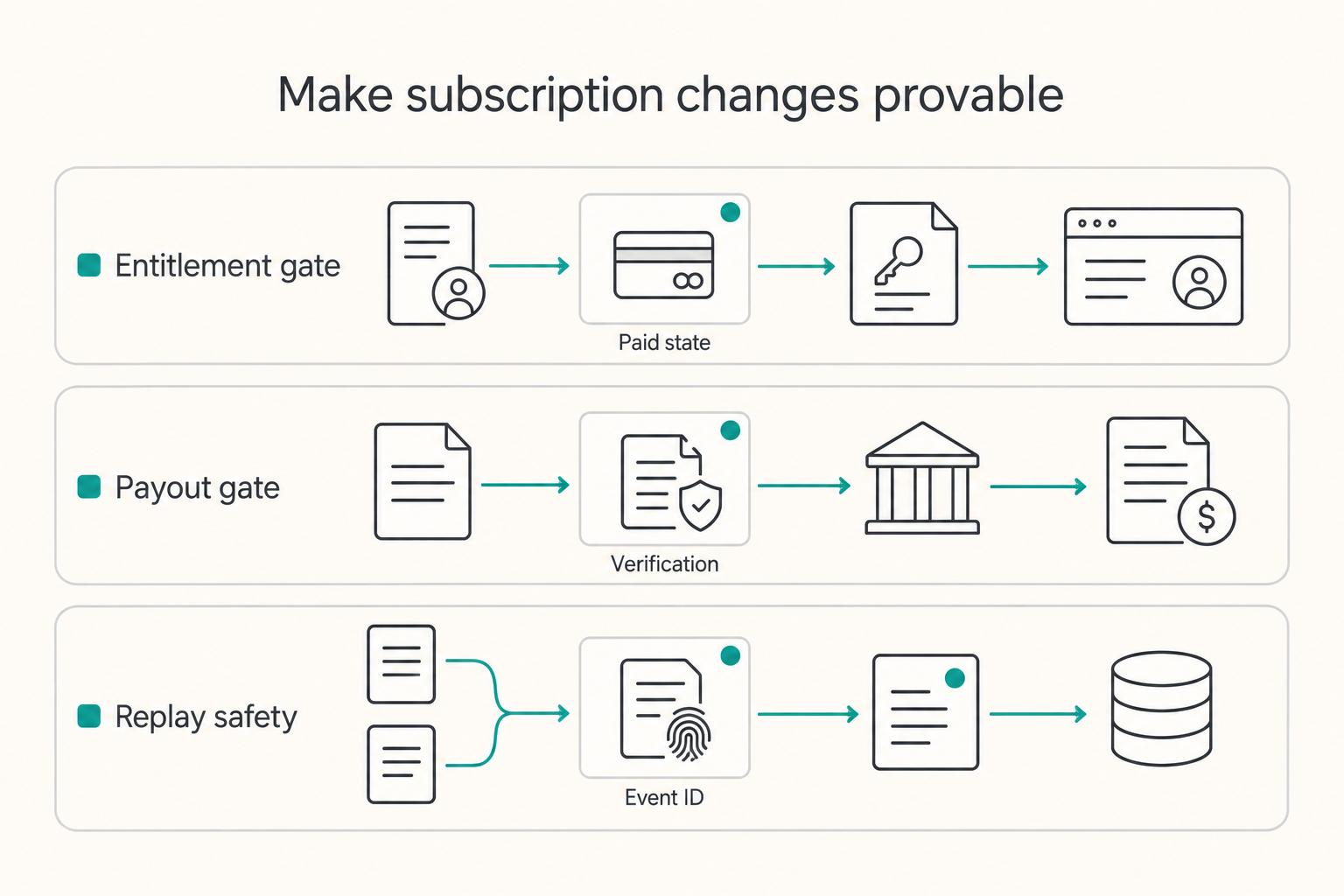
Define your money flow before launch: attempt the charge, confirm the result server-side, activate entitlement after confirmation, and keep fund availability and payout eligibility as separate states.
Step 1. Define the exact order of operations#
Use a server-side event flow, not browser-return logic, to drive entitlement changes. With Hosted Checkout, the customer is redirected to a provider-hosted payment page, but a successful payment can still occur even if the buyer never reaches your landing page again.
A practical sequence:
- Attempt collection under the subscription policy.
- Verify the relevant server-side payment and subscription state, or trial authorization.
- Persist the confirmed event and replay-safe accounting and entitlement actions.
- Activate, renew, or restrict access under the paid-period, trial, and grace-period rules.
- Track provider fund availability separately from accrued revenue.
- Check required payout prerequisites for each disbursement instruction.
Keep "paid subscriber" separate from "payout ready seller." A charge can succeed and entitlement can be active while payouts remain blocked until required account information is complete.
Step 2. Assign Merchant of Record and payment-rail responsibilities#
Identify the merchant of record for the subscription sale and separately for marketplace transactions. It is the entity presented as responsible for the sale and customer payment relationship, including applicable refunds and disputes. A checkout integration does not itself outsource tax duties or establish that your platform is a regulated financial institution. Document tax, verification, and payout responsibilities from the actual legal and provider setup.
There is no universal boundary that applies identically across jurisdictions, so document your boundary by program and country. For each flow, specify who accepts payment, who handles indirect tax, and who determines payout release.
| Flow | Use it for | Operator detail | Verification point |
|---|---|---|---|
| Hosted Checkout | Card-like subscription collection | Redirect payer to hosted payment page; do not fulfill from the return page alone | Entitlement changes only after server receives payment event |
| Virtual Accounts | Bank-transfer intake | Provider-assigned account details can route incoming funds to a customer reference; ownership and reconciliation behavior vary by program | Incoming transfers map to the correct customer or invoice |
| Payout Batches | Scheduled seller disbursement | Define cadence and cut-off rules before launch | Finance can explain why a seller is queued for a specific batch |
If you plan bank-transfer intake, confirm Virtual Accounts and batch behavior for your countries and program before pricing that option.
Step 3. Build replay-safe event handling and failure recovery#
Make retries safe and duplicate delivery harmless. Use idempotency keys for retried billing or payout requests, and treat webhook consumers as duplicate-safe because the same event may be delivered more than once.
Keep a durable record of the confirmed billing event and its required downstream actions. Apply accounting and entitlement changes through replay-safe processing, with recoverable queues when either step fails. A full finance journal outage should not require a second charge; reconstruct the missing posting from the confirmed payment and track the exception.
| Failure state | What it means | Correct handling |
|---|---|---|
| Payment succeeded, entitlement failed | Money moved, product access did not | Keep payment journaled, retry entitlement from confirmed event, alert support if recovery fails |
| Entitlement active, payout blocked by AML or missing account info | Access is active, disbursement cannot proceed | Keep access and payout state distinct; resolve required release conditions and show only permitted customer explanations |
| Duplicate webhook delivery | Same event arrives more than once | Deduplicate by event identity or stored processing key so billing, journal posting, and payouts remain replay-safe |
For a step-by-step walkthrough, see Retainer Subscription Billing for Talent Platforms That Protects ARR Margin.
Roll out by cohort, country, and vertical instead of one global launch#
Once failure testing passes, do not launch subscriptions globally in one shot. Start with a single vertical-country cohort where support, finance, and payment or payout rails are already reliable.
Pick a narrow first cohort#
Choose a cohort that is small enough to monitor and real enough to surface operational gaps. Prioritize fit between your Merchant of Record setup, supported geographies and currencies, and payout path for that country-program pair.
If requirements vary by country, make that a product gate. Use programmatic country checks (for example, Country Specs), and assume some capabilities can still be region-limited even where a provider operates, including flows tied to billing address, currency, or Virtual Accounts availability.
Before launch, keep one eligibility view that answers:
- Who can buy?
- Which billing-address countries are supported?
- Which currency will be charged?
- Whether payouts can proceed for that program.
Expand in phases#
Use phased rollout: internal cohort, then limited paid cohort, then broader release. Staged launches are designed for this percentage-based expansion over time instead of a single global cutover.
If possible, separate DEV and PROD offers (or equivalent environments) so you can validate entitlement activation, renewals, downgrades, and exception routing before full production exposure. Include support and finance in internal rollout, not only engineering.
Do not expand based on conversion alone. Expand when entitlement failures and payout-related exceptions remain controlled as volume grows.
Gate uncertain coverage by program#
If Merchant of Record coverage or Virtual Accounts support is not confirmed for a country-program combination, keep it out of the cohort and publish eligibility rules clearly in product, checkout, and help surfaces.
Before adding the next country or vertical, require:
- Support SOPs are documented and in use.
- Exception queues have clear owners and SLAs.
- Finance confirms subscription charges, Ledger Journals, and Payout Batches reconcile for the live cohort.
Run the first 90 days with explicit go and no-go checkpoints#
After you open the first live cohort, use the next 90 days to prove the offer is operable, not just attractive. If conversion to paid improves while payout or compliance exceptions worsen, treat that as a no-go for expansion even if early revenue looks strong.
Track a small KPI set#
Track a small KPI set on a fixed cadence. The minimum set is activation to paid, paid retention, failed renewal recovery, payout success rate, and reconciliation lag. Together, these show adoption, recurring durability, and whether money movement stays controllable.
Do not stop at raw failure counts. Failed-renewal recovery shows whether retries and dunning are actually recovering revenue. For payouts, review Payout Batches by state, not just total volume. If your tooling shows statuses like processing, posted, failed, returned, or canceled, track them separately. Finance should be able to match each payout batch to underlying transaction history and related Ledger Journals without manual detective work.
Do not expand when payout exceptions rise beyond the agreed operating tolerance. Compare rates and aged backlog, not raw counts alone as volume grows. Provider success can later be followed by a return; track the relevant rail’s return behavior rather than assuming a universal two-to-three-day finality window.
Review compliance friction every week#
Review compliance friction every week because it affects whether subscribed sellers can use what they paid for. Keep three items in one view: approval latency for KYC/KYB, AML hold rate, and unresolved tax profile gaps such as missing or incomplete W-8 or W-9 documentation.
Name the party responsible for required recipient verification under the program. Your platform may collect data, a provider may verify it, or the duties may be shared. Give stalled cases an owner and permitted next action; keep confidential screening details out of customer messages and do not treat every missing optional field as a payment prohibition.
Keep a monthly decision log#
Publish a monthly decision log before changing price, packaging, or country coverage. This keeps decisions audit-ready when billing, compliance, and payouts are asynchronous.
For each entry, record the change, affected cohort, reason, and evidence. Tie evidence to Ledger Journals for financial impact and webhook event trails for charge attempts, renewals, retries, and payout updates. If those records are missing, postpone rollout expansion or pricing changes.
Need the full breakdown? Read How to Calculate and Manage Churn for a Subscription Business.
Common mistakes that break subscription monetization and how to recover#
Most subscription monetization failures are sequencing failures. Recovery starts with making each state change provable: access after payment, payouts after verification, and ledger effects after replay-safe event handling.
| Mistake | Recovery | Key detail |
|---|---|---|
| Charging before entitlement enforcement | Make Access Control authoritative and tie entitlement activation to the billing state that matters | For a Stripe paid flow, verify invoice.paid and an active subscription; handle authorized trials separately |
| Shipping pricing without a compliance path to payouts | Gate payout eligibility behind required verification checks and only route payouts to verified bank accounts | Communicate required identity, business, and bank-account evidence up front |
| Weak retry design that allows duplicate side effects | Use idempotency keys, log processed webhook event IDs, and make Ledger Journals replay-safe | Duplicate webhook delivery is expected |
| Expanding geographies faster than operations can absorb | Roll back to the last validated cohort and re-open only after exception behavior returns to the validated baseline | Finance should be able to trace affected Payout Batches to journal entries without manual reconstruction |
Related: How to Build a SaaS Marketplace That Manages Subscriptions and Contractor Payouts.
Conclusion#
Subscriptions work when three things are designed together: what a paid user is entitled to, what compliance gates must clear, and how money and events move through your platform. If you choose pricing before those three pieces line up, you usually end up debugging trust, not revenue.
Keep the decision order disciplined. Start with market constraints and model fit, then package tiers, then sequence rollout. If your marketplace still depends heavily on transaction growth, pressure-test a Commission Revenue Model or a Hybrid Revenue Model before you make recurring fees the center of the business. If repeat utility is already clear and enforceable, subscriptions can carry more weight. Before you launch, use this copy/paste checklist:
- Confirm the revenue model choice.
Write down why subscriptions beat a pure Commission Revenue Model for this cohort, or why a Hybrid Revenue Model is less risky. The checkpoint is simple: can you name the distinct value each charge buys? If not, users will read the pricing page as overlap or double charging.
- Validate entitlements in Access Control.
Your paid tier should map to explicit access rules, because entitlement management is the gatekeeper for what subscribers can use. Verify the downgrade path too: if renewal fails, what exactly turns off, when, and who can restore access? A common risk is charging successfully while Access Control does not grant the paid capability.
- Test signup in hosted checkout and renewal in recurring billing.
Test signup through hosted checkout and renewals through the recurring billing flow. Then test customer authentication, payment-method updates, dunning, cancellation, and restoration after recovery. The browser return is not proof of payment; verify the server-side billing state and the resulting entitlement.
- Verify compliance and tax readiness before payout-linked benefits turn on.
Confirm the required recipient checks and tax documentation for each program. Form W-9 applies to U.S. persons in the relevant reporting context; Form W-8BEN is for foreign individuals, while entities may need another form such as W-8BEN-E. Use VIES as evidence for a relevant EU VAT-number check, not as a complete determination of tax liability. Check eligibility before selling a benefit that an account cannot use.
- Prove replay-safe processing and auditability.
Replay the same supported API request within the provider’s rules and verify that it does not create another instruction. Redeliver duplicate and out-of-order events; verify that access and accounting stay consistent. Recover an interrupted action from its confirmed record instead of issuing a second charge.
- Launch one cohort and review early operations before expanding.
Start with one country or vertical where support, compliance handling, and payment rails are already stable. Review early checkpoints, inspect exceptions, and expand only where the evidence says the model is holding up operationally.
Related reading: MoR vs. PayFac vs. Marketplace Model for Platform Teams.
Frequently Asked Questions
What is marketplace subscription monetization in practical terms?
In practical terms, marketplace subscription monetization means charging a recurring fee in exchange for subscriber-only rights, services, or capabilities. The important test is operational, not branding: you should be able to point to the exact permission or service a paid user gets that a non-subscriber does not.
When should we add subscriptions instead of relying on transaction commissions?
There is no universal KPI threshold for when subscriptions should replace commissions. A practical checkpoint is whether subscribers still receive clear value in slower periods, while commissions continue to map to transaction activity.
Can a Hybrid Revenue Model combine subscriptions, commissions, and ads without confusing users?
Yes, but only if each charge maps to a different benefit and the reason for each one is visible to users. Hybrid monetization can combine subscriptions with other revenue streams like ads or purchases, but it needs careful testing, measurement, and guardrails to avoid cannibalization and complexity creep. The red flag is users who cannot tell whether they are paying for access, paying per transaction, or being degraded by ads after already subscribing.
What should be included in a subscription tier besides basic marketplace access?
Include benefits that are specific enough to enforce and explain, not a vague "premium" label. At minimum, define the distinct permissions, services, or capabilities each paid tier unlocks so teams and users can clearly see what subscription access means in practice.
Which compliance checks must be complete before subscription-funded payouts are allowed?
Complete the checks required by the actual payout program and applicable rules. Subscription status and payout eligibility are separate decisions. Disclose any eligibility condition attached to a paid payout benefit before charging, and show safe next steps for unresolved prerequisites.
How do we prevent duplicate billing or payout events in an API-driven setup?
Use supported request idempotency for uncertain API outcomes, with the same instruction and parameters under the provider’s key-retention rules. Deduplicate events separately and make each downstream action replay-safe. Delayed or out-of-order events should reconcile against authoritative state; do not create a new charge or payout because a callback is missing.
Try a related tool
Researched and edited by the Gruv editorial team. Gruv builds cross-border billing, payouts, and finance-operations software for global businesses.
Sources
- csrc.nist.gov/glossary/term/access_controltrusted
- docs.stripe.com/webhookstrusted
- docs.stripe.com/checkout/quickstarttrusted
- europa.eu/youreurope/business/taxation/vat/check-vat-n...trusted
- irs.gov/forms-pubs/about-form-w-9trusted
- irs.gov/forms-pubs/about-form-w-8-bentrusted
- stripe.com/resources/more/subscription-marketplaces-101trusted
- stripe.com/resources/more/subscription-revenue-models-1...trusted
Educational content only. Not legal, tax, or financial advice.
Related Posts
Choosing Creator Platform Monetization Models for Real-World Operations
Popularity alone can be a poor way to choose among creator platform monetization models. If a model only looks good during a viral spike, a sponsorship burst, or a one-time product drop, it is a weak base for product and go-to-market bets.
How to Build a SaaS Marketplace That Manages Subscriptions and Contractor Payouts
Design customer billing and contractor payouts separately. This guide uses AWS Marketplace as a billing-channel example; if you sell directly or through another marketplace, map its own charge and seller-receipt rules. Contractor payouts still need their own eligibility, funding and recovery controls. If you choose subscription mechanics before deciding how money reaches contractors, country expansion can leave you with bills you can collect and obligations you cannot yet settle.
Building Subscription Revenue on a Marketplace Without Billing Gaps
Recurring billing usually breaks after the pitch stage for a simple reason. Teams buy a feature story when they really need an operating decision. If you are evaluating a subscription revenue platform for marketplace billing, the real question is not which vendor demo looks strongest. It is where you can launch first, which recurring-charge rules apply, and what your finance team can prove after go live.