
Quick Answer
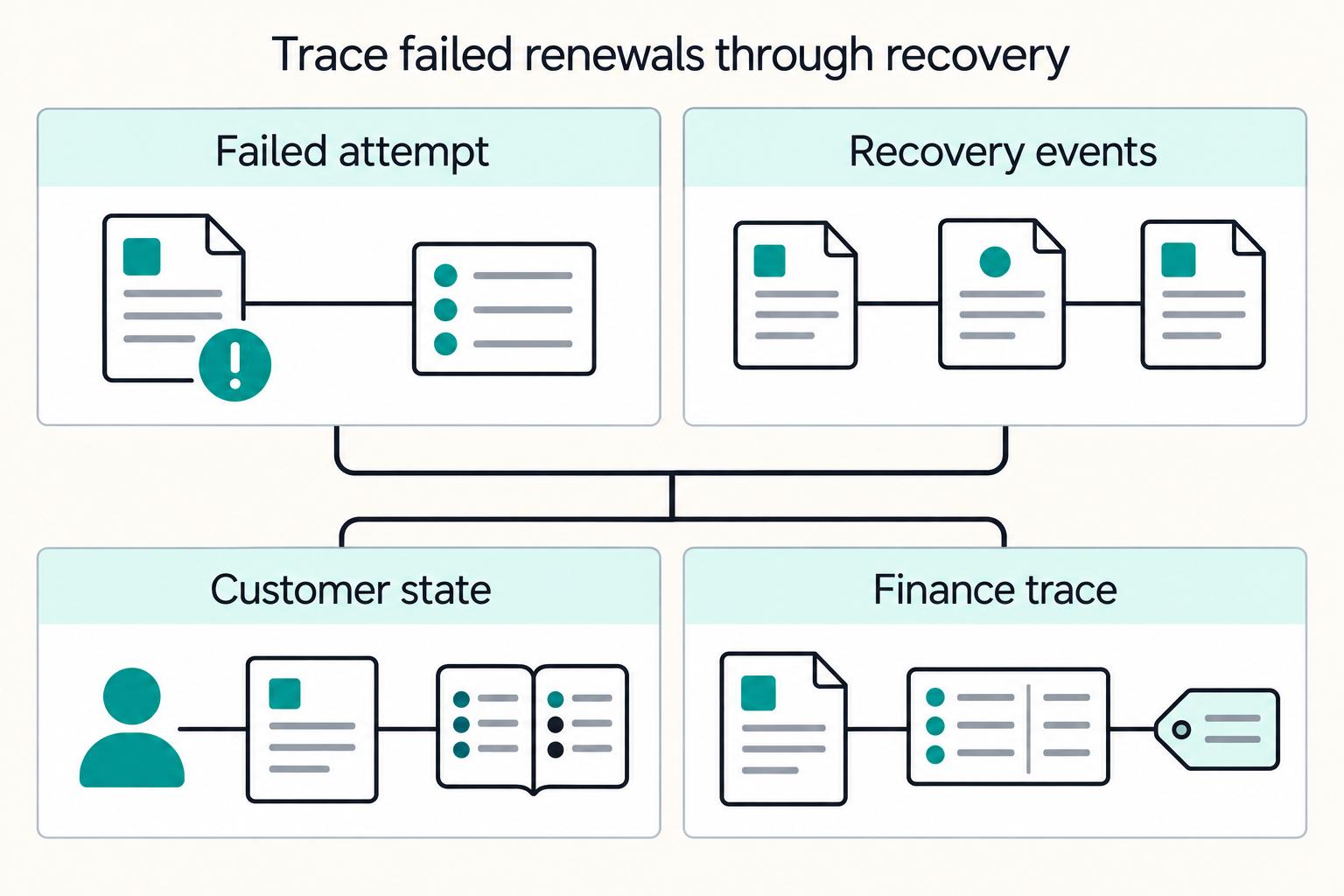
Separate involuntary churn from customer-led cancellations first, then run a renewal evidence pack on every miss: attempt time, processor response, retry outcome, and final account state. Route each decline bucket to a named owner within a defined SLA, and send payment-failure notices quickly. Rank fixes with both customer churn and revenue churn so high-ARR leakage is handled before low-impact decline-code cleanup.
Involuntary Churn Is a Revenue Leak You Can Actually Control#
This is a billing operations problem, not a customer-intent problem. When renewals fail because charges do not go through and retries do not recover them, you can measure that path, triage it, and reduce it.
Teams miss this because billing-failure cancellations often get folded into one churn number. The customer may still want the product, but the payment fails, retries do not recover it, and the subscription gets canceled anyway. If you treat that the same as a customer choosing to leave, you can end up prescribing product fixes for a collection problem.
Billing failures can account for a material share of cancellations. RevenueCat's State of Subscription Apps 2026 reports billing errors for 32.2% of Google Play cancellations and 15.2% on the App Store in its analyzed subscription-app population. The report primarily measures 2025 and covers over 115,000 apps and $16 billion in revenue. These are cancellation shares, not first-attempt failure rates or recovery guarantees for your web subscriptions.
Why teams miss it#
Teams often put voluntary churn work first because it involves product changes, retention experiments, and messaging tests. Billing operations often gets attention later.
That bias is expensive. Failed renewals can quietly compound into recurring revenue loss, even when the customer never intended to leave.
What makes this controllable#
This kind of loss is usually more operational than emotional. Voluntary churn often needs longer product loops. Billing-failure churn is more recoverable through concrete levers such as billing settings, retries, notifications, and payment-process changes.
In-app subscriptions need store-specific recovery controls. Check Google Play and App Store grace-period and billing-retry settings alongside RevenueCat's recorded entitlement state. Your web processor's retry policy does not control store-managed charges.
That does not mean recovery is guaranteed or always fast. It means the path from diagnosis to action can be shorter than teams assume.
The checkpoint that matters first#
Start by separating customer-initiated cancellations from billing-failure cancellations in reporting. If you cannot see initial charge failures, retry outcomes, recovered renewals, and cancellations tied to failed payment attempts, you are operating blind. A practical first evidence pack is:
- renewal attempts
- decline outcomes
- retry results
- final cancellation event by subscription
Once those events are visible, dunning becomes a deliberate recovery and prevention process, not a last-ditch collection step. From here, the job is to turn visibility into execution.
If you want a deeper dive, read Involuntary vs. Voluntary Churn on Platforms: How to Measure and Attack Both Separately.
Define the Failure Types Before You Try to Fix Them#
Classify the failure correctly first, or you will run the wrong fix. Involuntary churn is customer loss after a failed or declined payment even when the customer still intends to continue, while voluntary churn starts with the customer actively canceling. Those are different problems and need different playbooks.
| Label | How the article frames it |
|---|---|
| Involuntary churn | Customer loss after a failed or declined payment even when the customer still intends to continue. |
| Voluntary churn | Starts with the customer actively canceling. |
| Passive churn | Often used interchangeably with involuntary churn, but terminology is not fully standardized. |
| Accidental churn | If your team uses this label, define it explicitly and document how it is handled so dashboards do not mix unlike cases. |
Keep adjacent labels tight as well. Passive churn is often used interchangeably with this kind of churn, but terminology is not fully standardized. If your team also uses "accidental churn," define it explicitly and document how each label is handled so dashboards do not mix unlike cases. Use a shared glossary before you touch retries or messaging:
- Decline code: the processor error code on a failed charge; codes vary by processor, so use a shared internal mapping.
- False fraud decline: define this term internally so support, risk, and payments classify the same event type the same way.
- Subscription renewal: the recurring billing event, including the attempt and outcome.
Map the processor's decline code and network advice to the required action. Some failures permit a later retry; others require corrected credentials, customer authentication or a different method. A “hard” label does not mean the customer can never pay again.
Map Exactly Where Revenue Leaks in the Renewal Cycle#
Map the renewal obligation, collection attempt and subscription state separately. A failed renewal may precede service delivery, so it does not by itself prove earned revenue or an accounting write-off. Use the lifecycle map to locate collection gaps, then let finance apply its revenue-recognition and receivable policies.
| Stage | What to document | Customer surface to log | Collection and subscription checkpoint |
|---|---|---|---|
| Pre-renewal | Upcoming renewal amount, due date, payment method status, and owner if action is needed | Any pre-dunning email or in-app reminder (if used) | Invoice amount due and linked subscription MRR/ARR |
| Charge attempt | Attempt timestamp, processor response, and decline or success outcome | Whether any customer-visible surface exists at this point | Amount actually charged or paid on the first attempt |
| Post-payment failure | Exact failed payment event and current owner queue | Payment-failure notification and any in-app notification (if used) | Unpaid amount, required next action and notification status |
| Recovery window | Retries, payment method updates, support contacts, and finance exceptions | Reminder emails, update-payment page, and in-app notification (if used) | Recovered cash, credits and unresolved invoice amount |
| Churn event | When the account is marked churned, by whom, and on what billing evidence | Any final account-status notice (if sent) | Final subscription MRR/ARR movement; receivable treatment recorded separately |
Document customer surface with the billing event#
A billing event without customer-surface context is hard to diagnose. If a customer says they did not know renewal failed, check whether pre-dunning was sent, whether a payment-failure notice went out, and whether an in-app notification appeared while the account was still active.
Keep that record attached to the renewal event, not split across separate threads. A practical evidence pack is: account ID, renewal amount, event timestamps, decline outcome, customer message sent or not sent, and current owner. When this data is fragmented across tools, the same failures can repeat each billing cycle.
Make handoffs explicit across billing, support, and finance#
Unowned failures are often where billing-failure churn turns into a finance surprise. A common break is the billing engine logging the failure, support seeing only a generic past-due state, and finance seeing lower collections with no clear cause.
Use one visible handoff record so each failed payment has a status, an owner, and a next action. Any queue where events can sit without a named team is a leak risk, especially in disconnected systems where missed collections can persist for months.
Track ARR impact at every stage, not just ticket volume#
Ticket counts alone can be a weak proxy for financial risk. Add one finance-visible checkpoint per stage tied to dollars at risk or dollars recovered.
Compare collections with the invoices actually due in the same cohort. ARR is an annualized recurring-revenue measure, not cash collected or an amount due today; annual prepayment, billing dates, growth and service periods can explain a difference. As an illustrative case, 100 failed monthly renewals at $100 leave $10,000 initially uncollected. If 60 recover and 10 are validly canceled or credited, $3,000 remains unresolved. Separately, if 30 subscriptions end, their $3,000 MRR corresponds to $36,000 annualized recurring revenue lost—not a $36,000 cash write-off.
Classify Declines Into Buckets You Can Act On#
Turn each decline response into a clear next action quickly, or recoverable revenue can slip into involuntary churn. A decline code matters only if it tells your team what to do next within minutes or hours.
Build an internal reference table that maps raw decline responses into a small set of operational buckets. This is not a universal taxonomy. It is a decision tool for your billing setup, messaging paths, retry logic, and ownership model.
Build buckets around the next action#
If a bucket does not trigger a clear next move, it is not useful. Keep the first version narrow enough that support, finance, and payments ops classify the same event the same way.
| Internal bucket | Typical situation | First action | What to verify |
|---|---|---|---|
| Retry later | Time-sensitive decline where a retry may succeed | Queue the next retry and send a real-time payment failure alert | Confirm this response permits a retry, its timing and the notification status |
| Update payment method | Credentials may be outdated or unusable | Run card updater or account updater where available, then request a new method only if needed | Verify updater was attempted and whether a refreshed credential was returned |
| Risk review | Possible risk-related block | Pause blind retries, route to a payments or risk owner, and tailor customer messaging | Verify which control triggered the block and what was communicated to the customer |
| Manual review | Unmapped, conflicting, or unclear decline | Assign a named owner and internal review target | Verify no event sits without a bucket, owner, or customer status |
Consistency matters. If billing treats an event one way but support gives the customer a conflicting instruction, you create avoidable friction across the recovery path.
Keep expired credentials, insufficient funds, and risk signals separate#
These causes can look similar in a dashboard because they all show up as failed payments, but they need different handling. Expired or stale credentials are often good candidates for card updater or account updater first. If updater does not resolve it, then move to a payment-method update path that requires direct customer action.
| Signal | First move | Note |
|---|---|---|
| Expired or stale credentials | Card updater or account updater first | Move to a payment-method update path only if updater does not resolve it. |
| Insufficient funds | Treat it as timing-sensitive | Use a permitted schedule; the code does not reveal when funds will arrive. |
| Possible risk-related declines | Route them for review | Do not default to repeated retries or generic update-card messaging. |
For insufficient funds, use the processor's permitted retry timing and tell the customer the next action. A failure code does not reveal when funds will be available; rapid repeat attempts are not a substitute for a recovery policy.
Possible risk-related declines should not default to repeated retries or generic update-card messaging. Route them for review so the team can align the decline response, internal risk outcome, and customer communication before the next step.
Force ambiguity into manual review fast#
Give unmapped declines an owner and a review target. Retain the raw response and network advice rather than guessing a cause, and send a useful status notice while investigation proceeds. Measure your own notification timing and recovery results instead of assuming a universal uplift.
Make manual review a decision queue, not a dumping ground. At minimum, attach: account ID, renewal amount, attempt timestamp, raw decline response, assigned bucket, customer messages sent or not sent, updater attempt status, and current owner.
If too many events land in manual review, tighten the table. Each class should lead to one obvious next move, one owner, and one verification check. Once those buckets are stable, assign the people who can actually change the outcome.
This pairs well with our guide on How to Reduce Subscriber Churn on Your Platform Without Sacrificing Margin.
Assign Owners by Function So Fixes Actually Ship#
Assign clear owners by function to reduce handoff stalls in failed-payment recovery. This split helps because billing-failure churn and voluntary churn need different responses, and one blended churn view can hide what is actually driving loss.
This is not a universal org mandate. It is a practical operating model: name one owner per function, define what they control, and review handoffs together.
| Function | Ownership focus | What to verify | Common miss |
|---|---|---|---|
| Product (or CX owner) | Customer-facing recovery path: notification timing, payment method update friction, and abandonment points | Can the customer understand what to do next, update details quickly, and return to renewal without dead ends? | Sending every failure to "update your card" when some cases need a different recovery path |
| Finance or revenue ops | Revenue impact tracking, revenue churn tie-back, and unit-economics context | Does recovered revenue reconcile to finance reporting, and are high-impact losses surfaced quickly? | Reporting lower failure counts while revenue churn remains high |
| Payments ops | Processor behavior, dunning management, and retry-policy oversight | Are recovery rates shifting by processor or over time, and are dunning steps firing as intended? | Running retries without adjusting the recovery workflow when outcomes lag |
| Engineering | Reliability and end-to-end event traceability | Can each decline be traced from attempt to customer message to final state, including technical failure modes? | Invalid API calls or integration failures that break recovery flow |
Keep the model evidence-based. Failed-payment recovery is a system, not a single feature. It spans customer flow, dollar impact, payment mechanics, and technical reliability, so ownership should cover each dimension. Once ownership is clear, you can rank fixes by what they are worth.
Prioritize the Fixes With Unit Economics Math#
Prioritize fixes by economic impact first. Put work that is likely to recover recurring revenue ahead of cosmetic billing changes. If a fix does not clearly change a revenue-loss bucket, it should not lead the queue.
Before ranking work, track both churn views in the same period:
- Customer churn rate:
(Customers lost ÷ Customers at start of period) × 100 - Revenue churn rate:
(MRR lost ÷ MRR at start of period) × 100
Customer churn shows how many accounts you lost. Revenue churn shows what that loss cost. You need both so high-volume noise does not outrank higher-value leakage.
Use this table as a working template, and validate each rating with your own churn data.
| Work item | Recoverable recurring-revenue impact (estimate) | Implementation effort (estimate) | Customer friction risk (estimate) | Time to impact (estimate) |
|---|---|---|---|---|
| Fix a high-volume failed-payment cause affecting renewals | High | Medium | Low to medium | Fast to medium |
| Improve post-failure payment update flow | Medium to high | Medium | Low to medium | Fast |
| Clean up edge-case decline-code handling (small bucket) | Low to medium | Medium to high | Low | Slow to medium |
| Do not ship yet: hard lockouts or pressure-heavy recovery tactics | Unclear | Medium | High | Fast, but risky |
Use these decision rules when ranking fixes:
- If two fixes look similar, prioritize the one with the larger expected revenue-churn improvement.
- Failed-payment and friction fixes are often high-leverage, but confirm with your customer- and revenue-churn data.
- Move risk-related decline issues up when the financial downside is clearly larger than volume suggests.
- Keep a real "do not ship yet" lane for ideas that may recover some payments but create meaningful voluntary cancellation risk.
Treat this as a system audit, not a dashboard exercise. Every prioritized fix should map to a measurable churn bucket and a clear post-launch check in both customer and revenue churn.
Related reading: What Is Negative Churn? How Platform Operators Achieve Revenue Expansion Without New Customers.
When you rank fixes by expected recurring-revenue impact and implementation effort, use a technical checklist for retries, statuses, and auditability in Gruv Docs.
Design Dunning and Messaging That Recovers Revenue Without Annoying Good Customers#
Use a dunning sequence that customers can act on: a relevant pre-renewal notice, a failure notice and reminders during the allowed recovery window. Measure completion of the update or authentication flow alongside recovered invoices to identify where customers get stuck.
Sequence the outreach around the renewal event#
Sequence communication around the renewal event: an upcoming-charge reminder where useful, a notice after the first failure, then spaced reminders while recovery remains possible. Include the invoice amount, next action, secure update link and any service-access deadline. Suppress reminders after payment or cancellation.
| Stage | What to send | Main goal | Common mistake |
|---|---|---|---|
| Before due date | Pre-dunning email | Prompt a payment-method check before renewal fails | Vague copy that does not mention the upcoming renewal |
| Right after first failure | Payment failure notification | Explain what happened and what to do next | Delayed notice after service impact |
| Recovery window | Timed reminders | Recover payment without overpressure | Too many messages too close together |
Confirm that the first failed renewal creates one useful notice, duplicate events do not resend it, and the link reaches the correct account. Stop reminders when the invoice is paid or the recovery case closes.
Match the message to the likely cause#
Match the notice to the required action. Incorrect details may need correction; an authentication-required response needs a customer confirmation flow. Do not describe every hard decline as a permanently unusable card or imply that changing the method is the only remedy.
When a payment is blocked, state the observed status and renewal impact without asserting fraud or revealing risk rules. Offer the appropriate secure confirmation or support path; an issuer may disclose details only to its cardholder.
Put a ceiling on contact pressure#
Set explicit limits for both retry attempts and customer contacts. Overly aggressive dunning frustrates customers, while an overly lenient cadence can miss the recovery window.
Set retry limits from the selected processor, method and current network advice. There is no single attempt ceiling that applies to every renewal. Count actual charge attempts separately from scheduled retry events and stop when authorization is revoked or the applicable response prohibits another attempt.
Make the recovery path as direct as the message#
Clear messaging only works if the fix path is short. Send customers to a secure self-service payment-update flow with as few steps as possible from notification to completion.
Watch for avoidable friction in that flow. If reminders are going out but recovery is weak, the bottleneck may be the update experience, not the message text. After that, the next place to focus is upstream: reducing avoidable declines before dunning has to do the work.
Choose Payment and Billing Options That Reduce Avoidable Declines#
Reduce preventable failures at the source by checking credentials, required authentication and supported recurring methods. Give customers an authorized alternative where one exists; do not charge another saved method solely because the first failed.
Give recurring billing a fallback path#
Offering multiple payment options is a documented way to reduce this kind of churn. That matters because failed renewals can reflect blocked payment processing, not cancellation intent.
For recurring billing, design for fallback. If renewal depends on one method, one failure can stop continuation until the customer intervenes. Make sure the options you present are available in renewal and payment-update flows, not just at signup.
Match your billing model to your communication reality#
Billing systems can support structures ranging from recurring billing to usage-based billing and sales-negotiated contracts. Pair that setup with clear customer communication when payment issues happen.
Treat billing clarity as part of payment recovery, not a separate UX layer. In these cases, customers may still want the service but run into technical or financial obstacles that block payment processing.
Use payment-focused playbooks without overpromising#
This is different from voluntary churn, so product-update tactics alone are not enough. Prioritize payment optimization and customer communication, and validate outcomes in your own reporting before claiming gains.
The key operating rule is simple: verify what is enabled and what outcomes you can actually observe, then communicate those limits internally.
Validate changes before broad rollout#
Do not assume one billing or payment change will improve results by itself. Roll out changes in small, observable steps and expand only after results are clear in your own reporting.
That keeps avoidable decline issues visible early, so you can adjust before they scale. To make those adjustments confidently, you need instrumentation that other teams can verify.
Instrument the System With Verifiable Checkpoints#
If you cannot trace a failed renewal from first charge attempt to final customer state, you are guessing. The fix is to instrument a small set of checkpoints that finance, product, and payments can all verify. Start with what teams can actually use: the data should be good enough to support decisions, not pristine in every field.
At minimum, your event trail should let you answer a few core questions for any renewal: did payment attempts occur, what happened during recovery, and what final customer state was recorded. Keep records consistent across systems so finance and operations are working from the same story. When key states are captured differently across tools, recovery and loss metrics can drift.
Make finance able to reconcile the story#
A dashboard is not enough if recovery performance cannot be checked against finance outputs. Build a baseline with current cost, cycle time, and conversion rates, then review movement monthly. Use an evidence pack that can be validated across teams and keeps the discussion concrete: monthly movement, tradeoffs, and dollar impact instead of opinion.
| Artifact | Included detail |
|---|---|
| Baseline | Current cost, cycle time, and conversion rates |
| Monthly movement view | Movement finance can validate |
| Sensitivity table | Base, conservative, and upside scenarios |
| Cost-of-delay estimate | Impact of waiting that finance can evaluate |
Review on a cadence that catches drift early#
Review these checkpoints on a cadence that catches drift early. Use a cadence your teams can sustain, and keep the outputs verifiable.
| Cadence | What to inspect | What you should leave with |
|---|---|---|
| Monthly | Baseline movement in cost, cycle time, and conversion rates, plus key recovery tradeoffs | A finance-reviewable view of what changed and why |
| First quarter checkpoint | Quick wins delivered versus baseline and where gains are compounding | A clear decision on what to scale next |
| Planning cycle | Base, conservative, and upside scenarios with an updated cost-of-delay estimate | A current risk and investment view finance can validate |
Watch the failure modes that distort decisions#
The biggest instrumentation risk is not missing data. It is misleading data that looks complete. Inconsistent labels, duplicate records, or disconnected system states can distort recovery measurement. Real-time fraud controls can reduce chargebacks and manual review load, but false declines still need to be monitored as part of the tradeoff.
A practical check is to validate that account outcomes are represented consistently across billing, recovery, and finance reporting, then review the same evidence monthly with finance and operations.
For the detailed recovery workflow, pair this with How to Reduce Involuntary Churn: A Platform Operator Playbook for Payment Failure Recovery.
If you build one habit here, make each checkpoint produce something another function can verify. That is how billing-failure churn becomes an operating metric instead of an argument.
Avoid the Mistakes That Keep Teams Stuck in Reactive Mode#
Teams stay reactive when they treat every payment failure the same, rely on one blended churn metric, and run recovery across disconnected tools.
A generic failure bucket hides different jobs, like retrying later or collecting updated payment details. Split failures by reason so each path has a clear owner and next action. If everything lands in one queue, diagnosis weakens and root causes stay blurry.
Do not optimize retries while ignoring churn type. Billing-failure churn is an operations problem, while voluntary churn is a customer decision, so they require different interventions.
Keep measurement split by intervention type. Billing-failure churn and voluntary churn require different responses, and blending them weakens diagnosis. Also separate logo churn from revenue churn: losing ten $500/mo accounts is not the same financial hit as losing one $50,000/mo account.
Finally, watch for operational fragmentation. When billing recovery, cancellation, and feedback are spread across disconnected tools, teams end up reacting to dashboards instead of managing one verifiable recovery process.
For a step-by-step walkthrough, see Subscription Revenue Forecasting for Platform Teams Modeling MRR Churn and Expansion.
Turn Billing Failures Into a Managed Revenue System#
Treat this as a payment-operations system, not a generic retention problem. If customers still want to continue but cannot get a payment through, the priority is to manage the payment-failure lifecycle end to end. Then recover revenue with controlled friction.
A lifecycle view is the practical shift. Handling each stage with separate fixes can create conflicts, such as pre-dunning emails in one flow, generic failure notices in another, and risk actions that can block legitimate customers. When that happens, avoidable payment blocks can be misread as customer choice. Use a small operating baseline your team can maintain:
- One decline-bucket table
Group failures into practical buckets, for example retry later, update payment method, or manual review, and define the message, next action, and recovery check for each bucket.
- One ownership map
Assign clear ownership across lifecycle checkpoints: pre-renewal planning, first miss, customer notification, recovery follow-up, and final churn decision.
- One regular review cadence
Use a fixed review rhythm to check what entered each bucket, what recovered, what aged out, and what stayed unresolved. Treat this as your operating choice, not an industry benchmark.
Prioritize expected recoverable invoice amounts and retained recurring revenue, then subtract recovery fees and operating cost. Keep cash recovery separate from ARR movement. Send useful notices, suppress duplicate or obsolete contacts, and verify the final invoice and subscription state before expanding a change.
We covered this in detail in How to Calculate and Manage Churn for a Subscription Business.
Frequently Asked Questions
What is involuntary churn in subscription businesses?
It is customer loss caused by a legitimate renewal payment failing even when the customer intends to stay. You will also hear it called accidental churn, and some teams use passive churn similarly, though definitions can vary. Many customers do not realize there is a problem until they lose access.
How is involuntary churn different from voluntary churn?
Voluntary churn starts with a customer choosing to cancel, while this starts with a payment issue. Because the causes differ, the response differs: voluntary churn is addressed with different retention tactics, while this category needs payment recovery operations. If you blend both into one churn metric, teams can end up solving the wrong problem.
What usually causes a payment decline at renewal?
Outdated payment details, insufficient funds, authentication requirements and risk controls can all stop renewal. Separate issuer declines from integration or server errors; a technical timeout needs status verification before another charge. Map your processor's actual codes rather than relying on a universal code count.
Can product improvements alone reduce involuntary churn?
Not reliably. Product improvements can still help the overall experience, but they do not resolve payment failures by themselves. When losses are driven by decline and renewal issues, billing and payment operations changes are still required.
Which tactics usually reduce failed-payment losses first?
Start with permitted retries, clear failure notices and a secure payment-update or authentication flow. Confirm that the updated method is the one used for the next renewal and offer supported alternatives with customer authorization. Measure recovered invoices and customer outcomes before expanding.
How should teams balance fraud controls against false fraud declines?
Treat fraud settings as a tradeoff, not a one-way gain. Tighter controls can block legitimate renewals, and false fraud declines are a known cause of this churn. After any fraud-rule change, review decline outcomes so you can catch good customers being filtered out.
Try a related tool
Researched and edited by the Gruv editorial team. Gruv builds cross-border billing, payouts, and finance-operations software for global businesses.
Sources
Includes 2 external sources outside the trusted-domain allowlist.
Educational content only. Not legal, tax, or financial advice.
Related Posts
Involuntary vs Voluntary Churn on Platforms and How to Attack Each
Measure voluntary and involuntary churn separately. Treating churn as one number can fund the wrong fix. In a subscription business, **Voluntary churn** and **Involuntary churn** are different failures. One is a customer choosing to leave because price or value no longer works. The other is a customer dropping unintentionally because of a payment failure or technical issue.
Reducing Involuntary Churn with a Payment Failure Recovery Playbook
Treat payment-failure churn as a monetization issue first. Many failed payments are recoverable, so what looks like churn is often revenue collection leakage rather than clear product rejection.
How to Use a Community to Reduce Churn and Increase LTV
If you run community as an engagement channel, you can rack up activity and still miss churn. Run it as a retention loop instead: detect risk early, intervene by segment, and verify whether the action changed retention outcomes. That is how community starts affecting churn.