
Quick Answer
Start by treating intake to procure platforms request to pay before po as a control layer, not a fast form. Build one intake front door, validate required fields, route through owned approval rules, and decide PO-required versus governed non-PO paths with written exceptions. Then verify handoffs from request ID to provider reference, ledger posting, and reconciliation output. If required compliance or tax data is missing, hold the request instead of letting it advance.
Why Request-to-Pay Starts Before the PO#
Yes, some Request-to-Pay work can start before a Purchase Order (PO) is raised without turning into a free-for-all. The key is to treat pre-PO intake as a control layer, not just a form: one front door that collects, validates, and routes each request before traditional payment activity begins. That gives teams a clearer path for legitimate payouts while still giving finance and procurement a place to enforce policy before money moves.
That tension is the real operating problem. Operating teams want payments to move quickly to avoid unnecessary friction. Finance and procurement are solving for something different: policy gates, approval discipline, data quality, and an audit trail that still makes sense when someone asks why a payment happened without a PO. Skip that design work, and speed usually comes from side channels while control arrives too late to help.
A workable rule is simple: if intake cannot tell you what is known, what is missing, and who owns the next decision, it is not ready to feed payment execution. In a pre-PO flow, that usually means each request needs a traceable record, a clear business purpose, and enough structured information to route it through the right governed path. If key risk data is unknown, the right outcome is a controlled hold, not a silent pass.
This article shows how to make that decision-ready in practice. We will pin down the model boundaries between intake, procurement, and payment so teams stop arguing over overloaded terms. Then we will walk through the minimum inputs, owners, and decision rules needed to run pre-PO intake well. From there, we will focus on the checkpoints that matter in live operations: where approvals belong, how to verify that routing decisions match policy, how to keep the control trail intact from intake through payout, and what to do when requests arrive incomplete, approvals stall, or compliance checks show up too late.
The scope is intentionally narrow and practical. We are focused on pre-PO intake design and the handoff into payment controls, not a full Source-to-Pay redesign. If your current process already has payment rails but weak request intake, this is where to tighten the front end first.
For a step-by-step walkthrough, see How Platforms Evaluate Third-Party Service Providers Before Signing.
Pin Down the Model Before You Buy Tools#
Choose the operating model before you choose software. If your bottleneck is request routing and policy enforcement before a Purchase Order (PO), start with Intake-to-Procure; if your bottleneck is carrying approved requests through settlement, expand to Intake-to-Pay.
Use these boundary lines as a working operating map, not a cross-vendor standard:
| Model | Trigger point | Typical owner | Where PO creation sits |
|---|---|---|---|
| Intake-to-Procure | A business request enters intake | Procurement intake or business ops with procurement | End point or major milestone |
| Intake-to-Pay | A request is submitted for purchase or pay | Procurement plus finance or AP | Midstream, after intake and approvals |
| Procure-to-Pay | Requisition or formal procurement activity begins | Procurement and AP | Core transaction step inside the process |
| Source-to-Pay | Supplier sourcing or contracting begins | Strategic procurement or sourcing | After sourcing and contracting, before invoicing and payment |
Then match model scope to the failure point you actually need to fix. Intake-to-Procure is designed for the path from initial need to PO creation, so it fits when requests arrive incomplete, get rerouted repeatedly, or reach approvers without enough context.
Treat vendor narratives as category guidance, not operating design. Ramp frames intake as an early checkpoint; Coupa distinguishes intake from broader orchestration; GEP describes a hybrid pattern where intake-led handling can sit alongside P2P for routine buying. The practical mistake is buying end-to-end tooling when front-door decisioning is the real gap, or buying intake tooling when payment execution and AP ownership are where things are actually breaking.
For the payment-control side of this workflow, Wire Fraud Prevention for Platforms: How to Spot Spoofed Bank Details Before You Pay covers how teams catch spoofed bank detail changes before funds go out.
Prepare the Minimum Inputs and Owners Up Front#
Automate intake only after two things are explicit: named owners and a minimum evidence pack for each request type. If either is unclear, route to review instead of letting requests pass through.
| Owner | Primary responsibility |
|---|---|
| Process owner | Defines what a valid request is |
| Approver matrix owner | Maintains who can approve what based on predefined authority criteria |
| Legal or procurement | Owns policy and commercial interpretation |
| Engineering | Owns routing logic and required fields |
| Payments ops | Owns what happens when an approved request still cannot be paid cleanly |
Step 1 Assign named owners before intake opens. At minimum, name an owner for the process, the approver matrix, legal or procurement, engineering, and payments ops. One person can cover multiple seats in a smaller team, but each seat still needs clear ownership.
The process owner defines what a valid request is. The approver matrix owner maintains who can approve what, based on predefined authority criteria. Legal or procurement owns policy and commercial interpretation. Engineering owns routing logic and required fields. Payments ops owns what happens when an approved request still cannot be paid cleanly.
Step 2 Define the minimum evidence pack before approval routing starts. Before a Purchase Order (PO) is issued, a pre-PO request should already be decision-ready, much like a purchase requisition that captures the need, cost, and business justification for review.
Require each request to include:
- business purpose, need, and cost or business justification
- vendor or payee profile, including who will be paid and the nature and purpose of the relationship
- risk flags and reliability checks on key ownership or risk data
- required compliance artifacts attached at intake
Step 3 Put explicit ownership on approval-workflow and policy-gate changes. If no one owns rule changes, exceptions become shadow policy. Keep one accountable owner for approver changes and one for policy-gate changes, with engineering implementing rules rather than deciding policy.
Step 4 Add a known-vs-unknown verification checkpoint before automation runs. Intake should collect the right information and route to the right approvers, but it also needs a stop condition. If ownership or risk data is missing, inconsistent, or reasonably in doubt, place the request in a controlled hold queue for review, not auto-approval.
This matters most before PO issuance: weak intake evidence creates weak approvals downstream.
Build One Intake Front Door With Structured Request Data#
Use one guided intake front door for every pre-PO request so capture, routing, and tracking start from a single record. If requests start in separate channels, decision history fragments and traceability weakens when approvals and payments need review.
Step 1. Set one submission entry point, then branch after intake#
Set one submission entry point, then branch after intake into procurement, finance, or engineering as needed. The requester should submit once, and that same structured request data should follow the request across downstream queues. If requests arrive through side paths, require re-entry into the front door before review or approval.
Step 2. Make required fields control-driven, then route accordingly#
Make required fields control-driven, not form-driven. At minimum, capture whether a Purchase Order (PO) is expected and whether the request has KYC/KYB/AML relevance, then route accordingly.
| Required field | Downstream purpose | Hold if missing |
|---|---|---|
| Business purpose and request type | Drives routing and approval logic | Yes |
| Vendor or payee identity | Supports procurement and payment handling | Yes |
| PO expected (yes/no) | Separates PO-required vs alternate governed path | Yes |
| Country/currency and cross-border context | Flags added review needs | Yes, if route depends on it |
| KYC/KYB/AML relevance flag | Signals potential compliance handling | Yes, if unresolved |
| Legal entity or beneficial-owner details, where required | Supports procedures to identify and verify beneficial owners | Route to review |
Sanity check: each required field should map to a real approver, policy gate, or compliance step.
Step 3. Validate required fields before routing to approval#
Keep the operating order strict: submit request, validate required fields, route to approval workflow, then classify into PO-required or alternate governed path. Do not route approvals before completion checks.
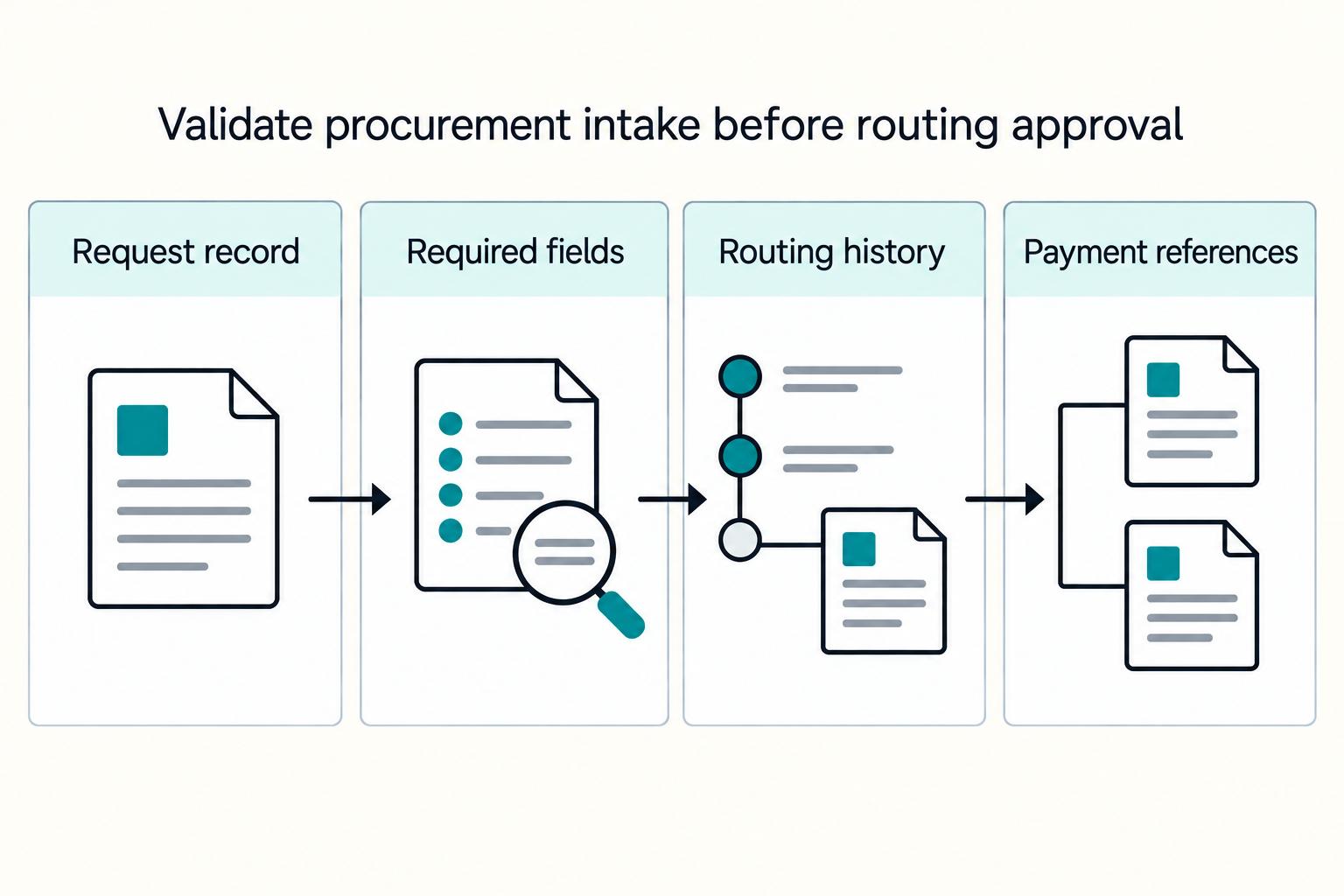
Create a request ID at submission and carry it through the purchase request record, audit trail, and payment-side references. Design for one-to-many linkage, since one approved request can map to multiple authorization-related records. Implementation checkpoint: from one request record, you can see request ID, validation status, routing history, and linked payment references end to end.
Set PO Decision Rules and Exception Paths That Teams Can Actually Use#
Set PO policy as a written, risk-based rule with named approvers for every path. If teams still decide in chat, exceptions have already become your real policy.
Step 1. Publish one PO decision table with both lanes explicit#
Publish one PO decision table inside documented procurement procedures. Make both lanes explicit: when PO is required and when a governed non-PO path is allowed.
| Request pattern | Default path | Risk rationale | Accountable approver |
|---|---|---|---|
| Planned purchase with defined scope, known vendor, and ongoing business use | Require PO | Stronger commitment control and cleaner traceability before payment | Procurement owner plus budget approver |
| Low-risk one-time payment where a PO adds little control value and the evidence pack is complete | Allow governed non-PO path | Faster handling and lower admin burden, but only with strong pre-pay checks | Finance or payments ops owner plus budget approver |
| New vendor or unclear scope that may become sourcing, contracting, or repeat spend | Require PO | More review is needed before money moves or the relationship expands | Procurement owner |
| Higher-risk or more complex cross-border request | Escalate before choosing path | Risk-based control means tighter review in higher-risk areas | Procurement plus designated risk, finance, or legal approver |
The requester should not choose the lane. Intake captures facts, then policy gates decide. If you use spend thresholds, publish them in local policy with a named owner. A public policy example uses under $5,000 versus purchases exceeding $5,000; treat that as an example of documented thresholds, not a universal private-sector rule.
Step 2. Add clear escalation rules before payment initiation#
Add clear "if X, do Y" escalation rules before payment initiation. This is where request-to-pay usually fails: urgency is used to bypass PO, then risk shows up later.
- If request risk is high, block the fast non-PO lane and require procurement review before payment initiation.
- If cross-border complexity rises, tighten policy gates and require a fuller evidence pack plus a second approval outside the requesting team.
- If a request is urgent and seeks non-PO treatment, require documented compensating controls before approval.
- If key facts are unknown, hold the request.
Check enforcement with samples: similar facts should route to the same path. If near-identical cases route differently based on who escalated louder, your rules are too vague or not enforced.
Step 3. Keep exceptions narrow, named, and auditable#
Keep exceptions narrow, named, and auditable. A valid exception is a written override by a named procurement authority or designee for one specific rule on one specific request.
Require an override pack with request ID, rule overridden, business reason, remaining risks, compensating controls, approving authority, and timestamp. Record what the exception does not waive. An approved exception can remove one requirement without removing all other procurement obligations.
Watch the failure mode: exception volume rises, but reasons are unclear: speed, missing data, vendor pressure, or intake design gaps. When that happens, exceptions become shadow policy and audit risk increases. In the audit trail, store override reasons as structured fields with linked approval evidence, not only free text.
The tradeoff is straightforward: broader PO coverage usually improves control and traceability but can slow urgent operations. Narrower PO scope can increase speed, especially for one-off payout flows, but only with stronger pre-pay checks and disciplined exception governance. Start stricter on ambiguous or higher-risk lanes, then relax only after the non-PO path shows clean records, consistent approvals, and a complete audit trail.
For a broader operations view, Business Process Automation for Platforms: How to Identify and Eliminate the 5 Most Expensive Manual Tasks shows where automation usually removes the most cost and delay.
Want a quick next step on request-to-pay before a PO? Try the free invoice generator.
Insert Compliance and Tax Gates Before Any Money Moves#
For any lane that requires compliance or tax completion, those gates come before payout authorization. Do not treat "pending docs" as approved; hold the request and route it to an exception queue with a named reviewer and written reason.
| Item | Use | Specific note |
|---|---|---|
| Form W-9 | Payee's correct TIN for IRS information reporting | Use when needed before payment moves |
| Form W-8 BEN | Foreign beneficial owner | Used when requested by the payer or withholding agent |
| Form 1099-NEC | Reportable nonemployee compensation | Route reporting through it |
| Form 2555 | Qualified FEIE cases | FEIE is a tax-review signal, not a replacement for required intake documents |
| VIES lookup | EU VAT number validation | Store the lookup result and timestamp; result is valid or invalid |
| FBAR review | Foreign-account reporting questions | Trigger noted above $10,000 in aggregate foreign financial accounts during the calendar year |
Step 1. Set identity and business verification at intake#
Set identity and business verification at intake for markets and programs that require it. Where your flow includes KYC, KYB, AML, or CIP-style obligations, collect required identifying information and complete review before payout approval. Use a risk-based model, but do not let "risk-based" become "complete later."
Make status explicit in intake and approvals: complete, failed, or escalated. Do not let unknown or in progress behave like approved. A practical control check is to sample paid requests and confirm each required screening has a reviewer action, status, and timestamp before payment approval.
A common failure mode is treating "already known" as a substitute for evidence, then paying while verification is still open.
Step 2. Map tax documentation into intake before payment moves#
Map tax documentation into intake so approvers can see what is required before payment moves.
- Use Form W-9 when you need the payee's correct TIN for IRS information reporting.
- Use Form W-8 BEN for a foreign beneficial owner when requested by the payer or withholding agent.
- If payment is reportable nonemployee compensation, route reporting through Form 1099-NEC.
Handle edge cases the same way every time. If a payee raises FEIE, treat it as a tax-review signal, not a replacement for required intake documents. FEIE handling points to Form 2555 for qualified cases, and the bona fide residence test references a full tax year from January 1 through December 31. For EU VAT numbers, validate in VIES and store both the lookup result and timestamp; at lookup time, VIES returns valid or invalid.
If a request raises foreign-account reporting questions, route it for tax review and note that FBAR uses a trigger above $10,000 in aggregate foreign financial accounts at any time during the calendar year.
Step 3. Retain the evidence for each gated request#
Retain the evidence, not just the final status. For each gated request, keep request ID, required document type received, compliance outcome, reviewer identity, action taken, escalation or rejection reason, and timestamps. For VAT checks, retain the VIES result captured at review time. For exceptions, retain the override and link it to the original gate.
Set retention by governing requirement for that lane. BSA recordkeeping under 31 CFR 1010.430 requires retaining records for five years and storing them so they are accessible within a reasonable period. Where federal-award rules apply, a three-year baseline can also apply; do not let a shorter setting override a longer applicable requirement.
Before scaling, test retrieval on one paid case and one blocked case: if you cannot reconstruct who reviewed what, when, and why without searching chat, your audit trail is not strong enough.
If this process feeds into supplier or partner payouts, Payee Verification at Scale: How Platforms Validate Bank Accounts Before Sending Mass Payouts covers the verification controls that matter before money moves.
Connect Procurement Decisions to Payment Rails Without Data Drift#
Your control is only as strong as your record chain: every approved request should trace cleanly from approval to provider execution, ledger posting, and reconciliation output.
Step 1. Define one canonical handoff chain and make every link queryable#
Define one canonical handoff chain, and make every link queryable. At minimum, store a stable request ID at approval, the provider reference created at execution, the ledger posting ID, and the reconciliation export or report reference. Field names can vary by provider, but the chain must let your team trace one decision forward and backward without relying on chat logs.
| Stage | Record you keep | Why it matters |
|---|---|---|
| Approval | Request ID and approval timestamp | Confirms authorization happened before execution |
| Execution | Provider reference | Links the approved request to the external payment attempt |
| Accounting | Ledger posting ID | Shows the financial record created from execution |
| Reconciliation | Export row or payout report reference | Lets finance match records for accuracy and consistency |
If a request is marked paid but has no provider reference or ledger entry, status drift has already started.
Step 2. Require idempotent execution for every payment-creation call#
Require idempotent execution for every payment-creation call so retries do not become duplicate payment attempts. Use one execution intent and one idempotency key, and reuse that key on retries caused by timeouts, network errors, queue replays, or worker restarts. Reusing the same key should return the same result for the same request, including error responses.
Also account for key retention limits. Stripe notes keys can be removed after they are at least 24 hours old, so if your retry window can exceed that, keep your own request-level dedupe keyed to request ID plus execution intent.
Step 3. Treat webhooks as delivery signals and plan for stale-status recovery#
Treat webhooks as delivery signals, not your only source of truth. Stripe can automatically resend undelivered events for up to three days, and your consumer should process those events in a duplicate-safe way. Store provider event IDs and processing status so retries are recognized as already handled.
Plan for stale-status recovery too. If a request stays stuck in a pending-paid state, your team should be able to pull or review recent events; Stripe's documented listing window here is the last 30 days. Do not assume webhook arrival order matches business-process order, and do not allow backward or duplicate state transitions.
Step 4. Run a reconciliation checkpoint before scaling volume#
Run a finance-plus-engineering reconciliation checkpoint before scaling volume. Sample approved requests and confirm each maps to one intended execution outcome and the expected ledger result. This catches duplicate retries, stale statuses, and partial posting mismatches early.
If you use Stripe, automatic payouts preserve transaction-to-payout association, and the balance transaction endpoint with the payout parameter can list transactions in an automatic payout. Use that linkage to verify your internal ledger and payout reporting agree.
Test at least these three cases before widening the lane:
- One clean success from approval through reconciliation export.
- One retry after timeout using the same idempotency key.
- One webhook delay or resend case with duplicate-safe handling.
If any test produces two provider references for one request, or a provider success with no matching ledger posting, pause and fix the control path. Duplicate charges quickly create refund work, support overhead, and trust loss.
Related: What Is Source-to-Pay? How Platforms Can Automate the Full Procurement Lifecycle.
Common Failure Modes and Fast Recovery Steps#
Once the payment handoff is stable, most failures come from upstream intake and approval controls. The fastest recovery is usually operational: close side channels, tighten routing, move compliance checks earlier, and make the decision path fully auditable.
| Area | Recovery action | Operational check |
|---|---|---|
| Intake channel | Use one structured submission path and close email, chat, or spreadsheet side channels | Sample recent approved requests and confirm they all started in that channel |
| Approver routing | Route by request attributes such as amount, department, location, or category | Review longest-pending items and remove tiers that duplicate the same control |
| Compliance artifacts | Move KYC, KYB, AML, and tax artifacts earlier in the procurement intake process | If a lane depends on those checks, gate it before approval completion |
| Audit trail | Make each action attributable and timestamped from request creation through payout outcome | Reconstruct who submitted, who approved, what compliance artifacts were reviewed, and what payout result occurred without relying on chat logs |
Step 1: Enforce one intake channel. If requests still come through email, chat, or spreadsheets, intake is not truly centralized. Use one structured submission path so requests are collected, validated, and routed consistently before formal buying. Verification point: sample recent approved requests and confirm they all started in that channel, not via inbox forwards or ad hoc files.
Step 2: Tighten approver tiers and route by policy. Approval latency is often a routing design issue, not a control requirement. Set policy gates and route by request attributes such as amount, department, location, or category, with low-risk requests sent to the smallest valid approver set. Verification point: review longest-pending items and remove tiers that duplicate the same control.
Step 3: Move KYC, KYB, AML, and tax artifacts earlier in the procurement intake process. Do not wait until payout authorization to discover missing identity or tax data. In covered banking programs, customer identifying information is obtained before account opening, and CIP requires risk-based identity verification procedures. If a lane depends on those checks, gate it before approval completion.
Step 4: Rebuild the audit trail end to end. Recovery only works if each action is attributable and timestamped from request creation through payout outcome. Your test is straightforward: can you reconstruct who submitted, who approved, what compliance artifacts were reviewed, and what payout result occurred without relying on chat logs? If not, the pre-PO chain is still fragile. For covered CIP records, specified identification records are retained for five years after account closure.
Related reading: How Streaming Platforms Calculate and Pay Artist Royalties Per Stream.
Conclusion and Copy-Paste Execution Checklist#
Pre-PO Request-to-Pay works best when you treat it as an operating model, not a form. The right mental model is closer to procurement orchestration: connect intake, approvals, compliance, supplier or payee handling, and visibility so teams are working from one source of truth.
That matters because intake alone does not fix downstream breaks. If the front door looks clean but ownership is fuzzy, you can still get wrong approvers, incomplete evidence, and approval records that do not line up with execution later. Use the checklist below as a build order, not as a document you publish once and forget.
Copy-paste execution checklist#
-
Define the model terms. Write down where Intake-to-Procure stops, where Procure-to-Pay starts, and when a request belongs in Intake-to-Pay instead. Verification point: ask procurement, finance, and engineering where Purchase Order creation sits. If you hear three different boundaries, do not automate yet.
-
Assign named owners. Finance and procurement should align on the approval workflow and policy gates, and implementation ownership should be explicit across teams. Red flag: if approval logic can change in code without policy sign-off, shadow policy is already forming.
-
Publish the PO decision table. Make the PO-required lane and the governed non-PO lane explicit, including the approver, rationale, and required evidence for each exception. A good check is whether a requester can tell, before submission, which path applies and what artifacts are mandatory.
-
Enforce compliance gates before money moves. Standardized forms should capture the right information up front and route it to the correct approvers early. Do not let "pending docs" stand in for approval where required documentation is missing. A common failure mode is speed pressure pushing people into chat or email approvals that never make it back into the formal record.
-
Validate handoffs, not just approvals. Keep a consistent request identifier through downstream processing so the decision can be traced from intake to execution. Sample recent requests and confirm the approval decision, payee details, and payment record still match. If they do not, your issue is not intake quality alone, but data drift between functions.
-
Test failure recovery on purpose. Before broader rollout, simulate common failure cases such as duplicate submissions, missing documents, stale statuses, and rejected exceptions. Expected outcome: the request lands in a visible hold or exception queue, not in someone's inbox and not in a paid state because nobody wanted to block an urgent request.
Next move#
Run one controlled pilot lane first. A pilot program is a small-scale trial, which is exactly what you want before deciding whether to scale the process across more request types.
Choose a path with enough volume to expose real exceptions, baseline your current PO cycle time in days from requisition receipt to PO release, then compare post-change results against that baseline. Measure cycle time, but also measure exception quality: complete evidence, correct routing, and clean handoffs. If the pilot holds up, expand coverage by request type, not all at once.
Frequently Asked Questions
What is intake-to-procure in a platform payments context?
It is the pre-PO control layer where a request is captured, validated, routed, and approved before a purchase order is created or a governed non-PO path is chosen.
How is intake-to-procure different from procure-to-pay and intake-to-pay?
Intake-to-procure stops at approved pre-PO handling, procure-to-pay covers the downstream acquisition flow including PO and payment activity, and intake-to-pay spans the broader path from request submission through supplier payment.
What should happen in request-to-pay before a PO is raised?
The request should be classified, checked for required data, routed through approval rules, and split into either a PO-required lane or a governed non-PO lane. Unknown or missing risk data should trigger a visible hold.
Do all platform payment requests need a purchase order?
No. Some organizations allow documented non-PO paths, but those still need clear policy rules, named approvers, and audit-ready evidence.
Who should own intake rules across procurement, finance, and engineering?
Procurement and finance should co-own the rules, while engineering implements the required fields, routing logic, and integrations without changing policy on its own.
What breaks first when intake is not centralized?
Intake quality usually breaks first. Requests arrive through side channels, required checks get skipped, and teams lose the audit trail that should connect the request to approval and payment outcomes.
How do you keep requester UX fast without weakening compliance controls?
Use one guided front door with progressive fields, remove unnecessary approval hops, and keep required control steps automated inside the formal process instead of bypassing them.
Try a related tool
Researched and edited by the Gruv editorial team. Gruv builds cross-border billing, payouts, and finance-operations software for global businesses.
Sources
- ecfr.gov/current/title-31/subtitle-B/chapter-X/part-1...trusted
- ecfr.gov/current/title-31/subtitle-B/chapter-X/part-1...trusted
- europa.eu/youreurope/business/taxation/vat/check-vat-n...trusted
- fdic.gov/news/financial-institution-letters/2024/fil2...trusted
- finance.cornell.edu/sites/default/files/bm-200-sections-no-po.pdftrusted
- irs.gov/forms-pubs/about-form-w-9trusted
- irs.gov/individuals/international-taxpayers/foreign-...trusted
- mass.gov/doc/procurement-exceptions/downloadtrusted
Educational content only. Not legal, tax, or financial advice.
Related Posts
How Platforms Validate Bank Accounts Before Mass Payouts
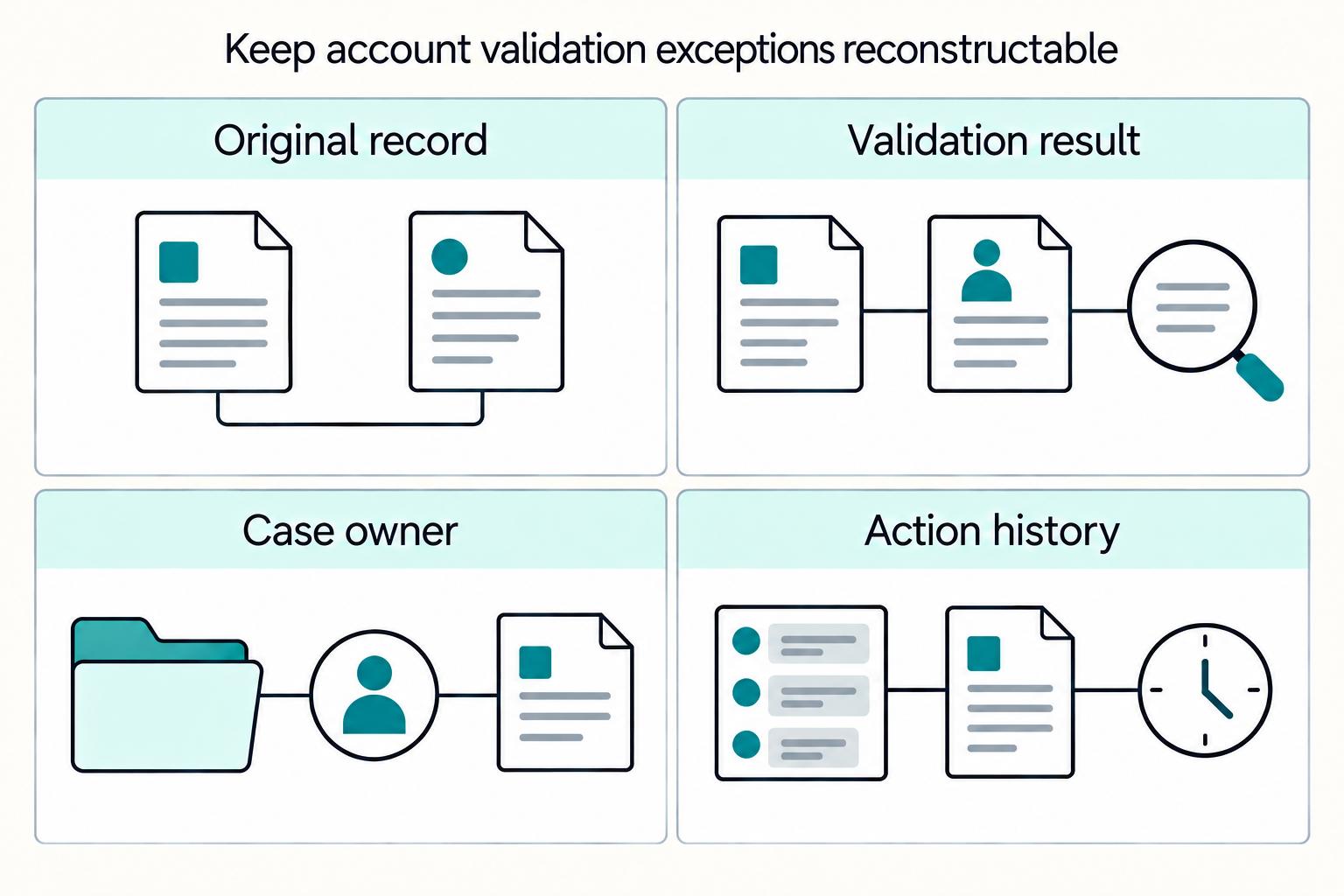
For mass payouts, the real question is not whether to verify payees. It is how much verification you require before release, who can override it, and what evidence you can produce later. If you cannot show that evidence on demand, your release rule is weaker than it looks.
What Is Source-to-Pay? How Platforms Can Automate the Full Procurement Lifecycle
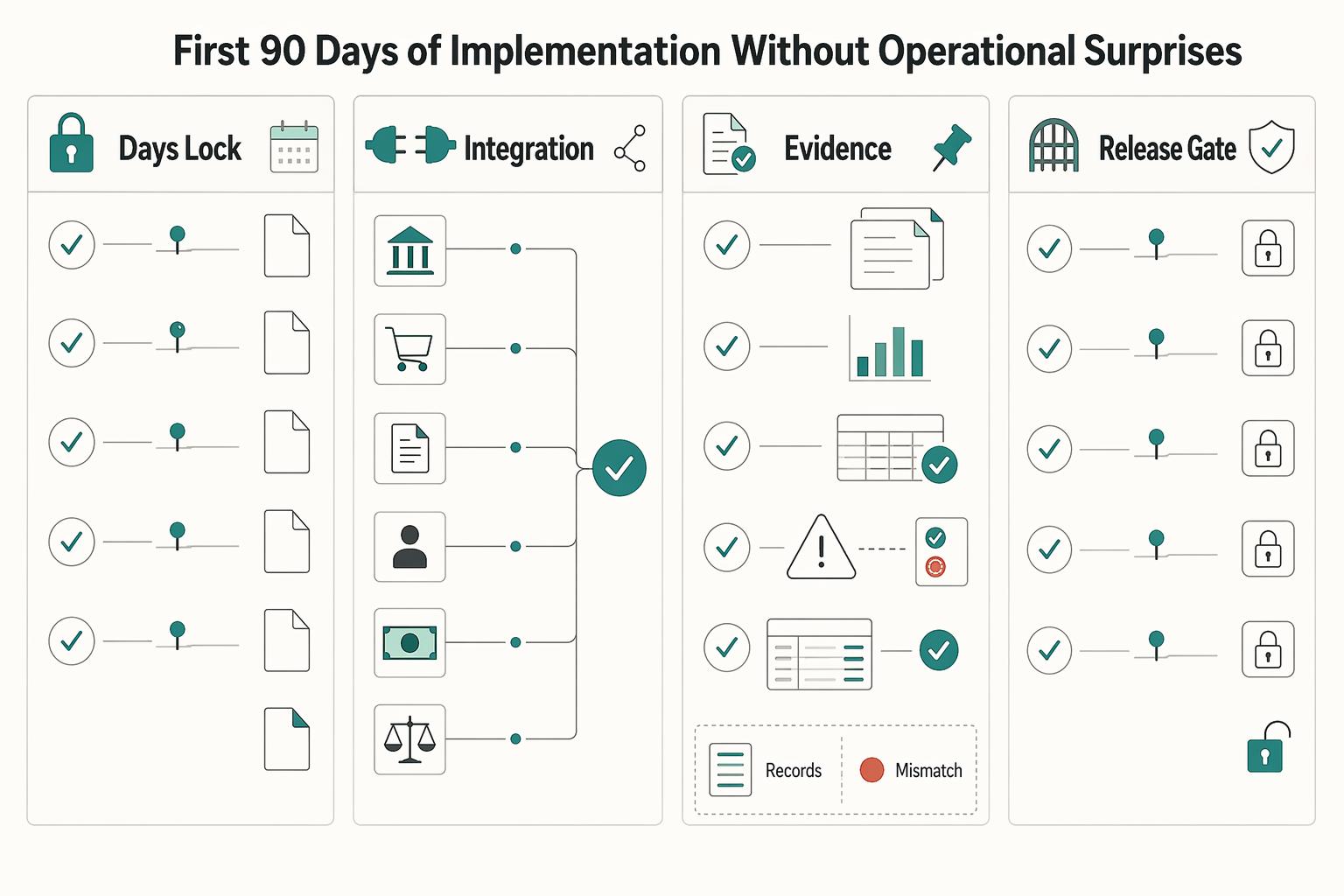
For platform teams, the pain usually does not sit in one isolated procurement task. It shows up in the handoff between finance, ops, product, and engineering as a supplier relationship moves from evaluation to agreement, purchasing, invoice review, and payout. A credible S2P platform should support that path end to end, not just the last mile of AP. In practical terms, the scope includes strategic sourcing, contract lifecycle management, procurement, invoice processing, and payment. You can frame S2P as four linked decisions:
Wire Fraud Prevention for Platforms: How to Spot Spoofed Bank Details Before You Pay
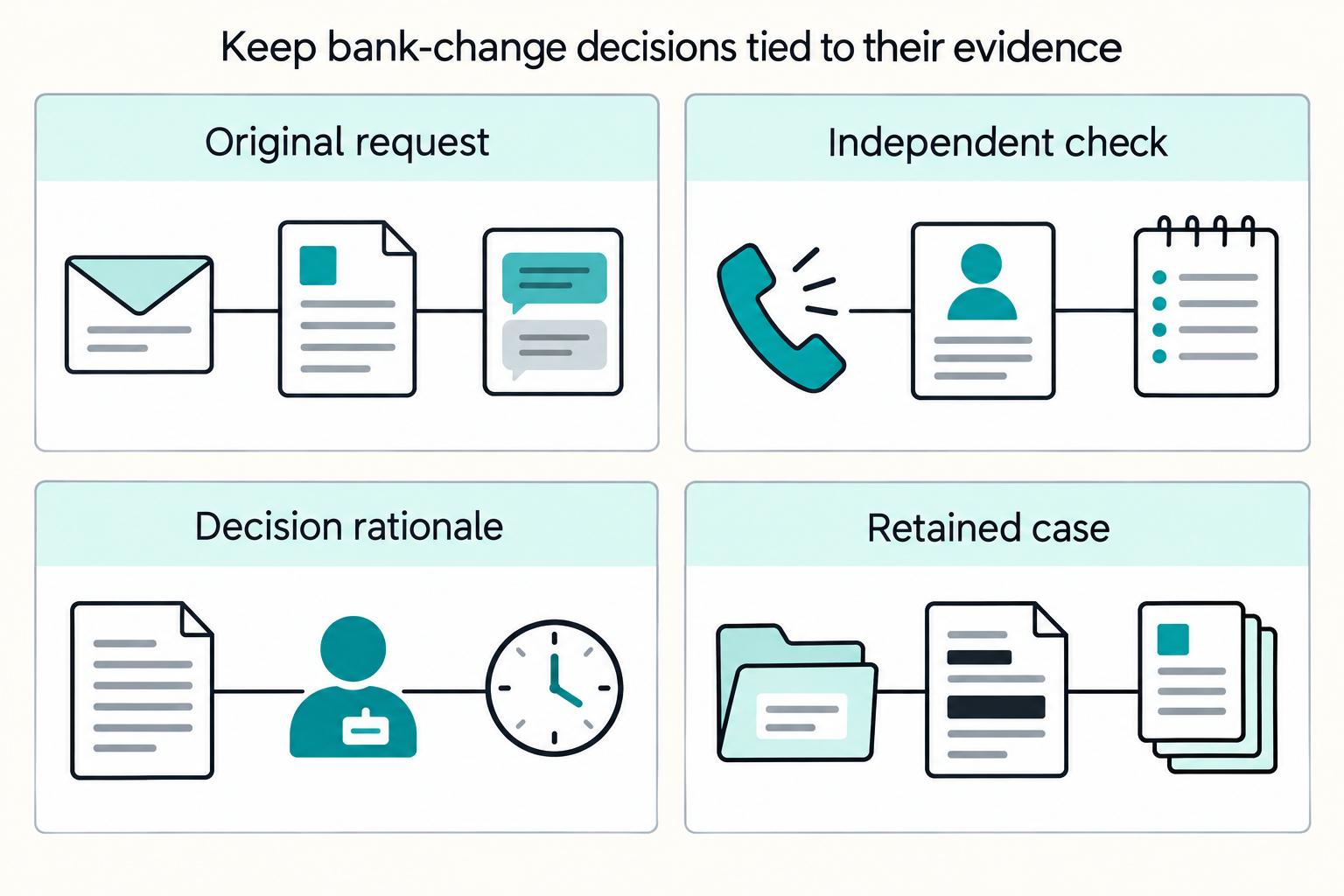
Wire fraud prevention for platforms is a pre-payment control problem. Once a payout goes to spoofed bank details, you may be dealing with a loss event, especially on rails like Fedwire that are immediate, final, and irrevocable once processed.