
Quick Answer
Agree the compensation denomination, receiving asset/network and fees, then confirm a provider supports that exact business payout. Verify recipients and usable funding, execute one authorized operation and reconcile delivery against the obligation. Investigate uncertain outcomes before any replacement; a subsequent failed offramp does not automatically make the invoice unpaid.
Define what the contractor will actually receive#
Pay-fiat-receive-crypto means your business funds a payment in government-issued currency and the contractor receives an agreed digital asset in a wallet. A provider may perform the conversion and delivery while you keep a fiat balance. The important implementation question is who owes what to whom at each stage, especially when conversion succeeds but delivery is uncertain.
Start with the compensation agreement, supported recipients and the complete money flow. Stablecoins can give a contractor another receipt option, but a wallet transfer does not automatically provide local spending money, eliminate funding reversals or make every corridor lawful. This guide gives six implementation steps and a worked fee example. Provider scope was checked on October 4, 2026.
Step 1: Agree the payout obligation and supported route#
Record the payer and recipient jurisdictions, individual or business status, compensation denomination, receiving asset and network, and who bears conversion and network costs. Obtain the contractor’s informed agreement to the receipt method and define what evidence satisfies the payment obligation under that agreement and applicable law.
A USD-denominated invoice paid in USDC differs from an obligation denominated in a fixed number of USDC units. State the valuation time and conversion method where relevant, including what happens if the quote changes. A stablecoin’s intended peg is not a guarantee that every exchange, withdrawal or merchant will value it at one dollar. Explain any extra steps and costs the recipient needs to spend or withdraw the asset.
| Flow | What happens | Implementation consequence |
|---|---|---|
| Provider converts and pays a wallet | Business funds fiat; provider delivers the agreed asset | Verify business-disbursement eligibility and the conversion/delivery contract |
| Fiat payout followed by recipient purchase | Contractor receives fiat and separately buys crypto | The purchase has its own consent, fees and verification; it is not your wallet payout |
| Crypto-to-fiat offramp | Digital assets convert into a bank payment | This is the reverse direction or a subsequent withdrawal, with separate eligibility and outcomes |
A hybrid policy chooses routes across these flows; it is not a third conversion mechanism. Compare the contractor’s usable receipt, fees, timing and support burden with the bank route available to that same recipient. Do not select crypto simply because an advertised blockchain speed is shorter than a bank’s processing window.
Step 2: Select a product that supports business disbursements#
Ask the provider to confirm your exact funding-to-recipient flow, eligible countries and entity types, supported asset/network pairs, fees, limits, approval requirements and legal roles. Inspect operational documentation and contract terms, then validate representative success and failure cases in the supported test environment.
Stripe Connect stablecoin payouts are documented as a private preview for US-based platforms, with access approval. The platform balance stays fiat while Stripe converts and pays out. Recipients must be eligible individuals or sole proprietors in supported countries, with Express Dashboard access; companies and nonprofits are excluded. The documented route uses the Transfers API. These restrictions make it unsuitable to assume universal corporate-contractor coverage.
Stripe’s onramp, by contrast, lets customers purchase crypto. Its merchant-of-record, verification and fraud/dispute responsibilities apply to that purchase product. They do not prove that the same integration accepts employer-funded disbursements or transfers all your platform’s compliance obligations to Stripe. Confirm the product rather than borrowing a consumer checkout sequence for contractor pay.
BVNK’s stablecoin payment guide explicitly includes contractor payments and describes converting an available fiat wallet balance into an external wallet payout. Its customer-payout model separately describes prefunded partner balances and customer onboarding. These are examples of documented business flows, not confirmation that your business, recipient or corridor is approved. Obtain the applicable product and contract confirmation.
Bundling conversion and delivery can reduce interfaces; a modular flow can give more control while adding operational boundaries. Neither guarantees better reconciliation. Require references linking the funding, quote, conversion, fees and delivery, including a partial-failure case. Ask MoonPay, Alchemy Pay, Request Finance or any other candidate for the same evidence without treating their product names as interchangeable implementations.
Step 3: Verify recipients, wallets and release controls#
Assign responsibility for individual identification, business and ownership information where applicable, sanctions/AML controls, wallet verification and jurisdiction-specific requirements. Make holds and release decisions explicit. Recheck relevant facts when a queued payout’s beneficiary, wallet, risk information or release circumstances change.
KYC for an individual and business verification for an entity are different checks. Not every individual needs a company KYB record, and provider checks do not by themselves establish that your platform has no duties. Confirm which regulated entity performs each required control and what evidence or decision you receive. Wallet-control evidence does not by itself establish identity or entitlement to the invoice.
Validate the exact asset, token identifier where applicable, network, destination and any required memo/tag against the recipient’s instructions and provider support. Similar-looking addresses on different networks are not proof of compatible delivery. An exchange may accept one network and reject another. Use a recipient-approved test where supported and appropriate, but do not treat a test as permission to bypass later checks or address-change controls.
OFAC’s virtual-currency guidance explains that sanctions apply to virtual and fiat transactions and recommends risk-based controls. Determine applicability through the parties, jurisdiction and transaction nexus. A blocked-property obligation differs from an ordinary failed payout: the compliance owner must direct holding, reporting and any authorized disposition. Changing to a bank rail must never serve as a way around a sanctions restriction.
Choose screening and monitoring points based on the legal and risk assessment, including changes while queued, rather than claiming three identical checks are universally mandatory. Keep the decision, responsible reviewer and necessary evidence linked to the payout. Restrict sensitive identity data and wallet information to those who need it, with the appropriate retention policy.
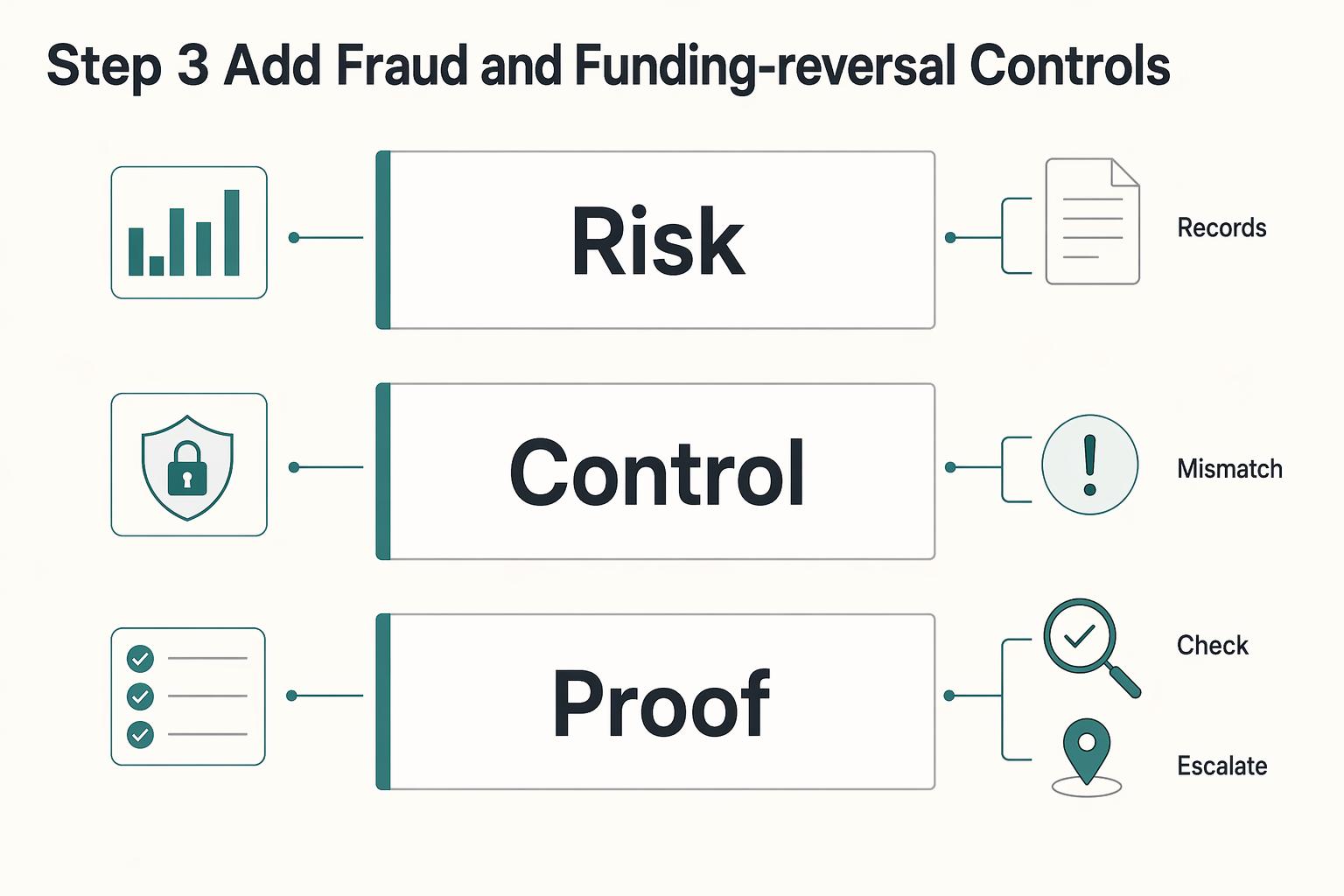
The diagram connects funding risk, controls and the evidence used to check or escalate a payout. Card or bank funding that appears available may still be reversible under its own rules. Set a release policy for liquidity, reversal exposure, reserves and approval limits. Do not declare all risk closed after an authorization or allow an operator’s undocumented override to release funds.
Step 4: Execute one funded payout and handle uncertain results#
Create a durable payout record before external execution and link it to the approved obligation. Confirm the release conditions and usable funding, apply a valid quote, then submit one authorized conversion/delivery operation. Store provider references and handle retries according to that specific API’s documented recovery and idempotency behavior.
Drafting an intent or reserving a payable can happen before funding arrives; releasing the external payment requires the approved conditions. Keep quote expiry, rate, asset units, fee allocation and acceptance state explicit. If the product executes conversion and delivery as one operation, record that boundary rather than inventing separate endpoints. If it has approval or reservation stages, use the documented stages and cancellation rules.
A timeout means the result is unknown until investigated. Query the original operation using its provider reference and supported recovery process before deciding whether another attempt is safe. Durable internal operation identity matters even when an API offers idempotency keys. Confirm the key’s scope, lifetime and parameter rules; a new key can create another payment. One invoice may have several legitimate adjustments, so do not permanently deduplicate everything merely by contractor ID.
Verify callback signatures using the provider’s procedure, deduplicate repeat deliveries and tolerate late or out-of-order notifications. Retrieve current authoritative status when required, and allow only documented state transitions. An accepted API request, provider-complete status, blockchain transaction and recipient’s spendable balance are different observations. Map each meaning explicitly instead of translating every successful HTTP response to paid.
Worked example: protect the agreed receipt and explain fees#
Assume a hypothetical USD 1,000 invoice, with the contractor consenting to receive 1,000 USDC at an illustrative one-dollar conversion quote and the payer bearing all execution fees. Suppose the provider fee is $10 and the network cost charged to the payer is $2. With no other costs, the payer needs $1,012: $1,000 for the agreed asset delivery plus $12 in expenses. These are illustrative amounts, not a provider’s price or a guarantee of the peg.
| Component | Illustrative amount | Evidence |
|---|---|---|
| Invoice obligation | $1,000 | Approved invoice and agreed receipt terms |
| Contractor receipt | 1,000 USDC on the agreed network | Conversion/delivery record and required confirmation |
| Provider fee | $10 | Itemized provider charge |
| Network cost | $2 | Itemized cost; specify who pays it |
| Total payer funding | $1,012 | Funding and provider records reconcile to receipt plus expenses |
Deducting the $12 from the agreed receipt and delivering only 988 USDC would not satisfy those example terms. If a fresh quote instead costs $1.01 per USDC, acquiring the same 1,000 units would require $1,010 plus the assumed $12 fees, totaling $1,022. Stop for the required budget or agreement approval rather than silently keeping the old funding amount and reducing the contractor’s receipt.
If the provider debits $1,012 but the callback times out, keep the operation under investigation. Sending another $1,000 by bank before resolving the original could pay the obligation twice. The response should explain that verification is pending, with a named owner and next update, while the original provider record and destination transaction are checked.
Step 5: Reconcile money, asset units and the obligation#
Link the invoice, funding reference, quote/conversion, fee lines, provider payment, network/transaction reference and internal accounting entries. Compare your records with provider, funding and delivery evidence. Keep usable liquidity, amounts in transit, held assets and outstanding payables distinguishable, with explicit exception ownership.
Do not net all movements into a single paid line or assume your internal ledger proves external completion. In the example, explain the $1,012 outflow as the $1,000 settlement allocation and $12 fees under the approved accounting treatment; separately retain the 1,000 USDC delivery evidence. A provider balance change without recipient confirmation remains a discrepancy to investigate, not a reason to force the status to paid.
Accounting close should include the appropriate treatment of assets held or in transit and unpaid obligations. Excluding unconfirmed transfers altogether can omit real balances or liabilities. Determine ownership, custody and settlement recognition from the actual agreement and accounting policy. A provider-managed conversion can avoid operating your own crypto wallet, but that does not automatically determine what appears on your books.
For US federal tax, the IRS digital-assets page treats digital assets as property and explains recordkeeping for services income and fair market value. Keep units, asset, receipt time and valuation evidence. Compensation reporting and covered-broker sale/exchange reporting are separate questions; a Form 1099-DA is not an automatic replacement for applicable contractor-compensation reporting. The IRS now provides Part II FAQs for transactions from January 1, 2025. Apply the relevant recipient jurisdiction and current-year rules rather than using old FAQ scope as a reason to omit the issue.
Confirm which party supplies required statements and reports for the actual flow, including any withholding or broker role. Subsequent sale, exchange or payment with the asset can have separate tax consequences. Retain the evidence needed for the parties’ obligations without promising one universal form or retention period for every country.
Step 6: Pilot recovery and expand only when outcomes reconcile#
Test successful delivery, changed destinations, expired quotes, compliance holds, funding reversals, repeated callbacks and uncertain submissions in supported environments. Run a controlled authorized pilot with clearly owned exceptions and contractor communications. Expand when both money and status reconcile; disabling future releases does not undo completed transfers.
| Situation | Action before another payment | What to communicate |
|---|---|---|
| Quote expired before execution | Obtain a valid quote and any required renewed approval | New cost/receipt and decision needed |
| Submission timed out | Investigate the original operation; prevent a second release | Verification pending and next update |
| Converted asset held; no confirmed delivery | Determine custody, available balance and supported cancellation/recovery | Current stage and who owns resolution |
| Wrong network or destination after broadcast | Escalate to provider/recipient support; do not promise recall | Known transaction details and recovery limits |
| Sanctions or AML hold | Follow the compliance decision; do not route around it | Permitted status and approved next steps |
| Recipient cannot offramp after wallet receipt | Distinguish withdrawal difficulty from initial delivery failure | Supported recipient options; no automatic replacement payout |
An alternate bank route can be appropriate when lawful, consented and supported, after establishing that the original payout will not also satisfy the obligation. Recover or allocate funds correctly, resolve costs and residual amounts owed, and authorize the new operation. Where delivery remains uncertain, hold the replacement while investigating. Where assets were already delivered, a recipient’s subsequent failed withdrawal does not alone justify paying the invoice again.
Set a practical operating record for each route: eligibility, limits, ownership, fee policy, evidence, support escalation and what happens during a provider or network outage. A route need not have an automatic replacement rail; a controlled hold and resolution procedure can be the safe response. Preserve completed financial history when pausing the pilot or switching providers.
Frequently Asked Questions
What does `pay fiat receive crypto` actually mean for contractor payouts?
Your business funds fiat and an agreed digital asset is delivered to the contractor’s wallet. Specify the compensation denomination, receiving asset/network, fees and evidence of discharge. Paying fiat first so the contractor separately purchases crypto is another flow; converting crypto into a bank receipt is the reverse direction.
Can we pay contractors in fiat and let them receive `USDC` without holding crypto on our treasury books?
Some provider-managed flows let the payer maintain fiat balances while the provider converts and delivers. Whether you own or recognize digital assets depends on the agreement, custody and accounting treatment. Confirm the specific product, eligible recipient and corridor; do not infer accounting treatment merely from the absence of your own wallet.
When should we choose `stablecoin rails` instead of `bank transfer` payouts?
Compare the recipient’s usable receipt, total conversion/network/withdrawal costs, funding and delivery timing, support and legal eligibility with the available bank route. Use stablecoin delivery when it fits those facts and the contractor agrees. A fast blockchain transaction alone does not establish a better end-to-end payout.
What are the non-negotiables before go-live for `KYC`, `KYB`, and `AML`?
Confirm applicable duties and provider roles, individual versus business verification, sanctions/AML controls, exact wallet asset/network and release conditions. Record holds and reviewer decisions and recheck relevant changes before release. A bank fallback cannot bypass blocked-property or other compliance restrictions.
How should we evaluate MoonPay Ramps, Alchemy Pay, Request Finance, and BVNK claims without relying on marketing pages?
Ask each candidate for the exact business-disbursement product, eligible jurisdictions/entity types, money-flow diagram, legal responsibilities, fee allocation, API/status definitions and recovery procedure. Validate one success and partial failure in the supported environment and inspect contract terms. A consumer onramp or reverse offramp is not interchangeable with contractor wallet delivery.
What should we ask vendors about `webhooks`, `idempotency`, and reconciliation before signing?
Ask about signature verification, repeated and out-of-order events, authoritative status retrieval, idempotency scope/lifetime, unknown-result recovery and references linking funding, conversion, fees and delivery. Require evidence for partial completion and cancellation, then show that retries cannot discharge the same obligation twice.
What fallback should we run if a `crypto-to-fiat offramp` route fails in production?
First distinguish a failed initial payout from a failed withdrawal after crypto already reached the contractor. Investigate the original outcome and funds before considering a replacement. An alternate bank payment needs lawful eligibility, consent, authorization and protection against duplicate payment. If crypto was delivered, offramp difficulty alone does not mean the invoice remains unpaid.
Try a related tool
Researched and edited by the Gruv editorial team. Gruv builds cross-border billing, payouts, and finance-operations software for global businesses.
Sources
Includes 2 external sources outside the trusted-domain allowlist.
- docs.stripe.com/connect/stablecoin-payoutstrusted
- docs.stripe.com/crypto/onramptrusted
- irs.gov/filing/digital-assetstrusted
- irs.gov/individuals/international-taxpayers/frequent...trusted
- ofac.treasury.gov/media/913571/downloadtrusted
- docs.bvnk.com/bvnk/use-cases/stablecoin-payments-for-platf...external
- docs.bvnk.com/bvnk/use-cases/stablecoin-payments-for-platf...external
Educational content only. Not legal, tax, or financial advice.
Related Posts
Freelance Crypto Payments That Protect Cashflow and Reduce Disputes
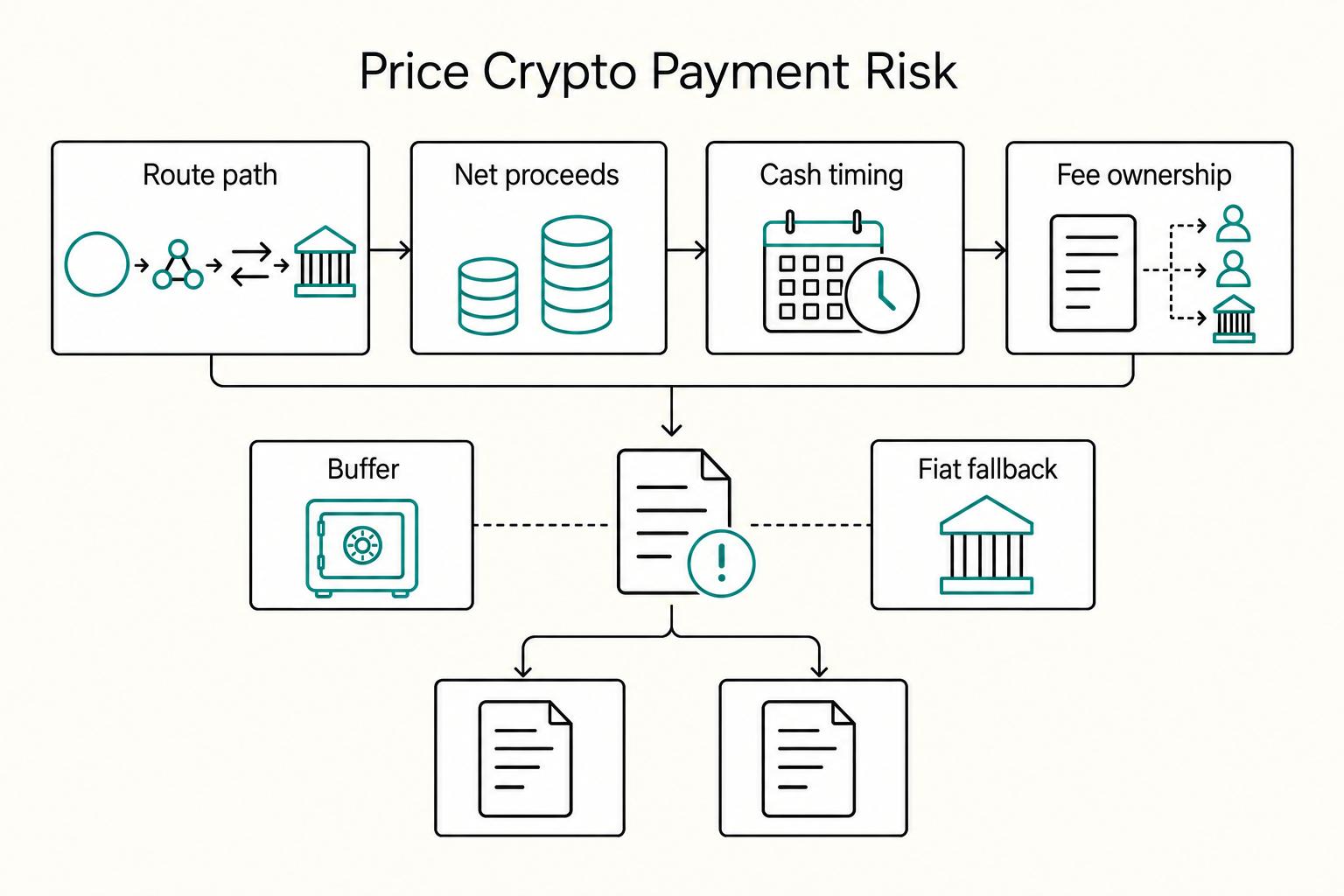
Crypto payments make sense only when they improve how reliably you get paid after you plan conversion, compliance, and recordkeeping up front. They can reduce friction in some international setups where traditional platforms add fees, restrictions, or extra steps. They also move risk onto conversion timing, exchange-fee exposure, and documentation quality, so use a simple acceptance test before you agree:
How to Get Paid in Crypto as a Freelancer (and Manage the Risks)
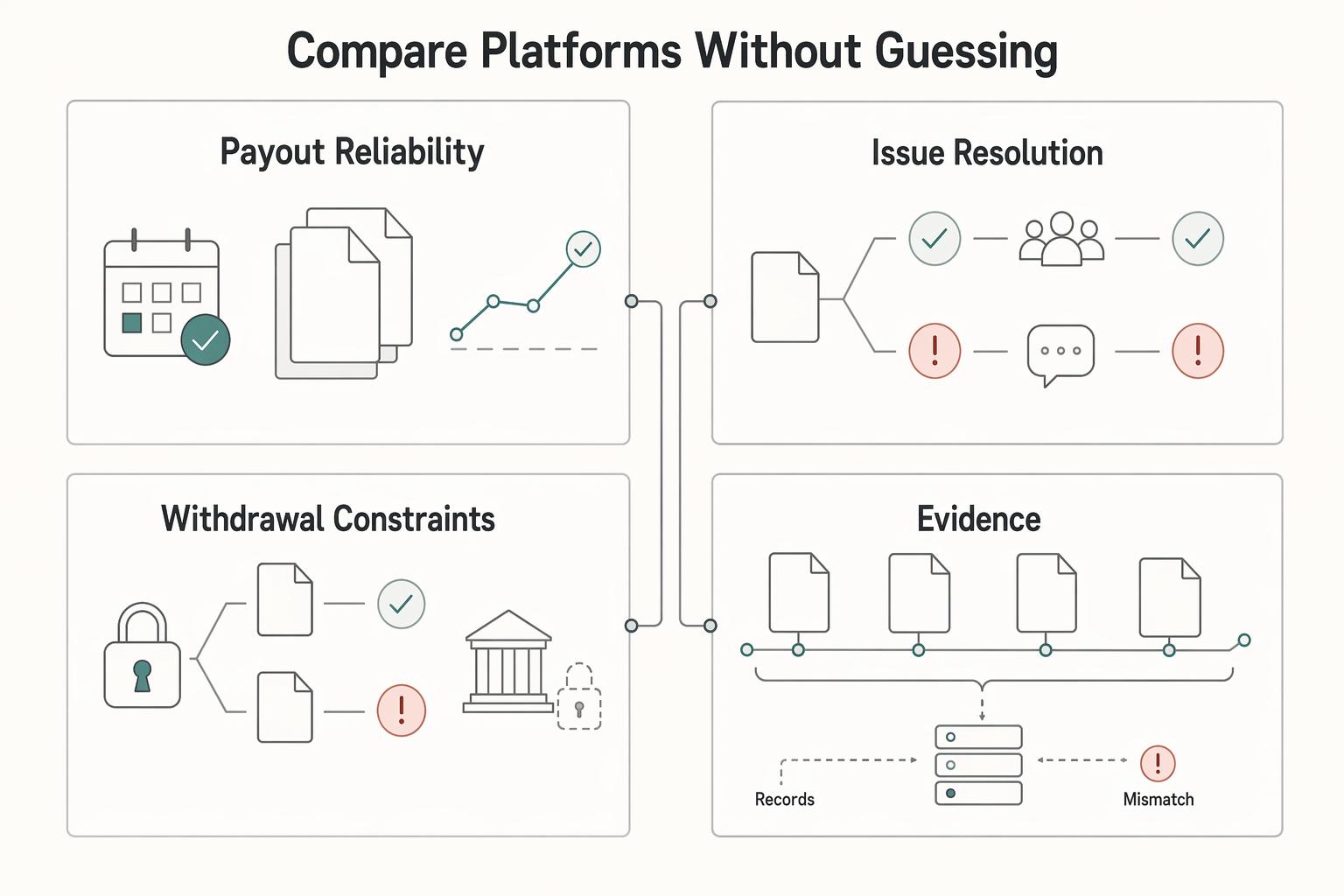
When a client wants to pay in crypto, compare the whole route: network costs, conversion spread, withdrawal fees, receipt timing, and the records you can retain. The goal is a payment you can verify and reconcile, with enough time to turn it into the currency needed for your expenses.
The Pros and Cons of Accepting Cryptocurrency Payments
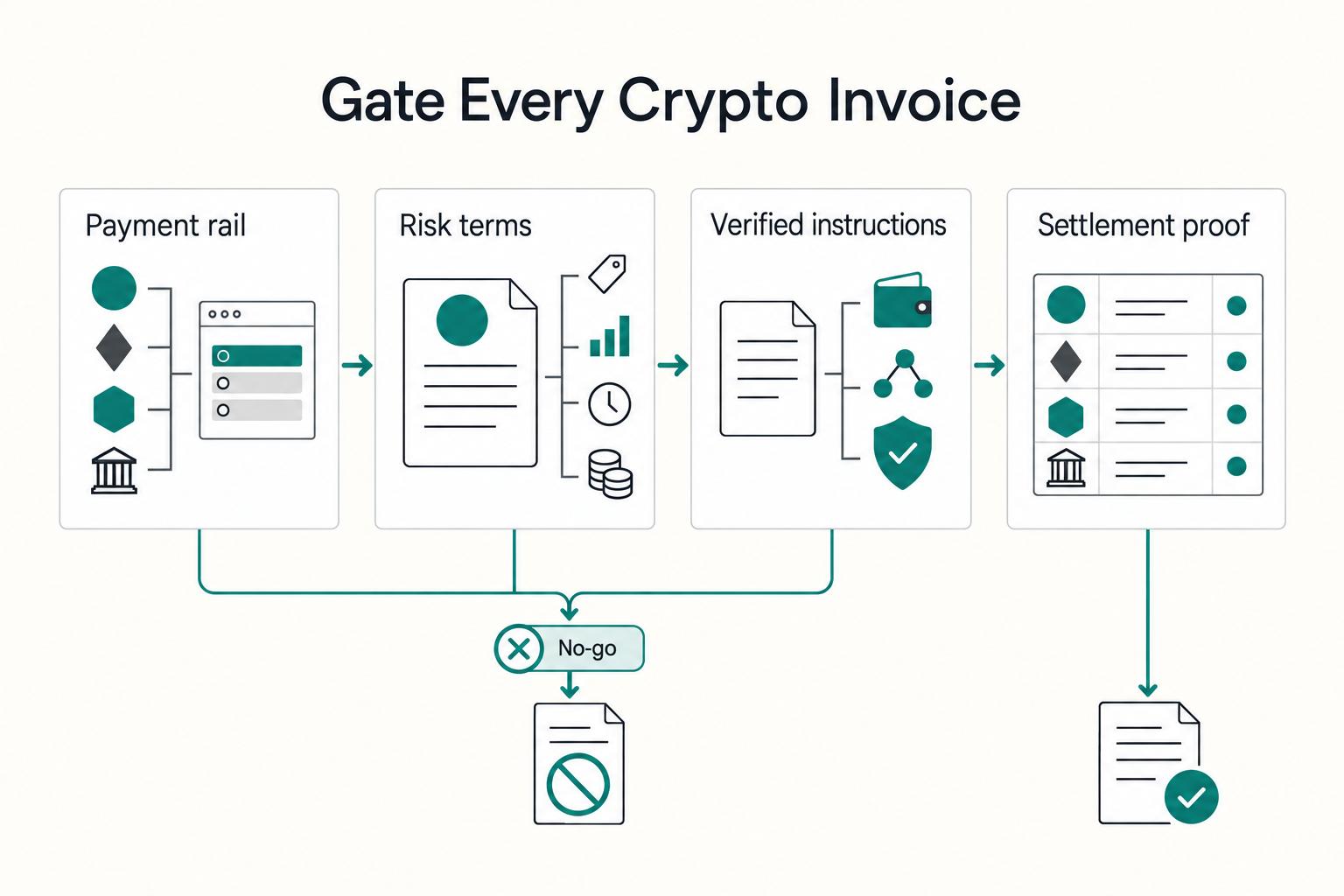
**Accepting crypto payments works when you set the terms before you send the invoice: how payment is received, which asset is sent, and your settlement policy.** If those terms are vague, you are taking on avoidable cash-flow and tax risk.