
Quick Answer
Start by scoring each market only on evidence you can retrieve, then block launch where key cells remain unknown. For this topic, concrete anchors include FBAR (FinCEN Form 114) timing, the April 15 due date, the automatic October 15 extension, and the fact that corrections are full amended refiles. Keep onboarding proof, sanctions outcomes, and ownership in one case trail before approving first payout.
Score regulatory burden before launching a market#
Use this watchlist to rank expansion markets by payment operability, not just demand. The real question is whether you can pay contractors with controls that hold up, support costs you can absorb, and evidence you can defend when exceptions or incidents happen. This gives you a decision-ready way to compare regulatory risk, control burden, and operating cost before you commit product, compliance, or GTM resources.
The early warning sign often appears before teams treat it as a legal issue. A March 30, 2026 Nasdaq-hosted release on an H&R Block Canada-commissioned survey points to 2024 legislation requiring digital gig platforms to report user income to the CRA. It also says the CRA can cross-reference platform-reported figures against taxpayer filings. Even if your primary market is elsewhere, the practical lesson is that payment-linked rules can change what data you need to collect and retain.
Contractor records that are good enough to pay from are not always good enough to report from. DAC7 wants the jurisdiction of residence, a tax identification number or an explicit statement that none is available, and the consideration split by quarter, which is a stricter shape than a payout ledger usually holds. DAC7 and DPI reporting for platforms sets out the full data set.
The scope here is narrow by design. This is not a general explainer on platform law or worker classification. It focuses on payment-adjacent entry decisions across target markets, including EU, U.S., and cross-border models, while treating market-specific legal details as unknown until verified. That includes onboarding controls, payout controls, reporting burden, and the evidence needed to show your policy and your payments stack match in practice. If a local requirement is unclear, treat that uncertainty as risk, not as a green light.
Speed matters only if your controls survive scale. One gig-focused vendor source frames the core tension as rapid onboarding versus strong identity verification, and the same source says up to 15% of gig-economy accounts show signs of being fake or duplicate. You do not need to treat that figure as universal to apply the takeaway. Define who gets activated, who gets paid, and what evidence is stored when exceptions are approved.
By the end, you should have four working outputs: a market scoring table, a minimum control stack for first payout, a launch evidence pack, and explicit go or no-go checkpoints for phased rollout. These are management tools, not legal substitutes, but they are what separate a market that looks attractive from one your team can operate without constant overrides.
Tax reporting belongs on the watchlist early; Gig Worker Tax Compliance at Scale covers 1099, W-8, and DAC7 scale issues.
What a gig platform regulatory watchlist actually includes#
A useful watchlist is not a law digest. It is a living tracker of what can stop onboarding or delay first payout once money starts moving, organized by country and payment flow.
Start by separating the issues teams often collapse into one compliance bucket. Digital labor platforms are platforms that intermediate work between businesses and independent contractors. From there, track distinct domains:
- Onboarding controls: identity fraud, worker legitimacy, and KYC/AML risk during onboarding.
- Payout controls: what must clear before funds are released, such as real-time payment screening of senders, beneficiaries, and related payment parties for sanctions risk.
Keep those domains separate because the failure modes are different. A market can look clean from a product view and still be operationally weak if self-serve onboarding is loose. Rapid onboarding and strong identity verification are often in tension, so shortcuts raise risk.
Use one rule to keep the watchlist practical. If a control can block or delay payout, it belongs on the watchlist, even if product or ops treats it as routine. Track the proof you would need by country and corridor, including screening results and policy logic. If you cannot show that evidence, treat the market as not ready. Once the watchlist is structured this way, you can score markets based on what you can actually prove.
For the law-change scan itself, Gig Platform Regulatory Radar 2026 gives the broader regulatory radar to compare against your market list.
The market scoring matrix founders should use before launch#
Use a split-column matrix with an explicit confidence column, and score only what you can prove. You can score FBAR-linked tax and reporting items and some filing-related operational burden. FATF, EU AMLR, the FinCEN Beneficial Ownership Rule, local enforcement posture, and vertical enforcement differences should stay marked as unknown.
Keep one row per market, with a vertical tag if needed, and avoid collapsing everything into one blended score. A simple burden scale of 1 light, 2 moderate, 3 heavy plus confidence of low, medium, high is enough if your evidence rules are strict.
| Column | What to score | Concrete signals you can use now | Mark as unknown when |
|---|---|---|---|
| Labor risk | Contractor-model exposure, including algorithmic-management-related exposure | Confirm with the relevant authority | You do not have primary local legal or enforcement support |
| Onboarding obligations | Identity/KYC/background-check burden | Confirm with the relevant authority | You are inferring from general practice |
| Payout obligations | Payout gating and control friction | Confirm FATF, AMLR, and Beneficial Ownership requirements with the relevant authority | Support is only generic or global |
| Tax and reporting load | Filing triggers, data capture, deadline pressure, correction effort | FBAR (FinCEN Form 114); $10,000 trigger; no filing if threshold not met during the calendar year; due date April 15th; automatic extension October 15th; amendment requires a full refile with Amend in Item 1 | You have not confirmed in-scope filing responsibility |
| Operational cost to serve | Manual review, exception handling, rework risk | Required XML elements can cause rejection if missing; item 15a amount unknown checkpoint; special handling references for filers with fewer than 25 accounts when aggregate maximum value cannot be determined; exchange-rate source must be verifiable if Treasury rate unavailable | No owner or tested filing workflow exists |
| Confidence | Evidence completeness and execution readiness | Primary source checked, owner assigned, execution path documented or tested | Any required source, owner, or execution proof is missing |
Score the tax, reporting, and operational columns first because that is where this pack gives you concrete checks. For example, maximum account value must be captured as a reasonable approximation. Your process should preserve the valuation method, exchange-rate source when applicable, and approval trail so filing decisions are auditable.
Treat correction and submission mechanics as launch inputs, not admin cleanup. If a required XML element is missing, submission can be rejected. If an FBAR is wrong, the correction path is a full amended refile, not a minor patch.
For unsupported areas, keep the cells blank or unknown on purpose. That includes FATF, AMLR, Beneficial Ownership scoring, local enforcement comparisons, and vertical differences such as rides, delivery, or household services until you have primary support.
Use confidence as a rollout signal. If confidence is low, do not treat the matrix as a full green light; close the unknowns before making launch-readiness decisions.
Related: Real-Time Payment Use Cases for Gig Platforms: When Instant Actually Matters.
How labor model risk changes the payment design#
Labor-model risk should affect payment design, not just legal notes. If Independent contractor classification risk is elevated or still unproven, use a payout flow that is slower to release, easier to explain, and easier to reconstruct in disputes.
A low-confidence labor assessment is a poor fit for fully automated, hard-to-reverse payouts on day one. Even without a specific legal payout mandate, you can design in checkpoints before exceptions turn into money movement.
Where the pressure shows up first#
The pressure can show up in payout timing, worker eligibility checks, and reserve decisions:
- Payout timing: In markets with active classification or privacy scrutiny, avoid defaulting every cohort to instant payout on day one. A batch cadence can create review time before funds move.
- Worker eligibility checks: For Digital labor platforms, make sure the payout system has required decision fields before release, for example market, service type, contracting entity, and the status used to approve payment flow. If those fields exist only in product or support tools, payment ops can end up guessing.
- Reserve policy: Do not invent fixed reserve ratios or hold rules. Instead, require a named owner, a reason code, and a release path for any reserve or delayed release tied to labor uncertainty.
Active scrutiny versus light evidence#
Treat scrutiny signals as current operating conditions, not permanent labels. One provided market article says classification and privacy risks could slow rollout in regulated states like California. That supports a cautious posture there, but not a full jurisdiction ranking.
If your support is thin, mark labor risk as unknown and keep rollout constrained. That is safer than optimizing for speed and redesigning payout controls after disputes.
Payment architecture choices that age better#
A few design choices make this easier to manage later. Separate earnings calculation from payout release. That keeps earnings visible while disbursement stays gated when classification or onboarding exceptions are unresolved, and it makes disputes easier to trace by issue type.
Use one exception trail across onboarding, ongoing monitoring, and payments. One provided fintech commentary describes screening as noisy and manual, and says fragmentation across those stages drives inconsistent decisions and duplicated work. The same failure mode can break labor-related payout decisions.
At minimum, keep an evidence trail for hold and release rules, reason codes, and event timestamps. If legal research relies on a FederalRegister.gov XML page, verify it against the official edition or govinfo PDF, because the XML rendition does not provide legal notice.
For a step-by-step walkthrough, see Gig Economy Payment Trends 2026 for Platform Operators.
The minimum onboarding controls before first payout#
The first payout gate should be strict and evidence-based. Moving fast without compliance controls increases regulatory and fraud exposure, so complete verification and recordkeeping before release.
Put checks in payout order#
Start with identity proofing. Keep identity documents, core payee data, banking details, and tax forms in the same pre-payout onboarding flow so approval status does not fragment across tools.
Use tax validation as a concrete checkpoint: collect W-8 or W-9 forms during signup and validate TINs against IRS records where applicable. If you run watchlist checks before release, store those results in the same onboarding session record.
Legal requirements vary by jurisdiction#
Treat the controls above as an operational baseline, then map any additional jurisdiction-specific legal requirements for each program and payment corridor.
No evidence, no payout release#
Do not leave this to judgment calls under pressure. Set a hard internal rule: if onboarding evidence is incomplete, payout stays policy-gated.
A common failure mode is fragmented review across systems. Use one shared session or case record that logs each control-step result and the final release decision.
Store the evidence you will need later#
If you claim strong verification controls, be ready to show evidence that matches those claims. At minimum, retain:
| Evidence record | Details |
|---|---|
| Shared onboarding session or case record | With each control-step result |
| Identity verification outcomes | Supporting onboarding documents |
| Tax form collection and TIN validation results | Where applicable |
| Watchlist screening results | Used in the release decision |
| Final hold or release decision | Tied to that same record |
This evidence supports clean first-payout decisions and later proof that policy was applied consistently.
For African payout corridors, Choosing M-Pesa, Chipper, or Local Rails helps validate rail choice alongside compliance scoring.
The payout compliance stack that prevents expensive surprises#
Your payout compliance stack should make each release, hold, or escalation decision explainable, not just add more checks.
What belongs in the stack#
The stack works best when it carries one connected decision trail across five control layers:
| Control layer | Purpose |
|---|---|
| Customer Due Diligence (CDD) | Keep ID&V, CDD, KYC, and AML checks connected from onboarding into case review |
| Risk-based review | Apply more or less scrutiny based on user risk and transaction context |
| Sanctions screening | Flag potential matches to block or pause for review under your policy |
| Politically Exposed Persons (PEP) screening | Treat PEP exposure as a separate risk signal when your policy calls for enhanced review |
| Escalation to SAR handling | Route suspicious cases to investigation and possible SAR handling instead of clearing them as routine support exceptions |
If these controls live in separate tools without shared case history, reviewers can lose context and audits can turn into reconstruction work.
Tune for risk, not maximum friction#
More controls are not automatically better. Tighter settings may reduce exposure, but poor tuning can still create avoidable review friction. A common failure mode is weak remote identity verification, which can let fraudsters create fake accounts before detection begins.
Keep identity and CDD connected to reviewable risk signals where your provider supports them, including phone, email, IP, browser, and device data. Those signals do not replace sanctions or PEP checks, but they can help explain why a payout should be held.
Recalibrate when payment patterns change#
When payment patterns change, revisit monitoring settings before scaling spend.
Check alert volume, hit reasons, release times, and whether new corridors shift the mix of sanctions matches, PEP flags, or manual investigations. If they do, update policy logic and reviewer guidance before expanding further.
What audit-ready looks like in practice#
In practice, audit-ready review often includes records for each blocked or released payout, such as:
- traceable policy logic
- reviewer identity
- event-level logs of status changes
- evidence reviewed
- documented overrides or exceptions, including reason, approver, and scope
That record is what separates a mature stack from one that only looks complete until incident review.
Turn the watchlist into policy language with How to Write a Payments and Compliance Policy for Your Gig Platform.
Tax and reporting obligations that change market attractiveness#
Tax and reporting workload can make a market less attractive before demand or payout economics do. Two markets can look similar commercially, then diverge once you account for document collection, year-end reporting prep, and support load.
Treat this as its own decision column. If launch depends on collecting tax documents and producing jurisdiction-specific reporting outputs, you are adding ongoing intake logic, follow-up, exception handling, and support work. This is not just forms.
Document flows drive cost before filing season#
The main cost driver is whether your systems can produce clean reporting records without manual reconstruction. Markets get more expensive when tax identity data, contractor status, payout totals, and reporting outputs sit in disconnected tools.
Use a simple readiness check: sample contractor profiles and confirm you can pull the source document or attestation, current status, country or tax-residency field, and payout totals from one audit trail. If you cannot, support burden rises later and that market should rank lower.
That is why similar markets can have very different support costs. One may run on clean intake and export logic. Another may require repeated document collection and a larger queue of tax-form support tickets.
US connected edge cases are usually support signals, not platform filings#
Some contractor populations trigger adjacent U.S. reporting questions that affect support even when they are not platform filings. Form 8938 is a good example. IRS guidance says it is used to report specified foreign financial assets when the applicable threshold is exceeded. It is attached to the annual return by that return's due date, including extensions.
Thresholds are not one-size-fits-all. IRS materials cite a $50,000 aggregate trigger for certain U.S. taxpayers. They also note higher thresholds for joint filers or taxpayers residing abroad, and Form 8938 instructions reference more than $50,000 at year-end or more than $75,000 at any time for certain specified domestic entities. Filing Form 8938 also does not remove a separate FBAR requirement, FinCEN Form 114, when FBAR applies.
Treat these as support-design signals. Questions about FBAR, FinCEN Form 114, or Form 8938 may reach your team, but filing responsibility can still sit with the contractor.
Final checkpoint before you rank the market#
Before final ranking, confirm scope in writing:
- whether reporting work is owned by the platform, a provider, or the contractor
- what data fields and documents are required at onboarding versus later
- who owns escalation for Form 8938 and FBAR (FinCEN Form 114) questions
- what evidence proves readiness, including sample records, output mapping, and clear exception ownership
If two markets are close commercially, prioritize the one with clear, testable ownership. If scope is still fuzzy or reporting data depends on manual patchwork, downgrade it until legal, tax, and operations align.
Related reading: FedNow vs RTP for Gig Platform Contractor Payouts.
The launch evidence pack every market owner should complete#
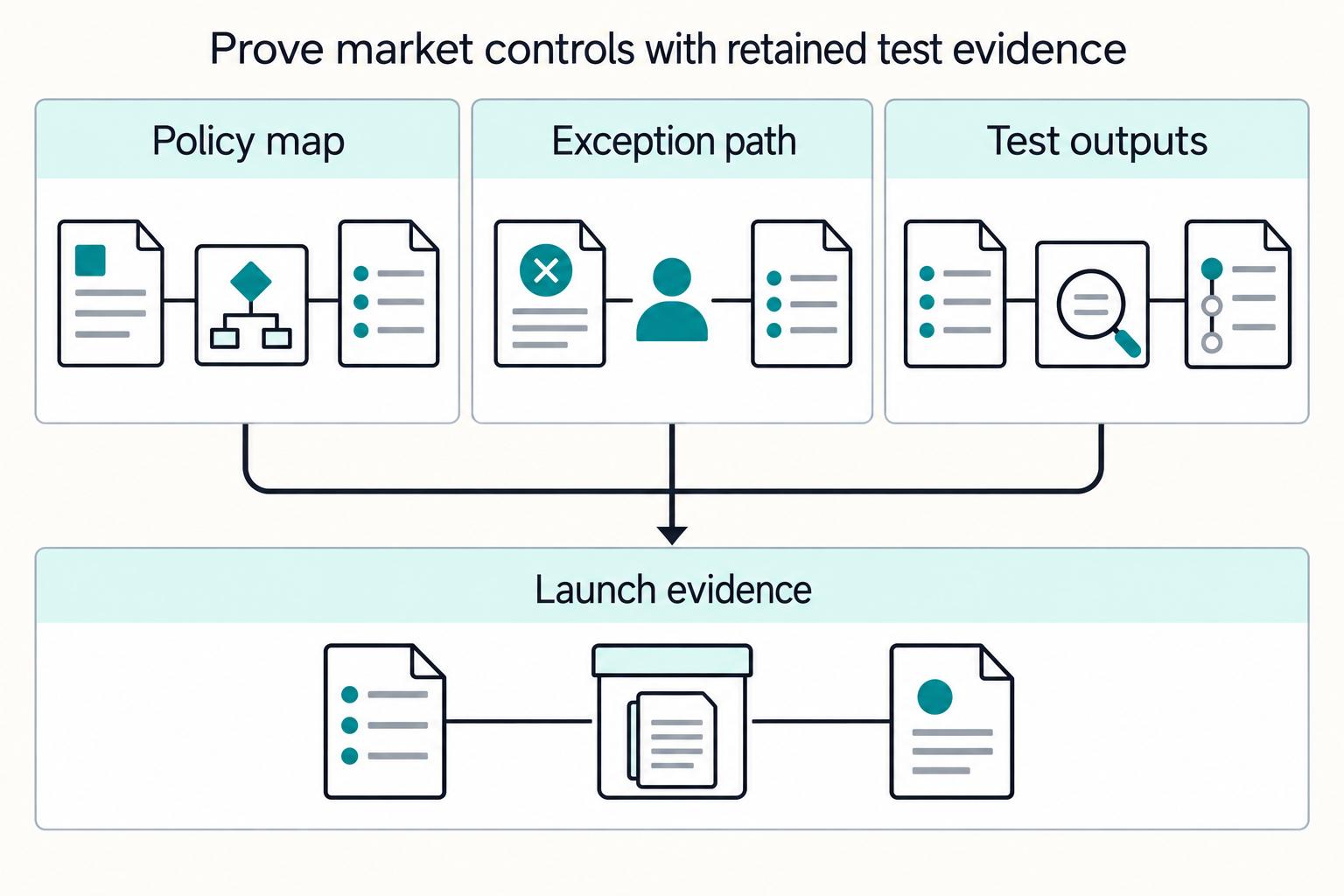
Treat the evidence pack as a launch gate. If you cannot show signed, archived proof of how controls work in-market, launch readiness is still unproven. The pack should show both policy intent and the exact system and operations behavior that enforces it, especially where you claim strong verification or step-up checks.
| Evidence artifact | What it must prove | Primary owner | Due date |
|---|---|---|---|
| Legal memo | Market-specific view of onboarding, payout, and reporting obligations, plus open questions | Legal | Before GTM commitment |
| Compliance control map | Mapping from policy to product and ops behavior, including applicable onboarding and payout checks, recovery and re-screening paths, and override approvals where used | Compliance with Product | Before build freeze |
| Payout exception path | Who reviews blocked payouts, what evidence is required for release, and what remains blocked | Payments Ops | Before pilot approval |
| Reconciliation test outputs | Evidence of payout state changes, failed-payment handling, and recovery-path consistency | Finance or Payments Ops | Before production go-live |
Policy must map to behavior#
The highest launch risk usually sits in the gap between policy language and real workflow behavior. A statement like "strong verification before first payout" is incomplete unless your pack also shows the gating point, review trigger, possible status states, and who can override a hold where that path exists.
Be explicit about identity and payout-check behavior in your own flow design. If payouts can proceed after partial review in defined cases, document the condition and approver. If a risk flag can block release, show where the block sits, how cases route, and what evidence is required before release.
A practical standard is one audit point that records evidence, gates actions by policy, and captures each step result in the same session record. If logic changes require app rebuilds or evidence lives across disconnected tools, governance gaps become harder to manage. SDK-only setups can also miss centralized management and workflow orchestration.
Use a quick proof test: one approved profile, one rejected profile, and one manually reviewed profile. For each, confirm you can reconstruct document or check results, timestamps, reviewer identity, and final decision state from the same session record.
Prove the ugly cases, not just the happy path#
Launch evidence should include failure and exception behavior, not just successful onboarding screenshots.
Start with a failed payout simulation. Show post-failure status, ops visibility, and recovery handling. For recovery, verify retry behavior is controlled so repeated requests do not create duplicate releases for the same obligation.
Then test risk-flag handling. Include the case record, disposition notes, release or reject decision, and approval trail. If that review path is not recoverable in records, the control is hard to defend.
If background checks are in scope, keep those artifacts equally concrete: disclosures, consents, adjudication notes, adverse-action pauses, and relevant state-law overlays. When technology is unreliable, opaque, or manual, operations usually absorb the exception burden.
Archive the pack like you expect to defend it#
Archive signed evidence in a controlled repository, not an editable shared folder. A strong model is explicit archive access permissions, such as a View Archive permission, plus immutable archived records that cannot be casually altered.
This matters because controls evolve over time. You can update policy-driven workflows without app rebuilds, but you still need the exact approved version and revision trail that supported launch at the time.
Governance and the stop rule#
Before GTM commitment, use cross-functional sign-off so legal, product, and payments ops each confirm their part of launch readiness. Without that alignment, the evidence pack is still a draft.
Set the minimum bar as an internal operating rule: no signed evidence pack, no country launch. That is a governance choice, not a universal legal requirement, but it is the clearest way to avoid treating policy slides as proof that controls are live. Before you lock a country launch, map each required control to a system behavior and owner using Gruv's docs.
How to phase expansion without creating compliance debt#
Use phased expansion as an internal control discipline, not a source-validated legal formula. The current source set supports auditable checkpoints and failure-mode review, but it does not establish payout-specific phase mandates or universal thresholds.
One internal sequence you can use is:
- Limited corridor pilot
- Controlled volume ramp
- Broader rollout only after an internal audit and reconciliation pass
Define go or no-go gates before growth pressure starts, and treat them as your own operating rules. You can use internal signals like incident trends, exception aging, and unresolved screening cases, but required numeric cutoffs for those signals are not provided here.
Set one explicit stop rule in advance: if unresolved compliance exceptions move beyond your internal tolerance, pause expansion and fix controls before scaling again. That is a governance choice, not a universal legal requirement.
Tie rollout pace to operating capacity. If investigation throughput, policy-change control, and regulator-response readiness cannot keep pace with payout volume, hold the phase change until records and review quality are defensible.
When rollout volume grows, How to Scale a Gig Platform From 100 to 10000 Contractors turns the same controls into an infrastructure checklist.
Mistakes that make watchlists look complete when they are not#
The core failure is false completeness. A watchlist can look thorough while still missing the evidence and market-specific detail needed for real decisions.
| Mistake | Why it weakens the watchlist |
|---|---|
| Treating global guidance as local truth | Obligations are tied to where you hold a license or registration, and some duties can follow cross-border flows |
| Confusing document collection with compliance completion | Collected forms are inputs, not proof; reviewers expect evidence that controls were tested for effectiveness |
| Measuring growth while ignoring control quality | Growth metrics alone can hide risk; watch false-positive load and missed-risk tradeoffs so tuning is visible in operations |
| Letting assumptions go stale after operational changes | If your risk profile, licensed markets, or cross-border flows change, retune and refresh the supporting evidence |
- Treating global guidance as local truth: Jurisdictions should not be handled as single-rule environments. Obligations are tied to where you hold a license or registration, and some duties can follow cross-border flows. If a U.S. legal interpretation is material, do not rely on an informational FederalRegister.gov page alone. Verify against an official Federal Register edition.
- Confusing document collection with compliance completion: Collected forms are inputs, not proof. Reviewers expect evidence that controls were tested for effectiveness, with explicit policy references, title plus version or date, and section-level pointers they can validate quickly. A yes-or-no response is weak evidence and may be returned for correction.
- Measuring growth while ignoring control quality: Growth metrics alone can hide risk. Watch false-positive load and missed-risk tradeoffs so your tuning is visible in operations, not only in policy text.
- Letting assumptions go stale after operational changes: If your risk profile, licensed markets, or cross-border flows change, retune and refresh the supporting evidence. Until that refresh is complete, treat prior watchlist assumptions as provisional.
Conclusion#
Expansion quality depends on evidence, not broad claims that a market is "compliant." Treat a market as ready only when you can show what controls exist, what they produced, what is unresolved, and who owns the decision to proceed.
That is the practical value of a watchlist. It separates verified checks from assumptions. If a row says controls are in place but you cannot retrieve the underlying outputs and audit trail, you have a status label, not launch readiness.
Build and score the watchlist now, then fund only markets that pass all three gates:
- Control gate: staged checks run from identity verification to role-specific screening and ongoing monitoring where relevant.
- Documentation gate: records are audit-ready across onboarding data, sanctions checks, risk assessments, and transaction logs.
- Ownership gate: unresolved items and release criteria have clear accountable owners.
Use a Risk-Based Approach rather than a single global template. Tune due diligence by jurisdiction, transaction amount, and worker profile so control strength and operating load are visible before scale.
Keep legal-source confidence explicit. If a rule interpretation depends on an informational FederalRegister.gov page rather than an official Federal Register edition, or on a source that was not fully accessible, treat confidence as low until it is verified against an official publication.
Score markets, keep evidence strict, and do not let GTM urgency outrun operational proof. If you need to validate payout control design and audit trails by market, confirm coverage where supported before you commit.
If you want a market-by-market sanity check on payout controls before committing GTM budget, talk to Gruv.
Frequently Asked Questions
What is a gig platform regulatory watchlist for contractor payments?
A watchlist is a living, market-by-market record of payout-relevant checks, risks, evidence, and open decisions. It is most useful when each line shows what was checked, what result was produced, and what still needs local confirmation. If a row only says “KYC complete” or “AML covered” without verifiable outputs, it may not be decision-ready.
What minimum controls should exist before entering a new market?
Use a staged minimum: identity verification first, then role-specific checks, then ongoing monitoring where relevant and lawful. In the cited workflow, identity verification includes government ID plus SSN trace, with consent and disclosure steps under consumer-reporting laws. Consider adding sanctions screening early so launch controls include it rather than treating it as a later patch.
Why can’t one global AML and onboarding checklist cover every country?
One checklist is not enough because rules vary across jurisdictions, and different services require different checks. A shared baseline can help consistency, but implementation still needs market-level consent, disclosure, and screening design. Treat “global template complete” as a starting point, not final coverage.
How do contractor classification risks affect payout operations?
Operationally, keep classification risk separate from identity and sanctions outcomes when you assess launch readiness. A clean screening result does not, by itself, resolve worker-status risk.
Which checks matter most for marketplace payouts at scale?
Prioritize the controls that prevent bad identities and risky payment exposure before funds move: identity verification, sanctions screening, role-based checks, and ongoing monitoring. The sources describe sanctions screening as fundamental and note that weak verification can lead to fraud, penalties, and reputational damage. The main tradeoff is speed versus control strength during onboarding.
What unknowns should founders validate before committing GTM budget?
Validate identity-input feasibility, consent and disclosure requirements, role-specific screening scope, and how sanctions screening applies to your target payment flows. Also test operational edge cases early, such as duplicate profiles, to estimate exception handling before volume ramps. If you cannot estimate exception load from real tests, treat the rollout forecast as provisional.
Try a related tool
W-8 form generator
Generate a W-8 form draft with the right fields and structure.
FBAR calculator
Estimate whether you may need to file and what accounts to include.
DAC7 seller data checker
Check a seller export against the OECD DPI XML Schema in your browser and get a chase list of the gaps.
Researched and edited by the Gruv editorial team. Gruv builds cross-border billing, payouts, and finance-operations software for global businesses.
Sources
- 2009-2017.state.gov/documents/organization/60641.pdftrusted
- bsaefiling.fincen.gov/docs/XMLUserGuide_FinCENFBAR.pdftrusted
- commerce.gov/sites/default/files/2025-01/T24%20DOC%20BRIE...trusted
- comptroller.war.gov/Portals/45/Documents/defbudget/FY2026/budget...trusted
- congress.gov/event/118th-congress/house-event/116280/texttrusted
- congress.gov/event/116th-congress/house-event/LC65343/texttrusted
- federalregister.gov/documents/2025/01/14/2024-31372/classificati...trusted
- federalregister.gov/documents/2024/10/29/2024-24582/provisions-p...trusted
Educational content only. Not legal, tax, or financial advice.
Related Posts

Gig Platform Regulatory Radar 2026: 10 Laws That Will Impact How You Pay Contractors
If you own compliance, legal, finance, or risk at a platform that pays contractors, sellers, or creators across multiple markets, the hard part is not keeping up with headlines. It is deciding which legal changes can actually disrupt pay operations, and which are still too early or too vague to justify new controls. That is what a decision-oriented regulatory radar is for.
When Instant Payout Matters for Gig Platform Payments
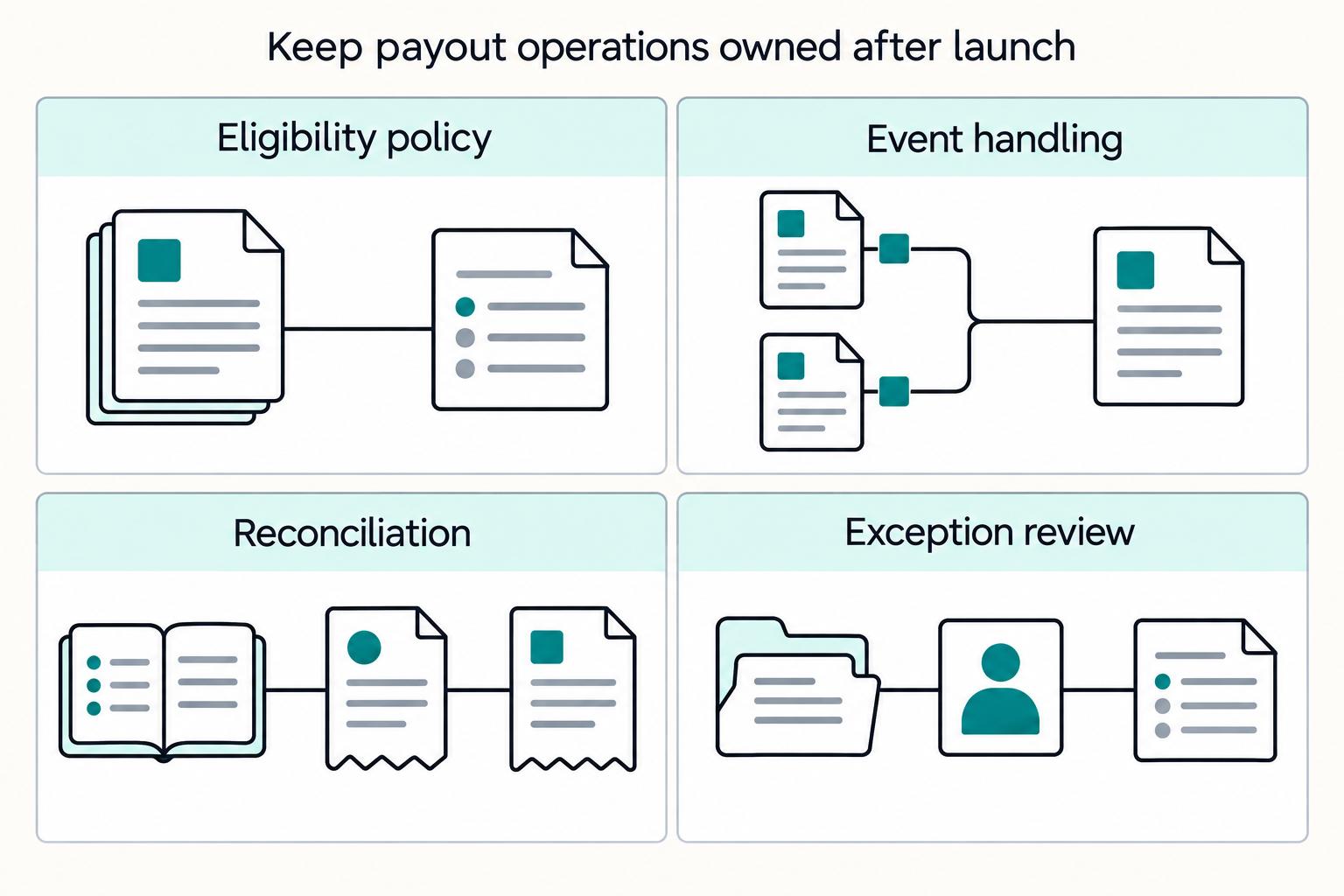
Instant payout is a tool, not the goal. The real operating decision is where instant timing creates measurable value, where batch timing is enough, and where both should run side by side.

Gig Worker Tax Compliance at Scale: How Platforms Handle 1099s W-8s and DAC7 for 50000+ Contractors
At scale, the hard part is not the acronyms. It is deciding sequence, ownership, and evidence when Form 1099-K, Form 1099-NEC, Form W-8BEN/W-8BEN-E, and DAC7 do not line up cleanly. If you run a high-volume marketplace, put controls in the right order and define clear stop points where legal or tax takes over.