
Quick Answer
Prioritize operational proof over trend momentum. The gig economy payment trends 2026 platform operators expect point to faster access becoming visible to workers, but coverage is not readiness even with instant schemes live in more than 70 countries. Start with a locally trusted fast rail, add one backup route, and verify truthful status states, eligibility gating, and traceable references under failed and delayed scenarios. If instant reliability is weak, use clear same-day positioning until controls and reconciliation hold in production.
What platform operators need to watch in 2026#
One report frames 2026 as a shift year for the gig economy, but platform expansion decisions should still be driven by operations, not headlines. Reported market signals matter, but market sizing is still directional, with global estimates ranging from $455 billion to $646 billion.
For operators, the core question is how to deliver faster settlements without overlooking the funding and payout friction in each market. Recent moves such as stablecoin payroll funding point to one way to reduce reliance on traditional banking and potentially ease currency-conversion pressure, but cross-border execution still brings hurdles, including exchange-rate volatility.
This guide helps you sequence rollout choices: what is table stakes, what is optional, and what to validate before you scale. It also treats demand swings as operating inputs. In one late-year example, November and December were linked to an over-60% increase in return-related bookings on Taskrabbit.
For a step-by-step walkthrough, see Indian Gig Economy in 2026: Treat Platform Income as Variable Until Settlements Prove Stability.
What changed in 2026 and why operators cannot ignore payout design#
Payout design is now a product decision, not just a finance workflow. As faster payment options become more available, any platform that promises speed but still settles through slower, schedule-bound flows creates a visible product gap.
Payout moved from back office to product surface#
The shift is not that every platform pays instantly. It is that faster payout is now a clear market expectation. JPMorgan describes real-time payments as transfers with near-instant money availability on networks that run 24/7, year-round and often complete within seconds. ACH can still take several business days.
That difference changes how users judge your product. Timing and confirmation become part of the user experience, not just internal operations. Provider messaging can point to market direction, but you should not treat it as standalone proof of gig-worker behavior.
Define the terms precisely#
For this guide, real-time payouts refers to near-immediate access to earned funds through rails that can confirm completion within seconds and remain available 24/7, year-round.
This guide uses global payouts orchestration as an operator term, not a formal standard. It means running one consistent operating layer across rails, geographies, and controls: method selection, eligibility checks, reference capture, status tracking, and exception handling.
Speed is only one part of the design. Real-time payments are final and irrevocable once completed, so validation, eligibility checks, and audit visibility should happen before release.
Why the economics still raise the stakes#
The evidence here does not provide gig-specific retention percentages or direct evidence that 1099 or multi-app workers reallocate labor based on payout reliability. What it does support is that payout speed and confirmation can vary by rail, and users can see that difference quickly.
Your practical checkpoint is simple. Confirm whether the rail provides immediate confirmation to sender and recipient, whether it runs on weekends and holidays, and whether your product shows truthful statuses such as pending, complete, or failed. If fallback paths route to slower processing, label that clearly rather than calling the whole experience real-time.
If you want a deeper dive, read The Gig Economy in 2026: Payment Volume Trends Contractor Growth and Platform Consolidation.
Table stakes capabilities every credible platform needs now#
In 2026, table stakes are a capability bundle, not a single fast rail. If a market cannot support reliable instant disbursement, ship a predictable same-day option and label it clearly instead of making an "instant" promise that does not hold in practice.
Workers judge payout quality on speed, flexibility, transparency, and reliability together. That is why each capability below needs a launch test, not just a roadmap slot.
| Capability | Why it matters | Minimum acceptable implementation | Common failure mode | Prelaunch verification checkpoint |
|---|---|---|---|---|
| Real-time payouts | Near-immediate access is a visible expectation in many markets, and slow or unclear payouts can drive worker loss. | Provide a genuinely fast method on a market-fit rail, with confirmed states and controls running during execution. | "Instant" labeling that hides delay from rail limits, fallback paths, or control flow. | Run end-to-end test payouts on the instant rail and confirm you can monitor risk, enforce controls, and produce regulatory evidence during execution. |
| On-demand withdrawals | Daily, same-day, and on-demand access is an active expectation. | Let eligible workers withdraw on demand with clear eligibility logic and accurate timing by method. | Withdrawal starts before eligibility is confirmed. | Test eligible and ineligible withdrawal attempts and verify block-or-allow behavior before release. |
| Payout status visibility | Fast payout is not trustworthy if state is unclear. | Show status from real provider outcomes, such as pending, complete, or failed, not static placeholders. | UI status lags or diverges from actual payment state. | Reconcile product status against provider references in live test flows and validate transition accuracy. |
| Transparent fee presentation | Flexibility is only usable when tradeoffs are visible. | Show any method-based fee before confirmation and distinguish faster from slower options. | Fees or method tradeoffs appear only after submission. | Walk every supported withdrawal path and confirm fee visibility before final confirmation. |
| Reliable exception handling | Fast rails can still produce failures and uncertain responses. | Capture references, route uncertain outcomes to review, and expose enough detail for support follow-through. | Failures collapse into generic errors with no traceable reference or next step. | Force failure scenarios and confirm request ID, provider reference, available reason, and follow-up case visibility. |
Rail baseline by market fit#
| Rail | Where it usually fits best | What to verify before launch |
|---|---|---|
| Push-to-card | Practical default in many markets. | Completion-state accuracy, fallback behavior, and control execution during payment. |
| Real-time bank transfers | Markets where domestic real-time bank rails are trusted. | End-to-end reliability and evidence generation during execution. |
| Instant account-to-account payments | Markets with trusted instant A2A behavior. | Operating consistency across controls, references, and status visibility. |
| Mobile wallets | Wallet-heavy regions where instant wallet credits are a baseline expectation. | Wallet credit confirmation, user-visible state, and exception routing. |
Real-time domestic schemes are now live in more than 70 countries, but coverage alone is not launch readiness. A credible launch is a fast primary method plus honest fallback behavior, with proof that controls pass, status is truthful, and references exist when something breaks. Related: Digital Platform Trends 2026: What Payment Infrastructure Shifts Mean for Marketplace Operators.
Which payout rails should you launch first in each market?#
A practical starting point is the rail workers already trust for fast access, then one fallback rail before you widen choice. In practice, that often means push-to-card where debit cards are the familiar destination, and real-time bank transfers or instant account-to-account payments where direct bank movement is the trusted pattern.
"Instant" is not one method. The grounded approach is rail-agnostic: fit rails to workforce behavior, because slow or unclear payout experiences can quickly reduce active worker supply.
| Rail type | Typical market fit | Operational burden | Reconciliation complexity | Fallback options |
|---|---|---|---|---|
| Push-to-card | Strong first rail where workers already expect fast access through existing debit cards | Practical first fast rail, but still requires accurate states and exception handling | Moderate if provider outcomes, user-visible status, and funds availability stay aligned | Real-time bank transfer where available, or a predictable bank payout |
| Real-time bank transfers | Better fit where instant bank movement is widely trusted | Requires strong handling of local rail behavior and clear payout-state visibility | Moderate to high when confirmation and final-state behavior vary | Push-to-card for eligible workers, or a predictable bank payout |
| Instant account-to-account payments | Good fit where direct A2A transfers are the trusted fast-money path | Similar to real-time bank transfers, with extra care when journeys span multiple systems | Higher when one payout journey touches multiple payment systems | Push-to-card, or another domestic bank method |
| Mobile wallets | Often a core rail in wallet-heavy regions where workers expect instant wallet credits | Adds operating surface when wallets must coexist with cards and local bank schemes | Can be high when card, wallet, and domestic transfer steps coexist | Push-to-card or bank payout if wallet credit fails or is unavailable |
Start with trust pattern, not broad menu#
If workers already rely on cards for earnings access, push-to-card is often the cleanest first launch. If workers trust direct-to-bank movement, start with real-time bank transfers or instant account-to-account payments instead.
Treat this as directional, not universal. The supporting evidence here comes from vendor-authored thought leadership published January 2, 2026 and February 28, 2026. Validate local fit with live tests before you treat any rail as a default.
Constrained team sequencing approach#
For a constrained team, a practical sequence is one primary rail plus one fallback rail before adding broader choice:
- Primary rail: matches local trust and expected speed.
- Fallback rail: carries volume when the primary rail is unavailable, delayed, or ineligible.
Expand only after support, finance, and compliance can explain failures on both rails without guesswork.
This keeps interoperability manageable. One payout journey can span cards, wallets, local schemes, and other settlement steps, and each added option increases the burden across treasury, compliance, support, and reconciliation.
When mobile wallets are core and when they are expansion#
In wallet-heavy regions, mobile wallets are often a core launch rail because workers expect instant wallet credits. Outside those markets, wallets can be an expansion path rather than a first-launch requirement.
Use a practical go-live check: can you get confirmation, and do funds appear where workers expect them? If wallet flows are inconsistent on either point, they are not launch-ready.
Stop-go criteria before adding another rail#
Do not add another rail until failure investigation and settlement reconciliation are stable on the rails you already run. Here, "stable" means your team can consistently answer what failed, where it failed, whether funds moved, and how settlement maps to payout outcomes.
If support sees complaints that finance cannot trace, or user-visible status diverges from provider outcomes, pause expansion and fix current-rail operations first.
Build compliance gates before speed promises#
Do not promise instant payouts until verification and authorization checks are part of the payout flow. In 2026, real-time payments are increasingly treated as a default operating model with 24/7 expectations, so latency and downtime become business risk, and control gaps become harder to absorb.
Treat verification as product behavior#
Keep authentication and payment authorization connected in the same journey, not split across disconnected steps. The broader payment pattern behind ideas like "Log in and Pay" is the useful takeaway: trust improves when identity checks and money-movement decisions happen together.
| Step | Action |
|---|---|
| 1 | Confirm the user meets your current verification state |
| 2 | Check whether the request can proceed under your current payout policy |
| 3 | Create the disbursement request only after prior checks pass |
| 4 | Capture the provider response when accepted |
| 5 | Persist auditable state changes through final outcome |
Use that sequence before launch, and treat it as an internal operator design pattern, not a universal standard.
The tradeoff is speed of activation versus payout friction later#
Looser early onboarding can reduce first-session friction, but it can also shift friction to later payout checks. As payment flows become more automated, the tension stays the same: move faster while still separating legitimate activity from fraud. If controls are weak when funds move, support and operations inherit preventable failures.
Define evidence before launch#
Before launch, require a payout audit trail that support, finance, and ops can all read the same way. Confirm your flow records key verification and payout decisions, timestamps, and state transitions.
Run at least one controlled non-happy-path test to verify the payout gate blocks before money movement starts, and one accepted-path test to verify accepted payouts leave traceable records for investigation.
Handle country and program uncertainty explicitly#
Country-by-country compliance checks and one required payout-control model are not defined here. Treat those requirements as market-specific and partner-specific unknowns to confirm before rollout, and avoid speed promises where control requirements are still unsettled.
Design reliability so instant payouts do not fail at scale#
Once you offer instant payouts, reliability becomes the product. For gig platforms, the bar is not just fast money movement. It is a payout state you can trust, explain to workers, and reconcile when provider responses arrive late or are confirmed asynchronously.
Real-time expectations are rising because instant schemes are already live in more than 70 countries, and domestic real-time systems are common in many markets. That raises expectations and operating load at the same time. With always-on settlement cycles, support, liquidity operations, and exception handling cannot depend on banking-hour assumptions.
Set the reliability contract before volume grows#
Define the contract early, then scale volume:
- Make retries idempotent so one logical payout cannot become two attempts after a timeout, client refresh, or queue retry.
- Define clear terminal states with explicit next actions, such as
paid,failed,returned, orunder review, and avoid indefinite states likeprocessingwith no owner. - Show worker-facing status that matches certainty. If confirmation is pending, say so directly instead of showing
paidtoo early.
Expect ambiguous provider behavior#
Assume ambiguous outcomes are normal, not edge cases. In real-time environments, final outcomes may be confirmed asynchronously rather than immediately.
Recent outages show this is not hypothetical, including a seven-hour ECB outage in 2025. Weak state handling is where the damage compounds: duplicate attempts after timeouts, stale UI status when later updates are missed, and unresolved exceptions with no closure path.
Faster settlement also compresses fraud windows, so ACH-era fraud timing assumptions break down. In real-time environments, verification has to happen before funds move, and fraud defenses need to work consistently across RTP, FedNow, and card rails.
A practical checkpoint is to confirm your instant-corridor controls are in place and observable: robust name-matching, fraud controls, real-time sanctions screening, clear settlement-finality rules, and strong dispute handling. If those controls are weak, the gap is operational readiness, not scale.
Pause expansion when status certainty is weak#
If status certainty is weak, pause rail expansion and fix observability before you increase payout volume. Interoperability can speed rail rollout, but adding rails before you can detect duplicates, track asynchronous confirmations, and resolve exceptions raises support load and reconciliation risk.
In payout workflows, predictability is often as important as raw speed in the day-to-day experience. A slightly slower payout with accurate status is easier to operate than an "instant" promise that ends in confusion, duplicate attempts, or a missing transfer with no clear owner.
Plan reconciliation and audit evidence before go-live#
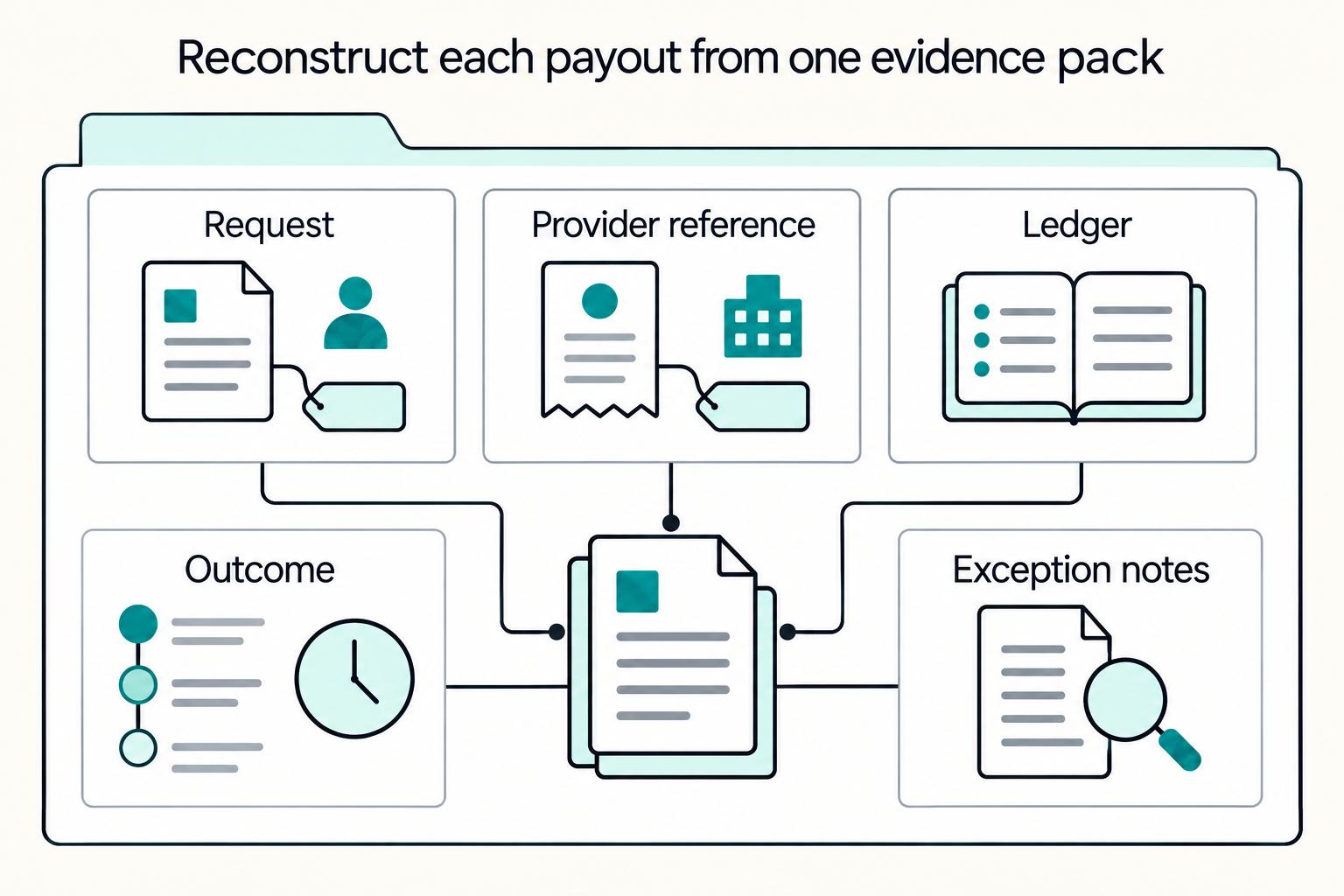
If you cannot reconstruct what happened to each payout, you are not ready to scale. Before go-live, define a minimum evidence pack for every payout flow and apply it consistently across rails, providers, and markets. Use this as your internal baseline for each payout event:
- Platform request ID
- Provider reference
- Internal ledger posting
- Final payout status
- Exception notes for non-happy-path outcomes
This is not about a universal regulator-defined schema. It is about giving finance, support, and compliance one trace from initiation to outcome when money is reported missing, delayed, duplicated, or reversed.
Why traceability matters more with global payouts orchestration#
Routing flexibility is useful, but it can raise reconciliation risk when data is split across providers and jurisdictions. Finance still has to reconcile one economic event to one settled outcome.
The operating risk is documented, not theoretical. In research fielded in November 2025, 69% of respondents cited manual processes and limited automation as their biggest scalability constraint. Another 67% said instant payment networks are accelerating the need for real-time controls. Cross-border operations also have to reconcile overlapping or conflicting obligations across jurisdictions, so your evidence trail should support both operations and local reporting expectations.
What to check every operating day#
A practical daily control does not need to be heavy, but it does need owners and timestamped output. Review the exception queue and move each item to an owned next state. In always-on payment environments, unresolved latency and downtime turn into business risk quickly.
Match settlement activity to initiated payouts and ledger postings, and be able to explain settled lines, returns, and open differences with referenceable records. Track unresolved items by queue age and escalate on a defined internal cadence so old breaks do not become support, write-off, or audit problems.
Before launch, sample payouts from each rail, including failed or delayed confirmations, and confirm you can reconstruct the full timeline from request creation to final status.
The artifacts worth producing from week one#
Define your control outputs from the start, not at month-end. The useful week-one set is:
| Artifact | Included items |
|---|---|
| Payout reconciliation export | request ID, provider reference, amount, currency, ledger status, payout status, timestamps, open-break flag |
| Failed payout root-cause log | provider rejection, compliance hold, account issue, timeout, return, internal processing error |
| Weekly controls review summary | open exceptions, aged items, repeat failure reasons, reporting and third-party oversight evidence coverage |
A clear red flag is any launch that depends on manual stitching across tickets, bank files, and provider dashboards. Only 33% of surveyed respondents said they were fully prepared for upcoming safeguarding deadlines, so evidence readiness should come before adding rails, countries, or payout volume.
We covered this in detail in Platform Economy Payment Index for Contractor Payment Quality Across 20 Industries.
Choose rollout order by vertical economics not headline growth#
Set rollout order by where worker economic pressure is highest and payout trust is weakest, not by headline growth. When pressure signals are elevated, prioritize payout reliability and fee transparency before you add niche payout options.
Start with verified pressure signals in your own market#
Treat cross-vertical assumptions as hypotheses, not facts. The grounded evidence here is specific to California app-based transportation workers in transportation network companies and courier network services, where reported concerns included pay, benefits, classification, platform transparency, and punitive actions such as deactivations.
Use that as a practical rule: when workers are already under economic pressure, reduce payout uncertainty first. If your logs show recurring issues around missing funds, unclear fees, payout timing, or status confusion, fix those before expanding payout method choice.
Use outside labor signals as prompts, not proof#
Outside labor signals can be useful directional context, but they should not decide rollout order on their own. Validate any outside signal against your own payout and support evidence before changing roadmap priorities.
Apply a stricter filter in transportation-like contexts#
In California transportation, cost pressure can compound overall worker pressure. A July 2026 multi-method analysis with 41 literature sources, 8 expert interviews, and 7 case studies covered October 2022 to May 2024. It highlights worker concerns and also notes EV transition pressure, including the Clean Miles Standard (SB 1014) target requiring 90% of vehicle miles traveled to be electric by 2030.
In conditions like this, the priority is straightforward: make payout timing, payout cost, and failure handling clear and dependable before adding complexity.
Expand only after current operations are stable#
Use expansion as an operating decision, not a growth reflex. If reconciliation, exception aging, fee presentation, and failed-payout ownership are still noisy in your current market, solve those first so you do not scale the same breaks into the next launch.
Related reading: Subscription Benchmark Report for Platform Operators: Churn Trials Payment Declines and LTV.
Use worker behavior signals without overreading weak data#
After setting vertical priority, let verified evidence drive payout decisions. Third-party references can be useful prompts, but they are not decision-grade proof unless you can see how the metric was built.
Use one operating test consistently: separate verified signal from interesting noise. A grounded example outside payments shows why. GreyNoise reported 242,666 new scanning IPs geolocating to Hong Kong in seven days, but 99.7% never completed a TCP connection. Only 702 completed connections and counted as the verified subset. The lesson is methodological, not cybersecurity-specific: large counts without a verification checkpoint should not drive roadmap choices.
Use confidence tiers#
| Confidence tier | What belongs here | How to use it |
|---|---|---|
| High confidence | Your own payout logs, support tickets, failed withdrawal reasons, settlement mismatches, fee complaints | Use first for launch and sequencing decisions |
| Medium confidence | External indicators, third-party summaries, and references where methods are only partly visible | Use as directional context, then test against your own data |
| Open unknowns | Gated reports, partial excerpts, metrics without sample definitions, opaque vendor charts | Do not convert into roadmap claims until verified |
Before treating any external claim as practical, check source definition, time window, sample scope, and collection method. If a third-party metric does not show how data was gathered, keep it at medium confidence at best. If content is gated or excerpt-only, keep it as an open unknown, similar to verifying informational FederalRegister.gov content against the official Federal Register edition before treating it as legally definitive.
The main failure mode is mixing verified and unverified inputs without labels. When that happens, low-confidence records can dominate the narrative. In your research notes, require this minimum evidence pack for each external claim: source name, publication date, visible methodology, exact metric definition, and why it is practical. If any piece is missing, narrow the claim and defer the product decision.
Common expansion mistakes that create ops drag#
A common source of ops drag is when the payout promise scales faster than the payout operation.
- Treating "instant" as one rail: In multi-app labor markets, payout speed and reliability can influence where workers spend their time. "Instant" should mean fast access through rails that fit your workforce and market conditions, not one universal method. Push-to-card may be a practical default in many markets, while other markets may fit real-time bank transfers better.
- Adding rails before operations are ready: Launching multiple rails too early can increase manual process burden. Use one consistent operating layer across rails, geographies, and worker preferences, and sequence new rails only after the current flow is operationally stable.
- Skipping a worker-facing readiness check: Before launch, validate whether payouts meet four worker-facing criteria: speed, flexibility, transparency, and reliability. A slow or unclear payout experience can quickly reduce active worker participation.
- Copying provider messaging into launch specs: Use market messaging as context, not implementation truth. Validate local rail fit before committing roadmap scope.
30-day prelaunch checklist for founders and ops leads#
In the last 30 days before launch, prioritize proof over optimism. A practical way to structure that month is staged validation: define the decision, develop candidate options, and validate the shortlist so the launch call is evidence-based and relevant, not driven by vanity metrics.
| Week | Focus | Key action |
|---|---|---|
| Week 1 | Define decisions and assumptions | Record how each assumption will be validated, who owns it, and what would count as disconfirming evidence |
| Week 2 | Shortlist candidate approaches | Make the evaluation criteria explicit and flag any metric that looks positive but does not reflect real readiness |
| Week 3 | Validate the shortlist | Use a mixed-methods approach and capture what held up, what changed, and what remains uncertain |
| Week 4 | Go-or-no-go review | Use the evidence pack, and reduce scope or delay if evidence is thin or teams cannot align on the same decision rationale |
Week 1
Define the launch decisions you must make, and document the assumptions behind each one. For every assumption, record how you plan to validate it, who owns it, and what would count as disconfirming evidence.
Week 2
Narrow to a shortlist of candidate approaches and make the evaluation criteria explicit. Favor practical frameworks over surface-level overviews, and flag any metric that looks positive but does not reflect real readiness.
Week 3
Validate the shortlist with a mixed-methods approach rather than a single signal. Capture what held up, what changed, and what remains uncertain so teams are aligned before launch review.
Week 4
Run a go-or-no-go review using the evidence pack, not momentum. If evidence is thin or teams cannot align on the same decision rationale, reduce scope or delay until the gaps are closed.
Conclusion#
Winning in 2026 is less about promising instant payouts than about running payout operations workers can trust. In multi-app labor markets, slow or unclear payouts can quickly push active workers to another platform, so execution quality matters at least as much as payout-speed messaging.
Use a conservative rollout plan: phase controls and rail expansion instead of changing everything at once. This is not a universal rule, but it is a practical way to reduce compounding failures as each new rail and jurisdiction adds operating and regulatory complexity.
Before launch, pressure-test your payout experience against four worker-facing factors: speed, flexibility, transparency, and reliability. Speed may get attention, but transparency and reliability help protect trust when payouts do not go as planned.
Keep market assumptions local. Rail fit varies by country, and oversight patterns vary across jurisdictions, so a setup that works in one corridor may not transfer cleanly to the next.
Before GTM spend, map the next target market across three areas:
- Rail fit: the primary rail and fallback that match local behavior
- Compliance burden: jurisdiction-specific oversight that can complicate disbursements
- Reliability readiness: your ability to show payout status clearly, investigate failures, and resolve exceptions consistently
If one of these is weak, fix it before expansion. A safer approach is to treat payouts as an operating product with market-specific constraints, not as a feature promise.
Need the full breakdown? Read Gig Platform Regulatory Radar 2026: 10 Laws That Will Impact How You Pay Contractors.
If you want to pressure-test country rollout order against compliance gates, payout reliability, and reconciliation ownership, talk to Gruv.
Frequently Asked Questions
What payout capabilities are table stakes for gig platforms in 2026?
Table stakes now means a payout experience workers trust, not just basic disbursement. Workers judge speed, flexibility, transparency, and reliability together, so in markets that support it you should offer real-time or on-demand access, clear payout status, and predictable exception handling. If reliable instant access is not ready, a dependable same-day flow is better than an instant promise that fails.
How much do payout speed and reliability actually affect retention and churn?
They are a meaningful behavior lever, especially where workers multi-home across apps. The evidence is directional, not universal: payout speed and reliability often shape where workers spend time, and slow or unclear payout experiences can reduce active worker supply. Validate impact with your own signals, including shift acceptance, repeat activity, payout-related support contacts, and drop-off after payout failures.
Which rails should a platform support first in a new country?
Start with a primary rail and a fallback, then expand after you have operational proof. Push-to-card is a practical default in many markets, while real-time bank transfers can fit better where instant account-to-account rails are trusted. In wallet-heavy regions, instant wallet credits can be important. More than 70 countries have live instant schemes, but availability alone does not confirm local fit.
What are the biggest risks of offering instant payouts too early?
The main risk is treating instant payout as a UI feature instead of a full execution path. Instant corridors need robust name matching, fraud controls, real-time sanctions screening, clear settlement finality rules, and strong dispute handling, with controls operating alongside the payment itself. Launching before this is ready can increase payout failures, exception volume, and support load, and create confusion about final payout state.
Does faster payout fix worker earnings pressure on its own?
No. Faster payout can improve liquidity and influence platform preference, but it does not resolve earnings pressure by itself. Treat it as one part of a package that also includes transparent payout terms, reliable execution, and broader worker-stability support.
How should operators validate market-readiness before adding another payout rail?
Add another rail only after you can run the current one predictably and explain outcomes clearly. You should be able to verify results consistently, investigate failures quickly, and produce compliance evidence during the payment flow rather than reconstructing it afterward. If your team cannot clearly explain failure cause, control behavior, and final settlement state, you are not ready to expand.
What should founders do when source data is directional but not fully verified?
Use confidence tiers and keep claims proportional to evidence quality. Treat operating facts as high-confidence inputs, and treat findings like the "roughly 85%" faster-payout survey result as directional evidence from one survey, not a universal forecast. When confidence is limited, narrow claims, run small live tests, and document unknowns so decisions stay evidence-based.
Try a related tool
Researched and edited by the Gruv editorial team. Gruv builds cross-border billing, payouts, and finance-operations software for global businesses.
Sources
Includes 3 external sources outside the trusted-domain allowlist.
- chicagounbound.uchicago.edu/cgi/viewcontent.cgitrusted
- congress.gov/119/meeting/house/118968/documents/HMKP-119-...trusted
- federalregister.gov/documents/2024/11/12/2024-25024/premerger-no...trusted
- sec.gov/Archives/edgar/data/1410384/0001410384260000...trusted
- sec.gov/files/ctf-written-input-daniel-bruno-corvelo...trusted
- accenture.com/content/dam/accenture/final/industry/banking...external
- autorek.com/wp-content/uploads/2026/02/The-Future-of-Pay...external
- carry.com/learn/gig-economy-trends-for-freelancers-and...external
Educational content only. Not legal, tax, or financial advice.
Related Posts

The Freelance Payment Penalty: A Modeled Audit of Platform Fees, FX Spreads, and Payout Delays
The money rarely disappears through a single, easy-to-spot fee. The real loss is stacked. A marketplace takes its commission, a processor adds a charge for international cards, a bank or payment company converts the currency at a spread, a platform holds the funds before release, and a wire sheds a little to intermediaries on the way in. Each layer looks defensible on its own, but the worker feels the combined result as a smaller deposit and a later payday.

How to Respond to a Subpoena for Business Records
Move fast, but do not produce records on instinct. If you need to **respond to a subpoena for business records**, your immediate job is to control deadlines, preserve records, and make any later production defensible.

A US Expat's Guide to Investing in UCITS ETFs to Avoid PFIC Issues
The real problem is a two-system conflict. U.S. tax treatment can punish the wrong fund choice, while local product-access constraints can block the funds you want to buy in the first place. For **us expat ucits etfs**, the practical question is not "Which product is best?" It is "What can I access, report, and keep doing every year without guessing?" Use this four-part filter before any trade: