
Quick Answer
Offer USDC only with recipient consent and verified program, asset, network and destination support. Compare the full cost and path to usable funds, including any off-ramp. Reserve balances atomically and guard the payout obligation across rails. Investigate uncertain or wrong-address sends before replacement, and never reroute around a legal or compliance restriction.
Decide whether USDC is a controlled payout rail#
USDC freelancer payouts need a supported recipient, network and provider program, plus a clear agreement about how the commercial obligation will be settled. Evaluate the path to usable funds, including any conversion to a bank balance, rather than the blockchain send alone.
Before you start#
Start with three assumptions locked in:
- USDC is one payout option, not the whole payout strategy. Bank rails still matter when predictable fiat receipt and exception handling are the priority.
- Measure the full path to usable funds; a fast broadcast is not proof of destination credit or low off-ramp cost.
- Confirm applicable program and legal requirements before release; a restriction may apply across all rails.
Define the scope in one sentence#
Enable recipient-approved USDC payouts only where the program and destination are eligible. Offer a supported bank option before sending when appropriate, without bypassing a legal or compliance restriction.
That sentence does two jobs. It stops the team from treating USDC as a blanket replacement for existing rails. It also gives you a fallback rule when a crypto payout cannot be released. If your draft scope does not say what happens when USDC is unavailable or blocked, it is not ready.
Separate recipient experience from platform controls#
Confirm the recipient's preference, ability to control the wallet and ability to use or convert the funds. The platform must still approve release, prevent duplicate execution and preserve evidence linking the payout to the obligation.
For wallet intake, record the exact supported blockchain, native USDC asset or contract, address and any destination-specific memo requirement. An exchange deposit address may support only particular networks or assets; validate against the actual destination instructions and Circle's USDC contract reference, not the token symbol alone.
Set launch criteria before anyone writes payout code#
Set launch criteria before anyone writes payout code. At minimum, you need a documented answer for three failure points: a payout blocked by policy, a transfer that looks fast at the wallet level but is not usable by the recipient yet, and a payout that finance cannot tie back to an invoice or ledger entry.
That frame carries through this guide. We will treat stablecoin payouts as a controlled rail choice, compare them directly with bank options, and spell out what must be true before you let recipients choose USDC in production.
If you want a deeper dive, read How to Get Paid in Crypto as a Freelancer (and Manage the Risks).
Define the operating scope before you build#
Define supported USDC and bank routes for each program and recipient. Distinguish a rail-specific availability problem from a restriction on paying the person or transaction; changing rails does not remove the latter.
Step 1: Write scope as a routing rule. Use a sentence finance, engineering, and support can execute, not a vision statement. It should define what happens when a crypto payout cannot be sent.
Compare current end-to-end quotes and actual outcomes for the same corridor and amount. Include funding, conversion spread, provider fees, network fees and off-ramp or bank withdrawal costs. USDC is not a universal cost or speed advantage over bank methods.
A practical checkpoint is a one-page assumption sheet per launch market: payout rail, conversion point, who bears fees, and fallback rail. If that sheet is missing, rail comparisons are not decision-ready.
Step 3: Separate platform controls from recipient experience. Define platform-side controls first: approval rules, payout traceability, ledger references, and exception handling. Then define recipient-side experience: wallet requirement, expected timing, and what to do if they cannot receive USDC.
Keep the caveat up front: stablecoin support and off-ramp behavior vary by program, jurisdiction, and provider coverage.
For a step-by-step walkthrough, see The Best Way for a UK Freelancer to Get Paid by an Australian Client.
Compare payout rails and pick a default routing policy#
Offer USDC when the recipient has chosen it and the program, exact network, asset and destination are supported. Compare the complete path to usable funds with supported bank routes. A bank account identifier such as IBAN is not itself a payment rail.
Stablecoin support should sit inside a multi-rail payout stack, not replace bank rails by default. Keep the policy grounded in operational readiness, wallet access, regulatory expectations, off-ramp workflow, and recipient preference for non-crypto methods.
Build a decision table that forces tradeoffs#
Run this by program and corridor so finance, product, and support evaluate the same criteria.
| Rail | Settlement predictability | Traceability | Exception handling | Conversion dependency | Known unknowns |
|---|---|---|---|---|---|
| USDC | Network/provider confirmation policy applies; not guaranteed cash | Verify asset, network, amount, address and transfer event | Broadcast or final transfers generally lack automatic bank-style reversal | Holder may need gas, exchange credit and an eligible off-ramp | Custody, freezes, outages, market-price risk and conversion costs |
| ACH | Often preferred when beneficiary bank certainty is the priority | Bank/provider references are familiar for support workflows | Bank-side exception paths are usually established | Depends on currency path into the beneficiary account | Bank and corridor handling differences |
| SWIFT | Useful for broader bank reach, with corridor-dependent predictability | Bank references exist but visibility can vary by provider flow | Exceptions can be slower and more manual | Often includes conversion dependency | Corridor constraints and fee visibility |
| Local rails (for example, Pix or SEPA) | Strong when local endpoint support is clear | Usually easier to match local payout records | Depends on provider support for local validation/returns | Lower when funding and payout stay in local currency | Coverage gaps and recipient data requirements |
Set the fallback in policy, not in ops memory#
If USDC is unavailable before any send, offer an eligible bank route with recipient approval. If a legal, sanctions or other person/transaction restriction applies, hold or escalate it across all routes rather than auto-reroute. After a send is uncertain or broadcast, investigate that attempt before considering a replacement; changing rails can otherwise pay twice.
Keep one payout intent across the reroute so finance and support can trace the full path: selected rail, policy result, fallback decision, and final payout reference.
Treat vendor claims as hypotheses until your data confirms outcomes#
Separate documented eligibility from measured performance. Verify the actual program's sender and recipient rules, supported networks, fees, confirmation policy, custody model and off-ramp support before testing outcomes.
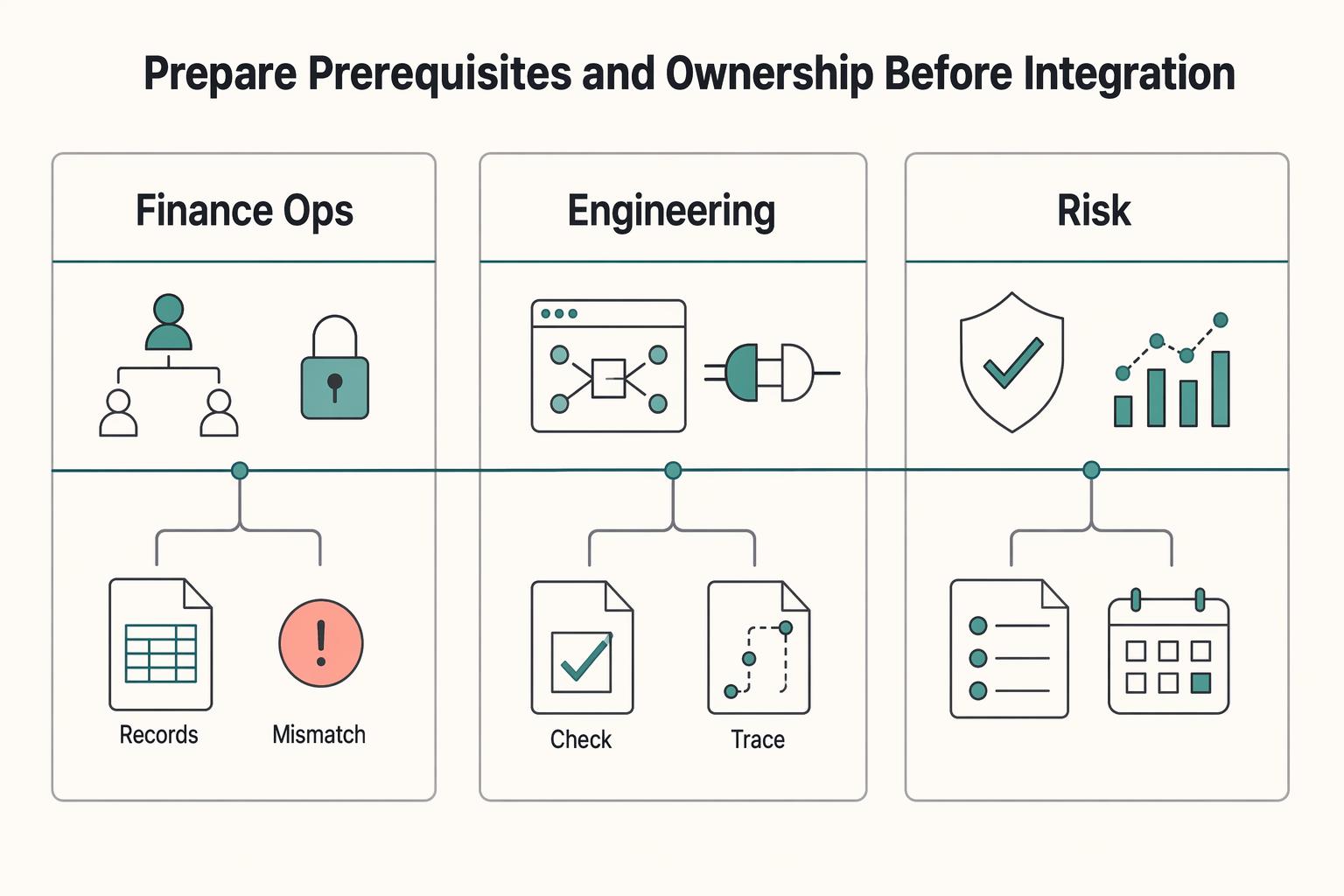
Prepare prerequisites and ownership before integration#
Before you integrate, lock ownership and data requirements so payouts do not stall or break at scale. Stablecoin payouts can improve speed and cost in some cross-border cases, but complexity rises with volume, especially around compliance checks, reconciliation, and reporting.
Step 1: Assign clear owners before any build work. Set one accountable owner for each decision that can release, hold, reroute, or dispute a payout. Keep ownership explicit across finance ops, engineering, and risk, with a defined handoff path.
| Function | Accountable for | Verification point |
|---|---|---|
| Finance ops | Rail selection rules, fallback approval, ledger posting integrity | Can trace one payout from invoice ID to final provider reference |
| Engineering | Data capture, payout initiation logic, status updates, reroute behavior | Can show the event history when a rail changes from USDC to ACH or SWIFT |
| Risk or compliance | Release gates, review holds, incident escalation | Can state what evidence clears a hold before funds are sent |
If support asks who can approve a rail switch and the answer is unclear, ownership is not ready.
Confirm sender and recipient eligibility, country and entity support, exact asset/network, destination format and a usable off-ramp. Verify whether the recipient can receive native USDC and how an exchange credits deposits. Do not assume one program's asset support establishes another's.
Step 3: Freeze the invoice-to-payout data contract. Lock the minimum fields that must persist from invoice through payout and reconciliation:
- payer ID and payee ID
- invoice or payment request ID
- currency intent (invoice currency and payout currency)
- quote reference when conversion applies
- payout method metadata (selected rail and recipient endpoint at send time)
Snapshot payout metadata at initiation so ops can distinguish original endpoint issues from later profile edits or bank-side returns.
Explain the supported asset and network, how to verify the address, which fees each party pays, confirmation requirements and the bank option available before sending. Never request a wallet private key or recovery phrase. Verify changed payout details through a trusted channel and record recipient approval.
Implement the end-to-end payout sequence with checkpoints#
Treat payout delivery as a controlled sequence of checkpoints, not a single send call. Keep the flow traceable from invoice creation to the status support sees in the UI.
Record the obligation, approved funding source and accounting treatment before execution. Reserve the available balance atomically so concurrent withdrawals cannot spend it twice. Then validate eligibility and destination, approve any conversion, create the payout and reconcile subsequent events. A prefunded or approved credit model differs from waiting for the particular invoice to be collected; document the model rather than impose one universal event order.
Use a durable obligation ID with an atomic execution claim across all rails. Each provider operation has an attempt record and a provider-scoped idempotency key; reuse the same key and unchanged payload only within its protection window. Including rail or endpoint in a new key must not bypass the obligation guard. Retrieve and reconcile an uncertain attempt before any replacement.
Step 3: Add explicit conversion controls. If a payout moves from USDC to fiat for SWIFT or local bank delivery, treat conversion as its own checkpoint. Store quote reference and timestamp, reject stale quotes, and require explicit approval for post-intent conversion changes.
Step 4: Publish action-ready status states. Define one shared model for operations, support, and webhooks.
| Status | What it means | Owner action |
|---|---|---|
| pending | Approved or initiated but exact delivery stage not complete | Retrieve provider/chain state; do not blindly resend |
| on-chain confirmed | Intended token transfer satisfies documented confirmation policy | Verify asset, amount and destination; distinguish custody credit and fiat receipt |
| held | Required review or data blocks release | Resolve applicable requirement; do not bypass by changing rails |
| returned/recovered | Provider return or separate recovery confirmed | Reconcile the recovered funds before an approved replacement |
Test failed pre-send validation, pending broadcasts, confirmation delays, destination credit problems and provider or bank returns as separate scenarios. An on-chain transfer does not have the same automatic return path as a bank payout. Define finality and recovery rules for the specific network and provider before launch.
Related: Getting Paid as a Freelancer with Cryptocurrency: Platforms and Tax Implications.
Build reconciliation and evidence packs finance can trust#
Finance should be able to audit every USDC payout end to end without engineering help. If you can show a send succeeded but cannot tie it to the invoice, ledger posting, and payout reference, the operation is not audit-ready.
Keep invoice or payment request ID, obligation and attempt IDs, provider reference, chain ID, exact token identifier, transaction hash and recipient endpoint snapshot linked to ledger records. For on-chain evidence, retain token-transfer details and the block or confirmation state; a hash alone or a successful unrelated transaction does not establish the intended asset, amount and destination. Keep raw events and approved adjustment records.
Step 2: Split exception queues by failure type. Run separate queues for unmatched deposits, returned payouts, and delayed confirmations across SWIFT and stablecoin rails. Legacy rails are often reliable but slower, and newer options are often marketed as instant or same-day, but speed claims are not reconciliation evidence. A fast payout with a missing match or final confirmation is still an exception.
Step 3: Require daily exports finance can action directly. Export both current state and status deltas every day. Include prior status, new status, timestamp, trigger source, reference value, and linked journal or reversal entries so finance can answer what changed, what was adjusted, and what remains unresolved.
A useful control check: finance should be able to start from any anchor (invoice ID, ledger entry, or payout reference) and trace to the rest. This matters more as you add rails, because one route rarely covers all payout needs and reconciliation complexity grows quickly.
Apply compliance and tax gates before payout release#
Gate payout release on compliance and tax checks first, for both USDC and bank rails. The payout record finance audits should also show why a payout was allowed, held, reviewed, or rejected.
| State | When used | Article note |
|---|---|---|
| Held | Applicable identity, tax or other required evidence incomplete | Resolve and obtain approval; submitting a form alone does not clear the restriction |
| In review | Mismatch or policy/legal question | Owner investigates with restricted access to sensitive details |
| Rejected | Unsupported or prohibited combination | Offer another route only if the restriction is rail-specific and payment remains permitted |
Identify the actual identity, reporting and withholding requirements for the payer, recipient and program. Form W-9 generally documents U.S. persons for applicable U.S. reporting; foreign recipients may need an appropriate W-8 or other documentation depending on their status and income. These are not a simple U.S.-resident versus nonresident choice. Submission alone does not establish provider approval, and paying in USDC does not remove tax obligations.
Step 2: Define held, reviewed, and rejected states with explicit unblock evidence. Do not use a generic "compliance issue" state.
- Held: list the specific applicable requirement and next review action; do not promise a universal form-processing time.
- In review: assign an authorized owner to the mismatch and preserve the evidence.
- Rejected: distinguish an unsupported rail from a prohibition on paying the recipient or transaction.
Run release checks for the actual sender, recipient, jurisdiction, asset and network. Stripe Connect's stablecoin payout documentation illustrates a program with its own availability and account requirements; verify the current contracted program before assuming eligibility. Test rail-specific unsupported cases separately from restrictions that block payment across all rails.
Handle common failure modes and recovery paths#
Most payout exceptions here come from three issues: wrong destination details, overpromised speed, and unclear status visibility. Treat each as a controlled recovery workflow, not a one-off support ticket.
| Issue | What to do | Article note |
|---|---|---|
| Wrong destination details | Stop retries; establish original execution/finality and recovery before any authorized replacement or separate loss remediation | Once initiated or broadcast, a sent transfer generally cannot be canceled |
| Overpromised speed | Publish corridor-specific SLA ranges instead of "instant" language | Measure approval, network confirmation, destination credit and off-ramp stages for the actual program |
| Unclear status visibility | Expose one canonical payout timeline to support: processing, posted, failed, returned, or canceled, plus provider reference or trace ID when supported | Do not treat posted as guaranteed recipient receipt |
Stop automatic retries after a wrong-address or unsupported-network send. Investigate whether the transaction was broadcast and finalized, contact the provider, and assess any recovery route. A corrected address does not undo the original transfer. If funds cannot be recovered, an additional payment is a separately authorized remediation with an explicit loss and accounting decision, not a retry of the original obligation.
Before an authorized replacement, record the original status, destination, asset and network, any recovery evidence, the verified new destination, reason and approver. Prevent replacement while the original may still complete. If recovery or additional compensation is approved later, track it separately.
Publish estimates for the actual network and provider, distinguishing platform approval, broadcast, confirmation, destination credit and fiat withdrawal. Bank off-ramp hours, checks, fees and limits can affect usable cash even after an on-chain transfer is final. Assign an investigation trigger for each overdue stage.
Keep on-chain finality, custodial wallet credit and fiat bank receipt as distinct milestones. Support needs the current stage, exact transaction or provider reference, confirmation evidence and next action. Do not label a blockchain send as a bank payment received.
Verification point: pick one posted payout and confirm support can explain the status, the provider reference, and the next expected action without escalating to finance ops.
This pairs well with our guide on How to Get Paid in Multiple Currencies Without Forced FX.
Final takeaway and copy/paste launch checklist#
Use USDC as one rail in a controlled payout system, not a blanket replacement for bank rails. Launch only when routing rules, retry behavior, and reconciliation evidence are production-ready end to end.
Define rail policy by corridor before you ship#
Document USDC, ACH, SWIFT and supported local routes such as Pix or SEPA by corridor. IBAN is an account identifier, not a rail. Record any eligible alternative offered before sending, plus the conditions that prohibit rerouting.
Show the primary route, required recipient setup and the point after which a transfer must be investigated before replacement. Confirm the actual program's fees, operating windows and usable-funds path. Do not use another rail to bypass a restriction on the person or transaction.
Make payout initiation retry-safe, quote-aware, and audit-ready#
Keep a shared obligation and attempt timeline across rails. Authenticate events, persist them durably, deduplicate processing and guard ledger transitions against out-of-order delivery. Track provider acceptance, broadcast, finality, destination credit and any separately confirmed bank withdrawal without collapsing them into one generic completed state.
If conversion is involved, store the authenticated quote ID and reject or refresh expired quotes. Do not leave payouts stuck in "processing" when the quote is stale and conversion never executed.
Release funds only after evidence and eligibility checks are complete#
Before release, retain the approval, applicable eligibility checks, validated destination and authorized funding record. After execution, reconcile invoice, obligation, attempt, provider and chain evidence to the ledger. Use per-transfer evidence for on-chain sends rather than assume a merchant bank-settlement batch exists.
Apply identity, tax and beneficial-owner requirements only where the entity, jurisdiction and provider program require them. Test wrong network, wrong address, pending broadcast, freeze, timeout and provider return scenarios, and confirm who can investigate, authorize loss remediation or approve a safe replacement.
Use this checklist as your go/no-go gate:
- Supported USDC asset/network and bank routes documented by corridor; no reroute around person or transaction restrictions
- Atomic balance reservation, durable obligation guards and provider-scoped retry windows prevent duplicate execution
- Conversion and quote-expiry handling documented and tested
- Reconciliation pack ties invoice, provider reference, and ledger journal for every payout
- Compliance and tax gating rules documented with hold and release procedures
- Exception procedures validated for wrong address, return, hold, and timeout scenarios
Frequently Asked Questions
What does "get paid in USDC" actually mean for a platform, not just a freelancer?
USDC is a dollar-linked token issued by Circle, which describes eligible redemption at one USDC per U.S. dollar. That is not a guarantee that every freelancer can redeem directly or receive exactly one dollar net of fees. Circle Mint is not available to individuals or small businesses; they may depend on an exchange or off-ramp with its own eligibility, pricing and withdrawal rules. USDC also carries issuer, market-price, custody and network risks.
When should we route payouts to USDC instead of ACH, SWIFT, or local bank rails?
Compare supported routes for the same recipient, amount and intended use. USDC can suit a recipient who chooses and can use the supported asset and network. If they need local bank cash, include the off-ramp's eligibility, costs and timing. Check the actual bank option before assuming non-business-day blockchain availability makes the complete payment faster.
Should recipients hold USDC or auto-convert to fiat at payout time?
Obtain the recipient's choice and explain who bears conversion and withdrawal costs. Holding USDC shifts custody, network and off-ramp responsibilities to the holder and exposes them to issuer and market-price risk. Conversion needs a supported service and approved quote; it is not guaranteed instant cash. Offer an eligible bank option before sending if that better meets their needs.
How should invoices be structured when settlement may happen in USDC?
State the invoice currency, amount due and agreed settlement terms. If a USD obligation may be settled in USDC, agree the conversion or valuation basis, fees and the evidence that discharges the obligation. Store asset, network, destination, quote and timestamps separately. For example, sending 1,000 USDC for a USD 1,000 obligation does not automatically satisfy a promise of USD 1,000 net bank cash after off-ramp fees.
What is still unknown before we pick a provider for USDC payout support?
Verify sender and recipient eligibility, supported asset and network, custody, destination credit requirements, gas responsibility, fees, off-ramp availability and finality rules. Ask how freezes, outages, pending broadcasts and wrong destinations are investigated. Obtain a sample record linking the commercial obligation to the actual token transfer and ledger treatment.
Can we rely on claims like "instant" or "no hidden fees" without internal benchmarking?
No. Provider comparison data can be built from advertised exchange rates and fees, which is exactly why you should measure collected outcomes in your own corridors. Verification point: benchmark a small set of live payouts by route and compare promised timing and fees against actual posted time, receipt time, and total cost.
What minimum controls should be live before enabling USDC payouts in production?
Require recipient consent, exact asset/network/address validation, applicable eligibility checks, an atomically reserved balance, durable obligation guards and authenticated event processing. Reconcile provider and chain evidence to the invoice and ledger, and define uncertain-send investigation. Corrected wallet details do not permit an automatic resend; any replacement or loss remediation needs separate authorization.
Try a related tool
Researched and edited by the Gruv editorial team. Gruv builds cross-border billing, payouts, and finance-operations software for global businesses.
Sources
Includes 2 external sources outside the trusted-domain allowlist.
Educational content only. Not legal, tax, or financial advice.
Related Posts
How to Get Paid in Crypto as a Freelancer (and Manage the Risks)
When a client wants to pay in crypto, compare the whole route: network costs, conversion spread, withdrawal fees, receipt timing, and the records you can retain. The goal is a payment you can verify and reconcile, with enough time to turn it into the currency needed for your expenses.

How Platform Teams Manage Crypto Freelancer Payouts
A freelancer can find a blockchain job on a platform that pays through banks. Another platform may fund a crypto escrow contract but release it only after deliverables are accepted. A third may convert a USD balance into crypto when the freelancer withdraws. These are different products, with different points at which your payment obligation is satisfied.
Invoice Financing for Freelancers Who Need Cash Before Net-30
Net 30 gives the buyer 30 days to pay from the agreed contractual trigger, often the invoice date but sometimes receipt or acceptance. Confirm that trigger and the actual due date before financing the invoice; an unaccepted invoice or disputed work may not qualify.