
Quick Answer
Choose an EDI model by operational fit, not by preference. For large-buyer invoice programs, start by confirming whether your stack can produce a valid EDI 810 Invoice from ERP or accounting data, map it to ANSI X12 or EDIFACT, and track acceptance after transmission. Managed VAN delivery usually reduces early setup load, direct AS2 gives tighter control with heavier ownership, and hybrid works when buyer requirements split across both patterns.
How Platforms Use EDI to Exchange Invoices With Large Buyers#
If your platform needs to invoice enterprise buyers through EDI, the real decision is operational: which delivery model will let you exchange the required document set with the fewest surprises in production. Electronic Data Interchange (EDI) is a standards-based way to transmit business documents such as invoices and purchase orders between organizations, and it is primarily used in B2B exchange.
For invoice flows, the exact document matters. In ANSI X12, the EDI 810 Invoice is the transaction set that defines the format and data contents for invoice exchange, including billing for goods and services. That sounds straightforward until trading-partner requirements enter the picture. Field usage, validation expectations, and connection requirements can vary by buyer.
That is why "we can send invoices" is not a useful readiness test. A better checkpoint is this: can your ERP system or accounting platform produce the fields the buyer requires, can your translation layer map them correctly, and can you trace whether the invoice was transmitted and accepted? Transport can succeed while business-level validation still fails when content or mapping does not match buyer requirements.
This article covers the three implementation paths most teams actually choose:
- Managed Services Provider
You outsource most of the EDI setup and day-to-day handling to a provider. This is often the fastest path to launch when your team does not want to own partner mappings and connectivity from day one.
- Direct EDI Connection
You build and operate the integration path yourself, usually for tighter control over mappings, routing, and lifecycle behavior. You get that control, but you also take on more testing, partner-specific change handling, and exception ownership.
- Hybrid setup
You combine managed onboarding for standard buyer requirements with direct routes where strategic accounts need deeper customization. This gives you flexibility, assuming you keep one clear source of truth for invoice mappings and ownership.
The goal is not to argue that one model is always right. It is to help you choose the one that matches your buyer mix, your in-house EDI capacity, and your tolerance for manual exceptions. The thread through the rest of the article is simple: before go-live, verify document scope, standard choice (such as ANSI X12), connection path, test evidence, and the operational controls that keep invoice exchange predictable.
For a related breakdown, read Agent-to-Merchant Authentication for Platforms Verifying Autonomous Buyers.
Who this list is for and how to choose#
Use this list when your team needs buyer-required EDI exchange inside an ERP system or accounting platform, not just basic invoice delivery. The key scope is structured document exchange: an EDI 810 Invoice, often tied to an EDI 850 Purchase Order.
- Best fit
Use this framework if you own buyer-facing invoice operations across product, engineering, and finance. You likely need data to move from internal systems through EDI Translation Software into standards such as ANSI X12 or UN/EDIFACT. The real bar is compliant document content, not just file transmission.
- Less useful fit
If your current need is lightweight invoice sending, this framework may be more than you need right now. EDI is commonly used in B2B document exchange, so the extra operational load is most justified when structured exchange is required by the buyer or channel.
- How to compare options
Compare options on speed to launch, mapping control, exception-handling burden, and support for the 850-to-810 flow. A practical check is whether your process can reliably turn purchase-order data into a valid invoice workflow that can be tracked through acceptance states, not only transmission results. If launch speed is your constraint, a managed service is often worth evaluating first; if custom mappings and routing control matter more, direct or hybrid approaches usually deserve deeper review.
If your platform also supports cross-border invoice flows, see E-Invoicing for Platforms: How to Issue and Receive Invoices Electronically Across Borders.
If you want a quick next step on "edi electronic data interchange platforms invoice exchange large buyers," try the free invoice generator.
Option 1 managed EDI service over VAN#
If you need faster initial compliance with large-buyer EDI requirements and have limited in-house EDI capacity, this is usually the first option to price. A managed EDI service over a Value-Added Network (VAN) shifts more of the transformation and connectivity setup to the provider.
The upside is lower initial implementation lift. In this model, the provider runs document transformation, often across standards such as ANSI X12 and EDIFACT, and VAN connectivity gives you an established exchange path instead of building every partner connection from scratch. That helps when the immediate goal is to deliver a compliant X12 810 Invoice quickly.
The tradeoff is control. You typically depend on the provider's queue for mapping changes, partner-specific logic, and exception handling. Also, 810 support does not automatically cover shipping notices: X12 810 is the invoice transaction set, while ship notice/manifest is a separate 856 flow with separate content and testing needs.
VAN providers position this model as secure, reliable partner exchange, and at least one major provider advertises reach to over 3.1 million existing EDI trading partners. Treat that as potential network reach, not guaranteed buyer readiness.
Before committing, confirm in writing:
- support for your buyer's required standards and transaction sets, including 810 and any required 856 flow
- that your ERP system can produce all required mapping fields, not just a printable invoice
- that the provider will deliver certification evidence (mapping specs, test artifacts, and acceptance records) before production
This option is a strong fit when the alternative is building a dedicated EDI function from scratch. Set expectations correctly: faster initial compliance does not mean zero internal ownership.
Option 2 direct EDI connection#
Choose direct EDI when you need partner-specific control in your own stack and can handle ongoing partner-by-partner maintenance. In practice, this is often a direct AS2 route, where you send EDI over the internet using your own servers instead of a VAN.
This model works best when EDI behavior needs to stay tightly integrated with internal systems such as your ERP, and when your purchase-order and invoice lifecycle must be handled as separate standards artifacts: X12 850 for Purchase Order and X12 810 for Invoice.
Where direct control helps#
- You keep mapping and agreement behavior close to your product and operations systems.
- You can manage partner-specific X12 settings directly instead of assuming one configuration works for every buyer.
- You can align invoice-output logic and PO handling with your internal data flow.
The burden you take on#
- Direct AS2 onboarding is a multi-step setup.
- You and the buyer must exchange AS2 IDs during onboarding.
- Ongoing change management remains your responsibility across partner agreements, including X12 and, if used, EDIFACT.
Before choosing this route, confirm in writing:
- the buyer supports the direct AS2 path you plan to use, and AS2 identifiers are exchanged
- the partner agreement clearly defines document scope, including X12
850and X12810 - your source data can populate required fields for translation, not just a human-readable invoice
A common failure mode is confusing transport readiness with business readiness: AS2 can be live while documents are still rejected due to agreement settings, mapping logic, or source-data gaps. Related reading: Business Process Automation for Platforms: How to Identify and Eliminate the 5 Most Expensive Manual Tasks.
Option 3 hybrid model with managed onboarding and selective direct routes#
Hybrid is the practical choice when buyer requirements vary enough that one connection model cannot serve every account cleanly. Use a managed lane for lower-variance onboarding and document flow, and keep a selective direct lane for accounts that need tighter protocol or mapping control.
This split matches how EDI onboarding works in practice: setup, development, and testing can differ by partner across compliance, mapping, protocol, and testing requirements. A managed service can absorb standard onboarding and exchange operations, while direct routes can cover stricter partner demands.
| option | best for | control level | operational burden | change velocity | fit for EDI 810 Invoice at scale |
|---|---|---|---|---|---|
| Managed service over VAN | buyer portfolios with many similar onboarding patterns | provider-led for much of onboarding and exchange operations | shared with provider; internal teams still govern business rules | can be efficient for common partner patterns; custom cases may need extra coordination | strong when buyer invoice requirements stay within supported managed patterns |
| Direct connection | strategic accounts with strict protocol or mapping expectations | internal-team-led for partner setup, transport, and mapping behavior | internal ownership for setup, testing, and maintenance | depends on internal capacity and partner certification cycles | strong when invoice behavior must stay tightly aligned to internal system logic |
| Hybrid | mixed portfolios with both low-variance and high-variance buyer accounts | shared: managed lane plus selective direct lane | governance-heavy unless ownership is explicit | supports parallel paths for common and exception buyers | strong when one mapping authority keeps invoice behavior aligned across both lanes |
How to make hybrid work without drift#
Treat hybrid as one operating model, not two separate systems. Keep one canonical mapping ownership model in your EDI Translation Software, even when execution differs between managed and direct routes. That will not eliminate drift in every organization, but it gives you one place to review rule changes and investigate rejections.
Before go-live, lock three decisions in writing:
- buyer routing: which accounts are managed vs direct, and which direct protocol is used (for example AS2, FTP/SFTP, HTTP(S), or MQ where supported)
- mapping governance: who approves changes for ANSI X12 or EDIFACT handling in each lane
- certification evidence: partner agreement, mapping version, protocol details, and successful test artifacts for each buyer
A hybrid start is usually justified when buyer profiles vary widely. If nearly all buyers fit managed onboarding, stay managed longer; if nearly all are heavily customized, direct can be cleaner.
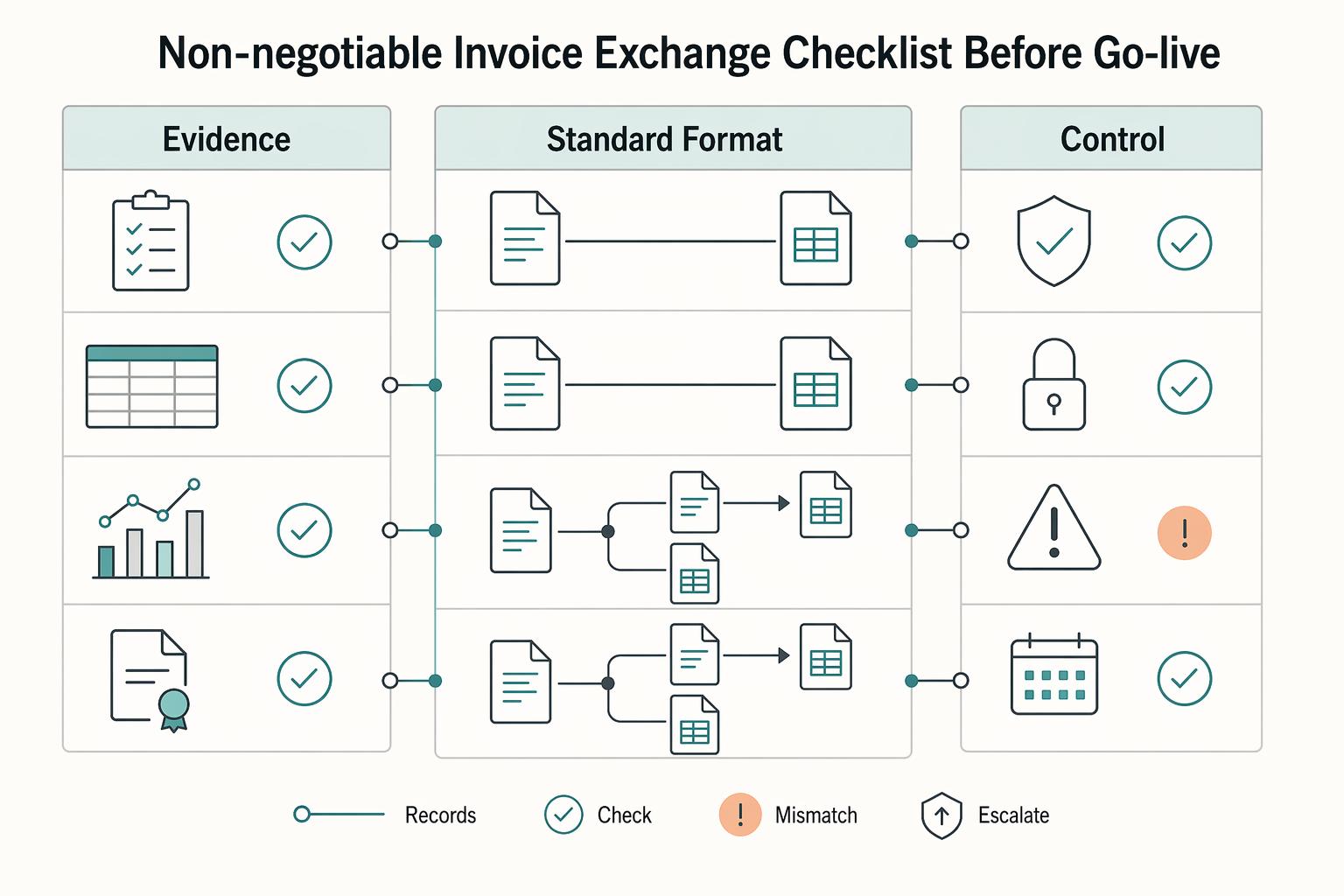
Non-negotiable invoice exchange checklist before go-live#
You are not go-live ready until these four checks are documented and signed off for each buyer lane.
| Check | What to confirm | Key details |
|---|---|---|
| Document scope and sequence | Confirm the exact transaction path before testing | Often EDI 850 Purchase Order to EDI 810 Invoice; add EDI 856 Ship Notice/Manifest or 820 only when the buyer requires them |
| Standard, format, and field mapping | Validate formal conformance to ANSI X12 or UN/EDIFACT | Confirm the ERP System and Accounting Platform can produce the buyer-required invoice fields across real scenarios |
| Transmission path, acknowledgments, and duplicate controls | Document the route, retry ownership, and success criteria for each buyer | Use 997 and 999 where applicable as receipt or syntax signals only; configure duplicate checks including ISA13 or UNB5 |
| Buyer sign-off evidence pack | Keep one buyer record with tested artifacts and owners | Include the approved mapping version, representative test files, exception categories, owner matrix, and buyer approval artifacts |
- Lock document scope and sequence first
Confirm the exact transaction path before testing. For X12, that is often EDI 850 Purchase Order to EDI 810 Invoice; add EDI 856 Ship Notice/Manifest or 820 only when the buyer requires them. Make the sequence explicit: what event triggers the invoice, and which prior document it must reconcile to.
- Validate standard, format, and field mapping against source systems
Treat validation as formal conformance to ANSI X12 or UN/EDIFACT, not just a plausible sample file. Include partner-specific outbound configuration where needed to reduce rejection risk. Confirm your ERP System and Accounting Platform can produce the buyer-required invoice fields consistently across real scenarios, not only happy-path tests.
- Define transmission path, acknowledgments, and duplicate controls
For each buyer, document the route (Value-Added Network (VAN) or Direct EDI Connection), retry ownership, and success criteria. Use functional acknowledgments like 997 (and 999 where applicable) as receipt/syntax signals only, not proof of downstream business acceptance. Configure duplicate checks at interchange, group, and transaction levels, including control-number checks such as ISA13 (X12) or UNB5 (EDIFACT), and keep interchange control numbers unique per partner.
- Assemble a buyer sign-off evidence pack
Keep one buyer record with the approved mapping version, representative test files, exception categories, owner matrix, and buyer approval artifacts. In hybrid setups, maintain this for both managed and direct lanes. The pack should let an operator quickly verify what was tested, what acknowledgment or approval was returned, and who owns the next action if something fails.
Related: Improving Credit Card Reconciliation for Platforms: How to Auto-Match Card Charges to Invoices.
Buyer onboarding and certification checkpoints teams skip#
Buyer onboarding is faster and safer when you run it as a gated certification flow: confirm requirements, lock mapping and tests, validate acknowledgments, then release to production only after pass criteria are met.
- Start with the trading partner implementation guide
Before mapping starts, get the buyer's implementation guide and treat it as the active spec. That guide defines how documents should be formatted and transmitted, including partner-specific expectations on top of ANSI X12. Confirm the in-scope document pair and transmission path up front (for example, VAN or direct). If the guide version or transport method is still unclear, pause before build work.
- Lock mapping and test cases before certification starts
Pre-certification should prove source-to-translator mapping accuracy, not just produce one plausible file. Use buyer-aligned test cases with traceable inputs and expected outputs. If your scope includes PO-to-invoice flow, require each PO test case to produce a valid EDI 810 Invoice path with evidence: source record, translated file, mapping version, and acknowledgment.
- Assume partner-specific X12 variance until proven otherwise
Base-standard optionality is not enough for production. A trading partner can require segments that are optional in generic X12, and those partner rules control certification outcomes. Do not reuse one buyer's map as a default for another buyer without checking that buyer's usage rules first.
- Release to production only after certified pass criteria are met
Move to production after testing passes and compliance is confirmed, not before. Keep traceable acknowledgment evidence in your EDI lane; for example, EDI 997 confirms structural acceptance or rejection at the functional group or transaction set level. If onboarding stalls, freeze scope to one buyer, one document pair, and one path until pass criteria are clearly met.
For a step-by-step walkthrough, see How Payment Platforms Really Price FX Markup and Exchange Rate Spread.
Failure modes and decision rules for steady-state operations#
After certification, steady-state success depends on separating delivery signals from business acceptance and routing fixes to the right layer.
| Issue | Signal | First action |
|---|---|---|
| Mapping drift | Releases, config changes, or buyer-specific map edits can cause rejected invoices even when transport looks healthy | Keep each EDI 810 Invoice map under version control by buyer, document type, and expected ERP field set |
| Receipt vs content acceptance | An MDN and an X12 997 functional acknowledgment confirm receipt-level processing, not business-content acceptance | Track application-level outcomes such as 824 or APERAK in the Accounting Platform |
| Buyer-specific rejection patterns | Failures cluster by buyer or variant | Correct partner mapping or partner-specific rules first; if the same pattern appears across buyers, fix source data contracts in ERP or upstream systems |
| Exception queues and no-response states | Keep separate queues for EDI 810 Invoice and Shipping Notice with explicit ownership and cause tagging | Monitor missing acknowledgments as a separate state, not just explicit rejects |
- Treat mapping drift as a primary run-state risk, not a rare edge case.
Your EDI Translation Software and ERP System can drift after releases, config changes, or buyer-specific map edits, and the result is often a rejected Invoice even when transport looks healthy. Keep each EDI 810 Invoice map under version control by buyer, document type, and expected ERP field set, and require change approval gates before source-field changes go live.
- Do not treat receipt acknowledgments as content acceptance.
An MDN and an X12 997 functional acknowledgment confirm receipt-level processing, not business-content acceptance. Track lifecycle status in your Accounting Platform beyond transmission, including application-level outcomes (for example 824 or APERAK), so content rejections are visible and practical.
- Use rejection patterns to decide where to fix first.
If failures cluster by buyer or variant, isolate and correct partner mapping or partner-specific rules first. If the same rejection pattern appears across buyers, fix source data contracts in ERP or upstream systems before onboarding additional buyers.
- Run exception queues by document type with explicit ownership and cause tagging.
Keep separate queues for documents such as EDI 810 Invoice and Shipping Notice, assign owners, and tag root cause categories consistently (content, sequence, connection, routing, configuration). Monitor missing acknowledgments as a separate state, not just explicit rejects, because no-response conditions are often early indicators of routing or connectivity issues.
For the collections side of the workflow, see Accounts Receivable Automation for Platforms to Collect from Enterprise Buyers at Scale.
Conclusion#
The decision that holds up is not "doing EDI" in the abstract. It is choosing the implementation model that fits your buyer mix, then enforcing hard checks on mapping, transport, and what counts as real acceptance.
-
Pick the model by buyer mix, not by preference. Trading-partner requirements really do vary across compliance, mapping, protocol, and testing, and that variance is exactly why onboarding can become difficult and time-consuming. If your near-term buyers mostly need speed and you do not want to own every connection detail, a managed or hybrid path can be a practical starting point. Operational burden is the real tradeoff: a managed cloud service can reduce build and management work, while direct AS2 gives you control only if you are prepared to buy AS2 software, run it on your own web server, and work through a multi-step setup.
-
Treat go-live as a verification exercise, not a transport milestone. One checkpoint matters more than teams admit: test with the buyer before production. SAP guidance for VAN setup explicitly includes a test account so you and your customers can confirm the configuration before actual use, and that is the right bar whether you route through a Value-Added Network or go direct. What you want is proof that your system can carry buyer-required data from document creation to acceptance, not just evidence that a file left your side.
-
Keep unknowns explicit until buyers and providers validate them. Pricing, certification timing, and partner-specific constraints should stay marked as open items during discovery. A provider may offer pay-as-you-go pricing or low-code partner management, but that still does not tell you what your total cost or onboarding time will be for a specific buyer relationship. Be honest in planning: if those assumptions are not validated partner by partner, do not present them as settled.
-
Watch the failure mode that hurts teams most in practice. Transport success is not the same as business acceptance. A VAN can relay documents to a supplier EDI mailbox, and a direct AS2 route can connect using your own servers instead of a VAN, but the invoice can still fail because the buyer-specific mapping or testing expectation was wrong. Fixes should follow the pattern: if the issue is isolated to one buyer, keep it in that partner mapping. If it shows up across buyers, stop adding scope and fix the source data or document logic first.
For many teams handling EDI invoice exchange, that often means starting managed or hybrid, then adding selective direct connections where the extra control clearly pays back after partner-by-partner validation. If discovery is still noisy, narrow it to one buyer, one document pair, and one route until the pass criteria are real.
Try a related tool
Researched and edited by the Gruv editorial team. Gruv builds cross-border billing, payouts, and finance-operations software for global businesses.
Sources
Includes 8 external sources outside the trusted-domain allowlist.
- aws.amazon.com/about-aws/whats-new/2025/06/aws-b2b-data-int...external
- aws.amazon.com/b2b-data-interchangeexternal
- docs.aws.amazon.com/b2bi/latest/userguide/what-is-b2bi.htmlexternal
- ediacademy.com/blog/testing-edi-transactions-before-going-liveexternal
- help.sap.com/docs/business-network-for-trading-partners/c...external
- help.sap.com/docs/business-network-for-trading-partners/e...external
- ibm.com/think/topics/edi-electronic-data-interchangeexternal
- ibm.com/docs/en/b2bisexternal
Educational content only. Not legal, tax, or financial advice.
Related Posts
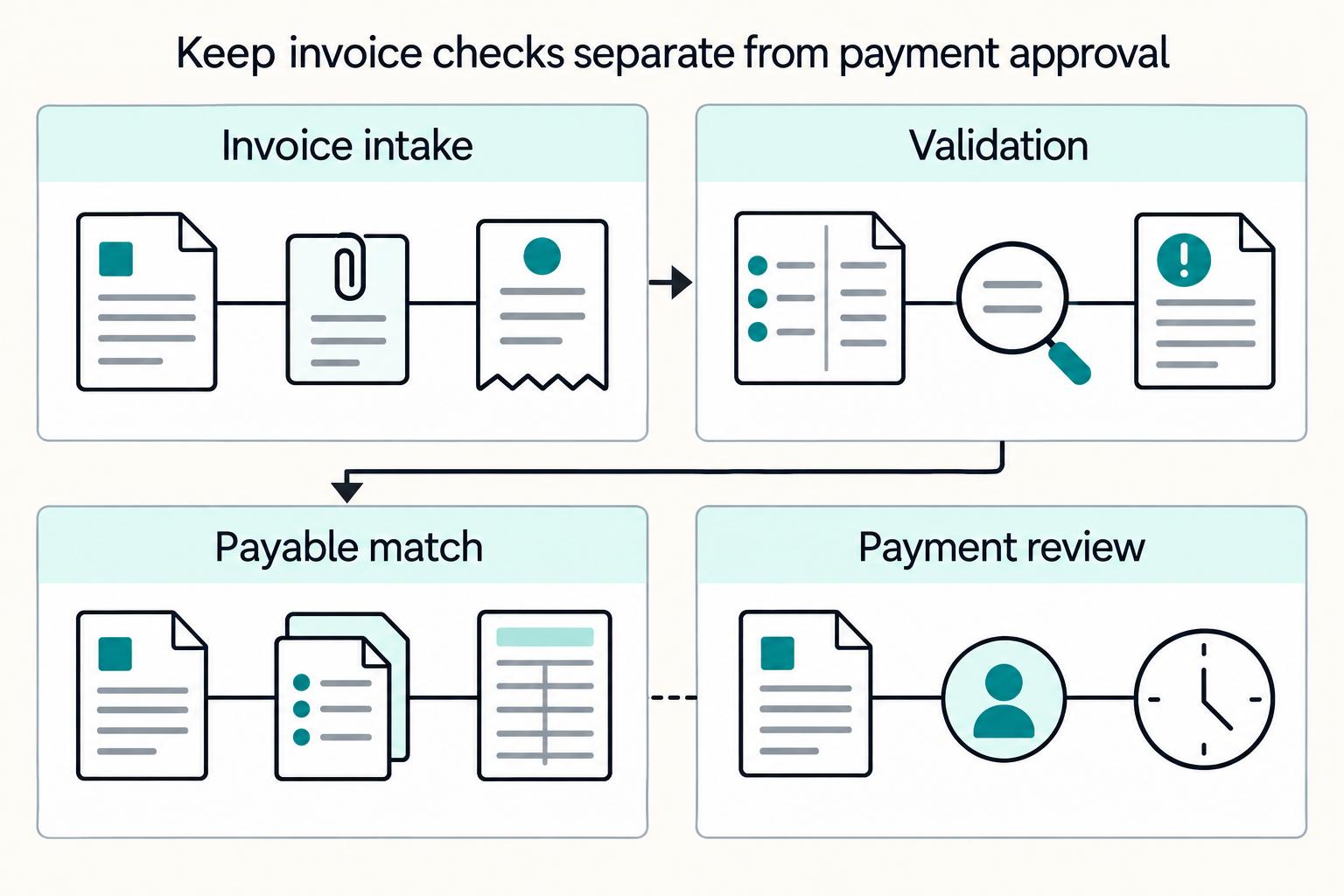
Cross-Border E-Invoicing Controls for Platform Payouts
Step 1: **Treat cross-border e-invoicing as a data operations problem, not a PDF problem.**
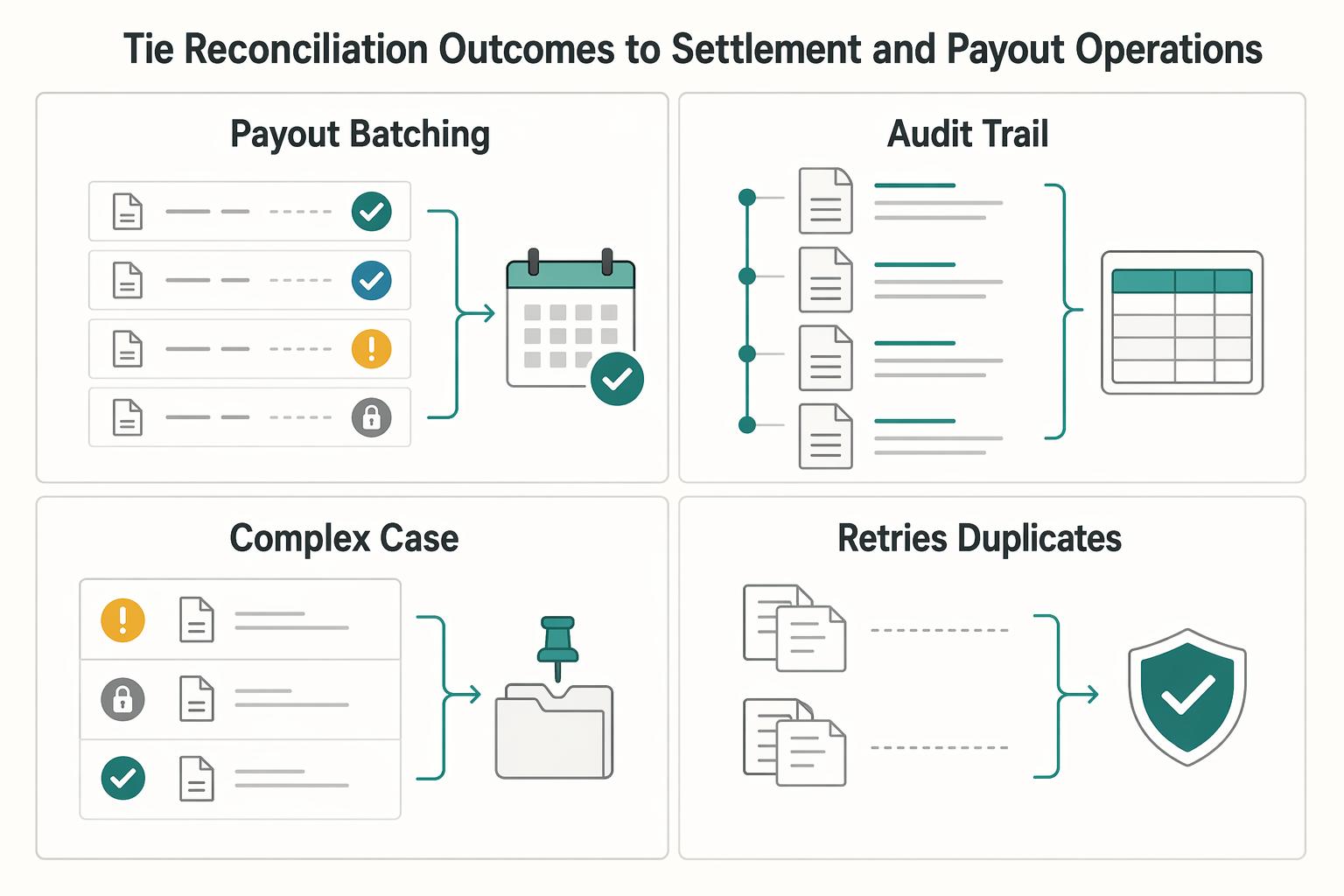
Improving Credit Card Reconciliation for Platforms with Auto-Match Invoice Controls
Auto-match works at scale only when you treat it as a control layer across invoices, the general ledger, approvals, and payout decisions, not as a convenience feature. At its core, credit card reconciliation is still a financial-control task. You are comparing card activity to internal accounting records to confirm transactions are accurate, authorized, and posted correctly.
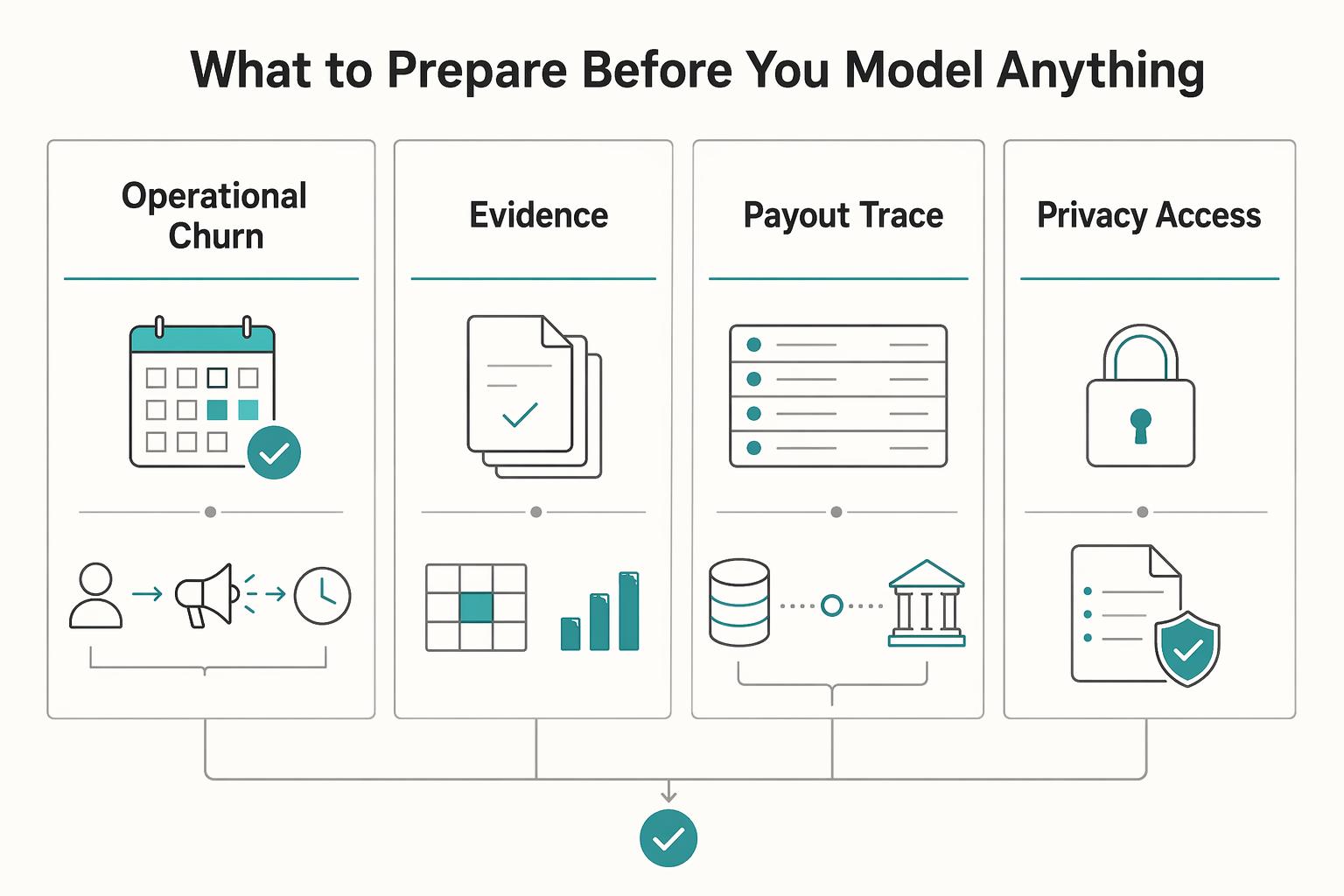
How Platforms Can Use Payout Data to Predict Contractor Churn
Treat contractor churn as a supply problem first, with payments as a potentially useful early signal. If your payout signals cannot trigger a concrete save action or margin decision, they are analytics, not useful prediction.