
Quick Answer
Compare protocol-led, payment-led and hybrid designs against your actual merchants and rails. Verify agent identity, delegated purchase scope and payment authority separately before executing a retry-safe payment. Retain signed evidence and actual transaction outcomes; recognition alone does not authorize payment or prove settlement.
Agent to merchant authentication is becoming a checkout design problem, not just a fraud control#
Agent to merchant authentication is becoming a checkout design problem, not just a fraud control. Once AI agents can transact for users, the core design question is where you anchor trust so onboarding, payment orchestration, and later disputes all point back to the same proof instead of splintering into separate records.
That shift is already visible in public materials. Google described its Agent Payments Protocol, or AP2, on September 16, 2025, as an open protocol built with payments and technology partners for agent-led payments across platforms. Visa was similarly direct in its 12/17/2025 announcement around Trusted Agent Protocol, saying agentic commerce only scales if network participants can trust the agents involved. For a CTO or solution architect, that makes this a platform choice, not just an API choice.
The practical issue is scope. It is not enough to verify that an agent exists. You need the merchant to recognize it, the request to map cleanly to user authority, and enough retained evidence for reviews, audits, and reconciliation later. When those pieces live in different systems, teams often end up rebuilding parts of the flow under pressure.
A good first filter is whether the model can handle unknown-agent scenarios. Visa Developer materials for Trusted Agent Protocol explicitly say the protocol applies when the agent is initially unknown to the merchant. That matters in real deployments because new agents and long-tail merchant environments are where brittle trust assumptions usually break first.
The same materials also include a clear warning: signatures can be ignored by merchants that do not adopt. So if you need broad acceptance early, do not mistake a valid signature format for guaranteed merchant-side enforcement.
There are three workable starting points:
- Protocol-led trust proof
Start here when the main job is authenticating the agent at the merchant touchpoint. What matters is whether the merchant can explicitly recognize agent identity, especially when it has never seen that agent before.
- Payment-led trust proof
Start here when your team needs trust controls tied more tightly to authorization and token rails. The upside is closer alignment with transaction execution, but public interoperability detail may be thinner than the headline suggests.
- Layered hybrid proof
Use this when you need one record across checkout, ledgering, and disputes. The upside is better long-term evidence quality, with more integration and governance work up front.
One caution should frame the rest of the article. Standards are still uneven. Industry commentary in early 2026 notes that inconsistent standards still make it hard for merchants to confidently recognize trusted agents. That is why the sections below separate what can be validated from public specs and announcements from what still needs direct vendor confirmation before production rollout.
For a step-by-step walkthrough, see Merchant of Record for Platforms and the Ownership Decisions That Matter.
Selection criteria that matter for platform teams#
Use one scorecard across all options: proof-chain completeness, operational resilience, payment coupling, and integration evidence. If an option is strong in only one area, expect rework later.
| Criterion | What to verify | Public signal |
|---|---|---|
| Proof chain completeness | Separate agent recognition, user/delegated purchase authority, payment authorization and outcome | Visa TAP defines recognition plus linked consumer/device and payment-container signatures; recognition alone is not payment authority |
| Operational resilience | Trusted keys, freshness, replay nonces and durable action identity | Visa TAP verification prose defines current timestamps, a maximum eight-minute interval and nonce/key checks |
| Payment coupling | Fit with network tokenization, strong authentication, and existing transaction flows | Mastercard public materials describe agentic tokens as cryptographically secure and traceable, reference MDES flows, and position payment passkeys around strong authentication |
| Shippable integration evidence | Onboarding steps, service discovery, integration guides, and reject or failure states | Mastercard says onboarding begins with registering and verifying AI agents before transaction permission, and its developer toolkit references service discovery and integration guides |
- Proof chain completeness
Build separate proofs for agent provenance, linked user/delegated purchase authority, payment authorization and actual transaction outcome. A valid recognition signature alone does not prove that this user authorized this purchase or that money settled. Retain the relevant signed scope and references across these checks.
- Operational resilience under normal failure
Require trusted-key lifecycle, current signature timestamps and replay-nonce checks. Retain key/algorithm identifiers and the actually verified signed inputs. An application session identifier can help investigation but does not replace the specification’s replay nonce or separate delegated/payment scope checks.
- Payment coupling that matches your rails
Favor trust models that connect directly to the payment path you already run. Look for support around network tokenization, strong authentication, and reuse inside existing transaction flows so proof records and payment records stay reconcilable. Mastercard public materials describe agentic tokens as cryptographically secure and traceable, reference MDES flows such as cardholder authentication before transaction and post-tokenization authentication, and position payment passkeys around strong authentication. Do not assume identical rail or regional coverage without confirmation.
- Shippable integration evidence
Separate announcement quality from implementation readiness. Check whether public docs expose practical artifacts such as trust onboarding steps, service discovery, integration guides, and clearly described reject or failure states. Mastercard states onboarding begins with registering and verifying AI agents before transaction permission, and its developer toolkit references service discovery and integration guides. If you cannot identify onboarding artifacts, verifier entry points, and expected reject paths before design review, the integration is not ready.
If you want a deeper dive, read ASC 606 for Merchant-of-Record Platforms: Principal vs Agent Revenue Recognition.
Quick comparison of the top architecture options#
If you need broad merchant interoperability early, start with the path that has fewer hard payment-stack dependencies. If you need stronger dispute evidence, prioritize an explicit Verifiable Intent-style authorization record.
| Option | Best for | Strongest proof primitive | Payment stack dependency | Known unknowns | Rollout risk by merchant environment |
|---|---|---|---|---|---|
| Trusted Agent Protocol led integration | Early agent verification across varied merchant setups | TAP-led agent verification; Web Bot Auth is referenced as the shared authentication layer | Lower relative dependency when your first goal is agent trust, not a single card program | Public excerpts do not confirm live production interoperability, full onboarding mechanics, or dispute coverage by acquirer/region | Lower-to-medium when you need a narrower dependency set first; rises where protocol support is uneven |
| Mastercard Agent Pay led integration | Teams already operating close to Mastercard network flows | Agent registration and verification before agents are permitted to transact on the Mastercard network | Higher, because onboarding and controls are tied to Mastercard network participation | Mastercard says the framework is still being refined; public detail does not provide a full acceptance matrix by merchant, PSP, and region | Medium-to-high in heterogeneous or multi-rail estates; lower where Mastercard-centric flows already exist |
| Layered hybrid with protocol proof plus payment layer controls | Multi-rail platforms that want both agent verification and stronger authorization evidence | Validated protocol recognition plus separately verified signed purchase/payment authority | Moderate-to-high, based on how tightly trust proof is coupled to payment orchestration | Verifiable Intent has an open specification and initial reference implementation; announcement-time future tooling is not confirmed current partner integration | High in fragmented environments unless precedence, retention, and failure handling are defined up front |
| Treat as unconfirmed until partner verification | Teams tempted to treat announcements as production guarantees | Treat as unconfirmed until partner verification | Treat as unconfirmed until partner verification | Production interoperability today, complete dispute-resolution coverage, and full regional support matrices are not confirmed in the public material cited | Highest if treated as solved before design review and partner verification |
Two checkpoints help avoid roadmap risk. First, treat "compatible with recently announced agentic protocols" as directional, not proof of live interoperability. Second, before committing engineering capacity, confirm three concrete artifacts: the current onboarding document, the verifier entry point, and at least one example failed transaction caused by missing or invalid agent proof.
Related: Merchant of Record for AI Agents: Who Is the Buyer of Record in Autonomous Transactions?.
Option 1 with Visa Trusted Agent Protocol#
Use TAP where the merchant needs trusted-agent recognition and can validate the required linked consumer/payment proof. Verify recognition separately from delegated purchase constraints and payment authority; one signed browsing request does not establish all three.
| Validation element | Public detail | Implication |
|---|---|---|
| Agent recognition | Validate the required signature inputs and trusted public key | Establishes trusted-agent participation, not settlement or purchase authority |
| Authority and operation binding | Validate linked user, purchase constraints and payment-container/mandate scope | Bind the actual merchant/action/amount required by the relevant proof |
| Freshness and replay control | Current timestamps; TAP interval no longer than eight minutes; key validity and nonce replay rejection | Reject invalid or repeated proofs; retain durable financial-action duplicate protection separately |
| Verification metadata | Retain key/algorithm IDs, signature inputs, timestamps, nonce and result | Reconstruct which checks actually passed |
| Signature verification | Rebuild the RFC 9421 signature base and verify through configured trust sources | A valid signature still needs linked authority and payment checks |
Visa TAP distinguishes agent recognition, linked consumer/device recognition and linked payment-container signatures. Recognition identifies trusted-agent participation; a merchant must separately validate the linked purchase/payment authority and normal risk controls. Merchant adoption is optional, and the generic specification and Visa implementation examples have distinct scopes.
Why this option is strong#
Validate the merchant domain, path and other required signature inputs for the relevant proof. Recognition binds agent interaction inputs; action-specific purchase/payment scope comes from the linked authority proof and its verified constraints.
Visa TAP verification prose requires a validity interval no longer than eight minutes, current created/expires timestamps, key expiry checks and replay-nonce rejection. These controls work only when the verifier enforces them; a time-bound signature does not automatically prevent replay.
- Enforce current created/expires timestamps, the specified maximum validity interval and key expiry.
- Reject previously recorded replay nonces and retain durable transaction duplicate protection.
- Rebuild the signature base, verify a trusted key and separately check linked user/purchase/payment scope.
Where you should be cautious#
The main risk is operational uncertainty, not the cryptographic model. Visa's overview states the product is still in development/deployment and may not be available in all markets, and public excerpts do not fully document onboarding prerequisites, cross-stack interoperability mechanics, or measurable production outcomes.
A practical fit is an autonomous cart assistant that must prove delegated authority for each merchant action before checkout confirmation. The tradeoff is that you still need to validate market support, key distribution expectations, and failure handling before you assume broad production readiness.
Option 2 with Mastercard Agent Pay#
This option is strongest when you want agent authorization tied directly to Mastercard's existing payment controls, not managed as a separate merchant-edge layer. If your stack already depends on MDES, secure card-on-file patterns, and passkey-style authentication, Agent Pay is usually the cleaner architectural fit.
Mastercard announced Agent Pay as its agentic payments program on April 29, 2025. In public materials, Mastercard frames it as building on familiar rails, including secure card-on-file, Mastercard Payment Passkeys, and tokenized credentials through MDES. That reduces conceptual drift when your payments and risk teams already operate inside those controls.
Why this option is strong#
The core advantage is payment coupling. MDES supports digitized payment credentials, and Payment Passkeys support device-based purchase authentication (fingerprint, face scan, or PIN). Together, they give you a practical way to connect agent actions to tokenized credentials and cardholder-intent checks in one flow.
Mastercard's Acceptance Framework positioning also states that it starts by registering and verifying AI agents before they can transact on the Mastercard network. For implementation, that shifts the question from "can the agent identify itself?" to "can we prove the agent was registered, verified, and then used within trusted payment controls?"
If you already optimize for network tokenization and passkey-aligned checkout, this route is often easier to align internally.
Where you should be cautious#
The main risk is rollout depth and access, not direction. Mastercard says the framework is still being refined with stakeholder feedback, so do not assume all implementation detail is fully public or production-ready for every merchant scenario.
Before committing, confirm:
- Your acquiring, gateway, and issuer partners support the MDES/passkey components you plan to use in your target markets.
- What merchant-side artifact proves an agent was registered and verified before transaction initiation.
- The fallback behavior when agent verification, token binding, or user-intent validation cannot be completed.
Confirm the actual provider/product version, onboarding and merchant participation in your proposed environment. An announced pilot or future toolkit does not establish current production support.
For platforms that need agent authorization tightly aligned to tokenization and cardholder-intent controls, this is a credible path.
Option 3 with layered hybrid verification#
Choose this model when you need trust proof to stay independent from any single payment program. For multi-rail or cross-border Merchant of Record stacks, a layered design can preserve audit quality, but only if you define conflict-handling rules before launch.
A hybrid design separates agent provenance, delegated purchase authority, rail/payment authorization and retained intent/outcome evidence. Define ownership for mismatches; public specifications do not establish one production rule for every cross-layer conflict.
Why this option is worth the extra work#
TAP can provide signed agent-recognition and linked consumer/payment evidence. Validate each proof’s scope and trust source separately; recognition can support merchant interaction across contexts without becoming a reusable payment-authorization badge.
There is also public support for a layered approach across ecosystems. Cloudflare says Trusted Agent Protocol and Agent Pay both use Web Bot Auth as an authentication layer, and Mastercard says its framework is designed to be compatible with recently announced agentic protocols. That supports the architecture direction, without proving universal production interoperability.
Current AP2 v0.2 uses Checkout Mandates and Payment Mandates, each with open or closed stages. Checkout binds purchase details shared with the merchant; payment binds instrument/amount authority for credential providers, networks and payment processors. Open stages specify constraints, while closed stages bind finalized details. Validate the relevant signed scope rather than assuming older mandate names are current across integrations.
| Layer | What you verify | Why it matters |
|---|---|---|
| Agent identity | Required recognition signature and trusted key checks | Establishes agent provenance; does not prove user permission |
| Purchase/payment authority | Linked user and signed purchase/payment constraints plus normal rail controls | Determines whether this action may proceed |
| Intent and outcome evidence | Relevant signed mandate, unique operation/attempt IDs and financial outcome references | Supports investigation without guaranteeing dispute resolution |
Where teams get tripped up#
The hardest part is governance, not cryptography. Once you combine protocol proof, payment proof, and intent evidence, you need explicit precedence rules for conflicts.
A common mismatch is when a payment layer authorizes but agent proof is missing, expired, or out of scope. Another is when the merchant can identify an agent but classifies the interaction as browse, not pay. Cloudflare's browse-versus-pay distinction should be enforced as a hard gate, not treated as telemetry.
If required purchase/payment authority is not proven, do not initiate payment. If payment already executed and trust review later fails, preserve the actual financial effects and required accounting records. Hold fulfillment or new downstream payouts your platform controls while reviewing the evidence; an internal hold cannot erase or pause completed network settlement.
The operator details that matter most#
Use a stable internal operation ID plus provider payment/attempt references as the transaction join. PAR, where available, links payment-account/token activity without using PAN; it is an account-linkage field, not a unique transaction key. Retain it alongside operation, authorization, settlement and dispute references.
At minimum, each transaction should retain:
- agent-signature evidence for that interaction
- user-authorization evidence (for example, a signed mandate record)
- payment references and outcome, including PAR where supported
Related reading: How to Choose a Merchant of Record Partner for Platform Teams.
Implementation sequence that avoids platform debt#
This stays manageable when you sequence controls in this order: verify agent identity and scope first, make payment execution retry-safe second, then automate reconciliation and payout release. If key lifecycle ownership or rollback handling is still unclear, keep agent actions in agent-assisted mode.
| Stage | Primary control | Grounded detail | Hold rule |
|---|---|---|---|
| Identity and scoped authorization | Per-interaction signature verification before payment initiation | Key lifecycle management needs clear responsibility across generation, distribution, and destruction | If signature validation fails, delegated scope is unclear, or required interaction metadata is missing, stop the flow |
| Retry-safe payment execution | Persist durable action intent; use the selected rail’s actual stages and supported request identity | Adyen company-account keys are valid 7–14 days; cross-regional duplication needs separate controls | Resolve unknown outcomes and retain internal uniqueness beyond provider windows |
| Reconciliation and payouts | Add payout automation only after payment and retry controls are reliable | Insert a reconciliation checkpoint before payout release and confirm payment and payout records align | If trust proof is missing, payment outcome is ambiguous, or reconciliation does not line up, do not release payout |
- Start with identity and scoped authorization
Before payment initiation, verify signatures against configured trusted key sources, key validity, the required signature inputs and the current freshness/replay nonce rules. Then separately validate the linked user, delegated purchase constraints and payment authorization. Do not discover keys from arbitrary untrusted issuer URLs or treat recognition alone as authority.
Treat this as an ownership checkpoint too. Key lifecycle management needs clear responsibility across generation, distribution, and destruction before you expand autonomy.
- Add payment execution only after retries are safe
Persist recoverable payment-action intent and durable uniqueness before external execution. For card flows supporting separate authorization/capture, validate those stages and their retry rules; other rails may combine or use different stages. Resolve an uncertain original outcome before any replacement action.
Adyen documents company-account-scoped idempotency keys valid for 7–14 days, with no cross-regional-endpoint duplicate checks. Apply the supported key to the same request retry, but retain internal action uniqueness and original-outcome recovery beyond provider retention. Provider keys do not establish exactly-once execution across rails.
- Automate reconciliation and payouts last
Add payout automation only after payment and retry controls are reliable. Where supported, insert a reconciliation checkpoint before payout release and confirm payment and payout records align.
Use a hard hold rule: if trust proof is missing, payment outcome is ambiguous, or reconciliation does not line up, do not release payout. Keep agent-assisted checkpoints in place until signature verification and rollback paths are proven end to end.
Failure modes and evidence packs you need on day one#
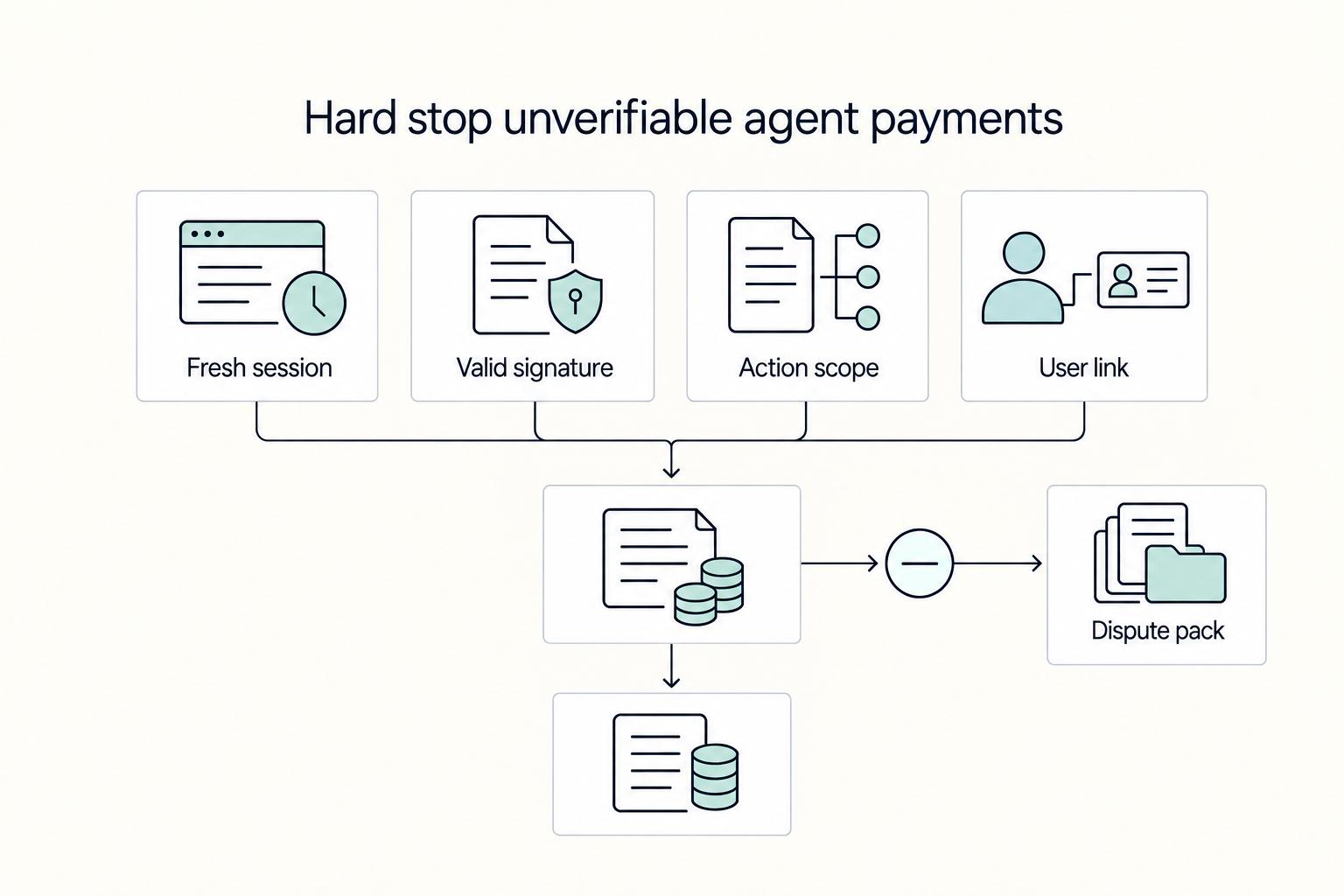
Treat verification failures as core product behavior from day one: hard-stop anything that breaks freshness, signature validity, scoped authorization, or user-authorization linkage, and build the dispute pack on every attempt.
- Hard-stop failures, not soft warnings
Your payable path should reject these as terminal failures:
| Failure mode | Day-one handling |
|---|---|
| Expired signature, invalid key or replayed nonce | Reject new payment initiation and retain the failed verification record |
Invalid digital signature | Reject immediately and route to human follow-up only |
| Action does not match delegated scope | Reject as out-of-scope, even if the agent is otherwise known |
| Missing user-authorization linkage | Reject until the request can be tied to a valid authorization artifact |
For verification context, keep the signature metadata together (timestamp, replay nonce and applicable interaction/session identifier, key identifier, algorithm identifier) and verify authorization for the specific action on your domain, not just generic agent approval.
- Use a fixed dispute evidence template
A reusable evidence pack should be consistent and generated the same way every time. Include the request payload hash, signature metadata (key identifier, algorithm identifier, timestamp, replay nonce and applicable interaction/session identifier), the user authorization artifact for that action, payment reference, and the full ledger event chain.
Retain PAR as optional account/token linkage alongside the unique operation and provider attempt references. Include processor status, settlement and refund records so reviewers can reconstruct both authorization evidence and actual money movement.
- Add operator checkpoints before incidents happen
Bound verification retries by the dependency’s documented semantics and your latency budget. During unresolved verification, stop new payment initiation; escalate eligible cases for manual review with evidence. Do not adopt an unexplained fixed retry count or retry uncertain payment execution as if it were a verification lookup.
Keep review triggers explicit (for example, incomplete verification telemetry or dependency timeouts), and keep customer-facing status coarse-grained: authentication requested, authenticated, or failed. Do not expose internals like missing algorithm identifier or key lookup errors.
This pairs well with our guide on What is a Merchant of Record (MoR) and How Does It Work?.
Conclusion#
- Favor layered proof over a single-program bet. Public signals point in the same direction: Cloudflare says both Trusted Agent Protocol and Agent Pay use Web Bot Auth as the agent authentication layer, and Mastercard says its framework is designed to be compatible with recently announced agentic protocols.
In practice, this can give you more flexibility. You can separate agent authentication from payment-rail specifics, keep user authority scoped to each action, and attach payment evidence where a rail supports it. If your merchant mix spans different checkout stacks or markets, this is often the lower-regret choice. The red flag is hardwiring your platform to one early program assumption when Visa's TAP overview still says the product is in development and deployment and "may not be available in all markets."
- Version the actual mandate contract. AP2 currently publishes v0.2 Checkout and Payment Mandates, with open/closed stages and ongoing FIDO standardization. Confirm which version and stages each partner supports before rollout.
That should shape your implementation plan. Start with the checks you must trust every time: recognized agent proof, valid user linkage, and action scope that matches what you will allow. Only then add deeper payment coupling and richer evidence handling. A useful checkpoint is simple: do not remove human fallback until you have tested failure handling for unsupported merchants, missing trust signals, and market-level availability gaps. A planning risk is integrating ledger, reconciliation, and exception handling as if early protocol coverage were already final.
- Use a controlled pilot with current partner support. Test recognition, delegated authority, payment authorization, recovery, settlement and evidence retention in the intended merchant/rail environment. Expand only after those paths pass.
The useful differentiator is evidence from your environment: which merchants accept the flow, which compliance teams are comfortable with the proof chain, and where manual review still needs to exist. So the next step is concrete: map your shortlist to your current merchant mix, regions, and compliance posture, then run one bounded pilot before broad rollout. If you operate a Merchant of Record model, tie that pilot to buyer-of-record and evidence ownership questions early, not after launch.
Frequently Asked Questions
What is agent-to-merchant authentication in practical terms?
Agent-to-merchant authentication identifies the agent interacting with a merchant. Purchase authority, user linkage and payment authorization require their own signed scope and validation. Visa TAP and AP2 supply different evidence structures; decide whether this agent may perform this purchase for this user only after checking the relevant authority, not merely a bot-recognition signature.
What must be verified on every autonomous agent transaction?
Check trusted-agent provenance, the linked user and delegated purchase scope, and the applicable payment authority separately. For Visa TAP, enforce current timestamps, an interval no longer than eight minutes, key validity, signature inputs and nonce replay rejection. Missing authority blocks payment initiation even when recognition succeeds.
How is agent-to-merchant authentication different from standard checkout authentication?
Interactive checkout commonly authenticates a user present in the flow; recurring and other delegated payment models already use different authority structures. Autonomous-agent checkout needs verifiable purchase/payment scope that travels with the request, rather than relying only on a recent human session.
What does `Verifiable Intent` add beyond normal fraud checks?
A valid signed mandate makes authorized content changes detectable under the verified key and trust model. It can help investigators establish what was signed, but does not by itself prove genuine consent, nonrepudiation, settlement or a favorable dispute outcome. Preserve user-authority, payment and outcome evidence as distinct artifacts.
Do `Trusted Agent Protocol` and `Mastercard Agent Pay` interoperate today?
There is one meaningful public overlap: Cloudflare states that both Trusted Agent Protocol and Agent Pay use Web Bot Auth as the agent authentication layer, which relies on cryptographic signatures in HTTP messages. Mastercard also says its framework is designed to be compatible with recently announced agentic protocols. The warning is that public excerpts still do not show a full bilateral interoperability spec, so you should not assume end-to-end interchange across merchant environments without partner testing.
What is still unknown before committing to one architecture?
The biggest unknowns are the operational ones: onboarding mechanics, trust enrollment, key lifecycle ownership, fallback behavior, and measurable production outcomes across real merchant stacks. Public material is useful for direction, but it is not a substitute for acceptance docs, failure states, and evidence expectations in your own environment. If a vendor cannot show those artifacts, keep autonomy narrow and require a manual review path until the gaps are closed.
Try a related tool
Researched and edited by the Gruv editorial team. Gruv builds cross-border billing, payouts, and finance-operations software for global businesses.
Sources
Includes 8 external sources outside the trusted-domain allowlist.
- ap2-protocol.orgexternal
- blog.cloudflare.com/secure-agentic-commerceexternal
- cheatsheetseries.owasp.org/cheatsheets/Key_Management_Cheat_Sheet.htmlexternal
- cloud.google.com/blog/products/ai-machine-learning/announcing...external
- developer.mastercard.com/payment-account-management/documentation/api...external
- developer.mastercard.com/mdes/product/mdes-issuersexternal
- developer.visa.com/use-cases/trusted-agent-protocolexternal
- developer.visa.com/capabilities/trusted-agent-protocol/trusted-...external
Educational content only. Not legal, tax, or financial advice.
Related Posts
ASC 606 Principal vs Agent Decisions for Merchant-of-Record Platforms
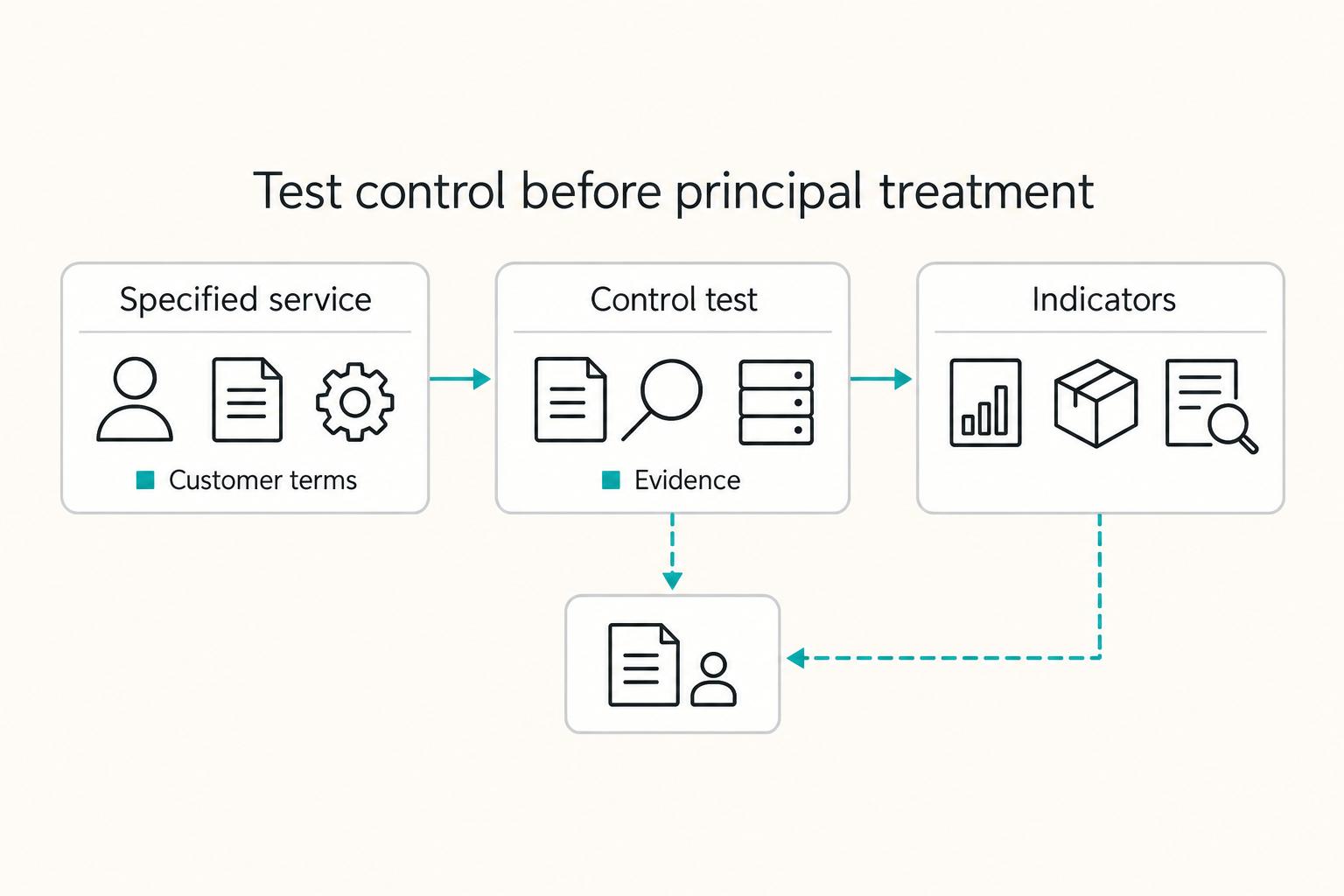
For merchant-of-record teams, the **ASC 606 principal vs agent merchant of record** call is a high-stakes judgment, not a presentation preference. It can move revenue from gross to net and raise the level of judgment finance, audit, and compliance teams need to defend.
Merchant of Record for AI Agents and Buyer of Record Decisions
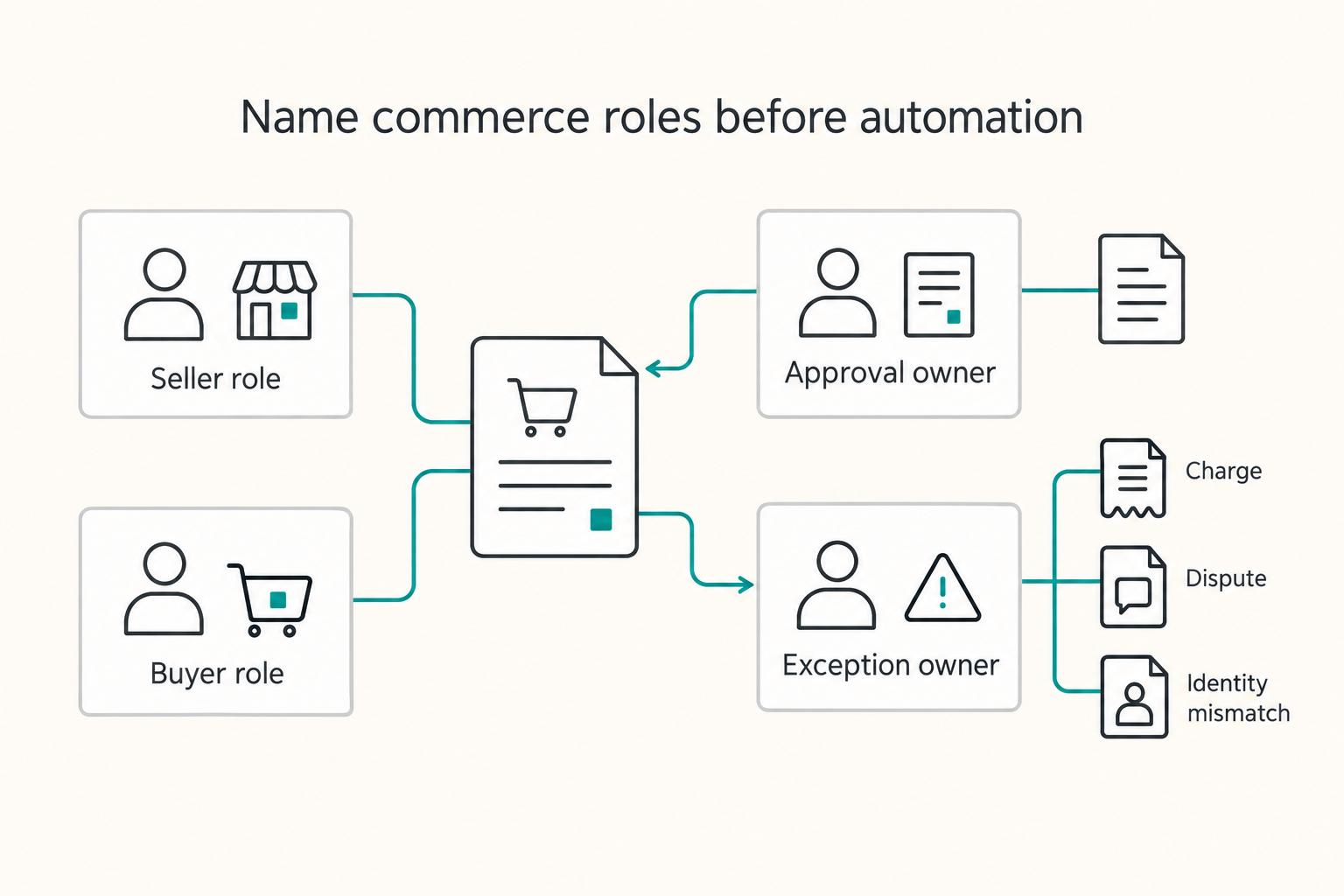
AI commerce is moving faster than role clarity, and that is where teams get into trouble. Before you debate protocols or checkout surfaces, decide who is actually selling, who is the recognized buyer, who captures approval, and who owns the fallout when a charge, dispute, or identity mismatch shows up later.

The Freelance Payment Penalty: A Modeled Audit of Platform Fees, FX Spreads, and Payout Delays
The money rarely disappears through a single, easy-to-spot fee. The real loss is stacked. A marketplace takes its commission, a processor adds a charge for international cards, a bank or payment company converts the currency at a spread, a platform holds the funds before release, and a wire sheds a little to intermediaries on the way in. Each layer looks defensible on its own, but the worker feels the combined result as a smaller deposit and a later payday.