
Quick Answer
Start by treating launch as a control test: can your team reconcile payouts to Form 1099-K records, prove KYC evidence, and show a resolved licensing decision for each country. For U.S. flows, IRS threshold language points to more than $20,000 and more than 200 transactions, and recipient copies can be due by January 31. If those artifacts are unreliable, delay scale; fixing them later usually means correction cycles, support spikes, and slower market entry.
Why These Costs Show Up Before Expansion#
The cost gig platforms absorb from non-compliance rarely sits neatly in a legal reserve on a spreadsheet. In expansion work, it often shows up first as operating drag. Launch plans can slow, operational flows may need exceptions or rewrites, and teams can lose confidence when compliance assumptions do not hold.
That matters because this is no longer a niche model. The International Labor Organization counted over 777 active digital labor platforms in 2021, up nearly sixfold from 142 in 2010. Gig-economy employment practices have also drawn close attention from regulators and courts across multiple jurisdictions. A comparative legal analysis published on 22 April 2024 describes an ongoing global contest over how these businesses preserve their model under pressure. If you operate a platform that recruits workers through an app or website, you are entering a market structure that is already being tested.
A big reason the downside compounds is worker status. Many platforms rely on independent contractor classification, and that choice can shift tax and employer-obligation exposure rather than remove it. In practice, classification, tax reporting, onboarding evidence, payout design, and privacy handling are closely connected. If one area fails, the fix often reaches into the rest.
This article ranks the cost buckets worth your attention before you enter a new country or vertical. The point is not to guess at a universal dollar figure. The useful question is which failures create the biggest operational blast radius, the slowest recovery, and the highest chance of forced rework.
A simple way to read the rest of the piece:
- What can stop normal operations
Risks that can disrupt payouts, force contractor-model rework, or draw regulator attention belong in launch review, not in the backlog. If a market depends on "we'll clean this up after go-live," treat that as a warning sign.
- What you should verify early
Confirm the worker model you are relying on, the reporting path tied to your payout flow, and the evidence you will need to keep. If you cannot point to the contract terms, onboarding fields, and audit trail you plan to use, you are still operating on assumptions.
- What we will not fake precision on
Source coverage is uneven. Where evidence is thin, this article flags the unknowns instead of pretending there is a universal cost curve for every platform, market, or launch model.
If you are choosing where to expand next, keep this frame in mind: treat compliance exposure as part of market-entry economics, not as a late legal cleanup.
For a step-by-step walkthrough, see Do Solo Consultants Need Traditional PRM Software? Use the Clients, Platforms, and Compliance Framework.
Who this list is for and how to score each risk#
Use this list as an operator scoring tool for go/no-go launch decisions, not as jurisdiction-specific legal advice. If a risk can block payouts or force contractor re-papering, treat it as a launch-gate item.
-
Use it when choosing markets, rails, or onboarding models. This section is for founders and operators comparing how a country launch will run in practice while payout setup, KYC requirements, and worker onboarding are still being finalized.
-
Score five dimensions, not just fines. Rank each market on regulatory penalties exposure, tax non-compliance exposure, operational blast radius, time to remediate, and impact on launch timing.
-
Rate each risk with a simple three-part method. Score likelihood, detectability, and recovery cost for every item. This follows established failure-analysis logic by prioritizing issues that happen often, are hard to detect, and are costly to unwind.
-
Escalate quickly when Internal Revenue Service or GDPR exposure appears. The Internal Revenue Service applies separate penalties for incorrect filings and incorrect payee statements, with 2026 per-item tiers of
$60,$130,$340, and$680, and no maximum for intentional disregard. GDPR Article 83 allows administrative fines up toEUR 20,000,000or4%of worldwide annual turnover. Risks at that level belong in launch review with a named owner and evidence.
The top cost buckets to rank before you enter a market#
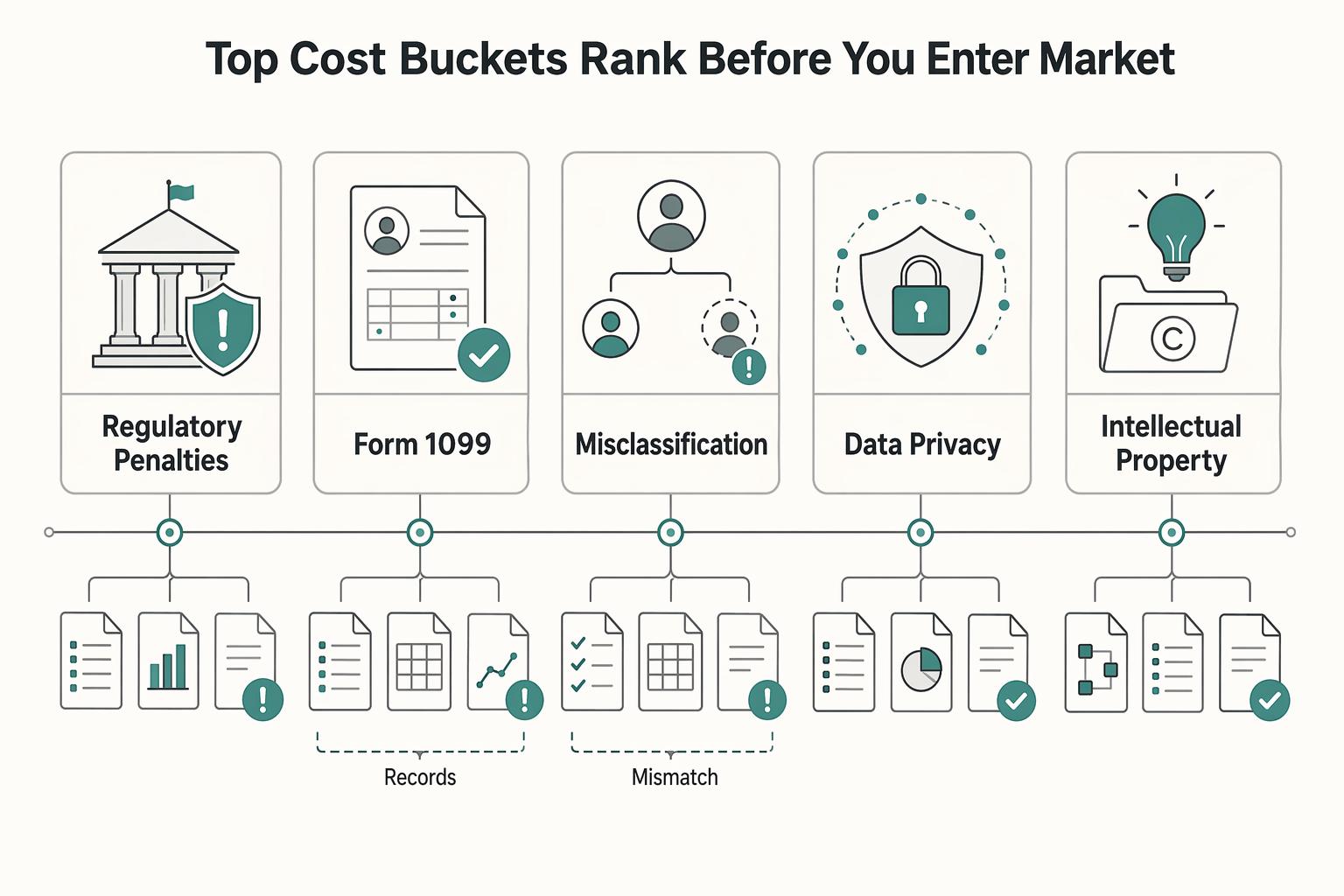
Rank the buckets that can stop payouts or force rework first, then sequence the rest. In practice, Form 1099-K and information-reporting exposure usually rank highest when you operate like a TPSO or rely on PayPal/Venmo contractor flows, while cross-border compliance and licensing often rank highest when country exceptions drive onboarding, payout, and tax-form logic.
| Cost bucket | Trigger | Leading indicator | Direct cost | Recovery path |
|---|---|---|---|---|
| Regulatory penalties | Reporting, privacy, or licensing duties are missed | Controls exist in policy docs but not in product gates or auditable logs | Fines, regulator response work, launch pause, mandatory remediation | Assign owner, build evidence pack, remediate control gaps, refile or respond |
| Form 1099-K and information reporting requirements | You operate as a TPSO or settle reportable payment transactions | Unreconciled payout totals, weak payee-data checks, unclear goods/services tagging | Incorrect or late Form 1099-K filings, corrected statements, support volume, IRS exposure | Reconcile settlement data to reporting outputs, fix payee records, reissue statements, document exceptions |
| Misclassification | Contractor model and local worker rules diverge | One onboarding/payout model reused across different labor models | Contract re-papering, tax and legal review, payout-process redesign | Review by market, update contracts and onboarding, align payout and tax treatment |
| Data privacy | Telemetry, support logs, or document handling processes personal data beyond need | Broad access to IDs, payout docs, or logs without clear limits | Incident response, audit work, possible GDPR fines up to €20 million or 4% of global turnover | Minimize fields, restrict access, set retention rules, clean historic data, document processing |
| Intellectual property | Contractor deliverables lack clear ownership or license terms | Onboarding terms omit assignment or usage rights | Claim defense, contract cleanup, payment holds, delayed delivery | Update contractor terms, capture assent, remediate disputed deliverables |
| Cross-border compliance | Country rules change payout routing, reporting, tax forms, or licensing path | Spreadsheet exceptions by country, unclear W-8 BEN collection, no licensing decision | Launch delay, blocked payouts, manual review cost, re-onboarding | Build country evidence pack, confirm licensing path, collect market-specific tax forms, pilot before scale |
Form 1099-K exposure usually rises faster than teams expect#
If your model touches payment-app or online-marketplace flows, treat information reporting as a launch gate. The IRS states that TPSOs, including payment apps and online marketplaces, are required to report payments on Form 1099-K, and current federal threshold language references more than $20,000 and more than 200 transactions.
Before launch, prove settlement totals, payee statements, and exception logs reconcile to the same source records. If you rely on Venmo or similar rails, validate goods-and-services tagging, since Venmo says its 1099-K rules do not apply to friends-and-family payments. Also account for backup-withholding cases: PayPal and Venmo state they may still issue Form 1099-K during 2025 outside normal threshold logic.
Cross-border and licensing risk wins when country exceptions multiply#
Move cross-border compliance and licensing to the top when each country introduces separate onboarding evidence, payout routing, or tax-form requirements. This matters most when your rollout depends on W-8 BEN collection, DAC7-aligned seller information, or a regulated payment-services setup.
DAC7 entered into force on January 1, 2023, and the first exchange for calendar year 2023 occurred at the end of February 2024, so this is already an operating requirement. In the UK, the Financial Conduct Authority states firms that provide payment services or issue electronic money must be authorised or registered. If that licensing path is unresolved, treat the market as not launch-ready.
Privacy moves up the list when your support stack sees too much#
Raise privacy risk in markets where onboarding and payout support involve heavy document handling. Under GDPR, personal data covers information relating to an identified or identifiable living individual, and processing includes collection, storage, retrieval, use, and disclosure.
Use access and retention as your practical test. If support teams can access identity documents, tax forms, or payout logs without a clear documented need, or those artifacts are retained without clear limits, move privacy higher in your ranking. For a deeper breakdown, see Gig Worker Tax Compliance at Scale: How Platforms Handle 1099s W-8s and DAC7 for 50000+ Contractors.
If you want a deeper dive, read The Compliance Moat: Why Gig Platforms That Invest in RegTech Win Long-Term.
Why tax reporting failures compound faster than most teams expect#
In U.S. payout flows, tax reporting should be a launch gate, not a back-office cleanup task. When Form 1099-K handling slips, the same data issues can carry from your records into payee statements, support work, and any IRS response. If your model touches U.S. contractor payouts, put reporting and reconciliation controls in place before scaling acquisition; if reconciliation is not stable yet, keep launch scope narrow.
| Example | Article statement | Threshold or caveat |
|---|---|---|
| IRS / TPSOs | TPSOs, including payment apps and online marketplaces, are required to report payments on Form 1099-K | Current federal trigger language points to more than $20,000 and more than 200 transactions |
| Venmo | 1099-K rules do not apply to friends-and-family payments | Validate goods-and-services tagging |
| PayPal and Venmo | May still issue Form 1099-K during 2025 outside normal threshold logic | Backup-withholding cases |
| Uber | 1099-K reports annual on-trip gross earnings | The obligation follows the settlement flow, not internal product labeling |
| DoorDash | Merchants can receive a 1099-K because DoorDash meets TPSO criteria | The obligation follows the settlement flow, not internal product labeling |
| Etsy and eBay | Issuance is tied to the restored federal threshold criteria | More than $20,000 and more than 200 transactions |
-
Weak source records create a chain reaction. Form 1099-K reports payments received for goods or services during the year, so failures often begin in settlement records and payee data. If gross amounts, adjustments, and account details do not reconcile to one record set, statements are harder to trust and payees get conflicting tax signals, even though taxable income still must be reported whether or not a 1099-K is received. Before growth spend increases, verify that settlement totals, issued statements, and exception logs all tie to the same underlying records.
-
ARPA-era changes still matter operationally, even after threshold reversion. ARPA moved TPSO reporting toward more than $600 in payments for goods or services regardless of transaction count. The IRS later said OBBB retroactively reinstated the pre-ARPA structure, and current federal trigger language points to more than $20,000 and more than 200 transactions. For operators, this is less about policy debate and more about durable data: goods-and-services tagging, payee records, and TPSO logic need to hold up across rule changes.
-
TPSO obligations can apply even when teams frame the feature as payments UX. The IRS explicitly includes payment apps and online marketplaces in TPSO treatment. Platform examples reflect that: Uber describes 1099-K as reporting annual on-trip gross earnings, DoorDash says merchants can receive a 1099-K because DoorDash meets TPSO criteria, and Etsy and eBay describe issuance tied to the restored federal threshold criteria. The obligation follows the settlement flow, not internal product labeling.
-
Per-return penalties are visible, but remediation drag is often harder. The IRS says penalties may apply when information returns or payee statements are late or incorrect, and the 2026 schedule lists $60, $130, $340, and $680 tiers. Keep an evidence pack ready: filed forms, correction history, payee communications, and payout-to-report reconciliation workpapers. When those records are fragmented, each correction cycle slows and IRS follow-up becomes harder to manage.
This pairs well with our guide on How to Get a Money Transmitter License State by State Without Cost Surprises.
Misclassification privacy and IP risks that become expensive when fixed late#
Late fixes in worker classification, GDPR data governance, and IP ownership are costly because they usually require contract and record-process rework after operations are already live.
| Risk | Keep or verify | Late-fix signal |
|---|---|---|
| Worker classification | A classification decision record tied to onboarding, plus supporting KYC and service-description records | The U.S. Department of Labor reported recovering over $24.5 million in back wages in fiscal year 2023 for about 20,000 misclassified workers nationwide |
| Privacy | Why each data point is collected, where it is stored, and when it is deleted | GDPR Article 83 allows upper-tier fines up to 20 000 000 EUR or 4% of annual worldwide turnover |
| IP ownership | Contractor agreements and acceptance flows should carry the relevant IP language, and the signed version in force at acceptance should be retained | Late cleanup can turn into retroactive contract cleanup when ownership questions surface |
-
Worker classification needs documented decisions from day one. The IRS treats employee vs. independent contractor status as a critical compliance decision, so the practical control is evidence, not opinion. Keep a classification decision record tied to onboarding, plus supporting KYC and service-description records. Enforcement scale is real: the U.S. Department of Labor reported recovering over $24.5 million in back wages in fiscal year 2023 for about 20,000 misclassified workers nationwide.
-
Privacy risk is also about routine over-collection and over-retention. GDPR Article 5 requires data minimisation and storage limitation, not just breach response. Field by field, verify why each data point is collected, where it is stored, and when it is deleted. If those answers are unclear, audit and remediation work expands quickly across teams and systems; GDPR Article 83 also allows upper-tier fines up to 20 000 000 EUR or 4% of annual worldwide turnover.
-
IP ownership terms belong in contractor onboarding, not only customer contracts. In freelancer-heavy models, ownership outcomes can depend on signed written terms, including whether parties expressly agreed otherwise in writing. Make sure contractor agreements and acceptance flows carry the relevant IP language, and retain the signed version in force at acceptance. That reduces the risk of retroactive contract cleanup when ownership questions surface.
As a sequencing heuristic, high-churn markets usually justify earlier focus on classification evidence and GDPR Article 5 controls, while high-value, longer-duration projects can justify improving signed IP controls to the same launch-gate priority.
Country entry checkpoints that decide go or no-go#
Country launch should be gated by controls you can prove in production-like conditions, not by policy text alone. If licensing is unclear or reporting artifacts are not reproducible, delay general availability and run a narrower launch or pilot.
| Checkpoint | What you need to confirm before launch | What to verify in the evidence pack | Typical owner |
|---|---|---|---|
| Licensing | Whether your payout or stored-value activity triggers payment-services authorization or registration in the target market | Written licensing assessment, product flow map, partner dependency notes, decision log on direct operation vs. regulated provider model | Legal or compliance |
| Cross-border compliance | Whether market-specific payout routing, withholding, or onboarding rules change your operating model | Market-by-market payout matrix, supported rails, exception categories, escalation path for blocked or returned payouts | Payments ops |
| KYC evidence | Whether identity and due-diligence checks are sufficient for the market and product risk | Required ID types, document acceptance rules, verification results, rejection reasons, review notes tied to the onboarding file | Risk or onboarding ops |
| W-8 collection | Whether non-U.S. persons who may receive U.S.-source income can furnish the right tax form to the payer or withholding agent | W-8BEN capture flow, form version, storage location, retrieval test, counterparty handoff process; it is given to the requester, not filed directly with the IRS | Tax ops or finance |
| DAC7 reporting fit | Whether the platform can collect and verify seller data where DAC7 applies | Required seller fields, verification status, report output mapping, exclusion logic, correction process | Tax or reporting |
| Escalation owner | Who resolves exceptions when controls fail in live operations | Named owner, decision rights, handoff rules across ops, finance, engineering, and support | Country lead or program owner |
The right order matters more than teams expect#
Use this sequence so later controls are built on decisions that already hold.
- Confirm the licensing path first. If your model touches regulated payment activity, get an early answer on whether authorization or registration is required.
- Define the onboarding evidence pack before localizing signup. KYC is a core control, so specify accepted documents, review outcomes, and failure or manual-review reason codes up front.
- Test payout exception handling before scale. Validate that common exception paths can be resolved with clear ownership and repeatable steps.
- Validate reporting outputs next. Where DAC7 applies, confirm seller data can be collected and verified. For U.S.-source income paid to foreign persons, confirm W-8 handling because withholding can default to 30%.
- Run a limited cohort before full launch. Pilot mode lets you validate real exception patterns, document quality, and reporting outputs before broader rollout.
What must be true before general availability#
Do not move to full launch until reporting artifacts, audit-trail completeness, and exception-resolution SLAs are proven at production-like volume. In practice, that means you can retrieve required records, trace a seller or contractor from onboarding through payout and reporting, and show the owner and timestamp for material exception resolution.
Where regulated recordkeeping applies, retention can run to five years, so the checkpoint is not just whether the data exists today, but whether storage will stay durable and retrievable over time.
As an internal launch rule, treat repeated failures on licensing or reporting-artifact checkpoints as a delay signal. Narrow scope or stay in pilot instead of shipping partial controls that require KYC, W-8BEN, or DAC7 backfill later.
Best control investments by stage and what each is best for#
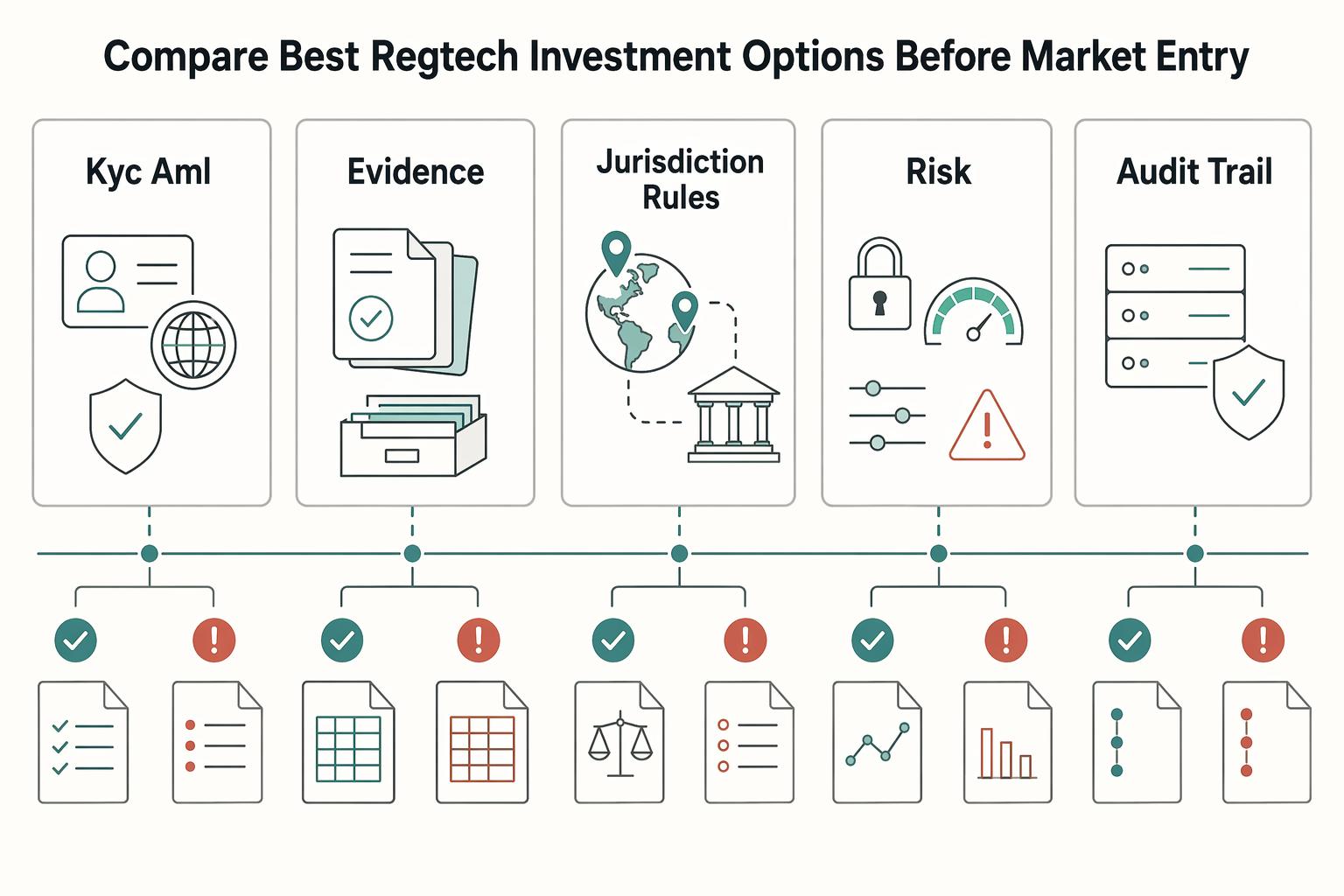
After a market clears entry checkpoints, prioritize controls that create reliable evidence at live volume. These five investments usually improve reporting accuracy and exception handling faster than broad policy updates.
| Control | Best for | Tradeoff or key point |
|---|---|---|
| Tax reporting engine and reconciliation layer | U.S.-first marketplace expansion when the flow can resemble a payment settlement entity or TPSO | Early integration cost, but payout records, adjustments, and year-end outputs trace back to one source ledger |
| Onboarding policy gates for KYC and document completeness | Fast-growing platforms running multi-rail contractor onboarding | Conversion friction, but payout eligibility stays blocked until required identity evidence is present and reviewable |
| Cross-border compliance and licensing tracker | Multi-country rollouts in the same year | Forces country-level decisions on licensing path, payout model, W-8 handling, DAC7 fit, and accountable owner before launch; tradeoff is ongoing policy maintenance |
| Privacy controls and data-minimization instrumentation aligned to GDPR | Platforms with heavy support tooling, analytics, and onboarding document handling | Engineering refactor effort, especially when data is already spread across logs and support systems |
| RegTech orchestration for rule updates and evidence exports | High-change environments, including DAC7 reporting and operations with possible FBAR-sensitive facts | Vendor dependency, so confirm export quality before rollout |
- Tax reporting engine and reconciliation layer
Best for U.S.-first marketplace expansion when your flow can resemble a payment settlement entity or TPSO. Form 1099-K is an IRS information return, and filing can be triggered when payments for goods or services are processed through a payment settlement entity; the current IRS threshold condition here is more than $20,000 and more than 200 transactions. The main upside is auditability: payout records, adjustments, and year-end outputs trace back to one source ledger. The tradeoff is early integration cost, but weak reconciliation can lead to payee-statement mismatches, support disputes, and penalty exposure if information returns are not filed correctly and on time.
- Onboarding policy gates for KYC and document completeness
Best for fast-growing platforms running multi-rail contractor onboarding. Where money movement creates AML obligations, controls must include verifying customer identification, so payout eligibility should stay blocked until required identity evidence is present and reviewable. This works best when onboarding files store accepted document type, rejection reason, and reviewer outcome. The tradeoff is conversion friction, but it reduces the risk of funding users you cannot verify later.
- Cross-border compliance and licensing tracker
Best for multi-country rollouts in the same year. It reduces avoidable reversals by forcing country-level decisions on licensing path, payout model, W-8 handling, DAC7 fit, and accountable owner before launch. The operational value is the decision log: product flow map, regulated-partner dependencies, and exception owner by market. The tradeoff is ongoing policy maintenance.
- Privacy controls and data-minimization instrumentation aligned to GDPR
Best for platforms with heavy support tooling, analytics, and onboarding document handling. GDPR data minimisation requires personal data to be adequate, relevant and limited to what is necessary for the stated purpose. In practice, map where identity data appears and remove fields you do not need. The tradeoff is engineering refactor effort, especially when data is already spread across logs and support systems.
- RegTech orchestration for rule updates and evidence exports
Best for high-change environments, including DAC7 reporting and operations with possible FBAR-sensitive facts. DAC7 places seller-information collection and verification duties on platform operators, and FBAR is fact-dependent with a clear trigger at aggregate foreign account value over $10,000 at any time in the calendar year. The upside is faster change management and cleaner evidence exports. The tradeoff is vendor dependency, so confirm export quality before rollout (field mapping, verification status, correction history, and audit-ready files).
Most of the cost here is avoidable earlier than teams expect. A filing rejected on structure is found in the submission window, when there is no time left to go back to a seller for a tax number or a place of birth, and the same gap found in October is an email. DAC7 and DPI reporting for platforms sets out what a filing has to carry, and the DAC7 seller data checker names the sellers whose records are short.
Related: The Compliance Cost of Going Global: What Platforms Spend on Tax KYC and Licensing Per Country.
Red flags that should pause expansion immediately#
Pause expansion if any of these are true. These are operational-evidence failures, not polish issues.
- No reliable payout-to-report reconciliation
Stop if you cannot tie contractor payouts, reversals, and adjustments to Form 1099-K outputs or equivalent information reporting requirements. The checkpoint is straightforward: can finance pull a sample payee file and confirm gross payment amounts against internal records without manual guesswork? If not, you increase the risk of incorrect or late filings, and penalty exposure can apply per information return, under a general rule of $250 per return.
- Required licensing or KYC is parked as a post-launch fix
Do not launch on a plan that defers licensing, customer identification, or cross-border compliance artifacts until after go-live. In relevant payment-services scope, providers may need to be authorized or registered before operating, and AML rules require procedures for verifying customer identification. Under live volume, this often turns into payout holds, contractor re-papering, and emergency exception handling.
- Policy exists, but product and contracts do not enforce it
Written policy alone is not enough if product gates and contract templates do not enforce it. GDPR accountability requires technical and organizational measures, so onboarding flows, retention settings, and templates should reflect the stated controls. A practical test is one live contractor journey: accepted terms, IP clause version, required fields, and blocks on missing evidence.
- No named audit-response owner
Pause if no one is explicitly responsible for coordinating operations, finance, and engineering when an Internal Revenue Service or regulator request arrives. AML governance expects designated day-to-day compliance ownership. Without that owner, response quality drops and evidence fragments across teams.
Need the full breakdown? Read The Cost of Using an Employer of Record (EOR).
Conclusion#
- Treat expansion risk like unit economics, not a legal afterthought.
If a control gap can block payouts, trigger reporting errors, or force contractor backfill, price it into the launch decision before you ship. In practice, rework under live volume is often more expensive than the policy debate that came before it.
A useful checkpoint is simple: before a market goes broad, have one owner prove that the team can trace a single payee from onboarding data to payout totals to reporting output, then explain reversals without spreadsheet archaeology. For U.S. payment flows, that means knowing whether your model creates Form 1099-K obligations and whether recipient copies can go out by January 31. It also means knowing whether payee-level totals are reliable if volume later crosses the $20,000 and 200 transactions threshold.
- Back the launch with evidence you can export, not policies you hope will hold.
The teams that expand cleanly are not the ones with the prettiest documentation. They are the ones that can show a regulator, auditor, or internal review that tax reporting, KYC, and privacy controls actually fired when they were supposed to. IRS guidance is clear that payment apps and online marketplaces can have Form 1099-K filing obligations each year, and DAC7 has placed reporting obligations on platform operators since 1 January 2023. Those are operating requirements, not just legal notes.
Ask for the evidence pack up front: accepted terms, identity records, seller-information verification, payout eligibility status, and the report output tied to the underlying transaction history. In KYC terms, customer due diligence exists to ensure funds are not linked with crime or terrorism, so a launch that depends on patchy identity evidence is already carrying avoidable risk. A common failure mode is not that a policy is missing. It is that the product still lets people onboard, get paid, or submit incomplete data outside the intended gate.
- Be explicit about market limits, and scale only after each checkpoint passes.
If coverage varies by country, rail, or worker program, say that directly and launch in a bounded phase. This matters most where requirements diverge across markets. Under DAC7, operators are expected to collect and verify seller information, and in privacy-heavy environments you also need to prove data minimisation, meaning personal data is limited to what is necessary. If support logs, analytics tools, or document uploads collect more than that, privacy exposure grows long before a breach does.
Keep the decision rule boring and strict. If reporting artifacts are incomplete, if KYC evidence is inconsistent, or if privacy handling cannot be shown in practice, narrow scope and fix the gap before scale. That discipline is usually cheaper than a fast launch followed by payout exceptions, re-papering, or GDPR exposure that can reach 20 000 000 EUR or 4%.
Frequently Asked Questions
What does non-compliance usually cost gig platforms in practice beyond fines?
It often shows up as restitution, remediation work, and operational strain, not just regulator bills. Public enforcement shows the scale: Amazon agreed to pay more than $61.7 million in an FTC tip case, Massachusetts announced a combined $175 million settlement with Uber and Lyft, and New York secured $16.75 million involving DoorDash delivery workers. If you cannot trace what workers were promised, paid, and reported, remediation can become a cash event quickly.
Is non-compliance typically more expensive than building compliance controls early?
Often yes when a missing control sits on a live payout or reporting path, but it is not a universal math rule for every platform. Early controls usually cost engineering time and some conversion friction. Late fixes can require re-papering, manual exception handling, and evidence reconstruction under scrutiny. If your gap touches tax reporting or worker terms, the impact can hit operations and legal teams quickly.
How does Form 1099-K readiness change risk for Third Party Settlement Organizations?
For TPSOs, Form 1099-K readiness lowers the chance that reporting becomes a year-end fire drill. The IRS states that third party settlement organizations are not required to file unless the gross amount of reportable payment transactions to a payee exceeds $20,000 and the number of transactions exceeds 200, so you need clean payee-level totals and transaction counts before volume builds. A practical checkpoint is whether finance can pull one payee, confirm gross payments against internal records, and explain reversals or adjustments without spreadsheet guesswork.
Which risks are most expensive to fix late in a cross-border launch?
There is no fixed ranking across markets, but cross-border tax reporting is a common late-stage cost driver. In the EU, DAC7 places the reporting obligation on platform operators, entered into force on 1 January 2023, and the Commission explicitly notes that cross-border cases are complex to enforce. If reporting data or onboarding evidence varies by market, exceptions can multiply quickly and backfilling records gets expensive.
What are the first controls to implement before entering a new market?
Start with three things: payout-to-report reconciliation, enforced onboarding gates for required document completeness, and a named owner for audit response. Then test one live contractor journey end to end: accepted terms, required fields, evidence captured, payout eligibility, and reporting output. If policy says a document is mandatory but the product still lets a worker through without it, you do not have a real control yet.
When should a platform delay launch instead of shipping with manual controls?
Delay when the manual process cannot reliably produce evidence for reporting obligations at production-like volume. A small pilot can tolerate some human review. A market launch should not depend on people hunting across support logs, finance exports, and contract folders to answer an Internal Revenue Service or regulator request. If manual handling is already creating unresolved reporting gaps, narrow scope before you scale.
Try a related tool
W-8 form generator
Generate a W-8 form draft with the right fields and structure.
FBAR calculator
Estimate whether you may need to file and what accounts to include.
DAC7 seller data checker
Check a seller export against the OECD DPI XML Schema in your browser and get a chase list of the gaps.
Researched and edited by the Gruv editorial team. Gruv builds cross-border billing, payouts, and finance-operations software for global businesses.
Sources
- bsaaml.ffiec.gov/manual/AssessingTheBSAAMLComplianceProgram/04trusted
- csrc.nist.gov/pubs/sp/800/30/r1/finaltrusted
- dol.gov/newsroom/releases/whd/whd20240725-0trusted
- ecfr.gov/current/title-31/subtitle-B/chapter-X/part-1...trusted
- ecfr.gov/current/title-31/subtitle-B/chapter-X/part-1...trusted
- irs.gov/payments/information-return-penaltiestrusted
- irs.gov/pub/taxpros/fs-2025-08.pdftrusted
- mass.gov/info-details/uber-and-lyft-settlement-inform...trusted
Educational content only. Not legal, tax, or financial advice.
Related Posts

Gig Worker Tax Compliance at Scale: How Platforms Handle 1099s W-8s and DAC7 for 50000+ Contractors
At scale, the hard part is not the acronyms. It is deciding sequence, ownership, and evidence when Form 1099-K, Form 1099-NEC, Form W-8BEN/W-8BEN-E, and DAC7 do not line up cleanly. If you run a high-volume marketplace, put controls in the right order and define clear stop points where legal or tax takes over.
Why RegTech Creates a Compliance Moat for Gig Platforms
For platforms that keep expanding, success is rarely about having the longest policy library. It is more often about compliance choices that make onboarding, payouts, and market entry more reliable under pressure. Use that lens if you are deciding where to launch next, which worker segments to serve, and which payment flows to support. It matters before product and GTM spend hardens around the wrong assumptions.

What Platforms Spend Per Country to Stay Compliant in Global Expansion
Per-country compliance cost planning starts with the operating model, and that choice needs to happen early. Use this guide if you are a compliance, legal, finance, or risk owner making country launch decisions before go-live. It helps you test assumptions before they turn into delays, rework, or avoidable spend.