
Quick Answer
Prioritize controls that remove launch blockers and produce exportable proof. For cross-border gig expansion, start with KYC and AML orchestration, then lock in tax-document handling for Form W-8BEN and 1099-NEC/1099-K paths before scaling payouts. Use a stop-or-go gate: if exceptions lack an owner, or one onboarding and one held payout cannot be reconstructed from system records, delay entry.
Where the Compliance Moat Comes From#
For platforms that keep expanding, success is rarely about having the longest policy library. It is more often about compliance choices that make onboarding, payouts, and market entry more reliable under pressure. Use that lens if you are deciding where to launch next, which worker segments to serve, and which payment flows to support. It matters before product and GTM spend hardens around the wrong assumptions.
- Compliance as an operating advantage
RegTech, as the FCA puts it, is technology developed to address regulatory challenges in financial services. Tool count is not the measure. The real measure is whether your controls improve compliance outcomes and risk management in ways the business can actually feel, a point the Financial Stability Board highlighted in its 9 October 2020 report. In practice, if a control still depends on scattered manual checks, launch can look fast until exceptions pile up and slow everything down.
- Cross-border complexity is the real filter
Cross-border platform operations can break on edge cases, especially once money and tax reporting move across borders. The European Commission describes digital platform activity as creating a complex environment where enforcing tax rules and ensuring compliance is challenging, and DAC7 entered into force on 1 January 2023. So country selection is not just about demand and acquisition cost. It is whether compliance obligations stay manageable when contractors and payouts span jurisdictions.
- Evidence matters more than policy backlog
This article is for operators making pre-launch decisions, not for teams arguing in the abstract about "taking compliance seriously." Before go-live, you should be able to explain why an onboarding or payout decision happened, who owns exceptions, and what evidence is retained if a regulator, partner, or bank asks later. By the end of February 2024, the first DAC7 information exchange for calendar year 2023 had already taken place. Reporting and scrutiny are not theoretical.
That framing changes how you should judge investment options. You are not looking for the most comprehensive policy stack on paper. You are looking for decisions that cut failure-prone manual work, stay auditable, and still hold up when you add a second or third market.
A good RegTech choice can improve quality and efficiency through automation of previously manual processes. A bad one can create a false sense of readiness because the controls exist only in documentation, or because they work in one corridor but break when local rules, tax handling, or review volumes change. If a proposed control cannot survive that kind of expansion stress, it is backlog, not moat. Related: The Cost of Non-Compliance: What Gig Platforms Pay When They Get It Wrong.
Who this list is for and how to judge each option#
Use this list if you are deciding market entry for a gig platform with cross-border onboarding and payouts, and you need decisions you can defend later. It is for operators comparing RegTech investment against launch constraints, not for compliance theater. It is not legal advice and does not replace local counsel on GDPR, India's DPDP Act, DAC7, Form 1099, or Form W-8 obligations.
| Check | What to confirm | Grounded detail |
|---|---|---|
| Time to launch | The investment removes a real launch blocker | A specific onboarding, payout, or review step disappears before go-live |
| Operational failure rate | Day-two operations, not the demo path | Tools that push edge cases into manual review can make exceptions become the bottleneck |
| Auditability | Retained, exportable decision evidence | Tie evidence to Form W-8BEN collection, 1099-NEC handling above the $600 threshold, and DAC7 reporting records |
| Policy coverage drift | Controls still hold as jurisdictions are added | GDPR can apply outside the EU when organizations monitor individuals in the EU, and DAC7 reporting obligations apply from 1 January 2023 |
Judge every option with the same four checks so you can separate real launch leverage from tooling that just moves work around:
- Time to launch
Confirm the investment removes a real launch blocker. The practical test is whether a specific onboarding, payout, or review step disappears before go-live.
- Operational failure rate
Evaluate day-two operations, not the demo path. Under a risk-based AML/CFT approach, tools that push edge cases into manual review can make launch look fast while exceptions become the bottleneck.
- Auditability
Assume a bank, partner, or regulator will ask why a worker was approved or a payout was held. Prefer options with retained, exportable decision evidence tied to key records such as Form W-8BEN collection, 1099-NEC handling above the $600 threshold, and DAC7 reporting records.
- Policy coverage drift
Check how well controls hold as you add jurisdictions. Scope can change across markets, including GDPR applying to organizations outside the EU when they monitor individuals in the EU, and DAC7 reporting obligations on platform operators from 1 January 2023.
If an investment improves one metric but worsens two, treat it as a weak moat signal. A common failure mode is faster initial launch with more manual reviews and weaker evidence reconstruction later.
Use this scorecard to rank options by the blocker removed first, not by the strength of the pitch. You might also find this useful: Why RegTech Becomes a Defensible Compliance Moat.
Compare the best RegTech investment options before market entry#
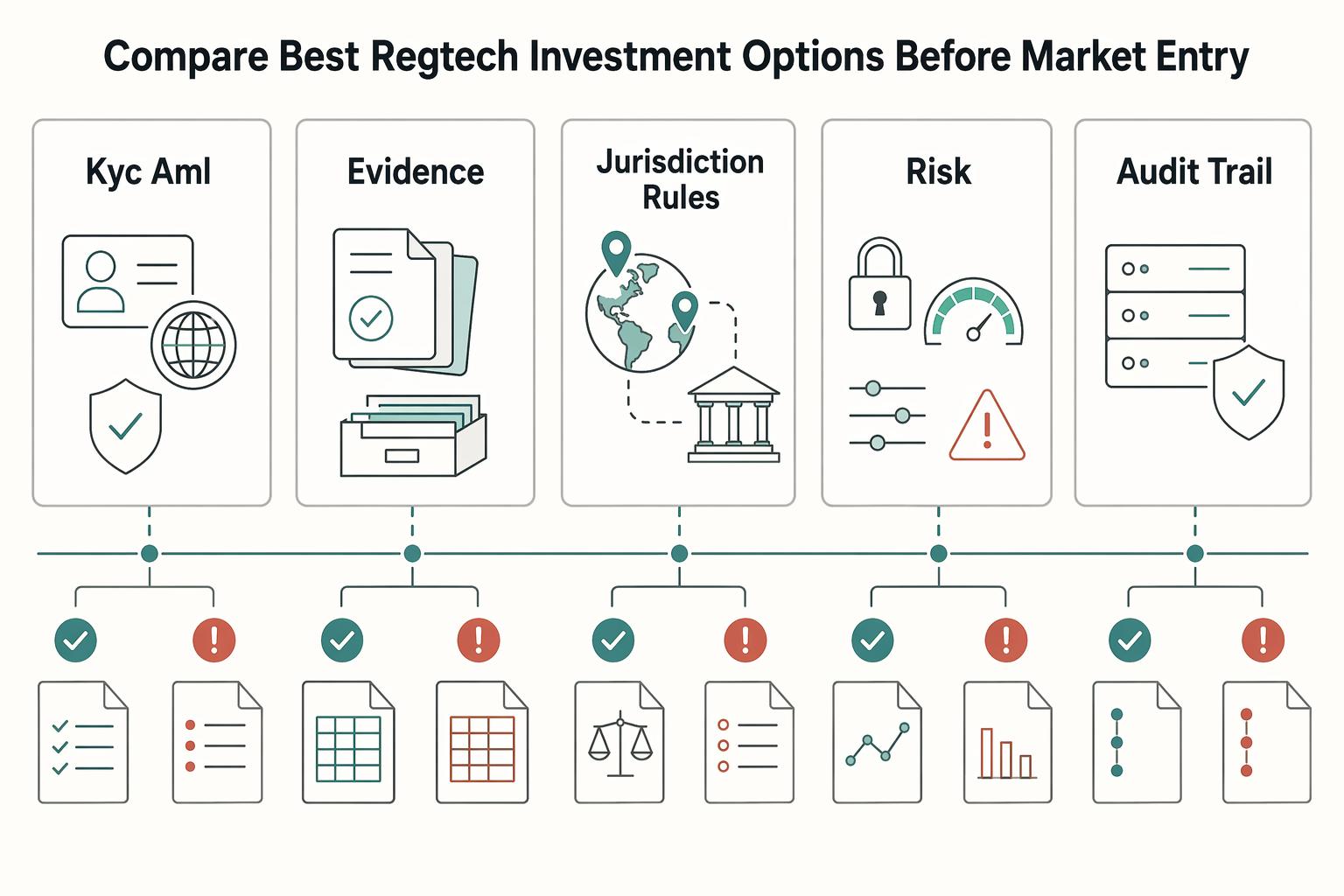
Before launch, prioritize controls that prevent irreversible errors: onboarding identity and AML decisions, tax-document handling, jurisdiction logic, payout risk controls, and audit-ready records. If your stack can move money but cannot explain who was approved, why a payout was held, or which rule applied, treat that as a launch risk, not a post-launch cleanup task.
Use the table in order: pick your nearest blocker, then apply the stop-or-go rule as written. If you cannot meet it with retained evidence, pause entry.
| Option | Best for | Key pros | Key cons | Dependencies | First market where it pays off fastest | Stop or go rule |
|---|---|---|---|---|---|---|
| KYC and AML orchestration | Platforms onboarding workers across borders where approval speed and consistency both matter | Centralized identity and AML decisioning, fewer fragmented reviews, clearer approve/hold records | False positives can slow activation; weak escalation creates hidden backlogs | Named owners for exception queues, document capture, retained decision logs | First cross-border launch with regulated payout partners | Stop if you cannot show onboarding evidence for each approval/hold, or if AML exceptions do not have an owner and closure path before go-live |
| Tax documentation automation for Form 1099 and Form W-8 | High contractor volume, US payer exposure, cross-border onboarding | Cleaner tax-data collection, organized W-8/1099 records, less payout friction from incomplete data | Edge cases still need review; teams can confuse 1099-NEC and 1099-K scope | Tax-form capture in onboarding, TIN validation, payout logic for missing/incorrect taxpayer info | US contractor payouts | Stop if you cannot determine 1099-K vs 1099-NEC treatment, or if missing/incorrect TIN handling is manual only; backup withholding can apply at 24 percent when required information is not properly provided |
| Jurisdiction rules engine for GDPR and DPDP | Platforms entering the EU, India, or both | Market-specific privacy obligations become explicit; controller/processor role clarity is forced earlier | Upfront mapping effort is significant when role ownership is unclear | Data inventory, controller/processor role assignment, market-level policy owners | EU first, then India | Stop if you cannot state controller vs processor responsibility for core data flows, or if India launch depends on future DPDP cleanup; DPDP statute text is dated 11th August, 2023 |
| Payout risk controls | New payout corridors, high fraud exposure, untested rails | Enables hold/review/release decisions from risk signals before losses compound | Tighter controls can slow payouts and increase support load when hold reasons are unclear | Hold/release logic, operations queue ownership, retained delay evidence, worker-facing comms templates | New cross-border payout corridors | Stop if held payouts are not explainable from trigger to final status, or if support cannot state what document/review step is blocking release |
| Audit trail infrastructure | Teams expecting partner diligence, regulator questions, or rapid expansion | Exportable logs across onboarding, payout, tax, and privacy decisions; faster incident reconstruction | Requires disciplined event instrumentation across product and ops | Event capture across onboarding, tax forms, payout decisions, policy/rule changes | EU launch with DAC7 in scope | Stop if you cannot export one record showing triggered rule, evidence used, reviewer action, and final outcome; DAC7 has applied from 1 January 2023, with first exchange for 2023 at the end of February 2024 |
| Scenario: FinTech first stack, weak Regulatory Technology controls | Teams optimizing for initial launch speed in one corridor | Fast setup, fewer pre-launch dependencies, cleaner demo path | First incident can erase speed gains when evidence is scattered and controls are retrofitted | Manual spreadsheets, inbox approvals, retroactive policy drafting | Looks fastest in a single-market MVP, often slows after first incident | Stop if your response to a held payout, missing tax form, or privacy complaint is "we can reconstruct later"; enforcement examples include $50 million penalty + $50 million compliance investment |
Two practical takeaways: tax-document automation is often an early blocker because it affects both onboarding quality and payout continuity, and weak evidence design usually shifts work into costly post-incident reconstruction. In EU entry, DAC7 operator obligations and GDPR role clarity raise that risk; in India entry, treat DPDP ownership as pre-launch scope, not deferred hardening.
Those are the pre-entry blockers. The next decision is which controls keep compounding as volume grows. For a step-by-step walkthrough, see Best Merch Platforms for Creators Who Want Control and Compliance.
The best RegTech bets for building a real compliance moat#
The controls that unblock launch are not always the ones that hold up at scale. The bets below are the ones that keep working when onboarding volume rises, payout risk increases, and diligence gets stricter.
| Bet | Best fit | Key requirement |
|---|---|---|
| Unified identity and risk controls | Entering multiple countries quickly | Each approval, rejection, or hold ties back to identity evidence, risk output, and reviewer action when a case leaves automation |
| Tax document automation layer | High-contractor-volume payouts | Act on missing or incorrect taxpayer information before funds move, and track W-8 validity through the last day of the third succeeding calendar year; backup withholding can apply at 24 percent |
| Jurisdiction policy engine | Privacy regimes across markets | For identity, payout, and support data, show ownership, market-specific legal posture, and active policy version |
| Payout gating and hold logic | Fraud-prone corridors or new payout rails | Include escalation ownership, decision timestamps, and a clear case outcome trail; suspicious activity reporting duty can apply when activity involves or aggregates at least $2,000 |
| Audit-grade event trail | Regulator or partner review | Keep event trails durable and exportable across the five-year baseline; one record should show evidence, triggered rule or policy, manual actions, and final outcome |
- Unified identity and risk controls
If you are entering multiple countries quickly, this is usually the first bet to make, because consistency at onboarding is hard to recover later. FATF treats reliable digital identity as a practical input for customer due diligence, so the operational standard is clear: each approval, rejection, or hold should tie back to identity evidence, risk output, and reviewer action when a case leaves automation. The tradeoff is queue pressure from false positives, especially during launch spikes.
- Tax document automation layer
For high-contractor-volume payouts, this bet matters because tax readiness directly affects payout continuity. Form-routing logic for marketplace-style payments can change whether amounts belong on certain 1099 paths, so form collection and payment facts need to stay linked. Your two hard checks are straightforward: act on missing or incorrect taxpayer information before funds move, and track W-8 validity through the default endpoint on the last day of the third succeeding calendar year. If tax data stays incomplete, backup withholding can apply at 24 percent. For deeper coverage, see Gig Worker Tax Compliance at Scale: How Platforms Handle 1099s W-8s and DAC7 for 50000+ Contractors.
- Jurisdiction policy engine
This pays off fastest when you are dealing with multiple privacy regimes because it prevents country-by-country rebuilds. GDPR and DPDP both regulate personal-data processing under different legal frameworks, and DPDP places responsibility on the entity determining purpose and means of processing. The practical checkpoint is role clarity by data flow: for identity, payout, and support data, you should be able to show ownership, market-specific legal posture, and active policy version. The cost is upfront mapping work.
- Payout gating and hold logic
If you are opening fraud-prone corridors or testing new payout rails, put this control in early because risk can scale faster than support capacity. For money services businesses, U.S. rules require an effective AML program, and suspicious activity reporting duty can apply when activity involves or aggregates at least $2,000. So hold logic needs more than a risk flag: include escalation ownership, decision timestamps, and a clear case outcome trail. The tradeoff is slower payouts when controls tighten.
- Audit-grade event trail
This is what makes the other controls defensible under regulator or partner review. Retention is the deciding requirement: BSA records and SAR support material carry a five-year baseline, so event trails must be durable and exportable across that window. The verification test is whether one record can show evidence, triggered rule or policy, manual actions, and final outcome. The usual failure point is fragmented instrumentation across product and ops.
Once these bets are clear, the next decision is rollout sequence. For a deeper walkthrough, see What Is RegTech? How Compliance Technology Helps Payment Platforms Automate Regulatory Reporting.
Sequence your market entry with an evidence pack before launch#
Do not launch because a policy exists on paper. Launch when you can show, for that market, the control, the owner, the exception path, and evidence that the control is being monitored.
- Start with a country and vertical hypothesis
Define the market, worker type, and payout flow first, then map the controls tied to that choice. In practice, this usually means KYC and AML treatment, privacy controls under GDPR Article 25 and India's DPDP Act Section 8(4), and tax-document routing for Form W-8BEN and Form 1099 reporting. Keep the routing explicit: some payment-card and third-party network transactions belong on Form 1099-K rather than 1099-NEC or 1099-MISC, and nonemployee compensation reporting starts at $600, moving to $2,000 for payments made after December 31, 2025.
- Build a per-market evidence pack
Include active policy rules, named owners, exception handling, escalation contacts, and proof that controls are monitored for effectiveness. Monitoring evidence is the deciding artifact, not a nice-to-have. In FCA observations across over 90 firms, teams with advance planning before February 2022 were better positioned to implement sanctions quickly, and effective monitoring through management information was a key capability. A strong pack also includes sample case output: what triggered a hold, who reviewed it, and the final disposition.
- Run a pre-launch sign-off checkpoint
Use one shared market pack for product, ops, and compliance sign-off. The practical test is traceability: can you follow one worker from onboarding through payout approval and show identity evidence, rule decisions, manual intervention, and final status? Treat manual-only handling on a high-risk step without a backlog plan as a launch blocker, especially when forecasted volume would create review queues your team cannot clear.
- Launch narrow, then expand on observed control performance
Start with constrained traffic, a limited corridor, or a smaller worker segment so you can observe controls under live conditions. Expansion gates should include ongoing due diligence performance, not only onboarding outcomes. Watch early for review backlogs and for missed W-8BEN collection when payer or withholding-agent workflows require it. If either appears, pause scale until the evidence pack reflects the operational fix, not just a policy update.
That same evidence pack is how you avoid entering a market that looks attractive on paper but does not hold up operationally.
Red flags that make a market look attractive but unscalable#
The evidence pack should make no-go calls obvious. If any of these appear, treat the market as a pause decision.
| Red flag | Grounded risk | What to verify |
|---|---|---|
| AML demand looks real, but escalation logic is still fuzzy | FATF's risk-based approach requires identifying and assessing risk, then applying mitigation, and is not aligned with wholesale exclusion of whole customer classes | Show risk-segmented review logic, named approvers, and a clear exception path |
| Form routing works in theory, but Form W-8 and Form 1099 handling is still partly manual | Form W-8BEN must be submitted when requested by the withholding agent or payer, and some payments are not reportable on Form 1099-MISC or Form 1099-NEC; 1099-NEC data must be complete and filed by January 31 | Validate one real payout path from onboarding to reporting output, including status changes during the year |
| Privacy is being framed as post-launch hardening | GDPR Article 25 and DPDP Act Section 8(4) require appropriate technical and organisational measures; administrative fines can reach 20,000,000 EUR or 4% of worldwide annual turnover | Confirm minimum data fields, access limits, retention handling, and clear owners |
| Leadership can explain growth targets, but not KYC failure handling by segment | If segment-level failure handling is unclear, the plan is not operationally ready | Ask for the actual decision path: retry, reject, manual review, or payout suspension |
| Frontline tooling is too weak to carry policy into daily decisions | If the reviewer must jump across stale docs, chat threads, and separate queues just to decide hold or release, control execution is not yet stable enough for scale | Observe one live case and verify active rules, required documents, and escalation contacts |
- AML demand looks real, but escalation logic is still fuzzy
Do not treat demand as enough if AML decisions rely on broad exclusions or ad hoc judgment. FATF's risk-based approach requires identifying and assessing risk, then applying mitigation, and it is not aligned with wholesale exclusion of whole customer classes. Check for risk-segmented review logic, named approvers, and a clear exception path. If your team cannot show who clears a high-risk payout hold, what evidence is required, and when a case must be blocked instead of escalated, deprioritize the market.
- Form routing works in theory, but Form W-8 and Form 1099 handling is still partly manual
Manual tax-form handling is a scale warning, not a minor cleanup task. Form W-8BEN must be submitted when requested by the withholding agent or payer, and some payments are not reportable on Form 1099-MISC or Form 1099-NEC. Validate one real payout path from onboarding to reporting output, including status changes during the year. If you cannot show how 1099-NEC data will be complete and filed by January 31, treat that as a launch risk. For deeper tax-scaling detail, see Gig Worker Tax Compliance at Scale: How Platforms Handle 1099s W-8s and DAC7 for 50000+ Contractors.
Contractor records that are good enough to pay from are not always good enough to report from. DAC7 wants the jurisdiction of residence, a tax identification number or an explicit statement that none is available, and the consideration split by quarter, which is a stricter shape than a payout ledger usually holds. DAC7 and DPI reporting for platforms sets out the full data set.
- Privacy is being framed as post-launch hardening
Treat this as a red flag, not just a sequencing preference. GDPR Article 25 requires appropriate technical and organisational measures by default, and DPDP Act Section 8(4) likewise requires appropriate technical and organisational measures. If privacy controls live in policy notes instead of product defaults, expect later rework. Confirm the market pack specifies minimum data fields, access limits, retention handling, and clear owners. GDPR downside is material: administrative fines can reach 20,000,000 EUR or 4% of worldwide annual turnover.
- Leadership can explain growth targets, but not KYC failure handling by segment
If segment-level failure handling is unclear, the plan is not operationally ready. You should be able to see how KYC failures are handled across worker and payee segments, with mitigation logic mapped to each. Ask for the actual decision path: retry, reject, manual review, or payout suspension. If the answer gets vague outside the slide deck, moat claims are still narrative.
- Frontline tooling is too weak to carry policy into daily decisions
When reviewers cannot quickly see active rules, required documents, and escalation contacts, treat that as an internal warning sign before launch. Verify by observing one live case. If the reviewer must jump across stale docs, chat threads, and separate queues just to decide hold or release, your control execution is not yet stable enough for scale.
If those red flags are under control, the next decision is architectural: how to keep controls durable as product and market mix change.
Choose architecture based on control durability not just launch speed#
After you filter out fragile markets, make architecture decisions based on whether your controls stay intact as your product, country mix, and payout rails change, not just on how fast you can launch.
- Use modular components when policy changes are frequent
A loosely coupled design with independently deployable units lets you update control logic without shipping full-stack changes. If market additions are likely, keep KYC, AML, and jurisdiction rules outside product-specific code so country-rule updates do not force unrelated payout changes.
- Separate jurisdiction logic from rail integrations
FATF's Recommendations (as amended in October 2025) emphasize that countries have different legal, administrative, and operational contexts, so identical measures do not fit every market. Design jurisdiction-aware policy components so adding a country rule does not require editing core payout services.
- Treat build vs buy as staged, not ideological
For smaller teams, a practical pattern is to buy baseline RegTech capabilities first, then build where your vertical advantage is truly proprietary. The goal is credibility and auditability early, with custom effort focused on differentiated risk signals and workflows.
- Require idempotency for every control-changing event
Retry safety is essential in payout and review flows. Idempotent handling allows safe retries without duplicating side effects, which protects you from conflicting case states during network failures or partner timeouts.
- Design audit logs for investigation, not just monitoring
Logging should make incident reconstruction possible, including what happened, when, and under which control path. NIST SP 800-53 AU-2 is useful here because it focuses on whether logged event types are adequate for after-the-fact investigation.
Good architecture still needs operational proof. That is where hard checkpoints separate a real moat from a well-described one. Related reading: How Freelancers Choose a Compliance-First Fintech Platform.
Verify moat strength with operating checkpoints not slogans#
A compliance moat is only real if you can verify controls under stress and reconstruct outcomes on demand. If you cannot prove a control during volume spikes, partner timeouts, or regulatory review, it is not moat infrastructure yet.
- Explain every payout outcome
You should be able to trace any payout from rule trigger to final status using system evidence alone. The record should show which rule or risk check fired, which version was active, any human override, and retained evidence for review. Test this with one held payout and one released payout; if reconstruction depends on chat logs or spreadsheets, the control is not durable.
- Govern exceptions like active risk, not backlog
KYC and AML exceptions should always have a named owner, an SLA target, and closure proof. This keeps roles, responsibilities, and follow-through explicit when failures are identified. In practice, each case needs a reason code, owner, due-by timestamp, and evidence of resolution.
- Export tax and jurisdiction artifacts without manual rebuilds
You should be able to export DAC7 reporting data at the platform-operator level, produce Form 1099-NEC data for the January 31 filing deadline, and track Form W-8 validity through the end of the third succeeding calendar year. Privacy coverage should include GDPR Article 30 processing records and DPDP-related processing artifacts for digital personal data. Run a sample export by market and reporting period before launch so readiness is proven, not assumed.
Conclusion#
The winning move is not buying more tools. It is choosing the few RegTech investments that let you say yes or no to a market with evidence, then keeping those controls maintainable as volume, payout rails, and jurisdictions change.
- Sequence the spend that protects the launch decision
Start with controls that gate onboarding and money movement, then add the layers that make them provable. For many platforms, that can include identity and AML checks, payout hold-and-release logic, tax document collection where applicable, and an audit trail before broader tooling. That order matters because compliance-driven technology investment gets expensive fast: research cited RegTech spend at over $30 billion in 2020 with forecasts above $130 billion by 2025, and it also notes that affected firms make significant investments in ERP and hardware while IT budgets rise and profits fall, especially at small firms. If a new market still depends on manual-only review for core onboarding or payout decisions, treat that as a pause signal, not a growth hack.
- Make stop or go decisions from evidence, not policy text
Your real readiness test is simple: can you reconstruct one failed onboarding, one approved onboarding, one held payout, and one released payout from records alone? If not, you do not yet have a durable control set for expansion. Under UK GDPR accountability, evidence is not optional documentation to tidy up later; you are expected to keep evidence of the steps taken to comply, and those measures must be reviewed and updated over time. In practice, your evidence pack can include the rule version, timestamp, final status, any human override, the exception owner, due date, closure proof, and exportable tax or jurisdiction artifacts where relevant.
- Measure moat strength under pressure, not in planning docs
The FCA's definition is useful here: RegTech is technology used to address regulatory challenges in financial services. That is a starting point, not the finish line. The finish line is whether your stack still works when onboarding spikes, false positives rise, or a payout corridor starts behaving differently. A strong setup contains the issue, shows who decided what and when, and lets you update controls without losing traceability. A weak one sends people back to chat threads, spreadsheets, and memory.
That is the clearest takeaway from the whole comparison. The real moat is not policy intent or vendor count. It is repeatable execution, with evidence, when the business is moving fast and the facts are messy. This pairs well with our guide on Merchant of Record for Platforms and the Ownership Decisions That Matter.
Frequently Asked Questions
What is a compliance moat for a gig platform in practical terms?
It is not a policy folder. It is your ability to prove why a worker was onboarded or blocked, why a payout was held or released, and what evidence supports that decision. The differentiator is repeatable reconstruction from records alone, not from chat threads or spreadsheet cleanup.
How does RegTech create strategic advantage beyond reducing fines?
It can shorten the time between market decision and controlled launch when your KYC, AML, tax, and privacy checks are already instrumented. That can also reduce partner friction during due diligence, since you can show internal controls, not just written intentions. In practice, the advantage is speed with evidence, especially when volumes spike or a payout corridor starts behaving differently.
Which controls are table stakes before entering a new country?
Start with identity verification, AML internal controls, payout gating, tax document collection, and privacy accountability. For U.S.-connected flows, know your operating calendar: Form 1099-NEC is due by January 31, while Form 1099-MISC has February 28 paper and March 31 electronic deadlines. If your Customer Identification Program is still manual-only, remember the baseline standard is a written, risk-based process for verifying each customer’s identity, not ad hoc review.
How should founders prioritize KYC and AML versus growth speed?
Treat them as launch gates, not as post-growth cleanup. A written CIP and AML controls are table stakes because AML expectations include “a system of internal controls to assure ongoing compliance,” not only policy text. If growth depends on bypassing those controls, you are buying activation now and operational drag later.
When should a platform delay launch because compliance readiness is too weak?
Delay when you cannot reconstruct one failed onboarding, one approved onboarding, one held payout, and one released payout from system records. Delay again if exception queues lack an owner, due-by date, and closure proof. One common failure mode is queue drift: reviews bounce between ops and compliance until launch traffic turns a small gap into a backlog you cannot explain.
How do GDPR, DPDP, and DAC7 change rollout decisions for marketplaces?
They change what “ready” means by forcing evidence, not just feature coverage. Under GDPR accountability, you must be able to demonstrate compliance; under India’s DPDP law, you need reasonable security safeguards to prevent personal-data breaches; under DAC7, the reporting obligation sits with platform operators and has been live since 1 January 2023, with the first exchange for 2023 activity completed at the end of February 2024. If those artifacts are not exportable before launch, your rollout is early.
What proof should operators keep to show regulator-ready execution?
Keep decision logs with rule version, timestamp, final status, and any human override, plus the document pack behind the decision. That includes collected tax forms such as Form W-8BEN, which foreign beneficial owners give to the withholding agent or payer, along with evidence of who reviewed exceptions and when they were resolved. If you cannot export that pack on demand for one market and one reporting period, your compliance moat is still narrative, not operating reality.
Try a related tool
Researched and edited by the Gruv editorial team. Gruv builds cross-border billing, payouts, and finance-operations software for global businesses.
Sources
- commission.europa.eu/law/law-topic/data-protection/rules-business...trusted
- commission.europa.eu/law/law-topic/data-protection/rules-business...trusted
- dfs.ny.gov/reports_and_publications/press_releases/pr20...trusted
- ecfr.gov/current/title-31/subtitle-B/chapter-X/part-1...trusted
- ecfr.gov/current/title-31/subtitle-B/chapter-X/part-1...trusted
- irs.gov/instructions/i1099mectrusted
- irs.gov/businesses/small-businesses-self-employed/ba...trusted
- occ.treas.gov/news-issuances/news-releases/2024/nr-occ-202...trusted
Educational content only. Not legal, tax, or financial advice.
Related Posts

Gig Worker Tax Compliance at Scale: How Platforms Handle 1099s W-8s and DAC7 for 50000+ Contractors
At scale, the hard part is not the acronyms. It is deciding sequence, ownership, and evidence when Form 1099-K, Form 1099-NEC, Form W-8BEN/W-8BEN-E, and DAC7 do not line up cleanly. If you run a high-volume marketplace, put controls in the right order and define clear stop points where legal or tax takes over.
What Is RegTech? How Compliance Technology Helps Payment Platforms Automate Regulatory Reporting
RegTech can automate regulatory reporting for payment platforms, but it should not replace legal judgment. The hard part is often not finding the rules. It is keeping up with changes across jurisdictions and producing a defensible record from onboarding through payout.
What Non-Compliance Costs Gig Platforms Before Market Expansion
The cost gig platforms absorb from non-compliance rarely sits neatly in a legal reserve on a spreadsheet. In expansion work, it often shows up first as operating drag. Launch plans can slow, operational flows may need exceptions or rewrites, and teams can lose confidence when compliance assumptions do not hold.