
Quick Answer
Build the process around one intake form, fixed evidence rules, and a triage-to-closeout path before cases scale. Tie each ruling to the agreement, invoice, ledger and provider records that apply, separate reviewer and approver authority, and require written reasons when proof is insufficient. Keep negotiation time-boxed, escalate contract-meaning conflicts to legal review, and keep final determinations and settlement actions under human approval even when AI support is used.
What a fair payment dispute process needs#
A dispute process that stays fair under volume has to be designed up front, not improvised when urgent cases hit. This guide is for platform finance, ops, and product owners building or adapting an internal contractor payment dispute process that is fair, usable, and auditable.
Fairness does not happen by default. Process design can privilege some perspectives over others, and vague rules can push reviewers toward inconsistent judgment. A workable process uses a consistent timeline, asks for consistent minimum evidence by issue type, and records why any exception was made.
The focus here is operational execution, not abstract policy. Decide who reviews, who approves, what evidence is enough to decide, when negotiation continues, and when escalation starts. In practice, that means grounding each decision in documented records and explicitly logged changes.
One early checkpoint matters: confirm that the underlying records and timeline agree before you rule. If records conflict or key changes were not documented, resolve that gap first. Rushing to approve or deny can create a second dispute.
Plan for repeat exceptions, not just one-off cases. A scalable process handles recurring cases across teams without rewriting the rules each time.
Ambiguity is a common trigger: unclear rights, obligations, milestones, or payment terms, plus informal undocumented changes. A practical control is to set a clear timeline at intake and document changes carefully. Negotiation-first handling can reduce escalation, but final determinations and settlement actions should still be human-validated, including when AI-supported tools are used.
By the end, you should have a design that separates evidence review from opinion, clarifies decision rights, and leaves a defensible case file months later.
Related reading: How to Handle Payment Exceptions at Scale: Routing Disputes Corrections and Manual Overrides.
Define fair process rules before you open intake#
Set fairness as policy before intake opens. Equivalent dispute types should follow the same evidence standard, the same review steps, and the same appeal path, with any exception documented.
- Write fairness as a repeatable rule
Treat your dispute channel as a formal grievance mechanism with clear criteria and outcomes. For each dispute type, define the intake and review steps and what qualifies as a valid first response. A practical check is simple: two reviewers using the same case packet should reach the same next step without unwritten guidance.
- Separate authority by risk and complexity
Keep intake, review, approval, and escalation responsibilities distinct where risk and complexity justify it. You can calibrate separation by case risk instead of forcing one model across all disputes. That keeps independence and speed in balance while making ownership explicit.
- Anchor decisions to source records
Your determination should be traceable to the internal records used in the review. If the note explains the conclusion but not the record trail, you have an opinion log, not an audit-ready case file.
- Define "insufficient evidence" before the first dispute arrives
Do not leave this to reviewer instinct. State what is required by dispute type, and require reviewers to name what is missing in writing when evidence is insufficient. Avoid vague requests like "send more proof," which create uneven treatment and unclear follow-up.
The executed contractor agreement and applicable local law determine actual rights and deadlines. Have legal counsel approve the policy and notice templates for each market before using them in production.
We covered this in detail in Internal Payment Audit Trail for Platform Compliance.
Set prerequisites and owners before launch#
Once the rules are set, launch discipline matters just as much. Before launch, lock key controls in writing: ownership, risk gates, and case-state synchronization. Use a checklist artifact for go-live so each handoff and stop condition is explicit and testable.
| Step | What to define | Why it matters |
|---|---|---|
| Assign owners by decision point | Name one accountable owner for each major decision and handoff; define who can change status and who approves movement between key states | Makes each handoff explicit and testable |
| Define risk gates and outcomes | Document which policy gates can pause actions, who can clear each gate, and clear outcomes for gated cases | Calibrates controls to the level of risk and complexity |
| Set one system of record and sync rules | Choose where status is authoritative, then define when it syncs with related operational systems | Prevents status drift across stages |
| Prewrite contractor-facing notices | Prepare core notice templates before intake opens and validate them against governing contracts and legal authorities | Keeps notice language ready before launch |
- Assign owners by decision point
Name one accountable owner for each major decision and handoff in the process. Define who can change status and who approves movement between key states.
- Define risk gates and outcomes
Document which policy gates can pause actions and who can clear each gate. Define clear outcomes for gated cases, and calibrate controls to the level of risk and complexity rather than forcing one path for every case.
- Set one system of record and sync rules
Choose where status is authoritative, then define when it syncs with related operational systems. Treat lifecycle coverage as a launch requirement so status does not drift across stages.
- Prewrite contractor-facing notices
Prepare core notice templates before intake opens. When notice language draws on manuals or policy references, validate it against your governing contracts and legal authorities, because reference manuals can be informational rather than controlling.
Classify dispute types into one intake path#
One intake path is usually enough. Use a single guided intake with structured choices, then branch behind the form. This keeps case selection sound, consistent, and transparent instead of letting similar disputes come in through inconsistent channels.
Build one guided intake form#
Treat intake as a step-based web flow that steers the submitter toward the right case type. Start with structured categories and a short context field instead of relying on free text alone.
Keep the form single and do the routing underneath it. Multiple entry forms and ad hoc channels can make case-selection decisions less consistent and less transparent.
Split major case families early#
Define major case families early, and test the workflow in one clearly scoped case type before broader rollout. Consider placing one required classification question near the top of the form, and keep the original selection visible if triage reclassifies the case later. This supports a more transparent selection process and makes intake quality easier to improve.
Add governance checks before rollout#
Before publishing the intake path, confirm that it aligns with the rules and requirements already governing your dispute process. If intake changes how cases are classified or escalated, run legal analysis before launch, not after live cases appear.
Capture core context for escalation#
At intake, capture the core case context needed for later review and escalation. You are not deciding legal effect at this stage. You are preserving the record so later review does not stall on missing context.
For the full breakdown, read How to Build a Payment Reconciliation Dashboard for Your Subscription Platform.
Build the evidence pack every case must include#
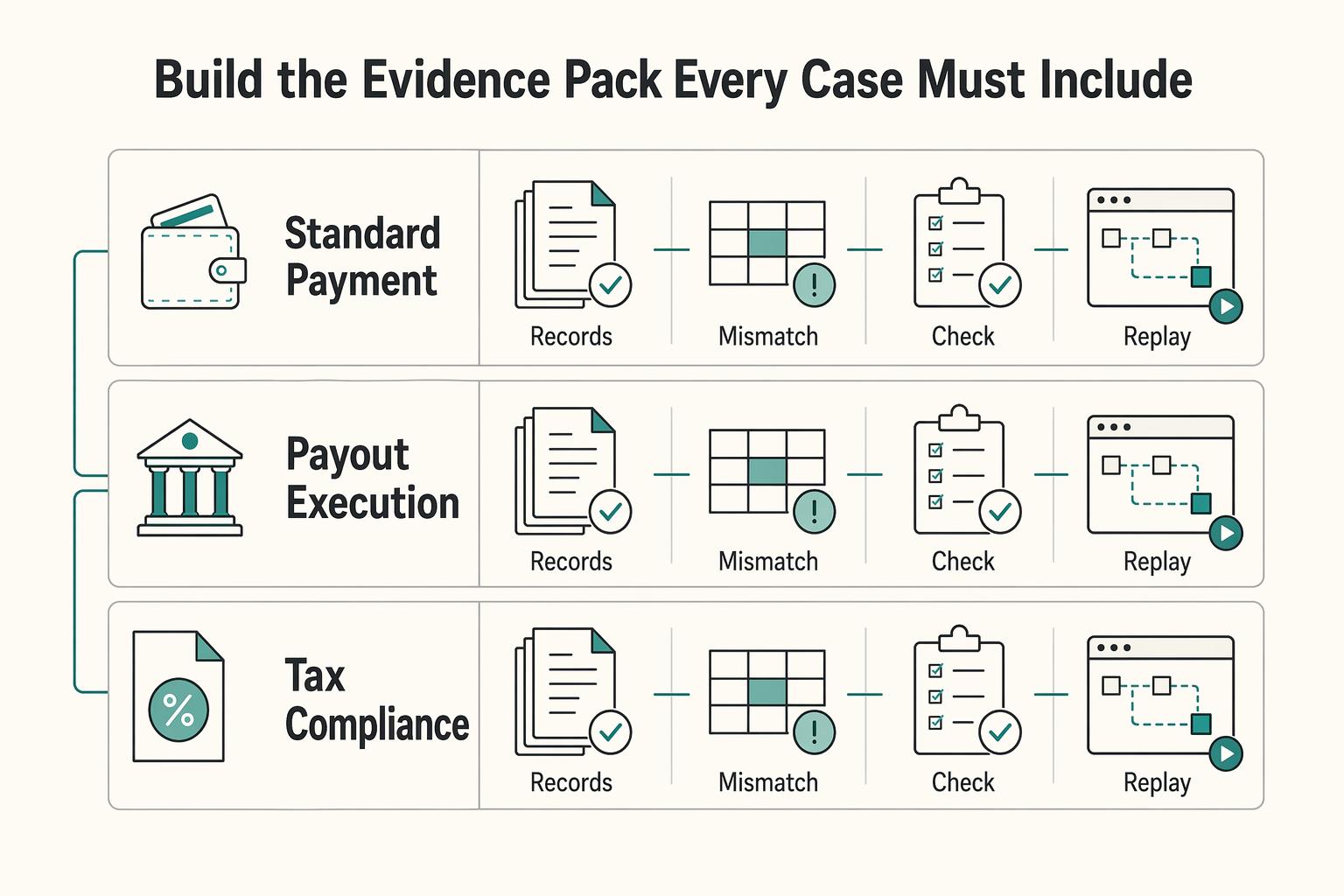
Review quality rises or falls on the case packet. Make the evidence pack explicit before review starts, and keep it consistent enough that a second reviewer can reconstruct the case without chasing side-channel context. Use dispute-type-specific fields as internal policy controls, not as claims about universal legal requirements.
Keep written messages, approvals and notices in the same case file as the payment records. Another reviewer should be able to follow the decision without searching chat or email.
| Dispute lane | Internal packet (policy-defined examples) | Review checkpoint | Common failure mode |
|---|---|---|---|
| Standard payment dispute | Example internal records: payment object ID, linked ledger entry, invoice reference from the system used, written communication copies, settlement timestamp | Can another reviewer trace invoice to settlement without extra context? | Screenshots are present, but system IDs or journal links are missing |
| Payout execution dispute | Example internal records: provider reference, webhook history, idempotency log tied to the Idempotency key, Payout batches context, communication copies | Can you reconstruct request, provider response, webhook sequence, and final posting state? | A provider status is shown, but replay or duplicate risk cannot be proven |
| Tax or compliance hold dispute | Example internal records: current tax profile, relevant forms when your policy requires them, and control outcome records | Is this missing documentation, execution failure, or a control state? | Tax or compliance holds are handled as payout rail failures |
Define the minimum file by dispute type#
Publish a short evidence matrix with intake rules so reviewers know what must be present before a decision. Put internal identifiers and record links ahead of narrative.
Stress-test the standard by handing a case to someone who did not triage it. If they cannot identify the disputed amount, authoritative record, and key written communication from the packet alone, the file is not ready.
Add sequence evidence for payout cases#
For payout execution disputes, include artifacts that let you prove sequence and final state, not just point-in-time status. This is an internal reliability choice so your team can test retries, duplicates, and posting outcomes.
The core question is operational: what did the platform send, what did the provider acknowledge, what did webhooks report, and did any replay or batch process change the result?
Keep tax-hold review tied to current documentation#
When a dispute includes a tax or compliance hold, preserve the current document and reason code, then route applicability and release decisions to the authorized specialist. Do not resolve a tax obligation from the payout status alone.
This prevents routing mistakes between documentation gaps, reporting disagreements and actual payout execution defects. Tell the contractor which issue is being reviewed and when to expect the next update.
Separate control outcomes from payment outcomes#
If controls flagged the case, record the control outcome clearly in the file and show how your policy treats that state. Review quality drops when teams cannot distinguish one control state from another.
Assign missing-record retrieval as a case task with an owner and due date. Preserve the approval artifact for any payout correction or exception, and keep the record version used for the decision.
Run the internal sequence from triage to closeout#
Use a grounded sequence: define scope and objectives, assign responsibilities and authority, complete internal case research, communicate clearly, and use reporting and appeals checkpoints. That keeps resolution consistent without assuming platform-specific payout rules.
Worked example: a disputed contractor underpayment#
Illustrative case, not a Gruv production policy: a contractor invoices $1,200 for an approved milestone but sees a $1,000 payout. Intake creates case DP-104 with the executed agreement version, milestone acceptance, invoice, approval history, ledger journal, provider payout ID and the contractor’s statement. The published example policy promises acknowledgment within two business days and an initial decision within ten; real deadlines must come from the operator’s approved terms.
| Evidence check | Case finding | Next state and owner |
|---|---|---|
| Executed agreement and accepted work | Milestone value is $1,200; no $200 deduction is authorized | Verification — finance reviewer |
| Invoice, ledger and provider record | Ledger posted $1,000 and the provider confirms a $1,000 paid payout; no second transfer is pending | Decision ready — finance approver |
| Written decision | Approve a $200 correction, subject to normal payout controls; do not replay the original $1,000 | Correction pending — payment approver |
| Contractor response and appeal | Send the calculation, evidence summary and correction reference; allow appeal under the executed terms | Notice sent; appeal open until policy deadline — separate reviewer |
If the provider instead shows a pending $200 transfer, hold the correction until that state is reconciled. The case closes only after the $200 posting and contractor notice are recorded. A contractor appeal should name the disputed finding and attach new evidence; the appeal reviewer records a separate written result.
Copyable case and notice template#
- Case ID, contractor ID, dispute type, amount, currency, received date, response deadline and current owner.
- Executed agreement version and clause, invoice and approved-work references, ledger and provider references, communications, missing evidence and reviewer findings.
- Written notice: “We reviewed [records] and found [calculation]. We will [action] by [date]. You may appeal under [policy clause] by [date] using [channel].”
- Appeal reviewer, evidence received, final written decision, authorized correction ID and closeout proof.
Validate intake and define the case scope#
Start by classifying the case and stating the objective so the handling path is clear. Similar issues can look alike at intake, so the initial scope should be explicit.
Separate responsibility from authority: record who gathers evidence, who decides the case and who can approve a money-moving correction. The contractor should know the current owner and next step.
Research internal systems before concluding#
Do not finalize conclusions until the agreement, invoice, work approval, ledger and provider records are reconciled. Record any gap and who is responsible for resolving it.
If internal records are unclear or conflicting, keep the case in research and resolve those gaps first. Move forward when the internal record supports a coherent explanation.
Document conclusions and communicate clearly#
When research is sufficient, document the case conclusion and the basis for it. If evidence is missing, request the exact item needed and explain why it matters.
Tell the contractor what is known, what evidence is missing, when to expect the next response and how to challenge the decision. Keep those messages in the case file.
Route case actions through the authority path#
After the conclusion is documented, route follow-on case actions through the defined authority path for the case. Keep the case record aligned with what was decided and what was carried out.
Use the appeal route stated in the executed contractor agreement and the platform’s published dispute policy. Assign an appeal reviewer who did not make the original decision, where the policy permits.
Close out with posting checks and appeal status#
Closeout should leave the outcome, supporting records, written contractor notice, approved payout adjustment and appeal status under one case ID. Reopen if a later provider or ledger event changes the financial result.
Use a clear escalation ladder when internal resolution fails#
Escalation works best when it follows checkpoints instead of instinct. One practical checkpoint is whether the dispute is still about missing facts or has shifted to contested contract meaning.
| Step | Use when | File needs |
|---|---|---|
| Negotiation | Unresolved facts or fixable misunderstandings are still driving the case, or a quick settlement is still realistic | The disputed amount, record references, and the exact unanswered questions |
| Legal review | Operations cannot resolve the case through record matching and policy application alone, or the dispute turns on contract meaning | Exact clause text, the internal written decision, disputed payment records, and the communication trail |
| Arbitration gate | Contract language and legal review support arbitration | Clause text, legal review outcome, final internal decision, amount in dispute, and settlement-hold status |
| AI support | Evidence summarization, pattern checks, and draft support | Records and contract text behind the result, with human approval for final determinations, notices, and settlement actions |
Start with negotiation when the record is incomplete or a quick settlement is still realistic#
Use Negotiation when unresolved facts or fixable misunderstandings are still driving the case. Keep the goal explicit: close the evidence gap or test whether both sides can accept a written settlement position based on reconciled records.
Keep this step bounded. The case packet should clearly show the disputed amount, record references, and the exact unanswered questions. If the same facts repeat and the disagreement becomes "what does the contract require," move to legal review.
Escalate to legal review when the dispute turns on contract meaning#
Escalate to legal when operations cannot resolve the case through record matching and policy application alone. A common trigger is disputed interpretation of the Dispute resolution clause.
Attach exact clause text, the internal written decision, disputed payment records, and the communication trail showing why internal resolution failed. If the contract references Binding arbitration, capture that language verbatim and flag it for review.
Confirm whether arbitration is actually in scope before you invoke it#
Treat arbitration as conditional, not automatic, and use it only when contract language and legal review support it. Document an arbitration gate before formal escalation. At minimum, confirm the file includes clause text, legal review outcome, final internal decision, amount in dispute, and settlement-hold status.
Do not escalate on the assumption that ADR will always be the lighter path. Process formality can vary by case, including situations where ADR becomes more formal. Treat formal-versus-informal labels as shorthand, not guarantees.
Use AI support as assistive analysis only#
Use AI tools for assistive tasks such as evidence summarization, pattern checks, and draft support. Keep final determinations, notices, and settlement actions under human approval controls.
Do not allow model output alone to trigger closeout, payout release, reversal, or notice sending. If the tool cannot show the records and contract text behind its result, treat it as a review input, not a decision.
Automate the controls that remove repeat disputes#
Automate case-quality controls first, and keep final dispute decisions under accountable human review. That approach can reduce repeat work without shifting final accountability away from people.
-
Tie each control to a written procedure. Use the executed contractor agreement and the platform’s own dispute policy. For each automation, document intake fields, evidence checks, decision authority, payout-correction approval and appeal handling before rollout.
-
Automate completeness gates before outcome decisions. Use automation to flag incomplete files before they move forward. This does not define exact mandatory fields, handoff rules, or override roles, so document those controls as internal policy before enforcing them.
-
Make settlement actions safe to retry. If your dispute process includes money movement, design retries to avoid duplicate financial effects. This does not confirm specific idempotency or replay controls, so validate duplicate-submission handling before broad rollout.
-
Route repeat patterns into improvement work. Review recurring underpayments, delayed payouts and reopened cases with a named process owner; do not auto-close a contractor case from a trend score.
Related: Payment Disputes and Chargebacks: A Step-by-Step Resolution Guide for Freelancers.
Handle cross-border tax and compliance edges inside the same process#
Keep cross-border tax and compliance checks inside the dispute workflow, but route them through a separate compliance branch instead of payout troubleshooting. The goal is to keep valid payouts moving without masking reporting issues as payment failures.
| Issue | Routing | Key note |
|---|---|---|
| Tax-document checks | Confirm document status and ownership in the case file, then route unclear or conflicting records to tax or compliance review | Treat W-8, W-9, Form 1042-S, Form 1099, and VAT rule logic as policy-owned checks |
| Compliance holds vs payout failures | Use distinct reason codes and evidence trails, and keep uncertain VAT-related amount disputes in tax or compliance review | Do not misreport reporting issues as payment-rail defects |
- Keep tax-document checks operational, not interpretive.
Confirm document status and ownership in the case file, then route unclear or conflicting records to tax or compliance review. This section does not define W-8 or W-9, Form 1042-S, Form 1099, or VAT rule logic, so treat those as policy-owned checks rather than reviewer judgment calls.
- Separate compliance holds from payout execution failures in case states.
Use distinct reason codes and evidence trails so reporting issues are not misreported as payment-rail defects. For VAT-related amount disputes, keep the case in tax or compliance review when treatment is uncertain rather than labeling it as an execution failure.
For a step-by-step walkthrough, see How to Handle Payment Disputes as a Platform Operator.
Measure process quality with decision checkpoints#
If you cannot see drift at each gate, you may only discover it after backlog and exceptions pile up. Track quality at each checkpoint, not just at closeout, so timeliness and consistency stay visible from intake through final acceptance.
- Set one metric for each stage. Use one decision checkpoint per gate: was the case ready to move forward, or did the process create delay or error?
| Stage | Metric | What to verify |
|---|---|---|
| Intake | Intake completeness | Required evidence is attached and the reason code matches the dispute type |
| Verification | Verification pass rate | Records reconcile cleanly enough to decide without data repair |
| Decision | Decision latency against internal target | The clock starts at triage and stops when a written decision is issued |
| Settlement | Settlement correction rate | Posted reversals, offsets, or releases did not require follow-up fixes |
| Closeout | Reopen rate | The case stayed closed because notice, posting, and evidence were complete |
Do not infer progress from timestamps alone. Require a visible completion mark at each gate, because correction is not complete until it is verified.
-
Report source-of-truth consistency first. Track the share of cases with matched ledger and invoice-system data at first review. This can be a practical health check: low match rates may indicate reviewers are repairing records instead of deciding the case. Define "matched" once and keep it stable. At minimum, the case should show that the ledger event, invoice reference from the system used, and settlement status point to the same payment object.
-
Watch fairness controls, not just speed. Speed alone can hide inconsistent treatment. Track decision variance by dispute type, escalation rate by reviewer group, and override frequency under
RBACto spot uneven handling of similar cases. For each override, capture the original decision, approver, reason, and added or reinterpreted evidence. Use outliers to review policy interpretation, training, or evidence standards. -
Publish one monthly exception review. Publish a monthly exception review across
Payout batches,Chargebacks, and compliance-gated holds. Focus it on fix priorities: recurring mismatches, repeated settlement corrections, reopened cases, and concentrated decision patterns. Build this from the same case system used for decisions. Fragmented spreadsheets and email threads weaken coordination and auditability. -
Compare trends to your own baseline. Be explicit about evidence limits. External benchmarks on dispute-team organization and operating patterns are often thin, so internal trend lines are usually more defensible. Read month-over-month changes with context. Annotate policy or intake-definition changes so metric movement reflects process reality, not classification drift.
If your team is defining SLA, variance, and reopen metrics, use this as a build reference for status surfaces, webhooks, and reconciliation workflows in one place. Explore the Gruv docs.
Common failure modes and how to recover fast#
Fast recovery starts with accurate classification. When you know whether the issue is reporting, controls, or approval, the correction path is usually clearer.
-
Identify the failure type and document it in case history. When a case starts accumulating multiple fixes, label what failed: reporting data, case controls, or decision approval. Use case history as the running log so the next reviewer can follow the file without reconstructing it.
-
Route tax-document disputes to the tax owner. Separate a contested payout amount from a tax-reporting or withholding issue, preserve the relevant documents and tell the contractor which team will answer each question.
-
Complete any approved correction end to end. Link the revised statement, ledger adjustment, provider action and contractor notice to the original case; have the tax team handle any amended reporting separately.
-
Use control checkpoints, not status labels. Capture who verified each evidence set, decision, correction and notice before moving the case to the next state.
-
Require written supervisory approval for exception paths. Before finalizing exception paths that can affect reporting outcomes, require written supervisory approval in the case record. This keeps the file clear on what was decided, by whom, and on what documented basis.
Copy and use this implementation checklist#
Use this as a controlled policy artifact. Fill in roles, deadlines and appeal rights from your executed agreement and approved platform policy before adopting it.
- We documented Roles and Responsibilities for key workflow steps, including review, approval, exception routing, and closeout.
- We documented Program Controls required before a case can be closed.
- We require a written supervisory approval checkpoint before final disposition.
- We maintain an explicit exception path for Cases Needing Further Action instead of forcing an approve or deny outcome.
- We require each closed case to show assigned owner, approver, and the policy or contract clause used for the decision, when applicable.
- We treat contract clauses as controlled artifacts and record the clause used when a dispute depends on contract language, using the version in the executed contractor agreement.
- We track dispute-process deficiencies and review them on a recurring cadence.
When you are ready to operationalize this process across compliance-gated payout flows and payout batches where enabled, map your requirements to a concrete rollout plan with Gruv. Talk with the team.
Frequently Asked Questions
What makes an internal contractor payment dispute process fair in practice?
A process is fair in practice when similar disputes follow the same evidence standard, the same review path, and a clearly documented rationale. The real test is consistency: equivalent cases should not be approved or denied on different levels of proof. Keep the decision record explicit so any reviewer can see why the outcome was reached.
Which parts should we automate first if we need visible impact in the next quarter?
Start with intake and control steps before automating judgment. Prioritize completeness checks, required case fields, and workflow tracking so decisions are based on complete records. Then add recommendation support, with human oversight, once your inputs are reliable.
Should negotiation always come before escalation to binding arbitration?
No. Negotiation can help when facts are still incomplete or a fast agreement is realistic, but it is not mandatory in every contract or jurisdiction. Escalation order should follow the dispute clause and legal review of the specific contract language.
Can AI tools replace human reviewers for dispute decisions?
AI should support decisions, not make final determinations on its own. The grounded use case is recommendation support that suggests fair, explainable paths, with human oversight on the outcome. If a tool cannot clearly show the reasoning behind its recommendation, treat that as a control risk.
What evidence should be mandatory before approving or denying a dispute?
Set a minimum evidence pack in your internal policy and apply it consistently across similar cases. The decision should be explainable from the documented record, not from reviewer memory or informal context. If core records conflict, pause the decision and resolve the mismatch first.
How do we keep cross-border tax and compliance checks from stalling valid payouts?
Separate tax or compliance review from payment-execution review at intake. Record the governing policy and authorized owner for every hold, and review only the records relevant to that specific dispute.
Researched and edited by the Gruv editorial team. Gruv builds cross-border billing, payouts, and finance-operations software for global businesses.
Sources
Includes 1 external source outside the trusted-domain allowlist.
Educational content only. Not legal, tax, or financial advice.
Related Posts

Freelancer Disputes and Chargebacks: Resolve the Right Case
A freelancer payment complaint can be a contract disagreement, a marketplace request or a card chargeback. The right response depends on the route. Before refunding or submitting evidence, identify the payment, case type, responsible account, current status and exact deadline. For an open chargeback, accepting the dispute and issuing another refund are different actions; a separate reimbursement can pay the client twice.

The Freelance Payment Penalty: A Modeled Audit of Platform Fees, FX Spreads, and Payout Delays
The money rarely disappears through a single, easy-to-spot fee. The real loss is stacked. A marketplace takes its commission, a processor adds a charge for international cards, a bank or payment company converts the currency at a spread, a platform holds the funds before release, and a wire sheds a little to intermediaries on the way in. Each layer looks defensible on its own, but the worker feels the combined result as a smaller deposit and a later payday.

How to Respond to a Subpoena for Business Records
Move fast, but do not produce records on instinct. If you need to **respond to a subpoena for business records**, your immediate job is to control deadlines, preserve records, and make any later production defensible.