
Quick Answer
A global platform can issue compliant tax invoices across many countries only by treating invoicing as a country-by-country control system, not a single template. Define the jurisdiction, counterparty type, channel, format, and required evidence first, then validate tax profiles, submit through the mandated route, and retain acceptance artifacts and reconciliation records so the process stays audit-defensible as rules change.
What Compliant Tax Invoicing Requires Across Countries#
Issuing compliant tax invoices across a multi-country platform is an operating design problem, not a template task. It touches tax rules, product behavior, integration paths, and record retention. If you assume one invoice layout or one vendor coverage claim will work everywhere, you usually create rework and weak audit evidence.
Start with the assumption that rules will change#
Treat this as a changing set of controls, not a one-time setup. In the EU, VAT in the Digital Age (ViDA) was adopted on 11 March 2025. Digital Reporting Requirements are set to affect cross-border B2B transactions from 1 July 2030, and rollout continues until January 2035. Your invoicing design has to stay valid as mandates evolve, not just pass launch.
This is not just an EU pattern. The OECD describes expanding digital VAT reporting with major differences across jurisdictions, which is why cross-border compliance gets complex quickly. Outside the EU, ZATCA's e-invoicing program shows the same reality. Compliance can require technical and business controls plus integration with authority systems, not just a correctly formatted invoice.
Treat legal validity, transport, and evidence as separate jobs#
An invoice can look complete and still fail in practice. The authority or reporting channel can still reject it. In other cases, it appears to pass, but later you cannot prove what was submitted, when it was submitted, or what response came back.
Before marking any country live, confirm three things:
- You know the current authority path and reporting model, not only required fields.
- You know which records must be retained to defend VAT treatment.
- You can retrieve those records during a tax check.
That third point matters operationally. VAT records are expected to be complete, up to date, available, and sufficient for correct VAT calculation. If you cannot produce relevant records and submission evidence on demand, the process is not audit-defensible yet.
Build for auditability before scale#
Use one strict rule throughout this guide: if a control cannot be tested and evidenced, do not rely on it. For each country, define a clear owner, an explicit acceptance path, stored outputs, and a recovery path for failed submissions or reports. Also map which controls are enforced in your product versus by external providers, because that boundary becomes risk when mandates change.
This guide gives finance, operations, and product owners a practical sequence for defining scope, validating channels and formats, handling failures, and retaining proof. The goal is not just to issue invoices in many markets. It is to keep the process defensible as rules change across the EU and beyond.
Related: Platform Invoicing at Scale: How to Auto-Generate Compliant Invoices for Thousands of Contractors.
Define compliance scope before you write one invoice#
Apply the auditability rule first: scope the country and channel before you scope the document. Starting from a PDF layout or a vendor coverage slide usually misses the control points that determine whether an invoice aligns with the required standard and is accepted through the required route.
Separate legal validity from transport acceptance#
EN 16931 defines core business terms and usage rules, and UBL/CII are the two syntaxes identified for that standard. Route-level acceptance is still separate. In Italy, electronic invoices to government departments go through SdI, which performs checks before forwarding. For each market, name both the legal standard and the submission path, then define what acceptance evidence you retain.
Split scope by counterparty type and channel#
Separate public-sector and domestic B2B flows. France’s covered domestic B2B reform requires businesses to receive electronic invoices from September 1, 2026, with issuance phased between larger businesses in 2026 and smaller businesses in 2027. Public-sector Chorus Pro remains a distinct scope. For German federal recipients, confirm the current OZG-RE route, exceptions and accepted EN 16931-compatible format; state recipients can have different instructions.
Define schema families by country and program#
Define accepted schema families by country and program, not as a generic "XML supported" claim. XRechnung is Germany's EN 16931-based federal standard. ZUGFeRD is a hybrid PDF/A-3 format with embedded XML. Peppol BIS Billing 3.0 is a separate implementation specification. Treat them as distinct requirements, not interchangeable options.
Write explicit support boundaries you can defend#
Do not mark a market supported based only on a "50+ countries" provider claim. Record support at country-plus-program level, such as "Italy public-sector via SdI" or "Germany federal B2G via OZG-RE with XRechnung." If you cannot name the counterparty type, channel, format, and current endpoint, that country is not in scope yet.
Once scope is defined this tightly, you can build the evidence pack without guessing what the implementation is supposed to prove.
Prepare the country evidence pack before build starts#
Prepare the country dossier before you open engineering tickets. If a launch market cannot be documented with an authority link, mandate status, required route and format, and retained acceptance proof, keep it out of scope.
Create one dossier per jurisdiction#
Create one dossier per jurisdiction and date-stamp it. Minimum fields: country, counterparty scope, channel, authority source, mandate status, and last-checked date. This forces a clear yes or no implementation decision per market.
Use official authority pages for each taxpayer and transaction scope. For Italy, establish whether the transaction falls under mandatory SdI invoicing and any exception before choosing FatturaPA. For France, distinguish public-sector Chorus Pro from covered domestic B2B routing. German federal guidance must be applied with recipient instructions and exceptions, rather than copied to all public bodies.
Pair route and format in the dossier#
Record route and format as one paired requirement. Saying a market is "XML supported" is not enough. You need the exact channel and schema for that program.
| Jurisdiction | Channel or platform | Format or schema to record | Verification detail |
|---|---|---|---|
| Italy | SdI | FatturaPA | Confirm the submitted file matches FatturaPA XML specifications |
| Germany federal B2G | OZG-RE | XRechnung or another accepted EN 16931-compatible format meeting recipient/platform requirements | Verify Buyer reference BT-10 includes the Leitweg-ID and mandatory fields pass portal checks |
| Poland | KSeF | FA(3) from February 1, 2026 | Record the exact schema reference used and require UPO-based acceptance evidence |
For German federal recipients, XRechnung is a common supported format; other EN 16931-compatible formats can qualify when they meet E-RechV and platform requirements. A plain PDF does not establish compliance. Record recipient routing and mandatory fields for the chosen format.
This discipline is risk control, not paperwork. As EU law notes, non-interoperable standards create complexity, legal uncertainty, and added operating costs.
Assign named owners and escalation#
Assign named owners in each dossier for tax, product, and operations, with an escalation route for changes. This is an internal control, not a regulator-prescribed ownership model, and it prevents tax updates from stalling before product and ops implementation.
Keep ownership explicit. Tax owns mandate interpretation and authority tracking. Product owns field mapping, schema updates, and release gates. Operations owns submission monitoring, receipt retention, and exception handling. If a country has no named owner and backup, treat it as not ready for build.
Define acceptance artifacts before live submission#
Define required acceptance artifacts before submitting any live invoice. For Italy, retain SdI delivery receipts and rejection notifications per invoice record. For Poland, retain the UPO and returned KSeF number. For France public-sector flows, retain the Chorus Pro status trail used for processing evidence. For Germany, retain the submission reference and validation result from the federal submission path.
Use one checkpoint: take one sample invoice per country and prove end-to-end traceability from generated schema to submission event to acceptance or rejection evidence. If you cannot do that, the compliance claim is still a slide, not an operating capability.
If your team is also standardizing tax forms, invoices, payouts, and disputes, How to Build a Vendor Portal for Platforms: Tax Forms Invoices Payouts and Disputes in One Workspace is a useful companion.
Build a country rule matrix your team can execute#
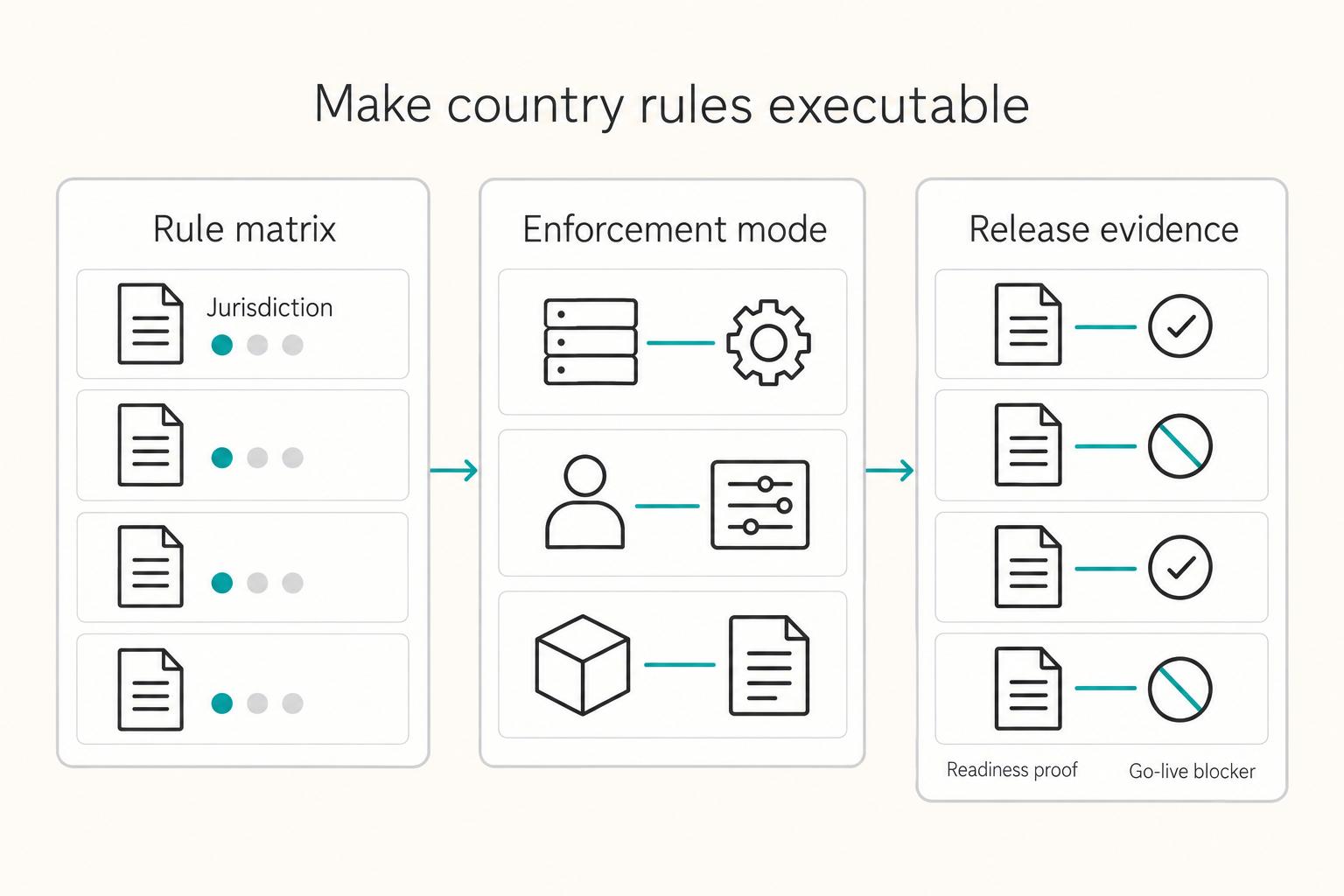
Turn the dossier into a dated release gate your teams can use, not a static country list. If a rule is not tagged as system-enforced, operator-enforced, or vendor-dependent, treat it as hidden manual risk.
Use one matrix as the operating source of truth for onboarding, QA, and incident response. At minimum, include: jurisdiction, B2B/B2G status, transport network, format, clearance model, archive requirement, go-live blocker, proof of readiness, and enforcement mode. For EU public-administration rows, include EN 16931 compatibility in the format requirement.
| Jurisdiction | B2B/B2G status | Transport network | Format | Clearance model | Archive requirement | Go-live blocker | Proof of readiness | Enforcement mode |
|---|---|---|---|---|---|---|---|---|
| Germany federal, current recipient scope | B2G | OZG-RE | Accepted EN 16931-compatible format | Portal submission with technical validation | Submission reference and validation result | Incorrect recipient routing or required fields | Successful OZG-RE submission with mandatory information accepted | Illustrative system-enforced implementation |
| Poland KSeF, through 31 Jan 2026 | Structured invoicing | KSeF | FA(2) XML logical structure | Central platform acceptance | UPO plus returned KSeF number | Wrong schema version or missing KSeF acceptance evidence | Test submission returns UPO and KSeF number | System-enforced |
| Poland KSeF, from 1 Feb 2026 | Structured invoicing | KSeF | FA(3) XML logical structure | Central platform acceptance | UPO plus returned KSeF number | Any production invoice still generated as FA(2) | Test submission returns UPO and KSeF number under FA(3) | System-enforced |
For German federal recipients, use the current federal route and an accepted compliant format, with the applicable exceptions. For KSeF, select the schema required on the issue/submission date and preserve the returned number and receipt evidence.
Require proof that QA can verify and ops can retrieve later. If a row depends on someone remembering recipient scope, schema version, or archive evidence, keep it marked operator-enforced until automated. For vendor-dependent rows, require clear confirmation of supported transport, format version, and returned acceptance artifact for that jurisdiction.
With the matrix in place, the next decision is architectural: where do these country rules live, and who controls them when they change? For a step-by-step walkthrough, see How to Build a Global Accounts Payable Strategy for a Multi-Country Platform.
Choose where invoice logic lives in your stack#
Once your matrix is in place, decide this explicitly: keep policy decisions in your stack and use external providers for transport and country endpoints.
Split semantic rules from transport rules#
Separate what the invoice means from how it is encoded and delivered. EN 16931 defines invoice semantics. UBL 2.1 and CII are syntax bindings. Peppol and country gateways are submission channels.
Jurisdictions combine semantics, syntax and transport differently. Peppol BIS Billing is an EN 16931 implementation. German federal recipients can use accepted EN 16931-compatible formats through the supported route; Italy’s covered SdI flows use FatturaPA. Test those separate layers rather than treating one vendor toggle as compliance.
Pick a control model you can defend#
Choose a model based on change frequency, rail complexity, and evidence requirements after failures.
| Model | Good fit | Main strength | Main risk | Verify before approval |
|---|---|---|---|---|
| Provider-native logic | Smaller country scope, one main provider | Less internal build at launch | Decision logic can be opaque and format/channel boundaries can blur | Country-level proof of supported format, transport, returned validation artifact, and update ownership |
| Internal rules layer | High audit pressure, strong in-house ownership | Clear decision trail and release control | Higher maintenance burden | Versioned policy rules, country test fixtures, and evidence retrieval by invoice ID |
| Hybrid orchestration | Multiple rails (for example, Peppol plus country gateways), mixed providers, frequent changes | Keeps policy and auditability internal while using external adapters | Boundary mistakes across policy, transformation, and submission | Explicit responsibility split, adapter support per country, and expected acceptance artifacts |
If you operate multiple rails or change country coverage often, consider hybrid as a starting point, then validate country by country. Keep internal policy strict and explicit. Let adapters handle submission mechanics.
Set an explicit idempotency boundary#
Create one durable internal submission identity before the external call. Reserve it atomically in your submission ledger so concurrent workers cannot send it twice. After a timeout, query the original outcome before another send; an internal identifier alone does not deduplicate an authority or provider request.
Do not assume uniform external behavior. Some APIs support idempotency keys, and some explicitly note that not all APIs support idempotency headers. Keep your own submission ledger with request hash, adapter, timestamp, and returned acceptance artifact so ops can trace one invoice ID to one submission path and response history.
Assign ownership for standards and release cadence#
Do not approve expansion without named owners for schema and channel updates. At minimum, assign ownership for EN 16931 semantics and syntax bindings (UBL/CII), and for country overlays such as XRechnung or FatturaPA plus channel release calendars.
Track each standard’s current publication and mandatory-use dates together with the relevant channel release calendar. Pin the versions used in testing and production. Do not treat an old example release as the current validator.
Implement invoice creation and submission in strict order#
Once you decide where rules live, make the execution order non-negotiable: validate first, generate the mandated format second, submit third, and store outcomes immediately after each attempt.
Validate the counterparty and tax profile first#
Use VIES where intra-EU VAT treatment requires confirmation, and preserve the lookup evidence. An invalid result can mean a nonexistent number, incomplete registration or missing cross-border activation; unavailable data is a separate state. Obtain official clarification where needed rather than automatically banning every invoice or payout.
Store the VAT ID, lookup time, result and draft ID together. For public recipients, validate the buyer reference and routing identifiers required by that recipient and invoice format before generation.
Generate the mandated output before submission#
Choose output from the applicable taxpayer, transaction and recipient scope. For covered Italian transactions requiring SdI, generate the prescribed FatturaPA file and retain the legally relevant submission outcome; do not generalize that mandate to every foreign seller.
For German federal recipients, follow current OZG-RE instructions and accepted compliant formats. State and local public recipients may use other routes or requirements. Use ZUGFeRD only where its profile and embedded XML meet the applicable acceptance requirements.
Submit to the required network and capture the first response#
Submit only after the mandated file is generated for the selected path, for example SdI, OZG-RE, or KSeF. Immediately store provider reference, request hash, submission timestamp, and raw response for every attempt, including timeouts and rejects.
Handle ambiguous attempts as a first-class case. A client timeout does not prove the network rejected the file. Keep one internal submission identity and attach acknowledgement artifacts to it. For example, SdI returns receipt outcomes to the transmitter, and KSeF documentation includes UPO retrieval in the API flow.
Post events into journals before balances#
Log every invoice and submission status transition. Post monetary journal entries only when the approved accounting policy calls for recognition, correction or payment; draft and transport acknowledgments can be no-posting events.
Keep separate invoice, submission, accounting and cash states linked by invoice ID and references. A delivery receipt does not prove recognition or payment, and an unpaid invoice can be validly issued.
Require end-to-end tests before launch#
Do not launch a market based on document generation alone. Require successful end-to-end test submissions on the real channel path and verify reconciliation across invoice status, acknowledgement record, and journal entries for the same transaction.
Use available test facilities where relevant, such as the OZG-RE test environment and OpenPeppol testbed, and keep KSeF production/test separation explicit because production invoices carry tax and legal consequences. A defensible go-live pack includes at least one passed path test, one stored acknowledgement example, and one reconciled journal trace.
Before go-live, run counterparties through the VAT Number Validator so tax-profile errors are reduced before invoice submission.
Gate payouts and tax documents to keep invoices defensible#
Define payment consequences from the applicable law, partner terms and approved policy. A missing tax field can require correction, a changed tax treatment or withholding; it does not universally authorize withholding the whole payable.
Make payout release depend on verified profile status#
Tie payout eligibility to defensible policy gates: customer identity verification (including CIP where applicable), AML review, beneficial-owner checks for legal entities where required, and VAT validation where the program and market require it. For EU VAT checks, use VIES as a key input because it returns explicit valid or invalid results, but do not treat VIES alone as full VAT compliance proof.
Store decision evidence with each check: identity data used, verification timestamp, result, and deciding operator or service. If your regulated setup requires beneficial-owner checks, keep that verification result attached to the legal-entity record.
Route an unresolved VIES result to tax-treatment review and official verification where appropriate. Record the permitted invoice and payment action under the actual transaction rules; a VIES result alone is not a universal payout block.
Collect the right tax form before payment logic is final#
For relevant US reporting contexts, collect Form W-9 from US persons. Form W-8BEN generally documents foreign individuals; foreign entities generally use W-8BEN-E or another applicable form. Select the form by payee status and withholding/reporting context.
Keep stored form data masked in ops views, with an audit trail for collection and updates, and preserve the exact version used at payout decision time. Operators should be able to answer quickly: which form was on file, when it was collected, and whether that version was used.
For covered reportable payments, missing or incorrect TIN information can trigger 24% backup withholding. Configure the required withholding, reporting and remittance action rather than treating every profile gap as a universal nonpayment instruction.
Connect tax-profile outputs to reporting only where enabled#
Where US information reporting applies, connect payee classification and paid amounts to the applicable form. The ten-return electronic-filing threshold is aggregated across covered information-return types, subject to applicable exceptions or waivers.
Keep holds explainable and resolvable#
Make every hold and release auditable with versioned policy logic and approval history. Record the rule version, triggering condition, evidence reviewed, action taken, and any later profile changes.
Surface holds clearly in ops tooling with plain-language reasons like W-9 missing, TIN mismatch, VIES invalid, or beneficial owner verification pending. If an override is necessary, require a named approver and a stored rationale.
Design the exception queue and recovery paths#
Your exception queue should answer two questions right away: what failed, and what happens next. If operators only see failed, they can resubmit blindly, create duplicates, and weaken audit evidence.
Adopt a fixed taxonomy and map authority status into it#
Use one internal taxonomy across markets, for example: validation fail, schema reject, clearance reject, reporting mismatch, reconciliation gap, and duplicate replay. Keep it stable as your operating model, while treating country statuses as mapped inputs rather than replacing your categories.
Map authority responses explicitly. SdI returns receipt outcomes such as scarto, consegna, and mancata consegna. Chorus Pro uses statuses like A recycler, Suspendue, and Rejetée. KSeF has its own send/receipt flow, including UPO download. Store both fields on every case: internal category and raw authority status. Verification checkpoint: each failed invoice should show internal category, raw authority response, submission timestamp, and exact invoice version sent.
Assign owner and action clock by failure type and channel#
Route by failure type first, then apply the country rule. Schema rejects may need integrations support; reporting mismatches may need finance ops. For Italian transactions subject to mandatory SdI invoicing, failure to submit through the required path can mean the invoice is not treated as issued. Confirm the taxpayer and transaction scope before applying that consequence.
Use current channel guidance to set pending, rejection and escalation clocks. A timeout or delayed acknowledgment is not proof of rejection. Preserve raw status, last check and owner, and retrieve the required receipt before closing the submission case.
Keep pending and rejected separate in your queue logic. Transport delay and rejection are different failure states.
Recover duplicates with idempotent replay#
Retry only under the channel’s documented support and retention rules, with the same unchanged payload where required. For an ambiguous outcome, query status or reconcile existing receipts before another attempt. An internal key alone does not guarantee external deduplication.
Persist submission identity, payload hash, channel and invoice version. Check for existing receipts before replay. A corrected invoice is a new legal/version decision under the country’s correction rules, not an arbitrary changed payload sent with the old key.
Store root cause and remediation notes#
Capture root cause, remediation, operator notes, and failure domain (data, schema generation, channel behavior, or reconciliation) for every incident. This turns the queue into a learning tool, not just a backlog.
Make notes searchable by jurisdiction and authority status. Repeated Chorus Pro A recycler patterns can indicate recipient-data issues. Repeated SdI duplicate blocks can indicate retry or payload-version control gaps. Repeated missing UPO evidence can indicate incomplete acceptance-artifact handling. The payoff is better future launches: clearer failure patterns, better evidence discipline, and more reliable recovery paths.
Reconcile invoice status with ledger and reporting outputs#
Reconcile operational status with the accounting result required by policy, including no-posting states. Submission, acceptance, recognition and payment remain distinct; an invoice can be accepted and unpaid.
Map each invoice transition to one financial consequence#
Map drafted, submitted, acknowledged, rejected, delivered, paid and corrected states to operational actions and accounting policy. Record when no monetary posting is expected. Keep settlement and payout status separate from authority receipt status.
Treat an SdI receipt or KSeF UPO as submission evidence. Compare journal entries only where recognition or a correction requires them. Investigate a missing required posting without assuming every operational event needs a journal or every gap authorizes withholding payment.
Reconcile gateway acknowledgements against invoice and journal records#
Reconcile on authority artifacts, not only internal invoice numbers.
In Italy, store IdSdI with the raw receipt outcome, scarto, consegna, or impossibilita di consegna. Keep rejection error code and reason attached to the failed invoice version instead of flattening them into a generic reject.
Keep the transmitted document ID separate from the KSeF invoice number and UPO. FA(3) applies from February 1, 2026; record schema and issue/submission dates without confusing the format change with taxpayer mandate eligibility.
For France, do not assume the same acknowledgement model as SdI or KSeF. PPF is refocused around directory/routing and fiscal data concentration, so reconcile what your platform actually sent and received (invoice, transaction, and payment data), then tie that back to posted journal entries.
Add periodic controls for VAT and tax-document outputs#
Run a regular operating control (for example, monthly), even when legal filing cadence differs by country. Compare posted taxable sales, invoice outputs, and gateway-confirmed invoice populations against what your VAT reporting uses. In the UK, VAT returns are usually every 3 months, so this monthly control is an internal checkpoint, not a legal filing claim.
Where Form 1099-NEC applies, reconcile payee classification, TIN evidence and paid amounts. The normal filing and furnishing deadline is January 31, moved to the next business day when it falls on a weekend or legal holiday. Handle withholding and corrections according to the applicable rules.
Tie FX, payouts, and approvals back to the originating invoice#
When invoice, settlement, and payout currencies differ, keep an explicit chain from invoice to FX record to payout approval. Otherwise, you may be able to explain each record in isolation but still not prove they belong to the same transaction path.
Require an audit evidence pack export for each close cycle: source request, authority or routing response, journal postings, settlement or payout references, FX record when used, and operator actions. If any piece is missing, treat the invoice as not audit-ready.
Run weekly and monthly change control across countries#
Run this as release control, not passive monitoring. When an official mandate, schema, or transport artefact changes, rerun core tests first, and treat new-country onboarding as an internal hold until those controls pass.
Track official updates by jurisdiction#
Keep a versioned change register with one entry per update and jurisdiction. Log the source, affected format or channel, effective date, owner, impact assessment, and approval status.
Track official mandate milestones separately from schema versions. France phases covered domestic B2B receipt and issuance; Poland phases mandatory KSeF taxpayer coverage. Keep each entity’s actual eligibility, effective date and exceptions in its dossier.
Regression-test schemas and channels on a fixed schedule#
Use a fixed internal cadence, such as weekly transport smoke tests and monthly schema and validation regression. Trigger retests from official releases, not assumptions.
Pin the validator and standard versions required for the transaction date. Record the published mandatory-use date and regression evidence instead of treating a sample historical release as current.
Technical components and validation profiles can change separately from headline standard names. Store the exact payload, validator version, result and channel response used for each approved release.
Link change logs to release approvals#
Make release approval evidence explicit so drift is visible. For every production approval, link the exact artefact versions, affected jurisdictions, test evidence, and approver identity.
That approval trail is what makes multi-country compliance claims defensible when you need to justify why a country was released on a specific date.
Common mistakes that break multi-country compliance#
A key failure pattern is false equivalence: teams treat a network connection, one schema, or a provider verification badge as proof that a country setup is compliant. For defensible multi-country invoicing, make separate release decisions by jurisdiction, channel, and payout controls.
Stop treating Peppol access as country compliance#
Peppol connectivity is not a universal legal pass. OpenPeppol allows country-specific validation rules, so local rule variance still applies even when transport is working.
For each country, confirm the exact rule set, accepted document profile, and counterparty context before launch. A payload can pass a generic validator but still fail local business rules or non-network requirements.
Separate B2B and B2G invoice logic#
Do not reuse one invoice schema unchanged across B2B and B2G flows. EU rules and country implementations still create legal and technical differences that can break interoperability in practice.
Set requirements by jurisdiction and recipient type. French public-sector Chorus Pro and German federal OZG-RE are examples; neither establishes the route for every commercial or state-level public invoice.
Require acceptance evidence before calling a country live#
A generated test file is not production readiness. Treat a country as live only when you can show the authority basis you used, successful submission evidence, and a documented internal fallback plan if acceptance fails after release.
Keep auditable receipt and status artifacts, not just internal logs. Italy's exchange system provides delivery receipts, and Chorus Pro provides status-change notifications. If those records are not retrievable on demand, the launch is not audit-ready.
Block payouts when identity or tax checks are incomplete#
Do not let payout execution proceed while required KYC, KYB/AML, or VAT checks are unresolved. Payouts can be blocked until KYC requirements are fulfilled, and provider verification does not replace your independent legal obligations.
Investigate invalid or unavailable VIES responses under the transaction’s VAT requirements. Preserve official verification and any required tax-treatment change; do not equate the result with a universal ban on payment.
Final takeaway and copy-paste launch checklist#
Use one launch standard across every market: a country is not "supported" until legal rules, technical submission, and reconciliation are all proven with stored evidence. If you cannot show the rule source, submission proof, and ledger tie-out, the market is not launch-ready.
Use this launch checklist:
- Country rule matrix row approved with authority references and owner
- Required channel and format tested (for example Peppol, KSeF, or SdI)
- KYC/KYB/AML and VAT validation gates configured where payout policy depends on them
- Tax document flow mapped (W-8/W-9 and downstream reporting where enabled)
- Exception queue, SLA, and replay logic tested with idempotency
- Ledger reconciliation proves invoice state, settlement, and payout consistency
- Change control and rollback criteria documented before go-live
When you are turning this checklist into production controls, use Gruv Docs to map policy gates, idempotent retries, and reconciliation flows.
Frequently Asked Questions
Can one platform issue compliant tax invoices in 50+ countries by default?
Not reliably by default. Peppol BIS Billing can apply validation rules based on supplier country, and countries or sectors can apply CIUS-level variations, so one generic setup is not enough. If a vendor claims support across 60, 70, or 80+ countries, use that as a starting point and request country-level proof of format, channel, and acceptance path.
What are the minimum controls before launching a new country?
Use a minimum launch gate: one approved rule-matrix row for the jurisdiction, a tested schema and submission path, payout and tax-profile policy gates, a named exception owner, and a reconciliation checkpoint after submission. Validate against external evidence, not only internal logs. If you cannot retrieve an acknowledgement, submission ID, or status artifact from the actual gateway or public platform, treat the country as not launch-ready.
What fails most often in cross-border e-invoicing?
There is no single global failure ranking, but recurring breakpoints include schema mismatches, incorrect B2B versus B2G routing, platform-level validation rejects, and status changes that never return to your ledger or ops queue. Italy's SdI shows why: it receives FatturaPA files and performs checks, so a payload can pass internal checks and still fail at clearance. Another recurring failure mode is treating submission as final acceptance before the authority or platform returns final status.
Do we need separate logic for B2B and B2G?
Usually yes. EU country guidance shows e-invoicing is expanding from B2G into B2B, so scope and timing do not move as one fixed rule set. In practice, French public-sector invoicing runs through Chorus Pro, while German federal processing runs through OZG-RE with formal correctness and completeness checks, so those flows should not be routed like standard commercial invoices.
How should we evaluate vendor coverage claims?
Evaluate coverage country by country, not by headline totals. For each market, ask for the supported format, authority or transport path, regulatory update ownership, post-submission evidence, and contract or SLA handling for changes. Treat "Peppol supported" as incomplete unless local validation rules, platform, and endpoint are explicitly identified.
When should we block payouts due to invoice compliance risk?
Apply a payout hold only when the applicable law, partner terms or approved payment policy requires it. Missing TIN information on covered US payments can require backup withholding rather than complete nonpayment. Keep invoice acceptance, accounting recognition and cash settlement distinct.
Researched and edited by the Gruv editorial team. Gruv builds cross-border billing, payouts, and finance-operations software for global businesses.
Sources
- agenziaentrate.gov.it/portale/aree-tematiche/fatturazione-elettron...trusted
- ec.europa.eu/digital-building-blocks/sites/spaces/DIGITAL...trusted
- ecfr.gov/current/title-31/subtitle-B/chapter-X/part-1...trusted
- ecfr.gov/current/title-31/subtitle-B/chapter-X/part-1...trusted
- europa.eu/youreurope/business/taxation/vat/check-vat-n...trusted
- irs.gov/forms-pubs/about-form-w-9trusted
- irs.gov/forms-pubs/about-form-w-8-bentrusted
- ksef.podatki.gov.pl/integratorzy-ittrusted
Educational content only. Not legal, tax, or financial advice.
Related Posts

The Freelance Payment Penalty: A Modeled Audit of Platform Fees, FX Spreads, and Payout Delays
The money rarely disappears through a single, easy-to-spot fee. The real loss is stacked. A marketplace takes its commission, a processor adds a charge for international cards, a bank or payment company converts the currency at a spread, a platform holds the funds before release, and a wire sheds a little to intermediaries on the way in. Each layer looks defensible on its own, but the worker feels the combined result as a smaller deposit and a later payday.

How to Respond to a Subpoena for Business Records
Move fast, but do not produce records on instinct. If you need to **respond to a subpoena for business records**, your immediate job is to control deadlines, preserve records, and make any later production defensible.

A US Expat's Guide to Investing in UCITS ETFs to Avoid PFIC Issues
The real problem is a two-system conflict. U.S. tax treatment can punish the wrong fund choice, while local product-access constraints can block the funds you want to buy in the first place. For **us expat ucits etfs**, the practical question is not "Which product is best?" It is "What can I access, report, and keep doing every year without guessing?" Use this four-part filter before any trade: