
Quick Answer
Use a fixed control sequence: set lane ownership, require complete invoice payloads, create in Stripe Invoicing as `draft`, apply idempotency keys on create and send, then release only after status evidence and ledger checks pass. For self-billing lanes, confirm legal and acceptance conditions before straight-through processing. For PO-governed lanes, block payment when matching fails. Treat webhook lag or missing retry proof as hold conditions, not cleanup tasks, until the invoice trail is complete.
Automated platform invoicing requires more than invoice creation#
In practice, platform invoicing at scale auto-generate is not just invoice creation. It is an operations control problem. Every invoice still has to be created, validated, routed, sent, tracked, reconciled, and preserved in an audit trail without dumping cleanup on finance later.
That distinction shows up quickly in contractor-heavy platforms. At low volume, people can patch missing fields, chase status by hand, and fix mismatches after the fact. At higher volume, that stops working reliably. A simple test from Stripe is whether you process one invoice or 1,000 invoices and the quality stays the same. If quality drops as volume rises, you do not have scale yet. You have automated document creation with manual exception work hiding underneath.
Before you start#
Use this guide if your team needs more than invoice generation. The baseline should be:
- a clear source event for each invoice, such as approved earnings or completed work
- a minimum required payload before creation, including supplier identity, service period, currency, and tax treatment
- a visible lifecycle after creation, so AP and ops can see whether an invoice is draft, sent, paid, overdue, or in review
- a reconciliation target, usually your accounting or ERP record, that matches invoice status and totals each cycle
A simple rule helps: if you cannot trace one invoice from its trigger to its final ledger outcome, you are not ready to automate that lane at scale. A generated invoice is not enough. You need transaction-level traceability that an auditor, finance lead, or payout operator can follow without rebuilding the story from emails and exports.
IBM's definition of automated invoice processing is a useful bar because it goes beyond creation. The important parts are ingest, validation, and routing. For platform teams, that means the engine should flag incomplete records before they become invoice debt, route exceptions to the right owner, and keep status visible in real time through each billing cycle. If your tool can auto-create but cannot reliably track status or sync into accounting and ERP records, the reconciliation work has simply moved downstream.
So the goal here is narrower, and more useful, than "fully automate invoicing." You want an auto-generation sequence that supports compliance monitoring and is ready for reconciliation every cycle. That means treating AP, tax handling, invoice status tracking, and audit evidence as design inputs, not cleanup tasks after launch.
A good starting rule is simple: if a lane cannot produce consistent invoice quality, status visibility, and audit traceability under load, do not put it on straight-through automation yet. Fix the operating model first, then automate the lane that can stay clean as volume grows.
Related: Expired Card Management at Scale: How Platforms Automatically Refresh Payment Credentials.
Define your operating model before you automate#
Set invoice ownership, approval controls, and legal conditions for each lane before you automate.
Step 1: Assign invoice responsibility. Decide whether each lane uses contractor-issued invoices or self-billing. If you use self-billing in EU VAT contexts, Article 224 of Directive 2006/112/EC requires prior agreement between the parties and a supplier acceptance procedure for each invoice. Document the arrangement, the acceptance method, and the invoice fields your system generates, including unique number, date, description, pricing, and VAT calculation.
Step 2: Split flows by risk class. Route low-risk invoices through straight-through processing only when core checks pass. Route higher-risk invoices to review before payment release, especially where supplier verification, matching, or exception handling is required. Treating all invoices as low risk usually pushes approval and tax problems downstream.
Step 3: Name owners before launch. Set explicit owners for exception approvals, VAT correctness, and dunning policy sign-off. Keep this visible across product, finance, and operations so overdue reminders and payment controls are part of the model from day one.
Step 4: Write one-page decision rules. Define when invoices are auto-approved, held, or rejected, and tie each path to explicit business rules and tolerances. Keep the rules short, but enforce them in the approval workflow so product, AP, and engineering execute the same logic.
Prepare the data and compliance inputs your engine cannot guess#
Once invoice ownership is clear, block creation unless the required data is present. If tax treatment, supply date, or PO status is missing, stop and fix the input first.
Set a minimum invoice payload#
Define one minimum payload per lane. At minimum, require supplier identity, customer identity, service period or supply date, currency, tax treatment (including VAT when applicable), PO linkage for PO-backed lanes, and payout destination for settlement routing.
For VAT cases, keep the fields explicit: identity details, the date goods or services were provided, and VAT amount when applicable. Validate this with a sample draft invoice populated from source data, not operator free text after creation.
Define PO behavior by lane#
Make PO policy binary by lane. If a lane is PO-backed, require a valid PO before generation and route it through matching. If a lane is non-PO, flag it as non-PO and assign approver accountability.
Your record-level check should be simple: each invoice shows either a valid PO reference or an approved non-PO path with approver identity. If neither is present, the invoice should not be created.
Decide where 3-way matching is mandatory#
Use 3-way matching where receipt confirmation materially reduces risk; keep it optional where it does not. Basic matching compares invoice to PO, while 3-way matching adds receipt verification, and some setups also consider goods receipts and service entry sheets before proposing an automatic match.
If you bypass 3-way matching, log the reason in the invoice record. When matching fails tolerance rules, place a matching hold and stop payment processing until resolved.
Capture compliance evidence at creation time#
Capture evidence when the invoice is created, not at month end. Store tax profile status, policy-check results, match outcome, overrides, approval history, and audit fields such as creation timestamp, actor or service identity, and source event reference.
If your tool supports append-only or otherwise protected audit logging, use it. If not, require visible edit history so later changes do not overwrite the original decision trail.
Build the auto-generation sequence in strict order#
Strict order is a control, not a formatting preference: ingest and normalize first, compute and create second, then make retries safe, then dispatch and track lifecycle, then post outcomes.
| Step | Action | Control |
|---|---|---|
| 1 | Ingest approved earning events into one canonical invoice input | Reject records with missing or conflicting required fields |
| 2 | Run server-side calculations, then create draft invoices | Check source-event amount, computed total, and draft total before moving forward |
| 3 | Apply idempotency keys to create and send/finalization actions | Reuse the original key on retry and persist it with the source event reference |
| 4 | Dispatch invoices and reminders after the draft is correct | Track draft, open, and paid, plus overdue and dunning path |
| 5 | Post payment confirmations to your ledger with event-driven updates | Tie payables activity to journals posted in the general ledger |
Step 1 Ingest only approved earning events and normalize them into one canonical invoice input before creation. Reject records with missing or conflicting required fields instead of creating drafts and fixing them later. Keep invoice creation out of manual patching for service dates, tax treatment, quantities, or payout references.
Step 2 Run server-side calculations and controls, then create draft invoices in Stripe Invoicing or your internal equivalent. Programmatic creation is supported, and new invoices begin in draft status, so totals, line items, taxes, and credits should be computed deterministically before send. Check source-event amount, computed total, and draft total before moving forward.
Step 3 Apply idempotency keys to both create and send/finalization actions. With idempotent requests, retries with the same key return the same result, so reuse the original key on retry and persist it with the source event reference. Use separate keys for separate business operations to avoid accidental duplicates.
Step 4 Dispatch invoices and reminders only after the draft is correct, then track lifecycle transitions with timestamps. Track states such as draft, open, and paid, along with your overdue and dunning path. If you use automatic collection, Stripe waits 1 hour after successful invoice.created webhook responses before attempting payment, and can attempt finalization/send after 72 hours if success responses are not received.
Step 5 Post payment confirmations to your ledger and expose status in ops dashboards using event-driven updates. Webhook events are the clean path for asynchronous payment confirmations, and reconciliation should tie payables activity to journals posted in the general ledger. This keeps month-end review focused on exceptions, not reconstruction.
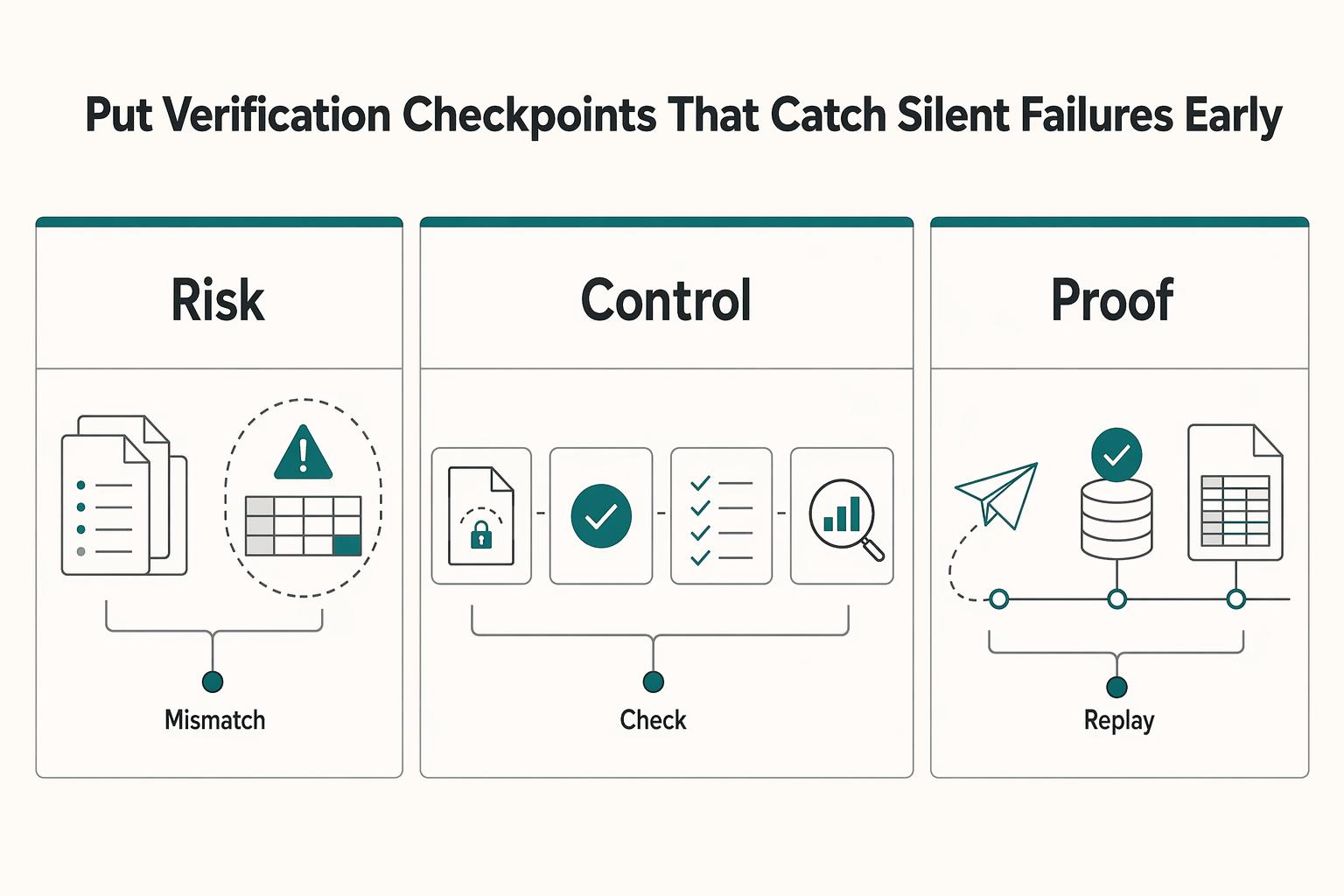
Put in verification checkpoints that catch silent failures early#
Sequence alone will not catch quiet failures. Add checkpoints before send, after send, and at reconciliation so bad states do not spill into customer comms, payouts, or ledger cleanup.
| Step | Checkpoint | Control action |
|---|---|---|
| 1 | Pre-send checks on draft invoices | Hold release if required fields, tax-treatment flags, totals, or duplicate detection fail |
| 2 | Post-send confirmation from webhook events | Track first send, each reminder, and paid/overdue transitions in your own system |
| 3 | Cycle-close reconciliation to the general ledger | Route mismatches in invoice total, paid total, or posted ledger amount to an exception queue |
| 4 | Payout auto-release during event lag | Hold auto-release until state is confirmed |
Step 1: Block send until pre-send checks pass. Use draft as a hard control point, since invoices start in draft and must move to open before payment can be accepted. Before finalization or send, confirm required fields are present, tax-treatment flags are valid for your lane, totals match the computed source record, and duplicate detection passes.
For each draft, store one evidence pack with source event ID, invoice ID, computed total, tax-treatment flag, and create idempotency key. If any field is missing, hold release. Duplicate-number checks and pre-submit total-consistency checks are proven controls in invoice systems and are worth mirroring.
Step 2: Confirm post-send activity from events, not UI status. A send action is not proof that delivery, reminders, or payment progression happened. Invoice workflows are asynchronous, so post-send control should rely on webhook events and verify that send succeeded, reminder logic is active where required, and expected status changes arrive within your internal windows.
Track and store timestamps for first send, each reminder, and paid/overdue transitions in your own system. Use that record to resolve timing disputes and missed reminder sequences.
Step 3: Reconcile receivables to the ledger with explicit exceptions. Invoice completion is an accounting outcome, not just a status change. Reconciliation should match detailed invoice and unpaid billing amounts to accounts receivable in the general ledger, then confirm paid amounts post correctly when cash settles.
On each closed cycle, compare invoice total, paid total, and posted ledger amount. If any value differs, route the record to an exception queue with a clear owner and reason code; if payment is partial, keep the open balance visible.
Step 4: Pause payout auto-release when event lag creates state uncertainty. If payout release depends on webhook-confirmed invoice state and those events are delayed or missing, hold auto-release until state is confirmed. This is a risk-control gate: incomplete status evidence increases the chance of downstream cleanup across invoices, settlements, and ledger postings.
Related reading: ARR vs MRR for Your Platform's Fundraising Story.
Compare platform options with operations criteria, not feature lists#
Choose based on control behavior under failure, not demo polish. Score retry safety, lifecycle visibility, and exception traceability first, then score AP workflow depth separately.
Score documented control depth first#
Start with three controls: duplicate-safe retries, invoice lifecycle visibility, and traceable status and exception history. If a vendor cannot prove these with records, feature breadth will not protect operations.
| Option | Strongest documented control | What you should verify live |
|---|---|---|
| Stripe API + Stripe Invoicing | Idempotency keys for create/update requests; lifecycle-stage communications; webhook retries for up to 3 days; documented charge gating while waiting for successful webhook responses | Re-run the same create request with the same idempotency key and confirm no duplicate side effect. Then verify your system captured the event timeline. |
| Tipalti | Built-in approval routing, audit trails, reporting, document storage, tax/payment validation, and duplicate/anomaly control messaging | Walk one invoice from intake to exception to approval, then export its audit evidence by invoice ID. |
| SAP Concur | Near-real-time visibility and status-history rows when approval or payment status changes | Confirm status history can be exported with invoice ID, status change, and actor. |
| AvidXchange | Approval routing plus 24/7 visibility into invoices, approvals, and payments | Verify a held invoice shows owner, reason, and payment status without manual side channels. |
| Rillion | Rule-driven approval routing to the right owner | Test whether policy ownership still holds when an invoice changes lane (for example PO vs non-PO). |
| Stampli | Dynamic approval workflows and immutable action/change/approval records | Verify the record remains intact through reassignment, rejection, and reapproval. |
| Medius | End-to-end AP flow across capture, approval, processing, and payment | Verify reconciliation evidence stays linked as invoices move from approval into payment. |
If duplicate prevention is your top risk, start with the stack that explicitly documents idempotency and retry behavior. If ownership, policy routing, and audit evidence are the main pain, prioritize deeper AP workflow validation.
Test contractor-scale behavior, not demo behavior#
Run scenario tests on a realistic contractor batch, not one clean invoice. Focus on partial-failure conditions: some invoices created, some held, some retried, late approvals, and duplicate or policy exceptions in the same run.
Use three tests:
- Force create retries. With Stripe, reuse the same idempotency key and confirm the same result is returned instead of creating a second invoice. For other vendors, require explicit proof of dedupe behavior for retries or repeated imports.
- Simulate event or handoff delay. Validate not only provider retries, but also that your side records missed events, retry attempts, and hold states clearly enough for finance to explain delayed cash or payout movement.
- Validate reconciliation traceability after partial failure. Your evidence pack should tie together source event ID, provider invoice ID, status or approval history, duplicate-flag reason, if any, payment status timestamps, and ledger posting reference.
Treat rankings as a longlist, then make vendors prove it#
Roundups like V7 Labs are useful for building a shortlist and framing criteria. They are not selection proof.
Final selection should come from your scenario-test results and evidence-pack quality. If a tool cannot demonstrate duplicate-safe retry handling, status-change history, and clear exception ownership on your sample data, it is not ready for scale.
For a step-by-step walkthrough, see How to Automate Invoicing with Stripe for a Webflow Site: A 3-Stage Maturity Model.
Handle common breakpoints and decide recovery paths fast#
When a batch breaks, stop uncertain money movement first, assign a named owner, and recover with evidence-backed controls.
| Breakpoint | Immediate control | Recovery path |
|---|---|---|
| Duplicate risk after retries | Block resend until the retry chain is provable | Route to exception handling and run your duplicate search before any settlement release |
| Missing or invalid PO data | Treat it as an AP exception | Require correction and rerun validation; where required, confirm PO, supplier invoice, and delivery receipt align before payment |
| Overdue concentration spikes | Tune dunning cadence by segment, not globally | Separate the affected cohort and adjust timing and escalation there first |
| Tax or compliance mismatch (including VAT treatment) | Hold settlement until corrected | Use traceable reason codes and release only after evidence and treatment are updated on the same invoice record |
- Duplicate risk after retries: block resend until the retry chain is provable.
If a create or update retry cannot be tied to one idempotency key and one invoice outcome, do not resend or release payout yet. Idempotency is meant to make retries safe without performing the same operation twice, so missing proof is an exception-state signal. Route it to exception handling and run your duplicate search before any settlement release.
- Missing or invalid PO data: treat it as an AP exception, then revalidate.
For PO-governed lanes, incomplete or invalid PO data is a payment-control break, not a fix-later field issue. Send the invoice to an AP exception queue with a named assignee, require correction, and rerun validation. Where your lane requires 3-way matching, confirm PO, supplier invoice, and delivery receipt align before payment.
- Overdue concentration spikes: tune dunning cadence by segment, not globally.
Do not apply one reminder sequence to every contractor cohort when overdue volume clusters in one segment. Separate the affected cohort and adjust timing and escalation there first. Recovery timing can be adaptive rather than purely fixed, so monitor overdue and outcomes by segment before increasing reminder pressure.
- Tax or compliance mismatch (including VAT treatment): hold settlement until corrected.
On VAT-sensitive lanes, missing acceptable VAT evidence should keep the invoice on hold until corrected and assigned to the right tax or AP owner. Use traceable reason codes so the hold, owner, and correction path are visible. Release only after evidence and treatment are updated on the same invoice record.
Build a copy-paste operating checklist for weekly use#
Use this weekly checklist to confirm your invoicing process is controlled end to end, not just producing invoices.
Step 1: Reconfirm policy gates before trusting output. For UK VAT self-billing lanes, confirm both customer and supplier are VAT registered, a supplier agreement is in place, and agreements are reviewed regularly. If a self-billing agreement has lapsed, or AP approval rules changed without corresponding invoice-logic updates, take that lane out of straight-through processing until fixed.
Step 2: Check automation health against defined ranges. Review creation success, send success, reminder execution, reconciliation closure, and lifecycle movement. In Stripe Invoicing, the five statuses are draft, open, paid, uncollectible, and void; investigate unexplained pile-ups in draft or open, and any segment with overdue volume but no reminder activity.
Step 3: Treat exception ownership and aging as a control. Compliance and PO blockers should be assigned to a named user or assignment group, and you should be able to view assigned and unassigned items by assignment date. Unassigned VAT or PO exceptions, or aging items with no assignee change, are operating breaks.
Step 4: Spot-check audit-pack traceability before it is requested. For a sample of recent invoices, confirm you can retrieve the API request identifier from the Request-Id response header, match it to provider request logs, trace the linked ledger entry, and show approval history for held, corrected, or overridden items. If any link is missing, output may continue, but defensible audit traceability does not.
Conclusion#
The practical test is simple: can your team explain any invoice from its trigger to the ledger outcome without hand-waving? If the answer is no, do not add more automation yet. The stronger setup is usually the one with tighter decision rules, stricter sequencing, and cleaner evidence, not just the one with the longest feature list.
Tighten the order of operations#
Keep invoice creation, validation, finalization, sending, payment, and reconciliation in a fixed sequence. That matters because draft invoices are editable, but in Stripe Invoicing finalizing an invoice sets status=open, and the system automatically finalizes drafts before sending and attempting payment. Your first verification point is whether every draft is complete enough to finalize cleanly. If drafts need manual repair after creation, you are already carrying silent failure debt.
Retry safety also has to be non-negotiable. Use an idempotency key for create and send actions so the server can recognize a replay of the same request, and log webhook event IDs because webhook endpoints can receive the same event more than once. If you cannot prove a retry was idempotent, treat resend as a duplicate-risk event and hold downstream actions until you confirm state.
Build around visibility, not just generation#
High-volume invoicing only works when status visibility keeps pace with volume. Stripe's scale test is a useful benchmark: whether you process 1 invoice or 1,000 invoices, quality should remain the same. That means your monitoring has to show where an invoice sits now, what changed, and what should happen next.
A concrete checkpoint is invoice state timing. Stripe notes a 1 hour wait after successful webhook responses to invoice.created before attempting payment, and a 72 hour fallback if those responses do not arrive. If your event consumer is lagging or failing, do not assume the downstream state is trustworthy. Pause downstream release steps, confirm the invoice state and payment state, then resume.
Scale only after the evidence pack is boring#
As one lane becomes consistently clean, expand deliberately. "Clean" here means duplicates are rare and explainable, reconciliation closes without heroics, and exceptions have an owner and a reason code. If policy or compliance status is still being corrected after send, you are scaling instability.
Your minimum evidence pack should stay attached to every invoice cycle: the invoice record, payment confirmation tied to that invoice, ledger posting reference, and approval or exception history. When your team can pull that chain quickly for any invoice, automation becomes a control advantage instead of an operational risk.
Frequently Asked Questions
What does platform invoicing at scale auto-generate mean in practice?
It means invoice quality stays consistent as volume rises, not just that invoices get created faster. Stripe’s framing is a useful test: whether you process one invoice or 1,000 invoices, the output should be just as accurate. In practice, generation, validation, send, status tracking, reconciliation, and audit evidence all need to hold together under load.
When should we use self-billing invoices instead of contractor-submitted invoices?
Use self-billing when supplier invoice quality is inconsistent and you can meet the policy conditions for that lane. The key gate is jurisdiction-specific. Under HMRC self-billing guidance, you may only issue self-billed invoices if the supplier has agreed to that method, and self-billing is a commercial arrangement between supplier and customer. If you cannot show a current supplier agreement, do not automate that lane as self-billing.
Which checks must run before an invoice is sent automatically?
Run completeness, duplicate-detection, and policy checks before send. If you use Stripe, draft invoices are finalized before automated send or payment attempts, so the question is whether the draft is valid enough to finalize cleanly. For PO-based lanes, this is also where invoice, PO, and receipt records should pass 3-way matching if your policy requires it.
How do we prevent duplicates when jobs retry or webhooks arrive late?
Use an idempotency key on invoice-creation and send requests so retries are recognized as the same request instead of creating a second invoice. In that API, the key can be up to 255 characters, and keys can be removed after they are at least 24 hours old, so keep your retention window aligned with your retry behavior. On the event side, log processed webhook event IDs. Webhook endpoints can receive the same event more than once.
What is the minimum reconciliation evidence finance needs each cycle?
Finance needs a chronological trail from invoice creation through payment, with enough linkage to explain how an invoice reached paid state. At minimum, keep the invoice record, payment confirmation tied to that invoice, and the approval or exception history. For PO lanes, include the PO and receipt evidence used in matching. If automatic reconciliation is in use, verify the payment was actually matched to the invoice rather than assuming a paid status explains itself.
How should we evaluate Stripe, Tipalti, SAP Concur, and AP-focused tools for our use case?
Judge them on control depth, not on a feature checklist or ranking table. Stripe and Stripe Invoicing are a fit where idempotent retries, invoice finalization, and automatic reconciliation matter. SAP Concur should be tested for purchase-request-to-payment coverage. AP-focused tools should be checked for 3-way matching and immutable action history. Tipalti belongs in the same scenario test, but the decision should come from your evidence pack: duplicate resistance and whether you can trace every invoice from creation to final payment.
Try a related tool
Researched and edited by the Gruv editorial team. Gruv builds cross-border billing, payouts, and finance-operations software for global businesses.
Sources
Includes 3 external sources outside the trusted-domain allowlist.
- docs.stripe.com/api/idempotent_requeststrusted
- docs.stripe.com/invoicing/integration/workflow-transitionstrusted
- legislation.gov.uk/eudr/2006/112/article/224trusted
- stripe.com/resources/more/how-to-invoice-at-scale-a-qui...trusted
- stripe.com/resources/more/dunning-management-101-why-it...trusted
- chargebee.com/recurring-billing-invoicing/einvoicing-compl...external
- docs.oracle.com/cd/A60725_05/html/comnls/us/ap/point04.htmexternal
- gov.uk/invoicing-and-taking-payment-from-customers/...external
Educational content only. Not legal, tax, or financial advice.
Related Posts
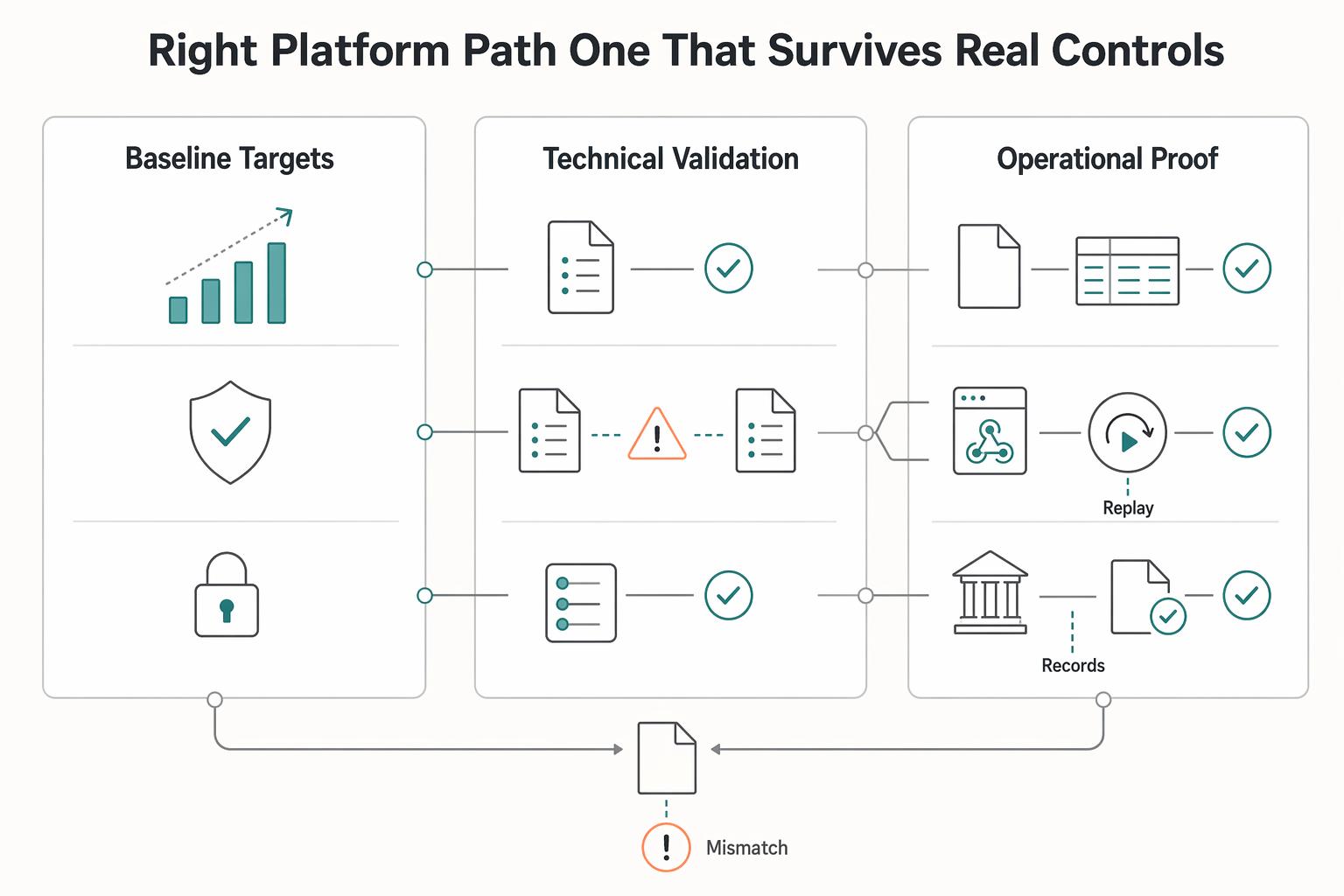
How Platform Teams Scale AP Volume Without Adding Headcount
Use this as a decision list for operators scaling Accounts Payable, not a generic AP automation explainer. In these case-study examples, invoice volume can grow faster than AP headcount when the platform fit is right, but vendor claims still need hard validation.
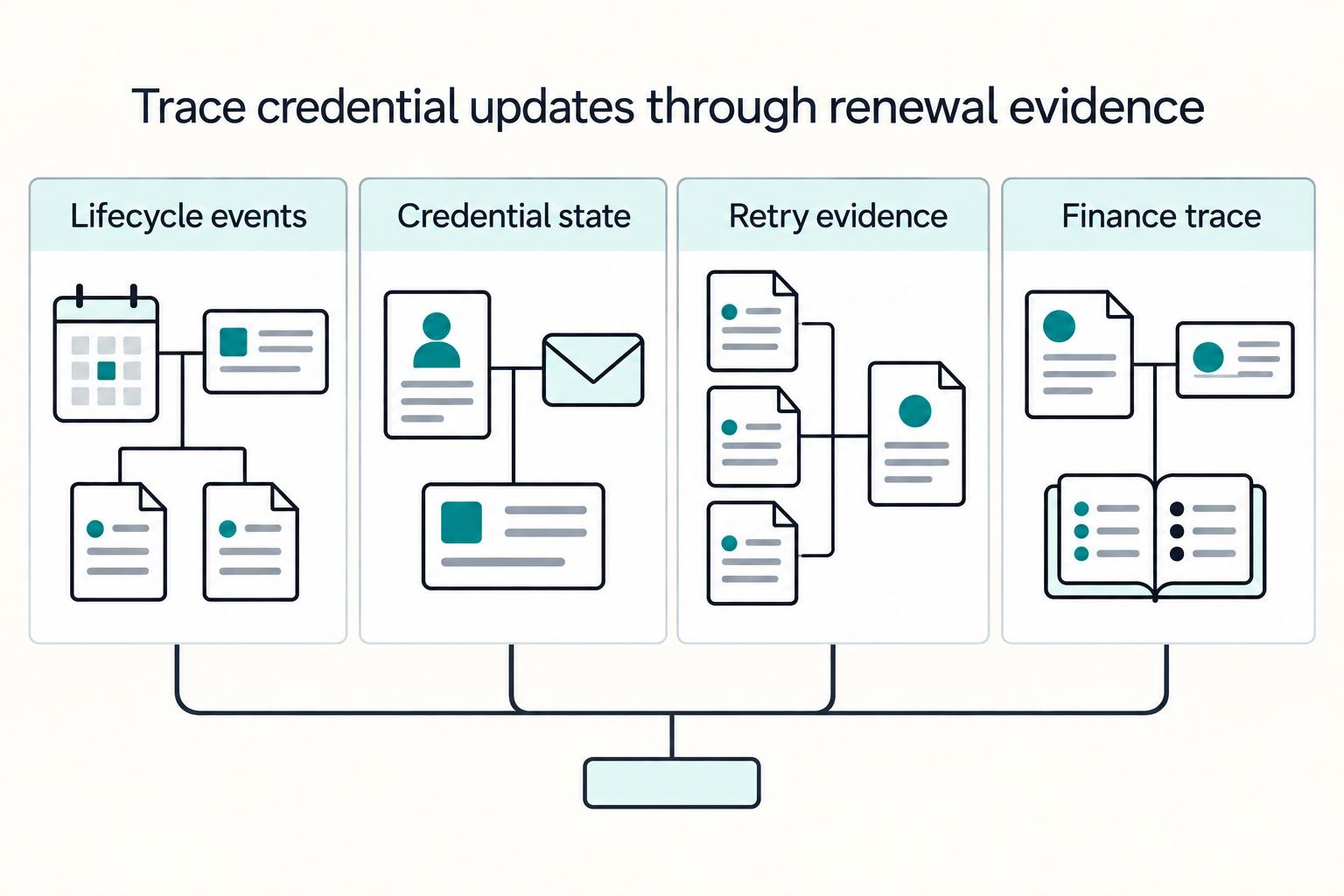
Expired Card Management for Platform Teams Scaling Card-on-File Payments
If you run card-on-file payments across products or merchant entities, this guide is about operating decisions, not billing basics. The real question is not whether you have an updater. It is which credential failures you actually cover, what still falls through, and how you will prove outcomes in logs and reconciliation.
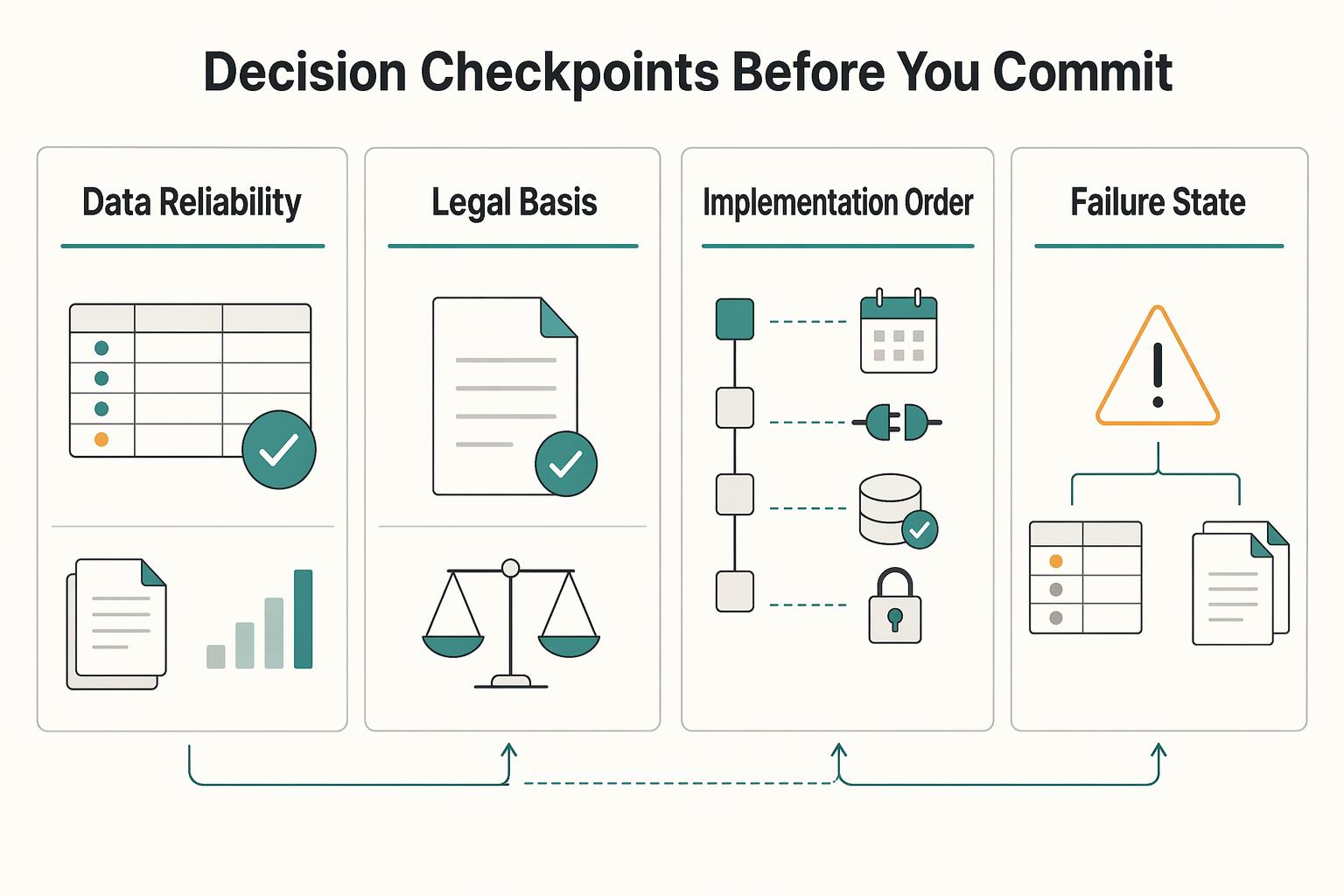
Self-Billing Invoices for Platforms That Pay Contractors
If you are choosing a self-billing path for a platform, the real decision is not which invoicing app looks polished. It is whether your product can turn approved work into a supplier invoice, keep finance comfortable with the paper trail, and give ops and engineering a clean path to payout and reconciliation.