
Quick Answer
Start with same-medium cancellation: if signup is in-app or online, cancellation should finish there without phone, chat, or email handoffs. Use ROSCA’s simple-stop standard and the FTC equal-ease framing to design neutral copy, a visible Cancel Subscription button, and a skippable retention branch. Before launch, run parity checks on channel, step count, and completion time, then verify in billing logs that cancellation prevents the next renewal charge.
Click-to-cancel is now a monetization decision, not just a UX cleanup#
If you run recurring billing, your cancellation path is no longer a design side project. It is a revenue decision with legal exposure attached, so product, finance, and legal need to treat it as part of how the business operates.
- Who should care
This guide is for the people who own the tradeoff: founders, revenue leaders, product teams, and finance operators at subscription platforms. If your team controls checkout, renewal logic, account settings, or retention offers, you already own the cancellation experience, whether that work sits in product, billing, or support.
At bottom, this is an operational accountability issue. A weak cancel path does not just frustrate users. It can create enforcement risk and leave your team defending saves that came from friction rather than real customer intent.
- Why this moved out of the UX bucket
The Federal Trade Commission announced its final Click-to-Cancel Rule on October 16, 2024, saying sellers should "make it as easy for consumers to cancel their enrollment as it was to sign up." The agency also said most provisions would take effect 180 days after publication in the Federal Register, after receiving more than 16,000 public comments and while reporting nearly 70 consumer complaints per day on average in 2024, up from 42 per day in 2021.
But you do need the current status right. Legal reporting states the Eighth Circuit vacated the rule on July 8, 2025, shortly before the most demanding requirements were set to take full effect. But that does not make hard-to-exit design a smart bet. ROSCA still requires "simple mechanisms for a consumer to stop recurring charges," and FTC enforcement has already targeted cancellation flows described as "manipulative, coercive, or deceptive" dark patterns.
The practical question is not just whether a specific rule survived. It is whether your flow looks built to let people leave, or built to stop them.
- What this article will help you do
Your goal is not to maximize cancels, and it is not to preserve margin through obstruction. The target is a defensible flow where cancellation is plainly available, optional save tactics are transparent, and any recovered revenue comes from a real choice rather than confusion.
One checkpoint matters more than many teams admit: compare enrollment and cancellation by channel, step count, and completion time. If a user can start online or in-app, routing them to phone, chat, or email to finish is a red flag. Another common failure mode is the "one quick offer" that quietly turns into stacked modals, vague copy, or a hidden exit.
Treat evidence like part of the product. Keep screenshots of the live flow, approved copy versions, experiment notes, and sign-off records tied to consumer protection reasoning. If your cancellation design is ever questioned, that record is far more useful than opinion.
For a deeper dive, read FTC Click-to-Cancel Rule: What Subscription Platforms Must Build Before the Deadline.
Who this list is for and how to pick the right cancellation design#
Use this list if you already run online checkout and self-serve account management; if cancellation still depends on phone or agent contact, fix that channel mismatch before comparing design variants.
- Qualified teams
This section is for teams that can ship account settings, billing pages, or in-app subscription controls without forcing every cancel through support. In the 2024 §425.6 text, cancellation had to be available through the signup medium and easy to find, so if users enroll in app, your baseline is an in-app path with a visible Cancel Subscription button, not a forced jump to phone, chat, or email.
- How to evaluate options
Score each cancellation flow on five factors: fit with ROSCA's "simple mechanisms" standard, expected retention quality, support load, engineering effort, and legal review complexity under consumer protection expectations. Compare signup vs. cancel by channel, step count, and completion time; a flow is not truly self-serve if the last step still creates a ticket or requires human follow-up.
- Apply the legal baseline correctly
Treat the timeline as context, not a shortcut. The 2024 final rule expanded Part 425 and listed January 14, 2025 as an effective date, with May 14, 2025 compliance dates for §§425.4-425.6; then the FTC recodified Part 425 to pre-2024 text effective February 12, 2026, and the current eCFR shows Part 425 as prenotification-focused (up to date as of 3/26/2026). Choose one primary cancellation flow that keeps cancellation plainly available, then run legal review on live screens and copy before adding optional save steps.
Related: Subscription Pause vs. Cancel: How to Give Users a Middle Option That Protects Your Revenue.
The 5 cancellation UX designs that are worth using#
After you establish a same-medium cancellation baseline, these are the five designs worth considering. The practical test is whether the flow still provides a simple mechanism to stop recurring charges while matching real customer exit behavior.
- Immediate self serve cancel
Use this when you want the clearest same-medium path from account or billing settings to confirmed cancellation. It aligns with the FTC's October 16, 2024 framing that cancellation should be as easy as sign-up, and it usually keeps routine exits out of support queues. The tradeoff is higher visible cancel volume when friction is removed. If the final step sends users to phone, email, chat, or a review queue, it is not truly self serve.
- Cancel with optional pause
Use this when customer usage is cyclical and a temporary stop is a legitimate alternative to ending the subscription. Pause is a distinct lifecycle option, and customers can resume later without starting from zero. Keep the Cancel Subscription button visible and present pause as a parallel choice, not a gate. If pause rules are hard to explain quickly, keep pause out of the critical cancellation path.
- Cancel with optional retention offer
Use this carefully for price-sensitive subscriptions where some users may stay with a different plan or price. This is also the design most likely to drift into dark-pattern behavior if it makes cancellation harder. If you add a save step, make decline obvious and let cancellation continue immediately. The offer should be optional in both wording and interaction, not a forced detour.
- Scheduled end of term cancel
Use this when ending at renewal is operationally cleaner than immediate termination, such as annual auto-renew contracts. "Cancel at the end of the billing period" is a real implementation pattern in major billing tooling. After confirmation, show the exact end date, renewal status, and what access continues until then. Ambiguous status is what creates disputes later.
- Agent assisted only for high risk exceptions
Use this only for exceptions like fraud, identity issues, billing anomalies, or disputed charges. It should not be the default route for routine cancellation. When ordinary online cancellations are pushed into support channels, you reintroduce friction and weaken your parity position. If no investigation is needed, let cancellation complete first and handle follow-up separately.
If you are unsure, start with immediate self serve or cancel with optional pause, then add a retention step only if it remains clearly skippable and non-blocking. This pairs well with The Best Tools for Managing Subscription Billing.
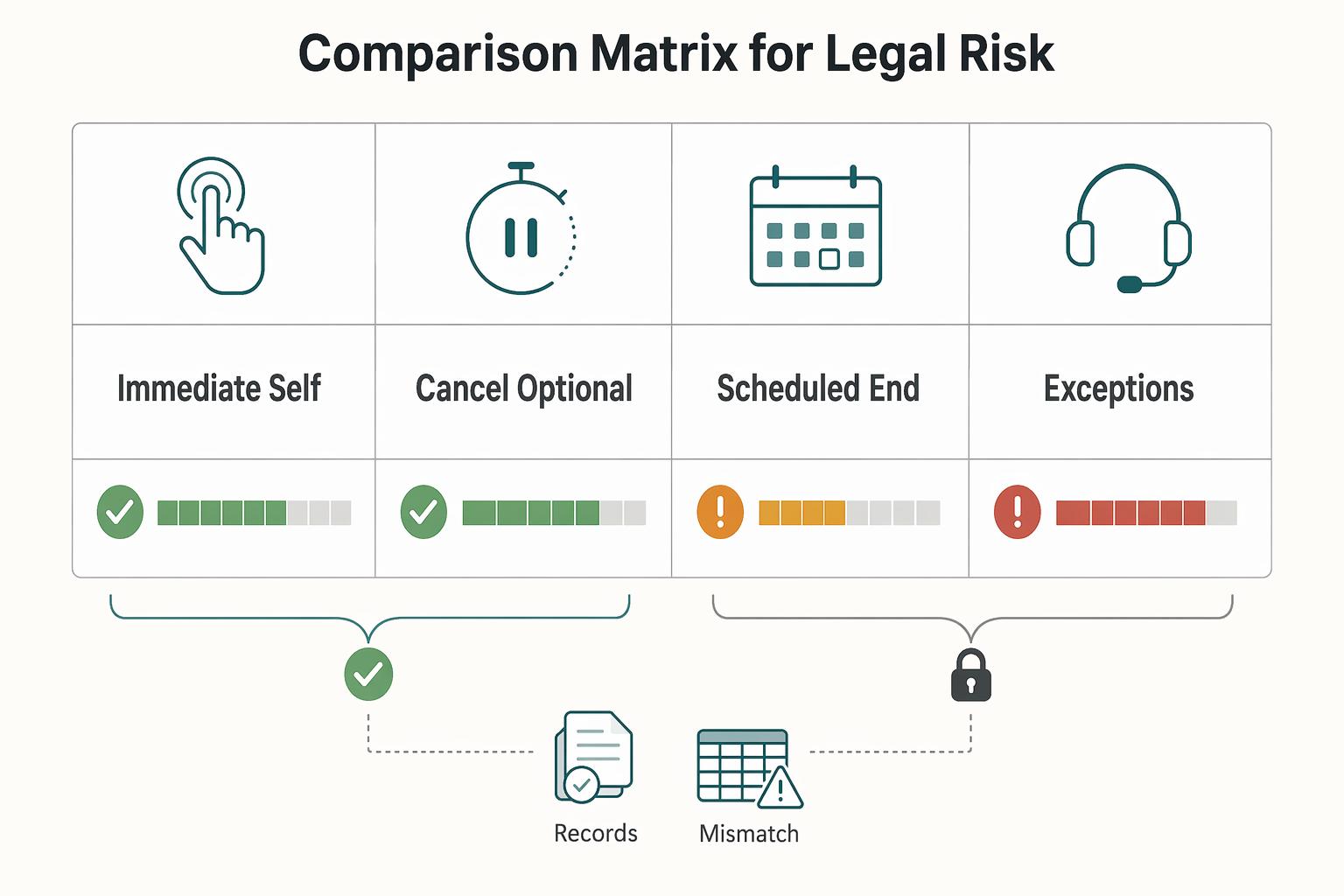
Comparison matrix for legal risk, retention quality, and operating load#
If you need a default, start with immediate self-serve cancel or cancel with an optional pause. They are usually easier to defend and run. As you move toward retention gating or agent dependence, you need tighter evidence, copy control, and cross-functional sign-off before release.
One legal framing point before the table: the FTC's February 12, 2026 conforming action said court decisions vacated the 2024 Negative Option amendments and recodified prior text. So use ROSCA's baseline in 15 U.S.C. §8403 ("simple mechanisms" to stop recurring charges) and test against the FTC's equal-ease benchmark ("as easy for consumers to cancel their enrollment as it was to sign up").
| Model | Best for | FTC risk level | Expected net revenue impact | Support ticket impact | Build effort | Audit evidence needed under Bureau of Consumer Protection scrutiny | Dark-pattern drift + guardrail | Approved by product + legal + finance | Verification |
|---|---|---|---|---|---|---|---|---|---|
| Immediate self serve cancel | Low ACV, month-to-month recurring billing | Usually most defensible when same channel and no holding state | Lower gross retention, often cleaner trust-adjusted revenue | Usually decreases routine tickets | Low to moderate | Live screenshots, full-path screen recording, approved copy, completion event logs | Lower drift risk; keep a visible Cancel Subscription action and no forced chat, phone, or email | Yes, before release | Compare checkout and cancel on the same device/channel; cancellation should complete in one session without human review |
| Cancel with optional pause | Cyclical usage, seasonal memberships | Defensible when pause is parallel and clearly optional | Can reduce regret churn without hiding exit | Flat to lower when pause terms are clear | Moderate | Pause eligibility rules, approved copy, side-by-side cancel/pause screenshots, branch analytics | Drift risk if pause blocks cancel; guardrail is visible cancel first, pause as alternative, not gate | Yes, before release | Confirm users can decline pause immediately and finish cancel without extra required steps beyond checkout |
| Cancel with optional retention offer | Price-sensitive subscriptions | Elevated drift risk if offer interrupts or obscures exit | Can recover some saves; quality drops if users feel trapped | Can increase complaints if copy feels manipulative | Moderate | Archived offer copy, screenshot history, experiment logs, decline-path proof, sign-off notes | Highest drift risk among self-serve models; use one skippable offer screen with an obvious decline that continues cancel immediately | Yes, mandatory | Time this branch against checkout; if cancel becomes materially slower or adds extra non-enrollment friction, review before launch |
| Scheduled end-of-term cancel | Annual auto-renewing service contracts | Moderate when timing and status are explicit | Preserves current-term revenue while stopping renewal | Mixed; ambiguity creates avoidable tickets | Moderate | Confirmation screen, account status screenshot, exact end-date display, renewal-off logs | Drift risk is ambiguity; guardrail is plain language on end date, access period, and no-renewal status | Yes, before release | Verify users see the exact end date after confirmation and can find the same status later in account settings |
| Agent assisted only for high-risk exceptions | Fraud, identity issues, disputed charges, billing anomalies | Highest exposure if used for routine cancellation | May preserve some short-term accounts, but can increase refunds, disputes, and enforcement risk | Usually increases tickets and handle time | Low product build, high operating load | Written exception policy, routing logic, training docs, recordings/transcripts, proof routine accounts are not routed to support | Severe drift risk if exceptions become default; guardrail is narrow eligibility plus self-serve completion for ordinary cancels | Yes, with written exception policy | Sample ordinary accounts to confirm they are not pushed to support; only flagged risk cases should leave self-serve |
This evidence is not optional. In September 2025, the FTC said Chegg "made it extremely difficult for consumers to cancel recurring subscriptions," with a $7.5 million settlement, and said nearly 200,000 consumers had been charged after requesting cancellation since October 2020. In the same month, the FTC's Amazon matter cited a "complex and difficult process" to cancel Prime and included a $1 billion civil penalty plus $1.5 billion in refunds.
For release, verify equal ease in practice, not just intent. Record full checkout and cancellation flows on the same platform, count steps, check for channel switches, and time completion from first intent to confirmed outcome. If signup is fast online but cancel ends in a ticket queue or "request received" state, parity is weak.
Ship only when the evidence pack is complete: approved copy versions, dated screenshots, branch logic, and at least one completed test run for each real user path.
For a step-by-step walkthrough, see Retainer Subscription Billing for Talent Platforms That Protects ARR Margin.
Non-negotiables every flow must meet before you optimize retention#
Before you test pause, discounts, or win-back copy, lock these four constraints first. If any one fails, you are adding friction to cancellation, not optimizing retention.
| Constraint | Requirement | Why it matters |
|---|---|---|
| Baseline constraint first | Treat cancellation parity as a product requirement at spec time; use the equal-ease standard from 16 CFR 425.6 and ROSCA's simple way to stop recurring charges | If it fails, you are adding friction to cancellation, not optimizing retention |
| Discoverability must match checkout | Make cancellation easy to find; a visible Cancel Subscription button in account settings is usually the clearest path | Avoid hiding the exit behind support paths |
| Keep cancellation language neutral | Use factual, plain actions, make outcomes clear, and state reversibility or end-of-term timing where relevant | If users feel steered or confused, legal and trust risk rise |
| Retention offers must stay optional | Show offers only after cancellation is clearly available, and let users decline immediately to continue | If decline adds forms, forces support, or ends in a vague request received state, the flow is no longer clean cancellation |
- Baseline constraint first
Treat cancellation parity as a product requirement at spec time. The FTC's 2024 amendments were announced on October 16, 2024 and later vacated by the Eighth Circuit on July 8, 2025, so do not treat that amended text as enforceable nationwide as written. Use the equal-ease standard in 16 CFR 425.6 as your operating baseline, and keep ROSCA's requirement for a simple way to stop recurring charges front and center.
- Discoverability must match checkout
If signup is easy to find in your checkout flow, cancellation should be easy to find when users want it. Federal law does not explicitly require account-settings placement, but a visible Cancel Subscription button there is usually the clearest way to meet an easy-to-find standard and avoid hiding the exit behind support paths.
- Keep cancellation language neutral
Avoid copy or interaction patterns that can trick or manipulate users. Use factual, plain actions, make outcomes clear, and state reversibility or end-of-term timing where relevant. If users feel steered or confused at the decision point, legal and trust risk both rise.
- Retention offers must stay optional
Show retention offers only after cancellation is clearly available, and let users decline immediately to continue. Treat the decline branch as a release-critical path: if it adds extra forms, forces support, or ends in a vague "request received" state, the flow is no longer clean cancellation.
We covered this in detail in Subscription Billing Platforms for Plans, Add-Ons, Coupons, and Dunning.
Where teams hurt revenue by overcorrecting or undercorrecting#
Teams usually miss by swinging to extremes: removing every save option, or making cancellation hard to complete. The practical middle is to keep cancellation easy to find and finish, then use optional retention steps that match why the person is leaving.
- Overcorrection in membership programs
Stripping out every pause, downgrade, or save option may reduce risk, but it can also drop recoverable subscribers when the issue is temporary. A cancellation flow can still be a retention touchpoint, as long as cancel is clearly available first. Key differentiator: keep save steps optional and skippable, and make sure declining goes straight to confirmation.
- Undercorrection by hiding the exit
Hiding cancellation in layered menus may protect short-term metrics, but it tracks directly with tactics the FTC has flagged, including difficult cancellation and buried terms. The FTC's April 21, 2025 action against Uber also centers on allegations of consent and cancellation friction despite "cancel anytime" messaging. Key differentiator: test whether a first-time user can find cancel quickly on web and mobile, not just whether the flow works after the button is found.
- Using the wrong save tactic for the wrong cancellation reason
When the reason is temporary budget pressure, a pause option can reduce churn while preserving trust. When the reason is trust loss, billing conflict, or a broken expectation, fast cancel is usually the safer path. Key differentiator: ask cancellation reason after users can access cancel, then branch: pause for short-term cost pressure, fast cancel for trust-related exits, with a clear effective end date.
- Letting renewal timing stay fuzzy in auto-renewing service contracts
Unclear renewal status and end-date timing creates avoidable disputes. California guidance says annual reminders for auto-renewal or continuous-service plans must include cancellation instructions. Key differentiator: show plan status, renewal date, and cancellation effective date clearly in-account and in confirmation messages.
Order of operations to ship a compliant and commercially sound flow#
Ship this in sequence: verify cancellation parity first, lock one allowed save pattern second, confirm current Part 425 posture third, and set KPI guardrails before launch.
| Step | What to do | Key point |
|---|---|---|
| Map checkout and cancellation as users actually experience them | Run side-by-side journeys for signup and cancel on each active channel; mark hidden navigation, extra authentication, support handoffs, forced surveys, and channel switching | Run a parity review, not just a final-button review |
| Choose one primary cancellation pattern and fence the save attempt | If you use a retention offer, show it only after cancel is clearly available, keep decline immediate, and document approved and prohibited copy before launch | One skippable save step can work; layered persuasion is where risk grows |
| Align legal and product on current Part 425 interpretation | Use current text and dates; the 2024 revised rule listed May 14, 2025 for §§425.4-425.6, and by February 12, 2026 the FTC said court decisions had vacated the revised rule and recodified Part 425 to pre-2024 text | Build to the posture in force, not headlines |
| Set KPI guardrails before launch, then review quality after live usage | Agree in advance on retention quality, support cost, and dispute trend so teams do not overreact to short-term cancel movement | Treat short-term saves that raise disputes or weak reactivations as a commercial loss |
- Map checkout and cancellation as users actually experience them
Start with side-by-side journeys for signup and cancel on each active channel. Use the FTC's equal-ease framing as your baseline: cancellation should be as easy as enrollment. Mark every extra step that adds friction, especially hidden navigation, extra authentication, support handoffs, forced surveys, or channel switching. Key differentiator: run a parity review, not just a final-button review.
- Choose one primary cancellation pattern and fence the save attempt
Keep the flow simple: if you use a retention offer, show it only after cancel is clearly available, and keep decline immediate. Document approved and prohibited copy before launch so experiments do not drift into pressured retention. Preserve evidence such as approved screenshots, final strings, and test notes. Key differentiator: one skippable save step can work; layered persuasion is where risk grows.
- Align legal and product on current Part 425 interpretation
Use current text and dates, not stale summaries. The 2024 final rule retitled 16 CFR Part 425 and listed May 14, 2025 as the compliance date for §§ 425.4-425.6, but by February 12, 2026 the FTC stated court decisions had vacated the revised rule and recodified Part 425 to pre-2024 text. Separate what is currently codified from broader FTC signals on informed consent, pre-billing disclosures, and cancellation friction. Key differentiator: build to the posture in force, not headlines.
- Set KPI guardrails before launch, then review quality after live usage
Agree in advance on retention quality, support cost, and dispute trend so teams do not overreact to short-term cancel movement. A cleaner exit may increase visible cancels while lowering downstream complaints and support load. FTC reporting also showed recurring-subscription complaints rising to nearly 70 per day in 2024 from 42 per day in 2021. Key differentiator: treat short-term saves that raise disputes or weak reactivations as a commercial loss.
Need the full breakdown? Read Choosing Between Subscription and Transaction Fees for Your Revenue Model.
QA checks and evidence you should keep for audit readiness#
Audit-ready cancellation QA means proving the live flow is simple to cancel, easy to find, and at least as easy as enrollment. Treat this as a release requirement, not a post-launch cleanup.
| Check | What to review | Key point |
|---|---|---|
| Parity and discoverability check | Test enrollment and cancellation side by side from the same starting conditions; confirm Cancel Subscription is easy to find and cancellation stays self-serve if signup was self-serve | Do not stop at click counts; discoverability and hidden detours are part of risk |
| Copy for pressure and ambiguity | Review retention offer copy, decline copy, confirmation text, and post-cancel status language | Blocking behavior usually comes from stacked friction, not one obvious line of copy |
| Dated evidence pack | Keep dated flow screenshots, approved copy versions, experiment notes, and sign-off notes with your consumer-protection rationale | Store evidence by version and date so you can reconstruct what users saw at a specific time |
| Cancellation outcomes and ownership | Test recurring subscriptions, annual renewals, and every retention-offer branch; validate that cancel status, renewal status, and billing outcomes stay in sync | The highest-risk defect is a cancellation request that does not actually stop charges |
- Run a parity and discoverability check
Test enrollment and cancellation side by side from the same starting conditions: logged out, logged in, mobile web, desktop, and native app (if used). Confirm the Cancel Subscription control is easy to find when a user seeks to cancel, and confirm cancellation stays self-serve if signup was self-serve. Key differentiator: do not stop at click counts. Discoverability and hidden detours are part of risk, and FTC allegations in the September 15, 2025 Chegg matter specifically called out buried, multi-click cancellation paths.
- Review copy for pressure and ambiguity
Review cancel-path strings end to end: retention offer copy, decline copy, confirmation text, and post-cancel status language. Remove pressure patterns and unclear wording that could make users think they canceled when they did not. If you include a save offer, keep the decline path immediate and the cancellation state explicit. Key differentiator: blocking behavior usually comes from stacked friction, not one obvious line of copy.
- Keep a dated evidence pack for what was actually live
Keep practical artifacts that show release intent and release reality: dated flow screenshots, approved copy versions, experiment notes, and sign-off notes with your consumer-protection rationale. Key differentiator: store evidence by version and date so you can reconstruct what users saw at a specific time.
- Scenario-test cancellation outcomes and assign ownership
Test recurring subscriptions, annual renewals, and every retention-offer branch to confirm no blocking behavior and no post-cancel billing error. Validate that cancel status, renewal status, and billing outcomes stay in sync after cancellation. Assign a clear owner for monitoring and a clear owner for incident response before launch. Key differentiator: the highest-risk defect is not awkward UX; it is a cancellation request that does not actually stop charges.
You might also find this useful: DMCCA Compliance for Subscription Platforms: What the Dark Patterns Law Means for Checkout and Cancel Flows.
Easy cancellation still wins when you design it with economic intent#
If you need one default, use a transparent self-serve cancellation flow and make save tactics optional. That remains the strongest commercial posture: it matches the FTC's repeated cancellation-ease standard and avoids the trust damage that comes when people feel stuck in plans they do not want or cannot cancel.
The rule text has changed, but the product judgment has not. The FTC announced the final click-to-cancel rule on October 16, 2024, recodified older Negative Option Rule text effective February 12, 2026, and reopened amendments through an ANPRM published March 13, 2026. That procedural shift is not a reason to keep a messy exit. The agency is still publicly focused on hard-to-cancel experiences and dark-pattern concerns.
- Choose one primary path
Start with one clear cancellation path that works end to end for routine cases. Keep the route easy to find, and make sure the action actually stops recurring charges.
- Let retention earn its place
Pause or discount prompts can be useful, but cancel should stay plain and easy to continue. Measure completed saves, downstream retention quality, support load, disputes, and whether users who intend to leave can still exit without confusion.
- Fix manipulation before you optimize
If your current flow relies on buried exits, vague labels, or pressure language, fix that first. The FTC has tied enforcement concerns to "manipulative, coercive, or deceptive" designs and has publicly highlighted complicated cancellation paths.
Use a practical decision rule. If churn is mostly temporary timing or budget pressure, test a skippable pause option. If the issue is trust, billing confusion, or service breakdown, prioritize a clean exit over forcing a save attempt.
Verify more than UI presence. Confirm cancellation is as easy as enrollment, then verify in billing logs that cancel state prevents the next renewal. A common failure mode is mismatch between what the UI says and how renewal settings or charge logic behave.
Keep an evidence pack for that exact reason: dated screenshots, approved copy, experiment notes, and production proof that cancellation requests stopped charges. Easy cancellation is not anti-revenue. It protects long-term value better than short-term MRR gained through confusion. For related reading, see Before You Click Agree to an EULA for Client Work.
Frequently Asked Questions
What does click-to-cancel require in practical UX terms for online subscription platforms?
The practical test is simple: cancellation should be as easy as sign-up, and the path should actually stop recurring charges. In FTC language from October 16, 2024, sellers should make it as easy to cancel as it was to enroll and provide a simple mechanism to immediately halt charges. For product teams, that usually means a visible self-serve cancel path, neutral copy, and a clear confirmation state.
Can we present a retention offer before showing the cancellation option?
The current sources do not support a blanket rule that every retention offer shown before cancel is always unlawful. The real risk is when the offer hides, delays, or confuses the exit. If you want a lower-risk approach, show the cancellation choice plainly and make any save offer easy to skip.
Do users have to call support to cancel if they signed up in-app?
Usually, no. FTC business guidance said you cannot require people to talk to a live or virtual representative to cancel if they did not have to do that to sign up. If enrollment was self-serve in app or online, routine cancellation should stay self-serve in that same general channel.
What design patterns are most likely to be treated as dark patterns?
Start with the obvious ones: flows that hide the exit, use misleading labels, or push users away from the choice they intended to make. The FTC’s dark patterns report specifically calls out flows that require users to navigate a maze of screens to cancel recurring subscriptions. A common failure mode is when “keep benefits” or “continue” is clearer than the cancellation option.
Is a pause option safer than a discount offer for reducing churn?
Not automatically. Either one can create risk if it blocks the exit or obscures billing consequences. If you offer pause, make the next billing date and account status explicit before the user confirms.
How much friction is legally acceptable in a cancellation flow?
No federal rule is documented here that sets a fixed maximum number of clicks. A better test is functional: if the path is hard to find, forces a channel switch, or is meaningfully harder than enrollment, risk increases under FTC/ROSCA principles. Also, the federal rule text changed in 2026, with Part 425 recodified to pre-2024 text and a new ANPRM process opened, so teams should confirm current obligations with counsel.
What evidence should we keep if regulators question our cancellation experience?
Keep a dated evidence pack even though the FTC has not published one universal retention checklist for every company. A practical internal set can include versioned screenshots, approved copy, experiment notes, sign-off records, and test results showing that cancel requests stop charges. The key verification detail is not just the screen flow, but billing proof that cancellation state, renewal state, and charge logic match after the user cancels.
Try a related tool
Researched and edited by the Gruv editorial team. Gruv builds cross-border billing, payouts, and finance-operations software for global businesses.
Sources
- ecf.ca8.uscourts.gov/opndir/25/07/243137P.pdftrusted
- ecfr.gov/current/title-16/chapter-I/subchapter-D/part...trusted
- federalregister.gov/documents/2026/02/12/2026-02866/revision-of-...trusted
- federalregister.gov/documents/2024/11/15/2024-25534/negative-opt...trusted
- ftc.gov/news-events/news/press-releases/2024/10/fede...trusted
- ftc.gov/news-events/news/press-releases/2025/09/ed-t...trusted
- govinfo.gov/content/pkg/FR-2026-02-12/pdf/2026-02866.pdftrusted
- oag.ca.gov/news/press-releases/attorney-general-bonta-i...trusted
Educational content only. Not legal, tax, or financial advice.
Related Posts
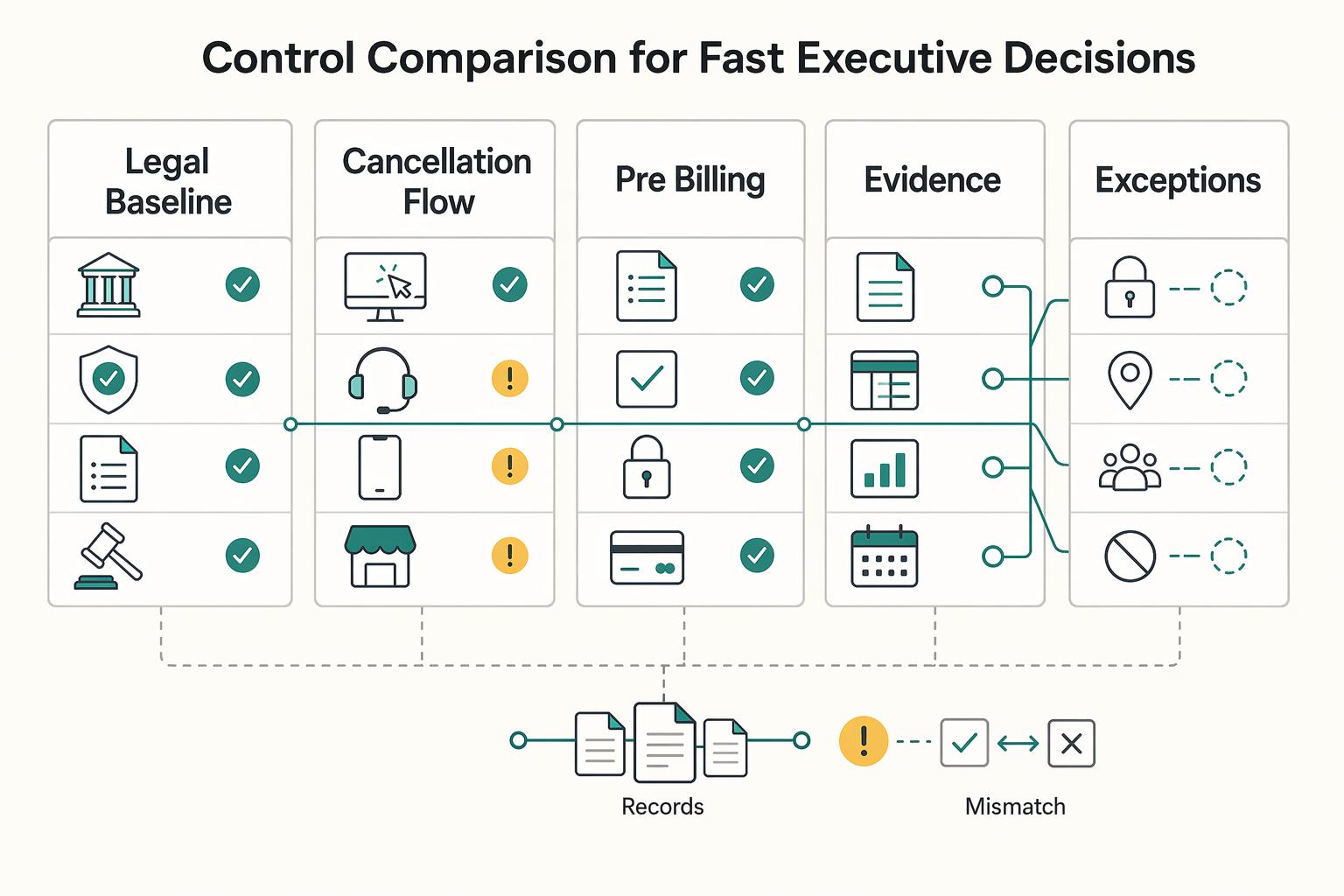
FTC Click-to-Cancel Rule Status: 6 Controls Subscription Platforms Should Prioritize
This article gives you a decision-ready baseline for what to build, test, and document now, based on what is clear in FTC and Federal Register records and what is still unsettled.
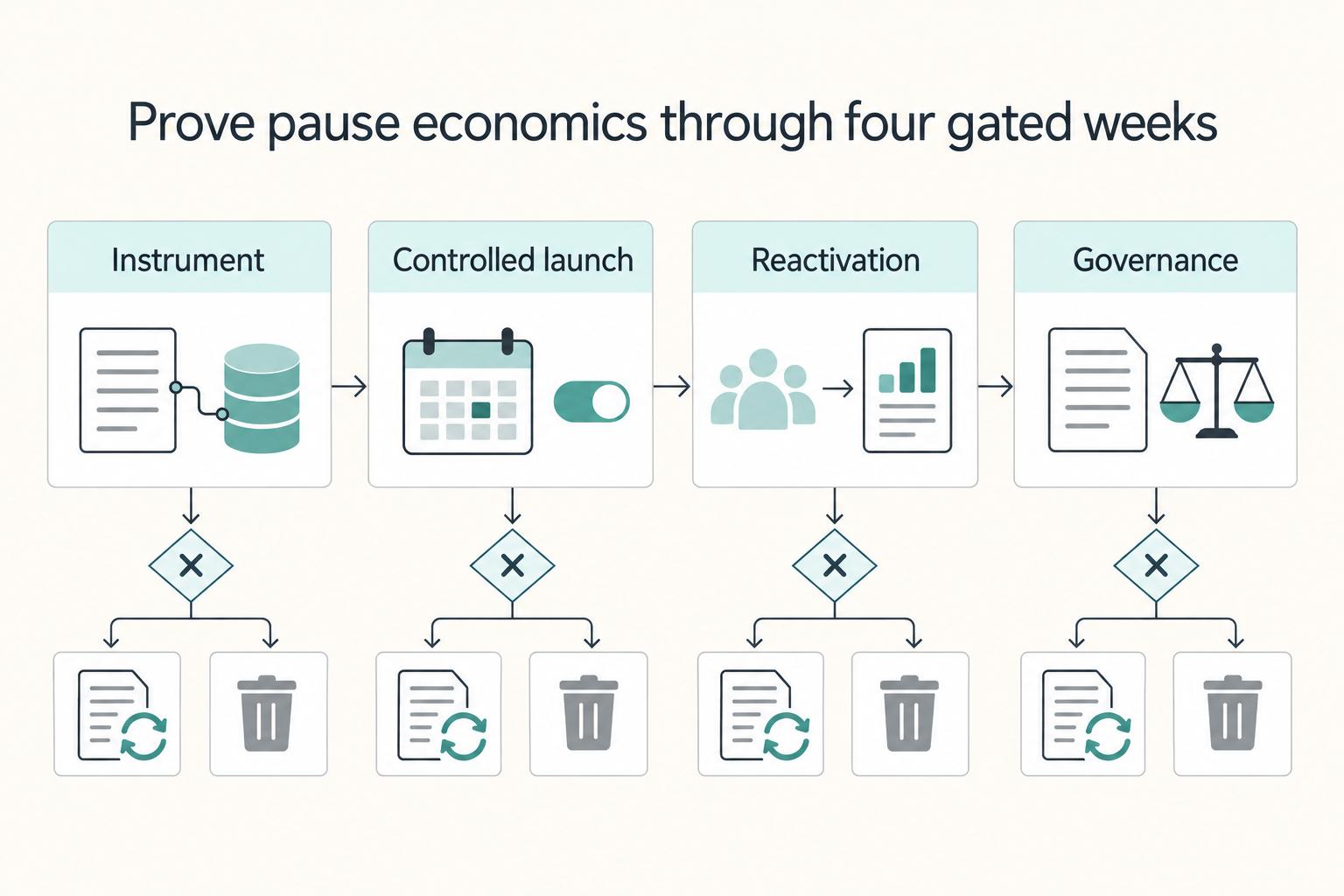
Subscription Pause vs Cancel and the Middle Option That Protects Revenue
Subscription pause is not a nicer cancel button. It is a revenue decision. When cancel is the only path, you lose the current subscription and, in many cases, the chance to re-engage that customer later. A paused state can reduce churn, support loyalty, and preserve longer-term revenue. It also affects how you track revenue and churn across future billing cycles.

DMCCA Compliance for Subscription Platforms: Checkout and Cancel Risk
What product teams call dark-pattern risk now sits inside the live unfair-commercial-practices regime of the Digital Markets, Competition and Consumers Act 2024, not inside one standalone UK design rule with a magic click limit. The practical question is whether a checkout or cancel flow omits material information, misleads, uses pressure, or otherwise falls short of the standards described in the [CMA's simple explainer for businesses](https://www.gov.uk/government/publications/what-businesses-need-to-know-about-unfair-commercial-practices/what-businesses-need-to-know-about-unfair-commercial-practices) and the fuller [CMA207 unfair commercial practices guidance](https://www.gov.uk/government/publications/unfair-commercial-practices-cma207/unfair-commercial-practices). For subscription platforms, that means the risk starts before payment is taken and continues after the customer is on book.