
Quick Answer
Subscription platforms should prioritize six controls now: scope triage, cancellation parity, disclosure and consent integrity, an evidence pack, exception handling, and governance for unsettled rule questions. The article treats current Part 425 as the codified baseline, uses the 2024 record as a strong signal of FTC priorities, and treats the 2026 ANPRM as monitoring input rather than final text.
What this article gives you before the deadline#
This article gives you a decision-ready baseline for what to build, test, and document now, based on what is clear in FTC and Federal Register records and what is still unsettled.
-
A ranked control list, not a generic recap. You get an order of operations for recurring subscriptions, memberships, and other negative option programs where a consumer's silence or inaction can be treated as consent to be charged. The ranking starts with clear FTC record points, including the October 16, 2024 announcement that cancellation must be as easy as sign-up, and then accounts for the February 12, 2026 recodification action.
-
A decision path for teams that have to ship and defend the result. Legal and compliance need scope and interpretation. Product and engineering need channel-level requirements. Finance and support need evidence, exception handling, and customer-facing fallback logic. The goal is to help cross-functional teams make consistent calls before release, budget, and counsel checkpoints.
-
A clear split between settled record and open rulemaking. The 2024 Federal Register entry had set a January 14, 2025 effective date and a May 14, 2025 compliance date for key sections. In February 2026, the FTC said it was recodifying the Negative Option Rule text to its pre-2024 form in light of federal court decisions vacating final rules. In March 2026, the FTC opened an ANPRM, requested comments by April 13, 2026, and sought input on whether amendments are needed.
-
A documentation and escalation model that stays audit-ready without overbuilding. You get a minimum evidence approach for consent, disclosures, cancellation flow behavior, and exceptions tied to product version history. If a requirement cannot be tied to FTC or Federal Register materials, treat it as an escalation item for counsel or compliance, not an automatic engineering build.
The FTC said it received more than 16,000 public comments before the 2024 final rule announcement and cited more than 100,000 negative-option-related complaints in the past five years when launching the March 2026 ANPRM. That context does not settle every requirement, but it does support an evidence-first build order.
How this list is prioritized and who should use it#
Use this ranking if you run recurring subscriptions or memberships across multiple billing channels and need a defensible build order. It puts exposure and evidence controls first, then optimization, because the legal backdrop shifted after the 2024 final rule, the Eighth Circuit vacatur, and the February 12, 2026 recodification. This is an operational framework, not an FTC-mandated control formula.
| Factor | What raises priority |
|---|---|
| Legal defensibility | Ties directly to authoritative records: current 16 CFR Part 425, the 2024 Federal Register final rule record, the later vacatur, and the March 13, 2026 ANPRM stage |
| Implementation effort | Can ship consistently across web, app, partner, and support-assisted billing paths without a full rewrite |
| Failure impact | Creates the most regulatory and customer risk if wrong, including cancellation friction, missing consent proof, or conflicting disclosures across channels |
| Audit evidence quality | Produces durable, inspectable records such as dated disclosure snapshots, consent logs, cancellation journey captures, and exception logs tied to version history |
- Legal defensibility
Controls rank highest when they tie directly to authoritative records: current 16 CFR Part 425 for prenotification negative option plans, the 2024 Federal Register final rule record, the later vacatur, and the March 13, 2026 ANPRM stage. Because the FTC is seeking comment on possible amendments, treat 2026 planning as legally unsettled, not final-text certain. If you cannot trace a control to source record plus internal scope interpretation, it should not be a top priority.
- Implementation effort
Controls move up when they can ship consistently across web, app, partner, and support-assisted billing paths without a full rewrite. Early wins usually come from channel inventory and scope triage that reduce inconsistent handling.
- Failure impact
Next, prioritize what creates the most regulatory and customer risk if wrong: cancellation friction you cannot support, missing consent proof, or conflicting disclosures across channels. If a defect can lead to disputed charges or an unexplainable customer journey, it comes before optimization work.
- Audit evidence quality
Controls rank higher when they produce durable, inspectable records: dated disclosure snapshots, consent logs, cancellation journey captures, and exception logs tied to version history. A practical test is whether you can reconstruct what one customer saw, accepted, and attempted to cancel.
This framework is for teams that need one shared order of operations across complex subscription platforms. It is not a substitute for jurisdiction-specific advice beyond FTC and Federal Register materials. Escalate state-law, non-U.S., or unsettled interpretation questions to counsel.
Best first control is legal baseline mapping and scope triage#
Before you change checkout or cancellation flows, map your legal baseline in three lanes. Separate what is currently codified, what appears in the vacated 2024 rule record, and what is only proposed in the 2026 ANPRM. This is the fastest way to avoid both overreach and false comfort.
As of the eCFR snapshot up to date as of 3/26/2026, 16 CFR Part 425 is USE OF PRENOTIFICATION NEGATIVE OPTION PLANS. The FTC's February 12, 2026 rulemaking states it recodified Part 425 to pre-2024 text after court decisions vacated the revised rule text. On March 13, 2026, the FTC published an ANPRM, which is a request for public comment, with comments due April 13, 2026.
Separate the record into three buckets#
| Record bucket | What it tells you | How to use it |
|---|---|---|
| Current codified baseline | 16 CFR Part 425 is the current legal text, in prenotification form | Use this as the starting point for what is codified today |
| 2024 final rule record | Published November 15, 2024 (89 FR 90476); describes broader negative option programs and emphasizes disclosures, consent, and simple cancellation | Use this as a strong signal of FTC priorities, not as current codified text |
| 2026 ANPRM | Published March 13, 2026 as an advance notice of proposed rulemaking | Treat this as uncertainty and monitoring input, not a finalized nationwide requirement |
This split gives leadership one defensible view of the market: the current baseline, the historical FTC position, and the open questions. The tradeoff is that it pulls counsel in early, because the record is not binary even when teams want yes-or-no answers.
Build the map at product-line level#
Do the triage product by product, not company-wide. For each offering, document the billing model, enrollment path, cancellation path, and whether inaction is treated as assent to recurring charges or not. For SaaS and streaming offerings, do not assume automatic coverage just because the business looks subscription-like.
Use these minimum fields:
- product line and channel
- recurring or one-time billing
- whether the offer fits your internal negative option definition
- source record used: current
16 CFR Part 425, 2024 Federal Register record, or 2026 ANPRM - control decision: apply now, monitor, or carve out
- counsel note, owner, and last review date
If one product line has recurring subscriptions and another only has one-time credits or one-off fees, you can apply Click-to-Cancel-style controls to the recurring path as a risk-control choice and document the carve-out for the non-recurring path. If auto-renew or a free-to-paid rollover is introduced later, reclassify before launch.
What to verify before moving on#
Your checkpoint is evidence, not opinion. Pick three live SKUs and confirm you can trace each one from product page to billing event to cancellation path, with a written legal basis for inclusion or exclusion. If that trace fails anywhere, scope triage is not done.
A common failure is treating FTC concern as the same thing as a currently codified requirement. That leads teams to remediate non-recurring products broadly while real negative option exposure stays untested. With the FTC reporting more than 100,000 complaints in the past five years about negative option practices, your first memo should be specific, plain, and defensible.
Best second control is cancellation flow parity across every channel#
Once scope triage is done, fix cancellation flow parity before you tune retention. The clearest FTC signal in the 2024 record was to "make it as easy for consumers to cancel their enrollment as it was to sign up." That remains a practical control standard for memberships and recurring subscriptions.
There is still a legal-status caveat. As of the cited eCFR snapshot, 16 CFR Part 425 is labeled PART 425 - USE OF PRENOTIFICATION NEGATIVE OPTION PLANS. On February 12, 2026, the FTC said it recodified Part 425 to pre-2024 text after court decisions vacated the amended rule. So treat channel parity as a high-confidence control aligned to FTC direction and the 2024 record, not as proof that every 2024 mechanism is currently operative text.
What parity should mean in practice#
Parity is an ease standard, not a rule about identical click counts across channels. For each enrollment path, provide a cancellation path that does not force the customer into a meaningfully harder channel, longer queue, or higher-effort route just to stop recurring charges.
If enrollment is self-serve in-app, requiring support contact to cancel can indicate a parity gap. If enrollment was assisted, assisted cancellation can still be defensible, but it should meet similar availability and authentication standards.
| Enrollment path | Parity question to test | Common failure pattern |
|---|---|---|
| Web self-serve | Can the user cancel from the authenticated account area without mandatory phone or chat contact? | "Cancel" is hidden, then diverted to a ticket form |
| In-app self-serve | Can the user cancel in-app or through a clearly linked account path without forced support contact? | Mobile sign-up is easy, but cancellation is email-only or desktop-only |
| Assisted support sale | Is there an equally available assisted cancellation route with similar identity checks and service window? | Sales is available immediately, cancellation is limited to weekday queues |
The 2024 materials treated cancellation simplicity as central, including simple cancellation mechanisms to halt recurring charges. Even after the February 12, 2026 conforming revision, parity is still one of the clearest controls to test and defend.
The decision rule that saves time#
If sign-up is self-serve in-app but cancellation requires support contact, fix that before you run new retention experiments. Fraud checks and account verification can be legitimate, but they should not become a default reason to route users into a harder channel than the one they used to enroll.
A failure pattern to watch for is channel transfer disguised as customer care: cancel starts in-product, moves to chat, then to email, while billing continues.
Run a parity test pack every week#
Run a parity test pack for each channel and send failures into weekly remediation. Keep it small enough to run consistently: one live recurring SKU per major channel, one fresh test account, and one end-to-end cancellation attempt from the same device class used to enroll.
Capture:
- enrollment path: channel, product, app or site version
- cancellation route shown to that same user
- whether support contact became mandatory
- whether recurring billing stopped after cancellation, with timestamped proof
Do not stop at UX screenshots. Verify that the cancel event and billing state match. Keep exception logs blunt and comparable: channel, product line, failed step, date found, owner, severity, and whether the issue blocks self-serve cancellation or only adds delay.
The upside is clear alignment with the FTC's cancellation-ease direction. The tradeoff is organizational, because some retention and support scripts will have to change.
For a deeper look at cancellation UX after the FTC rule changes, see Click-to-Cancel After the FTC Rule: Why Easy Cancellation UX Still Matters for Subscription Platforms.
Best third control is pre-billing disclosure and informed consent integrity#
After cancellation parity, lock down the point where billing authorization starts by standardizing pre-billing disclosure and consent capture. Inconsistent checkout disclosures or incomplete consent records create avoidable enforcement risk and weak evidence.
This matters most for teams that own checkout, billing-information capture, and consent UX across web, app, and assisted sales. The operating standard is simple: present material terms before billing information is obtained, then capture express informed consent to the negative-option feature before charging.
What the FTC record supports, and what it does not#
The FTC's 2024 final-rule materials said sellers should provide important information before obtaining billing information and obtain informed consent before charging. The November 15, 2024 Federal Register text also framed this as clear, conspicuous disclosure of material terms before billing information is obtained, plus express informed consent before the charge.
| Date | Record point | Status note |
|---|---|---|
| November 15, 2024 | Federal Register text | Framed this as clear, conspicuous disclosure of material terms before billing information is obtained, plus express informed consent before the charge |
| January 14, 2025 | Effective date | The amended rule was effective on this date |
| May 14, 2025 | Compliance date | Key sections had this compliance date |
| July 14, 2025 | Deferral | The rule was later deferred to this date |
| February 12, 2026 | Recodification | The FTC said it recodified Part 425 to pre-2024 text after federal court vacatur decisions |
Legal status still requires caution. The amended rule was effective January 14, 2025, had a May 14, 2025 compliance date for key sections, and was later deferred to July 14, 2025. Then, on February 12, 2026, the FTC said it recodified Part 425 to pre-2024 text after federal court vacatur decisions. Treat this as a strong control aligned to the FTC record, not as proof that every 2024 mechanism remains operative as of April 2026.
The decision rule that prevents messy drift#
If disclosure text differs by platform or market, freeze those variants until legal-approved disclosure snapshots are in place. That is an internal governance rule, not an FTC-quoted mandate, but it prevents version drift.
A common failure mode is mismatched disclosures across web, iOS, and assisted enrollment, with stored proof that does not match what users actually saw.
What to standardize before billing information is collected#
Focus on material facts tied to the recurring feature itself. Negative-option offers rely on continuing acceptance, so disclosure should make recurring charges explicit before billing information is captured.
| Artifact | What it should prove | Verification checkpoint | Common red flag |
|---|---|---|---|
| Disclosure snapshot | Exact material-term text shown before billing-information capture | Snapshot tied to product, channel, market, and version ID | Checkout copy differs between app and web |
| Consent log | User took an affirmative consent step before charging | Timestamp, user or account ID, SKU, channel, and consent event are all present | Charge posts with no linked consent event |
| Assisted-sale record | Phone or chat script or form matches approved disclosure | QA sample confirms current approved text was used | Agent improvises terms or skips recurring-charge language |
Do not stop at UX mocks. Verify event order in production records: disclosure rendered, consent captured, then billing triggered.
Why this ranks here#
This control reduces disclosure mismatches and gives you stronger records when legal or audit asks what the user was shown. DMCCA and UK dark-pattern work reinforce the risk of manipulative or inconsistent design, but that is separate jurisdictional context from FTC text.
The tradeoff is operational: checkout changes, copy governance, and tighter release discipline across teams. Under your own governance standard, treat missing consent logs or missing disclosure snapshots as release-blocking defects.
Best fourth control is an evidence pack built for audit and investigations#
Once cancellation parity and consent instrumentation are in place, package the proof so you can answer scrutiny with records, not explanations. This is especially useful for compliance, finance, and risk owners who may need to respond to internal audit or the FTC Bureau of Consumer Protection.
The need for evidence is clear even while rule text is in flux. The FTC revised Part 425 on February 12, 2026 to restore pre-2024 text, and the agency opened a new ANPR comment process through April 13, 2026. So do not claim a fixed nationwide build mandate from the 2024 rule.
Do not treat evidence as optional, either. FTC materials still describe clear material-term disclosure and express informed consent before charging in covered online contexts, and recent subscription enforcement still focuses on simple cancellation.
An evidence pack closes the gap between "we think this is compliant" and "here is what the consumer saw, clicked, requested, and was charged." In the FTC's 2024 announcement, the Commission said it received nearly 70 consumer complaints per day on average about recurring-subscription issues.
What the minimum pack should contain#
Keep it narrow and tied to each subscription line, not a full log dump. At minimum, include consent logs, disclosure snapshots, cancellation journey proof, and exception logs linked to product and version history. If one line has web, app, and assisted-sale variants, the pack should trace each variant separately.
| Evidence artifact | Primary owner | Source system | Retention trigger | Verification checkpoint | Escalation threshold |
|---|---|---|---|---|---|
| Consent logs | Product or billing ops | Checkout event logs or billing events store | New release, billing logic change, or audit cycle | Timestamp, account ID, SKU, channel, and consent event align before charge | Any charge with no linked consent event |
| Disclosure snapshots | Compliance or product | Approved CMS, design archive, or release artifact store | Copy change, pricing change, market change, or new product version | Snapshot matches live version ID and shows material terms before billing-information capture | Text shown in production cannot be tied to an approved snapshot |
| Cancellation journey proof | Support ops or product | Cancellation logs, QA captures, or support platform records | Flow change, high complaint volume, or channel-specific incident | Request timestamp, path used, completion outcome, and stop-charge result reconcile | Cancellations fail, stall, or require unsupported channel switching |
| Exception logs | Risk or operations | Ticketing system, incident tracker, or support queue | Any failed cancel, delayed deactivation, or identity mismatch case | Exception has owner, timestamp, root cause, and customer outcome | Repeat defect pattern or unresolved exceptions crossing an audit period |
These fields are internal governance choices, not FTC-prescribed requirements. They matter because they make records reviewable, sampleable, and ready to hand off.
How to operationalize it without overcollecting#
Use a repeatable export cadence for each subscription line and tie each export to a named product or version period so finance, compliance, and product review the same slice of history. A monthly cadence is one workable operator choice when flows and copy change frequently, but it is not an FTC-mandated interval.
Build redaction into export steps where screenshots or logs may include billing information. Extra payment detail can add privacy and storage risk without improving defensibility. Apply role-based access for the same reason: reviewers validating consent, disclosure, and cancellation usually do not need unrestricted payment-data access.
Test reconstructability, not file presence. Sample successful enrollments and confirm the sequence: disclosure rendered, consent captured, charge posted. Sample cancellations and confirm request time, completion time, and whether later charges occurred. If you cannot reconstruct the sequence, the pack is decorative.
What usually breaks under scrutiny#
One failure pattern is evidence that documents policy but not production behavior. Teams keep approved screenshots but cannot tie them to the exact version a user saw, or they keep strong charge data but weak cancellation records and cannot show whether billing continued after cancellation requests.
The risk is concrete. In the 2025 Chegg matter, the FTC alleged nearly 200,000 consumers were charged after requesting cancellation since October 2020, and the settlement required a simple cancellation mechanism. If records cannot connect cancellation request timestamps to deactivation and later billing outcomes, rebuttal gets harder.
This control has real overhead: storage growth, privacy review, and retention governance. It can still shorten incident response. Treat missing version linkage, unredacted billing fields, or any charge without a matching consent record as escalation events, not housekeeping. Related reading: How Dunning Works for Subscription Platforms.
Best fifth control is exception handling for failure modes and edge cases#
Treat failed cancellations as a control failure, not a one-off ticket. For negative option programs, use a short internal exception taxonomy and a fallback path so support and operations can resolve failures consistently across memberships and recurring subscriptions.
ROSCA requires internet negative option sellers to provide simple mechanisms for consumers to stop recurring charges. The FTC's 11/15/2024 Federal Register publication for the Negative Option Rule also centers harm on practices that make cancellation difficult or impossible. When cancel paths break, compliance risk can move straight into the exception queue.
Name the failures before they blur together#
Use a small, stable set of internal categories that are meant as control labels, not FTC-prescribed terms.
| Exception type | Meaning | What to log |
|---|---|---|
| Blocked request | The customer cannot submit or complete cancellation because of an error, broken link, loop, or missing control | Attempted channel, request timestamp, case or account ID, reason code, owner, completion outcome, and whether customer confirmation was sent |
| Identity mismatch | The customer asks to cancel, but ownership checks, account status, or stale profile data prevent completion | Attempted channel, request timestamp, case or account ID, reason code, owner, completion outcome, and whether customer confirmation was sent |
| Channel outage or forced channel switch | The original web, app, or assisted path is unavailable, and the customer is pushed elsewhere | Attempted channel, request timestamp, case or account ID, reason code, owner, completion outcome, and whether customer confirmation was sent |
| Delayed deactivation | The request is accepted, but entitlement or billing does not shut off on time | Attempted channel, request timestamp, case or account ID, reason code, owner, completion outcome, and whether customer confirmation was sent |
For each exception, log the attempted channel, request timestamp, case or account ID, reason code, owner, completion outcome, and whether customer confirmation was sent. If you cannot connect the exception to later billing activity, you cannot show whether charges continued after a cancellation attempt.
Make fallback automatic when the original path fails#
If cancellation cannot complete in the original channel, route it to a fallback path immediately and preserve the original timestamp. That design is not mandated by FTC text, but it helps keep the stop-charge mechanism usable during failures.
Confirm receipt and next steps clearly: whether access ends immediately, whether billing stops immediately or at period end, and how completion will be confirmed. One failure mode is creating a second obstacle, such as forcing a support call after self-serve fails while losing the original request time.
Review exceptions as defect signals, not support noise#
Review exceptions on a fixed cadence and treat repeated patterns as product defects, not queue volume. Weekly review is a practical operator choice, not a legal requirement. Sample by category and check three things: did the request start in the promised channel, did fallback complete cancellation, and did any charge post after the recorded request time?
This control turns ad hoc support handling into repeatable governance, but it depends on aligned ownership across support, billing, entitlement, and engineering. Repeated exception clusters should trigger engineering fixes, especially given FTC focus on cancellation friction and public allegations in the Amazon and Adobe matters.
Best sixth control is governance and escalation when legal status is unclear#
When legal status is moving, keep settled requirements separate from unsettled items and assign explicit ownership to the unsettled lane. The goal is not to reach the fastest interpretation. It is to anchor decisions to FTC and Federal Register primary materials.
The record changed. On 11/15/2024, the FTC published amendments stating the rule applies to "all negative option programs in any media," with a January 14, 2025 effective date and a May 14, 2025 compliance date for key sections. On February 12, 2026, the FTC issued a conforming rule that recodified pre-2024 Negative Option Rule text. As of 03/13/2026, the agency is in ANPRM stage and "seeks public comment on the need for amendments," with comments due April 13, 2026.
Keep two tracks, not one#
Use a split register so teams do not treat commentary as binding policy. Track the current baseline and the unsettled items separately.
| Topic | What the primary record supports | What you should do |
|---|---|---|
| Current codified baseline | Current 16 CFR Part 425 is titled "USE OF PRENOTIFICATION NEGATIVE OPTION PLANS" | Treat the current eCFR text as the live codified baseline |
| Status of the 2024 amendments | FTC recodified pre-2024 text effective February 12, 2026 | Do not treat the 2024 amendments as currently in force as written |
| New rule activity | The 03/13/2026 action is an ANPRM, not a final rule | Track it as pending, not binding, until new final text is issued |
| Enforcement risk | FTC sued JustAnswer on January 13, 2026, alleging consumers were enrolled in recurring subscriptions without affirmative consent | Keep baseline consent and disclosure controls operating during uncertainty |
Governance is not a pause button. The FTC says it received more than 100,000 complaints in the past five years, so continued scrutiny is a reasonable planning assumption.
What every uncertain item needs#
For each disputed issue, require the same fields before policy action, then verify that any proposed change maps to the exact FTC or Federal Register primary text.
- authoritative source, document date, and source type: Federal Register or FTC release; secondary commentary only as clearly labeled context
- status label: clear requirement, pending, withdrawn, or unconfirmed
- owner, deadline, affected product lines, and counsel decision note
- policy impact decision: ship now, hold, monitor, or reverse prior assumption
Red flags that justify escalation#
Escalate when secondary summaries outrank primary documents, or when internal guidance has not been updated after the February 12, 2026 recodification. If a claim cannot be tied to an authoritative source, treat it as unconfirmed before any rewrite, launch block, or rollback.
A practical stance in this phase is to operate on the current codified baseline, document assumptions, and escalate unsupported claims.
For a step-by-step walkthrough, see Pause vs Cancel Subscription and the Revenue Impact of Getting States Right.
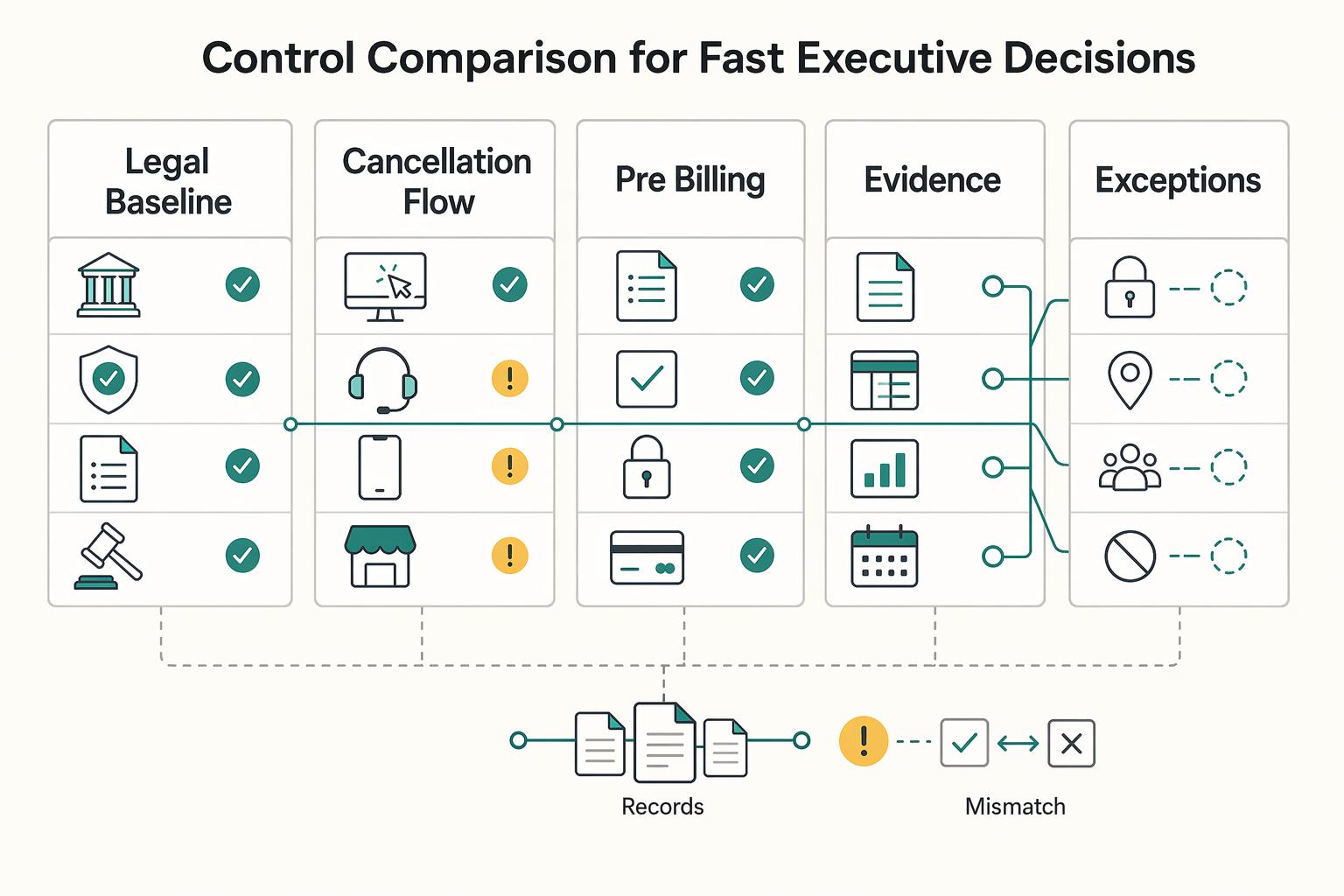
Control comparison for fast executive decisions#
For a single steering decision, use this sequence: baseline mapping plus disclosure and consent integrity first, then cancellation parity in the highest-risk channels, then exceptions and evidence, with governance running throughout legal uncertainty. If a channel still requires support-assisted cancellation, move parity earlier. Keep disclosure and consent paired with it because ROSCA ties all three duties together: clear material terms before billing info, express informed consent before charging, and a simple way to stop recurring charges.
| Control | Relative implementation effort (directional) | Potential legal exposure reduction (directional) | Expected time to operational value (directional) | Key dependency or tradeoff |
|---|---|---|---|---|
| 1. Legal baseline mapping and scope triage | Low to medium | High | Fast | Prevents teams from building against commentary instead of the live record. As of 3/26/2026, 16 CFR Part 425 displays prenotification-plan text, so decisions should track eCFR, Federal Register, and ROSCA text in effect on March 30, 2026. |
| 2. Cancellation flow parity | Medium to high | High | Medium | Depends on disclosure and consent instrumentation to show sign-up and cancellation are comparably easy. Build effort can be higher, but it can reduce risk of friction patterns like the FTC's 2025 Uber allegations of up to 23 screens and 32 actions to cancel. |
| 3. Pre-billing disclosure and informed consent integrity | Medium | High | Fast to medium | Strong early build because it creates the data spine for later controls. Without disclosure snapshots or consent logs, parity is harder to defend. |
| 4. Evidence pack for audit and investigations | Medium | Medium to high | Medium | Depends on log quality from controls 2, 3, and 5. It improves defensibility only if source logs are reliable. |
| 5. Exception handling for failure modes | Medium | Medium | Medium | Reduces repeat support issues and reveals broken paths, but adds operational overhead and cross-team ownership. |
| 6. Governance and escalation for legal uncertainty | Low | Medium | Fast | Keeps unsettled rule-status questions from blocking baseline controls. Tradeoff: ongoing process discipline and counsel time. |
In practice, approve 1 and 3 first, then 2 for the highest-risk channels, because disclosure and consent artifacts make cancellation remediation easier to prove. Then add 5 and 4 together so exception logs feed a usable evidence pack instead of producing documentation with missing facts.
Before approving the sequence, confirm each control produces an inspectable artifact in your normal operating cadence. If not, it is still too abstract for this phase.
Use this table as your sign-off input, then map each approved control to internal owners and system flows with the Gruv docs.
A 90-day implementation sequence for multi-market subscription platforms#
Use this as an internal execution cadence, not as a regulator-set deadline. FTC-specific timing or documentation requirements are not established.
-
Start with scope and internal baselines. Inventory recurring offers, billing channels, and cancellation routes, including support-assisted paths. For each live variant, keep a consistent internal snapshot of disclosure/copy by market, channel, and product version.
-
Then address the hardest cancellation paths and recordkeeping gaps. Prioritize channels where customer exit is harder or records are least reliable. Where useful, link logs to offer, channel, timestamp, and disclosure version so teams can reconstruct what happened later.
-
Then operationalize retrieval and escalation. Make internal exports repeatable by product line and channel, with clear ownership and handling rules. Define escalation triggers for material disclosure changes, broken cancellation routes, and repeated exceptions so issues move quickly to legal or compliance review.
-
Verification checkpoint: gate releases on outcome checks. Before each release, verify disclosure version alignment, record linkage, and cancellation completion across affected channels. If a required internal check fails, hold release until the path and records are corrected.
The practical takeaway for compliance and risk owners#
Start with six controls in order, not a broad policy rewrite: scope triage, cancellation parity, disclosure and consent integrity, evidence capture, exception handling, then governance for open questions.
- Sequence by exposure, not org chart
First, map which offers are negative option programs and which are not. The FTC's March 13, 2026 action is an advance notice of proposed rulemaking for 16 CFR Part 425, not a new final rule, and the February 12, 2026 conforming action recodified Part 425 text to its pre-2024-amendment version. If an offer is one-time purchase only, document that carve-out and move on.
- Ship cancellation parity first
The clearest FTC throughline is cancellation ease. The October 16, 2024 FTC announcement described making cancellation as easy as sign-up, and the March 2026 ANPRM again targets cancellation without unwarranted obstacles. If sign-up is self-serve but cancellation requires support intervention, treat that as a priority defect before adding more retention language or process.
Use a simple release checkpoint: test one full enrollment path and one full cancellation path in each live channel, and confirm cancellation can be completed without support intervention where self-serve sign-up exists.
- Build for retrievable proof, not assumed compliance
FTC materials describing the 2024 rule package highlight three baseline control themes: important information before billing information is obtained, unambiguously affirmative consent before charging, and simple cancellation mechanisms to stop recurring charges. Keep records that let you prove those events happened: disclosure snapshots, consent events tied to the recurring offer, cancellation outcomes, and timestamped exception logs.
Test retrieval, not just logging: for one customer and one product version, verify your team can pull the disclosure shown, consent captured, and cancellation outcome from source records in one review session.
- Escalate uncertainty quickly, but keep shipping grounded controls
Do not wait for perfect legal clarity before implementing baseline controls. FTC materials still describe ongoing complaints in the thousands each year, and the ANPRM comment deadline was April 13, 2026. Use an explicit decision rule: if a control maps to current Part 425 text, the February 2026 Federal Register action, or explicit FTC statements on cancellation, disclosure, or consent, implement it; if not, escalate to counsel and log it as unresolved.
For most platform teams, the practical move is to operationalize cancellation parity and evidence quality first. Once those are working in production, governance gets lighter because decisions rely less on assumptions and more on records you can produce.
For more on pause flows versus full cancellation, see Subscription Pause vs Cancel and the Middle Option That Protects Revenue.
Frequently Asked Questions
Does the FTC Click-to-Cancel Rule apply to SaaS businesses and streaming platforms?
Not by label alone. The cited FTC materials did not explicitly name SaaS or streaming, but the 2024 materials described negative option marketing, including automatic renewals and free trials, across B2B and B2C. As of April 1, 2026, court decisions had vacated the 2024 revisions and Part 425 was reset to pre-2024 text, so each recurring offer should be mapped to the negative option concept and edge cases confirmed with counsel.
What is clearly required from the FTC material versus still uncertain?
The clearest themes in the FTC record are easier cancellation and clear disclosure of material terms, and the vacated 2024 amendments also described affirmative consent before charging for a negative option feature. The current eCFR text again reflects a prenotification-focused Part 425 framework. What remains uncertain is whether broader 2024-style requirements return, because the FTC reopened rulemaking through an ANPRM with comments due April 13, 2026.
What should we implement immediately even if legal status is disputed elsewhere?
Implement controls that reduce risk under either rule posture now. Prioritize lower cancellation friction, consistent disclosures, consent capture tied to recurring billing, and versioned records by offer and channel. Use release gates when cancellation fails, consent linkage is broken, or an approved disclosure snapshot is missing.
What proof should we retain for compliance defensibility?
The cited FTC texts do not prescribe one named evidence pack. Retain consent logs, approved disclosure snapshots, cancellation journey records, and exception logs with timestamps, channel, offer, product version, and owner so your position is defensible. Also test whether you can export records for one customer and one product line without manual reconstruction.
How should we handle channels where cancellation currently requires support intervention?
Treat support-only cancellation as a parity risk when sign-up is self-serve. It is not settled that support-assisted cancellation is always prohibited, but high-friction setups are harder to defend. Add a fallback path, confirm completion to the customer, and log cases that could not be completed in the original channel.
How do we avoid overbuilding?
Sequence controls by exposure and evidence gaps first. Start with scope mapping, cancellation parity, disclosure and consent integrity, and record retrieval, then add narrower exception classes or approvals only if residual risk justifies it. If a control cannot be tied to current Part 425 text, the vacated 2024 history, or counsel guidance, keep it in backlog.
Researched and edited by the Gruv editorial team. Gruv builds cross-border billing, payouts, and finance-operations software for global businesses.
Sources
- ecf.ca8.uscourts.gov/opndir/25/07/243137P.pdftrusted
- ecfr.gov/current/title-16/chapter-I/subchapter-D/part...trusted
- federalregister.gov/documents/2024/11/15/2024-25534/negative-opt...trusted
- federalregister.gov/documents/2026/02/12/2026-02866/revision-of-...trusted
- ftc.gov/news-events/news/press-releases/2024/10/fede...trusted
- ftc.gov/news-events/news/press-releases/2026/03/ftc-...trusted
- govinfo.gov/content/pkg/FR-2026-02-12/pdf/2026-02866.pdftrusted
- irs.gov/individuals/international-taxpayers/foreign-...trusted
Educational content only. Not legal, tax, or financial advice.
Related Posts

The Freelance Payment Penalty: A Modeled Audit of Platform Fees, FX Spreads, and Payout Delays
The money rarely disappears through a single, easy-to-spot fee. The real loss is stacked. A marketplace takes its commission, a processor adds a charge for international cards, a bank or payment company converts the currency at a spread, a platform holds the funds before release, and a wire sheds a little to intermediaries on the way in. Each layer looks defensible on its own, but the worker feels the combined result as a smaller deposit and a later payday.

How to Respond to a Subpoena for Business Records
Move fast, but do not produce records on instinct. If you need to **respond to a subpoena for business records**, your immediate job is to control deadlines, preserve records, and make any later production defensible.

A US Expat's Guide to Investing in UCITS ETFs to Avoid PFIC Issues
The real problem is a two-system conflict. U.S. tax treatment can punish the wrong fund choice, while local product-access constraints can block the funds you want to buy in the first place. For **us expat ucits etfs**, the practical question is not "Which product is best?" It is "What can I access, report, and keep doing every year without guessing?" Use this four-part filter before any trade: