
Quick Answer
Compare total cost per completed payout, worker net receipts and time to funds for matched cohorts. Keep scheduled payouts where they meet agreed obligations, and test faster access where its measured benefit justifies added cost. In the hypothetical example, a mixed route costs USD 1,200 rather than USD 2,000 for 1,000 completed payouts; those figures are illustrative assumptions, not Gruv pricing or a customer outcome.
The Cost Problem#
A cheaper payout route can save platform fees while increasing worker delays or manual cleanup. Compare the full cost and the promised time to funds before changing cadence. The useful question is which route meets payment obligations and worker needs at a defensible total cost.
This is an illustrative case, not a verified Gruv customer success story. It uses hypothetical figures to show how a gig platform could compare instant, scheduled and mixed payouts. Replace the assumptions with your program’s actual fees, observed outcomes and supported routes before making a savings claim.
The model keeps contractor payments separate from employee payroll and evaluates one currency and matched payout population at a time. A blended average across countries, currencies and worker classes can hide both a funding shortfall and a deterioration in worker receipts.
Treat this as an operator guide to economics and execution, not legal or tax advice. Coverage, rails, and policy constraints vary by market and program, so any production payout change still needs legal, tax, and payments ops review.
By the end, you should have four practical outputs: a cost stack model, instant versus batch decision rules, pilot checkpoints with rollback triggers, and a copy-and-paste implementation checklist for finance, product, and payments ops.
The routing change this example tests#
The scenario compares an all-instant route with a mixed route that keeps faster access for 200 payouts and schedules 800. It does not assume a retention improvement or that every worker prefers the same timing. Those outcomes must be measured during the pilot.
Step 1. Identify the starting state in concrete terms#
A common starting point is fragmented payout operations spread across multiple systems. That weakens reconciliation and slows support responses. When payout records, statuses, and follow-up live in different tools, teams lose a single traceable view of what happened.
That matters because gig platforms are expected to deliver payments that are both quick and secure, and workers expect payout methods and currencies that fit their needs. If your team cannot trace a payout cleanly, cost control and worker trust can suffer.
Step 2. Define the decision shift clearly#
The practical shift is to stop treating faster payouts as the default and start asking when faster rails are actually justified. In practice, that means testing routing choices against operational evidence such as payout success, exceptions, support load, and reconciliation quality.
This keeps the tradeoff visible. A faster promise can help in some cases, but it may also add cost and operational complexity when payout urgency is low or payout method fit is weak.
Step 3. Segment before scaling any payout-speed policy#
Do not roll out platform-wide payout speed rules until you have cohort-level evidence. The grounded baseline here is that gig worker supply includes independent contractors and service providers, so treating workers as one uniform group can hide operational differences that matter.
A practical standard is to require cohort-level evidence before rollout: payout counts, statuses, exceptions, support contacts, and reconciliation traceability. If that evidence is incomplete, keep the policy narrow and validate first.
What you need before you change payout economics#
Do not change payout economics until your evidence set and decision rules are stable. Weak savings conclusions often come from inconsistent time windows, mixed worker segments, or incomplete payout-status data.
Step 1. Gather one clean comparison window#
Use one comparison window across all inputs and keep it consistent end to end. Pull the records you already use to run payouts, including payout outcomes and issue data, and keep the scope steady.
Before modelling costs, link each payout obligation to its attempts and outcomes across your systems. Keep unresolved items visible, with their fees and effort still included. If missing data prevents allocation, report its size and mark the result provisional; silently excluding difficult payouts can make the pilot look cheaper.
Step 2. Lock metric definitions before analysis#
Set definitions before analysis starts, then keep them fixed through the full review. Align finance, ops, and product on what counts as a successful payout. Also align on how retries and returns are treated in cost calculations, how time to funds is measured, and how support contacts are counted by cohort. If teams use different definitions, the output may look precise but still be unreliable for pricing decisions.
Step 3. Confirm worker classes and payout-policy gates#
Keep employee payroll and independent-contractor payments in separate cohorts. Their payment obligations and processes can differ. Tax-form labels help locate records, but they do not establish classification or permit a slower pay schedule.
Then confirm the operational gates that can delay release, including compliance and program constraints where applicable. This matters because delayed or missing payouts, plus fee and timing friction, can reduce worker confidence and outcomes.
Build your payment cost stack before touching payout speed#
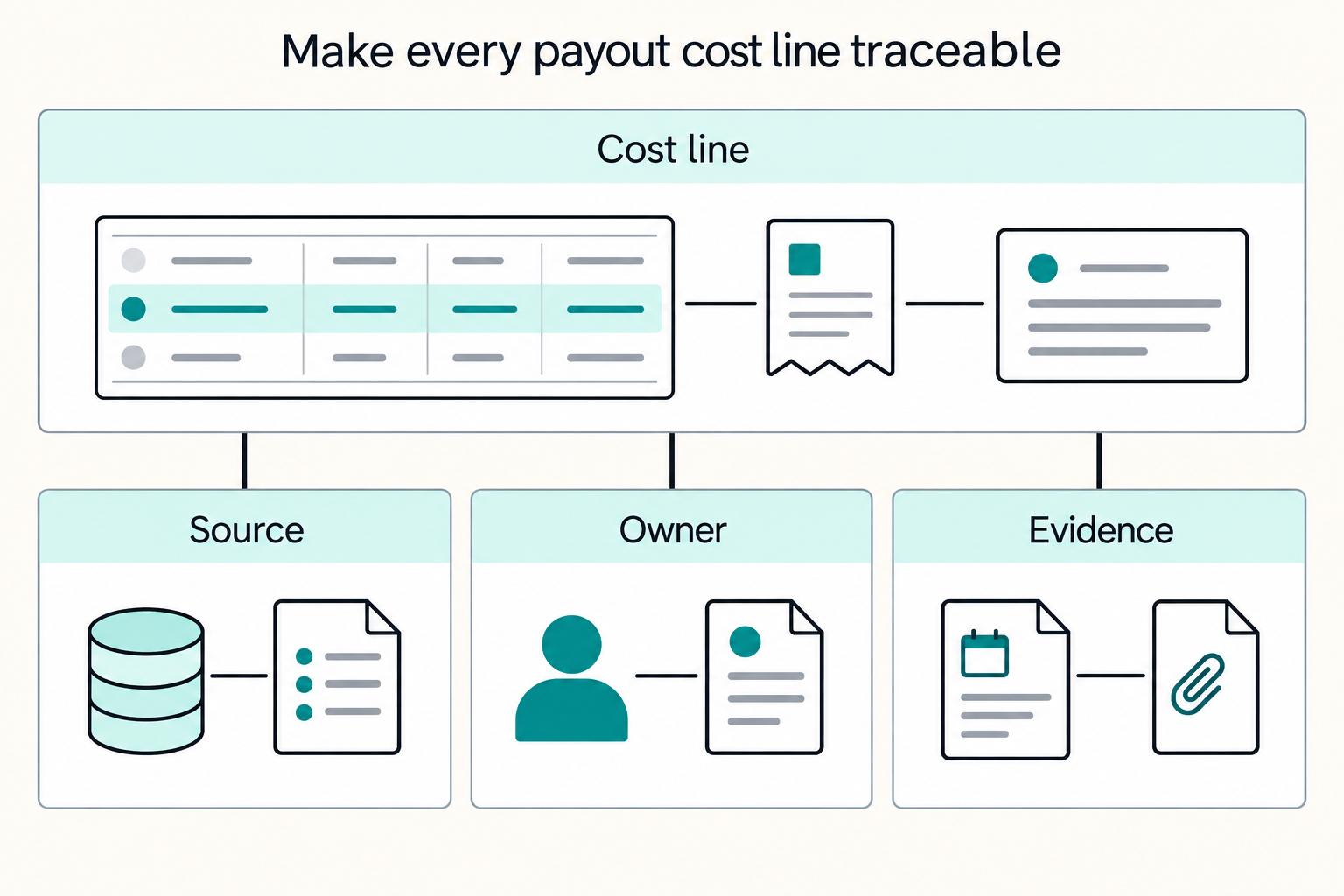
Once your window and definitions are locked, build the full cost stack before choosing instant versus batch. If any cost line in Gruv cannot be tied to a source system, an owner, and an evidence file, treat the claimed saving as unverified for pricing or product decisions.
Step 1. Map each payout path into a line-by-line stack#
Create one table per payout path in Gruv, and keep domestic and cross-border flows separate. Keep FX spread separate from rail fees so finance, product, and payments ops can challenge the same assumptions row by row.
| Cost line | What to include | Cost type | Verification checkpoint |
|---|---|---|---|
| Collection cost | Cost to bring funds into the platform before payout, including collection-side fees tied to that path | Direct | Source system: collection or settlement report. Owner: finance ops. Evidence file: collection fee statement matched to Gruv ledger export |
| FX spread cost | Conversion cost when funding and payout currencies differ | Direct | Source system: provider FX report or treasury settlement file. Owner: finance. Evidence file: FX conversion report for the same review window |
| Payout rail fees | Transaction or batch fees charged for sending payout | Direct | Source system: payout provider statement or status export. Owner: payments ops. Evidence file: provider fee invoice and payout status file |
| Exception handling labor | Manual work for exception handling, support follow-up, and false-positive review work | Hidden | Source system: ops queue and support tool. Owner: payments ops lead. Evidence file: ticket export plus time sample for manual resolution |
| Reconciliation overhead | File-format normalization and exception resolution work | Hidden | Source system: reconciliation log. Owner: controller or finops. Evidence file: recon workbook with normalized files and exception log |
Expected outcome: each payout path has a reviewable stack, not one blended payout-cost number. Visible fees are only part of true cost.
Worked example: the same 1,000 completed payouts#
Assume matched USD populations with 1,000 completed payouts and no extra worker deduction. All figures below are hypothetical, including rail prices and labor costs. The baseline sends all 1,000 through a USD 1 instant route. The mixed option sends 800 at USD 0.35 on a scheduled route and 200 at USD 1 instantly, so rail cost is USD 280 + USD 200 = USD 480.
| Cost for the matched population | All-instant baseline (USD) | Mixed-route scenario (USD) |
|---|---|---|
| Collection | 100 | 100 |
| FX cost allocated to the population | 150 | 150 |
| Payout rail fees | 1,000 | 480 |
| Support and exception labor | 500 | 300 |
| Reconciliation effort | 250 | 170 |
| Total | 2,000 | 1,200 |
| Cost per completed payout | 2.00 | 1.20 |
The hypothetical difference is USD 800, or 40% of the USD 2,000 baseline. USD 520 comes from the rail mix and USD 280 from assumed labor reductions. If the labor reduction is not observed, the mixed route costs USD 1,480 and the difference is only USD 520. Add any incremental prefunding, implementation, provider minimum or loss cost before claiming a net gain. This comparison says nothing by itself about retention or whether the 800 scheduled payments meet worker expectations.
Step 2. Pull hidden costs back onto the original payout path#
Do not leave exception handling, support contacts, and cleanup work in a generic operations bucket. Attribute that labor and any extra fees back to the original payout path, or faster paths can look artificially cheap.
Apply the same rule to reconciliation. It includes exception resolution and file normalization, not only transaction matching. This check matters even more in corridor-by-corridor setups, where fragmented operations can reduce unified visibility and reporting consistency as market coverage expands.
Step 3. Add worker net outcomes beside platform cost#
A platform-only cost stack is incomplete. Add two worker-facing columns for each payout path: net amount received and timing predictability.
Timing predictability should reflect routing constraints such as cut-off times and settlement windows, not only nominal rail speed. Also, do not assume workers are interchangeable. A path that looks cheaper on platform spend can still weaken worker outcomes if net receipts or timing predictability are worse.
Step 4. Attach challenge-ready evidence to every row#
Turn the stack into a review sheet by showing three fields on every row: source system, owner, and evidence file. Keep evidence names specific enough that another team can open and validate them without clarification.
Product can challenge timing assumptions, Finance can check FX separation, and Ops can show the effort spent resolving review holds or payment exceptions. Use measured work and invoices rather than an assumed percentage of platform revenue. Keep support and reconciliation tasks separate so the same labor is not counted twice.
We covered this in detail in How to Calculate Payment Processing Fees: A Total Cost of Ownership Framework for Platforms.
Segment your worker base before choosing rails#
Once the cost stack is visible, stop treating "workers" as one payout audience. Segment first, because one payout promise across a contingent workforce can mask compliance risk and create uneven payout experience.
Step 1. Split cohorts by traits that change operations#
Use operational traits: verified employee or contractor status, domestic or cross-border route, currency and payout frequency. Preserve employee pay deadlines and agreed contractor terms before optimizing rail cost. The U.S. Department of Labor’s payday resource illustrates why employee schedules require jurisdiction-specific checks; it is not a universal gig-worker cadence rule.
| Checkpoint field | Detail |
|---|---|
| Classification | W-2 versus 1099 |
| Payout country | Domestic versus cross-border |
| Participation pattern | More frequent versus occasional platform work |
| Recent payout outcomes | Keep recent payout outcomes in the checkpoint record |
For each worker in your review window, keep a checkpoint record with classification, payout country, participation pattern, and recent payout outcomes. If cohorting depends on a 1099 label, do not treat the form alone as proof of correct classification.
Step 2. Validate classification before building policy on top of it#
Do not design payout entitlements from an unverified tax-form label. IRS classification guidance considers behavioral control, financial control and the parties’ relationship for federal employment-tax purposes. Other applicable employment tests require their own review. Record the classification basis and responsible owner before using it to set cohort policy.
Keep a clear ownership and evidence trail for classification review before finalizing cohort rules. If that record is missing, pause policy design for that cohort.
Step 3. Set cohort-level experience expectations, then map rails in Gruv#
Define the experience expectation by cohort first, then map it to the payout rails you can support in Gruv for that program. Be explicit about when and how each cohort is expected to receive funds.
Measure actual timing needs and method preferences within the cohort rather than inferring urgency from income, gender or a broad worker label. Compare receipt timing and payout-related contacts after the routing change. For rail-level tradeoffs, see Real-Time Payment Use Cases for Gig Platforms.
Step 4. Document constraints before product makes promises#
Document where policy or market constraints can break the intended experience before targets become customer-facing promises. For cross-border cohorts, local-currency payout constraints can limit what is routable by market.
Keep a compact evidence pack for each cohort: corridor coverage, enabled payout methods, currency limitations, and policy gates where configured that can delay or block release. If routing or compliance can interrupt the promise, position that cohort on predictability rather than raw speed. For a related benchmark, see Platform Economy Payment Index for Contractor Payments.
Decide where instant payouts beat batch payouts#
Use instant payouts only when the expected retention or support upside is greater than the added rail cost and operating risk for that cohort. If you cannot show that trade in your own data, default to batch payouts and treat speed as an exception, not a baseline promise.
Payout speed is increasingly treated as a retention lever, not just a cost line. Workers can move to other platforms when payments are slow or inconsistent, and legacy payment systems may struggle with real-time expectations. The real decision is not "fast or cheap." It is whether faster access creates enough measurable value to justify added payout expense and operational complexity.
Step 1. Set the decision rule before product makes a speed promise#
Work cohort by cohort. Compare expected upside from faster access, such as retention pressure or support load, against expected added cost and risk, such as fees, failures, manual handling, and reconciliation effort.
Use this operator rule:
- Choose instant only when expected upside is likely to outweigh incremental payout and ops cost.
- Choose batch by default when urgency is low, margin is thin, or failures are costly to resolve.
- Use a missed agreed payment deadline or a measured increase in timing-related contacts as a trigger to investigate the route; set the pilot threshold from your obligations and baseline.
Measure from the same starting event to verified funds availability, including cutoff and weekend effects. A 48-hour threshold might be appropriate for a particular promise, but it is not a universal industry or legal benchmark. Test whether faster access resolves the measured problem before paying a premium for it.
Step 2. Compare operating models, not just rail speed#
Teams are usually deciding among all-instant, all-batch, and segmented hybrid. In practice, hybrid can be the most defensible because speed is used where it matters and cost is protected where it does not.
| Scenario | Margin impact | Worker experience impact | Failure risk by cohort |
|---|---|---|---|
| All-instant | Higher unit-economics pressure when premium payout paths are applied broadly | Strong "paid now" experience, but risk of promising speed you cannot deliver consistently | Availability and beneficiary eligibility must be checked; faster routing does not bypass review holds |
| All-batch | Lower premium-rail exposure and simpler scheduled global mass payout operations | Predictable scheduling, but slower access can frustrate workers who expect near-immediate funds | Lower rail complexity, but multi-day settlement and manual reconciliation can still create support load |
| Segmented hybrid | Better chance to protect margin by reserving premium speed for high-value cohorts | Better fit by cohort: urgent segments get faster access, others get predictable scheduled payouts | More policy and routing complexity, but risk is more contained when eligibility and exception paths are clear |
Do not let vendor positioning decide this for you. Your approval standard should stay the same: does this cohort show enough expected upside to justify the added cost and exception handling?
Step 3. Pilot with a hard stop and evidence pack#
Write the stop rule before launch. If failures or exceptions exceed the agreed threshold, suspend new instructions on the affected route. Resolve pending and unknown outcomes before moving eligible unsent obligations to a scheduled alternative. Never resend the whole cohort merely because routing policy changed.
Define exceptions explicitly. Include failed payouts, KYC/AML reviews, and any case needing manual intervention or reconciliation.
Keep the verification pack compact:
- cohort-level payout processing time
- successful and failed payout counts
- exception categories from ops
- support contacts tied to payout timing or missing funds
- reconciliation records for the same population
Do not judge instant payouts on rail fees alone, and do not assume batch is always good enough. Keep instant where the upside is real and pilot outcomes stay within cost and exception tolerances. Move back to batch when economics are weak or exception pressure rises.
Before locking your routing policy, model the all-instant vs segmented hybrid scenarios with your own cohort assumptions in the Payment Fee Comparison tool.
Redesign money movement in Gruv without breaking controls#
Redesign in sequence: collection clarity, ledger posting, routing, then event and request reliability. Use the ledger to record obligations and reconcile it to provider and bank evidence; an internal posting alone does not prove external completion. Confirm that your Gruv program and provider support the required routes and controls before making a promise.
Step 1. Map invoice and collection flow before touching payouts#
Start upstream, because payout issues can begin in collection states. Document transaction and settlement flow for each payment type you use so you can trace what was expected to settle, what settled, and what balance became payable.
Use a simple gate before routing changes: if Gruv exports and finance records cannot explain that chain cleanly, pause here. Ambiguous collection states can cascade into ambiguous payout states.
Step 2. Verify wallet and ledger posting before adding new routing logic#
Make posting consistency your next hard gate. For each payout state change, confirm a traceable provider reference, timestamped state transition, and matching ledger entry that finance can reconcile to exports.
Treat provider messages as evidence for recorded lifecycle transitions, with journal entries when value changes. Reconcile them to authoritative provider objects and settlement or bank records. If provider and ledger disagree, leave the item unresolved and recover the actual outcome before deciding whether funds can move.
Step 3. Add payout routing only after states and controls are stable#
Add rail-specific and cohort-specific routing only after state integrity is stable. Keep exception paths explicit at minimum for held, returned, and failed, each with a named owner and next action.
This helps reduce spreadsheet triage later. Keep exception queues tied to ledger states so ops, support, and finance all work from the same truth.
Step 4. Test webhooks and idempotency in production-like conditions#
Test duplicate, delayed and out-of-order event processing without double-posting or releasing twice. Separately test outgoing-request timeouts using the provider’s supported idempotency mechanism and a stable business-operation ID. Retrieve the original result before another send; a new rail or key does not make an unknown previous payment safe to repeat.
Preserve trust boundaries during this step: minimize PII in events, maintain masked views, and enforce policy gates before payout release where enabled. Focus on clear internal controls, explicit exception handling, and auditability that finance can prove after the fact.
Pilot the change with clear gates and failure thresholds#
Do not cut over everyone at once. In Gruv, start with one low-risk cohort, keep batch payouts ready as fallback, and expand only when weekly evidence shows the route is still reconciling cleanly.
Step 1. Choose one cohort you can observe end to end#
Start with the fewest moving parts: one market, one worker segment, and one payout pattern. If you mix very different flows in the first pilot, you will not be able to tell whether changes came from routing, policy, or ordinary operations noise.
Before launch, confirm finance, ops, and support can pull the same cohort with the same IDs and dates. If counts do not align across the ledger export, provider status log, and support queue, the cohort is not pilot-ready.
Keep jurisdiction and currency scope narrow so differences in obligations, cutoff times and route availability do not obscure the pilot result.
Step 2. Run weekly go/no-go checks from one evidence pack#
Use the same weekly questions each time: margin direction, payout stability, support contact pressure, and reconciliation completion time. Keep the review disciplined so decisions are based on the same operational evidence, not sentiment.
| Weekly pack item | Requirement |
|---|---|
| Gruv ledger export | For the pilot cohort |
| Provider payout status log | For the same date range |
| Support contact counts or tags | For that cohort |
| Reconciliation completion record | With owner and timestamp |
| Exception list | For payout exceptions and policy holds |
Use that as the required weekly pack. If one team reports improvement while another reports escalating strain, do not treat that week as a clean pass.
Step 3. Define rollback conditions before launch#
Before launch, name the owner who can stop new pilot instructions and restore the last stable route for unsent obligations. At rollback, inventory submitted, pending, failed and completed instructions; recover unknown results, confirm cancellation or returned funds where relevant, and reroute only obligations proven safe to send. Record the policy change separately from any transfer or reversal.
Use your own pre-agreed floors and limits for triggers, then enforce them consistently. The critical point is not the exact number in this section. It is that thresholds are set before incident pressure begins.
Your rollback checklist should cover all three layers together:
- routing change
- user-facing payout promise
- ledger and policy-state confirmation
Step 4. Expand only when uncertainty is documented and controlled#
Expand only when weekly evidence is stable and open risks are explicitly documented. If classification, compliance, or policy questions are unresolved, keep them as gates, not footnotes.
A useful pilot lets Finance explain cost changes, Ops explain each exception and Support tell workers which payment promise applies. Expand only when that process remains workable for the next cohort, with its payment obligations and route constraints checked.
Verify outcomes with finance and ops evidence packs#
If finance cannot trace a claimed improvement from the Gruv ledger to provider records and reconciliation proof, do not count it as a win. In this kind of payout cost review, you are testing whether unit economics, worker experience, and close quality actually changed for the same cohort.
Step 1. Build a side by side scorecard for the same cohort#
Use a narrow comparison on purpose: same market, same worker cohort, same eligibility rules, same review window. If cohorts drift, you may be measuring cohort mix rather than payout economics.
| Metric | Compare like this | Primary evidence | Common trap |
|---|---|---|---|
| Cost per successful payout | Before versus after for the exact pilot cohort | Gruv ledger export tied to settled payouts | Counting failed or reversed payouts in only one period |
| Failed payout rate | Same cohort, same date logic, same failure statuses | Provider status log plus exception list | Treating non-final statuses as success |
| Time to funds | Same payout promise and same completion timestamp rule | Provider status timestamps and worker-facing payout status | Mixing initiation time with funds-available time |
| Support burden | Same cohort and same support tags or queue filter | Support contact counts for that cohort | Using total support volume and masking payout-specific issues |
Match the cohort and payout population across exports and logs. Support contacts can have multiple records per payout; link them to the population rather than expecting identical row counts. Use the same completion cutoff and disclose unmatched, pending and returned items before presenting results.
Step 2. Require an evidence pack for every claimed gain#
Every claimed gain needs its own evidence pack, not a slide note. At minimum, require the ledger export, provider payout status log for the same window, and reconciliation proof signed off by finance ops.
Include cohort definition, pull time, owner, and exact date filter. Treat reconciliation proof as the control. Provider files can look clean while ledger state may still include unmatched changes, late returns, or manual adjustments outside the cutoff.
Step 3. Mark unknowns clearly when the evidence is incomplete#
If evidence is incomplete, mark the result as unknown or provisional. That is the same discipline you should apply when public case-study excerpts describe an initiative but do not show outcome tables.
Separate retention from payment-cost results. A worker may remain active because of work availability, earnings, predictable pay or other changes during the pilot. Report observed activity and receipt timing, and use a comparable control cohort where possible before attributing retention to payout speed alone.
Step 4. Close the loop with leadership in business terms#
Leadership should get three direct answers. What changed in gross margin for the tested cohort? What changed in worker experience from the scorecard? What remains risk-sensitive by market, policy, or routing constraints?
Be explicit about where results should not be generalized yet. Market-level policy differences vary by jurisdiction, including examples like New York and Seattle. The right close is simple: what improved, what is still unproven, and where to scale next using the same evidence-based standard.
For a step-by-step walkthrough, see Building a Creator-Economy Platform with 1-to-Many Payment Architecture.
Common mistakes that erase savings and how to recover#
Payout savings often disappear when broad instant-payout policies, incomplete cost math, or unsafe routing changes go unchecked. If reported savings rise while payout reliability worsens, treat that as a recovery signal before you scale.
Step 1. Revert broad instant payouts back to segmented policy#
If instant payouts were enabled broadly without a cost model, review the affected cohorts and stop new expansion. Preserve payments already in flight; adjust future routing only after confirming obligations, worker promises and the supported scheduled alternative.
Recover by reverting the affected cohort to the last stable policy, then revalidating economics on the same market, worker group, and date window. Confirm that ledger payout counts, provider status logs, and support contacts still tie out after rollback.
Step 2. Rebuild the cost stack with hidden operational costs included#
Do not treat payout fees as the full cost. Include operational overhead such as retries, failed or returned payouts, payout-related support labor, and reconciliation drag from unmatched ledger and provider states.
Use the same window and population for ledger, provider, support and reconciliation records. Include costs from missed promises and late returns even when the original payout was initially marked complete. Keep the completion cutoff visible so a short pilot does not conceal losses that emerge later.
Step 3. Pause unsafe routing changes and tighten failure handling#
If routing changes shipped without strong exception-handling checks, pause rollout. Monitoring alone is not a recovery plan when retries and exceptions can leave payout outcomes unresolved.
Recover by stopping the affected pilot, tightening failure handling, and rerunning pilot gates before restart. Verify that payout state changes are traceable, payout exceptions enter explicit handling paths, and support can resolve cases without manual spreadsheet triage.
Where most public guidance stays vague and what to do instead#
Public guidance is usually strong on labor risk, privacy, and classification, but thin on payout operator math. To make this part of your payout cost review credible, anchor claims in cohort-level evidence, ledger-backed evidence, and explicit tradeoffs.
Step 1. Show the before-and-after math, not just the pain#
Most sources explain platform-work risks, but they rarely show what changed in the payout cost stack. Replace broad "efficiency" language with a plain before-and-after view tied to Gruv records.
Include the same fields for each cohort and payout path: successful payouts, failed or returned payouts, support contacts, time to funds, and cost per successful payout. Map each row to the same review window across a Gruv ledger export, provider status log, and finance reconciliation proof. If a value is not traceable, mark it as unknown.
Step 2. Segment by worker type before discussing policy#
Do not collapse everyone into one "gig worker" group for payout decisions. Treat employee and independent-contractor cohorts separately, and only add cuts like frequency, market, or cross-border status when your evidence pack supports them.
This keeps your analysis aligned with what public research does show: classification, wage structure, privacy, and worker-protection debates. It also prevents a single payout promise from being applied to unlike groups without segment-level evidence.
Step 3. State tradeoffs when speed may cost more than it returns#
Do not frame faster payouts as universally better. Be explicit about where speed helped experience, where it raised cost, and where reliability did more to protect trust.
Use pseudonymous worker IDs and payout references in the analysis, with the identity mapping access-controlled. Do not put raw tax identifiers into routine review exports. Restrict who can join the analysis back to a person and retain only the fields needed for cost and outcome checks. For related operating context, see Gig Economy Payment Trends.
Conclusion and copy paste checklist#
Treat payout-cost reduction as a hypothesis to test with segmentation and controls, not a speed-only product choice. Keep batch where it already works, and test instant expansion with cohort evidence, ledger discipline, and a written rollback path. Until inspectable evidence is complete, payout-cost outcomes should be labeled unknown.
A savings claim needs transaction and cost evidence for the actual program. General research about gig work or an illustrative calculation cannot establish a Gruv customer result. Publish the matched scorecard, assumptions, cutoff and unresolved amounts alongside any measured improvement.
- Define cohort-level success metrics before changing rails.
Lock metric definitions and cohort boundaries before launch, then keep them unchanged across pre and post windows.
- Build a full cost stack with direct and hidden costs.
Compare direct payout costs with retries, reversals, exceptions, support effort, and reconciliation cleanup so a lower fee does not hide a higher operating bill.
- Set instant versus batch decision rules and rollback triggers.
Make the default explicit: if instant does not show a clear operating gain for a cohort, keep that cohort on batch.
- Implement routing changes in Gruv with ledger and idempotency checks.
Confirm payout-state mapping, traceable provider references, and replay-safe behavior before scale.
- Pilot by cohort, review weekly checkpoints, and scale only when evidence holds.
Expand only when weekly results stay consistent against baseline records. If results are mixed, hold or revert.
- Publish a before and after scorecard with finance-approved evidence packs.
Present matched metrics and backing records side by side, and label incomplete evidence as unknown instead of inferring savings.
If you want a working session on payout segmentation, controls, and rollout gates for your markets, talk to Gruv.
Frequently Asked Questions
What payment costs actually move first in a gig platform when you redesign payouts?
Which cost changes first depends on the route. Rail fees can change immediately, while support labor, failed attempts and late returns may appear later. Compare posted charges, attributable effort and completed payouts at the same cutoff, then update the view as unresolved cases mature. A cheaper fee alone does not establish lower total cost.
When do instant payouts improve unit economics instead of just increasing payout expense?
Instant payouts can improve unit economics when they remove a larger cost, such as support load or repeated payment-status contacts. They usually do not improve economics if premium rail cost rises while success rates, transparency, and worker experience stay flat. Compare cost per successful payout and support contacts by cohort before expanding instant payouts by default.
How should W-2 and 1099 tax forms cohorts influence payout timing policy?
Employee payroll and contractor payments need separate obligation and classification checks before a cost pilot. A W-2 or 1099 label alone does not establish the correct worker status or pay deadline. Preserve applicable wage-payment rules and agreed contractor terms, then compare supported routes within those constraints.
What should founders measure in the first 30 days after changing payout rails?
Track the same core metrics each week: cost per successful payout, failed or returned payout rate, time to funds, support contacts, and reconciliation completion time. Keep cohorts matched so results are comparable across the same operating context. Treat any metric as unverified if it cannot be tied back to the records used in payout operations and reconciliation.
How do we prevent reconciliation chaos while scaling cross-border payouts in Gruv?
Link each payout obligation and attempt to ledger journals, provider references, amount, currency and outcome evidence. Reconcile returns and adjustments without deleting the original movement. Track unmatched records with an owner and next action, and verify which exports and controls your Gruv program provides before relying on them.
What evidence should a finance team require before claiming payout-cost savings?
Require a before-and-after pack that uses the same review window, cohort definitions, and metric definitions on both sides. Include payout-operation records, provider status evidence, reconciliation proof, and a short note for unmatched payouts or missing data. Any savings claim that excludes support labor, retries, or month-end cleanup is incomplete.
How do we decide whether to keep a cohort on batch payouts after a pilot?
Keep a cohort on batch payouts when instant payouts did not produce a clear operational gain beyond faster release. If premium payout expense rose while exceptions and support burden stayed flat or worsened, batch may be the better fit for that group. If batch delivers reliable time to funds, low support noise, and clean reconciliation, keep it until cohort-level evidence says otherwise.
Try a related tool
Researched and edited by the Gruv editorial team. Gruv builds cross-border billing, payouts, and finance-operations software for global businesses.
Sources
Educational content only. Not legal, tax, or financial advice.
Related Posts

The Freelance Payment Penalty: A Modeled Audit of Platform Fees, FX Spreads, and Payout Delays
The money rarely disappears through a single, easy-to-spot fee. The real loss is stacked. A marketplace takes its commission, a processor adds a charge for international cards, a bank or payment company converts the currency at a spread, a platform holds the funds before release, and a wire sheds a little to intermediaries on the way in. Each layer looks defensible on its own, but the worker feels the combined result as a smaller deposit and a later payday.

How to Respond to a Subpoena for Business Records
Move fast, but do not produce records on instinct. If you need to **respond to a subpoena for business records**, your immediate job is to control deadlines, preserve records, and make any later production defensible.

A US Expat's Guide to Investing in UCITS ETFs to Avoid PFIC Issues
The real problem is a two-system conflict. U.S. tax treatment can punish the wrong fund choice, while local product-access constraints can block the funds you want to buy in the first place. For **us expat ucits etfs**, the practical question is not "Which product is best?" It is "What can I access, report, and keep doing every year without guessing?" Use this four-part filter before any trade: