
Quick Answer
Use automation to improve market-entry decisions, not just speed AP tasks. For each target market, choose launch now, launch with constraints, or defer, then tie that choice to measurable gates like reconciliation aging, exception rates, and month-end close performance. Keep scope narrow with a 12-week pilot (weeks 1-2 baseline, 3-8 rollout, 9-12 stabilization) and scale only when performance gains hold without added control breaches or reconciliation debt.
Why Payment Automation Leads to Better Finance Decisions#
Automation is a real finance asset when it improves decision quality, not just task speed. For cross-border payment platforms, use it to answer three practical questions: where you can operate reliably, what controls you can defend, and whether reconciliation will still hold up as volume grows.
Treat automation as decision support first#
Start with one standard: automation should help your team make better business decisions, not just process work faster.
Scope expansion by market realities#
Cross-border payments are not a uniform environment. Public-policy work from BIS and the FSB points to speed, transparency, access, and cost as core goals, while also acknowledging legal and regulatory differences that create friction.
The IMF likewise treats cross-border payments as core global financial infrastructure. That means expansion choices are shaped by governance and policy, not demand alone. Coverage is market-dependent, and the World Bank tracks 367 country corridors with a 6.49 percent global average remittance cost.
Validate controls with reconciliation and audit-trail evidence#
Before launch, confirm that you can explain each payment from transaction activity to accounting records. Reconciliation means matching transaction records to confirm accuracy, and an audit trail is the chronological record that lets you reconstruct what happened.
Regulatory signals reinforce that standard. The FCA has reported weak safeguarding practices in some firms and ties outcomes to how external safeguarding reconciliations are designed and documented. Treat clean dashboards as insufficient on their own. Require documented procedures and verifiable records.
For more detail on reducing manual journals and speeding close, read Accounting Automation for Platforms That Removes Manual Journals and Speeds Close.
What to prepare before you evaluate any automation bet#
Many bad automation decisions start with bad prep, not bad software. If you cannot produce a trusted baseline for AP and reconciliation, pause tooling decisions and fix instrumentation first.
Assemble your current-state pack#
Start with the operating facts you already have: month-end close timeline, invoice management steps, reconciliation backlog, and exception logs. For each one, record where work enters, who owns each handoff, what gets queued, and how long items stay unresolved. Keep exception logs structured with a reason category, owner, and resolution status.
Before you go further, run one traceability check. Sample recent invoices and payments and verify that you can follow each one from initiation through settlement, posting, and exception handling. If that chain breaks, your baseline is not ready for decisions.
Write down hard constraints before features#
List market-specific non-negotiables before you compare vendors. Tax obligations can include withholding, information-return duties, and tax-return filing, and some platform models can create VAT or GST liability at the platform level. Internal controls should be explicit too. In EU-relevant flows, PSD2 can require strong customer authentication under Article 97(1)(c).
| Constraint | What to capture | Detail |
|---|---|---|
| Tax obligations | Withholding, information-return duties, tax-return filing | List these non-negotiables before anyone starts comparing vendors |
| Platform tax exposure | Possible VAT or GST liability | Some platform models can create VAT or GST liability at the platform level |
| Internal controls | Strong customer authentication | In EU-relevant flows, PSD2 can require it under Article 97(1)(c) |
| Execution speed | Seconds-level execution | Define this where instant payments matter |
| Availability and messaging | Continuous availability; ISO 20022 messaging | In U.S. rail contexts, that can mean 24/7/365 operations, and RTP's ISO 20022 messaging supports real-time reconciliation |
Set real-time expectations just as clearly. Where instant payments matter, define whether you need seconds-level execution and continuous availability. In U.S. rail contexts, that can mean 24/7/365 operations, and RTP's ISO 20022 messaging supports real-time reconciliation, not only faster funds movement.
Assign named owners before analysis starts#
Set decision ownership up front. Define named owners for operational automation decisions, data definitions, and escalation paths before analysis starts. Weak data quality is often a symptom of unclear accountability, and internal-control responsibility does not disappear once you buy a tool.
Stop if the baseline cannot be trusted#
If your data architecture and infrastructure do not reliably support aggregation and reporting, do not evaluate tooling yet. If AP and reconciliation numbers change by export method, provider IDs do not match ledger IDs, or exception categories live in free text, fix that first. Otherwise you risk buying cleaner dashboards and making worse decisions.
Define the expansion decision and the evidence that counts#
Once your baseline is clean, move from tooling talk to an explicit market decision. For each market, the outcome should be one of three things: launch now, launch with constraints, or defer. If you cannot tie that decision to measurable operating outcomes, you are still evaluating possibilities, not deciding.
Write one market decision statement#
Write one sentence per target market that names the market, the decision, the gating risk, and the outcome you expect to improve. It should be specific enough that finance ops, payments ops, and product can all test it.
Use this pattern: "Launch now/with constraints/defer in [market] because we can or cannot meet [control or operational gate] while improving the target metric." For example, in a U.S. ACH debit case, you might launch with constraints until unauthorized returns stay below the 0.5% Nacha threshold, measured over the preceding 60 days or two calendar months, and reconciliation aging improves.
For euro area instant-payment cases, make regulatory and fraud-control dependencies explicit. If your offer depends on instant payments, confirm that your setup can meet the relevant obligations and controls, including Verification of Payee, listed for euro area Member States from 9 October 2025, and receiving instant payments, listed from 9 January 2025. If that dependency is still unresolved, mark the market as launch with constraints or defer.
Use one simple check here: can someone outside the project tell what would change this market from defer to launch? If not, rewrite the statement.
Tier the evidence before you debate outcomes#
Separate evidence into tiers and keep those tiers distinct in the decision document.
| Evidence tier | What belongs here | How to use it |
|---|---|---|
| Observed internal metrics | Month-end close timing, exception rates, false-positive rates, reconciliation backlog, tax exception counts | Highest weight for go or no-go decisions |
| Partner or provider evidence | Processor reports, bank rail coverage, implementation constraints, settlement behavior, documented fraud-control features like VoP match responses | Use when specific to your flow and current setup; require documentation |
| Unverified vendor claims | Marketing claims such as "cut AP processing costs by up to 80%" | Treat as hypothesis only until method, baseline, and comparability are clear |
This matters because cross-border regulation is fragmented across jurisdictions, and inconsistent approaches can increase costs while reducing processing speed. Apply a reasonable-basis standard to objective claims. If there is no method and no comparable baseline, it is not decision evidence.
Set acceptance criteria operations can verify#
Define acceptance criteria per market before build starts. Keep the same core outcomes across markets so your comparisons stay clean: lower exception rate, faster month-end close, fewer false positives, and stable tax compliance operations.
Treat "faster" as conditional. Cycle time can improve, but not at the expense of reporting accuracy. Do not count speed gains that create reconciliation debt. For instant-payment-dependent markets, state the risk tradeoff plainly. Funds movement can be immediate and final, while fraud pressure can be higher in some instant-payment flows.
For tax compliance, require an evidence pack rather than verbal assurance. It should show filing and withholding ownership, reporting path, exception handling, and late-filing or late-deposit handling. If your model creates EU B2C exposure, the 1 July 2021 VAT rule change and EUR 10 000 threshold may matter. If U.S. tax deposits are in scope, late deposits can trigger IRS penalty bands of 2%, 5%, 10%, and 15%. If a market cannot meet these criteria without recurring manual overrides, classify it now as launch with constraints or defer.
For a step-by-step walkthrough, see How Embedded Finance is Changing the Competitive Market for Gig Platforms.
Compare market readiness before you commit product build#
Do not commit product build on revenue potential alone. Compare each target market side by side on compliance gating, rail behavior, settlement behavior, dispute or return complexity, and evidence quality. If a market still needs recurring manual overrides for tax compliance and reconciliation, treat it as phased entry, not full rollout.
Build a table that forces operational comparison#
Use one table in the decision document so commercial upside is weighed alongside infrastructure and legal reality. Cross-border performance depends on domestic rails in the first and last mile, and inconsistent regulation can raise compliance cost while slowing processing.
| Market / use case | Compliance gating | Rail availability | Settlement behavior | Dispute / return complexity | Operational fit and evidence quality |
|---|---|---|---|---|---|
| U.S. ACH debit | Track unauthorized returns against the Nacha 0.5% threshold; ODFI monitoring is required | Confirm bank and processor support on the domestic rail used by your counterparties | Document posting, return, and exception timing from current bank or processor materials | Formal return monitoring makes exception pressure measurable | Real-time fit should be judged against urgency requirements; routing value depends on proven alternatives. Proven: your return logs and reconciliation aging. Inferred: provider claims about coverage or savings |
| U.S. RTP payout | Pre-submit controls must be strong because submitted payments are final and irrevocable | Verify access through your sending institutions and processor setup | Settlement is final and irrevocable once submitted | Failure handling moves upstream because recall is not available after submit | Real-time fit is strong only if checks happen before release. Proven: your false-positive rate, escalations, and recovery cases. Inferred: partner claims about reach or ease |
| Euro area instant transfer | Record instant-payment regulatory dependencies; EU Instant Payments Regulation adopted on 13 March 2024 | SCT Inst rulebook coverage spans over 36 European countries, but confirm counterparty and provider support | Expected execution is within ten seconds | Fast execution leaves limited intervention time, so beneficiary and exception handling must be ready before launch | Real-time fit is good for time-sensitive payouts only if reconciliation posts cleanly. Proven: your live euro success rates and exception logs. Inferred: scheme-wide coverage statements |
| UK Faster Payments case | Include APP reimbursement exposure, up to £85,000 per claim from 7 October 2024 | Verify provider coverage and account-type fit for your flow | Confirm posting, rejection, and recovery behavior from provider documents | APP dispute exposure can create handling cost | Real-time fit depends on your fraud and review path. Proven: your UK dispute and escalation data. Inferred: generic PSP claims about speed |
Verification checkpoint: each cell should map to one named artifact, such as a regulation note, processor document, bank implementation guide, or internal metric export. Label anything based on general external material as inferred.
Add the operational attributes teams usually miss#
Teams often stop at rail availability, but readiness is broader than that. Add three fields to every market row: real-time payments fit, intelligent payment routing options, and failure-handling burden.
| Attribute | Article detail | Operational implication |
|---|---|---|
| Real-time payments fit | A rail can exist and still be a poor fit; euro area instant credit transfer is expected within ten seconds, and RTP settlement is final and irrevocable | If people still need to stop or edit payments after submission, treat that as a readiness gap for an instant-dependent launch |
| Routing options | Only a real readiness advantage if multiple paths are available in your current setup and each path reconciles cleanly | If routing creates unmatched settlements, extra exception queues, or provider-specific manual research, it is deferred operational debt |
| Failure-handling burden | On final rails, errors often become recovery cases instead of cancellations; on return-heavy rails, the load shifts to monitoring, exceptions, and disputes | Score dispute and return complexity directly |
Real-time fit is not the same as rail availability. A rail can exist and still be a poor fit if release decisions depend on manual review, tax checks, or post-approval corrections. In the euro area, instant credit transfer is expected within ten seconds. In RTP, settlement is final and irrevocable. If your team still needs to stop or edit payments after submission, treat that as a readiness gap for an instant-dependent launch.
Routing counts as a real readiness advantage only if multiple paths are available in your current setup and each path reconciles cleanly. If routing creates unmatched settlements, extra exception queues, or provider-specific manual research, it is deferred operational debt.
Make failure-handling burden explicit too. On final rails, errors often become recovery cases instead of cancellations. On return-heavy rails, the load shifts to monitoring, exceptions, and disputes. Because disputes can be expensive, score dispute and return complexity directly.
Separate proven evidence from inferred evidence before ranking markets#
Tag each row with one of three labels: proven in your data, partner-documented, or inferred. That keeps external material from being mistaken for operating proof.
Give the most weight to your own metrics: return rates, reconciliation aging, exception counts, and operator touch time. Use partner material as supporting context. It can highlight cross-border regulatory complexity or available tax-compliance features, but it does not prove your market-readiness outcomes.
Use a simple decision rule. If entry depends on recurring spreadsheet fixes, off-platform approvals, or manual intervention to keep tax compliance and reconciliation accurate, do not classify that market as full-rollout ready. Phase entry, constrain scope or volume, and require fresh live-operating evidence before full build.
Choose the automation scope that actually moves finance outcomes#
A narrow first scope often wins. One practical sequence is to start with high-volume, rule-based finance work in Accounts Payable and Invoice management, then expand to routing and credit support as controls become stable and measurable. That sequence helps prove outcomes instead of pushing problems from one team to another.
Start with the layers finance can measure cleanly#
Map each automation layer to one KPI and one owner. If one tool is judged against several outcomes at once, it becomes much harder to prove value or isolate breakage.
| Automation layer | Own one KPI | Why this comes first or later | Verification checkpoint |
|---|---|---|---|
| AP automation | AP cycle time | AP cycle time is measurable from invoice receipt to approval and payment scheduling | Baseline and post-change timing is visible from invoice receipt to scheduled payment |
| Invoice management | Exception volume | Exception handling can drive manual touch | Common exception reasons are coded and visible in a monthly export |
| Intelligent payment routing | Reconciliation lag | Routing can improve payment outcomes, but it also changes settlement and matching flows | Each route has clean posting logic, and unmatched items are traceable by processor and reason |
| Credit risk assessment support | Fraud-review load | Risk support is most useful when decisions and escalations are explainable | Review queue volume, override reasons, and final decisions are logged and auditable |
Each layer needs baseline exports. If those exports are missing, stop scope expansion until they exist.
Use RPA to remove repetitive work, not to simulate maturity#
Use RPA where the work is repetitive and time-consuming. In finance, teams use RPA to improve the speed, efficiency, and accuracy of specific tasks, and teams are extending it by combining it with ML.
Keep exception tracking and rework visibility in place before you widen scope. If teams still spend significant time on manual fixes, treat the process as not yet stable.
Add routing only when reconciliation can keep up#
Add intelligent payment routing when reconciliation controls are reliable enough to absorb new route logic. Routing can choose paths in real time based on factors such as accessibility, speed, and cost. In supported setups, rules can use attributes like country, currency, and amount, and failed payments can retry on another processor.
That can improve outcomes, but reconciliation remains a practical constraint. Every route should keep a named artifact, a posting rule, and a clear owner.
Treat AI for risk and credit as a governance decision#
Use AI support for credit and risk in a step-by-step rollout that matches your risk posture. AI is already used in finance for fraud detection, credit decisions, and risk management, but explainability is the gate for accountability and compliance.
If outputs are not explainable enough for accountability and compliance, this layer can increase operational risk rather than reduce it. When that is true, keep focus on AP automation and invoice management until governance is stronger.
Related: Finance Automation and Accounts Payable Growth: How Platforms Scale AP Without Scaling Headcount.
Set control points for compliance and risk before scaling volume#
Set non-bypassable control gates before you add volume. Otherwise growth will outrun your ability to explain, review, and remediate high-risk activity.
Make policy and risk gates non-bypassable#
Require every payout and collection to pass a policy check, a risk check, and a named escalation path before release. Define the response to a fraud-detection event in advance: allow, hold for review, block, or urgent escalation.
If you operate in a U.S.-regulated context covered by 31 CFR 1020.210, internal controls and ongoing monitoring are baseline requirements. Use a simple control test: sample recent high-risk events and confirm that each record shows who reviewed it, what triggered review, what action was taken, and how it was resolved.
Track false positives as capacity and quality#
Treat false positives as a core operating metric, not a side effect. A false positive is benign activity incorrectly flagged as malicious, and supervisory guidance already assumes detection is imperfect. The goal is better triage and better use of review capacity.
Keep these visible in each cycle:
- false-positive rate by rule or model
- median review time for flagged items
- release-without-change count
- repeat alerts on the same customer or transaction pattern
If one rule drives a disproportionate share of benign holds, tune it before expansion.
Require an audit trail finance can reconstruct#
For every high-risk action, keep an audit trail that can reconstruct the path from alert creation to final decision and posting outcome. At minimum, retain alert ID, transaction ID, timestamp, actor, disposition, notes, and any override or escalation record tied to the final ledger result.
Retention is not one-size-fits-all. Under BSA Chapter X, required records are retained for five years. Covered OFAC transaction records must be available for examination for at least 10 years.
Freeze expansion when exception drift persists#
Set an internal exception threshold before any launch or ramp. If exceptions stay above it across consecutive cycles, pause expansion and remediate controls first. This is an operating discipline, not a regulator-mandated trigger.
In U.S. SAR contexts, timing pressure is real. Suspicious transactions involving at least $5,000 can trigger reporting duties, generally within 30 calendar days of initial detection, and no later than 60 calendar days when no suspect is identified. Urgent cases may also require immediate law-enforcement notification in addition to SAR filing. If backlog or missing records threatens those timelines, stop expansion and fix the control point first.
Related reading: Accounts Receivable Automation for Platforms to Collect from Enterprise Buyers at Scale.
Design integration and data flows for audit-ready operations#
If you cannot replay a payment path and explain each state change, the automation is not audit-ready. Define a traceable flow for your own payment lifecycle so retries, callbacks, and postings are explainable without guesswork.
Write your event contract before you connect another rail#
Do not assume providers emit events in a provider-independent order. Define the sequence your platform will accept for each payment path, and make downstream checks enforce that contract.
A practical structure is to separate invoice state, payment request state, provider status state, and posting state. The exact labels can vary, but each transition should have a named trigger, an allowed prior state, and a timestamp.
Make retry behavior explicit. Use idempotent requests for outbound API actions so retries do not execute the same operation twice. Stripe also notes two operational limits: idempotency keys can be up to 255 characters, and keys can be removed after they are at least 24 hours old. If a retry happens after that window, check current provider state before retrying. Verification point: replay one create request multiple times and confirm one external operation and one final posting path.
Ingest provider events in the order that preserves evidence#
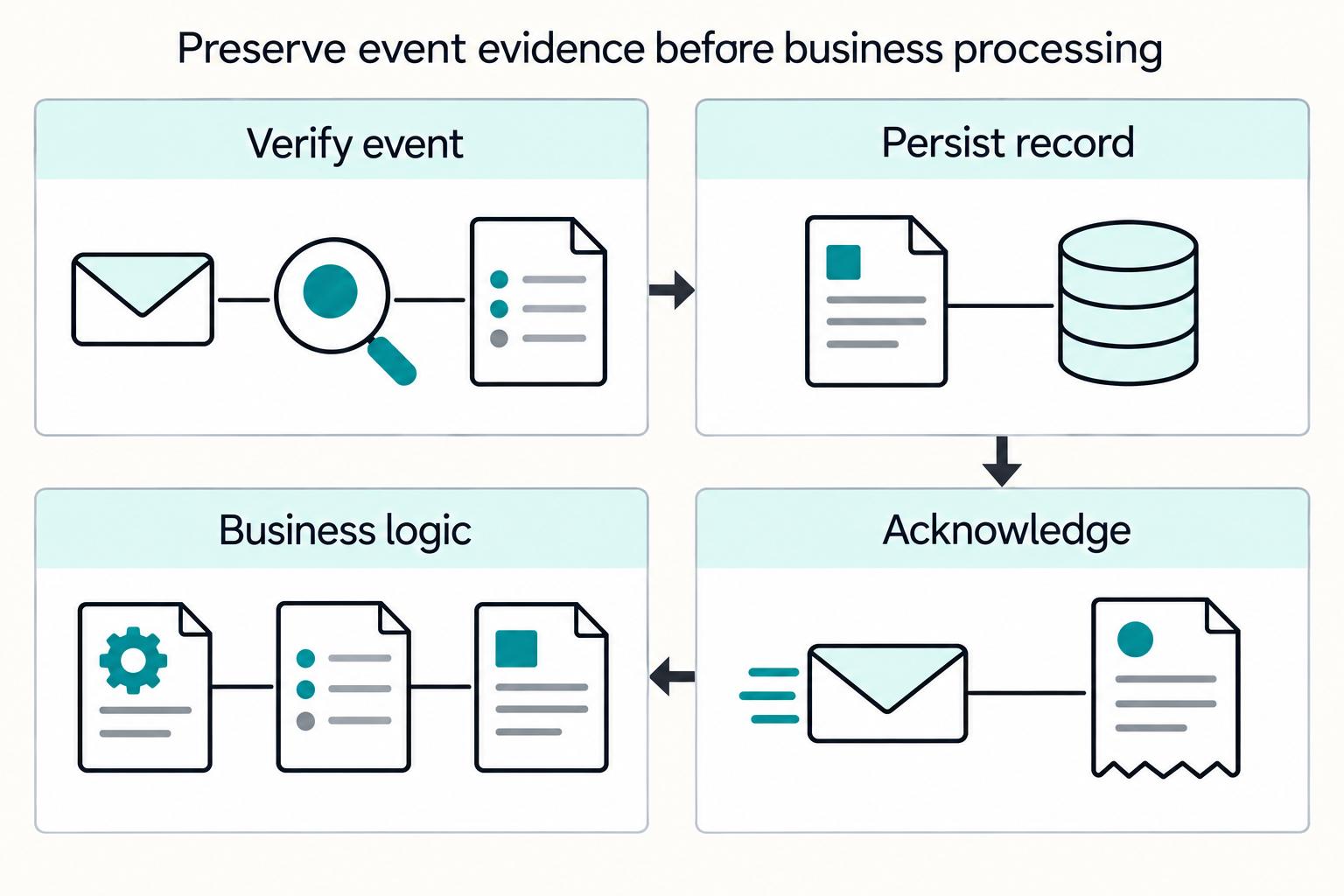
Use this order for ingestion: verify authenticity, persist to a database or queue, acknowledge receipt, then run business logic. That protects evidence if processing fails mid-flow.
Timing matters here. Adyen expects acknowledgment within 10 seconds. Otherwise delivery is treated as failing, retried three times immediately, then moved to a retry queue for up to 30 days. Stripe can automatically resend undelivered events for up to three days. Keep ingestion fast and durable, and do not put reconciliation or notification logic ahead of acknowledgment.
Store enough to reconstruct events later:
- provider event ID
- event type
- event timestamp and receipt timestamp
- signature or authenticity check result
- raw payload, or an immutable raw record plus hash
- internal invoice or transaction reference
- processing attempt count and final disposition
Process using event timestamps, not arrival order alone. Status changes can be asynchronous and delayed by seconds, minutes, hours, or days.
Report from postings and derive live views separately#
For finance reporting and near-real-time operations, keep posting status explicit and separate from provider or internal status views.
This split reduces errors from stale payloads. Some events are eventually consistent snapshots, so critical decisions should fetch the latest provider resource state instead of relying only on event payload content.
Keep status labels explicit in real-time payment flows. For example, "accepted by provider," "settled," and "reconciled" should not be collapsed into one "paid" label. Verification point: each dashboard record should clearly show state and posting status.
Predefine failure handling and replay rules#
Treat three failure modes as normal operations:
- missing provider events
- duplicate callbacks
- delayed status transitions
For missing events, run a catch-up check against expected transactions, received event IDs, and current provider state, then record any recovery action. For duplicates, design handlers and posting logic so repeated or concurrent calls do not create duplicate outcomes. For delays, keep transactions in explicit intermediate states until settlement or reconciliation evidence arrives.
Final checkpoint: sample one transaction and verify the full chain from request to final posting. Include idempotency key usage, provider responses, callbacks, retries, any latest-state fetch, and the final reconciliation outcome.
Run a 90-day pilot with explicit go or no-go gates#
The question is not whether automation ran. It is whether it improved operations without weakening control. Treat this 90-day pilot as a feasibility test before scale, and keep scope narrow enough that you can explain the results.
Limit pilot scope so results stay attributable#
Start with a narrow scope, for example one vertical in one market, so you can trust causality. This is a practical scoping choice, not a universal rule.
If customer behavior, tax handling, settlement patterns, and fraud patterns all change at once, you cannot isolate what drove the outcome. Define the pilot charter before rollout: market, vertical, owners, baseline dates, success metrics, and stop conditions. Build monitoring and evaluation in parallel with pilot design, and keep invoice, payout, and reconciliation scope explicit. Red flag: adding a second provider, market, or fraud rule set mid-pilot can break like-for-like comparisons and require a baseline reset.
Use a practical 12-week cadence and freeze the comparison set#
Use a stable cadence so gate decisions are based on like-for-like data. One workable pattern is weeks 1-2 baseline, weeks 3-8 controlled rollout, and weeks 9-12 stabilization and review.
| Phase | Weeks | What to do |
|---|---|---|
| Baseline | 1-2 | Collect the exact metrics you will use at go or no-go |
| Controlled rollout | 3-8 | Limit change volume and log every rule, exception-handling, and provider-config change |
| Stabilization and review | 9-12 | Avoid tuning unless a control issue requires intervention |
In weeks 1-2, collect the exact metrics you will use at go or no-go. In weeks 3-8, limit change volume and log every rule, exception-handling, and provider-config change. In weeks 9-12, avoid tuning unless a control issue requires intervention. Verification point: week 12 should compare consistent cohorts, not a blended view shaped by scope creep or late rule changes.
Review four gate areas with evidence, not anecdotes#
Use a gate pack that covers throughput, reconciliation, fraud, and tax. For this pilot, that is a practical minimum set for finance execution and control.
| Gate area | What to measure | Why it matters | Evidence to review |
|---|---|---|---|
| Accounts Payable throughput | Cycle time from receipt of invoice until payment is transmitted; first-time-error-free disbursements | AP automation should improve speed without adding rework | Baseline vs pilot cohort, exception logs, rework counts |
| Payment reconciliation aging | Open items by age bucket and unresolved breaks at review date | Reconciliation is a control for cash protection and record accuracy | Aging report, sampled unmatched items, ledger-to-bank tie-out |
| Fraud detection accuracy | False positive rate and review outcomes | Lower review load is not a win if bad blocks rise or risk slips through | Rule hit logs, analyst dispositions, blocked vs released samples |
| Tax compliance exception count | Exceptions tied to registration, timely filing, timely payment, and correct reporting | Operational gains do not offset compliance misses | Exception register, filing or payment misses, corrected records |
For reconciliation, review aged items with supporting evidence, not counts alone. For fraud, do not accept "accuracy improved" without a measurable false-positive rate and sampled dispositions.
Make the scale call only if gains hold without control debt#
Scale only if throughput gains hold without increased control breaches, growing reconciliation debt, or additional tax exceptions. Faster processing that leaves more aged breaks is not progress.
Before approval, ask one blunt question: if pilot volume doubled tomorrow, would the current exception-handling team, evidence trail, and reconciliation process still hold up? If not, stabilize before expanding.
Before scaling to more markets, map your pilot gates to a concrete operational flow and failure-handling model in the Payouts overview.
Build the ROI case without vendor math traps#
Build the case as an economic outcome, not a productivity story. After your pilot, count time saved as ROI only when it clearly reduces cost, cuts rework, or improves finance outcomes such as month-end close speed.
Convert pilot activity into money#
Use your pilot evidence first, not generic fintech growth narratives or broad AI benchmarks. Productivity and adoption metrics are useful inputs, but they do not establish bottom-line impact by themselves.
Tipalti's AP automation ROI structure, net annual savings divided by total initial investment, is a practical starting formula after you verify what actually changed in your operation. Keep a hard split between activity metrics and economic impact. A reported 60 hours per month saved can matter, but your case still needs evidence of changes in spend, backlog, or close timing. Verification point: tie each savings line to source records such as payroll cost, exception logs, bank fees, or close calendars.
Compare vendor evidence by what it can prove#
Treat vendor evidence differently based on what it can actually prove.
| Source | Evidence style | Transparency | Comparability | Operational relevance |
|---|---|---|---|---|
| Tipalti | Named customer case studies with challenge, solution, and results | Higher | Medium | Stronger for AP automation and close impact |
| GoGloby | Compilation of 120+ deployments across finance segments | Medium | Low | Useful for idea scouting, weak for your ROI model |
| V7 Labs | Product KPI claims such as "3x more deals screened" | Low to medium | Low | May have limited fit if your scope is payment ops or reconciliation |
| AutomationEdge | Headline improvement claims and rapid-ROI messaging | Low | Low | Hypothesis input only, not approval evidence |
If a vendor cites category growth figures, treat them as market context, not proof for your platform economics.
Add the costs vendors usually leave out#
Many ROI cases underprice downside cost. Include integration rework, exception handling, failed-payment investigation and reprocessing, and delayed month-end close risk.
Failure handling is a real cost driver. Failed payments take time to identify, resolve, and reprocess, and manual errors add exception handling and approvals. That helps explain why finance AI ROI can stay uneven in practice. In March 2025, BCG surveyed over 280 finance executives and reported mixed outcomes, with median ROI at 10% versus a 20% target. If throughput improves but exception work rises or close work shifts into the final days, pause scaling. As one finance leader said, "You can't make decisions unless you have a quick monthly close."
Common mistakes in payment automation expansion and how to recover#
Many costly mistakes happen before implementation. A common pattern is buying tools before defining what success looks like for AP, reconciliation, and fraud review.
Define acceptance metrics before you buy anything#
Set acceptance metrics first, then evaluate tools against them. Recovery starts when KPIs and OKRs are tied to business objectives rather than feature lists.
For each market or use case, keep a one-page scorecard with:
- metric
- baseline
- owner
- data source
- win condition
If a metric cannot be traced to source records, such as exception logs, ledger outputs, bank returns, or close calendars, it is probably not ready for vendor comparison. Treat proposals that promise "efficiency" or "visibility" without showing measurable reconciliation or AP impact as non-decision-ready.
Validate rail behavior by market, not by marketing copy#
Do not assume real-time payment behavior is portable across markets. Fast payment systems differ by jurisdiction in design and adoption, so fallback handling and operating procedures must be market-specific.
Use rail notes per market that cover:
- supported payout and collection rails
- status timing and finality behavior
- fallback path when a rail is unavailable or excluded
- customer support and reimbursement scope
Ground your assumptions in market reality. FedNow went live on July 20, 2023, and the ECB defines instant payments as funds made available within ten seconds, but those facts do not standardize reimbursement or dispute handling across countries. Keep domestic versus cross-border treatment explicit in support and escalation workflows. For example, UK Finance states that a payment sent overseas is not covered.
Use RPA for repetitive work, then add AI where complexity earns it#
RPA is a foundation, not a full strategy. It works well for repetitive, rules-based tasks, but complex routing, risk judgment, and exception prioritization usually need a mixed model of RPA, AI, and human review.
Recover by sequencing the work:
- automate stable repetitive work first
- add AI where decision complexity is high
- retain human review for judgment-heavy cases
Then verify outcomes, not activity. If touch time drops but unmatched items or manual overrides rise, the underlying control problem is still there.
Tune false-positive handling and assign escalation ownership#
False positives must be treated as an operating metric, not an acceptable side effect. Reducing them can lower compliance burden, especially when data quality and escalation ownership are both explicit.
Run this control loop:
- improve input data quality used in detection
- define owners for review, escalation, disposition, and reporting
- apply risk-based rules instead of one blanket rule set
- review alert outcomes each cycle: false-positive rate, missing fields, escalation time, repeat alert types
If queues grow or the same alert patterns keep returning, pause expansion and retune controls before adding more payment volume.
For a closer look at event-driven payment operations, read Webhook-Driven Payment Automation: How Modern Platforms Handle Real-Time Payment Events.
Conclusion and copy-paste launch checklist#
Automation is a finance asset when it improves controllability and evidence quality, not just task speed. Launch where your controls and reconciliation hold up under live volume, and phase markets where they do not.
Use this copy-paste launch checklist#
- Confirm baseline metrics for Accounts Payable, Month-end close, and Payment reconciliation.
Use explicit baselines, targets, and reporting periods with source records. You should be able to trace a sample item from request or invoice through approval, payment status, ledger posting, and final reconciliation. If you cannot, you do not have decision-grade evidence. IAS 7's reconciliation requirement makes this a finance control issue, not just an operations issue.
- Confirm your market comparison table is complete with controls, rails, and evidence quality.
Separate what is proven in your records from what is inferred from partner or market material. In the EU, treat the Instant Payments Regulation as a rollout input: it was adopted on 13 March 2024, follows a staggered implementation timeline, and Article 5a requires providers that offer standard credit transfers to also offer instant credit transfers. The ECB dates, 9 January 2025 for receiving and 9 October 2025 for sending in euro-area member states, are checkpoints, not a substitute for validating your own settlement, returns, and support behavior.
- Confirm pilot scope, go/no-go gates, and escalation owners are documented.
Keep scope narrow enough that failures produce clear decisions. Gate reviews should include goals, metrics, baselines, and targets, not qualitative summaries such as "looked stable."
- Confirm risk controls for fraud detection and false positives are testable.
Testability means you can show which rule fired, what evidence was captured, who reviewed it, and what happened next. If you accept or process payment cards, PCI DSS applies, including access tracking and monitoring controls. Treat false positives as a first-class metric. In one cited card-not-present context, actual fraud losses were estimated at 7% of total fraud cost versus 19% for false-positive losses.
- Confirm your ROI model includes implementation and failure-handling costs, not only productivity claims.
Include build effort, control redesign, integration rework, exception handling, support coverage, and post-launch cleanup or close-delay costs. Require a source record or accountable owner behind each benefit and cost. If the model cannot pass that check, it is not decision-ready. For deeper cost-structure detail, see AP Automation ROI for Platforms That Need a Defensible Business Case.
After you complete the launch checklist, validate market coverage and compliance gating assumptions for your rollout by contacting Gruv.
Frequently Asked Questions
How is automation finance’s greatest asset for payment platforms in practice?
Automation becomes a finance asset when it improves decisions, not just task speed. In practice, judge it by whether it improves control over reconciliation, exceptions, and auditability as you enter new markets. For cross-border operations, test every workflow against the four service problems the FSB highlights: cost, speed, access, and transparency.
Does automation replace finance teams or shift their role?
A practical framing is that it often shifts the role more than it removes it. The IMF’s framing is useful here: AI affects almost 40% of jobs globally by replacing some tasks and complementing others. OECD survey evidence also reports that four in five workers say AI improved their performance. In practice, this can mean less repetitive handling and more exception review, control tuning, escalation, and market-specific compliance checks.
Which use cases matter most beyond fraud detection?
Beyond fraud, prioritize the use cases tied to your highest-volume operational friction. Federal Reserve survey reporting points to bill payment, mobile wallet funding and defunding, account-to-account transfers, and immediate payroll as major faster-payment use cases. Choose the sequence based on the bottleneck. If your pain is unmatched or delayed items, focus on reconciliation-heavy flows first. If your pain is payout timing, prioritize routing and real-time status handling.
What proof should operators require before trusting ROI claims?
Require measured evidence from your own records, not generic ROI benchmarks. At minimum, ask for baseline and post-pilot results for exception volume, reconciliation aging, close timing, and manual review effort, with source records that verify each metric. If the case omits integration rework, manual overrides, or audit-evidence quality from request through final posting, treat it as non-decision-ready. For a deeper checklist, see AP Automation ROI for Platforms That Need a Defensible Business Case.
How should founders compare markets before committing GTM resources?
Compare markets as operating conditions, not just demand. Use the same four checks in each country or corridor: cost, speed, access, and transparency. Then validate with external evidence such as GPSS, the World Bank remittance dataset, with 367 corridors, 48 sending countries, and 105 receiving countries, plus local regulatory requirements including the EU Instant Payments Regulation adopted on 13 March 2024. Keep expectations realistic. The FSB reports only slight KPI improvement since 2023 and says global end-user gains remain limited.
When should a team choose phased rollout instead of full launch?
Choose phased rollout when controls are still unstable in the target market. Signals include recurring manual overrides, unclear fallback behavior, weak status-timing evidence, or repeated control exceptions in pilot cycles. Move to full launch only after a narrow pilot holds under live volume without increasing reconciliation debt or review queues.
Try a related tool
Where Gruv fits
See reconciliation and mismatch review
Compare ledger entries, provider payment records, and statement rows to see what matches and what finance needs to review.
Plan and approve payout batches
See how payee status, approval rules, route review, and exception handling sit in one payout workflow.
Researched and edited by the Gruv editorial team. Gruv builds cross-border billing, payouts, and finance-operations software for global businesses.
Sources
- bankingsupervision.europa.eu/ecb/pub/pdf/ssm.supervisory_guides240503_ris...trusted
- bsaaml.ffiec.gov/manual/AssessingTheBSAAMLComplianceProgram/02trusted
- bsaaml.ffiec.gov/docs/manual/06_AssessingComplianceWithBSAReg...trusted
- csrc.nist.gov/glossary/term/audit_trailtrusted
- csrc.nist.gov/glossary/term/False_Positivetrusted
- ecfr.gov/current/title-31/subtitle-B/chapter-X/part-1...trusted
- ecfr.gov/current/title-31/subtitle-B/chapter-X/part-1...trusted
- fdic.gov/frequently-asked-questions-regarding-suspici...trusted
Educational content only. Not legal, tax, or financial advice.
Related Posts
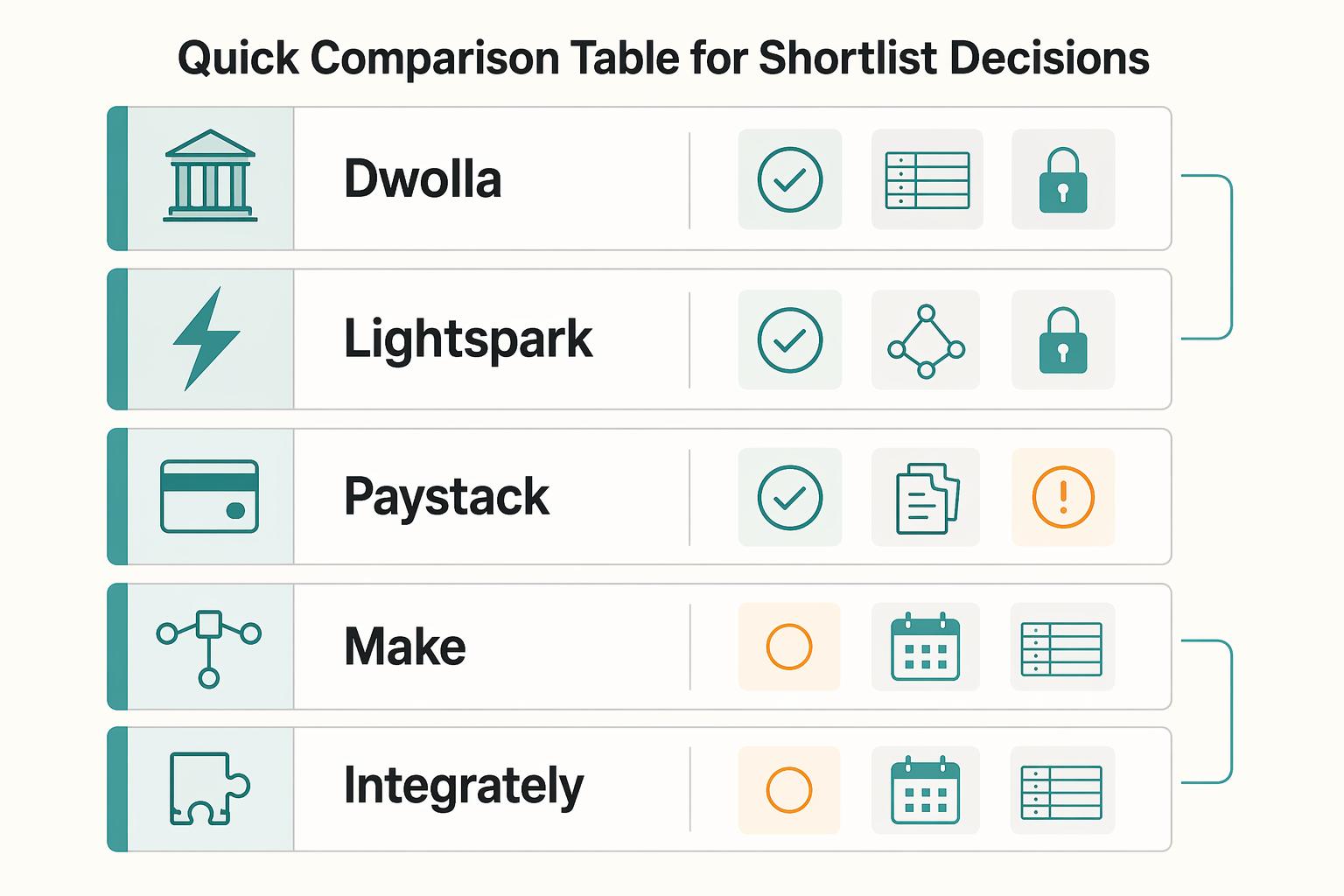
Webhook Payment Automation for Platforms: Production-Safe Vendor Criteria
This guide is for the teams that carry the operational risk after launch: product, engineering, and finance ops. If you are comparing payment automation platforms built around event callbacks, the real question is not feature breadth. It is whether the platform still holds up when payment events drive status changes, notifications, internal record updates, and accounting workflows. Providers describe this model as HTTPS callbacks, essentially an API call in reverse, and as a way to avoid constant polling. That matters, but it does not make an implementation production-safe by itself.
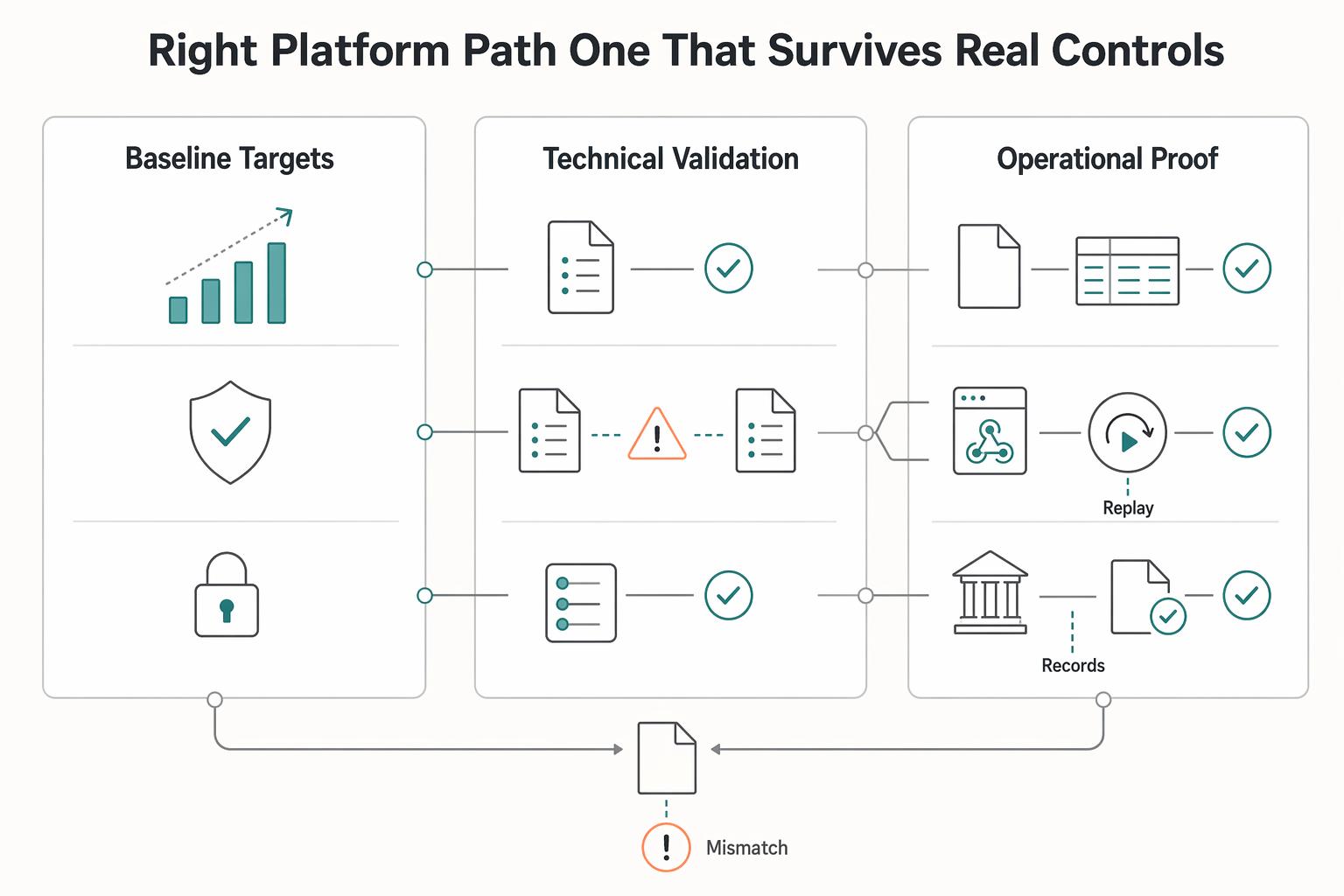
How Platform Teams Scale AP Volume Without Adding Headcount
Use this as a decision list for operators scaling Accounts Payable, not a generic AP automation explainer. In these case-study examples, invoice volume can grow faster than AP headcount when the platform fit is right, but vendor claims still need hard validation.
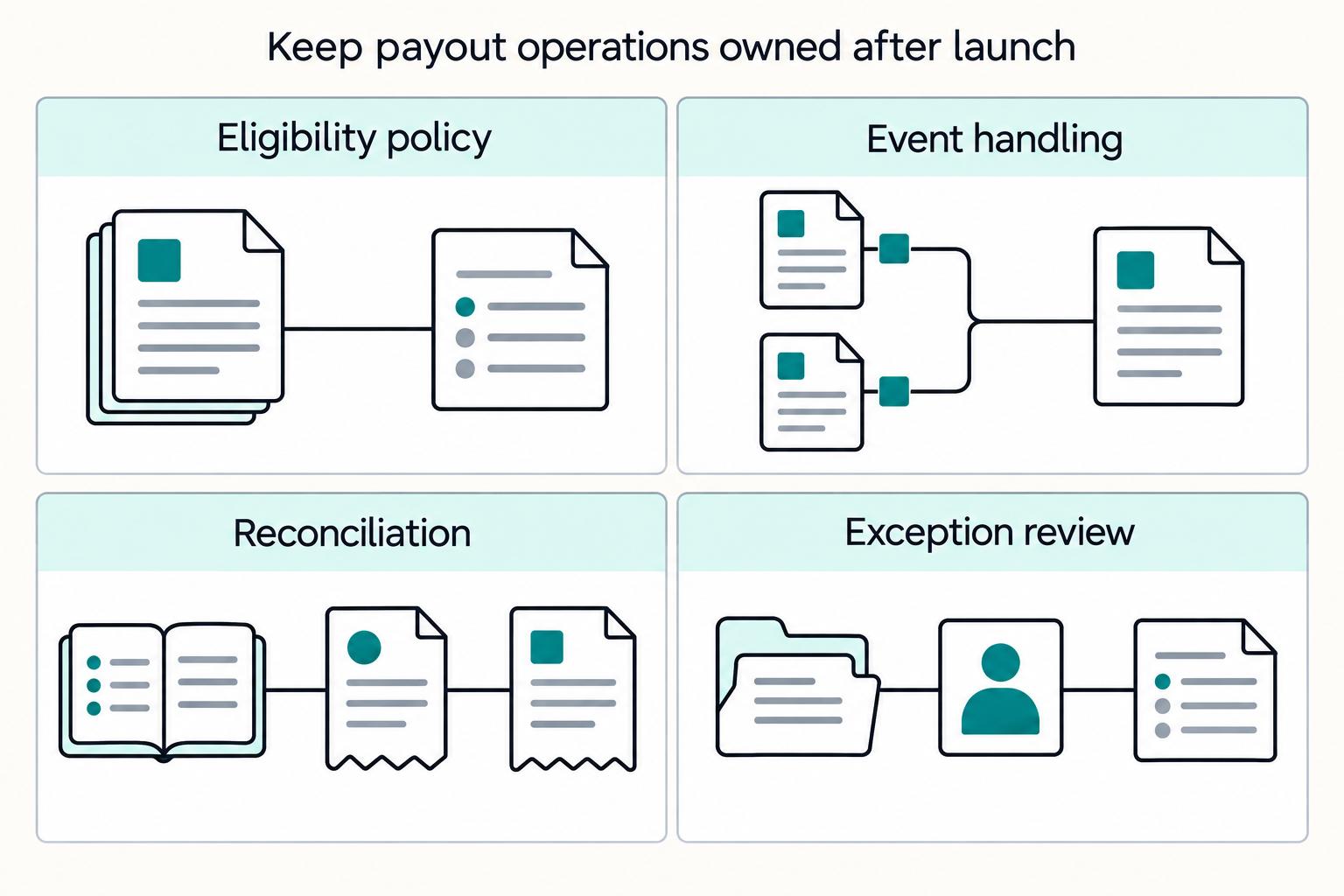
When Instant Payout Matters for Gig Platform Payments
Instant payout is a tool, not the goal. The real operating decision is where instant timing creates measurable value, where batch timing is enough, and where both should run side by side.