
Quick Answer
Map each store to the receiving bank country and currency, compare supported payout paths, then confirm your account’s eligibility before a controlled pilot. Choose between local banking, ACCS, Seller Wallet or a participating PSP by FX control and actual cost. Keep unknowns labelled during discovery and reconcile the first live transfer before increasing volume.
Why payout architecture should be your first expansion decision#
People often treat international Amazon seller payouts like a settings page. That's the wrong starting point. Your payout setup is an operating choice that shapes who controls FX, how quickly you can launch, and where issues show up after you go live.
Start with operating ownership#
Treat payouts as part of market entry. Amazon offers international selling tools, including currency conversion and wallet services, but each service’s store coverage and account eligibility need separate checks.
That matters because money movement is not incidental to expansion. It sits alongside listing, shipping, and supply chain decisions. Those paths are not identical. Depending on the setup, you may get different levels of treasury control, setup effort, and operational dependency between Amazon disbursement and your bank. If you decide late, finance ends up cleaning up a commercial decision it did not make.
Before you approve any new marketplace launch, answer three basics: who owns FX conversion, which account receives settlement, and what fallback path exists if the primary payout route cannot be used.
Separate public guidance from account proof#
Public Amazon pages establish service features and coverage. Use them to compare options, then confirm the account-specific setup and receiving-bank details required before live operation.
What you still need to verify in your own account are the exact options shown in Amazon Seller Central and any setup fields or onboarding steps tied to your entity and bank details.
That discipline prevents an avoidable failure mode. Teams commit GTM spend based on a general expansion page, then find that the payout route they expected is not the one available in their account or is harder to operate than expected. Before you lock a launch date, capture screenshots of the payout options visible in Amazon Seller Central, note the date, and save the exact labels shown. That gives finance, legal, and the operator owner one shared evidence trail.
Set decision criteria before comparing options#
Set decision criteria before you compare providers. If you do not define the test up front, every payout path will look plausible. The useful checkpoints are simple:
- Map control needs. If treasury control is the priority, weight that above launch speed.
- Map dependency risk. Count how many parties sit between Amazon and your operating cash.
- Map verification burden. Prefer the option you can document and reconcile from day one.
The right outcome here is a shortlist, not a final answer. The next sections turn those checkpoints into a country-, currency-, and evidence-based decision instead of guesswork. You might also find this useful: Southeast Asia eCommerce Market Guide: Marketplace Payouts and Seller Compliance.
What to prepare before choosing a payout setup#
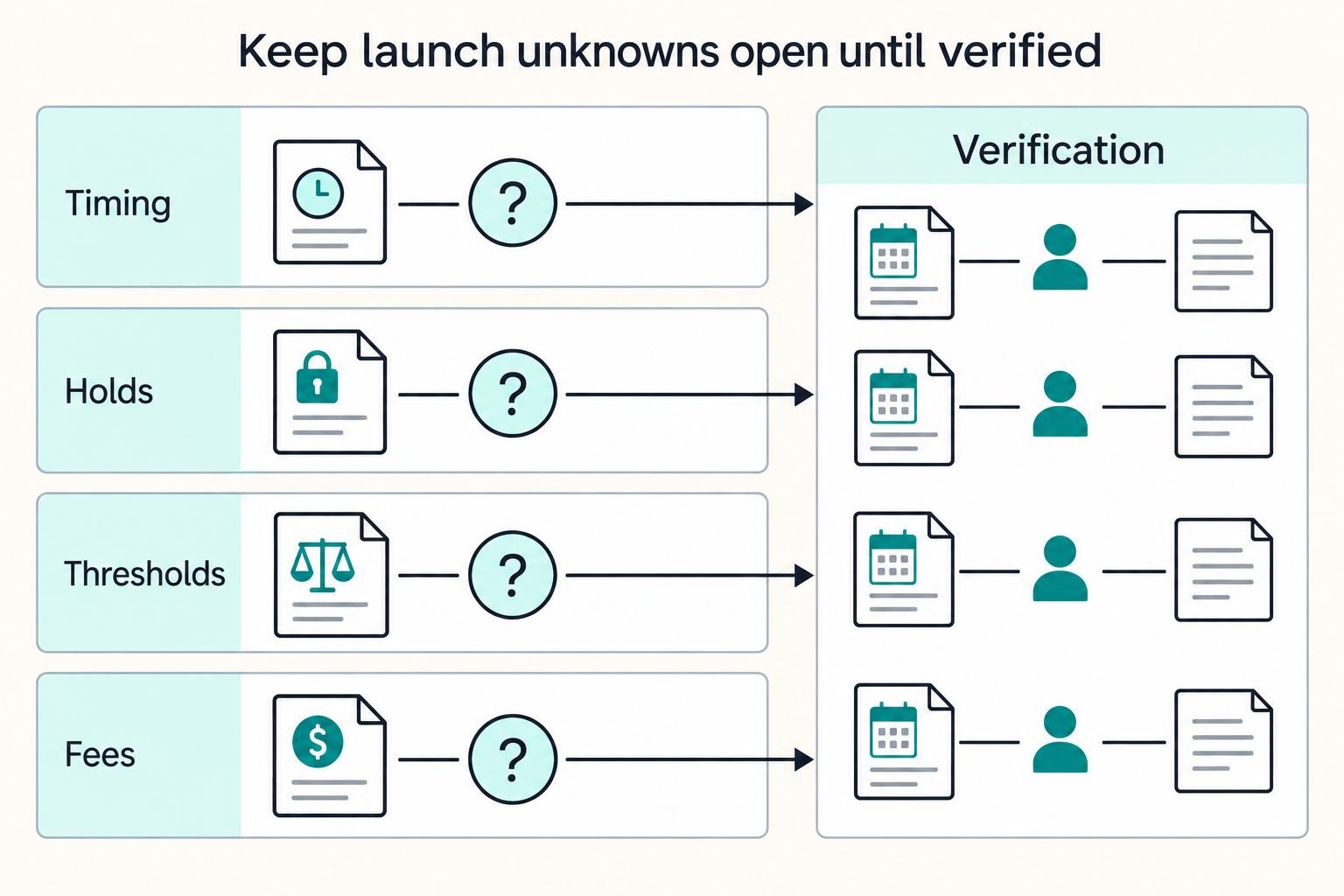
Start a market-by-market decision sheet with the facts you have and labelled gaps. Use it to compare payout options and ask partners or Amazon support about unresolved entity, bank and currency requirements.
Map stores, currencies, and entity owners#
Start with your target Amazon marketplaces and map each one to:
- marketplace
- intended settlement currency (for example USD, EUR, GBP, JPY)
- legal entity owner
Record the intended entity owner for each route, or label ownership as an open decision. Confirm ownership and required documents before registering the live deposit method.
Filter your plan against Amazon disbursement support#
Use the current Amazon disbursement support list in your workflow and annotate it against your plan. Mark the bank-country and currency combinations you may need, and flag anything that still needs in-account verification in Seller Central.
A route that appears unsupported needs investigation, not an automatic stop to comparison. Check supported alternatives such as another bank destination or participating PSP. Do not use a confirmed unsupported route for live disbursements.
Lock constraints and the evidence pack#
Record your current constraints and open questions while comparing options:
- acceptable disbursement cycle
- tolerance for international transaction fees
- whether local bank account opening is operationally feasible
Build the evidence pack as diligence progresses: dated account views, source-page IDs, bank onboarding requirements and owner decisions. Missing screenshots need not stop initial comparison; resolve the actual setup requirements before live use.
Build a country and currency eligibility matrix#
Use this matrix during discovery and launch planning. Separate published support, account-specific questions and confirmed restrictions. Resolve the receiving route before live launch; provisional budgets and comparison can proceed with explicit assumptions and contingencies.
Build one row per payout corridor#
Turn each planned launch into one corridor row with six fields: Amazon Marketplace store, receiving bank country, allowed payout currency, local-currency-only rule, confidence level, and evidence reference.
| Amazon Marketplace store | Receiving bank country | Allowed payout currency | Local-currency-only rule | Confidence level | Evidence reference |
|---|---|---|---|---|---|
| Planned store | Planned bank country | Planned currency | TBD | published support / account confirmation pending / confirmed unsupported | saved screenshot or help-page title |
| Exception row (if needed) | Planned bank country | Planned currency | TBD | account confirmation pending | exception note, approver, screenshot |
Keep rows granular. If entity ownership or bank setup differs by region, split the rows instead of applying one broad assumption across multiple corridors.
Use confidence labels that match your proof#
Use separate labels for published support, account confirmation pending and confirmed unsupported. A missing reference means the route is unverified, not that Amazon prohibits it.
| Confidence label | Use when | Action |
|---|---|---|
| published support | Current Amazon documentation lists the route or service | Save the source and check account-specific setup |
| account confirmation pending | Eligibility or configuration remains unclear | Compare alternatives and resolve the question before live use |
| confirmed unsupported | Current Amazon rules or account verification exclude the route | Select a supported alternative before live launch |
Seller Central help is account-gated in places ("Sign in to use the tool and get personalized help (desktop browser required)") and can be scope-limited ("This article applies to selling in: United States"). Use those markers as constraints, not global rules. Where translations exist, keep the English reference in your evidence pack because "the English version will control."
Separate exceptions and resolve them before live use#
Track exceptions in separate rows, including Hong Kong-related assumptions on Amazon.com, and keep them qualification-dependent until verified. Do not hide exception logic inside standard rows.
Keep the Hong Kong exception distinct from standard routes. During comparison, record available facts and questions; before live use, confirm the account’s currency option and qualification or select a supported alternative. Uncertainty does not require stopping all market research or provisional budgeting.
Compare the three payout paths against operating tradeoffs#
After you build the corridor matrix, compare payout paths as planning options, then confirm what your account actually supports before you commit rollout.
Rank each path by control, setup burden, and failure risk#
Use this to structure decisions, not to prove availability.
| Path (verify in account) | Setup burden | FX control | Operational dependencies | Change risk | What breaks first |
|---|---|---|---|---|---|
| Local in-market bank account | Highest; typically heavier legal/entity/banking setup. | Highest; conversion timing and policy stay closer to your treasury process. | Bank onboarding, ownership matching, and marketplace-to-entity mapping. | Higher upfront execution risk. | Bank-country/currency mismatch, local-currency constraints, or owner-document mismatches. |
| Amazon-side conversion option (for example, ACCS if shown) | Lower to moderate when available. | Lower; conversion sits inside Amazon's option. | Account-level eligibility and current in-account terms. | Higher exposure to account-level option or fee presentation changes. | Option not shown for the account/corridor, or cross-currency net proceeds shift. |
| Third-party conversion service (if permitted) | Moderate; adds external onboarding and reconciliation. | Medium to high, depending on provider flow. | If the service receives Amazon proceeds as a PSP, it must participate in Amazon’s PSP Program; check onboarding and reconciliation | Medium to high from added dependency. | Unsupported corridor, onboarding delays, transfer mapping failures, or reconciliation drift. |
Verify the exact label and scope in Seller Central#
Do not treat public or third-party summaries as confirmation of payout method eligibility. For each target store/entity/bank-country combination, save the exact in-account label, marketplace scope, date, and screenshot ID. If you cannot produce that evidence, keep the row at requires Seller Central sign-in verification.
Match the path to your change tolerance#
Compare conversion control and actual setup effort. ACCS converts proceeds for supported local bank destinations; Seller Wallet lets eligible sellers choose when to transfer or convert. A PSP adds a provider relationship and may offer different currency controls. If it receives Amazon proceeds, check Amazon’s PSP Program requirement; an FX service used after bank receipt is a different role.
Keep sales reserves, marketplace disbursement and onward transfer timing separate. Amazon’s delivery-date reserve guidance describes the standard DD+7 reserve, but your account’s reserve and disbursement settings determine availability. Model working capital from those settings and bank transit rather than assuming a fixed 14–21-day cash gap.
Decide when Seller Wallet should be primary and when it should be fallback#
Select Seller Wallet as a pilot option when its store coverage, account eligibility and treasury controls fit. No prior successful wallet transfer is needed to choose the first contained pilot. Resolve enrollment and bank requirements first, then test transfer timing and reconciliation before increasing volume.
| Check | What to record | If not confirmed |
|---|---|---|
| In-account page evidence | Page title, date, marketplace, screenshots, transfer options, exchange-rate treatment, international transaction fees, and disbursement-cycle wording | Resolve account-specific enrollment and bank requirements before live transfer; retain a supported alternative where feasible |
| Fee sensitivity | Scenario bands, internal review triggers, international transaction fees, and cross-currency proceeds received | Investigate unexplained fees before increasing volume; compare the actual alternatives |
| Timing pilot | One contained first pilot, with an alternative route or a documented response if transfer is delayed | Investigate timing or amount differences before increasing volume; a prior live cycle is not required to start the pilot |
Capture the in-account evidence first#
Identify the wallet variant first. Amazon’s March 2026 update confirms Seller Wallet USD for the US store and a separate EUR wallet for Germany, France, Italy, Spain, Belgium, Ireland and the Netherlands. Record the target store, variant, bank destination and actual account terms; do not apply USD-wallet fees to EUR by assumption.
If account access or a setup option is unclear, keep the question open during comparison and obtain the relevant enrollment or support answer before live transfer. A missing account page does not make the service universally unavailable.
Model fee sensitivity without fixed assumptions#
Amazon’s public USD-wallet pricing bases international transaction tiers on total cross-currency net proceeds over the trailing 12 months across all Amazon stores, with currency-specific exceptions. Use the actual transfer quote and applicable variant’s pricing rather than assuming rates are unavailable publicly or identical for EUR.
Track effective cost from actual transfers, including the conversion quote, transaction charge and bank credit. Investigate unexplained month-end fees and compare alternatives before increasing volume.
Validate timing with one controlled pilot#
Run one contained first pilot to test the chosen route. Distinguish sales proceeds becoming available, disbursement into a wallet and onward bank transfer. Keep a supported alternative or a documented delay response where feasible.
Judge the pilot by documented amounts and expected timing at each step. Allow for disclosed fees, FX and bank posting differences; investigate unexplained variances before increasing volume. For a cross-platform comparison, see How to Get Paid on Etsy as an International Seller: Fees Currency and Tax Guide.
Plan treasury and reconciliation before first live disbursement#
Before you scale volume, lock down reconciliation. If you cannot trace a payout from Seller Central to the bank ledger by marketplace and currency, the setup is not operational yet.
-
Define internal payout states and evidence rules. Use
initiated,converted,transferred,failedandreversedas illustrative internal states, not claimed Amazon API labels. Store timestamps, marketplace, currency, amount and supporting wallet, Seller Central and bank records. -
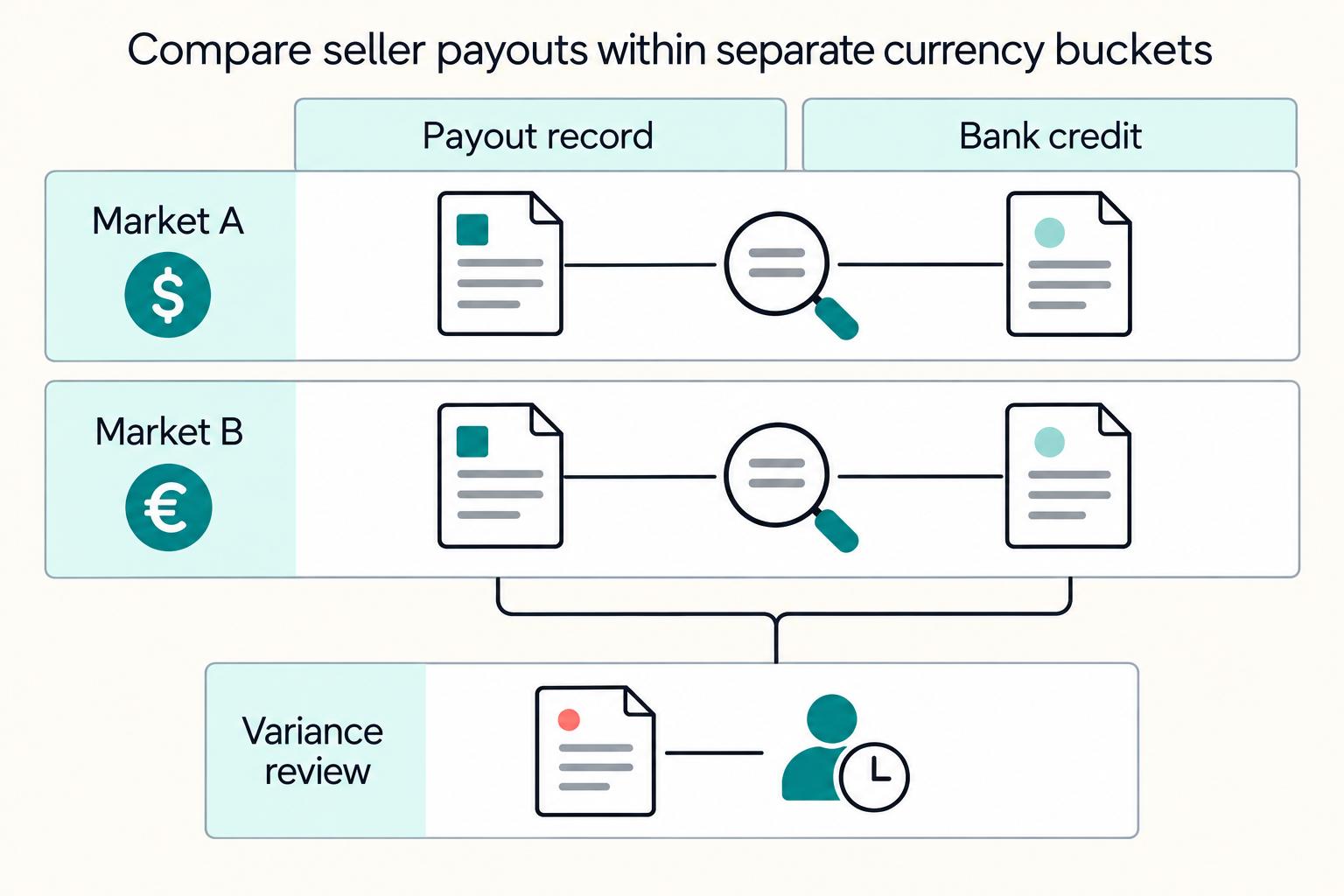
Reconcile by marketplace and currency bucket, not in aggregate. Keep Amazon.com separate from non-US stores, and track USD, EUR, GBP, JPY, and HKD in distinct buckets. For each bucket, compare expected disbursement amount, posted bank credit, posting date, and any gap tied to conversion or bank handling, with clear export and transaction references.
-
Set exception handling for timing mismatches before go-live. Define your own owner, review window, and escalation path. If Seller Central shows a payout but the bank credit is missing in your window, open an exception with the Seller Central payout record attached.
-
Review variances before scaling. Compare stores and currency buckets on a schedule suited to your volume. Assign unexplained differences and resolve material control gaps before expanding live coverage; small explained fees or timing differences need not make the whole process fail.
Set compliance and tax checkpoints for international payout expansion#
Make reporting ownership explicit before you expand any payout corridor. If you cannot show who owns foreign-account evidence for the target entity, delay launch in that corridor.
-
Assign each payout account to a named reporting owner and evidence file. Treat every receiving account as a compliance record, not only a bank endpoint. For each route, document the legal entity, finance owner, tax reviewer, and where launch evidence is stored so ownership is clear from day one.
-
Assess the relevant U.S. reporting rules. FBAR applies to U.S. persons with financial interest in or signature authority over reportable foreign accounts when aggregate value exceeds $10,000 at any time in the calendar year. Form 8938 has different specified-filer, asset and threshold rules and is attached to an income tax return; no required return generally means no Form 8938. For an unmarried specified individual living in the US, the thresholds are more than $50,000 at year end or $75,000 at any time. Joint/abroad thresholds and specified domestic-entity rules differ. Use current IRS and FinCEN instructions for the actual entity and account.
-
Design payout accounts so finance and tax can trace disbursements quickly. Keep routes structured so a reviewer can start from a disbursement, identify the receiving account and entity, and determine whether that account enters Form 8938 or FBAR review where applicable. If that trace path is unclear, your payout setup is ahead of your controls.
-
Require legal and tax review before each new corridor launch. Confirm the planned account structure can be opened, documented, and owned by the intended entity in each target market. Decision rule: if reporting ownership is unclear, postpone that corridor rather than backfilling controls after live disbursements begin.
Keep reporting records linked to the account and entity, alongside the payout references used for reconciliation.
Common mistakes that delay international payouts and how to recover#
Avoid treating assumptions as policy. Confirm the receiving route before live use, then use the first pilot to validate behavior before increasing volume. Continue discovery and planning with gaps explicitly labelled.
| Mistake | Recovery |
|---|---|
| Treating setup labels as final approval | Confirm required account setup and operational controls before live use; keep unresolved questions labelled during planning |
| Scaling markets before validating first disbursement behavior | Investigate material unexplained variances in a contained pilot before increasing volume |
| Ignoring net-proceeds changes until costs spike | Run a monthly review of payout outcomes and trigger route checks when your realized proceeds or fee impact shifts |
| Treating forum or vendor guidance as policy truth | Use third-party content as a warning signal only; do not let Seller Forums or blog guides decide operating policy |
- Use Amazon policy and current product documentation for requirements. A forum post written by an Amazon representative can help locate an official rule, but distinguish it from seller anecdotes and confirm the rule’s applicable store/account scope.
If you want a deeper dive, read eCommerce Reseller Payouts: How Marketplace Platforms Pay Third-Party Sellers Compliantly.
Final recommendation and copy-paste launch checklist#
Compare supported routes with available facts and labelled gaps, confirm account eligibility before live use, validate a contained first pilot, then increase volume as material control gaps are resolved.
Confirm the route before you approve the market#
Confirm the target store, receiving bank country, and settlement currency as one route, not separate checks. Start with Countries, regions, and currencies supported by Amazon for disbursement, then re-check the exact bank-country and currency pair in Amazon Seller Central.
Keep a dated screenshot from Seller Central showing the store, bank country, and settlement currency. If the signed-in view is unclear, treat that corridor as not approved and use your fallback path or delay launch.
Pick a primary path and a fallback#
Choose a primary pilot route: local banking, ACCS, Seller Wallet or a participating PSP. Document a feasible alternative or delay response before go-live; do not require a previous wallet pilot to select the first one.
If you plan to use Seller Wallet, document assumptions for fees, exchange rates, and disbursement cycle before the first transfer lands. Keep your evidence pack with the in-account fee view, the month reviewed, and the cross-currency proceeds context used.
Run one pilot before you expand#
Start with one contained pilot. Reconcile marketplace, wallet/provider and bank records, explaining fees and timing differences; resolve material unexplained variances before increasing volume.
Assign a reconciliation owner, set a variance threshold, and define an escalation path for amount or timing mismatches. Require one full live cycle with documented amounts, dates, FX assumptions, and any reversals or delays.
Map tax and compliance ownership before scale-up#
Map tax and compliance ownership before scale-up, especially for foreign financial accounts. For U.S. reporting, this checklist should include Form 8938 and the FinCEN FBAR reporting area.
Form 8938 applies to specified filers and foreign financial assets above their applicable thresholds. For an unmarried specified individual living in the US, the limits are more than $50,000 at year end or $75,000 at any time; other filing/residence and domestic-entity rules differ. FBAR separately tests U.S. persons, reportable foreign accounts and aggregate value over $10,000 at any time. Determine the actual scope using current IRS and FinCEN instructions, not seller geography alone.
- Confirm target market appears in
Countries, regions, and currencies supported by Amazon for disbursement - Validate bank country and settlement currency pair in Amazon Seller Central
- Choose primary pilot path: local banking, ACCS, Seller Wallet or participating PSP
- Document Seller Wallet assumptions for fees, exchange rates, and disbursement cycle
- Define reconciliation owner, variance threshold, and escalation path
- Assess applicable foreign-account reporting for the actual entity and accounts; assign evidence and filing ownership
- Resolve material unexplained pilot variances before increasing volume
Frequently Asked Questions
How do international Amazon seller payouts work across Amazon Marketplace stores?
Amazon says you must provide a bank account in a country it supports when you sell outside your business location. Treat each store-to-bank route as a separate setup check, because marketplace availability alone may not confirm the receiving bank country and disbursement currency combination you need. Verify the route in Amazon Seller Central.
Can I receive payouts in my local currency through Amazon Currency Converter for Sellers (ACCS)?
Sometimes, but do not reduce this to "ACCS equals any local currency." Amazon's public help says disbursements can only be made in the local currency of the country or region where the bank account is located, unless a documented exception applies. The main risk is assuming the currency name you want is enough without checking whether your bank country is supported for that route inside Seller Central.
When should I choose a local bank account instead of ACCS or a third-party conversion service?
Choose a local bank account first when you can open one in a supported country and you want the simplest match to Amazon's default disbursement rule. That usually reduces ambiguity because Amazon gives a clear example: if your bank account is located in the United States, disbursements can only be made in USD. If you cannot open the local account you need, compare ACCS or another provider using available support information, then confirm the chosen route before live use.
Does Amazon support USD payouts outside the United States, including Hong Kong cases?
Yes, but not as a general rule across all stores. Amazon documents a specific Amazon.com case where qualified sellers with a USD-denominated bank account opened in Hong Kong can choose to receive proceeds in HKD or USD. The qualification Amazon names is cross-currency net proceeds of ≥ USD 100K during the trailing 12 months across all Amazon stores, so treat anything beyond that exact case as unconfirmed until you see it in your account.
What determines Seller Wallet international transaction fee tiering?
For Seller Wallet USD, Amazon publicly bases international transaction tiers on total cross-currency net proceeds during the trailing 12 months across all Amazon stores. Currency and transfer type affect the applicable charge. Check the current quote and account terms, and use the separate pricing for EUR-wallet flows rather than assuming one table covers both variants.
What payout details can only be confirmed after signing in to Amazon Seller Central?
Some payout-policy details are account-gated, and Amazon explicitly says to sign in to get personalized help, using a desktop browser. In practice, that means signed-in views are needed for account-specific eligibility and payout setup details that are not fully visible on public help pages. If you are making an expansion decision, do not rely on a public article alone when the help page itself says the final answer is personalized.
Try a related tool
Researched and edited by the Gruv editorial team. Gruv builds cross-border billing, payouts, and finance-operations software for global businesses.
Sources
Includes 4 external sources outside the trusted-domain allowlist.
- fincen.gov/report-foreign-bank-and-financial-accountstrusted
- irs.gov/businesses/corporations/do-i-need-to-file-fo...trusted
- irs.gov/instructions/i8938trusted
- aboutamazon.com/news/small-business/its-now-easier-for-selle...external
- sell.amazon.com/tools/seller-walletexternal
- sellercentral.amazon.com/help/hub/reference/external/GY8JTVAWBPQT2XFCexternal
- sellercentral.amazon.com/help/hub/reference/external/G200497780external
Educational content only. Not legal, tax, or financial advice.
Related Posts

How Marketplace Platforms Pay Third-Party Sellers Compliantly
Generic marketplace payout advice usually skips the part that breaks in production. Paying many sellers is not just moving money out. It is deciding who gets paid, when they become eligible, what happens when a buyer disputes a payment, and how finance proves every release later. If you are working on **ecommerce reseller payouts marketplace platforms pay third-party sellers**, this guide is for the marketplace operator, not for solo freelancer banking tips.
Etsy International Seller Payouts: Eligibility, Payoneer and Cash Flow
Etsy international seller payouts depend on the shop’s seller and receiving-account setup. Selling to a new buyer country does not, by itself, mean opening a seller account or receiving bank account in that country. Start with the existing shop’s approved payment route, then evaluate shipping, demand and local selling obligations for the buyers you want to reach.

Southeast Asia Marketplace Payouts: Six Local Routes
A Southeast Asian marketplace needs a dependable way to turn collected customer money into the amounts owed to sellers. Start with who owes whom, which entity holds the money, the permitted funds flow and each seller’s receipt currency. Domestic payout rails help deliver those amounts; they do not decide ownership, tax duties or permission to hold seller funds.