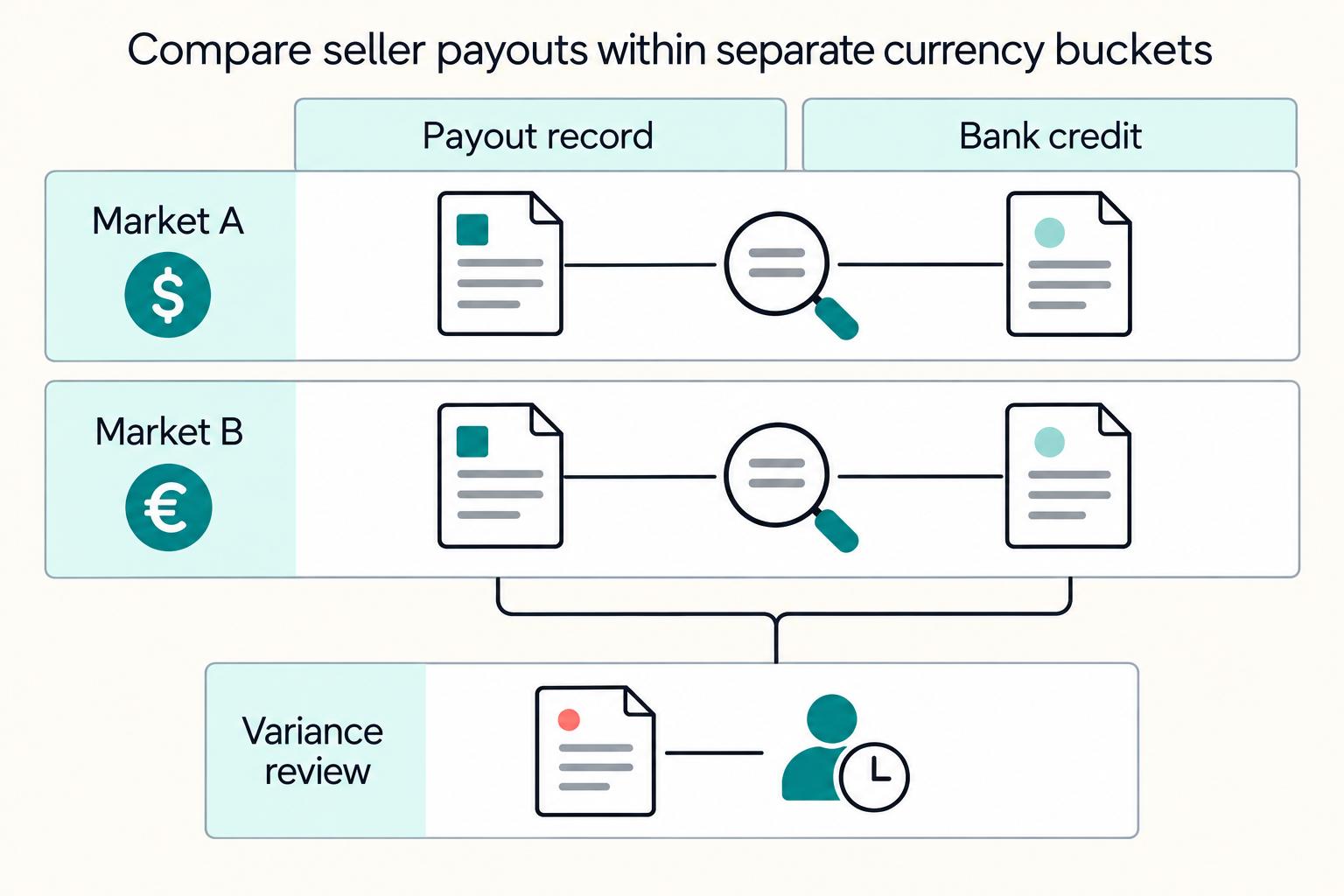
Screen markets one by one and keep any unclear country in research. Approve rollout only after you save a dated Etsy excerpt for eligibility, assign the onboarding lane, and confirm deposit behavior for the bank country on file. Treat Bulgaria, Croatia, Czech Republic, Hungary, Poland, and Romania as mandatory EUR checks because bank FX fees can change net payout. Move forward only when payment-method evidence and named owners for open risks are documented.
Treat Etsy international seller payouts as a market-by-market screening exercise, not a generic marketplace capability. The real question is straightforward: can this seller entity in this market onboard, get paid, and protect margin under the payout and currency conditions that apply?
Do this work before you spend on localization, inventory placement, or launch operations. Etsy confirms the basic building blocks: Etsy Payments handles checkout, buyer payment methods vary by market, and for certain newly supported countries outside U.S. territories, Etsy uses a Payoneer partnership to help sellers get paid in local currency. What the provided excerpts do not fully resolve is every rollout rule you will need, so this guide separates confirmed Etsy statements from the items you still need to verify.
Before you start. Use Etsy primary materials as your baseline, especially the Etsy Seller Handbook and recent Etsy updates tied to your target markets. A useful anchor is the Seller Handbook expansion announcement dated March 26, 2025. It names South Korea, Serbia, Pakistan, Georgia, Egypt, Brazil, United Arab Emirates, Kazakhstan, Puerto Rico, Guam, U.S. Virgin Islands, and American Samoa.
Use that announcement as evidence, not as a full eligibility matrix. By itself, it does not settle every payout, currency, or onboarding detail you need for launch.
Follow this decision sequence. Work through the decision in this order so each market gets a clear status:
Confirm whether support is clearly stated for each target market. Outcome: each country is labeled launch, research, or no-go.
Separate straightforward enrollment from markets where Etsy's Payoneer partnership may shape setup and support dependencies. Outcome: you know whether rollout depends on an additional payout intermediary.
Once eligibility is clear, assess listing currency, deposit assumptions, and potential FX pressure on margin. Outcome: you can judge payout economics before launch.
Etsy says payment options are market-dependent and may include PayPal, cards, Etsy Gift Cards, and Etsy Credits. Checkout flexibility may help demand, but it does not confirm payout feasibility for your setup. Outcome: you confirm checkout support and payout viability in the same market.
Track questions Etsy public materials do not close, then assign owners and deadlines before launch approval. Outcome: no market moves forward on assumptions alone.
Separate confirmed facts from rollout risk. Do not treat checkout expansion as automatic payout certainty. Also account for the adjacent blocker Etsy calls out: most international buyers only see items that ship to their country while searching on Etsy. Etsy also directs sellers to manage shipping destinations through its Help guidance. Shipping destinations are part of payout-market viability, not a later merchandising task. If listings are not set to ship to the target country, demand can look weaker than it really is.
Use one practical checkpoint per market: save the exact Etsy excerpt that supports eligibility, then pair it with one open question still requiring proof. If you cannot show both, the market is not ready for launch commitment.
If you want a deeper dive, read How to Get Paid on Amazon Marketplace: Payout Options for International Sellers.
These payouts are country-specific, not one global model. The scope is Etsy's payments program plus country-level eligibility and deposit rules: how buyers pay, how seller funds are routed, and which market constraints apply.
Start with what Etsy clearly says. The program lets sellers accept multiple buyer methods on Etsy, including cards, PayPal (where available), Pay by Bank, Apple Pay, and Google Pay. Where PayPal is available, it is processed through Etsy Payments, and Etsy says those funds are not paid into your own PayPal account.
On timing, Etsy gives a planning example rather than a universal SLA. If weekly deposits are selected, Etsy says it sends funds every Monday, and banks typically make them available in 2 to 3 days.
"International" is not one rule set. Etsy says payment services are available only in certain countries, and the eligibility page is the operational source of truth.
| Market or category | Confirmed note | Operational effect |
|---|---|---|
| Countries marked with an asterisk | Sellers can accept Etsy Payments with a Payoneer Payment Account | Onboarding includes an added dependency |
| China | New shops cannot currently open there | Only already-open shops can use the program |
| Türkiye | PayPal is not available to Etsy Payments sellers located there | This is a PayPal availability limitation |
These exceptions are not interchangeable: asterisk markets add a Payoneer Payment Account dependency, China is limited to already-open shops, and Türkiye has a PayPal availability limitation.
Do not approve a market until you have checked the exact country entry. In Bulgaria, Croatia, Czech Republic, Hungary, Romania, and Poland, Etsy says it sends EUR to the bank account on file, and banks may charge foreign exchange fees when converting those funds.
| Country | Deposit currency note | Bank note |
|---|---|---|
| Bulgaria | Etsy says it sends EUR to the bank account on file | Banks may charge foreign exchange fees when converting those funds |
| Croatia | Etsy says it sends EUR to the bank account on file | Banks may charge foreign exchange fees when converting those funds |
| Czech Republic | Etsy says it sends EUR to the bank account on file | Banks may charge foreign exchange fees when converting those funds |
| Hungary | Etsy says it sends EUR to the bank account on file | Banks may charge foreign exchange fees when converting those funds |
| Romania | Etsy says it sends EUR to the bank account on file | Banks may charge foreign exchange fees when converting those funds |
| Poland | Etsy says it sends EUR to the bank account on file | Banks may charge foreign exchange fees when converting those funds |
Also keep Etsy's policy control visible: if account funds are insufficient, Etsy may charge the card on file for amounts owed. In practice, if eligibility, onboarding lane, or deposit-currency behavior is not explicit by country, keep that market in research until you have the exact excerpt and capture date saved.
Related: eCommerce Reseller Payouts: How Marketplace Platforms Pay Third-Party Sellers Compliantly.
Before you compare markets, pull the inputs together. You need a current evidence pack, bank-account setup inputs, a payment-method proof checklist, and a decision log. That keeps decisions tied to what Etsy currently states, not what your team assumes.
Create one market file per country. Save the exact Etsy Help or policy excerpt, the URL, and the capture date for every conclusion you plan to use. The Seller Handbook includes a Site Updates section, so track it for change monitoring, but do not treat it as complete launch guidance.
A good market file shows the exact Etsy page behind each claim and a short note on what it confirms. If another reviewer cannot verify your conclusion from that file, keep the market in research.
Collect payout-account inputs early. Etsy states that available sales funds are deposited to the bank account on file for Etsy Payments according to the deposit schedule. Capture the bank-account country, the account name, and whether that name matches the legal or business identity you will use on Etsy.
Record two constraints up front. Required bank-account input format varies by country, and some sellers must update bank details through a Payoneer Payment Account instead of Etsy's direct flow. Also keep the timing risk visible. Etsy says net earnings become available for deposit 5 days after a bank-account update.
Build a simple matrix for priority markets with the payment methods you need to verify as rows or columns. Mark each item as documented, not documented, or needs verification, and require a source URL plus capture date for anything marked documented.
Use the matrix as a verification tool, not a memory aid. If the source is missing, the item stays unknown.
For each market, require three fields: confirmed fact, unknown risk, and owner for verification. This makes unresolved items explicit before they turn into launch assumptions.
Keep the log live through rollout. If a launch-critical point is not tied to a current Etsy source, treat it as unresolved and keep that market in research.
For a step-by-step walkthrough, see What Is a SWIFT Code? How Platforms Use BIC Codes to Route International Payouts.
Country eligibility is a hard gate. This source pack does not confirm Etsy payout-country eligibility rules on its own, so keep a market in research unless current Etsy documentation confirms its path.
Your evidence pack can include useful tax and cross-border context, but that does not confirm payout eligibility. Keep confirmed Etsy evidence separate from team inference so assumptions do not quietly become launch decisions.
Start with one row per market and keep the same fields for every row:
| Country | Etsy Payments eligible status | Payoneer Payment Account required | Caveats | Launch recommendation |
|---|---|---|---|---|
| China | Unverified from current section sources | Unverified from current section sources | Require current Etsy documentation before decision | Research |
| United Arab Emirates | Unverified from current section sources | Unverified from current section sources | Do not infer from nearby markets or internal memory | Research |
| Puerto Rico | Unverified from current section sources | Unverified from current section sources | Require direct documentation before decision | Research |
| Guam | Unverified from current section sources | Unverified from current section sources | Same handling as Puerto Rico: document, then decide | Research |
| Bulgaria | Unverified from current section sources | Unverified from current section sources | Keep payout confirmation separate from EU tax-admin complexity | Research |
| Croatia | Unverified from current section sources | Unverified from current section sources | Same caution as Bulgaria | Research |
| Czech Republic | Unverified from current section sources | Unverified from current section sources | Same caution as Bulgaria and Croatia | Research |
Only upgrade a cell beyond unverified when you have a saved Etsy URL, capture date, and a clear note on what that source confirms.
List China, United Arab Emirates, Puerto Rico, and Guam in your first-pass table even if they are not immediate priorities. Mark them exception review required until an owner documents the country path with current Etsy evidence.
If wording is ambiguous, keep the row in research. Do not turn ambiguity into a launch assumption.
For Bulgaria, Croatia, and Czech Republic, keep two checks separate: payout eligibility evidence and EU tax-administration complexity.
The EU material in this pack is a complexity signal, not payout proof. OSS is optional, but if used, all supplies under that scheme must be declared via that OSS return. Registration is in one Member State of identification, and some choices can bind the calendar year plus two following years.
For more complex cross-border VAT treatment, CBR can be used for advance rulings. Requests are filed in the participating EU country where the requester is VAT-registered and under that country's national conditions.
Use one rule: if eligibility is conditional, unclear, outdated, or inferred from non-Etsy material, keep the market in research rather than launch.
launch only when current Etsy documentation confirms the country path and the verifier and date are recorded.research when evidence is missing, stale, or based on inference.Need the full breakdown? Read IBAN vs SWIFT for International Contractor Payouts on Platforms.
Once eligibility is clear, onboarding lane becomes the next gate. Keep each market in one of two working lanes: direct onboarding, or an additional payout-dependency lane only when current Etsy documentation explicitly confirms it.
Default to unverified until you have saved Etsy proof, a capture date, and a note on what the source confirms. Do not infer lane from region, marketplace norms, or internal memory.
| Market | Onboarding lane | Proof saved | Bank country noted | Launch sequence |
|---|---|---|---|---|
| Confirmed market A | Direct onboarding or additional dependency only if documented | Yes | Yes | Candidate |
| American Samoa | Unverified | No | Pending | Hold |
| United States Virgin Islands | Unverified | No | Pending | Hold |
| Puerto Rico | Unverified | No | Pending | Hold |
Also log bank country for every row. Etsy states payment processing fees vary by bank country, so onboarding and fee assumptions can shift with the receiving bank setup.
If demand is close, the cleaner onboarding path usually deserves priority. Use onboarding screens as your checkpoint. Etsy references automatic deposits, and if a one-time shop set-up fee applies, Etsy shows the amount before final setup steps. Save that evidence for finance and launch records.
For any market with an extra payout dependency, keep setup and reconciliation unknowns explicit until documented. Do not claim better payout control for either lane from this evidence set.
Track two items for every tested market:
If demand is similar, launch the market that does not add another payout dependency first. That gives you one stable path to document end to end before you take on extra dependencies.
Etsy support specialists and the Seller Handbook can help during setup, but they are support inputs, not substitutes for saved country-path evidence.
Keep American Samoa, United States Virgin Islands, and Puerto Rico out of launch sequencing until direct Etsy evidence confirms their onboarding path. If they matter strategically, assign an owner to verify and archive proof first. If not, leave them in research.
Related reading: Account Reconciliation for Payment Platforms: How to Automate the Match Between Payouts and GL Entries.
Once you have an onboarding lane, treat payout economics as unproven until currency handling is documented. If you cannot show where conversion might happen between pricing, fees, and deposit, pause launch for that market.
Do not treat payout as one fixed number. Etsy reports both reported and currency-neutral performance (0.9% vs 0.1% in the cited quarter). It also disclosed a non-cash FX swing from a $16.8 million loss to a $0.8 million gain. You do not need to import that company-level result into your model, but it is a practical reminder that currency effects can materially change how performance looks.
Create a second table beside eligibility and onboarding so finance can see where margin may move and where evidence is still missing.
| Market | Listing currency plan | Deposit currency (proof saved) | Forced EUR behavior (verified) | Likely FX touchpoints | Margin risk |
|---|---|---|---|---|---|
| Bulgaria | Your planned shop currency | Pending verification | Unknown, must verify | Any conversion between pricing, fees, and deposit or bank receipt | High until verified |
| Croatia | Your planned shop currency | Pending verification | Unknown, must verify | Any conversion between pricing, fees, and deposit or bank receipt | High until verified |
| Hungary | Your planned shop currency | Pending verification | Unknown, must verify | Any conversion between pricing, fees, and deposit or bank receipt | High until verified |
| Poland | Your planned shop currency | Pending verification | Unknown, must verify | Any conversion between pricing, fees, and deposit or bank receipt | High until verified |
| Romania | Your planned shop currency | Pending verification | Unknown, must verify | Any conversion between pricing, fees, and deposit or bank receipt | High until verified |
Use the Fees & Payments Policy as the checkpoint, including "4. Etsy Payments." Save the capture date and exact excerpt used for approval. Etsy also states that opening a shop means agreeing to this policy and the Terms of Use, so this is part of launch governance, not optional reading.
For each target market, require explicit verification before rollout. If Bulgaria, Croatia, Hungary, Poland, or Romania are in scope, record EUR handling as confirmed or unknown based on what your saved source actually shows.
For each market, archive:
Separate checkout convenience from payout economics. Keep buyer checkout upside and seller payout economics on separate lines. Better buyer payment convenience may help conversion, but it does not prove deposit-currency outcomes or conversion costs on the payout side.
Apply a hard stop rule. If FX uncertainty can erase target margin, pause rollout until treasury assumptions are validated. No launch approval when deposit handling is unconfirmed, currency handling is still unknown in any mandatory-check market, or tax and cost treatment is still incomplete.
Do not approve a market on payout feasibility alone. A country can be operationally payable and still underperform at checkout. If deposits work but buyer payment methods are thin or unverified, treat conversion risk as higher and launch later.
Under Etsy Payments, buyer methods include PayPal (where available), Pay by Bank, Apple Pay, Google Pay, and some country-specific installment methods, all in domestic Etsy Payments currencies. In practice, you need a per-market method map, then a check that buyer-side currency behavior does not conflict with the FX assumptions from Step 3.
First, build a market-by-method matrix from policy evidence. For each target country, mark each method as confirmed, unknown, or not evidenced. Save the capture date for the Etsy Payments Policy method list, and review 07. Deposits in the same pass so checkout and deposit assumptions stay aligned. If PayPal availability is not verified for a market, keep it unknown.
Next, flag conversion risk without forcing a precise uplift claim. More payment choice is directionally positive, but this evidence set does not support one reliable uplift percentage. If a market appears to be missing a method buyers may commonly expect, mark it as a conversion headwind even when payouts are technically supported.
Then sequence launch by combined readiness. Launch first where both payout setup and buyer-method fit are confirmed. If onboarding and FX review pass but method availability is still unclear, keep the market in pilot or research.
Keep one more control in the same review packet: Etsy can charge the card on file for amounts owed when account funds are insufficient. A broader checkout mix does not remove settlement-side exposure, so keep the method matrix, policy excerpt, and card-on-file ownership documented together. Recheck before go-live because Etsy guidance pages can change.
Do not move a market from pilot to scale until payout-critical unknowns are verified with current Etsy evidence or risk-accepted in writing.
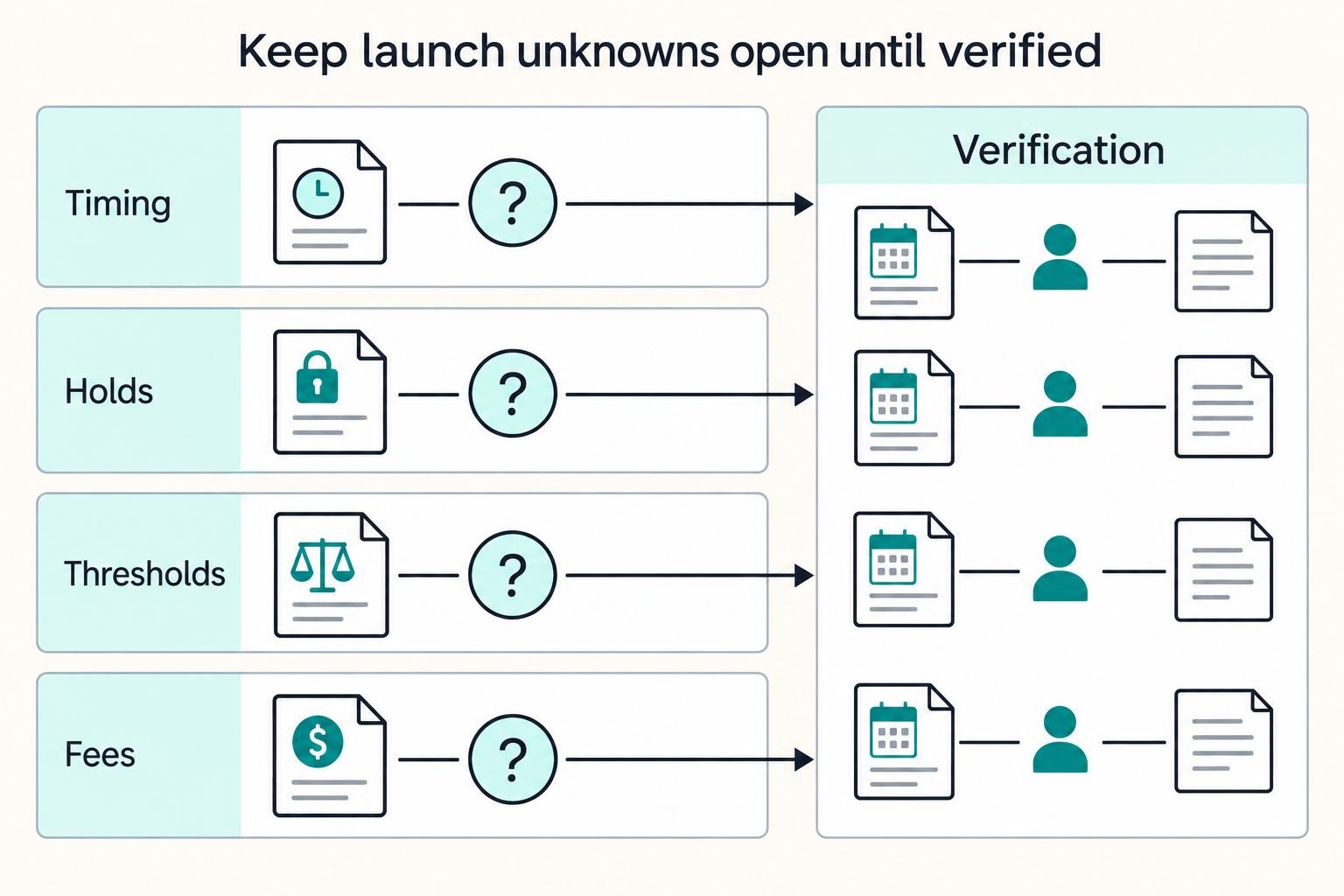
Track the gaps your current Etsy excerpts do not close: payout timing, holds or reserves, thresholds or minimum balances, and fee-detail depth in current Etsy policy/help text. If the evidence is incomplete, keep the item marked as unknown.
| Unknown | Why it matters | Verification source | Owner | Deadline | Launch impact |
|---|---|---|---|---|---|
| Payout timing | Cash planning, reconciliation, support messaging | Current Etsy policy/help text or written Etsy confirmation saved in your log | Finance ops | Before pilot exit | High |
| Holds or reserves | Working-capital exposure | Current Etsy policy/help text or written Etsy confirmation | Finance ops | Before pilot exit | High |
| Thresholds or minimum balances | Forecasting and cash-sweep assumptions | Current Etsy policy/help text or written Etsy confirmation | Treasury/finance | Before pilot exit | High |
| Fee detail depth | Margin model and exception handling | Current Etsy policy/help text plus pilot payout records | Finance/rev ops | During pilot | Medium to High |
Each row stays open until it has a verification source, owner, and decision date.
Weak inputs should not drive launch decisions. Treat the provided GitHub source as unusable because it returns 404. Treat the Ecwid/Lightspeed payments help article as non-Etsy evidence.
Use older third-party material only as a friction signal, not policy proof. For example, a source dated Feb 28, 2019 describes listing-first onboarding and listing fees starting when listings are published. Use that as a planning warning, then verify current Etsy policy before signoff.
Set a written stop condition. Add a hard gate: no market moves from pilot to scale until all high-impact unknowns are closed or explicitly risk-accepted in writing by the accountable owner.
Monitor policy/help updates during rollout planning. Re-check your verification log at each gate: market approval, pre-pilot, and pre-scale. Save capture dates so approvals stay tied to the exact policy text reviewed at that time.
We covered this in detail in How to Build a SaaS Marketplace That Manages Subscriptions and Contractor Payouts.
If your verification log is expanding, map it to a payout flow with explicit status tracking and policy gates in Gruv Payouts.
Build the minimum tax packet before volume scales. Collect the evidence now, and escalate U.S.-linked Form 8938 and FBAR/FinCEN judgment calls before expansion.
Do not wait until year-end to reconstruct cross-border account activity. Your packet should be usable by finance and ready for tax counsel or a preparer without backfilling records.
At minimum, collect:
A useful checkpoint: if an advisor asks how many foreign deposit accounts were involved, your team should be able to answer from records, not memory. Form 8938 includes account summary data such as the number of deposit accounts in Part V.
Do not apply one fixed threshold across the organization. IRS guidance says higher thresholds apply to joint filers and taxpayers residing abroad, and this evidence set does not provide a complete threshold table for every case.
| Filing lane | What the article confirms | Threshold note |
|---|---|---|
| Specified individual | Includes a U.S. citizen or U.S. resident alien | IRS says some U.S. taxpayers with specified foreign financial assets above $50,000 may need Form 8938 |
| Specified domestic entity | Certain domestic corporations, partnerships, and trusts can be specified domestic entities | File if values exceed $50,000 on the last day of the tax year or $75,000 at any time during the tax year |
| Joint filers and taxpayers residing abroad | Higher thresholds apply | This evidence set does not provide a complete threshold table for every case |
| No income tax return otherwise required | Form 8938 is not required even if assets exceed a threshold | Confirm whether the taxpayer is otherwise required to file an income tax return |
Document the filing lane now. A specified individual includes a U.S. citizen or U.S. resident alien, and certain domestic corporations, partnerships, and trusts can be specified domestic entities. IRS says some U.S. taxpayers with specified foreign financial assets above $50,000 may need Form 8938.
The instructions also say specified domestic entities file if values exceed $50,000 on the last day of the tax year or $75,000 at any time during the tax year.
Use two checks before scale:
Treat FBAR as a separate review track. IRS instructions state that filing Form 8938 does not relieve you of the requirement to file FinCEN Form 114 (FBAR) when FBAR is otherwise required.
Keep a distinct FBAR line item in the packet and escalate before expansion if:
Route these edge cases to qualified tax counsel, not ops.
If Schedule SE could be relevant, add an advisor-review flag for individual operators. Collect payout records and ownership facts now, but do not infer self-employment treatment or compute liability from marketplace exports alone.
A good handoff note should state who earned the income and which records support that view. That keeps the packet decision-ready without turning ops into taxpayer-specific legal decision-makers.
Once the tax packet is in shape, most failures are rollout failures, not filing failures. The fastest recovery comes from treating public Etsy guidance as incomplete launch input, keeping a live unknowns register under the Etsy Payments Policy, and refusing to scale on assumptions you have not rechecked.
A common mistake is treating one policy snapshot as complete operating guidance. Reserve-related conditions can change, and Etsy has published additional reserve details in community channels, so assumptions that were valid at approval can drift before scale.
Track each unknown with owner, source checked, last verification date, and launch impact. Before moving from pilot to scale, require a fresh recheck of reserve and hold assumptions against current Etsy communications. If one issue thread can draw over 200 replies, treat unclear payout behavior as an operational risk, not background noise.
Teams waste time when they push markets that rely on unverified exceptions. If your rollout depends on country-specific eligibility, account requirements, or other conditional setup rules you have not confirmed, keep that work in a research lane and label it as unknown.
The recovery move is sequencing: scale first where onboarding and payout operations are already verified, then return to exception-heavy markets. That prevents one unclear dependency from blocking the whole launch.
Another costly miss is hard-coding settlement economics before verification. If reserve behavior is still uncertain, rerun the margin model with hold-impact uncertainty included.
Use at least a base case and a reserve-stressed case before scale decisions. If either case materially weakens contribution, pause expansion until finance and ops align on acceptable exposure.
Do not treat assumed payment-path behavior as launch-ready demand input. If your forecast depends on checkout assumptions you have not verified, keep that dependency in the unknowns register and validate it in a controlled pilot before locking conversion expectations.
Keep the pilot small and measurable, then update forecasts from observed behavior. This avoids scaling on unresolved assumptions while reserve holds can still distort real post-launch cash flow.
You might also find this useful: Xero + Global Payouts: How to Sync International Contractor Payments into Your Accounting System.
Launch only markets with a documented payout path, known currency exposure, closed cash-flow unknowns, and a compliance packet you can actually file from.
Keep each market in research until your evidence pack answers, with dated proof, whether Etsy Payments is available, what onboarding path applies, and what receiving-account and deposit-currency outcome you should expect. If another teammate cannot reopen the pack and reach the same answer quickly, do not approve launch.
Before launch spend, record the exact payout lane and receiving-account setup for each market. If FX exposure is margin-sensitive, treat any unclear payout-currency outcome as a launch blocker.
Check market fit for buyer payment methods, including PayPal, Apple Pay, and Google Pay, but keep that separate from seller payout economics. Do not use PayPal's U.S. consumer fee page as a cross-market Etsy cost proxy. That page states its rates apply to U.S.-resident PayPal accounts.
Track unresolved payout timing, holds, reserves, thresholds, and full fee visibility as named open items with an owner, source, and deadline. If an unknown can materially affect margin or working capital, require written risk acceptance before launch.
For U.S.-linked operators, the grounded filing artifact here is FBAR (FinCEN Form 114). FinCEN states FBAR filing is required when the maximum value of foreign financial accounts, singly or in aggregate, exceeds $10,000 during the calendar year; due date April 15th, with an automatic extension to October 15th.
Build records so filing is operational: periodic statements that fairly reflect yearly maximums, U.S.-dollar amounts rounded up to the next whole dollar, and a documented source for any non-Treasury verifiable exchange rate used. FinCEN guidance also notes filings can be rejected when required elements are missing, including a listed state/country-code mismatch case for U.S. territories.
Copy-paste launch checklist:
Before moving markets from research to launch, align your rollout checklist with implementation constraints in the Gruv docs. ---
You cannot assume Etsy payouts are available everywhere by default. Etsy’s language is conditional: availability depends on whether Etsy Payments is available in a given country, and eligible sellers are required to use it. Keep any target country in research until you verify current country availability and confirm a valid bank account is on file for the shop.
Etsy states that some sellers are required to use a Payoneer Payment Account, and in those cases sales funds are deposited into Payoneer. The public excerpts confirm that this requirement exists, but they do not provide a complete country list. Treat Payoneer as a market-specific dependency and do not assume payout timing from these excerpts alone.
Etsy says deposit currency is set according to the currency of the country tied to the bank account on file. In most markets, deposits go to the seller’s bank account in local currency, with funds first added to the Etsy Payment account and then sent based on the deposit schedule. If weekly deposits are selected, Etsy says payments are sent every Monday and banks typically make funds available in 2 to 3 days.
Etsy’s public currency guidance is explicit for six countries: Bulgaria, Croatia, Czech Republic, Hungary, Poland, and Romania. For these markets, Etsy says it sends funds in Euros to the bank account on file. Etsy also notes that banks may charge foreign exchange fees when depositing these funds.
The excerpts indicate that deposit minimums, fee thresholds, deposit fees, and payment account reserves exist, but they do not provide full numeric detail. That means you can confirm these controls are part of payout operations, not their exact values by country from excerpts alone. One explicit operational detail is that updating bank details can trigger a 5-day hold on funds in the Etsy Payment account.
No. Etsy highlights multiple buyer payment methods, but also states that sale increases are not guaranteed. Broader checkout coverage can improve buyer convenience, but it does not guarantee better payout outcomes. Cash flow still depends on deposit-currency behavior, possible bank FX fees, and hold or reserve conditions.
Mateo covers the operational side of international growth—payments, tooling, and compliance basics for cross-border commerce.
With a Ph.D. in Economics and over 15 years of experience in cross-border tax advisory, Alistair specializes in demystifying cross-border tax law for independent professionals. He focuses on risk mitigation and long-term financial planning.
Educational content only. Not legal, tax, or financial advice.

People often treat international Amazon seller payouts like a settings page. That's the wrong starting point. Your payout setup is an operating choice that shapes who controls FX, how quickly you can launch, and where issues show up after you go live.

Generic marketplace payout advice usually skips the part that breaks in production. Paying many sellers is not just moving money out. It is deciding who gets paid, when they become eligible, what happens when a buyer disputes a payment, and how finance proves every release later. If you are working on **ecommerce reseller payouts marketplace platforms pay third-party sellers**, this guide is for the marketplace operator, not for solo freelancer banking tips.
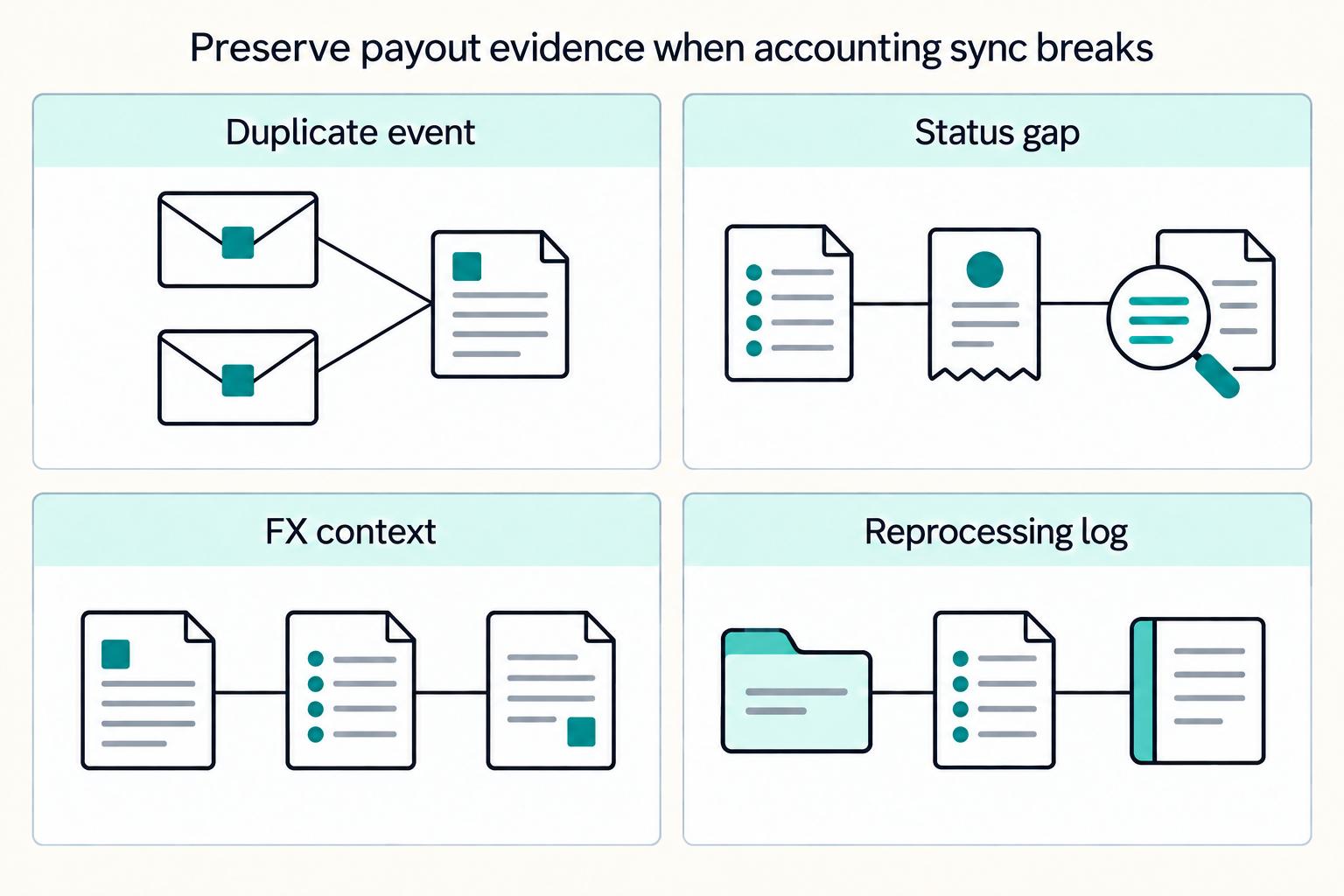
Treat this as a disbursement-sync problem, not a receivables setup task. Xero has clear ways to help customers pay invoices and, in some cases, to pay certain supplier bills. That is not the same as running outbound contractor payouts across countries, currencies, and payout methods end to end.