
Quick Answer
Start with a sale-based or tightly validated action model, then add hard release gates before money moves. PPS or constrained PPA is usually easier to defend than click-led payouts because items can remain pending until checks pass. Require a minimum evidence pack for every payable record: attribution source, approval status, amount, and matching record for finance close. Collect W-9 or W-8BEN during onboarding so missing tax data does not stall payout execution.
Start With a Defensible Payout Model#
An affiliate payout design works best when you can show, clearly and consistently, how commission is earned, verified, approved, and reconciled after funds move. This guide is for teams that need a structure they can defend in unit-economics reviews and run without constant cleanup.
Affiliate marketing is performance-based. Partners promote your offer through trackable attribution links and earn when the agreed outcome happens. The model you choose changes more than payout math. It can also change attribution requirements, approval logic, reversals, and finance workload.
For payment teams, that tradeoff is operational, not theoretical. Commission structure influences partner behavior and overall program performance. In practice, payout policy and validation rules determine how clearly payable events can be verified before funds are sent.
Before you start#
Use this guide if you own one of these decisions:
- Commercial logic
Decide which outcomes are payable and which are not.
- Product and data path
Maintain reliable attribution records so commissionable events can be verified later.
- Money movement and close
Reconcile payout records against transaction history so payment accuracy is provable.
Manual payouts raise the bar. If you create payouts manually, your team is responsible for reconciling them against transaction history. So the core design question is not which model sounds attractive, but whether your team can prove, approve, send, and match every payout record with confidence.
Treat compliance gates as part of payout design from day one. KYC checks can block processing or payouts until users are verified. That means a partner can drive growth activity but still be operationally ineligible for payout. If that handoff is unclear, finance inherits the failure mode.
The goal here is practical and narrow. Separate earning logic from payout rails, choose a model that matches your attribution confidence, and define the minimum evidence required before funds leave your account. At minimum, that evidence should include the attribution record, the approved payable amount, and the payout record needed for reconciliation.
Define your decision scope before comparing payout models#
Set scope before you compare models. If you do not define what is payable, how credit is assigned, and what records must exist before money moves, every later decision gets harder.
- Lock commissionable outcomes first.
Decide exactly which events are payable (click, qualified lead, or sale) and list explicit exclusions next to each one. For click- or lead-based plans, define the qualifying event in operational terms, not just a marketing label. If you use Awin commission groups, choose transaction type carefully. Sale vs Lead cannot be changed after creation.
- Separate earning logic from payout rails.
Keep commission logic and disbursement architecture as separate decisions. Models like CPC, CPL, or CPA define how partners earn. Payout rails, for example Global Payouts vs Connect payouts, define how funds are sent. Changing rails will not fix weak attribution rules or unclear commission conditions.
- Set attribution, validation, and fraud posture up front.
Because conversions can involve multiple ad interactions, define your attribution model before debating payout fairness. Set review triggers for suspicious traffic or lead patterns, and define pre-payout approval steps before launch. If validation windows apply, choose the review period deliberately rather than inheriting a default, for example 30, 45, or 60 days.
- Define the minimum evidence pack before launch.
Require a record for every payable event: event definition, attribution source, approval status, payable amount, and payout reconciliation details. This is what makes payouts auditable later. If you run manual payouts, enforce this strictly, since transaction-to-payout composition is not identified automatically and reconciliation responsibility stays with your team.
Once scope is fixed, choose a commission model based on the latest event you can actually defend.
Match partner behavior to the right commission structure#
Choose the model tied to the latest event you can verify with confidence. If attribution is weak, avoid paying premium rates on impression- or click-level activity. Shift compensation toward validated lead, action, or sale outcomes instead.
Step 1. Pick the latest defensible event#
Start with incentive quality, not partner preference. PPI and PPC reward impression and click volume, while PPA rewards a defined action. PPL maps to qualified leads, and sale-based variants map to completed sales.
Lifetime commissions can fit when you can reliably maintain the customer-to-affiliate link across future purchases. The tradeoff is longer commission exposure, since future approved purchases can remain commissionable.
Step 2. Price fraud surface and margin risk before setting rates#
Use a simple rule: if you do not trust the signal, do not price it like revenue. Click and impression models push exposure earlier in the funnel, where invalid activity is harder to absorb.
PPC is not automatically wrong, but it needs strong controls. For example, impact.com notes that for newer CPC V2 contracts (from January 2024), clicks are registered instantly, with no locking period and no reversal for registered clicks. If your network cannot filter invalid traffic before payout eligibility, margin risk increases.
Lead- and sale-based models also need controls. Keep transactions in pending, move only validated items to approved, and decline failures. Also check campaign overlap. When models run in parallel, payouts can stack unless you configure otherwise.
Step 3. Keep two-tier and lifetime models tightly controlled#
TTAP adds second-order payout logic by rewarding affiliates for sub-affiliate sales. Because it expands attribution paths, use it with clear referral-lineage tracking and explicit contract rules for handling invalid or disputed events. If that chain is weak, a single-tier model is usually safer.
Apply the same discipline to lifetime commissions. Confirm that referral records and future purchase records can still be joined when payouts are due.
Step 4. Define minimum payable fields per model#
| Model | Trigger event | Validation gate | Reversal condition | Payout timing |
|---|---|---|---|---|
PPI | Recorded impression | Impression record accepted per program policy | Contract/policy-defined handling of invalid or ineligible impressions | Per network/program payout schedule |
PPC | Valid click | Click accepted under program quality rules | Contract-dependent; some CPC V2 contracts do not allow reversal of registered clicks | Per click payout terms (some CPC V2 contracts register instantly) |
PPA | Completed defined action | Action matches program definition and passes validation | Contract/policy-defined handling of invalid actions | After validation per contract terms |
PPL | Qualified lead | Lead passes qualification review | Contract/policy-defined handling of fake, duplicate, or unqualified leads | After lead approval per contract terms |
PPS | Completed sale | Transaction confirmed as genuine and completed | Contract/policy-defined handling for declined or invalid transactions | After approval per contract terms |
Lifetime commissions | Future purchase by referred customer | Customer-to-affiliate link verified and purchase approved | Contract/policy-defined handling for invalid attribution or transactions | After each approved future purchase per contract terms |
If you want the shortest rule, use PPI/PPC when traffic integrity controls are strong, and lean toward PPL/PPS when you need tighter validation and margin control.
That model decision sets the bar for the platform and payout controls you will need to operate at scale. If you are documenting the operating terms alongside payouts, How to Structure an Affiliate Agreement for Your Digital Product covers the agreement side.
Choose payout platform capabilities before you scale partner count#
Before partner volume grows, make sure your payout stack can onboard, gate, approve, and reconcile partners without turning finance into a manual cleanup team. Tipalti has the deepest documented payables coverage. Impact is well documented on affiliate-program operations. Post Affiliate Pro covers batch payout configuration. EverLink is too lightly evidenced to treat as a finance-grade payout backbone without further validation.
Step 1. Lock non-negotiables before vendor demos#
Treat these as table stakes: affiliate onboarding, identity verification, tax verification, payout method choice, and global payments. If any of that sits outside the product and outside a clearly owned process, partner growth will outpace controls.
| Capability | Grounded detail |
|---|---|
| Affiliate onboarding | Treat as table stakes and test one end-to-end partner flow |
| Identity verification | Tipalti states payouts are blocked until KYC is completed and approved |
| Tax verification | Impact states payouts cannot be released until required tax forms are submitted and reviewed |
| Payout method choice | Tipalti documents partner choice of payment method, currency, and payment threshold |
| Global payments | Tipalti documents coverage across 200+ countries and territories, 120 currencies, and 50+ payment methods; availability is method- and region-dependent |
Run one end-to-end test partner and confirm they cannot become payable until required checks pass. Tipalti states payouts are blocked until KYC is completed and approved. Impact states payouts cannot be released until required tax forms are submitted and reviewed. Hard gates like that reduce payout-week judgment calls.
Also test partner-facing setup, not just back-office workflows. Tipalti documents partner choice of payment method, currency, and payment threshold, plus coverage across 200+ countries and territories, 120 currencies, and 50+ payment methods. Do not assume headline coverage means every rail works everywhere. KYC requirements vary by region, and payout availability is method- and region-dependent.
Step 2. Compare native depth, then mark required additions#
| Platform | Native evidence in the sources | What to verify or add before rollout |
|---|---|---|
| Tipalti | End-to-end scope from onboarding through reconciliation; KYC gate; tax ID validation, OFAC and sanctions screening; partner choice of method, currency, and threshold; payment-status and reconciliation reporting; global payouts | Confirm plan availability and country-method coverage. Do not assume every control is enabled by default. |
| Impact | Native affiliate recruiting, payouts, and reporting; tax forms block payout until submitted and reviewed | Verify identity or KYC depth, finance reporting, and support for your required payout methods and countries. |
| Post Affiliate Pro | Batch payouts, multiple payout options, encryption for stored payout fields | Confirm native KYC, tax gating, sanctions screening, and AP-style reconciliation support with the vendor. Plan for extra tooling or manual controls. |
| EverLink | Referenced here only in an ad-network affiliate-dashboard context | Treat onboarding, identity, tax, and global payout capability as unverified until directly demonstrated. |
Prioritize payout-status visibility in every demo. Have each vendor show the exact states finance will operate from: onboarded, KYC approved, tax approved, payment method selected, payable, paid, failed, and returned. If those states are vague or split across tools, close will slow and exception handling will stay opaque.
Step 3. Prioritize finance visibility when finance owns close and audit#
If finance owns close, prioritize AP automation and payout-status reporting over a better-looking affiliate dashboard. Tipalti explicitly positions scope from onboarding through reconciliation and documents reporting across payment status, due dates, and reconciliation signals. That operating visibility matters more than publisher-facing polish when auditability is the requirement.
Add where supported and when enabled constraints to launch planning for each program, country, currency, and payout method before rollout. That prevents signing partners you cannot verify, tax-review, or pay on the timeline you promised.
Once the platform choice is grounded, the next job is to define the gates that determine whether a payable record can actually be released.
Set compliance and approval gates before any payout is released#
Use one release rule: if required identity, tax, or risk checks are incomplete, do not release payout.
Step 1. Define the pre-payout gates in writing#
Write the payable gate first, then configure your platform to enforce it. Define identity verification for the payee, legal-entity verification when onboarding businesses, tax profile collection, and sanctions-related controls where your scope requires them. Add program risk rules for edge cases, such as unusual account changes, rapid payout-profile edits, or late exception requests.
Keep legal scope explicit. Not every platform is an MSB or covered financial institution, and requirements vary by model and jurisdiction. If you are in MSB scope, 31 CFR 1022.210 requires a written AML program with policies, procedures, and internal controls. For covered financial institutions, keep risk-based identity verification and beneficial-owner procedures for legal-entity customers where required.
Run one end-to-end test partner and confirm they cannot reach payable status while any required check is still open.
Step 2. Collect tax forms during onboarding, not during payout week#
Make tax readiness an onboarding gate so payout week is execution, not document chasing. For U.S. payees, collect Form W-9 for TIN-based information-return workflows. For foreign individuals, request Form W-8BEN when requested by the payer or withholding agent. For foreign entities, use Form W-8BEN-E to document foreign entity status for chapters 3 and 4.
| Payee type | Form | Use |
|---|---|---|
| U.S. payees | Form W-9 | TIN-based information-return workflows |
| Foreign individuals | Form W-8BEN | When requested by the payer or withholding agent |
| Foreign entities | Form W-8BEN-E | Document foreign entity status for chapters 3 and 4 |
This is an operating choice, and it can reduce predictable payout holds. Microsoft states partners must submit a tax profile before creating a payout profile and notes validation can take up to 48 hours. Google also documents payment holds tied to missing tax information and identity or address verification.
If you run multiple earning models, including PPL or PPS, keep payout eligibility gates consistent even when earning logic differs.
Step 3. Enforce a no-tax-profile, no-payout rule#
Set the rule once and apply it every cycle: no verified tax profile, no payout release. Keep payout release on hold until the missing step is completed, and show a clear remediation path in the partner portal or payout notice.
Keep approval evidence in one place: tax form status, validation timestamp, identity status, payout method status, and reviewer notes. When those states are split across tools, exceptions can be approved on partial information.
Step 4. Keep an explicit approval chain for exception payouts#
Treat exception payouts as controlled events, not informal overrides. Require a written approval chain that records partner, amount, reason, missing control, compensating evidence, approver, and expiration date.
Assign a named owner for sanctions-related holds and reporting decisions. If property becomes blocked under OFAC rules, initial reports are due within 10 business days. Your exception process should clearly define who stops payout, who investigates, and who files when reporting is required.
Those gates work best when partners can complete onboarding and tax intake once, in one path, without back-and-forth re-entry.
Related: Accounting API for Platforms: How to Connect Your Payment Infrastructure to Any General Ledger.
Build one onboarding and tax intake path partners can complete#
Use one supplier-portal-style, self-service onboarding flow that captures partner, payout, and tax data in a single intake path and reuses it downstream where possible. That can keep approval, payout setup, and finance review tied to the same profile and reduce re-entry across tools.
Step 1. Use one self-service intake for all required partner data#
Collect only the fields you need to approve and pay the partner, and collect them in one place. For affiliate onboarding, standardize website details, country, tax information, preferred payment method, and any legal name or entity details your payout process requires. If a field is required for payout, capture it here instead of handling it later by email.
Use one test partner as a control: confirm the profile can support program approval, payout setup, and tax review without unnecessary rekeying.
Step 2. Route tax forms by partner type at onboarding#
Tax intake should happen during onboarding, before commissions reach payable status. For U.S. persons, use Form W-9 to collect TIN information. For foreign persons, request Form W-8 BEN when requested by the payer or withholding agent in a U.S. withholding or reporting context.
Keep tax verification status visible so finance can quickly see received, under review, or verified states.
Step 3. Gate active status on identity and tax verification#
Do not mark a partner fully active until identity verification and tax verification are complete. Payment-platform onboarding may require identity collection and verification because KYC obligations can require collecting, verifying, and maintaining user identity information.
Use clear states such as draft, submitted, action needed, and active. If identity fails or tax documentation is missing, move the record to action needed and keep commissions pending.
Step 4. Mask sensitive views and define retention rules#
Treat data handling controls as part of payout operations, not a side process. Mask sensitive internal views, and if card numbers are displayed, limit visibility to the first six and last four digits. Set explicit retention rules so personal data is not kept longer than needed, with a defined disposal or anonymization step when it is no longer required.
Keep ownership explicit. Define who can view data, what is masked, who owns retention, and how disposal is executed. With onboarding in place, you can define when a partner moves from eligible to actually payable.
Set payout cadence, holds, and reversals in writing#
Once a partner is active, define exactly when commission stops being provisional. Put that policy in writing before launch so payout timing, hold logic, and reversal handling are explicit.
Step 1. Publish a payout policy table partners and finance can both read#
For each earning model, publish four fields: payout cadence, minimum payout threshold, hold window, and reversal triggers. If these rules live in ad hoc emails, disputes and exceptions can escalate quickly.
| Model | Cadence to publish | Minimum payout threshold | Hold window anchor | Reversal triggers to state explicitly |
|---|---|---|---|---|
| PPS | Name the cycle and approval cutoff | State by payout currency and rail | Tie finalization to your lock point before payout scheduling | Returns, fraud, invalid customer information, and other documented reversals |
| PPL | Name the cycle after lead validation | State threshold and rollover rule | Tie release to your documented validation checks before payout | Document the validation conditions that can reverse eligibility |
| Revenue-sharing | Name the cycle after revenue is recognized for payout purposes | State threshold and whether balances roll to the next cycle | Hold until refund and dispute exposure is within tolerance | Refunds, billing disputes, and fraud-linked revenue |
Use your platform's exact status terms. On Impact, actions can be modified or reversed before the Locking Date, then become Approved Actions or Locked Actions, and commission is delivered on the Scheduled Clearing Date. That sequence keeps earning, lock, and payout as separate control points.
Be equally precise on thresholds and cutoffs. Awin documents £20 / €20 / $20 minimum thresholds, payments twice per month, cutoff checks on the 15th or last day of the month, and rollover when threshold is not met. Even if your numbers differ, publish the same structure.
Verification check: trace three recent partner records and confirm the same dates and states appear in your affiliate tool, payout queue, and finance review view.
Step 2. Tie hold windows to reversal risk, not to partner pressure#
Set hold length based on reversal exposure. If your refund cycle is long, delay payout finalization until reversal risk is within tolerance.
This matters most for PPS and revenue-sharing, where reversals can come from invalid customer information, fraud, and returns, not just attribution mistakes. On Impact, reversed actions carry 0.00 payout, and pending actions are where those modifications or reversals happen before lock.
The practical compromise is a published lock rule tied to your refund and dispute profile, plus an explicit exception path for higher-risk cohorts.
Step 3. Define dispute, refund, and clawback rules before you offer Lifetime commissions#
Before offering Lifetime commissions, define in contract language how refunds and disputes affect paid and unpaid earnings. Do not assume post-payout reversals work the same way across platforms.
PartnerStack states paid commissions cannot be taken back directly in-platform. Recovery uses a clawback or negative commission. If the balance turns negative, partner withdrawals can be blocked until the balance is positive again.
Your policy decision is straightforward:
- If post-payout recovery is limited, keep a longer pre-payout hold.
- If you pay faster, state clearly whether verified refunds or disputes can offset future earnings through negative commission entries where your platform supports them.
Second verification check: trace one paid commission, one refunded transaction, and one disputed transaction to the exact record or event authorizing the adjustment and the partner-facing policy clause.
Step 4. Add blocked-transfer handling for Global payments#
Treat failed transfers as a standard flow, not an edge case. Your payout policy should define trigger events, retry logic, fallback routing, and partner communication handling.
For Stripe Connect, a failed payout raises payout.failed, and the destination external account can be disabled for payouts until details are updated. In that case, retrying the same payout without fixing details is usually ineffective.
For Stripe Global Payouts, destination errors can return funds in about 2-3 business days, though timing varies by country. Recovery requires corrected destination details plus a new payout.
Document these decisions up front:
- which event or status starts failure handling
- who contacts the partner and through which channel
- when to retry automatically vs pause for updated details
- when to switch to a fallback route, if available
If this is not written in advance, blocked transfers can become manual finance work and can hurt partner trust.
The next control is proving that every payout can be reconciled before launch, not after the first bad month-end.
For a step-by-step walkthrough, see How to Set Up an Affiliate Program for Your SaaS Product.
Make reconciliation a launch gate not a cleanup task#
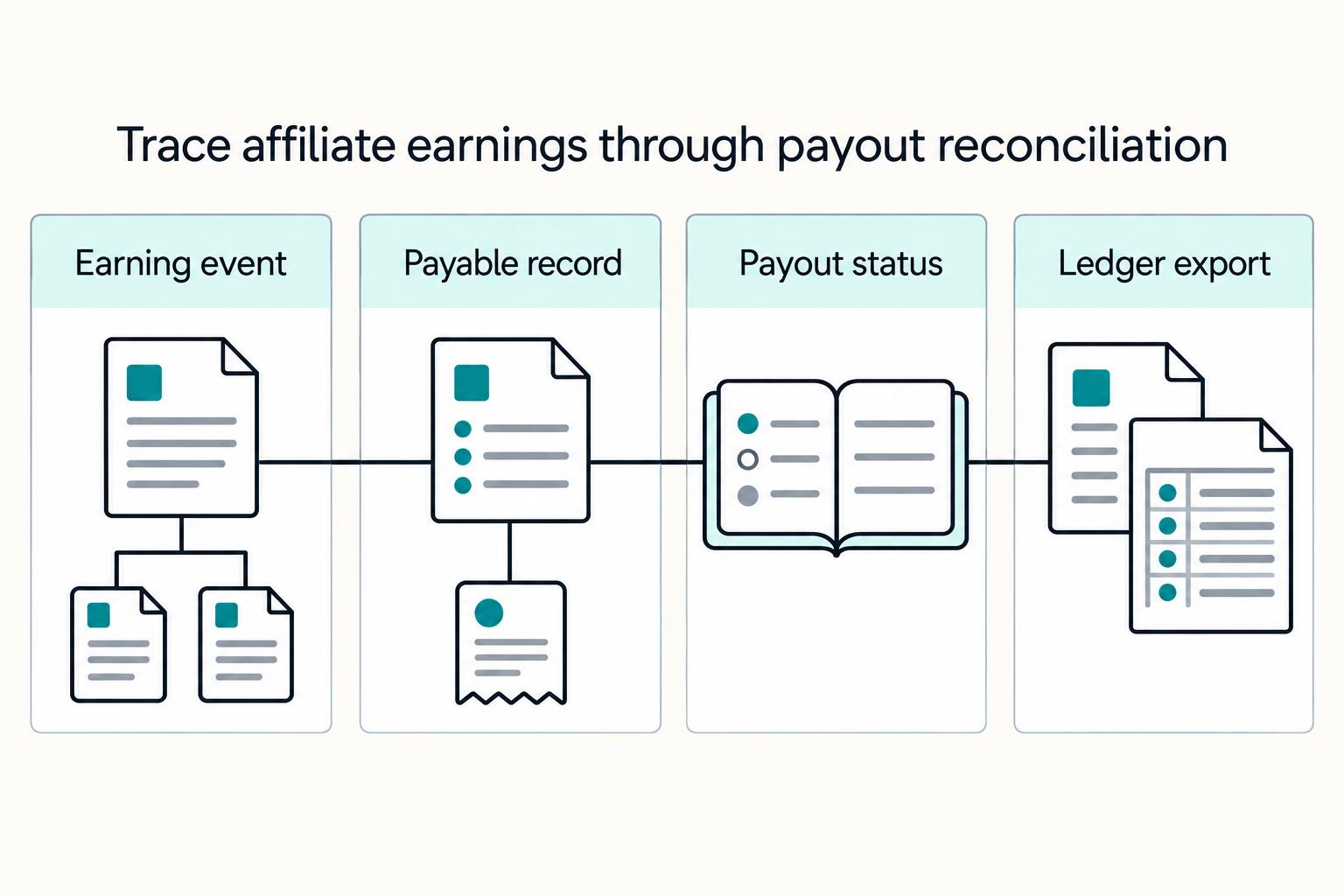
Make reconciliation a pre-launch control, not a month-end repair task. If finance cannot trace one commission from earning event to payout status and ledger impact before launch, delay partner payouts.
Step 1. Map the record chain before the first live payout#
Define the full record path before go-live, for example: commission event, payable record, disbursement status, ledger posting, and the export pack finance reviews. Treat that chain as core operating design, not reporting cleanup.
Require a stable earning identifier that survives every status change. Whether an item is approved, held, reversed, paid, or clawed back, it should stay traceable across your affiliate tool, payout system, and accounting view.
Verification check: sample three earnings in different states, for example approved, reversed, and paid, and confirm end-to-end traceability without spreadsheet reconstruction.
Step 2. Make Payment reconciliation artifacts mandatory for your launch sign-off#
Treat Payment reconciliation outputs as launch evidence. Finance should be able to match each payout to its underlying transaction batch and drill into the underlying records when needed.
If you run Stripe-backed payouts, automatic payouts preserve transaction-to-payout association. Manual payouts are an operational tradeoff, but Stripe does not provide transaction-level reporting for funds in manual payouts, which weakens reconciliation detail.
A practical sign-off pack includes:
- Payout reconciliation report for the payout period
- Item-level metadata in that report for faster matching
- Underlying transactions retrieved via the balance transaction endpoint with the payout parameter
- A ledger or sub-ledger posting tied to the payout batch in your finance system
Step 3. Trigger reconciliation from payout events, not memory#
Start reconciliation from payout events, not manual reminders. Stripe documents webhook-driven retrieval on payout.paid or payout.reconciliation_completed, which gives a trigger to fetch payout details and build the export pack.
Stripe computes report data daily, with each day defined as 12:00 am to 11:59 pm account activity. If your finance cutoff differs, document the cutoff policy before launch to avoid recurring timing mismatches.
Checkpoint: compare one payout-day export with bank movement and confirm matching batch totals and transaction population.
Step 4. Build idempotent payout execution before retries are allowed#
Assume retries will happen, and make them safe. Use idempotent requests for payout or transfer execution so retries do not create duplicate partner payments.
Stripe idempotency returns the same result for the same key, including 500 errors. Keys can be up to 255 characters and may be pruned after they are at least 24 hours old. If your retry window is longer, you need an internal payout-attempt registry in addition to provider behavior.
Red flag: if an operator can click "send again" after a timeout and your system creates a new request instead of reusing the original idempotency key, duplicate-payment risk is still in the design.
Once reconciliation is proven, rollout becomes a sequencing problem, not a leap of faith. Related reading: Webhook Payment Automation for Platforms: Production-Safe Vendor Criteria.
If reconciliation is your launch gate, pressure-test payout statuses, retries, and batch controls against your finance workflow with Gruv Payouts.
Execute rollout in phases with clear verification checkpoints#
Scale in phases, and only advance when attribution, payout execution, and finance traceability are proven with live partner data.
| Stage | Change | Proof before advancing |
|---|---|---|
| Phase 1 | Start with one earning model | Prove end-to-end traceability from attribution event to payable record to payout status to the payout reconciliation report and underlying transactions |
| Phase 2 | Expand payout methods and geographies | Do it only after onboarding, tax intake, and exception handling are complete; confirm operators can triage processing, posted, failed, returned, and canceled |
| Phase 3 | Add TTAP and Lifetime commissions if needed | Do it after reversal and dispute operations are stable; test action-locking-period reversals before adding multi-layer earnings logic |
| Every phase exit | Review the same three checks | Payout success rate, unresolved exceptions, and reconciliation close time |
Step 1. Start with one model and prove the full money trail#
Start with a controlled cohort and one earning model, usually one tied to paying-customer outcomes for SaaS or a tightly defined Pay-Per-Action (PPA) when the action is strongly validated. For SaaS programs, paying on paying-customer outcomes is generally the safer default, while non-revenue conversion payouts are more fraud-prone.
Your Phase 1 proof is end-to-end traceability: attribution event to payable record to payout status to the payout reconciliation report and underlying transactions. Sample actions in different states, pending, paid, and reversed, and confirm the status trail is visible without spreadsheet repair.
Step 2. Expand payout methods and geographies only after onboarding is complete#
Expand methods and geographies only after onboarding, tax intake, and exception handling are complete for the accounts you plan to pay. Provider reach is not a rollout gate by itself, even if coverage is broad, for example payouts to more than 50 countries.
Connected accounts must complete onboarding requirements before activation, and required verification information varies by location, business type, and requested capabilities. Tax intake should also be complete: use Form W-9 to provide a correct TIN for IRS information reporting, and submit Form W-8BEN when requested by the payer or withholding agent. If tax intake is incomplete, keep commissions pending.
Before moving forward, confirm operators can triage payout states such as processing, posted, failed, returned, and canceled.
Step 3. If needed, add TTAP and lifetime commissions after reversals are boring#
If your program needs Two-Tier Affiliate Programs (TTAP) and Lifetime commissions, add them after reversal and dispute operations are stable. Two-tier models add sub-affiliate earnings, and lifetime models extend payouts to future purchases, so both can increase payout and unwind complexity.
Validate reversal handling first. Pending actions can still be modified or reversed during the action locking period, and reversals can cancel partner payouts for that action. Test those flows before adding multi-layer earnings logic.
Step 4. Hold every phase exit to the same three checks#
Use the same phase-exit checks every time:
- Payout success rate: share reaching posted status versus failed, returned, or canceled
- Unresolved exceptions: open onboarding, tax, and payout-state issues, including aging
- Reconciliation close time: time for finance to match payout batches to underlying transactions and close without manual rebuilds
If any check degrades, pause expansion and fix it before adding partner types, geographies, or commission complexity.
Even with a phased rollout, mistakes can still turn into margin leaks if you do not correct them early.
Fix common mistakes before they become margin leaks#
Once rollout is working, protect margin by fixing four common failure points early: weak earning triggers, mixed rule logic, missing tax gating, and partner growth that outpaces payout operations.
Step 1. Tighten earning triggers when signals are weak#
If you are paying on Pay-Per-Click (PPC) and seeing refunds, cancellations, or signs of low-quality traffic, tighten the trigger before scaling. Clicks can include accidental, duplicate, or fraudulent interactions, so raw click volume alone is a weak payout basis when quality is uneven.
Shift payouts toward validated Pay-Per-Action (PPA) or Pay-Per-Sale (PPS) events. For leads, pay after the lead passes your approval gate. For sales, tie the payable record to an actual order or paid subscription, with a clear reversal path for cancellations or refunds.
Checkpoint: sample payable events and confirm each maps to a real attributed action, customer record, and current commission status.
Step 2. Split commission logic from disbursement logic#
Keep commission adjudication and payout execution separate. Commission logic should answer whether earnings were created, adjusted, or reversed. Disbursement logic should answer whether funds can be released, by which method, and in which payout state.
That separation matters because reversal risk and cash movement run on different timelines. In one major affiliate-platform flow, actions can still be changed during the action locking period. Invoicing starts only after that and can run for 2 to 3 weeks before payout scheduling. When both phases are merged, it can become harder to explain whether a delay comes from reversals, tax gaps, or transfer failures.
Audit test: for one partner, operators should be able to answer both questions clearly. "Why was this commission earned or reversed?" and "Why is this payout in its current state?"
Step 3. Gate tax collection before partners become payable#
Collect tax forms during onboarding, not during payout week. Use Form W-9 for U.S. payees to capture the correct TIN, and collect Form W-8BEN before income is paid or credited when that form is required for foreign individuals. If tax intake is incomplete, block payout release until documentation is complete.
Control check: no partner should move to payable status without completed tax documentation. If a requested W-8BEN is missing, withholding may apply at 30%.
Step 4. Cap partner growth until payout ops can keep up#
Scale partner volume only as fast as your payout operations can process and reconcile it. More affiliates can mean more onboarding exceptions, payout-state issues, reversals, and reconciliation workload.
If exception queues are aging or finance is rebuilding reports manually, pause expansion of cohorts, geographies, or payout methods. Resume growth once your team can consistently explain, approve, send, and reconcile payable amounts end to end.
If fraud checks are part of the release flow, How Platforms Stop Affiliate Fraud Before Commissions Are Paid goes deeper on pre-payout controls.
Conclusion and copy-paste launch checklist#
Use one rule: choose the commission model your team can verify, approve, and reconcile when failures happen.
Define commissionable events and exclusionsChoose model set (PPC/PPL/PPS/two-tier) with reversal rulesImplement onboarding + tax gating (W-9/W-8BEN when requested)Publish payout cadence, holds, thresholds, and dispute policyRun a pilot and verify end-to-end reconciliation before scale
Step 1. Define commissionable events and exclusions#
Start by defining the exact Action you pay on. In affiliate terms, an Action can be a transaction, a lead, or another agreed event. For each Action, document the source record, attribution field, and non-payable exclusions, for example canceled or returned orders, or failed payments.
Checkpoint: a teammate outside growth should be able to decide payable vs non-payable from the written rule alone.
Step 2. Choose the model set and lock reversal rules#
Pick PPC, PPL, PPS, or a two-tier structure based on what you can reliably validate. For PPC, define click-quality controls up front. If you use a two-tier structure, define what proves second-tier attribution and who handles disputes.
Make reversal rules explicit. Action locking and validation periods exist so returns, cancellations, and failed payments can be modified or reversed before payout approval. One documented setup uses 37 days when the return period is 30 days, with a 7-day buffer.
Step 3. Implement onboarding and tax gating#
Collect payout details and tax forms during onboarding, before commissions become payable. Form W-9 is used to provide the correct TIN for U.S. payees, and Form W-8BEN is submitted by foreign individuals when requested by the payer or withholding agent.
Keep commissions pending until required tax documentation is present and reviewed.
Step 4. Publish cadence, holds, thresholds, and disputes in writing#
Publish payout terms before launch: minimum payout threshold, payment cycle, payment methods, and any hold window or dispute process you apply. If reversal risk remains high through the return window, consider holding payout finalization until that window closes.
Your terms should answer three questions: when payout happens, what can reverse, and how disputes are handled.
Step 5. Run a pilot and verify reconciliation before scale#
Run an end-to-end pilot before scaling: clicks, conversions, validations, and custom parameters. Then run a payout test that traces each commission event to its payable record and to payout-level transaction review.
Do not scale until you can explain a payout from event to disbursement with clear reconciliation evidence. When you are ready to operationalize the checklist, use the implementation references and event patterns in Gruv Docs.
Frequently Asked Questions
What commission structures are most common for payment platforms?
Across affiliate programs, directly supported common models are Pay-Per-Sale (PPS), Pay-Per-Click (PPC), and Pay-Per-Lead (PPL). PPS ties commission to completed purchases and actual revenue events, while PPC pays on clicks even if no purchase follows. Other structures exist, but the practical decision is choosing an earning trigger you can verify and reconcile reliably.
What is the difference between commission structure and payout operations?
Commission structure defines how an affiliate earns from a qualifying lead or purchase. Payout operations cover execution after earnings are created: request validation, payout status handling, recipient notification, and reconciliation to underlying transactions. If those are mixed together, root-cause analysis can be harder when payouts are delayed or disputed.
What capabilities are table stakes in an affiliate payout platform?
A practical baseline can include partner onboarding, identity verification, tax form collection (such as W-9 and W-8BEN), payout execution, status tracking, and reconciliation. Onboarding requirements can vary by country and payment model, so test this with your actual partner mix. You should also confirm account-ownership controls before payout release to reduce fraud risk.
How should we decide between PPC and PPS?
Use PPC when you can consistently detect invalid clicks, including fraudulent, accidental, or duplicate clicks. Start with PPS when you want commission events tied to completed purchases and realized revenue. That keeps payout logic closer to outcomes you can audit financially.
When should we use two-tier affiliate programs?
Use a two-tier model when you want affiliates to recruit other affiliates as part of your growth design. Two-tier programs pay on direct sales and on sales generated by referred affiliates. If you do not need that second earning layer, a single-tier model may be sufficient.
What key unknowns should we validate before scaling?
Validate click-quality exposure if you use PPC, because invalid clicks can become a cost driver. Validate onboarding completion and compliance friction by country and payment model before volume ramps. Validate payout reconciliation end to end so each payout can be matched to its underlying transactions and bank movement.
What should be true before the first payout run?
Collect Form W-9 from U.S. payees so you have the correct TIN. Collect Form W-8BEN from foreign individuals when requested by the payer or withholding agent. Run a reconciliation test that proves payouts can be matched to underlying transactions and bank deposits. If you use PayPal batch payouts, also test duplicate sender_batch_id handling because reuse within 30 days is rejected.
Try a related tool
Where Gruv fits
Gruv for affiliate payouts
Turn approved commission rows into a payout batch with clear partner references, item status, and exception context.
See reconciliation and mismatch review
Compare ledger entries, provider payment records, and statement rows to see what matches and what finance needs to review.
Researched and edited by the Gruv editorial team. Gruv builds cross-border billing, payouts, and finance-operations software for global businesses.
Sources
Includes 1 external source outside the trusted-domain allowlist.
- docs.stripe.com/payouts/reconciliationtrusted
- docs.stripe.com/reports/payout-reconciliationtrusted
- ecfr.gov/current/title-31/subtitle-B/chapter-V/part-5...trusted
- ecfr.gov/current/title-31/subtitle-B/chapter-X/part-1...trusted
- irs.gov/forms-pubs/about-form-w-9trusted
- irs.gov/forms-pubs/about-form-w-8-bentrusted
- stripe.com/resources/more/payment-reconciliation-101trusted
- help.awin.com/docs/commission-modelsexternal
Educational content only. Not legal, tax, or financial advice.
Related Posts
Affiliate Program Management for Platforms Running a High-Performing Publisher Network
If a partner setup does not improve contribution margin after commissions, payout costs, compliance overhead, and internal operating load, it is the wrong choice, no matter how polished the marketplace pitch sounds. This guide is for founders, revenue leaders, product teams, and finance operators who need an answer that holds up in a planning meeting and in the monthly close.
Accounting API Platforms for General Ledger Integration
These integrations usually break at the same point. The happy path works, then asynchronous events, retries, and month-end pressure expose controls you did not design upfront. To reduce rework, define posting boundaries, dedupe behavior, and matching checks before you spend time on ERP exports or reporting polish.
Choosing M-Pesa, Chipper, or Local Rails for African Gig Platform Payouts
If you are choosing between M-Pesa, Chipper Cash, and local rails, start with corridor execution, not brand popularity. This list is meant to help you choose the setup you can actually verify by country, payout type, and operating workflow before launch.