
Quick Answer
Use a sequence that turns the contract into operating rules: define scope, lock mechanics, then assign clauses to Protect, Perform, and Profit. In the draft, state legal entities, Effective Date, Initial Term, and a written notice path with a 30 day cure period if that fits your program. Put performance and payout exceptions in a Schedule A process both parties approve. Add clawback and recovery language so refunded or non-payable transactions are adjusted the same way every time.
Build the Agreement in This Order: Scope, Mechanics, Then Pillars#
Build the agreement in this order: set scope, lock the contract mechanics, then draft the three pillars for brand control, partner conduct, and money handling. That sequence helps you manage common risks like brand misuse, payout leakage, and unclear obligations. A weak affiliate agreement for digital product leaves those risks open to interpretation. A workable one turns them into rules you can review and enforce, with counsel where it matters.
Step 1: Set scope before you draft. If you skip this, the later clauses may not match how the program actually works.
- Affiliate type: creators, publishers, agencies, existing customers, or mixed
- Channels: email, content, paid media, social, communities
- Geographies: where affiliates operate and where buyers are located
- Product class: course, SaaS, membership, downloadable asset, mixed offer
- Risk tolerance: light-touch growth program or tightly controlled brand program
A common failure mode is using one generic form for every partner type. That can create loose definitions, mismatched obligations, and weaker evidence if a dispute starts.
| Area | Template agreement | Strategic agreement |
|---|---|---|
| Scope | Generic parties and broad activities | Named legal entities, defined channels, geographies, and product scope |
| Enforceability | May be enforceable if properly formed and reviewed | Explicit term, notice, cure, and breach mechanics tied to how the program operates |
| Operational clarity | Basic duties, limited checkpoints | Clear deliverables, definitions, and ownership boundaries |
| Dispute readiness | More room for argument if obligations are vague | Written notice, cure process, and termination triggers are easier to administer |
Step 2: Build the three pillars in the right order. Pillar 1 covers your brand and IP. Pillar 2 sets conduct and performance rules. Pillar 3 controls payouts, validation, and what happens when results or conduct fall short. Problems usually start when all three are buried inside one vague "terms and conditions" section.
Step 3: Lock the contract mechanics before polishing the language. Identify the legal entities, state the Effective Date, set the Initial Term, and define what counts as material breach. Use a written notice path and a 30 day cure period if that matches your program. Those mechanics often decide whether a breach is manageable or just messy. If the program depends on asset handoffs or approvals, list those deliverables explicitly instead of assuming everyone reads them the same way. That structure carries through the rest of the agreement: brand and IP controls first, then performance rules, then profitability controls.
Related: How to Create a Referral Program for Your SaaS Product. Want a quick next step? Try the SOW generator.
Pillar 1: Protect Your Brand & IP#
Treat this section as your enforcement playbook, not generic legal text. In the agreement, spell out what affiliates can use, what they cannot publish, what they must document, and what triggers suspension or termination.
If you keep brand rules outside the main agreement, name them and incorporate them by reference. One workable structure ties brand protection to platform access, incorporates obligations by reference, and allows you to require prompt compliance certifications on request.
Define the brand license and promotion boundaries#
Use a narrow, revocable license. Limit use to the trademarks, product names, and creatives you approve, and only for the listed product, channels, and territories. State that affiliates cannot modify logos, remove notices, register lookalike domains or handles, or publish unapproved claims.
Address non-cannibalization directly. If you want to restrict use of your materials, program access, or business insights to build a competing offer, define that scope with legal review. Avoid vague wording like "use the brand reasonably," because it is harder to enforce.
| Risk area | Weak drafting | Enforceable drafting |
|---|---|---|
| Brand misuse | "Use our brand appropriately." | "You may use only the marks and creatives we approve in writing, only for the approved product, approved channels, and approved territories. No logo edits, lookalike domains/handles, or branded paid placements unless approved in writing." |
| Deceptive promotions | "Do not mislead customers." | "Use only substantiated, approved claims; include required affiliate disclosures where applicable. Confirm the correction timeline with legal review." |
| IP leakage | "Do not copy our content." | "You receive a limited license to approved assets only. No derivative works, no reuse outside the program, and no use of program materials/confidential information to build a competing offer. Confirm the scope of any competition-related restriction with legal counsel." |
| Disclosure/privacy failures | "Follow the law." | "Follow applicable advertising, disclosure, privacy, and platform rules; ensure employees and contractors comply; provide requested records/certifications promptly." |
| Dispute venue | "Disputes handled legally." | "Confirm the governing law and venue with legal counsel, subject to mandatory local rules." |
| Termination triggers | "We may terminate for violations." | "We may suspend for high-risk violations (for example restricted content, unapproved claims, missing disclosures, or suspected misconduct) and terminate for cause based on documented breach, non-cooperation, or uncured violation under notice and cure language confirmed with legal counsel." |
Make cross-border compliance auditable#
For cross-border programs, replace broad "follow the law" language with concrete duties. Require disclosure of the commercial relationship whenever applicable law or platform policy requires it. Keep editorial rules aligned with those disclosure duties, and maintain a prohibited-content schedule (for example, a "Restricted Content" exhibit) so banned categories are explicit.
| Control area | Article guidance |
|---|---|
| Disclosure | Require disclosure of the commercial relationship whenever applicable law or platform policy requires it. |
| Restricted content | Maintain a prohibited-content schedule (for example, a "Restricted Content" exhibit) so banned categories are explicit. |
| Workforce coverage | Apply obligations to the affiliate's employees and independent contractors, not only the named party. |
| Privacy/data | Permitted collection and sharing only; required notices/permissions where applicable; records kept for audits or disputes. |
| Historical compliance representation | Define the start point; some addenda use the later of agreement execution or January 1, 2020. |
Apply obligations to the affiliate's employees and independent contractors, not only the named party. That closes a common enforcement gap when work is subcontracted.
Keep privacy/data clauses operational: permitted collection and sharing only, required notices and permissions where applicable, and records kept for audits or disputes. If you want a historical compliance representation, define the start point.
Tie notice, suspension, and termination to evidence#
Make enforcement steps explicit: where notice is sent, what can be suspended immediately, when cure is available, and what cooperation is required during review. For lower-risk issues, cure may require asset removal, a traffic stop, and written remediation confirmation.
For for-cause termination, require an evidence file: screenshots, URLs, timestamps, ad copy, landing pages, approval records, platform notices, and complaint logs. If you cannot show what ran, when it ran, and how it breached the clause, enforcement is harder to defend.
Before signing, run this checklist:
- Attach and incorporate your editorial and brand rules and restricted-content schedule.
- Define permitted assets, channels, territories, and creative-approval workflow.
- Require disclosure compliance, platform-policy alignment, and contractor compliance.
- Require prompt compliance certifications on request.
- Separate immediate suspension triggers from notice-and-cure issues using verified local language.
- Define records and retention expectations for evidence and approvals.
- Confirm governing-law and venue language with legal counsel.
Pillar 2: Engineer Performance#
After brand controls are in place, your payout terms become the main behavior-setting tool. In digital-product affiliate sales, reward durable customer value, not just raw volume. Make sure your clawback clause lets you recover commissions on refunded sales.
Before drafting details, align operations: confirm who owns tracking rules, who approves exceptions, and whether affiliate, finance, and contract definitions match.
Choose the commission structure that matches your control needs#
Your structure choice affects control, admin workload, and exposure to low-quality volume.
| Structure | When it fits | Operational complexity | Risk of low-quality volume |
|---|---|---|---|
| Flat | You want simple onboarding and predictable administration | Low | Medium to high if quality controls are outside payout terms |
| Tiered | You want stronger incentives for sustained performance over time | Medium | Medium if tiers reward volume without refund-period or quality checks |
| Hybrid | You want base commissions plus quality-linked bonuses | Higher | Lower when bonus eligibility and reversal rights are clearly defined |
Define a qualified sale in clause-ready terms#
Do not leave "qualified sale" to platform defaults. Put it in the agreement or a schedule, and mirror it in tracking and finance reports.
| Element | What to define |
|---|---|
| Attribution model | Attribution model pending contract and platform verification. |
| Attribution window | Attribution window pending contract and platform verification. |
| Conversion event | Commissionable conversion event pending contract and platform verification. |
| Disallowed transactions | Confirm the exclusion list in the contract; once confirmed, tie it to reversal rights and the clawback clause. |
At minimum, define:
- Attribution model: Pending contract and platform verification.
- Attribution window: Pending contract and platform verification.
- Conversion event: Commissionable event pending contract and platform verification.
- Disallowed transactions: Confirm the exclusion list in the contract; once confirmed, tie it to reversal rights and the clawback clause.
Tie bonuses to customer quality and guard against gaming#
If you use bonuses, base eligibility on post-sale quality signals, not top-line volume alone. A practical checkpoint is whether customers remain past the refund period; if you add activation or retention signals, define them in reportable terms.
Add anti-gaming safeguards to the agreement so churn-heavy or manipulated traffic does not qualify for bonus payouts. Use explicit mechanics such as pending status until the refund period closes, review rights for abnormal cancellation patterns, and authority to withhold or reverse bonus eligibility when supporting data is unreliable.
Implementation checklist (this section)#
- Define commission structure, qualified sale, refund-period treatment, bonus eligibility, and clawback triggers in one place.
- Name one approval owner for payout exceptions.
- Require written approval before any custom payout rule applies.
- Keep a dispute file with affiliate ID, order record, attribution log, payout report, refund status, and exception approvals.
You might also find this useful: How to structure a 'joint venture' agreement for a software product.
Pillar 3: Architect Profitability#
After you define a qualified sale, your next job is to control when cash leaves your account and how you recover payouts when revenue does not hold. In most digital-product programs, that means delayed release, a clear clawback clause, and one payout currency unless you intentionally accept more complexity.
Choose a payout architecture you can reconcile every month#
Your payout model should follow business outcomes, not just tracked activity. If refunds or review steps are common, delayed settlement usually protects margin better than paying immediately and reversing later.
| Payout choice | Cash flow | Admin burden | Dispute risk |
|---|---|---|---|
| Immediate settlement | Faster cash out | Lower upfront, higher if reversals are frequent | Higher when paid commissions later become non-payable |
| Delayed settlement | Better protection during refund/review periods | Medium because you manage holds and releases | Lower if hold rules are explicit |
| Single-currency policy (for example, USD) | More predictable treasury in cross-border payouts | Lower reconciliation overhead | Lower when conversion responsibility is explicit |
| Multi-currency payout | More flexibility for affiliates | Higher due to FX tracking and payout mapping | Higher if conversion rules are unclear |
| Platform-led fees | More predictable net receipts for affiliates | Medium because fee impact sits with your team | Lower when statements show gross and net |
| Affiliate-borne fees | Better margin protection for you | Medium because deduction rules must be explicit | Higher if payout notices are unclear |
If you run cross-border payouts, use one currency unless there is a clear business reason not to. If you support multiple currencies, define conversion timing, rate source, and who bears conversion costs.
Define payout and clawback terms as operating rules#
Write this section like a policy, not a promise. Define Eligible Balance as commissions on qualified sales that clear your hold logic, minus listed deductions. Track these unresolved fields before the agreement is final:
- Hold period pending contract and finance verification.
- Reserve logic pending contract and finance verification.
- Payout exceptions pending contract and finance verification.
- Treatment for refunded transactions that post after payout pending contract and finance verification.
For clawbacks, list trigger events instead of relying on broad discretion. At minimum, include refunded sales and any other non-payable transaction classes you choose to enforce.
Use a fixed recovery workflow:
- Identify the affected order and reason.
- Notify the affiliate using your defined notice method.
- Apply the recovery using your documented adjustment method.
- If recovery is not fully offset, follow your stated next-step collection method.
- Recovery window pending contract and finance verification.
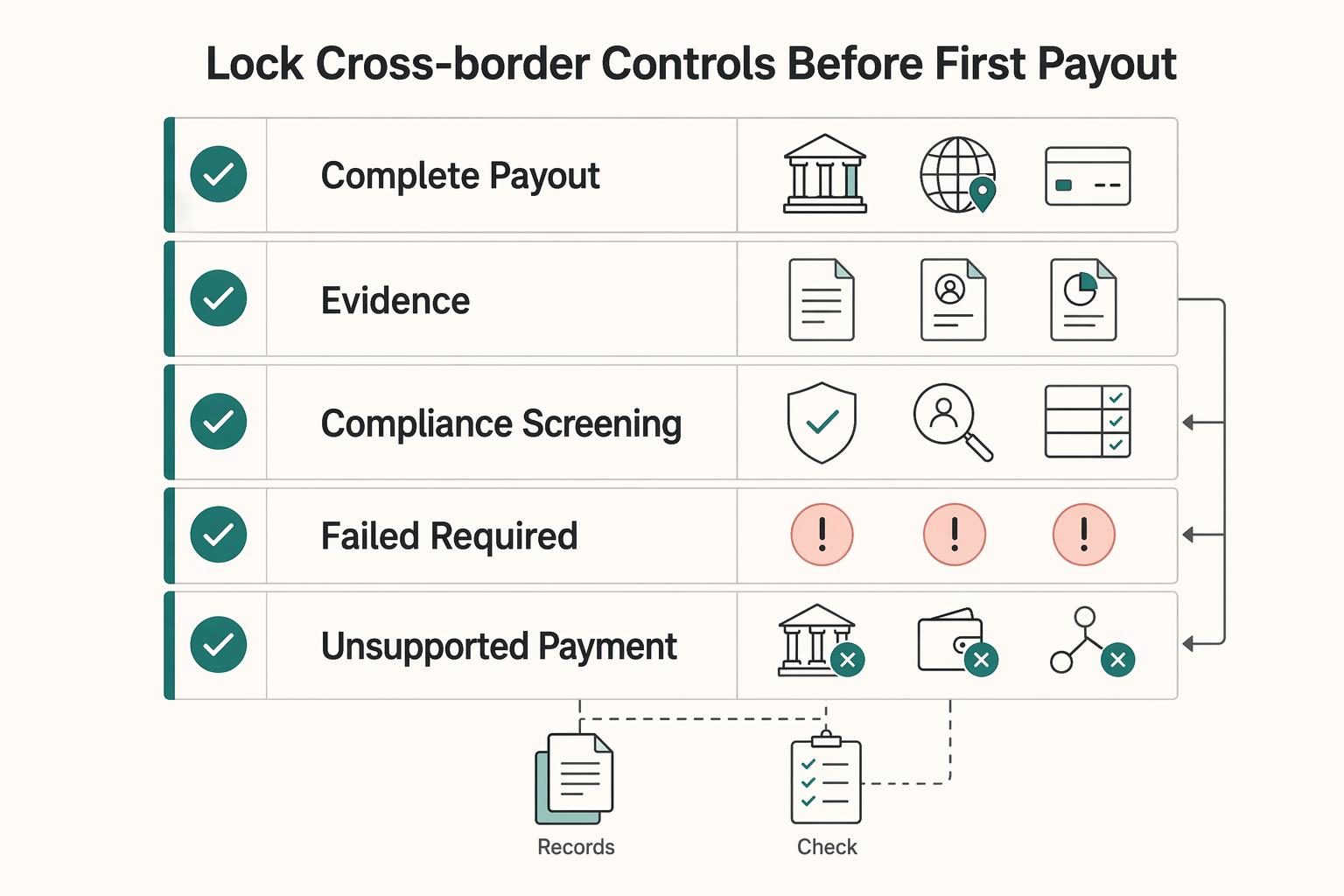
Lock cross-border controls before first payout#
Before first release, require complete payout details, required tax documentation, and completion of your compliance screening checks. State that payout may be paused if required checks fail, if available payment rails do not support the affiliate location, or if required material-connection disclosures are not met.
| Item | Operational rule |
|---|---|
| Complete payout details | Require before first release. |
| Tax documentation | Require before first release. |
| Compliance screening checks | Require before first release. |
| Failed required checks | Payout may be paused. |
| Unsupported payment rails for the affiliate location | Payout may be paused. |
| Required material-connection disclosures are not met | Payout may be paused. |
Implementation checklist for legal and finance handoff:
- Assign one policy owner for payout rules, reversals, and exceptions.
- Run a monthly reconciliation of platform totals, held balances, released payouts, reversals, and open exceptions.
- Confirm contract fields match platform settings: payout currency, hold logic, eligible-balance definition, clawback triggers, recovery workflow, payout exceptions, and notice timing.
For a step-by-step walkthrough, see How to Create a Service Agreement for a SaaS Product.
From Legal Document to Strategic Asset#
Your agreement becomes strategic only if it changes how you run the program day to day. Use each clause for one job: Protect, Perform, or Profit.
| Area | Template agreement | Strategic agreement |
|---|---|---|
| Control | Generic compliance language | Clear operating control: affiliates follow your instructions, any provider-affiliate involvement is disclosed and pre-approved, and service changes move through a defined Schedule A update process by mutual agreement |
| Performance alignment | General referral wording | Commission design that rewards longer-term customer value (for example, tiered terms tied to retention past the refund period) |
| Cash-flow protection | Commission payout terms only | Payout terms plus a clawback clause so refunded sales can be recovered |
Protect: Write rules people can execute without guessing. Spell out what affiliates can say and use, and require disclosure plus pre-approval before any affiliated service provider is added.
Perform: Define how performance is rewarded, then keep operational updates in a Schedule A-style attachment that both parties must agree to so key terms do not drift informally.
Profit: Treat clawbacks as a core finance control, not a footnote, so refunded sales do not stay booked as affiliate commission.
In your next review cycle, tag every clause as Protect, Perform, or Profit. If a clause does not clearly fit one of the three, rewrite it or remove it.
We covered this in detail in How to Set Up an Affiliate Program for Your SaaS Product.
Frequently Asked Questions
What is a standard affiliate commission for a high-ticket digital course?
There is no useful default if the rest of the program design is different. If you want simple admin and easy forecasting, use a flat rate; if you want to reward sustained quality or volume, use tiered terms; and if your product bills over time, decide whether commissions are one-time or recurring. Whatever you choose, pay only on your defined qualified sale and state the tracking method, rate logic, and attribution window. Keep commission range and cookie duration unresolved until the program's contract and tracking setup are verified.
How do I protect my brand from bad affiliates?
Use specific restrictions, not broad promises to "follow the law." Your agreement should say whether affiliates may use your branding and content, require disclosure of the financial relationship, and give you termination rights when they cross the line. Before launch, review sample promotional materials against the signed terms, and include both an "Affiliate Responsibilities and Restrictions" clause and a separate license section for brand and content use.
Do I need to pay affiliates in different countries differently?
Requirements can differ by country, so do not assume one payout or disclosure setup works everywhere. Define payout currency, payment schedule (such as net-30 if used), and tracking-window terms clearly in the agreement, then escalate jurisdiction-specific compliance language to local counsel when uncertain. Verify payout-threshold and tax/compliance document requirements for each market before release.
What is an affiliate clawback clause?
It is a clause that can let you reverse or recover commissions when a sale no longer qualifies under your terms. If you use one, define the trigger events, how affiliates are notified, and how adjustments appear in affiliate records and future payouts. The practical check is simple: confirm your order record, affiliate statement, and finance report reflect the same adjustment and reason.
What is the most important clause in an affiliate agreement?
Usually it is not one clause but a cluster of clauses working together. The highest-value preventive section is often the one that defines affiliate responsibilities and restrictions, because that is where brand protection, disclosure duties, tracking expectations, and prohibited conduct meet. If you run multiple campaigns, keep the core rules in a base agreement or MSA and put campaign-specific terms in a Statement of Work so the same definitions for approved channels, commission eligibility, and termination rights do not drift.
Can an affiliate agreement prevent someone from copying my product?
It can help, but it is not a lock. You should state that your intellectual property, branding, content, and confidential information remain yours, limit how affiliates may use them, and include disclaimer and privacy-policy terms where relevant. If you want stronger anti-copying or competition-related restrictions, get local counsel to review them because enforceability can change across jurisdictions, and make sure post-termination duties are defined clearly.
Try a related tool
Researched and edited by the Gruv editorial team. Gruv builds cross-border billing, payouts, and finance-operations software for global businesses.
Sources
- acquisition.gov/dfars/part-252-solicitation-provisions-and-c...trusted
- comptroller.texas.gov/purchasing/docs/96-1809-4.0-print.pdftrusted
- ecfr.gov/current/title-2/subtitle-A/chapter-II/part-200trusted
- europarl.europa.eu/RegData/etudes/STUD/2021/676006/IPOL_STU(202...trusted
- ftc.gov/news-events/news/speeches/antitrust-intellec...trusted
- hcpf.colorado.gov/sites/hcpf/files/Colorado%20Community%20Heal...trusted
- leginfo.ca.gov/pub/03-04/bill/asm/ab_3051-3100/ab_3082_bill...trusted
- sec.gov/Archives/edgar/data/922723/00009063180000007...trusted
Educational content only. Not legal, tax, or financial advice.
Related Posts

Germany Freelance Visa Application Path for Freiberufler and Gewerbe
Choose your track before you collect documents. That first decision determines what your file needs to prove and which label should appear everywhere: `Freiberufler` for liberal-profession services, or `Selbständiger/Gewerbetreibender` for business and trade activity.

How to Create a Referral Program for Your SaaS Product
A major early risk is not the reward. It is launching with fuzzy attribution, unclear ownership, and payout rules nobody can defend once disputes start. Build this channel as part of your revenue system, not as a side tactic. Otherwise, you may end up cleaning up support, finance, and trust issues after the first signups arrive.

The Freelance Payment Penalty: A Modeled Audit of Platform Fees, FX Spreads, and Payout Delays
The money rarely disappears through a single, easy-to-spot fee. The real loss is stacked. A marketplace takes its commission, a processor adds a charge for international cards, a bank or payment company converts the currency at a spread, a platform holds the funds before release, and a wire sheds a little to intermediaries on the way in. Each layer looks defensible on its own, but the worker feels the combined result as a smaller deposit and a later payday.