
Quick Answer
Recognize revenue when or as the relevant performance obligation is satisfied under a qualifying contract. An earned conditional payment right creates a contract asset; an unconditional right creates a receivable even before invoicing. Reclass the asset when the condition clears and match billing to the existing balance without new revenue.
How accrued revenue shows up on a platform#
A marketplace can earn revenue before the buyer pays. To post it correctly, separate the platform’s performance, its right to consideration, the invoice and cash collection. Those facts determine the revenue amount, the balance-sheet account and the later clearing entry.
Accrued revenue commonly describes earned revenue that has not yet been billed. It does not mean every unpaid sale. Under ASC 606, an earned amount with a remaining performance condition is a contract asset; an unconditional payment right is a receivable even if no invoice has been sent. Billing status is an operational field, not the accounting classification test. FASB’s basis for conclusions explains why invoicing does not determine whether that right is unconditional.
Set two rules before automating: when or as each performance obligation is satisfied, and when the payment right becomes unconditional. Record the platform’s own fee or gross revenue according to its principal-versus-agent conclusion, rather than treating all buyer funds as platform income.
For an earned amount whose payment right remains conditional, debit the contract asset and credit revenue. When that right becomes unconditional, debit receivables and credit the contract asset. If the right was already unconditional when the service was earned, recognize a receivable from the start. A later invoice must not add the same revenue again.
That matters because month-end reconciliation is the formal accuracy check at close, and timing gaps do not stay small for long. Small breaks can distort reporting, delay close, and increase audit risk. In a marketplace context, they can also create friction between finance records and operational decisions.
The guide follows four steps:
- Define prerequisites. Set policy ownership, source records, and cutoff rules before you post the first accrued item.
- Decide the earned event. Use clear rules for when platform revenue is earned, independent of when the buyer pays.
- Design the entry sequence. Classify the earned payment right, then clear or reclass the original asset without duplicate revenue.
- Verify at period end. Reconcile accrued, billed, and collected states so stale balances, duplicate postings, and missed reversals are visible before close is signed off.
Get those four pieces right, and recognizing revenue before cash arrives becomes a controlled accounting choice instead of a month-end guessing exercise. We would rather see your team prove one clean close cycle than automate a rule it cannot explain. For related reading, see Marketplace Subscription Monetization: How to Add Recurring Revenue.
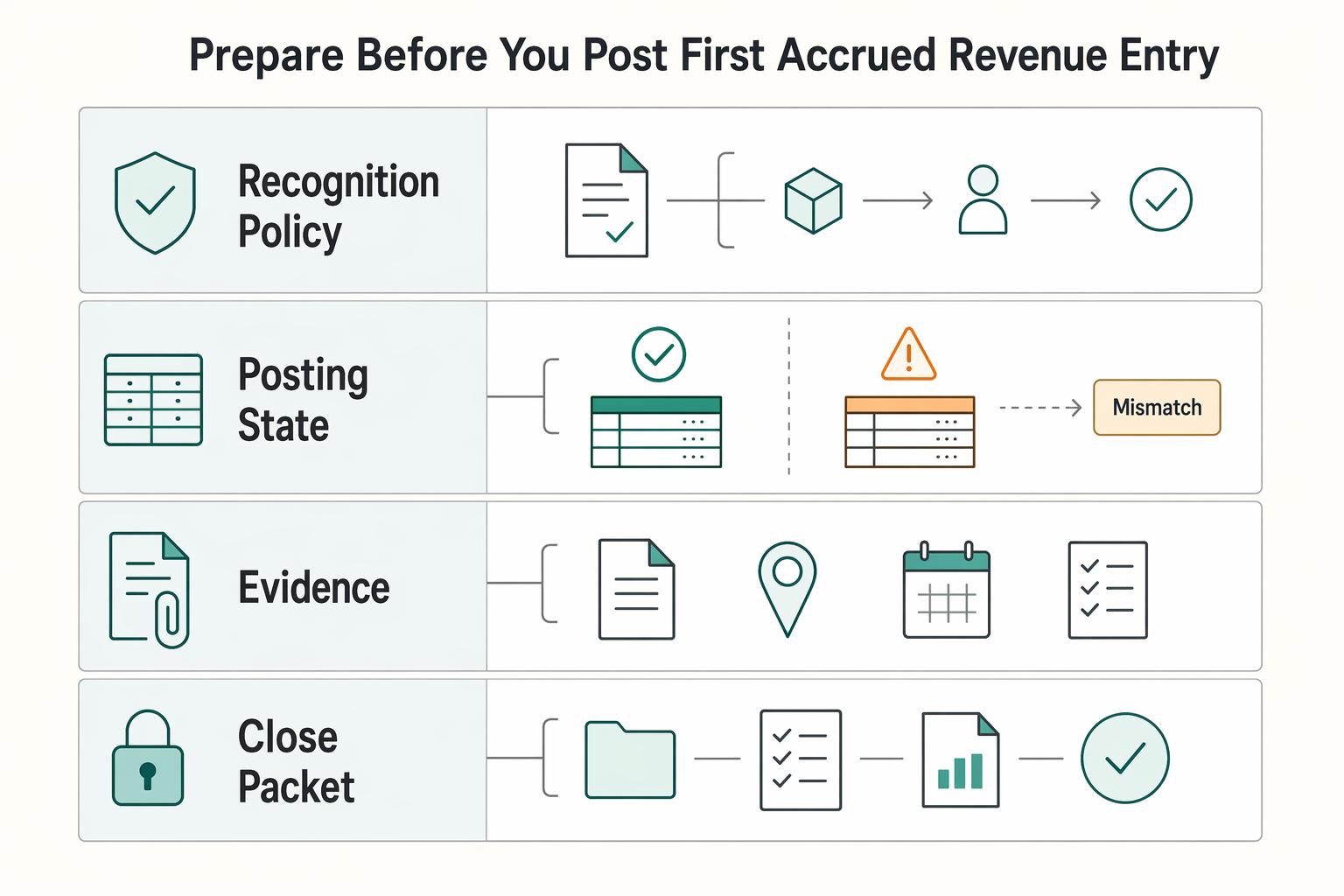
What to prepare before you post the first accrued revenue entry#
Before the first posting, align policy, ownership, evidence, and close review so everyone uses the same earned-event definition.
| Preparation area | What to set up | Review check |
|---|---|---|
| Recognition policy | What "earned" means, how that aligns with accrual accounting, the customer contract, the performance obligations, and the event that shows those obligations were met | If two reviewers choose different earned dates for the same transaction, the policy is still too vague |
| Posting-state ownership | Ownership for the earned event, payment-right assessment, invoicing and asset clearing | Each state needs a named owner and a clear handoff trigger |
| Evidence pack | Contract terms, fulfillment or event record, invoice status, and the period cutoff rule used for the close | Tie the pack to the specific performance obligation so reviewers can trace why recognition was triggered |
| Close packet | Revenue and asset effects, any later right becoming unconditional and subsequent cash clearing | If accrued-versus-billed movement is not clear, fix the workflow before live posting |
Write the recognition policy in plain language#
Define what "earned" means under your GAAP policy, how that aligns with accrual accounting, and how your team applies the revenue recognition principle in this marketplace model. Anchor it to the ASC 606/IFRS 15 core idea of depicting the transfer of promised goods or services, then state the customer contract, the performance obligations, and the event that shows those obligations were met. Verification point: if two reviewers choose different earned dates for the same transaction, the policy is still too vague.
Assign one accountable owner for each posting state#
Assign owners for fulfillment evidence, contract/payment-right assessment, invoice creation and ledger clearing. The same transaction can become earned, unconditional, billed and collected on different dates. Each transition needs a source record and a clear handoff; name the owner in the workflow the close team uses.
Assemble an evidence pack for each recognition trigger#
Standards do not mandate your artifact format, so define it internally. For each trigger, keep the contract terms, fulfillment or event record, invoice status, and period cutoff rule used for the close. Tie the pack to the specific performance obligation so reviewers can trace why recognition was triggered.
Build a close packet that shows both statement effects before go-live#
Show the revenue and balance-sheet effects together in the close packet. Include the earned amount, the conditional or unconditional right, subsequent clearing entries and any liability or seller-payable movement. A mock close with representative transactions should demonstrate that the schedule ties to the GL before live posting.
For a related angle, see Building Subscription Revenue on a Marketplace Without Billing Gaps.
When is revenue actually earned in a two-sided marketplace?#
Recognize the amount allocated to a performance obligation when or as it is satisfied. A point-in-time obligation needs the relevant transfer of control; a qualifying over-time obligation earns revenue as progress occurs. Start with a contract that meets ASC 606’s recognition criteria, including probable collection of the consideration to which the platform expects to be entitled. Delivery alone does not bypass those criteria.
| Scenario | Recognition response | Grounding |
|---|---|---|
| Promised good or service is transferred to the customer | Recognize the amount allocated to the satisfied obligation | The earned date should follow delivery evidence, not invoice timing or cash receipt timing |
| Payment looks likely but obligations are not satisfied | Do not post | "Likely to pay" is not the same as "earned" |
| Obligation is satisfied over time | Recognize measured progress for a qualifying over-time obligation | Recognize supported progress rather than front-loading the full fee at transaction start |
| It is unclear whether the platform controls the specified good or service before transfer | Pause posting and resolve the principal-versus-agent assessment first | Treat role ambiguity as a policy decision before close |
Anchor recognition to transfer, not payment confidence#
Tie recognition to the transfer of the promised good or service under the contract. For a point-in-time obligation, record the supported transfer date; for an over-time obligation, record supported progress. Invoice issuance and cash receipt remain separate milestones.
Keep fulfillment and payment as separate milestones#
Keep fulfillment and payment as separate milestones. Collection confidence cannot substitute for performance, and performance cannot substitute for the contract-recognition and measurement requirements. Estimate the transaction price, apply the variable-consideration constraint where relevant, and allocate it to the obligations before calculating the earned amount.
For partial fulfillment, recognize only the earned portion#
Use a measure of progress appropriate to a qualifying over-time obligation. For example, a fixed $3,000 monthly stand-ready service delivered evenly over a 30-day period may earn $1,000 after ten days; this assumes the over-time conclusion and even-service pattern are supported. Do not apply elapsed-time recognition to a point-in-time delivery merely because work has begun.
Treat role ambiguity as a policy decision before close#
If it is unclear whether your platform controls the specified good or service before transfer, pause posting and resolve the principal-versus-agent assessment first. For deeper detail, see ASC 606 for Platforms: How to Recognize Revenue When You're the Merchant of Record.
Build a trigger-to-journal map your team can audit#
Turn the earned-event rule into a map that links each trigger to evidence, journal behavior, and cleanup behavior. If a reviewer cannot trace one fulfillment trigger to one journal pattern and one follow-up path, pre-billing revenue control is weak.
Draft a practical trigger-to-journal table#
Start with the trigger event, then define the proof, posting date rule, and expected financial effect.
| Trigger event | Evidence source | Posting date | Debit account | Credit account | Expected balance sheet effect | Expected income statement effect |
|---|---|---|---|---|---|---|
| Earned performance; payment right remains conditional | Contract, performance record and remaining condition | Supported earned date or period-end adjustment | Contract asset | Revenue | Contract asset increases | Earned amount increases revenue |
| Payment right becomes unconditional for an amount already recognized | Contract condition cleared, linked original asset/event | Date the right becomes unconditional | Receivables | Contract asset | Asset reclass; no net asset increase | No new revenue |
| Earned performance; payment right already unconditional | Contract/payment terms and performance evidence | Supported earned date or period-end adjustment | Receivables, including unbilled detail | Revenue | Receivable increases | Earned amount increases revenue |
| Evidence identifies incorrect original recognition | Error assessment, original journal and approved correction | Date/period required by applicable error-correction rules | Determined by correction assessment | Determined by correction assessment | Correct the affected asset or other balance | Correct affected revenue if required |
Checkpoint: the first-row posting date should match earned evidence, not billing or cash timing. If contract support or fulfillment proof is missing, route to exceptions instead of posting.
Define accrual and reversal rules explicitly#
Choose one documented clearing design. A maintained contract-asset schedule reclasses the balance when the payment right becomes unconditional. A temporary close accrual may instead reverse in the next period and be replaced by the normal billing or earning entry. These are alternative processing patterns: do not automatically reverse an item and then reclass the already-cleared asset.
Define the follow-up paths in advance:
- Maintained schedule: reclass the contract asset when the right becomes unconditional; clear the receivable when collected.
- Temporary close accrual: if your process uses a reversing journal, link it to its replacement and reinstate any still-earned unbilled amount at the next close.
- Incorrect recognition: assess the affected period and materiality, then post the supported correction rather than treating it as a routine automatic reversal.
Track the original journal, reversal or reclass, replacement entry and outstanding balance together. If an automatically reversed item remains unbilled and still earned at the next close, the closing schedule must reinstate the supported amount. Otherwise a convenience reversal understates cumulative revenue.
Add control checkpoints and exception lanes#
Give each journal operation a stable reference for the event, obligation, journal type and accounting version. Enforce uniqueness in the posting system and reconcile retries to accepted journal IDs. Stripe’s API idempotency protects its own supported requests; it does not enforce uniqueness in a separate GL or eliminate the need to reconcile that ledger.
At close, reconcile GL balances with subledgers and work exceptions directly. A practical tie-out is a matched list of accrued events that later became invoices or approved reversals, with amounts and event IDs linked to the original accrual.
Build these exception lanes into the map:
- Missing evidence: no posting until fulfillment and contract support are attached.
- Late fulfillment updates: hold for cutoff review when earned-date evidence changes late.
- Post-close corrections: assess the affected period/materiality and link the approved correction to the original journal.
For monthly sign-off, treat auto-approval as a controlled lane under your policy, not a default. If you use it, require prior close-cycle evidence that the trigger's evidence pack runs without exceptions.
Post entries correctly before and after invoicing#
Classify the payment right before selecting the asset account. Earned and conditional means a contract asset; earned and unconditional means a receivable, whether billed or unbilled. Present the asset as current or noncurrent under the applicable balance-sheet rules; a pre-invoice label does not establish current classification.
| Step | When it applies | Treatment |
|---|---|---|
| Earned conditional right | Performance earns an amount while another payment condition remains | Debit contract asset; credit revenue |
| Earned unconditional right | Only time remains before payment is due, including before invoicing | Debit receivable; credit revenue |
| Right becomes unconditional | A recognized contract asset’s remaining condition clears | Debit receivable; credit contract asset; no new revenue |
| Advance consideration | Cash received or unconditional amount due before relevant performance | Record contract liability and cash or receivable as appropriate |
| Period cutoff | Later invoices/evidence relate to the closed period | Match to original balances; separately assess any recognition error |
Step 1: Record earned activity in the correct period. For a conditional payment right, debit the contract asset and credit revenue; for an unconditional right, debit receivables and credit revenue. Use the supported earned date for event postings or the period-end date for a closing adjustment. Retain the event date and cutoff basis so a period-end aggregate remains traceable.
Step 2: Reclass when the payment right becomes unconditional. Debit receivables and credit the existing contract asset for the supported amount. This often coincides with billing, but the invoice itself does not establish the right. If the amount was already an unbilled receivable, issuing its invoice only changes the billing detail or receivable subaccount, with no new revenue.
Step 3: Keep advances separate from earned revenue. Customer cash received before the platform performs normally creates a contract liability: debit cash, credit deferred revenue. If an unconditional amount becomes due before performance, a receivable and contract liability can arise before cash arrives. Release the liability when or as the relevant obligation is satisfied. Buyer funds owed to sellers require their own payable accounting; they are not automatically deferred platform revenue.
Step 4: Protect period cutoff. Match post-close invoices to the existing asset and the actual payment-right transition. A valid prior-period earning event stays in its earned period; invoicing must not automatically add or move revenue. If later facts identify an original error, assess the affected period and materiality, approve the appropriate correction, and retain the explanation with the original journal.
If the timing issue comes from billing cadence, Recurring Billing for Marketplaces: How to Charge Buyers and Pay Sellers on the Same Cycle shows how to line up charges and payouts.
Worked example: an earned fee with a remaining payment condition#
Assume a platform’s contract contains two distinct arranging services with allocated fixed fees of $300 and $200. The first is completed on June 30; the second on July 5. The contract makes the full $500 payable only after both are performed. Collection is probable, the other contract criteria are met, and the platform has supported its agent conclusion. These amounts are platform fees, excluding taxes and amounts owed to sellers.
| Date/event | Debit | Credit | Result |
|---|---|---|---|
| June 30: first service earned | Contract asset $300 | Revenue $300 | June revenue $300; payment right still conditional |
| July 5: second service earned; right unconditional | Receivable $500 | Contract asset $300; revenue $200 | July revenue $200; contract asset cleared |
| July 20: buyer pays | Cash $500 | Receivable $500 | No new revenue; receivable cleared |
The July invoice must match the $500 receivable rather than credit another $500 to revenue. If a temporary reversing design is used instead, the June accrual reverses with debit revenue $300 and credit contract asset $300; the July replacement credits revenue $500, giving July net revenue of $200. Do not also credit the cleared contract asset. Reconcile those linked entries and re-accrue supported amounts at the next reporting date if the replacement has not occurred.
Worked example: an unbilled receivable is already unconditional#
Suppose the platform earns an unconditional $150 fee on June 30 and sends its invoice on July 3, with payment due later. At June close, debit unbilled receivables $150 and credit fee revenue $150. Issuing the invoice changes billing status, or reclasses between receivable subaccounts, without additional revenue. Collection debits cash and credits receivables. The right arose from the contract and completed service, not the act of sending the invoice.
Reconcile accounting state and cash state without month-end surprises#
Reconcile performance, payment rights, invoices and cash as separate fields. The same dollar must not be recognized twice, but a contract can contain different earned and unearned amounts and a separately presented receivable. Contract asset and liability presentation is assessed on a net basis for each contract; do not offset unrelated contracts or seller payables merely to simplify the schedule.
Step 1: Build a rights-and-performance schedule. Record contract/event ID, obligation, earned amount/date, remaining payment condition, unconditional-right date, invoice ID/date and cash applied. Classify the actual balances, then aggregate them into the ledger accounts.
| State at period end | Balance sheet home | What should exist as support | Main risk if it stays unresolved |
|---|---|---|---|
| Earned, payment right conditional | Contract asset; current/noncurrent as applicable | Performance support, remaining condition and clearing action | Condition unresolved or wrong classification |
| Unconditional, billed or unbilled, not collected | Receivable | Contract right, billing status, collections/credit-loss assessment | Missed billing or collection exposure |
| Consideration received or due before performance | Contract liability, with any receivable presented separately | Receipt or unconditional due amount, remaining performance | Premature revenue or omitted liability |
Check for duplicate amounts and stale transitions at transaction level. A receivable can coexist with a contract liability for an advance amount due, so do not force an entire contract into exactly one operational bucket. Reconcile the separately presented receivable and the net contract position.
Step 2: Tie detail schedules to top-line balance sheet accounts every close. Run period-end tie-outs between subledger/detail activity and the related GL balances, including A/R aging-to-GL reconciliation as part of close. Apply the same discipline to accrued detail and deferred schedules so each support schedule ties to its control account for the same period.
Practical check: freeze detail schedules at cutoff and reconcile those snapshots to ledger balances for that period. Reconciling against live, changing data after close creates timing noise instead of surfacing real breaks.
Step 3: Age accrued items, not just receivables. Use aging views for accrued balances so old items trigger investigation instead of rolling forward indefinitely. Teams often use 1-30, 31-60, 61-90, and >90 day buckets for A/R; the same mindset helps surface stale accrued items.
Require an owner, reason and next action for carried-forward items. Delayed invoicing may leave an unbilled receivable rather than a contract asset. A missing condition or fulfillment record may require classification or recognition correction; aging alone does not settle that question.
Step 4: Separate collection losses from recognition corrections. If the original recognition was valid and the buyer later fails to pay, assess the required credit-loss allowance for the receivable or contract asset as well as collections. A refund, price concession, contract modification or incorrect earned event can require a different revenue adjustment. The revenue recovery playbook covers the collection workflow.
If the earned trigger was wrong, document the original error, affected period and required correcting entry. Do not assume every closed-period error can be fixed by a current-period revenue reversal: evaluate materiality and the applicable error-correction requirements before posting.
When supported unbilled rights become billed receivables, the accounts receivable automation guide covers billing and collection follow-up.
Decide principal versus agent treatment before scaling automation#
Decide principal versus agent treatment before you automate posting logic. Under ASC 606, this is a fact-specific judgment, not an accounting policy election, and it drives whether revenue is presented gross or net on the income statement.
Write a formal principal-versus-agent memo before you automate anything#
Document the two-step assessment first: identify the specified good or service, then assess whether your platform controls that specified good or service before transfer to the end customer. That control test is central to ASC 606, including ASC 606-10-55-37.
Your memo should clearly state the contract or product variant, the promised good or service, who delivers it, and when transfer occurs. If two reviewers cannot read the memo and reach the same posting result, the logic is not ready for automation.
Translate the conclusion into explicit gross-versus-net posting rules#
Map the conclusion directly to journal behavior and presentation. Principal treatment means gross revenue presentation; agent treatment means net revenue presentation (for example, fee or commission).
Treat this as a reporting and ledger design decision, not a label exercise. If your model resembles Merchant of Record, still document why the control assessment supports the result, because the label alone does not settle the accounting outcome.
Allow mixed conclusions when the arrangement actually has mixed roles#
Do not force one global outcome across the whole arrangement. One contract can support principal treatment for some goods or services and agent treatment for others.
At the system level, map automated triggers to the memoed conclusion for each service line, not only to a single customer- or seller-level rule.
Add change-control triggers that reopen the memo when facts change#
Reopen the assessment when approved contract modifications change scope, price, or both, or when fulfillment responsibilities shift between parties. Reassess again if operational transfer points change in practice.
Keep an active inventory of decision memos with effective dates and tie automation changes to that inventory. If contract terms change but posting logic does not, pause release and recheck the ASC 606 conclusion before the next posting cycle.
For a step-by-step walkthrough, see Platform Revenue Split Calculator for Modeling Marketplace Take Rates.
Common failure modes and recovery steps in live operations#
Treat timing errors as triage items: correct the entry, fix the trigger, and verify the control before close.
| Failure mode | Recovery step | Control check |
|---|---|---|
| Revenue was recognized before the performance obligation was satisfied. | Assess the affected period/materiality; correct the entry and failed trigger under the applicable error-correction rules. | Each accrued posting ties to evidence of satisfaction under Step 5, not billing intent or cash expectation. |
| A conditional asset remained after its payment condition cleared. | Reclass the supported amount to receivables and match any invoice without new revenue. | Rights assessment and original clearing record agree; no duplicate amount. |
| Advance cash was treated as earned revenue. | Move it to deferred (unearned) revenue in the correct liability account until delivery occurs. | Release from deferred revenue is tied to delivery, not payment success alone. |
| Operating reality changed and posting logic no longer matches your role. | Reopen the principal-versus-agent assessment and refresh the policy memo before the next close. | Current posting rules match current responsibilities and contract flow. |
Copy and paste close checklist:
- Confirm earned-event evidence for every accrued posting.
- Validate conditional-right clearing and billed/unbilled receivable status, with no duplicate revenue.
- Reconcile contract assets, receivables and contract liabilities to the GL, plus cash and seller-payable movements separately.
- Review aging and assign owners and due dates for exceptions.
- Archive policy decisions, reassessments, and approvals in the close packet.
For the cash impact of booking revenue before payment arrives, How to Build a Float Management Strategy for Marketplace Platforms explains how to manage the gap.
Test the recognition and clearing rules through one close#
Use performance to determine earned revenue and payment rights to classify the related asset. Keep invoice and cash records linked to those decisions so automation clears the original amount without recognizing it twice.
Define clear earned triggers and require evidence for each#
Keep the contract or fee terms, fulfillment or progress record, posting date, payment-right condition and invoice status with each earned amount. Weak, late or contradictory support belongs in cutoff investigation, even when the buyer is expected to pay.
Classify the earned payment right and clear the original amount once#
Reconcile each invoice to existing earned balances or a documented new earning event. An unconditional unbilled receivable changes billing status when invoiced; a contract asset reclasses only when its payment condition clears. If you use temporary reversing accruals, verify the replacement and any still-unbilled closing accrual so neither duplication nor omission survives close.
Reconcile the accounting state at period end and treat unresolved items as process signals#
Tie contract-asset, receivable and contract-liability schedules to the GL and reconcile collections and seller payables separately. Investigate old conditional rights, unbilled receivables, missed clearing entries and incomplete records. Review credit losses after payment failure; correct revenue when performance or consideration facts require it.
Test the trigger map with an earned conditional item, an earned unconditional unbilled item, an advance, a partial performance event and a duplicate retry. Give each expected journal and closing balance an owner. This makes the policy testable before it controls a larger transaction volume.
Frequently Asked Questions
What is accrued revenue in a marketplace context?
Accrued revenue commonly means revenue earned before billing. Under ASC 606, distinguish a contract asset, whose payment right has a remaining condition beyond time, from an unbilled receivable, whose right is already unconditional. Revenue can be recognized before cash arrives, but an unpaid invoice is not automatically an accrued-revenue balance.
When should a platform recognize revenue before buyer payment?
Recognize the amount allocated to an obligation when or as that obligation is satisfied, using a contract that meets the applicable recognition criteria and the appropriate transaction price. Buyer cash need not have arrived. Decide separately whether the earned amount creates a contract asset or an unconditional receivable.
What is the operational difference between accrued revenue and deferred revenue?
Earned revenue precedes billing in an accrued-revenue workflow. Deferred revenue is a contract liability for consideration received or due before the related performance. The distinction is performance versus consideration, rather than a rule that every unpaid amount is accrued or that liabilities arise only after cash collection.
What entry is posted before billing, and what changes after invoicing?
For an earned amount with a conditional payment right, debit the contract asset and credit revenue. When the right becomes unconditional, debit receivables and credit that asset without new revenue. If the right was already unconditional, recognize a receivable initially; issuing its later invoice changes billing detail, not revenue.
How do accounts receivable and accrued revenue interact during month-end close?
Reconcile conditional contract assets and both billed and unbilled receivables to their ledger balances. Trace when payment conditions clear and match each invoice to the existing earned amount or a separate new earning event. An invoice cannot itself prove that a contract asset should become A/R.
Does principal-versus-agent treatment change how much revenue we recognize?
Yes. A principal generally recognizes gross consideration for the specified good or service it controls before transfer; an agent recognizes its fee or commission for arranging supply. Assess each specified good or service from the contract facts. Collecting buyer funds or using a Merchant of Record label does not itself settle control.
What should we do when an accrued item remains open across multiple closes?
Check whether performance supports the amount, whether its payment right remains conditional, whether billing has occurred and whether a credit-loss allowance is needed. Assign a billing or condition-resolution action with an owner/date. Correct classification or recognition when facts require it; do not reverse valid revenue solely because it is old.
Researched and edited by the Gruv editorial team. Gruv builds cross-border billing, payouts, and finance-operations software for global businesses.
Sources
Includes 7 external sources outside the trusted-domain allowlist.
- docs.stripe.com/api/idempotent_requeststrusted
- asc.fasb.org/layoutComponents/getPdfexternal
- dart.deloitte.com/USDART/home/codification/revenue/asc606-10/r...external
- dart.deloitte.com/USDART/home/codification/revenue/asc606-10/r...external
- docs.oracle.com/en/cloud/saas/netsuite/ns-online-help/sectio...external
- ifrs.org/issued-standards/list-of-standards/ifrs-15-r...external
- storage.fasb.org/ASU%202014-09_Section%20D.pdfexternal
- storage.fasb.org/Rev_Rec_Implementation_QAs.pdfexternal
Educational content only. Not legal, tax, or financial advice.
Related Posts

Revenue Recovery Playbook: Recover Failed Subscriber Payments in 7 Steps
A subscriber whose renewal fails may still want the service. Product owns the customer path and access policy, engineering owns payment state and event processing, and finance owns collection reconciliation. Give support a view of the invoice, failure reason and next action so a customer receives one consistent answer.

ASC 606 Revenue Recognition for Merchant of Record Platforms
If you run a Merchant of Record flow, cash movement is not your revenue policy. Under ASC 606, the hard part is that customer payment, processor settlement, and the point when revenue is actually earned can sit on different dates and in different records.
Revenue-Based Financing for Payment Platforms: How to Use Future Transaction Volume as Collateral
Revenue-based financing (RBF) can fit a payment platform with real revenue that wants growth capital without equity dilution. It only works if the repayment structure matches how cash actually comes in.