
Quick Answer
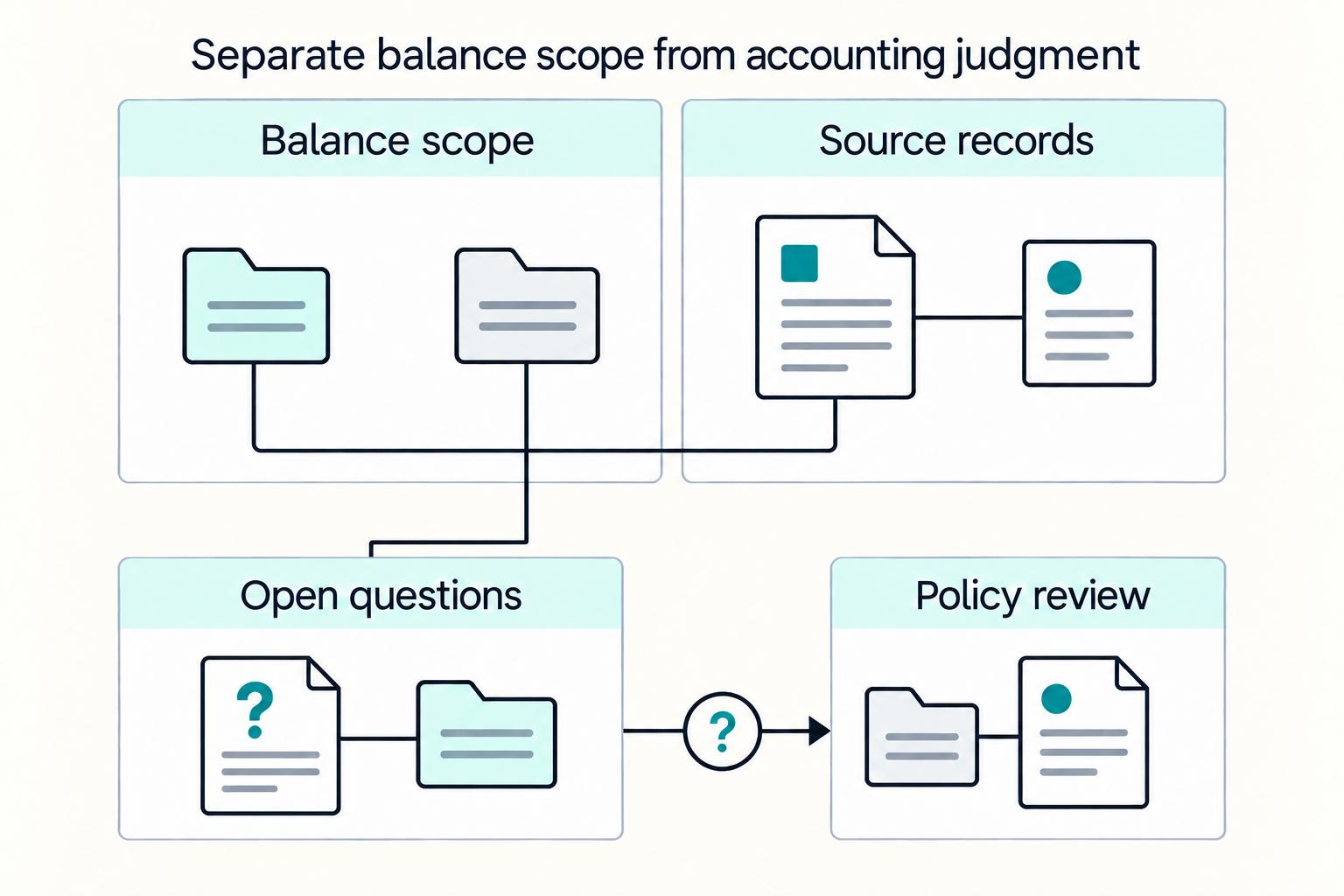
Platform float should be accounted for through a controller-owned close process that defines scope, locks period evidence, maps statement fields to the chart of accounts, and routes unclear items to accounting policy review before final presentation under GAAP. Exported PDF and CSV statements are evidence, not the accounting answer, and final classification needs linked support, sign-off, and tie-back controls.
Why this guide matters for platform finance teams#
If you are working through account platform float financial statements gaap treatment, treat exported statements as the starting point, not the accounting answer. This guide is for teams that own close quality and need a defensible path from Float Account Statement data to posting and review decisions a controller can sign off on.
Reframe the problem#
Guidance often focuses on retrieving PDF statements and CSV statements. That alone does not settle close judgment. In practice, statement files are evidence, and your close process turns that evidence into accounting decisions.
Treat statement access as the beginning of a controlled review. For each period, consider defining one final PDF as period authority, one matching CSV for tie-out, and one named owner responsible for explaining any differences to the general ledger.
Put the controller's sign-off at the center#
This belongs inside controller-owned work, not beside it. Accurate reporting, standards compliance, and the systems that keep finance running sit in the same chain. Closing the books, producing statements, and satisfying audit expectations are connected, so float treatment needs to live inside close controls.
Build backward from sign-off, not forward from exports. A workable chain is simple: source statement, mapping logic, journal support, and reviewer check. Speed matters, but only after those judgment points are clear. Automation can reduce manual effort, but it cannot fix unclear decision rules.
Define the practical outcome you need#
The outcome here is simple: move from Float Account Statement data to defensible classification, posting, and review checkpoints. It is not a one-size-fits-all GAAP conclusion from exports alone. At minimum, your process should produce:
- a clear rule for what is booked now versus routed for accounting review
- period-locked source artifacts, for example a retained PDF as evidence and a CSV used for tie-out and journal support
- a pre-close review check that posted totals still trace to source data
Define platform float boundaries before you post anything#
A practical approach is scope first, posting second. If you define the balance population up front, you avoid mixing a scoping decision with a journal-entry decision later.
Write a one-page scope memo#
Use a short memo to separate platform-related balances from operating cash into clear working populations based on verified source metadata. Treat those labels as scoping tools, not as an accounting conclusion on their own.
| Memo item | What to document |
|---|---|
| Population includes | what each population includes |
| Source artifact | which source artifact identifies each population |
| Initial posting scope | what is out of scope for initial posting |
| Judgment owner | who owns classification judgment when treatment is unclear |
Keep the memo focused on:
- what each population includes
- which source artifact identifies each population
- what is out of scope for initial posting
- who owns classification judgment when treatment is unclear
Verification checkpoint: a reviewer outside the preparer role can place a sample statement line into a population without extra context.
Set a liability review gate before any cash presentation#
Put the gate in place before anyone posts a cash presentation. If ownership, obligation, or classification is unclear, route the item to accounting policy review before final presentation under GAAP. This is a control step, not a universal classification conclusion.
Do not let export format drive presentation. If period-end ownership or obligation is unclear, hold the final presentation entry and park the item for review.
Record what the platform documents do not answer#
Platform documentation can tell you how statements behave, but not everything you need for accounting policy. Use those materials to understand statement behavior, then log what they do not resolve. Keep an open-items list so policy owners can close each gap directly.
For a practical refresher on what happens between collection and payout, see Understanding Payment Platform Float Between Collection and Payout.
Collect prerequisites and assign owners before month-end#
Month-end issues often start before month-end, and a platform-float close procedure is not defined here. Treat ownership, source artifacts, and ledger destinations as internal decisions you need to document before posting.
Inventory the exact source artifacts you will use#
Create a short retrieval inventory for your environment. Document the actual retrieval path, the file types you can access, and the period each file covers.
Optional check: ask a reviewer who did not prepare the inventory to retrieve the same period files from your notes alone. If they cannot, your instructions are still too implicit.
Assign a primary owner and a backup for retrieval#
Set retrieval ownership under your internal control policy, including backup coverage where required. Confirm access in practice for the assigned users instead of assuming permissions from role names, and record that confirmation in your close records.
Freeze the period evidence set before posting starts#
If your policy requires an evidence snapshot before posting, define the snapshot point and storage location internally. Record the metadata your team needs, for example filename, retrieval date, covered period, preparer, and version notes.
If a later export does not match the earlier package, retain both versions and note which file was used for posting and why.
Confirm ledger destinations and mappings are current#
Before journal prep, confirm where each exported balance should land and whether mapping logic has changed. Platform-float GAAP treatment, presentation thresholds, and system-specific mapping requirements are not established.
If a reference you planned to use for classification is not accessible, treat it as unavailable support and escalate rather than assuming it validates your treatment.
Build the GAAP treatment decision table your team will use every close#
A shared decision table keeps judgment reviewable. Without it, last month's booking pattern can quietly become this month's policy.
Build one table that separates observed facts from accounting judgment#
Separate what you can observe from what you are concluding. That keeps open questions visible and makes policy review more efficient.
| Balance type | Account context | Currency (if relevant) | Obligation to assess | Expected settlement path | Proposed presentation under GAAP | Required evidence | Policy sign-off | Status |
|---|---|---|---|---|---|---|---|---|
| [balance population] | [account context] | [currency] | [working assessment] | [how it is expected to settle] | [proposed classification] | [linked support] | [owner/date] | Draft / Final |
Force comparison by context before you finalize treatment#
Review rows side by side by context and, where relevant, currency. If two rows look similar, document why they can share treatment. If they do not, document why they differ. Do not assume one outcome applies everywhere.
Set a hard close rule for final classification#
Treat every row as draft until the support is complete. No row is final unless it includes linked supporting evidence and policy sign-off. If either is missing, keep the row in draft status and escalate before posting.
Track unresolved items in a known-unknowns row#
Add a "known unknowns" row for points not resolved in current documentation. Assign an owner and due date so assumptions do not quietly drift from one close to the next.
Related reading: How to Build a Deterministic Ledger for a Payment Platform. Before you lock your treatment table, map each rule to the actual ledger events and exports in the Gruv docs.
Map statement fields to your Chart of Accounts without ambiguity#
Ambiguous mapping is a common way to produce a clean-looking close that later fails control review. If a field can be read two ways, keep it in draft until your team resolves the interpretation and documents the decision. Resolve those issues early so they do not show up in final review as compliance failures.
Write a field dictionary before you map anything#
Start with the current statement export exactly as it appears. Document each label verbatim, then record your team's interpretation, destination account, and approver. Do not rely on memory or prior-period assumptions.
| Statement field label | Team interpretation (current export) | COA target | Verification checkpoint |
|---|---|---|---|
<field label 1> | Approved interpretation for this export version | Assigned destination account | Ties to period support |
<field label 2> | Approved interpretation for this export version | Assigned destination account | Ties to period support |
<field label 3> | Approved interpretation for this export version | Assigned destination account | Ties to period support |
<field label 4> | Approved interpretation for this export version | Assigned destination account | Ties to period support |
Keep mapping-version history visible#
Do not overwrite old logic when output formats change. Keep version notes side by side, including version ID, effective date, owner, and a short rationale tied to what you observed in the export.
Add a reconciliation trail reviewers can follow end to end#
Make sure a reviewer can trace sampled items from source data to recorded entries and documented exceptions without extra explanation. If items cannot be traced quickly, treat that as a control gap and resolve it before close finalization.
Freeze logic before expanding to more entities#
Get one version working cleanly before you scale it. Keep the mapping approach documented and consistently applied before expanding to additional entities. Scale only after one version can run through a full close cycle without manual reinterpretation.
Post journals in a fixed sequence so replays stay clean#
Some of the guidance here covers procedural requirements in securities-law contexts, for example tender-offer disclosure and timing rules, plus Rule 10b-18 safe-harbor framing. It does not establish a required platform-float journal posting sequence or replay workflow. Treat any sequence here as internal policy, not an external GAAP requirement.
Define one posting order as a control choice#
If your team uses an order such as opening carryforward, in-period activity, settlement movements, then residual review, label that order as a house standard.
If reviewers need layer-level detail, set that expectation in your internal policy.
Keep Cash account and Charge account streams distinct when you manage them as different populations#
Do not assume separate posting streams for Cash account and Charge account are required. If you separate them, treat that as your operating design choice rather than a sourced requirement.
Add rerun protection before automation#
If you implement duplicate-prevention controls, define them as internal controls and apply them consistently.
Close with an explicit tie-back checkpoint#
A required tie-back of posted journals to PDF statements before close completion is not established. If you use this checkpoint, treat it as an internal close policy.
Reconcile clearing accounts and prove your tie-outs#
A tie-out is stronger when another reviewer can reperform it from retained period evidence. If the answer depends on memory or an informal view, treat it as incomplete.
Keep reconciliation aligned to your own posting structure#
If your close process already uses segments, keep those segments consistent from posting through review. This can make each reconciled balance easier to map back to its support and posting path.
Use the same grouping labels in your reconciliation file, support package, and journal references so a reviewer can reperform one segment end to end without rebuilding your logic.
Anchor each period to one authoritative artifact#
Pick one period-end artifact as the authority for the tie-out, then treat other exports as supporting detail. Verify against the official artifact, not an informational rendition.
This mirrors the Federal Register distinction: users are told to verify against an official edition, while the XML rendition on FederalRegister.gov is informational and does not provide legal or judicial notice. The page also links to the corresponding official PDF on govinfo.gov as the authoritative file. Apply the same discipline in your close package by fixing the authoritative file for the period and keeping it stable through review.
Make exceptions reperformable#
When a segment does not tie, record the exception so another reviewer can see what was tested, what differed, and what evidence supports the current status. Keep each exception tied to the support and ledger lines used in that test.
If an item depends on accounting policy judgment, route it through your formal review path instead of leaving it as unresolved reconciliation noise. Related: How to Reconcile Bank Statements in Xero.
Control cutoff risk across billing cycles and custom ranges#
Once tie-outs are in place, cutoff is the next place a close can break. A practical approach is to anchor the period to the fixed-period PDF statement and use custom-range CSV exports for analysis and exceptions.
| Source/view | Period or timezone | Close use |
|---|---|---|
| PDF statements | fixed to formal reporting periods | period authority; sign-off evidence and period totals |
| Custom-range CSV files | custom date ranges are CSV-only | investigate boundary items and reconciling differences |
| Transaction Export page | displays in ET | test boundary transactions in ET first |
| Accounting sync exports | post in UTC | confirm downstream accounting-export timing |
Anchor the close to the official period statement#
Use Accounts > Statements as your Float source for period authority. Float treats PDF statements as fixed to formal reporting periods and custom date ranges as CSV-only.
Use the PDF for sign-off evidence and period totals. Use custom-range CSV files to investigate boundary items and reconciling differences, not to replace period authority.
Verification point: keep one final PDF per account type and currency in the close package, and reference that exact period in review notes.
Set a boundary rule before testing exceptions#
Set one boundary rule at cycle reset, then apply it consistently. Cash statements follow calendar months. Charge statements follow contracted 14-day or 30-day billing cycles, starting at 12:00 AM ET and ending at the last second of the final day.
Test boundary transactions against the statement period in ET first, then confirm downstream accounting-export timing. Float's Transaction Export page displays in ET, while accounting sync exports post in UTC, so the same transaction can appear on different calendar days across views.
Failure mode to prevent: a boundary item can be counted in one period in ET and again in the next period in UTC. Or it can be missed because teams assumed both views used the same timezone.
Align Charge close tasks to billing-cycle timing#
For Charge populations, close to the billing cycle instead of forcing a month-end assumption. Float states Charge statements follow the contracted cycle and PDFs are generated only after the period is complete, for example, October available on November 01.
Schedule retrieval, review, and journal prep to each account's actual cycle close. Do not force all Charge work into a single monthly routine.
Confirm cutoff consistency across statement and export views#
Before sign-off, reconcile period membership across the PDF statement, the custom CSV used for exception work, and the Transactions page view. The goal is consistent period inclusion after ET and UTC differences are accounted for.
Keep the evidence pack minimal and reperformable: final PDF, boundary-analysis CSV, and brief notes for items that required ET-to-UTC cutoff review.
Build an audit evidence pack reviewers can reperform#
Here, completeness is not enough. Your pack should let a reviewer start at one CSV record and follow one clear path through the exact fields used in your check (OTL ID, title metadata, and Format/URL/Cost columns) without operator help.
Assemble one locked period folder#
Create one folder with the exact CSV snapshot and review outputs used for that check, then keep the final set clearly separated from drafts and reruns. Verification point: each reviewed item maps to one clearly named row, for example by OTL ID, and the same metadata fields (Copyright Year, Publisher, License, ISBN10, ISBN13).
Tie each balance to one trace path#
For each reviewed item, add a short trace note that links:
- row identifier and title
- metadata fields reviewed
- format/link/cost entries reviewed
Where applicable, record row-level pricing splits shown in the data, for example $0.00 digital entries and a $33.00 hardcopy entry in one record.
Separate evidence from accounting judgment#
Keep policy decisions explicit and separate from raw records. GAAP classification or presentation rules for platform float are not established, so do not present those points as settled by this evidence alone.
Add a one-page index reviewers can scan#
If you include an index, keep stable labels such as artifact name, period/snapshot, source, version, owner, and purpose. Consistent fields make reperformance faster and reduce ambiguity.
For a step-by-step walkthrough, see How to Build a Subscription Billing Engine for Your B2B Platform.
Handle common failure modes before they become restatements#
This section is about exception control, not a float-specific GAAP rulebook. Restatement thresholds or close-remediation procedures are not defined here, so treat those as internal policy decisions and keep evidence status explicit.
| Failure mode | Grounded detail | Handling |
|---|---|---|
| Citation structure is inconsistent | Use CFR citations in title-part-section format; example: 12 CFR 347.101 | Use title-part-section format |
| Legal status is misstated or omitted | CFR content is judicially noticed under 44 U.S.C. 1507 and is prima facie evidence under 44 U.S.C. 1510 | document any exception where that status is represented inconsistently |
| Support artifacts are missing | keep status explicit: "missing", "superseded", "unresolved" | mark the item as an evidence exception |
| Official marks are used inconsistently | inconsistent use of official NARA seals/logos is subject to penalties under 18 U.S.C. 506, 701, and 1017 | treat logo/seal handling as a compliance-sensitive exception |
Add scale checkpoints for multi-entity operations#
Scale only after entity-level controls are holding. If you do not gate each entity, unresolved issues can leak into group totals and get harder to unwind.
Gate each entity before consolidation#
Gate each entity before consolidation. Keep a separate close status and exception list per legal entity instead of one shared group status where possible. A practical checkpoint is to make entity-level status explicit for close calendars, journal latency, subledger-to-GL reconciliation, intercompany eliminations, chart-of-accounts changes, and FX policy drift before consolidation.
Consider using one repeatable verification set per entity: period artifacts, reconciliation result, and approval record. That keeps breaks visible at the entity level instead of discovering them after rollup.
Standardize Critical Data Elements before automation#
Standardize Critical Data Elements before automation. Declare GL and subledger journals, FX rates, and bank statements as CDEs with explicit data contracts.
Make those contracts enforce debits-equal-credits integrity, valid Chart of Accounts mappings, sign conventions, and close-aligned cutoffs. If you segment by currency or account type, keep labels and rules consistent across entities so drift does not create reconciliation noise later.
Route policy-owned topics outside the close lane#
Route policy-owned topics outside the close lane. Escalate questions about interest-bearing account treatment or state-regulation obligations with the affected entities and supporting evidence instead of patching through ad hoc mapping changes.
If you need a deeper policy read, pull in Platform Wallet Compliance: Float Rules Interest Bearing Accounts and State Regulations.
Reuse one evidence-pack template across entities#
Reuse one evidence-pack template across entities. Keep the same folder structure, index, and trace fields so lineage runs clearly from consolidated balances back to entity-level source artifacts.
That consistency will not eliminate review work, but strong finance data controls are associated with fewer restatements, faster closes, and cleaner audits.
If you are rolling this control model across entities, use your checklist as a requirements brief and talk with Gruv to confirm program and market coverage.
Copy-paste close checklist for GAAP-ready platform float#
Use a two-lane checklist. Mark items as source-backed only when you can point to explicit tokens in your source data. Keep everything else in the internal-policy lane.
Anchor the period to explicit source tokens#
Start with the period tokens the excerpt actually shows: 2024-01-01 to 2024-03-31, 2023-01-01 to 2023-03-31, and repeated point-in-time references such as 2023-12-31. If extracted data cannot be tied back to those tokens, stop before classification or posting. Because the source is a concatenated token stream, parsed output can look clean while still risking blended dates, units, and members.
Verify currency and tag context before inferring meaning#
Check unit and currency tokens in raw data first. The excerpt includes iso4217:USD and xbrli:shares, so those are valid extraction checkpoints.
Then review context for cash-related tags. The excerpt shows CashAndCashEquivalentsMember alongside MoneyMarketFundsMember and FairValueInputsLevel1Member. That context does not resolve GAAP presentation by itself, so keep raw tag context next to parsed balances for review.
Separate evidence-backed checks from policy-only checks#
This guide supports taxonomy and tag presence, along with token-level validation. It does not support a GAAP classification conclusion, retrieval workflow, posting sequence, reconciliation rules, cutoff rules, or audit-pack structure.
If your close process includes those items, keep them in a policy lane with explicit internal approval. If you operate in multiple currencies, note that only USD is confirmed here.
Paste and use this defensible checklist#
- Reporting period tied to explicit source tokens, for example
2024-01-01to2024-03-31and2023-12-31. - Raw extract retained because the source is a concatenated token stream.
- Currency and unit tokens verified in raw data, including
iso4217:USDandxbrli:shares. -
us-gaapcash-related tag context reviewed, including whetherCashAndCashEquivalentsMemberappears withMoneyMarketFundsMemberorFairValueInputsLevel1Member. - Classification, journal, reconciliation, cutoff, retrieval, and evidence-pack steps labeled as internal policy, not inferred from this excerpt.
If a reviewer asks where a checklist item came from, the answer should be either: "from source tokens" or "from approved internal policy."
Frequently Asked Questions
How should platform float be presented in financial statements under `GAAP` when settlement obligations are still open?
The article does not support a definitive GAAP presentation rule for open settlement obligations. Treat presentation as an accounting-policy decision based on documented facts, the underlying obligation, and settlement status. Merchant processing can affect settlement accounts, reserve balances, and contingent liabilities.
What evidence is the minimum for an audit-ready float balance from `Float Account Statement` exports?
The article does not set a universal minimum evidence standard for Float Account Statement exports. Define the minimum in internal policy, apply consistent reviewer checkpoints, and make the work reproducible from source export to closing balance.
Why should `Cash account` and `Charge account` balances be evaluated separately during close?
The article does not require separate GAAP review of Cash account and Charge account balances. If you review them separately, do it to improve traceability for timing differences across authorization, collection, and reimbursement flows. If you review them together, document how traceability is preserved.
What is the practical role of a `clearing account` when reconciling `CSV statements` to the general ledger?
The article does not define a mandatory role for a clearing account in this use case. It can serve as a reconciliation aid for timing differences between statement activity, posted journals, and settled items. Escalate unexplained balances instead of carrying them indefinitely.
How do fixed-period `PDF statements` and custom-range `CSV statements` differ in close control use?
The article does not set a universal rule that one format is always authoritative. In the recommended close control, teams anchor period-end evidence to the official period statement and use custom-range CSV files for boundary analysis and reconciling differences. The key control is consistent, documented use across periods.
How should teams handle cutoff timing when billing cycles do not align cleanly with calendar close?
The article does not provide fixed cutoff rules for billing-cycle boundaries versus calendar month-end. Set and document the cutoff boundary before close so timing differences are handled consistently. Track straddling items with evidence and expected resolution.
When do float issues require immediate accounting-policy escalation versus normal reconciliation follow-up?
Escalate immediately when the issue could affect accounting presentation, reflects unresolved settlement obligations, or indicates contingent exposure. Use normal reconciliation follow-up when the accounting conclusion is unchanged and the difference is a documented tie-out item.
Researched and edited by the Gruv editorial team. Gruv builds cross-border billing, payouts, and finance-operations software for global businesses.
Sources
- das.nebraska.gov/materiel/purchasing/6304/untitled/Technical%...trusted
- ecfr.gov/current/title-17/chapter-II/part-229/subpart...trusted
- federalregister.gov/documents/2023/09/18/2023-19200/regulatory-c...trusted
- federalreserve.gov/aboutthefed/files/bstfinaccountingmanual.pdftrusted
- federalreserve.gov/boarddocs/supmanual/cbem/200904/0904cbem.pdftrusted
- ffiec.gov/sites/default/files/data/reporting-forms/FFI...trusted
- ffiec.gov/sites/default/files/data/reporting-forms/FFI...trusted
- govinfo.gov/content/pkg/CFR-2025-title12-vol6/xml/CFR-20...trusted
Educational content only. Not legal, tax, or financial advice.
Related Posts

The Freelance Payment Penalty: A Modeled Audit of Platform Fees, FX Spreads, and Payout Delays
The money rarely disappears through a single, easy-to-spot fee. The real loss is stacked. A marketplace takes its commission, a processor adds a charge for international cards, a bank or payment company converts the currency at a spread, a platform holds the funds before release, and a wire sheds a little to intermediaries on the way in. Each layer looks defensible on its own, but the worker feels the combined result as a smaller deposit and a later payday.

How to Respond to a Subpoena for Business Records
Move fast, but do not produce records on instinct. If you need to **respond to a subpoena for business records**, your immediate job is to control deadlines, preserve records, and make any later production defensible.

A US Expat's Guide to Investing in UCITS ETFs to Avoid PFIC Issues
The real problem is a two-system conflict. U.S. tax treatment can punish the wrong fund choice, while local product-access constraints can block the funds you want to buy in the first place. For **us expat ucits etfs**, the practical question is not "Which product is best?" It is "What can I access, report, and keep doing every year without guessing?" Use this four-part filter before any trade: