
Quick Answer
Yes - treat aba routing number platform payouts as two decisions: where funds route and whether a payout is releasable. The RTN is a nine-digit bank identifier used for U.S. rails such as ACH and Fedwire, while account data targets the destination account. Keep recipients pending until KYC/KYB/AML checks and required tax-form status are complete, then run retries with a single idempotency key and reconcile final outcomes through stored webhook events and ledger links.
Where ABA Routing Numbers Fit in Platform Payouts#
If your team is shipping U.S. bank payouts, this guide moves you from "what is an ABA routing number?" to a production-ready payout plan with fewer avoidable errors and duplicate sends.
An ABA routing number, or Routing Transit Number (RTN), identifies the financial institution. The account number identifies the destination account. In U.S. transfer flows, those fields route funds through rails like the ACH Network for electronic bank transfers, or through wire rails like the Fedwire Funds Service for same-day, mission-critical transfers. That routing role matters, but it is narrower than many teams assume.
What routing fields do not solve matters just as much. A valid RTN does not, by itself, determine payout eligibility, satisfy collected-and-verified information requirements, prove account ownership, or give finance a complete reconciliation record. Those are separate controls: eligibility checks, account validation, idempotent retry handling, webhook-driven event intake, and reconciliation state.
The tradeoff is usually the same. Product wants fast onboarding, engineering wants a stable integration, and finance ops wants defensible records. When teams blur routing with compliance and operations, the failures are predictable: weak validation, duplicate payout risk from non-idempotent retries, and exceptions that are hard to trace once funds movement starts.
A practical checkpoint is to treat routing data as one required component in a broader payout system. In the U.S., keep the nine-digit routing number distinct from the account number in your UI and API. Validate format early, and keep payout destinations pending until required checks are complete. Treat account validation as a best practice, because that scales better than "bank details were entered, so we can pay."
This guide is deliberately scoped. It covers what ABA routing number data does in platform payouts, how routing and account details fit ACH and wire flows, and which controls you still need when you move from demo logic to real money movement. It is written for product, engineering, finance ops, and payments ops teams building U.S. bank transfer payouts.
What an ABA routing number actually does in a payout flow#
An ABA routing number (Routing Transit Number, or RTN) identifies the U.S. financial institution that should receive the payment instruction, not the person or business being paid. It is a nine-digit institution identifier. The account number points to the specific destination account.
Where it sits in the money path#
In a payout flow, your platform receives a payout request, packages bank details, and sends funds through rails such as ACH or Fedwire. ACH is a nationwide interbank network that processes batches of electronic credits and debits. In both cases, funds move electronically rather than by paper check.
The operating rule is simple: treat routing data as routing data. A nine-digit format check is table stakes. After that, confirm the RTN maps to a real U.S. financial institution before moving a payout destination beyond pending.
What it does not prove#
Routing and account fields move money. They do not make identity-verification or AML decisions. Identity verification procedures such as a Customer Identification Program are compliance controls, so a valid RTN is not proof that a payee is verified, eligible, or safe to pay.
| Item | Routing data alone? | Article note |
|---|---|---|
| Identity verification | No | Identity verification procedures such as a Customer Identification Program are compliance controls |
| AML decisions | No | Routing and account fields do not make AML decisions |
| Payee verified | No | A valid RTN is not proof that a payee is verified |
| Payout eligible | No | A valid RTN is not proof that a payee is eligible |
| Safe to pay | No | A valid RTN is not proof that a payee is safe to pay |
A common failure mode is approving a recipient because the bank fields look valid. If policy checks are still incomplete, keep the destination pending even when routing data passes format and institution checks.
For onboarding UX, payees often find the routing number on a paper check as the left-most number, followed by the account number. That is useful input guidance, not a substitute for payout controls. Related: What Is AP Automation? A Platform Operator's Guide to Eliminating Manual Payables.
Routing number variants teams confuse and how to prevent bad mapping#
Treat routing labels as rail-specific, not interchangeable. In U.S. payout onboarding, terms like ABA routing number, check routing number, and Fedwire number can refer to different operational contexts, so the payout rail should determine what you collect and how you validate it. If the payout is over the ACH network, require ACH-compatible routing details. If it is a wire transfer, confirm wire requirements with your payout provider before activation.
Routing identifiers started with checks, but they are used across ACH, wire, and other payment systems. That is why vague labels like "bank code" create avoidable failures. Users can enter a real value that is wrong for the rail, and the issue may not show up until later as an exception or failed payout.
| Field label shown to user | Rail used | Acceptable source | Validation rule |
|---|---|---|---|
| ABA routing number for ACH payouts | ACH network | Bank-provided U.S. routing details for the payout account | Require 9 digits; confirm institution mapping and ACH-context validity via an official directory or provider-supported check |
| Check routing number | ACH network (for ACH payouts) | Left-most number on a U.S. paper check | Treat as an ACH/ABA candidate; require 9 digits and verify institution mapping before activation |
| Fedwire number for wire payouts | wire transfer | Provider-confirmed wire instructions and official routing reference data | Require 9 digits and confirm wire-context validity before enabling wire payouts |
In product and API copy, avoid asking for "bank code" alone in U.S. flows. Request routing number and account number explicitly for ACH/direct-deposit setups. Name the rail in the label, for example, "routing number for ACH/direct deposit" versus "routing number for wire transfer," so support, ops, and engineering interpret the fields the same way.
Use official routing data for verification. A practical sequence is format check first, institution lookup second, rail-context check third. If any step fails, keep the destination pending. This matters because outdated routing data can lead to failed payments, exception-handling overhead, extra cost, customer dissatisfaction, and reputational risk.
One caveat belongs in both UI and docs: requirements can vary by bank and payout-partner integration. Public references help with field labeling, but your provider's acceptance rules are the final authority.
When ABA details are enough and when they are not#
For U.S. bank-account setup, ABA routing number + account number are necessary destination fields, but they are not enough on their own to make a payout eligible. Use bank details as a routing check, then gate payout creation on verification, compliance, and tax-document status required by your market and partner program.
| Check | What it answers | Go / no-go rule |
|---|---|---|
| ACH routing number + account number collected | Do we have the minimum U.S. destination fields? | Go only if both are present and the routing value is for ACH use, not wire routing |
| KYC/KYB status complete where required | Is the recipient verified for payout use under this program? | No-go if required verification is not complete |
| AML/CIP checks satisfied where required | Can this payout proceed under AML controls? | No-go if required AML/CIP checks are not satisfied |
| Tax form status assessed | Do we have the tax documentation needed for withholding/reporting workflows? | Go only if no form is required, or the required form is on file |
A routing number can identify the institution responsible for payment and still fail payout readiness if KYC, KYB, or AML gates are not met. Keep bank-detail validity and payout eligibility as separate statuses so finance and ops do not treat unverified recipients as ready to pay.
Tax documents are a separate track from routing. Form W-9 may be needed to provide a correct TIN for IRS information-return workflows, and Form W-8BEN is submitted when requested by a payer or withholding agent. Do not assume every recipient needs both forms. Determine which document, if any, is required for that recipient and program.
If your near-term scope is domestic U.S. payouts, start ABA-first. If cross-border corridors are likely, design now for schema expansion to IBAN, sort code, and other local bank-detail models. Required fields can vary by bank location and flow, including cases where IBAN-based account input changes routing-field requirements. If that is on your roadmap, this companion guide on IBANs for platform payouts is the next read.
Public ABA explainers do not define partner-specific eligibility rules. Confirm final payout acceptance rules directly with your payout provider before launch.
Design your bank details onboarding sequence to reduce payout rejects#
Use a fail-closed sequence: collect recipient context, collect rail-specific bank details, run validation and policy checks, then activate only if every required gate passes.
1) Collect recipient context before bank fields#
Start with the legal name or business name and bank country, then render the bank form for that country. At least one payout API requires name fields plus country code when adding payment details, which is a useful product pattern even if provider requirements vary.
For U.S. accounts, collect ABA routing number and account number next. Keep country normalized, for example a two-letter ISO code, before rendering bank inputs so your flow stays on the correct schema.
2) Require explicit rail selection#
Do not collect a generic "routing number." Ask the user to choose direct deposit/ACH or wire transfer first, then branch validation and guidance by rail.
Direct deposit is an ACH-credit use case, and one provider notes a settlement account can have 1-3 routing numbers across ACH, wire, and RTP. A routing value can be real and still be wrong for the rail you are about to use.
3) Run pre-activation checks before first payout#
Before you let a recipient go live, separate basic input checks from payout-readiness checks. That keeps malformed bank data separate from policy holds.
| Checkpoint | What to verify | Activation rule |
|---|---|---|
| Preflight field validation | Routing is nine-digit and required fields are present | Do not activate on incomplete or malformed input |
| Account-level review | Account validation where available, plus duplicate detection (for example, a provider fingerprint) | Hold for review if validation fails or a duplicate signal is returned |
| Policy status gate | Required identity/compliance verification status for your program (for example, CIP-related checks) | Do not activate if required verification is incomplete, failed, or restricted |
Nacha positions account validation as a best practice for payment senders to help ensure payments reach the intended account. If your provider offers hosted onboarding, use it where possible to apply built-in validation and real-time checks during collection.
4) Treat routing and account fields as sensitive data#
Bank details need tighter handling than ordinary profile data. Mask routing and account fields in ops tools, restrict raw-value access, and keep logs, analytics, and support tickets free of full bank details. Hosted collection can reduce how much raw bank data touches your systems. If you self-host, verify that downstream tooling does not capture full values.
5) Define rollback behavior when checks fail#
If validation or policy checks fail, keep the destination in your internal unverified state and block payout scheduling until corrected. Avoid auto-retrying unchanged details or silently switching rails without new input.
Use normalized internal states for operations, because provider status labels can vary by API version. Route failures by cause: recollect bank data for data-quality issues, and send policy-status issues to compliance review.
Build payout execution to be idempotent and observable from day one#
Once bank details are collected, execution risk shifts to duplicate sends and weak traceability. For platform payouts, keep one internal payout record, move it through one-way states, and force every retry and webhook back to that same record.
Use your own state model, not the provider's labels#
Use an internal model such as: requested, accepted, submitted, paid, returned, failed. The exact labels can vary by system. What matters is immutable, auditable transitions. When a payout changes state, preserve when it changed, what triggered it, and which provider reference, API response, webhook event, or recovery job supports that change.
This keeps operations clear when outcomes arrive in stages. A create call can be acknowledged synchronously, while final outcomes arrive later by webhook. If you collapse that into one generic "complete" state, you lose execution visibility. Require these fields on every transition:
- internal payout ID
- provider payout or transfer ID
- event timestamp
- transition source (API response, webhook event ID, or recovery job ID)
If key transition evidence is missing, hold terminal-state movement for investigation.
Make retries safe with idempotency keys#
Retries should be safe by design, not by hope. Send an idempotency key on payout creation, and reuse that same key for retries of the same attempt. Stripe states that the same key returns the original result, including errors. PayPal provides the same control via PayPal-Request-Id for REST POST calls and warns that omitting it can create duplicate requests.
Because retry behavior differs by provider, keep provider-specific retry and idempotency rules rather than one global policy.
Use a new key only for a true business change, for example a corrected amount or different recipient, typically with a new payout record. Two implementation details matter:
- Stripe idempotency keys can be up to 255 characters and may be pruned after they are at least 24 hours old.
- Persist keys before retries run, so retry wrappers do not accidentally create fresh sends.
Treat webhooks as asynchronous outcomes, not optional alerts#
Webhooks are core outcome signals, not secondary notifications. Stripe positions webhooks for asynchronous events, and PayPal defines them as HTTPS posts to your endpoint when subscribed events occur.
Handle them storage first, processing second. Adyen recommends storing webhook messages in a database or queue for later processing, and quick acknowledgment matters, with a 10-second response expectation. PayPal retries non-2xx responses up to 25 times over 3 days. Stripe warns duplicate deliveries can occur, automatically resends undelivered events for up to three days, and provides a 30-day Events API window for manual recovery.
Build the webhook consumer as idempotent: dedupe by provider event ID, map to internal payout ID, then apply transition logic.
| Event source | Required fields | Expected state transition | Retry policy | Human escalation trigger |
|---|---|---|---|---|
| Your payout create request | internal payout ID, recipient ID, amount, currency, idempotency key | requested to accepted if provider acknowledges creation | Client or job retries must reuse the same idempotency key | Same business request appears with different keys or multiple accepted records |
| Provider synchronous API response | internal payout ID, provider payout or transfer ID, request ID, returned status | accepted to submitted when provider confirms handoff for processing | Retry only when response is missing or ambiguous, using the original key | Accepted state exists without provider reference after retry window |
| Provider webhook event | provider event ID, provider payout ID, event type, event timestamp, mapped internal payout ID | submitted to paid, returned, or failed based on outcome | Return 2xx after durable storage; dedupe repeated deliveries by event ID | Webhook indicates paid or returned but ledger/internal state did not move |
| Manual recovery job for undelivered events | provider event ID, recovery job ID, original payout ID, prior processing status | no new state if already applied; otherwise apply missing terminal transition | Replays must check prior processing status before write | Recovery finds missing terminal events or conflicting terminal states |
Finance ops can prioritize exceptions where provider event history and your ledger diverge, while still reviewing high-risk provider notices.
Failure modes you will see in production and how to triage them#
Start triage by classifying the failure, not by retrying. In U.S. payouts, many incidents fall into three buckets: bad bank data, rail mismatch, or policy hold. That split is more useful than a raw status, because retries against the wrong root cause increase duplicate-send risk.
In practice, the pattern is predictable. Invalid ABA routing numbers and closed accounts are data-quality failures. ACH-versus-wire mismatch is a rail-mapping failure. Compliance holds are eligibility failures, and valid bank fields alone do not clear those holds.
For routing checks, confirm the Routing Transit Number is a 9-digit value and valid for the rail you are using. ACH payments route using the RTN of the receiving institution, and stale routing data is a known production failure driver. If you maintain routing reference data, keep it current: the Federal Reserve E-Payments Routing Directory is updated daily, generally by 5:00 a.m. Eastern Time.
| Failure type | First diagnostic check | Owner | Customer-facing message | Retry vs re-collect |
|---|---|---|---|---|
| Invalid ABA routing number | Confirm the RTN is 9 digits, rail-appropriate, and not from stale routing data | Payments ops | "Your bank routing details could not be verified for this payout method. Please check and resubmit." | Re-collect bank details. Do not retry with the same bad data. |
| Closed account or account-detail mismatch | Read the provider return reason or ACH return code and confirm whether the account is closed or mismatched | Payments ops | "Your bank rejected this payout because the account details on file are not accepting deposits." | Re-collect account details. Retry only after correction. |
| Rail mismatch | Verify the payout was created for the intended rail: ACH network versus wire transfer | Engineering | "The payout method on file does not match the transfer type required for this payout." | Fix rail mapping, then create a new attempt using the correct rail. |
| Compliance hold | Check account status for missing required information, including tax-status or other eligibility requirements | Payments ops | "Your payout is temporarily on hold while required account information is completed." | Do not retry until the hold is cleared. |
Investigate missing or reversed outcomes with traceable joins#
When an outcome is missing or reversed, start from your own record and join outward. Pull the internal payout record, provider payout ID, idempotency key, webhook event IDs, and timestamps. If a webhook shows a terminal outcome but your ledger did not move, treat it as a reconciliation break.
For missing payouts, use the provider's bank-facing reference. Stripe's Trace ID is designed for this case, and if a payout has not landed after 10 business days, the recipient can contact their bank with that Trace ID. For returned payouts, read the return reason before deciding what to do next. Stripe notes returns are typically within 2-3 business days and lists the reason in the payout timeline.
Use this investigation order:
- Check whether the webhook was a duplicate delivery.
- Join provider event ID to provider payout ID, then to your internal payout ID.
- Read the return reason or timeline note before choosing retry, re-collect, or escalation.
- If funds are missing rather than returned, escalate with the Trace ID and bank-facing dates.
Retry guardrails that prevent duplicate money movement#
Retry only when execution is transient or ambiguous. Do not auto-retry when the root cause is bad bank data, closed accounts, rail mismatch, or policy gating.
When a retry is valid, preserve idempotency exactly: one business attempt, one idempotency key, one terminal state. Reuse the same key for the same attempt, and account for the fact that providers can prune stored keys after at least 24 hours. Keep webhook deduplication active as well, because the same event can be delivered more than once.
Related reading: Visa Direct vs Mastercard Send Payouts for Platform Teams.
Compliance and tax checkpoints before you let payouts scale#
At scale, a payout can be blocked even when bank details are valid. A correct RTN tells you where money should go, not whether the recipient is eligible to be paid under compliance and tax controls.
Routing is not the same decision as eligibility#
An ABA routing number identifies the financial institution responsible for payment processing, and in ACH the RTN routes funds to the receiving institution. That is a money-movement instruction, not a customer-risk decision.
Keep a separate eligibility gate for identity and compliance status. CIP sits inside an AML program and is designed to support a reasonable belief in customer identity. For banks, CIP is part of BSA compliance, and money services businesses must maintain an effective AML program. Operationally, do not let a bank details verified result unlock payouts by itself.
Use two distinct states with two distinct owners: routing validity and payout eligibility. When those states are merged into one "verified" badge, teams can misread "valid bank data" as "payable."
Tax profile dependencies belong in the payout decision#
Tax forms are a separate dependency from routing validity. Form W-9 provides a correct TIN to a requester filing an information return, and Form W-8BEN is submitted by a foreign beneficial owner when requested by the withholding agent or payer.
| Form or report | Article description | Related note |
|---|---|---|
| Form W-9 | Provides a correct TIN to a requester filing an information return | Tax forms are a separate dependency from routing validity |
| Form W-8BEN | Submitted by a foreign beneficial owner when requested by the withholding agent or payer | Tax forms are a separate dependency from routing validity |
| Form 1099-K | A payment settlement entity files it for reportable payment transactions | Map reporting paths before launch |
| Form 1099-MISC / 1099-NEC | IRS instructions distinguish this treatment from 1099-K for card and third-party network transactions | Map reporting paths before launch |
Map reporting paths before launch, especially if your flow includes Form 1099 operations. IRS guidance states that a payment settlement entity files Form 1099-K for reportable payment transactions. IRS instructions also distinguish 1099-K from Form 1099-MISC/1099-NEC treatment for card and third-party network transactions.
Require tax-profile status alongside payout status. At minimum, keep the form type on file, collection date, review state, and expected reporting track in the payout-readiness record.
Keep FEIE and FBAR out of routing intake#
FEIE (Form 2555) and FBAR (FinCEN Form 114) can matter to a recipient's broader tax position, but they are not routing fields for U.S. payout setup. FBAR is an annual foreign-account report when aggregate foreign financial accounts exceed $10,000, due April 15 with an automatic extension to October 15.
Treat those as adjacent tax context, not bank onboarding inputs for routing. Mixing them into routing intake adds friction and blurs separate routing and tax decisions.
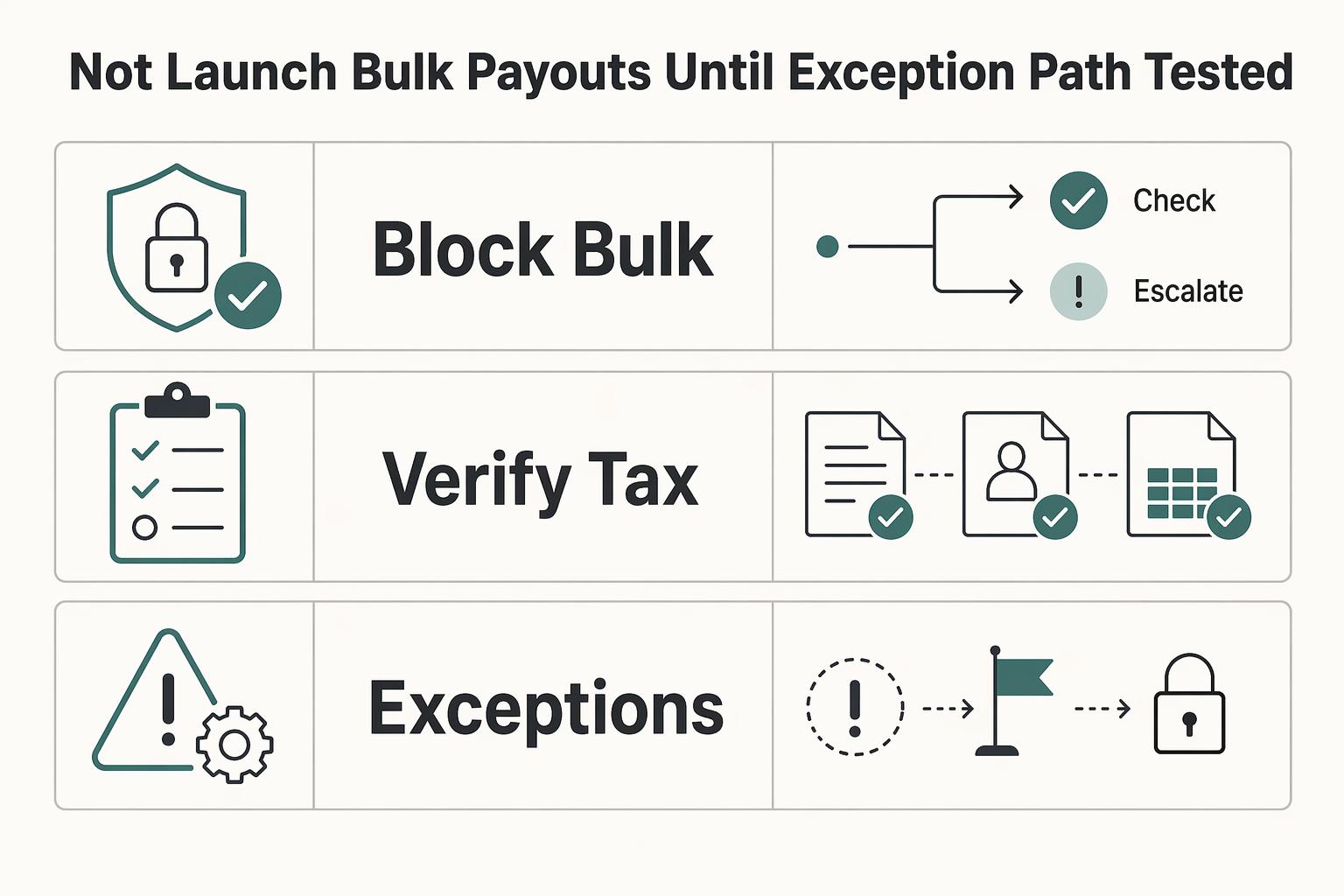
Do not launch bulk payouts until the exception path is tested#
Do not scale bulk payouts until compliance status, tax-profile requirements, and exception handling are proven in operations. Regulators are explicit that written BSA/AML policies alone are not sufficient without implemented controls.
Minimum launch checks:
- Block bulk payouts when compliance status is pending, restricted, or unresolved.
- Verify tax-form requirements by recipient type and payout program path.
- Confirm exception queues have clear owners and hold-resolution messaging.
If payout readiness cannot be cleanly joined to compliance status and tax profile, pause the rollout. Accurate routing data reduces rejects, but it does not replace eligibility controls.
Reconciliation evidence finance teams need for month-end confidence#
Month-end confidence comes from a complete evidence chain, not a payout status badge. For each payout, finance should be able to trace the request, provider outcome, bank movement, and ledger posting without manual guesswork. As a practical rule, if reconciliation still requires spreadsheet stitching across systems, treat that as a sign to improve joins before scaling payout volume.
| Evidence item | What it proves | Minimum join key or checkpoint |
|---|---|---|
| Payout request record | Who initiated the payout, for whom, for how much, and on which rail | Internal payout ID, recipient ID, amount, rail type |
| Provider reference | That the provider accepted the payout | Provider payout ID, or equivalent external reference |
| Final status event from webhooks | That the provider reported the terminal payout outcome asynchronously | Event ID, event timestamp, terminal payout status |
| Ledger posting record | That finance posted the movement to the correct journal entry | Internal payout ID or provider reference tied to ledger entry |
For each electronic funds transfer (EFT), require an auditable join between your payout entity and bank-movement records. A common pattern is joining by provider payout ID to underlying transaction records, then tying that record to your internal ledger posting. The payout identifier plus the terminal webhook outcome should be your primary close checkpoint.
Treat returns and reversals as a separate exception queue with internally defined ownership, SLA targets, and closure notes. For ACH exceptions, keep the identifiers needed for external investigation, including ABA routing number context and Trace Number, so resolution evidence is complete and reviewable.
Keep terminology identical across product UI, API docs, exports, and ledger references. ABA routing number, account number, rail type, and payout status names should map one-to-one across systems to prevent false mismatches and manual reclassification at close.
How U.S. routing data connects to global payout expansion#
If non-U.S. expansion is plausible, design your payout schema for multiple identifier systems now. Do not hard-code a single bank_code field. Model country, identifier type, and validation path separately.
| Market pattern | Common identifier | What it identifies | Validation note |
|---|---|---|---|
| United States | ABA routing number / RTN | U.S. financial institution | ABA number is 9-digit; confirm routing participation against Federal Reserve routing data for the rail you use |
| IBAN countries | IBAN | Standardized account structure used for international data processing | Format is country-specific under ISO 13616-1:2020 and can be up to 34 alphanumeric characters |
| United Kingdom | Sort code | UK payment routing identifier for PSPs/accounts in the UK | Treat as a UK-specific routing field, not a generic replacement for ABA or IBAN |
| Other markets | Local bank code | Local institution identifier | Required fields vary by country and provider, so this cannot be one universal format |
This matters even in a U.S.-first build. Field assumptions that work in a domestic flow often break during cross-border rollout. U.S. rails rely on ABA routing participation data, while IBAN participation is country-specific, sort codes are UK-specific, and providers may require different bank details based on bank location.
A practical baseline is to store bank_country, rail, identifier_type, and the raw identifier value as separate fields, then run country-aware validation. For U.S. rails, verify routing participation against Federal Reserve references when relevant. For IBAN markets, validate against country format rules and retain the country context used for the check.
The common failure mode is false generalization: one generic bank-details flow, then market-by-market exceptions after launch. That can lead to re-collection work and payout issues when provider requirements differ by bank location, local payout support, or country-currency rules.
Coverage is not uniform across providers, and unsupported local payout paths can route as cross-border transfers instead. For next steps, use the IBAN guide and the global identifier comparison guide: What Is an IBAN Number? How Platforms Use IBANs to Send Error-Free European Payouts and Bank Code vs. Routing Number vs. Sort Code: A Global Platform Payout Reference Guide.
For a step-by-step walkthrough, see Beneficiary Data Requirements by Rail for Platform Payouts.
Choosing integrated payouts or standalone payouts for U.S. bank routing#
If you need to ship faster with limited engineering capacity, integrated payouts are often the more practical starting point. Consider standalone when you explicitly need more control and can carry the extra reliability burden yourself.
| Decision area | Integrated payouts | Standalone orchestration |
|---|---|---|
| Control surface | More provider-defined behavior; lower build scope | More platform-defined behavior across providers |
| Implementation speed | Lower integration effort, for example Stripe positions Standard/Express as lower-effort than Custom | Higher implementation effort, especially when you own more account and payout flows |
| Reconciliation burden | Built-in event streams help, but you still need your own controls | You must design event handling, retry safety, and exception tooling end to end |
The tradeoff is explicit in provider docs: lower-effort account models give up some control, while higher-control models shift more responsibility to your platform. Stripe also states that account-type choice affects liability for fraud, abuse, negative balances, and identity verification. Its Custom model puts the platform in charge of verification-data collection plus onboarding, reporting, and communications.
Operationally, webhooks and idempotency are core implementation boundaries. Stripe says Connect integrations should establish a webhook endpoint, and Adyen documents webhook-based transfer progress and status updates, including events only delivered automatically by webhook. If you run standalone, enforce idempotency across create, retry, and webhook-consumption paths. For Stripe-style semantics, keep idempotency keys within the documented 255-character limit to reduce duplicate-operation risk during retries.
Also keep bank-data hygiene separate from architecture choice. An ABA routing number is nine digits, but the ABA public lookup is for limited individual confirmation use. It is capped at 2 lookups/day and 10/month, so it is not a bulk production validation method.
Before sign-off, align product, finance, and engineering on:
- Who owns onboarding, verification-data collection, and user communications
- Which webhook events are required to move a payout from submitted to paid, returned, or failed
- How idempotency is enforced on payout creation and retries
- What finance receives for reconciliation evidence: payout record, provider reference, final status event, and ledger link
- Whether provider-managed controls are sufficient or you need custom multi-provider orchestration
Conclusion#
An ABA routing number is necessary for U.S. bank payout routing, but it is not a reliability guarantee. Reliable execution comes from accurate, up-to-date routing data, separate payout-eligibility controls including KYC, retry-safe idempotent requests, duplicate-safe webhook handling, and reconciliation evidence finance can actually use.
ABA routing numbers get payments to the right bank, but they do not determine payout eligibility or operational readiness on their own. In practice, outdated routing information can cause failed ACH payments and extra exception work, so routing-data maintenance is part of payout reliability.
A practical launch checklist#
Before you scale, confirm all four are true:
| Launch area | What to confirm |
|---|---|
| Field schema | Your onboarding asks for explicit U.S. payout details, including the nine-digit routing number, and keeps rail-specific requirements clear when ACH and wire flows both exist |
| Validation rules | Product, ops, and support can explain payout status clearly, including when failures disable an external account and scheduling should pause |
| Failure handling | You have test paths for invalid or outdated details, eligibility checks, retry paths, and duplicate webhook delivery; payout creation uses idempotency keys, and webhook processors deduplicate on processed event IDs |
| Finance evidence | Each payout can be traced through request and payout records, webhook or status outcomes, and reconciliation outputs used in exception handling |
Who owns what#
Cross-functional ownership should be explicit: product owns onboarding UX and payee guidance, engineering owns idempotency and webhook-safe state transitions, and finance ops owns reconciliation plus exception handling. If ownership is blurred, failures usually show up as UI confusion, duplicate-risk retry logic, or manual reconciliation at scale.
Then confirm provider coverage and rail requirements directly. Payout behavior and requirements vary by geography, business type, and payout method, so validate market fit and reconciliation outputs before you ramp volume.
Before launch, confirm market/program coverage and U.S. rail requirements with Gruv so your onboarding and compliance gates match production reality: Contact Gruv.
Frequently Asked Questions
What is an ABA routing number in platform payouts?
An ABA routing number is a Routing Transit Number (RTN) used to identify a U.S. financial institution in a payment flow. It is a nine-digit bank identifier, not the recipient’s account number and not, by itself, a compliance approval signal. It helps route funds to the institution, but it does not decide whether a payout should be released.
Is an ABA routing number the same thing as an RTN?
Yes. In common U.S. payments usage, routing number, RTN, and ABA number are used interchangeably. Keep in mind that naming overlap does not mean ACH and wire instructions are interchangeable.
Do I always need both ABA routing number and account number for U.S. payouts?
For direct deposit and other ACH payments, you will often need both the routing number and the account number. Do not treat that as a universal rule for every provider or payout program. Valid routing and account details can still be only part of what is required to release funds.
Where should payees find the routing number when onboarding?
The best source is the payee’s bank or credit union website or mobile app. Payees can also use personal checks, where the routing number appears first and the account number follows. For wire payouts, do not assume check details are interchangeable with wire instructions.
Can valid routing details still fail payout compliance checks?
Yes. Payouts can still be paused when required tax status or other account information is missing, even if bank details are valid. ACH workflows can also carry screening obligations beyond basic bank-detail validity.
What is the difference between ACH routing use and wire routing use?
ACH is a batch electronic payment rail. Fedwire Funds Service is a real-time gross settlement rail where payments are immediate, final, and irrevocable once processed. Some institutions may use the same routing number in some contexts, but you should not assume ACH and wire instructions are interchangeable.
How should teams retry failed payouts without creating duplicates?
Retry with idempotency so repeated requests are recognized as the same operation instead of creating a second payout. Stripe documents idempotency keys up to 255 characters and notes keys can be removed after at least 24 hours, so retry behavior should account for that window. Treat webhooks as replayable and deduplicate by storing processed event IDs before updating payout state.
Try a related tool
Researched and edited by the Gruv editorial team. Gruv builds cross-border billing, payouts, and finance-operations software for global businesses.
Sources
- bsaaml.ffiec.gov/manual/AssessingTheBSAAMLComplianceProgram/01trusted
- ecfr.gov/current/title-31/subtitle-B/chapter-X/part-1...trusted
- ecfr.gov/current/title-12/chapter-II/subchapter-A/par...trusted
- federalreserve.gov/frrs/regulations/appendix-a-routing-number-g...trusted
- federalreserve.gov/paymentsystems/fedach_about.htmtrusted
- ffiec.gov/npwtrusted
- irs.gov/forms-pubs/about-form-w-9trusted
- irs.gov/forms-pubs/about-form-w-8-bentrusted
Educational content only. Not legal, tax, or financial advice.
Related Posts
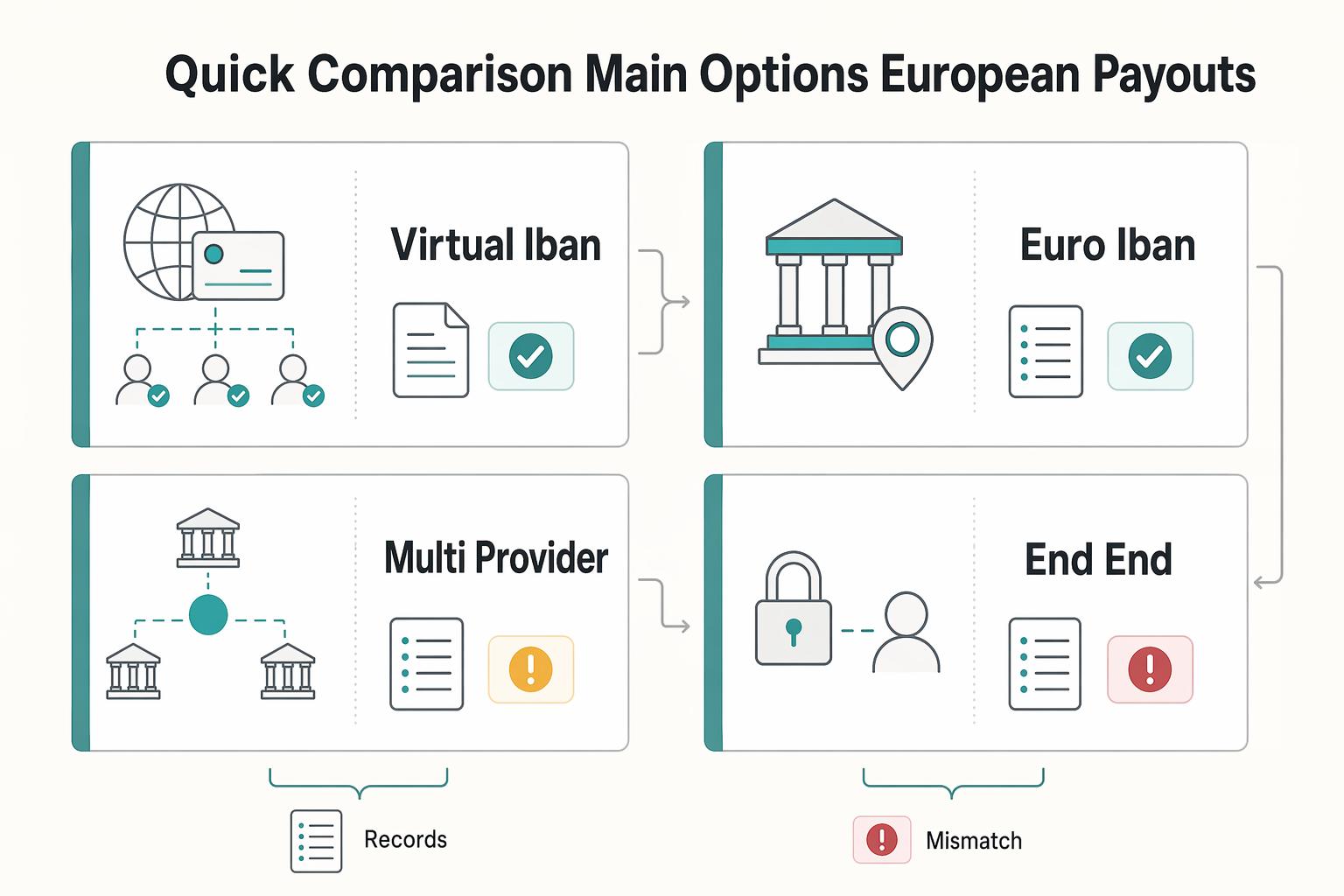
What Is an IBAN Number? How Platforms Use IBANs to Send Error-Free European Payouts
If you are evaluating **iban number platforms european payouts**, skip the glossary. The real decision is which payout setup will keep money moving, exceptions visible, and reconciliation manageable as volume grows. This guide is for platform founders, finance ops leads, and engineering owners who need to ship reliable European payouts, not for readers looking for a basic banking explainer.
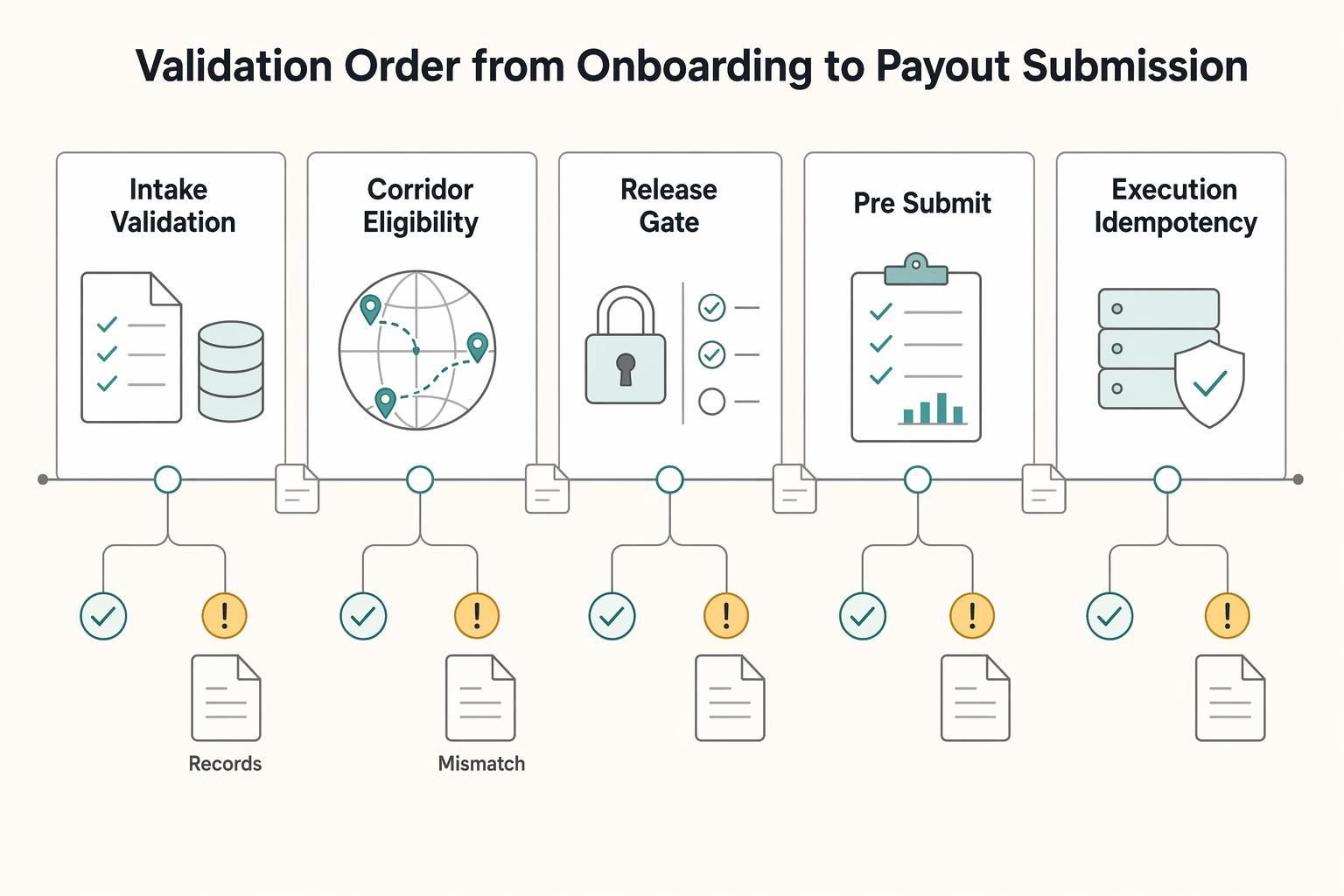
Bank Code vs. Routing Number vs. Sort Code: A Global Platform Payout Reference Guide
Treating `bank code`, `routing number`, and `sort code` as one generic field creates avoidable payout failures. Teams often discover the mismatch only after submission, when the provider cannot process the transfer.
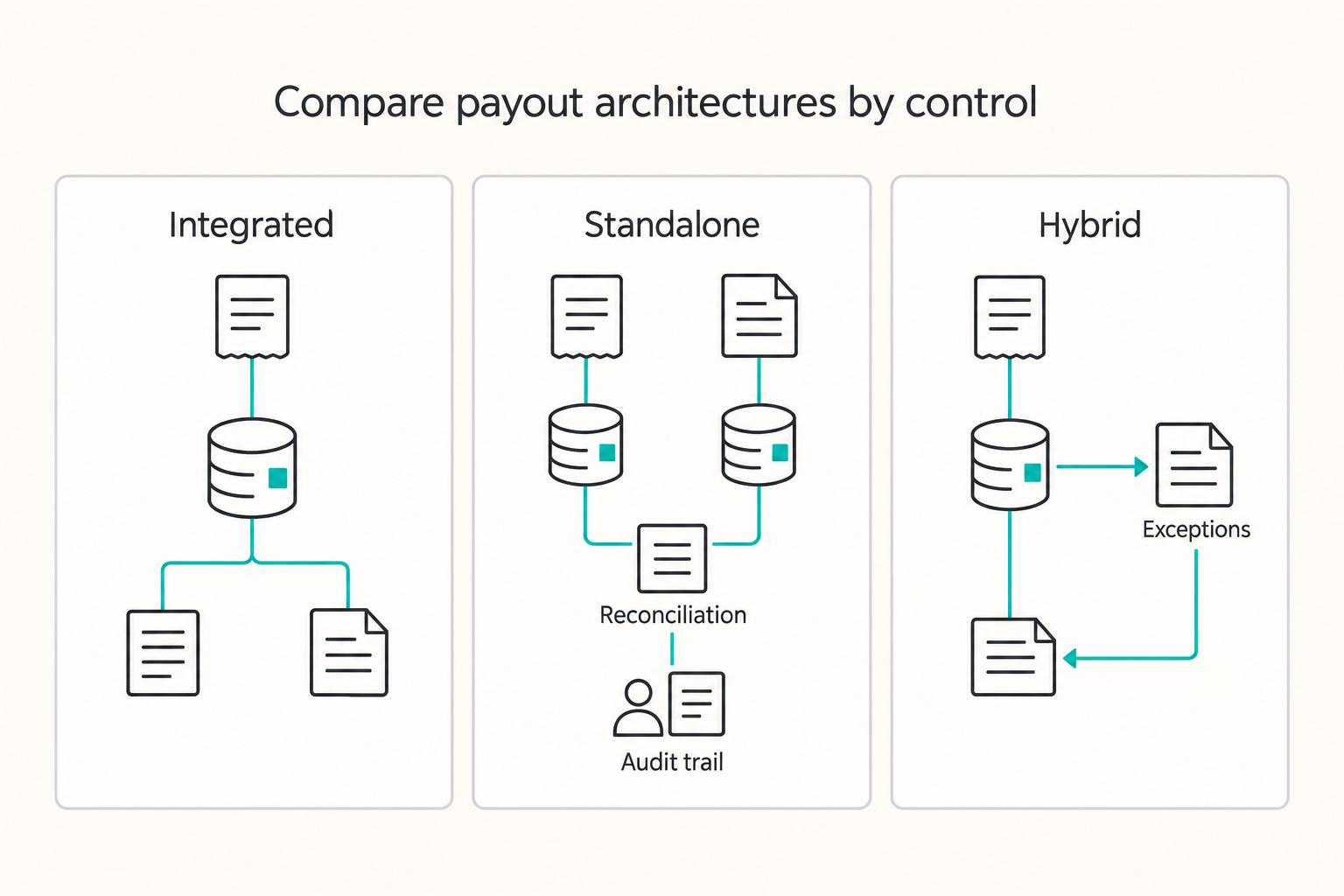
Integrated Payouts vs Standalone Payouts for Platform Architecture Decisions
**Treat integrated and standalone payouts as an architecture decision, not a product toggle.** The real split is the same one you see in payment processing more broadly: either payments are connected to the core platform experience, or they are not. [Lightspeed](https://www.lightspeedhq.com/blog/payment-processing-integrated-vs-non-integrated) puts that plainly in POS terms: your payment terminal either speaks to your point of sale, or it does not. For platform teams, the equivalent question is whether payment flows run through one connected system or sit in separate lanes you manage independently.