
Quick Answer
A year-end financial close for freelancer payout teams should end with reconciled records, approved adjustments, and a final statement package tied to one finalized ledger. Keep close separate from tax planning, assign owners and deadlines, build the evidence pack before day zero, reconcile settlement, bank, ledger, and balance sheet activity in order, review entries with approval gates, log exceptions, and lock the sign-off packet.
Year-End Close Priorities for Freelancer Payout Operations#
This year-end financial close freelancers checklist is for teams running freelancer payout operations, not for an individual 1099 contractor handling personal tax planning. If you own finance, ops, or product workflows tied to settlements, ledger accuracy, reconciliation, reporting, or payout controls, your goal is a defensible year-end close. You need traceable records, supported adjustments, and a complete statement package you can sign off.
That boundary matters from the start. IRS Publication 334 is guidance for self-employed people and independent contractors, and the IRS separately distinguishes employee wage reporting on Form W-2 from nonemployee compensation on Form 1099-NEC. So this is not a guide to personal deductions, estimated taxes, or individual filing choices. It is a close checklist for company-run freelancer payment operations.
What good year end close work needs to produce#
At year end, "close enough" is not enough. IAS 1 requires a complete annual set of financial statements, including a statement of financial position, a statement of profit and loss, and a statement of cash flows. For freelancer payout teams, close work has to support the balance sheet, P&L, and cash flow statement from underlying books and records.
The practical test is simple. For any material balance or transaction stream, you should be able to trace the source records, review the reconciliation, and see who approved it. If that trail is missing, the close package is incomplete.
Why the stakes are higher than clean reporting#
A weak close creates repeat work. When documentation is incomplete, teams often spend extra time rebuilding support for tax reporting and examinations. The IRS notes that the records used to monitor the business and prepare financial statements are generally the same records used for tax reporting. It also notes that complete records speed an examination.
Audit readiness is just as practical. PCAOB AS 1215 defines audit documentation as the written record of procedures, evidence, and conclusions. You still need written support for the numbers you report. A journal entry or reconciliation without preserved support or review evidence can leave the close package incomplete.
What this article gives you#
This guide turns that standard into a decision-oriented close checklist. Each step defines:
- the accountable owner
- required inputs
- the completion artifact
- key failure modes
- sign-off criteria
That structure is deliberate. The GAO Green Book ties internal control to reliable reporting and compliance, and calls for management to assign responsibility and delegate authority. In close operations, unclear ownership can let unresolved breaks carry forward until year end. Use one filter as you read: if a task does not support the annual balance sheet, P&L, cash flow statement, or the evidence behind them, it likely does not belong in year-end close.
Clarify scope before work starts#
Before work starts, split close from tax planning and keep those lanes separate. Mixing them can pull effort into tasks that do not strengthen the reporting package.
Use this boundary for this article: if a task does not support or explain the annual income statement (P&L), balance sheet, or cash flow statement, move it out of close. This is an operating rule, not a legal threshold. It keeps year-end work tied to annual financial reporting.
| Financial close tasks | Tax planning tasks |
|---|---|
| Maintain ledger records and complete account reconciliation between bank activity and ledger records | Calculate or discuss estimated tax payment items for income not subject to withholding |
| Review payout postings and balances that affect reported assets, liabilities, revenue, or expense | Assess whether an expense meets the ordinary and necessary business deduction standard |
| Prepare year-end adjustments tied to reported balances | Organize support for personal income, deduction, or credit items |
| Preserve reconciliation files and documentation so records are traceable and verifiable | Plan quarterly estimated-tax cadence for self-employed taxpayers |
Keep the close objective narrow: by year-end, produce complete, traceable records and the adjustments needed for the reporting package. If a task owner cannot name the statement it supports and the evidence file behind it, that task is likely in the wrong lane.
For a step-by-step walkthrough, see How to Create a 5-Year Financial Plan for Freelancers.
Set ownership and close calendar#
Once scope is set, lock down ownership and timing. If names, deadlines, approvals, and dependency gates are not clear before close starts, handoffs are more likely to fail.
Build the close plan as a written control document. It should assign responsibility and delegated authority, with separation of duties across key steps.
Name owners and define done#
Use role names that fit your team, but make responsibilities explicit. If one person has to cover multiple roles, avoid giving that person consecutive control points in the same chain.
| Role | Responsibility | Done means |
|---|---|---|
| Reconciliation owner | Prepare assigned reconciliations and document open items | Reconciliation file submitted, support attached, exceptions logged |
| Journal entry approver | Review year-end entries before posting to the general ledger | Approval captured, rejected items returned, approved items ready to post |
| Accrual reviewer | Review accrual support, logic, and treatment notes | Review completed, conclusion recorded, follow-up treatment noted |
| Final sign-off owner | Confirm the package is complete enough for statement drafting or issuance | Required artifacts present, approvals complete, unresolved exceptions logged |
Build the calendar by dependency order#
Treat the calendar as an execution map, not just a list of dates. Sequence tasks from source and subledger inputs to reconciliations, then review, then reporting, with named owners, due dates, approvers, required output artifacts, and defined escalation paths.
Statement drafting is safer when prerequisite reconciliations are complete or formally logged as exceptions, not simply because the calendar says it is time.
Add a blocked-task escalation rule#
Do not let blocked dependencies slide quietly into later stages of close. When a task is blocked, escalate on a defined trigger instead of letting downstream dates drift.
Set trigger timing to match your operating model, as long as ownership and escalation contacts are clear. During close, review your period-close exception output so unprocessed accounting events or untransferred journal entries stay visible and assigned.
Related reading: Health Insurance for Freelancers in France During Your First Year.
Build the evidence pack before day zero#
If the evidence pack is not ready before adjustments start, review can stall later. Treat any key account that lacks source support, a reconciliation file, and a reviewer path as not ready for close.
The pack should show what was done, what evidence was obtained, and what conclusion was reached. That supports internal review and audit readiness when close questions surface after handoffs.
1. Pull the baseline inputs up front#
Collect the minimum inputs your close depends on before execution, not after issues appear:
- Ledger exports from the financial transaction ledger for the close window
- Reconciliation files for each key balance sheet account
- The current open exceptions log, including unresolved breaks and aging
- Prior year-end accounting checklist artifacts, including carry-forward issues, recurring adjustments, and prior unresolved items
Do not rely on summarized balances alone. Your records should substantiate underlying income and expense activity, not just period-end totals. Make file provenance obvious so the evidence is reviewable later. Include the source system, report name, cutoff or fiscal period, and extraction timestamp in each filename.
2. Pair support at the account level#
Organize support by account, not just by team folder. For each key account, require:
- source report
- reconciliation worksheet
- reviewer sign-off
If any one of those is missing, the account is not reviewer-ready. The report shows the population, the worksheet shows the clearing logic, and the sign-off shows independent review.
Keep preparation and review with different people. If preparer and reviewer collapse into one control chain, you may still have documentation, but your control evidence is weak.
Keep open exceptions visible and linked to the account with owner, root cause, and expected resolution date. In practice, monthly reconciliation can surface discrepancies early, whether they come from misclassified transactions, missing documentation, or unauthorized activity.
3. Add policy and control evidence when balances depend on controls#
Do not stop at financial outputs when the accounting conclusion depends on approvals, compliance gates, or status history. In those cases, the close file needs the control evidence too.
Where balances depend on approval or compliance events, include the related approval records, compliance checkpoints, and status histories with the account support.
If a reviewer asks why an item stayed open or posted in a given period, the answer should come from dated approval records or status history, not memory. Snapshot or export that history before close so later system changes do not overwrite the evidence you used.
4. Use a checkpoint table so missing support is obvious#
Use one checkpoint table to expose missing documentation before review:
| Input | Source system | Owner | Validation test | Output file |
|---|---|---|---|---|
| Ledger export | Financial transaction ledger | Reconciliation owner | Cutoff date matches close window; totals agree to reconciliation population | Dated CSV/XLS export in close folder |
| Key account source report | Subledger, bank portal, settlement report, or operational report | Reconciliation owner | Report period and filters are visible; ending balance ties to worksheet start | Source report PDF/CSV |
| Reconciliation worksheet | Close workbook | Reconciliation owner | Balance agrees to source report; open items listed separately; preparer and date complete | Completed worksheet with support links |
| Reviewer sign-off | Close workbook or approval tool | Reviewer | Reviewer differs from preparer; conclusion recorded; follow-up noted | Signed review tab or approval record |
| Open exceptions log | Exception register | Final sign-off owner | Each item has owner, aging, impact, and target date | Current log snapshot |
| Policy/control evidence | Approval tool or compliance system | Ops or compliance owner | Approval identity, date, and status history are present and tied to the issue | Exported approval or history file |
Set one operating rule: no account moves to final review until its row is complete. That helps you catch recurring gaps before day zero instead of during late-close rework.
Related: The FIRE Movement for Freelancers: A Path to Financial Independence.
Reconcile money movement before adjustments#
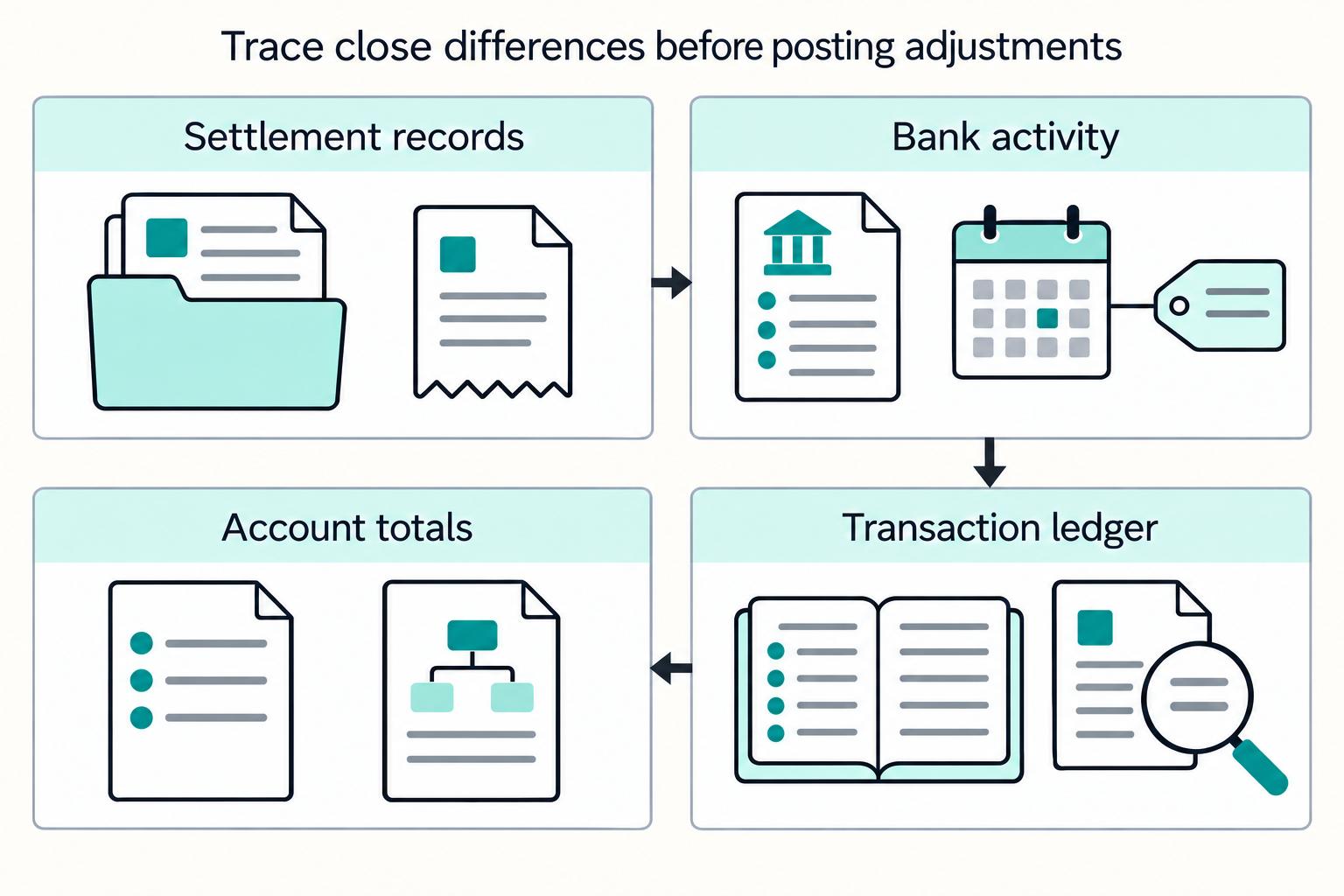
Before you post year-end adjustments, reconcile money movement end to end. Start with settlement records and bank activity, then tie bank activity to the financial transaction ledger, and finally tie ledger activity to balance sheet account totals. Use this as an operating sequence for close, not a universal accounting rule.
Reconcile in one direction#
Pick one direction and stick to it so each step answers a different control question:
- Settlement records to bank activity
Start with payout batches and bank deposits. Confirm each expected payout batch has a corresponding bank movement for the expected amount and timing window.
- Bank activity to financial transaction ledger
After cash movement is confirmed, trace each bank movement into ledger records. Use transaction identifiers where available, for example provider reference fields, so matches do not rely on memory.
- Ledger to balance sheet account totals
Then tie the ledger population to the target balance sheet account totals. This is where you catch mapping or posting gaps that are not visible at the bank layer.
Treat the first break as a stop signal#
When settlement-to-bank does not reconcile, stop and document the root cause before posting downstream cash-linked journal entry activity. Keep the rule narrow. Pause entries that depend on unresolved cash movement; unrelated accrual or presentation entries can continue.
Do not mask unresolved breaks with plug entries. Reconciliation differences should be corrected before you treat the reconciliation as balanced.
Be careful with timing before labeling an item as missing. Funds may remain pending before they become available, so compare settlement timing, payout timing, and bank value timing first.
Track breaks as reconciling items, not loose notes#
Every break should become a formal reconciling item, not a side note in chat or email. Record core fields such as the identifier, amount, aging bucket, owner, and committed resolution date.
Use explicit categories so triage stays consistent, for example timing mismatch, potential duplicate posting, identifier gaps, and unresolved refunds or chargebacks. Before you request a manual adjustment, verify whether the item is an incomplete-accounting case, for example when import, accounting, or posting is not complete.
| Common break | Likely cause | Next diagnostic step |
|---|---|---|
| Payout batch does not match bank deposit | Timing difference or batch composition differences, including fees or returns | Review payout or settlement batch details, compare payout timing to bank value timing, and confirm included transactions |
| One bank movement ties to multiple ledger entries | Possible duplicate import or duplicate posting | Search ledger and posting logs for repeated payout or bank reference values before posting a reversal |
| Bank or settlement line cannot auto-match to ledger | Identifier gap or incomplete accounting | Match by amount and timing window, then verify identifiers and accounting or posting status |
| Open refunds or chargebacks do not clear | Return activity not fully included in reconciliation scope | Check transaction-level settlement details and assign exception ownership |
| Ledger ties to bank, but balance sheet account is off | Account mapping or GL posting gap | Trace ledger postings into the target balance sheet account and confirm final posting status |
Related reading: The Best Financial Podcasts for Freelancers and Solopreneurs.
Review journal entries and accruals with approval gates#
Once cash and balance sheet reconciliations are stable, tighten control over what can still move year-end reporting. Allow only approved entry types, separate preparer and reviewer roles, and treat weak support as a stop signal.
A strong control is not "more entries reviewed." It is entries with a clear purpose and reliable support.
Restrict the entry types you allow#
Do not turn year-end into a free-form posting window. Define which journal entry types are allowed in your close process, and require each entry to be tagged before review.
| Entry type | When it is acceptable | Minimum support |
|---|---|---|
| Error correction | A specific posting or mapping issue is identified | Sufficient appropriate evidence that is relevant and reliable |
| Accrual | Income or expense was earned or incurred in the fiscal year, even if cash has not moved | Support that ties the amount to the covered period and calculation basis |
| Reclassification | Presentation needs correction | Support for the presentation change and reviewer approval |
| Reversal or carry-forward | A prior accrual must unwind or remain open with updated support | Link to the original entry and current-period support |
If you cannot tie an entry to a triggering event and sufficient appropriate evidence, it is not ready to post.
Enforce preparer and reviewer separation#
Use segregation of duties on every judgment-heavy entry: the preparer should not be the approver. Keep authorizing, recording, and reviewing responsibilities separate so one person does not control the full transaction flow.
Capture that control in the record itself: preparer, reviewer, posting date, affected accounts, amount basis, and evidence links. If review changes the logic or amount, return the entry for resubmission instead of editing and approving it in one step.
Make accrual support strong enough to survive reversal testing#
Accrual support should be strong enough that another reviewer can unwind the entry without guesswork. Under accrual accounting, income and expenses are recognized when earned or incurred, so the support has to show the period connection clearly.
At minimum, include support for the relevant period and calculation basis. Prioritize relevance and reliability over file volume.
Use an additional-procedures rule for ambiguous items#
If support is incomplete, do not treat the adjustment as resolved. Note the proposed adjustment, why support is incomplete, the potentially affected statement lines, the owner, and the follow-up date, then require additional or modified procedures before approval.
If the item could materially affect the profit and loss statement (P&L) or annual balance sheet presentation, escalate for additional procedures and hold approval until the evidence is adequate.
Do one final presentation review#
Before sign-off, review entries that could materially affect presentation. Confirm that significant accounts, disclosures, and any uncorrected misstatements still support fair presentation in all material respects.
Produce the final statement package and close memo#
Once entries are approved, lock the package scope and build it from one finalized ledger version. If a statement cannot be tied back to reconciled support, it is not ready for sign-off.
Build from the final ledger#
Generate the profit and loss statement (P&L), cash flow statement, and annual balance sheet from the same finalized ledger export. Do not mix statement outputs from different run times.
Treat these as the core close package, not automatically the full annual reporting set. Under frameworks such as IAS 1, present a complete annual set at least annually, with prior-year comparatives, rather than stopping at those three statements.
Write variance commentary that explains causes#
Variance commentary should explain the cause, not just restate the number. For material line movements, explain what changed and why, then tie that explanation to reconciled evidence. In SEC reporting contexts, Item 303 requires underlying reasons for material changes in both quantitative and qualitative terms.
Use a simple structure for each significant swing:
- Identify the line item and direction of change.
- State the operational driver in plain language.
- Link to supporting evidence in the close file.
- Classify the movement, for example timing, volume, pricing, classification, or one-time adjustment.
If commentary cannot be traced to support already in the close file, treat it as incomplete.
Add a short close memo for reviewability#
A short close memo makes the package easier to review and easier to defend later. Keep it concise, but specific enough that an experienced reviewer with no prior connection can see what changed, what remains unresolved, and why the package is fit for audit readiness.
Cover, at minimum:
- what changed since the prior draft or prior year
- significant findings or issues and actions taken
- unresolved items and whether they affect presentation, timing, or both
- why management concludes the package reflects the finalized ledger and supporting evidence
Keep the memo evidence-linked. If an item is important enough to mention, link it to the exact reconciliation, journal entry, or exception log entry that supports the current treatment.
Handle exceptions with explicit escalation paths#
Unresolved close items belong in a managed register, not in narrative notes. Put each open issue in a live log, classify it by risk, assign an owner and target date, and define the escalation path in advance.
A practical taxonomy is operations, reporting, and compliance. In a freelancer payout context, payout risk is the operational bucket, alongside reporting risk and compliance risk.
| Risk bucket | What it covers in close | Typical owner | Escalate faster when |
|---|---|---|---|
| Reporting risk | Misstatement risk, unsupported entries, unreconciled balance sheet accounts, classification errors | Controller or accounting lead | It could change statement reliability or close conclusions |
| Payout risk | Failed or duplicate payouts, settlement breaks, process or system failures | Payments ops or finance ops lead | Cash movement cannot be fully traced from source to bank to ledger |
| Compliance risk | Control failures, missing approvals, policy or regulatory handling gaps | Compliance lead, controller, or legal or finance owner | It indicates a potentially severe control deficiency |
Set escalation rules before exceptions occur#
Define internal response targets by risk level before period-end pressure starts, and route issues through established reporting lines on a timely basis. Everyone should know who gets notified, when, and what decision that notification triggers.
Use a clear management rule for sign-off: if an unresolved exception affects a high-risk balance sheet account, consider holding close sign-off until finance leadership reviews it. This is a policy choice, but it supports statement reliability when severity is high.
If you operate in a PCAOB or SEC reporting context, treat severe control issues with higher urgency. They can rise to significant deficiency or material weakness, and material weaknesses prevent an effective internal-control conclusion.
Keep the exception register practical#
At minimum, track relative risk rating, corrective action, deadline, owner, and current status. Many teams also track root cause and confirmation of remediation status because those fields make follow-through easier.
Include statement impact explicitly: does the exception affect cash-flow timing, cash-flow classification, or only presentation? Prioritize issues that change when cash is generated or used, or how cash flows are classified, ahead of display-only items.
Avoid "known issue" entries with no root cause and no clear corrective path. If an exception has no accountable remediation plan and no status confirmation point, it is logged but not yet managed.
Run sanity checks before close sign-off#
Before sign-off, make sure the package is internally consistent, fully evidenced, and unchanged since final reconciliation unless it was rechecked. This is the last place to catch drift.
- Tie the core statements before you trust the close.
Confirm the final set includes the profit and loss statement (P&L), cash flow statement, and balance sheet, plus prior-year comparatives and any other components your reporting basis requires for a complete annual set. Reconcile cash flow from operations back to net income. If net income changed after a late entry and cash flow did not, treat that as drift.
- Verify checklist artifacts and control coverage.
For each required close artifact, confirm the file exists, the final version is identifiable, the preparer is clear, and reviewer approval is recorded where your control design requires it. If the same person prepared and approved an item, flag it for review because that weakens segregation of duties.
- Re-test a targeted sample from the financial transaction ledger.
Re-testing can be sampling-based, rather than 100 percent, when full retest is not performed. Pull reconciled items from the financial transaction ledger and trace each one to source support, reconciliation output, and statement impact, prioritizing late adjustments and reopened breaks. If sampled items fail, expand testing before sign-off.
- Lock and archive the sign-off packet.
After approval, lock the packet under your change-control process so files cannot be silently replaced. Archive final statements, reconciliations, adjustment support, approvals, and the exception register under your records-retention schedule, with enough detail for an experienced reviewer to follow the conclusion and evidence trail.
Need a concrete reference for implementing traceable payout and reconciliation workflows? Review Gruv docs.
Turn year-end close into next-year operating improvements#
The close is not finished when the packet is archived. After you lock it, turn recurring exceptions into operating fixes instead of letting the same issues carry into next year.
Convert repeat exceptions into process changes#
Start with the repeats: the same balance-sheet breaks, late journal-entry support, or missing reference IDs. Because deficiencies can come from design, implementation, or operating effectiveness, match the fix to the failure point.
Update the specific control where the break occurred. If a reconciliation template missed a check, revise the account reconciliation SOP. If approvals were skipped, change the approval step and reviewer assignment. If bad inputs passed through, add a validation check at upload or mapping.
Close the loop on each recurring issue with a root cause, remediation owner, delegated authority, and retest date. If you cannot point to the updated SOP, approval evidence, or validation rule, the issue is logged, not fixed.
Track three metrics next year#
Track a small set of metrics you can define the same way every period:
- Close duration: cycle time from close start to final sign-off, including waiting time.
- Unresolved exception count: items still open when the final packet is archived.
- Post-close adjustment volume: entries posted after cutoff or after draft statements, tracked by count and dollar value.
Watch the trend across periods. If unresolved items decline while post-close adjustments rise, review quality may be weakening upstream controls instead of fixing root causes.
Push fixes into monthly discipline#
The best year-end close is the one that mostly confirms work already done. Build ongoing monitoring into normal monthly operations so year-end is more confirmation than discovery.
Move reconciliations, trend checks, and data validations into the monthly checklist, and add controls for the exact failure modes you saw at year-end. For settlement-heavy workflows, point teams to Month-End Close Checklist for Payment Platforms: Reconciling PSP Settlements Bank Statements and Ledger.
Run a prompt hot wash while evidence is fresh, document the top fixes, and assign retest dates with clear owners.
If you want a deeper dive, read Month-End Close for Payment Platforms: A Step-by-Step Checklist for Finance Teams.
Conclusion#
A strong year-end financial close is a controlled, evidence-backed operation, not a checklist you simply mark complete.
Use one decision rule for sign-off: no sign-off without reconciled records, documented review and approval, and complete written documentation. If support is missing, differences remain unresolved, or review evidence does not show what was checked, the close is not ready.
Before final approval, test traceability on selected accounts. You should be able to follow each item from source record to reconciliation to ledger to final statement presentation, with open-item status and a reviewer approval trail where relevant.
On your next cycle, apply this checklist in three steps:
- Run it on one recent close cycle.
- Measure the real gaps in reconciliation, review evidence, and documentation completeness.
- Standardize the fixes for the next fiscal year so the evidence pack and sign-off standard are consistent by default.
The goal is a close you can defend, re-check, and improve year over year. If you want to pressure-test this close checklist against your current payout operations, talk with Gruv.
Frequently Asked Questions
What is the difference between year-end financial close and freelancer tax planning?
Year-end close is for the company books, not personal tax planning. It focuses on reconciliations, adjustments, and final reporting outputs such as the balance sheet, income statement, and cash flow statement. Tax planning is a separate lane tied to items like estimated taxes and the annual return, except where a tax item affects company reporting.
What must be reconciled before year-end sign-off?
Before sign-off, internal ledger records should be reconciled to supporting external records, including bank statements. Common breaks include bank fees, outstanding checks, and potential error or fraud signals. If a difference remains unexplained, sign-off is premature.
Which journal entries and accruals require formal approval?
Manual, judgment-heavy, and period-end entries should have formal approval with separate preparation or posting and review or reconciliation responsibilities. Keep one person from initiating, authorizing, recording, and reconciling the same transaction. Apply extra scrutiny to late-period entries and entries without support.
What evidence is required for audit readiness in a freelancer payout operation?
Audit-ready evidence is a complete record of procedures performed, evidence obtained, and conclusions reached. For each key account, keep reconciliation support and review records, and prioritize relevant, reliable evidence over file volume. If records support tax reporting, retain them long enough to substantiate reported income and deductions.
What is the minimum viable year-end close checklist for a small platform team?
The minimum viable checklist is the smallest set of steps that proves completeness, approvals, and traceability. In practice, that means documented reconciliations, approved adjustments, logged unresolved exceptions, and a finalized statement package tied back to the ledger. If any step lacks ownership or review evidence, treat it as open.
What are the most common close failure points and how do you catch them early?
Common failure points include unreconciled cash differences, breaks from bank fees or outstanding checks, potential error or fraud signals, and manual entries posted without strong review. Catch them early by reconciling against external records and increasing scrutiny on journal entries where override risk is higher. Hold sign-off until unexplained differences are resolved.
Researched and edited by the Gruv editorial team. Gruv builds cross-border billing, payouts, and finance-operations software for global businesses.
Sources
- department.va.gov/financial-policy-documents/financial-documen...trusted
- gao.gov/greenbooktrusted
- govinfo.gov/content/pkg/USCODE-2011-title26/html/USCODE-...trusted
- guides.gaoinnovations.gov/greenbook/2025/principle-3-establish-structu...trusted
- guides.gaoinnovations.gov/greenbook/2025/principle-17-evaluate-issues-...trusted
- investor.gov/introduction-investing/getting-started/resea...trusted
- irs.gov/taxtopics/tc305trusted
- irs.gov/businesses/small-businesses-self-employed/se...trusted
Educational content only. Not legal, tax, or financial advice.
Related Posts

The Freelance Payment Penalty: A Modeled Audit of Platform Fees, FX Spreads, and Payout Delays
The money rarely disappears through a single, easy-to-spot fee. The real loss is stacked. A marketplace takes its commission, a processor adds a charge for international cards, a bank or payment company converts the currency at a spread, a platform holds the funds before release, and a wire sheds a little to intermediaries on the way in. Each layer looks defensible on its own, but the worker feels the combined result as a smaller deposit and a later payday.

How to Respond to a Subpoena for Business Records
Move fast, but do not produce records on instinct. If you need to **respond to a subpoena for business records**, your immediate job is to control deadlines, preserve records, and make any later production defensible.

A US Expat's Guide to Investing in UCITS ETFs to Avoid PFIC Issues
The real problem is a two-system conflict. U.S. tax treatment can punish the wrong fund choice, while local product-access constraints can block the funds you want to buy in the first place. For **us expat ucits etfs**, the practical question is not "Which product is best?" It is "What can I access, report, and keep doing every year without guessing?" Use this four-part filter before any trade: