
Quick Answer
Start with risk controls, then build growth on top: that is how to create a 5-year financial plan when freelance income is uneven. Use one operating account for all client receipts, sweep funds monthly into tax reserves and owner pay, and keep a documented policy for currency conversion decisions. In the first phase, lock in location logs, foreign-account records, and clean business operations. Once cashflow is steadier, pick one major asset priority and update the plan each year with specific actions.
Treat your 5-year plan as a solo business operating plan#
A 5-year financial plan works best when you treat it like an operating plan for getting paid reliably, not like a generic budget. For a business-of-one, the real constraints are usually timing, risk, and control.
You are dealing with issues employee-style plans often underemphasize: uneven collections, cross-border payments, and self-managed compliance. The IRS says self-employed people generally must file an annual return and pay estimated taxes quarterly. There are 4 payment periods, with standard due dates of April 15, June 15, September 15, and January 15. If the cash is not there when one of those dates arrives, the plan can break down even if annual income looks healthy.
Currency exposure can be a blind spot. When a deal is priced in one currency and paid later in another, exchange-rate moves can change what you actually receive. For predictable receivables, one direct hedge is a forward contract with a pre-agreed rate and a delivery date from 3 days to 1 year. You may not use forwards on every invoice, but you do need a rule for when FX exposure is large enough to act on.
| Planning lens | Traditional employee-style planning | Business-of-one planning |
|---|---|---|
| Cashflow | Often assumes regular payroll and withholding | Assumes uneven collections, manual tax set-asides, and timing gaps between invoicing and payment |
| Risk controls | Often emphasizes savings rate and retirement contributions | Starts with tax cadence, contract terms, payment timing, and FX exposure |
| Decision cadence | Often uses monthly or annual check-ins | Ongoing client-by-client decisions, with quarterly tax checkpoints |
Your baseline tool is the balance sheet because it helps you manage current obligations and project future cash flow from a real position, not a rough guess. If you cannot quickly see what you owe, what is due this quarter, what currency you hold, and which invoices are still unpaid, you do not yet have a working plan.
Build in a clear order: first compliance, then multi-currency cash control, then long-range asset decisions. Related: How to Set Up a US LLC from Australia.
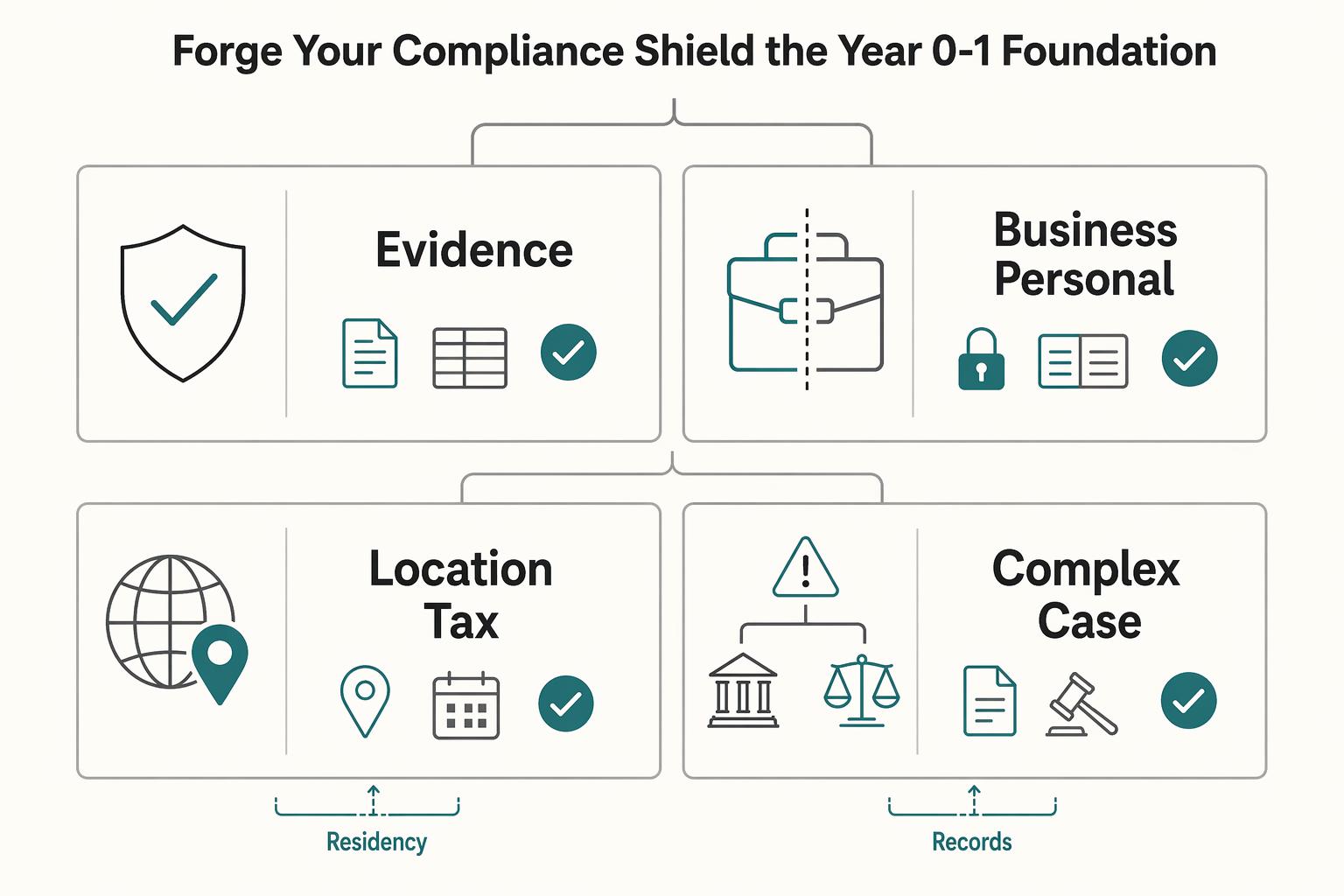
Step 1: Forge Your Compliance Shield (The Year 0-1 Foundation)#
A balance sheet only helps if the records behind it are clean. In Year 0-1, put three controls in place so filings, payments, and legal decisions do not depend on memory. Focus on location records, foreign-account records, and clear business-personal separation.
| Control | Set up | Monthly review | Escalate when |
|---|---|---|---|
| Location and tax-residency evidence | Create one travel log with arrival/departure, location, purpose, and linked evidence | Confirm the last 30 days are complete and explainable without checking multiple apps | You spend substantial time across jurisdictions, plan longer stays, or are unsure whether your pattern changes filing or residency analysis |
| Foreign-account record discipline | Create one ledger for each account with institution, country, owner, account type, currency, open/close status, and stored statements | Reconcile active and recently closed accounts against statements and your balance sheet | Balances, ownership, or account mix change materially |
| Business and personal separation | With legal and tax guidance, choose your structure and make banking, bookkeeping, invoicing, contract signature blocks, and document storage consistent with it | Flag mixed expenses, payments from the wrong account, and agreements signed in the wrong name | Before jurisdiction choices, debt, partner changes, hiring, or higher-risk client terms |
This is a risk-control step, not an admin perfection exercise. Treat these controls as a set, and use one documented workflow for each task instead of mixing methods. If you set them up early, Step 2 cashflow and growth decisions are usually easier to review. Specific residency tests, foreign-account rules, penalties, and entity-liability outcomes vary by jurisdiction and are not specified here, so verify them with qualified advisors.
| Control | If you implement now | If you delay |
|---|---|---|
| Location and tax-residency tracking | You can show where you were, when you were there, and what needs review before filing or travel changes | You reconstruct travel later from scattered records and increase error risk |
| Foreign-account record discipline | You maintain a complete account list and balances in one system, with clear review points | You rush at year end, miss records, and create avoidable filing uncertainty |
| Legal entity separation for operational clarity | Your contracts, banking, bookkeeping, and signatures are consistent from the start | You create the entity later but keep mixed records and unclear operating boundaries |
1. Track your location and tax-residency evidence#
Do this before your travel pattern gets hard to reconstruct. In practice, location tracking becomes painful only after it has already drifted.
- Set up: Create one travel log with arrival/departure, location, purpose, and linked evidence, for example confirmations, receipts, visa records, or passport images.
- Review monthly: Confirm the last 30 days are complete and explainable without checking multiple apps.
- Escalate: Ask a qualified tax advisor when you spend substantial time across jurisdictions, plan longer stays, or are unsure whether your pattern changes filing or residency analysis.
- Residency tests vary by jurisdiction; confirm the relevant criteria with a qualified advisor before relying on your travel pattern.
2. Build foreign-account record discipline#
The common failure mode here is not complexity. It is scattered records. Keep one ledger that makes it obvious what exists, what closed, and what still needs support.
- Set up: Create one ledger for each account with institution, country, owner, account type, currency, open/close status, and stored statements.
- Review monthly: Reconcile active and recently closed accounts against statements and your balance sheet.
- Escalate: Ask a qualified tax advisor when balances, ownership, or account mix change materially.
- Foreign-account reporting rules vary by jurisdiction; confirm which accounts must be reported and what consequences apply if reporting is missed.
3. Separate business and personal activity early#
This is worth fixing at the start because mixed records are easy to create and tedious to unwind. Clear separation also makes later lender, tax, and legal reviews easier, but it does not by itself determine legal-protection outcomes.
- Set up: With legal and tax guidance, choose your structure and make daily operations consistent with it, including banking, bookkeeping, invoicing, contract signature blocks, and document storage.
- Review monthly: Flag mixed expenses, payments from the wrong account, and agreements signed in the wrong name.
- Escalate: Involve qualified legal or tax counsel before jurisdiction choices, debt, partner changes, hiring, or higher-risk client terms.
Once these controls are steady, move into Step 2 with cleaner accounts, clearer cashflow, and fewer preventable mistakes. If you want a deeper dive, read Japan Digital Nomad Visa 2026: Six-Month Planning Runbook.
Turn this section into action by mapping your travel, residency, and filing checkpoints in one workflow with the Tax Residency Tracker.
Step 2: Engineer Your Multi-Currency Growth Engine (The Year 1-3 Plan)#
Years 1-3 are about making variable income behave more like stable pay. Keep the three buckets, but run them on a fixed monthly rhythm. Use one landing account for revenue, one protected reserve for tax and compliance, and one steady owner-pay transfer.
| Bucket | Main job | Key rule |
|---|---|---|
| Bucket 1 | Business operating account | Every client payment lands here first, and the remainder stays here as working capital until you have enough history to identify true surplus |
| Bucket 2 | Tax and compliance reserve | Move tax and compliance reserves here first on the monthly sweep, based on your actual filing position rather than a generic percentage |
| Bucket 3 | Personal account for owner pay | Transfer a fixed owner-pay amount set from a lean, repeatable month, and hold it steady unless the shortfall is persistent |
Step 1. Route every client payment into one operating account#
Start with one rule: every client payment lands in the same operating account. It gives you a clean intake point before money gets allocated elsewhere.
Send all invoice payments, processor payouts, and bank transfers into Bucket 1, your business operating account. If you receive multiple currencies, log each transaction with invoice number, received date, gross amount, processor fee, net deposit, currency, and exchange rate used for tax records.
For tax treatment, keep this strict. IRS guidance says tax determinations are made in your functional currency. If that is USD, translate income and expense items into dollars when you receive, pay, or accrue them. If multiple exchange rates exist, use the one that most properly reflects income and keep supporting records with the transaction.
Monthly check: confirm every Bucket 1 deposit ties to an invoice or statement, and every foreign-currency item has a stored rate and evidence.
Step 2. Automate the monthly sweep and fix owner pay#
Stability comes from order, not optimism. Pick one transfer day each month and move funds out of Bucket 1 in the same sequence every time.
- Move tax and compliance reserves to Bucket 2 first. Do not use a generic percentage. Base reserves on your actual filing position, and update them when income or jurisdictions change. If you are self-employed and expect to owe at least $1,000 at filing, you generally need estimated tax payments. FEIE may reduce regular income tax, but it does not reduce self-employment tax.
- Transfer a fixed owner-pay amount to Bucket 3, your personal account. Set it from a lean, repeatable month, not a strong month.
- Keep the remainder in Bucket 1 as working capital until you have enough history to identify true surplus.
If a month is weak, hold owner pay steady unless the shortfall is persistent. Cut discretionary business spend and delay extra retirement funding before you change your personal baseline.
Step 3. Match the retirement account to your filing reality#
Choose the account that fits your legal and tax setup, not the one with the most attractive headline limit. The wrong fit creates admin drag or contribution problems later.
| Reader profile | Usually worth reviewing first | Why it fits | 2026 numbers you can use now | Verify before funding |
|---|---|---|---|---|
| Owner-only business, or owner plus spouse | One-participant 401(k) | IRS describes this as a traditional 401(k) for a business owner with no employees, or that person and spouse | Employee elective deferral: $24,500; catch-up: $8,000 (age 50+) and $11,250 (ages 60-63, applicable plans) | Confirm the compensation basis and current eligibility rules before funding |
| Self-employed with uneven profits and preference for flexible employer contributions | SEP-IRA | Contributions can be higher in strong years and lower in weaker years | Lesser of 25% of compensation or $72,000 | If you have eligible employees, contribution rates must be uniform. Confirm current eligibility rules before funding |
| Business owner comparing options with salary deferrals plus employer contributions | SIMPLE IRA | Combines employee salary deferrals with required employer contributions | Salary reduction cap: $17,000; catch-up: $4,000 (age 50+) and $5,250 (ages 60-63) | Confirm current eligibility rules before funding |
| Cross-border filer using FEIE, housing exclusion, or a local-country retirement plan | IRA and local-country options with advisor review | Tax treatment can vary by exclusion method, treaty position, and local reporting | IRA limit: $7,500 | Confirm deductibility/reporting treatment with a qualified advisor |
Do not assume excluded foreign income automatically removes retirement contribution options. IRS international guidance says excluded foreign earned income and housing amounts are added back for IRA limit calculations. It also says modified AGI for IRA phaseout calculations is figured without FEIE and housing exclusions. Keep eligibility rules on your checklist and coordinate setup with a qualified advisor for your jurisdictions.
Step 4. Set a written currency policy#
If you bill or hold cash in more than one currency, write the rule down. Otherwise, conversion decisions turn into ad hoc reactions to headlines or short-term stress.
- Set one base planning currency for your balance sheet, tax forecasts, and net-worth tracking.
- Define one conversion trigger for non-base balances; verify the exact threshold before you use it.
- Rebalance on a fixed cadence, for example monthly or quarterly, not on emotion.
- Before recurring transfers, save fee and exchange-rate disclosures and compare all-in cost.
FINRA and SEC guidance both note that exchange-rate moves can help or hurt returns after conversion, so consistency matters more than prediction. Once this is working, you should have steadier owner-pay records and a much clearer view of surplus. That sets up Step 3.
For a step-by-step walkthrough, see How to Create a Financial Plan for a Sabbatical.
Step 3: Choose one primary asset track and fund it deliberately#
Once owner pay is stable and real surplus is visible, choose one primary asset track and fund it deliberately. Trying to push home purchase, investing, and business expansion at the same time can dilute progress across all three.
Step 1. Choose the track before you choose the asset#
Start with the decision that drives the rest: what are the next few years actually for? That choice should set your cashflow priorities, risk posture, and reinvestment level.
If you may apply for a mortgage, prioritize documentation discipline and liquidity first, and confirm lender-specific requirements early. If property is not the near-term priority, you can work on a longer funding timeline and send more surplus toward long-term investing or business growth.
Step 2. Build a lender-ready file before you need it#
For freelancers, mortgage readiness is often an evidence and process problem. Build one dated evidence folder, track each requested item by status (requested, sent, accepted, pending), and treat turnaround speed as a control point, not an afterthought.
Use this as a prep checklist, then confirm exact documentation expectations with the lender before relying on it.
| Decision area | Documents to prepare now (confirm exact lender requirements) | Income stability signal | Risk flags to fix before applying |
|---|---|---|---|
| Income evidence | Tax returns, business and personal bank statements, owner-pay records for the lender's required documentation window | Same owner-pay transfer cadence, clear invoice-to-deposit trail, no unexplained cash entries | Irregular draws, mixed personal/business spending, missing FX support |
| Business reporting package | Current P&L, balance sheet, year-end reports, concise client revenue summary | Reports completed on schedule, consistent categories, concentration explained | Late bookkeeping, uncategorized transfers, large unsupported swings |
| Liquidity and reserves | Down payment funds, reserve accounts, proof of accessible cash for the lender's reserve expectation | Source and ownership are easy to trace | Recent large deposits, borrowed funds presented as savings, credit used for routine expenses |
| Identity and residency records | Government ID, address history, relevant tax residency or immigration documents | Names, addresses, and filing jurisdictions align across files | Mismatched addresses, unresolved residency changes, inconsistent records |
If you cannot send a reasonably complete pack in one sitting, treat that as a readiness gap to close before you apply. A file can advance and still remain pending, so date every status change and keep due dates visible.
Step 3. Lock the personal safety net behind the plan#
Your business reserve covers operations. Your personal safety net covers your household if work stops or a claim takes longer than expected, including cross-border situations. Keep those two jobs distinct.
Use this implementation checklist to confirm the basics before you rely on coverage:
- Confirm policy scope from actual policy documents: covered care, covered countries, and covered claim events.
- Confirm portability in writing before you rely on it: what changes if you move, change tax residence, or spend extended time abroad.
- Test claim practicality now: filing channel, required documents, reimbursement vs direct billing, and expected cash gap while claims process.
- Coordinate with your reserve plan: if business reserves only cover operating costs, personal emergency cash must still cover household essentials and premiums.
- Maintain a live policy file: renewal dates, contacts, certificates, and prior approvals.
Step 4. Choose one endgame scenario for this cycle#
You do not need to solve every long-term goal at once. Pick one primary destination for this review cycle, then align cashflow priority, asset posture, and reinvestment level around it.
| Primary track | Cashflow priority (example) | Asset posture (example) | Business reinvestment level (example) |
|---|---|---|---|
| Permanent home base | Liquidity and application readiness | More conservative for funds tied to purchase timing | Selective, only where it strengthens flexibility |
| Financial independence | Consistent long-term surplus contributions | More growth-oriented for funds not needed soon | Focused on clear return, not lifestyle expansion |
| Agency or asset build | Hiring capacity, process depth, retained operating capital | Lighter outside-business allocation for a period | Deliberate and measured, not automatic spend |
Keep secondary goals on the list, but do not let them drive funding until the primary track is on pace. The next section turns that blueprint into an annual review so you can catch drift before it becomes risk. We covered this in detail in How to Create a Financial Safety Net as a Freelancer.
Run a yearly review of the numbers, risks, and next actions#
Run this review once a year, at roughly the same time, in one uninterrupted session. The aim is straightforward: verify the numbers, catch cashflow risk early, and leave with a short list of actions that have clear owners.
Step 1. Prep your inputs before the session#
Do the prep first or the review turns into guesswork. Block focused time away from client work. The venue matters less than the pre-work and follow-through.
Build one evidence pack so your decisions come from records, not memory. Include current bookkeeping reports, owner-pay records, tax payment history, annual filing data if filed, and the documents you rely on to support income and deductions. If you are a US freelancer, compare quarterly estimated tax payments with your annual filing outcome.
If you cannot trace major revenue flows clearly through your records, fix that first and then run the review.
Step 2. Review the signals that change decisions#
Use these as trend lines across years, not one-time pass-fail tests. You are looking for direction and pressure points, not perfect precision.
Effective hourly rate How to calculate: use one consistent method each year to compare annual profit and total hours worked (billable and non-billable). Trend to watch: falling or flat while effort rises. If it worsens: reprice, tighten scope, and remove low-yield work.
Client concentration risk How to calculate: track largest-client revenue share, then top-two share, as a percentage of total revenue. Trend to watch: largest-client or top-two share rising year over year. If it worsens: set a diversification target for the next cycle, assign pipeline ownership, and limit work that increases dependency.
Confidence/stress signal How to calculate: use one repeatable method each year, for example, the CFPB Financial Well-Being Scale (10 questions, score range 0 to 100). Trend to watch: declining score or repeated stress notes around taxes, compliance, or cashflow. If it worsens: simplify account structure, strengthen reserves, reduce fixed commitments, or delegate the blocked area.
| Review Area | Early Warning Signal | Risk if Ignored | Immediate Adjustment |
|---|---|---|---|
| Cashflow and tax rhythm | Tax payments feel reactive, cash gets tight around due dates | Cash strain, missed obligations, avoidable penalties | Reset tax set-aside workflow and owner-pay cadence |
| Effective hourly rate | More time worked with flat or lower profit | Underpricing and burnout | Reprice offers, narrow scope, cut low-value tasks |
| Client concentration | Largest-client share keeps rising | Revenue shock if one client exits | Set diversification target and assign pipeline actions |
| Confidence/stress trend | Lower year-over-year signal or recurring stress notes | Delayed decisions and reactive spending | Simplify systems and close open risk items |
Step 3. Log decisions with owners and due dates#
A review only matters if it produces decisions you can execute, so capture them while the discussion is still fresh. Use a decision log with: decision | reason | owner | due date.
Keep actions specific and owned. If you work solo, you are still the owner for each line item. End the session with a short priority list you can execute in sequence.
Step 4. Run three stress-test playbooks for next cycle updates#
Stress testing is where the annual review stops being descriptive and becomes useful. Run three simple scenarios and decide now what would change if one of them happened.
| Scenario | Assumption | Update focus |
|---|---|---|
| Income loss | A major client stops | Test what your emergency reserves cover, define which expenses pause first, and update reserve and outreach actions in next year's plan |
| Income spike | A strong year | Pre-assign surplus before it arrives; if you are in the US, account for quarterly estimated taxes first, then route remaining cash across reserves, debt reduction, and long-term goals |
| Life pivot | A move, family change, or residency change | Update document requirements, expected expenses, and timing-sensitive applications before the pivot happens |
Income loss scenario Assume a major client stops. Check what your emergency reserves actually cover, define which expenses pause first, and update reserve and outreach actions in next year's plan.
Income spike scenario Assume a strong year. Pre-assign surplus before it arrives. If you are in the US, account for quarterly estimated taxes first, then route remaining cash across reserves, debt reduction, and long-term goals.
Life pivot scenario Assume a move, family change, or residency change. Update document requirements, expected expenses, and timing-sensitive applications before the pivot happens, because life events can change tax outcomes. You might also find this useful: How to Reduce Stripe Processing Fees.
Give each pillar one outcome, one control, and one review signal#
Treat your 5-year plan like an operating plan with three jobs: reduce compliance risk, track core financial performance, and fund the next major goal without weakening the business underneath it. Each pillar needs one outcome, one control, and one review signal.
Compliance Shield#
Outcome: fewer compliance surprises that disrupt operations. Control: keep your core records complete and current, and do not let finance admin drift into spare-time improvisation. Review signal: when admin load starts draining client-work time or creating compliance risk, adjust who handles the work and consider outside support for bookkeeping, tax efficiency, and commercial insight.
Multi-Currency Engine#
Outcome: more predictable planning from variable income. Control: use one consistent planning view, then track practical checkpoints like revenue per client, cash conversion cycle, and gross profit margin. Review signal: when those checkpoints shift in a way that makes planning less reliable, tighten assumptions and ownership before issues compound.
Funding long-term goals without weakening resilience#
Outcome: progress on long-term goals without weakening day-to-day resilience. Control: document how operating cash, reserves, and goal funding are separated so your plan matches what your records show. Review signal: when goals move forward, get delayed, or start competing with reserve needs.
| Pillar | Risk It Reduces | Your Ongoing Action | Review Signal |
|---|---|---|---|
| Compliance Shield | Compliance risk and operational drag | Keep records current and address admin strain early | Admin work starts taking time from client work or creates risk |
| Multi-Currency Engine | Financial instability from weak planning signals | Use one planning view and monitor revenue per client, cash conversion cycle, and gross profit margin | Core checkpoints shift in a way that weakens planning reliability |
| Strategic Asset Blueprint | Goal drift and funding conflict | Keep operating cash, reserves, and goal funding clearly separated | Goal timing changes or reserve pressure increases |
Use this table as your periodic review agenda, then update controls and priorities for the next cycle. This pairs well with our guide on How to Create a Meal Plan to Save Time and Money.
When you are ready to run this plan as a system for invoicing, collections, and payout execution, review Gruv for Freelancer Businesses.
Frequently Asked Questions
How do you plan when freelance income is irregular?
Start by defining what you want the decision to accomplish, then write that goal down. Choose a horizon that fits the goal, and review at least annually to confirm your current income pattern still supports it.
How should you handle income in more than one currency?
Start with the goal, not the mechanics. Decide the outcome you want over your chosen horizon, then recheck annually whether your assumptions still match how you earn and spend.
How do you account for tax residency in a long-range plan?
Start by deciding the outcome you are planning toward before making major commitments. Write down the goal and assumptions, then review them each year to keep the plan aligned as circumstances change.
What is the right way to choose retirement accounts?
Start by clarifying the long-term goal this decision should support. Review the choice annually to confirm it still fits your goals and broader plan.
How do you get mortgage-ready as a freelancer or global worker?
Start by deciding whether buying is a near-term goal (one to two years) or a longer goal (three to 10 years). Recheck each year to confirm your timeline and assumptions still align with your goals.
What risks matter most in a five-year plan?
Start by identifying the risk most likely to block your goals over the next five years. Review it at least annually, and update sooner when conditions change, because multi-year forecasts are still informed guesses.
Try a related tool
Researched and edited by the Gruv editorial team. Gruv builds cross-border billing, payouts, and finance-operations software for global businesses.
Sources
- baltimorecity.gov/mayor/news-media/press-releases/2025-12-03-m...trusted
- business.louisiana.edu/sites/business/files/Personal%20Financial%20...trusted
- grants.nih.gov/grants/how-to-apply-application-guide/forms-...trusted
- irs.gov/retirement-plans/one-participant-401k-planstrusted
- irs.gov/businesses/small-businesses-self-employed/re...trusted
- phila.gov/media/20220331102747/FY2023-2027-Five-Year-F...trusted
- sba.gov/business-guide/manage-your-business/manage-y...trusted
- scstatehouse.gov/sess126_2025-2026/bills/4189.htmtrusted
Educational content only. Not legal, tax, or financial advice.
Related Posts

Japan Digital Nomad Visa 2026: Six-Month Planning Runbook
Treat this as your operating model: identify the right mission first, commit to one route, and keep dated records before you make irreversible plans. That is what keeps the rest of your timeline, paperwork, and decisions coherent.

How to Set Up a US LLC from Australia
**Treat a US LLC from Australia as a system, not a one-time filing.** Forming the LLC is only the first milestone. What matters after that is how you handle the ongoing obligations in Australia and the United States.

How to Reduce Stripe Processing Fees
**You can protect margin by treating fees, payout timing, and dispute exposure as one risk system.** It is easy to fixate on headline Stripe fees. In practice, margin usually leaks from three places at once: